
Hiring non-EU citizens in the Netherlands: Who can apply from abroad
By Joost Hubregtse, Director, ICS Staffing & Payroll
All blog posts are reviewed and fact checked by our labour law lawyer Zishan Hussain and our director. Editorial standards
You can begin the process of hiring a non-EU citizen while they are still abroad. Hiring non-EU citizens in the Netherlands depends on the candidate’s residence and work rights and the permit route for the role. For a highly skilled migrant, the employer must be a recognised IND sponsor. A candidate’s qualifications or experience alone do not establish eligibility.
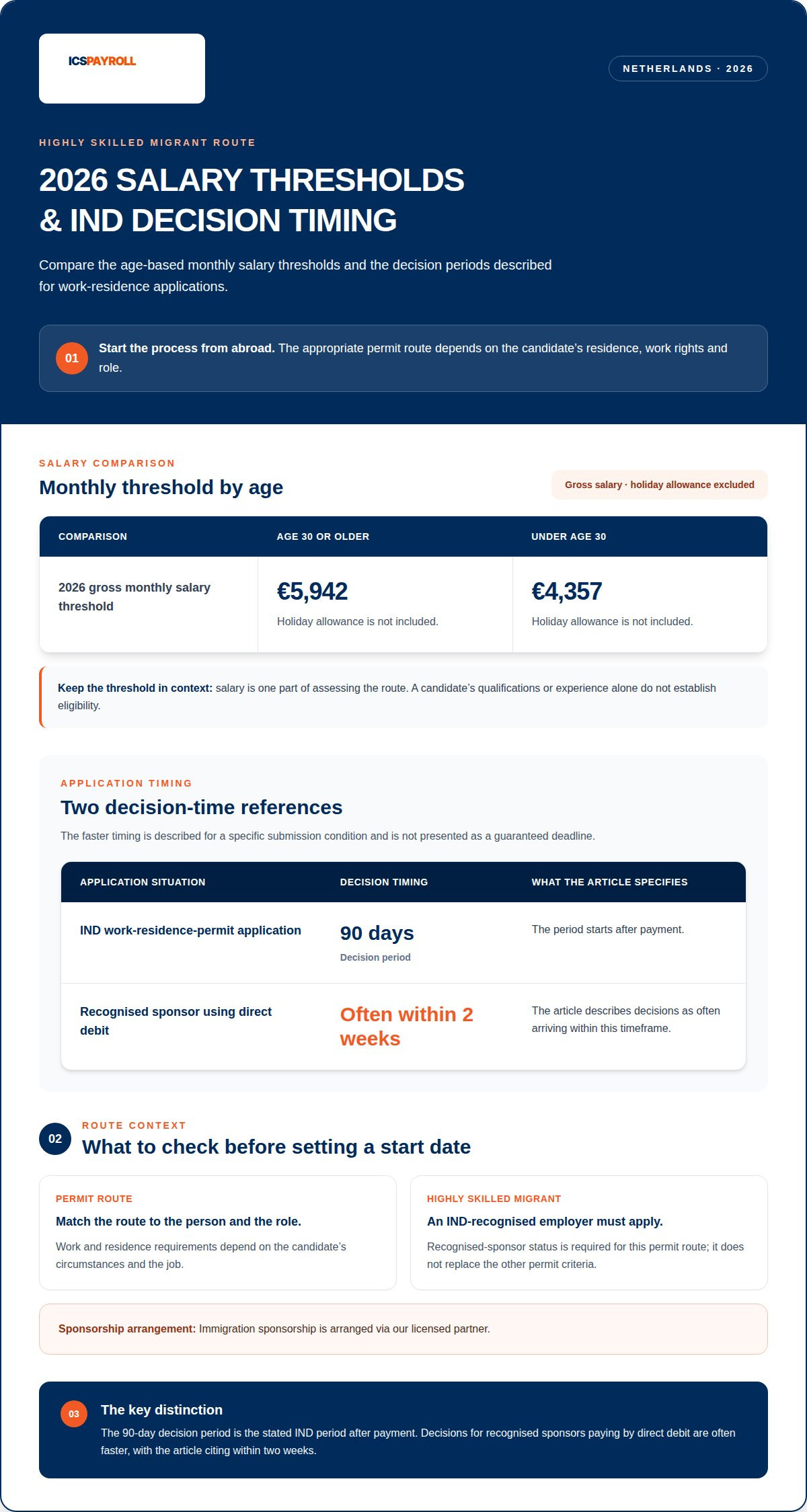
It’s understandable to expect sponsorship and salary rules to be the main hurdles. They matter, but the application route and timing also shape when someone can start. For 2026, the gross monthly salary threshold for highly skilled migrants is €5,942 for employees aged 30 or older and €4,357 for those under 30, excluding holiday allowance.
This guide explains who can apply from abroad, when recognised sponsorship is required, and how the IND process works. It also covers the applicable salary thresholds and decision times: an IND work-residence-permit application has a 90-day decision period after payment, while recognised sponsors paying by direct debit often receive a decision within two weeks. The right route depends on the candidate’s circumstances and the job.
By Joost Hubregtse, Payroll Director.
Joost Hubregtse is Payroll Director at ICSPayroll, the Dutch payroll and EOR specialist of Intercompany Solutions. A career payroll specialist and former Head of Payroll, he oversees wage tax filings, 30% ruling applications, and employment compliance for international employers.
Reviewed by Joost Hubregtse, Payroll Director, on 19 November 2026.
Key Takeaways
- You can apply to hire a non-EU employee from abroad, but the permit route depends on the role and the candidate’s circumstances.
- For a highly skilled migrant, only an employer recognised by the IND can apply for the permit, according to the IND.
- Explore the 2026 salary thresholds for highly skilled migrants and how age affects the applicable amount.
- Understand what information and documents support an application and how an Employer of Record can coordinate employment arrangements.
- See how the IND decision period works, including the faster decisions often made for applications submitted by recognised sponsors using direct debit.
Must employers be sponsors to hire non-EU staff?
No. Sponsorship depends on the employee’s immigration route, not simply on nationality. Before employment begins, identify the work and residence permission required for the candidate’s route.
Recognised Sponsor Status
Recognised sponsor status is IND approval that allows an employer to apply for permits under designated immigration routes. According to the IND, only a recognised employer can apply for a highly skilled migrant’s permit. Recognition matters when a role uses that route: it can make the process quicker and simpler. It is not a general requirement for every non-EU employee or every Dutch work permit.
Work Authorisation by Employee Group
EU and EEA nationals, and Swiss nationals, can work in the Netherlands without a work or residence permit. For non-EU employees, requirements depend on the role, stay duration and residence status. An employer may need a TWV from UWV for regular employment; for longer stays, a GVVA combines residence and employment permission. An existing residence document can also carry employer-specific work rights or restrictions.
Employment terms are a separate consideration. Dutch contracts can be fixed-term, permanent or employment-agency contracts. A Dutch health-insurance arrangement and clear pension terms also matter when structuring employment. The immigration permit does not set those terms.
Permit Requirements Across Worker Types
Highly skilled migrants need the relevant knowledge-migrant permit, and their employer generally needs IND recognised-sponsor status. Regular paid employment can involve labour-market conditions and supporting evidence from the employer. For work lasting no more than 90 days, a non-EU employee may need a short-stay visa depending on nationality, while the employer usually applies to UWV for a TWV.
Seasonal work is not automatically exempt from work authorisation. The applicable route depends on the job and circumstances of the stay; regular paid employment can involve labour-market requirements. A short contract or seasonal role does not, by itself, remove the need for a permit.
Employer and Sponsor Obligations
The employer must arrange the permission required for the employee’s route. For a knowledge migrant, the employer is responsible for obtaining the permit and must have recognised-sponsor status to apply. For an initial GVVA, work cannot begin until the residence document and additional employment document have been received. An urgent vacancy does not remove the requirements of the regular paid-employment route.
There is no single fee for every work or residence permit: application costs depend on the route and application. Employing someone without required authorisation can lead to a Wav fine of approximately €8,000 per worker. The employer should align the contract, permit route and start date before work begins. Pension terms should also be addressed separately in the employment arrangements.
Highly skilled migrants and researchers
A highly skilled migrant is a non-EU employee applying through the Dutch knowledge-migrant route. Researchers follow a separate permit framework, with recognised-sponsorship requirements applying to specific research routes.
Highly Skilled Migrant Eligibility
The highly skilled migrant route is for eligible employees whose Dutch employer applies for the required work and residence permit. Eligibility depends on the permit criteria, not simply on a candidate’s seniority or technical job title. A strong CV, relevant experience or advanced role alone does not establish eligibility.
The employer must assess the position and candidate against the route’s requirements before relying on this permit. The salary criterion is one important part of that assessment, and the applicable amount depends on the candidate’s age and circumstances. The next section explains the 2026 salary thresholds separately.
Some applicants may fall under exceptions to the usual employer application rule. These include certain Turkish citizens, graduates in the Netherlands, graduates with a Master’s degree from a top 200 university, and refugees. An exception should be assessed against the person’s specific circumstances; a degree or nationality alone does not establish which permit applies.
Researchers also require careful route selection. The researcher permit framework includes Directive (EU) 2016/801, and recognised sponsorship is required for researchers under that route. A research position should therefore be assessed under its own permit basis rather than treated automatically as a highly skilled migrant role.
Recognised Sponsors for Skilled Migrants
A recognised sponsor is an employer approved by the IND to submit applications under designated immigration routes. According to the IND, only an employer recognised by the IND can apply for a highly skilled migrant’s permit. This status matters before recruitment decisions become start-date commitments.
For a company hiring a highly skilled migrant, recognised-sponsor status is one part of the application process, not a substitute for meeting the employee’s permit criteria. The employer must still submit the relevant application and meet the route’s requirements. Technical expertise or an urgent vacancy does not replace these steps.
Recognised-sponsor status is relevant to particular routes. It does not make every non-EU hire a highly skilled migrant or automatically meet the requirements for regular employment or another residence status. First identify the employee’s intended route, then establish whether that route requires recognised sponsorship.
For research roles, the applicable framework matters as well. A researcher hired under Directive (EU) 2016/801 falls within a route requiring recognised sponsorship. Separating that assessment from the highly skilled migrant route helps the employer prepare the appropriate application rather than relying on a job title alone.
Where a company needs a Dutch employment structure for an international hire, an Employer of Record arrangement can form part of the employment setup.
2026 Salary thresholds for knowledge migrants
The 2026 salary criterion is a key part of the Dutch highly skilled migrant permit assessment. The applicable gross monthly threshold depends on the employee’s age and, for certain recent graduates, eligibility for a reduced criterion. Comparing the correct category with the agreed salary helps employers assess whether the proposed remuneration meets the route’s threshold.
Which monthly threshold applies?
For 2026, the gross monthly salary thresholds for highly skilled migrants are:
- €5,942 for employees aged 30 or older.
- €4,357 for employees under 30.
- €3,122 for certain recently graduated highly skilled migrants who qualify for the reduced criterion.
These are monthly gross amounts, and the listed thresholds exclude mandatory holiday allowance. The reduced criterion is not a general alternative for every younger migrant. It applies to certain recent graduates, so establish the employee’s eligibility category before assessing the proposed salary.
Which salary components count?
Holiday allowance does not count toward these thresholds. In the Netherlands, the mandatory allowance is 8%; for temporary workers under the ABU CLA, it is 8.33%. The employer therefore needs to compare the qualifying monthly salary itself with the applicable threshold, rather than adding holiday allowance to reach it.
A 13th-month payment or another allowance counts only when it is contractually agreed and paid monthly into the employee’s bank account. A payment made once at year-end does not meet that stated monthly-payment condition. Contract wording and payment frequency can therefore affect the salary calculation, even when the total annual compensation appears sufficient.
How employers should assess the offer
First, determine which 2026 category applies: age 30 or older, under 30, or a qualifying recent graduate. Then compare the contractual gross monthly salary with that category’s threshold. Keep holiday allowance separate, and include another allowance only when it meets the contractual and monthly-payment conditions.
The same amount is below the €5,942 threshold for someone aged 30 or older. This illustrates why the employee’s category matters as much as the headline salary.
Salary calculations should also align with the employment contract and actual payroll payments. A threshold assessment can help clarify the offer structure before an application proceeds. Employers reviewing a proposed package can discuss its salary structure in the context of the relevant Dutch employment arrangement.
Applying from abroad: how an EOR provider can support the process
A candidate can begin the Dutch employment process while living abroad. First, the employer and candidate identify the intended permit route using the candidate’s nationality, role, salary, stay duration and current residence status. These details help distinguish a highly skilled migrant application from regular employment or another route.
An EOR provider can coordinate Dutch employment arrangements while the candidate remains abroad. Information from the hiring company and candidate helps establish the role, contract terms and relevant immigration pathway. A residence permit from another European country does not itself grant Dutch work rights, so the candidate’s actual status matters.
For an initial assessment, the employer can provide a consistent set of role and employment details:
- Role and employment terms: the job description, proposed contract type and intended start date.
- Salary information: gross monthly pay and any contractual allowances, so the correct route’s salary criterion can be assessed.
- Candidate details: nationality, current country of residence and existing Dutch or European residence status.
- Supporting records: the candidate’s identity and residence documents, plus qualifications where the selected route depends on them.
This is an assessment pack, not a universal IND document checklist. Required application documents depend on the route. For example, a Dutch EU Blue Card applicant must hold a passport valid for at least six months from the application date. Other routes may require different evidence, so prepare documents for the selected permit category.
A non-EU/EEA or Swiss national without a job lined up needs to apply for a Dutch residence permit through the IND. Once a Dutch role is agreed, the employer’s information becomes central to choosing and supporting the work route. An offer alone does not establish work authorisation or remove route-specific conditions.
An EOR arrangement can structure employment in the Netherlands when a foreign company needs a local employment relationship. The provider can align the proposed contract and payroll setup with the selected hiring arrangement. Immigration sponsorship is arranged via our licensed partner. This keeps employment administration distinct from the IND sponsorship process.
Before the candidate’s planned start, align the permit route, contract terms and submitted information. For an initial GVVA, work cannot begin until the residence document and additional employment document have been received. Clear coordination helps prevent conflicting details between the employment offer and application while the candidate remains abroad during processing.
IND application process and decision times
The IND process begins by selecting the permit route and preparing its application. An EOR provider can coordinate employment information and application documents, while the employer supplies accurate role and contract details.
IND Application Process: How an EOR Provider Coordinates the Application
Coordination means aligning the proposed Dutch employment arrangement with the candidate’s immigration route before submission. The employer supplies the job description, contract terms, salary details and planned start date. The candidate provides identity and residence information relevant to the selected route, along with the supporting documents requested for that application.
The provider can organise these inputs into a consistent application file and coordinate submission with the responsible sponsor. Immigration sponsorship is arranged via our licensed partner. The client supplies key employment details, while the candidate provides personal records. The job, salary and contract terms in the application should match the employment arrangement.
For example, a highly skilled migrant application follows the applicable knowledge-migrant route, while regular paid employment may follow a different process. The coordinator identifies the route first, then aligns the employment information and supporting documents with it. Not every non-EU hire requires the same forms or evidence.
Document preparation also depends on the candidate’s status and intended permit. A person who already holds a Dutch residence document may have different work rights from an applicant abroad. The provider coordinates route-specific information, identifies missing inputs and keeps the employer and candidate aligned before submission.
IND Decision Times: What Affects the Timeline
For an IND application for a work residence permit and mvv, the IND has 90 days to decide after the application has been paid for. That period begins after payment, not when the employer first discusses the role or starts assembling documents. Preparation time therefore sits outside the stated decision period.
Recognised sponsorship can affect the pace. When a recognised sponsor pays by direct debit, the IND often decides on a work residence permit and mvv application within two weeks. This is a reported decision timeframe, not a replacement for the standard 90-day period in every case. The application route and payment method matter.
A coordinated process distinguishes three milestones: gathering information, submitting and paying for the application, and receiving the IND decision. The employer’s planned start date should account for each stage. Incomplete employment details can delay preparation before submission, while the IND’s decision period starts only after payment.
For international employers, clear ownership of documents and communication helps keep each stage visible. The provider coordinates employment inputs, the candidate supplies personal records, and the relevant sponsor handles the immigration application. This division helps employers plan around the IND timeline without confusing application preparation with the formal decision period.
ICSPayroll
ICSPayroll helps international employers structure Dutch employment when a candidate needs to relocate or begin work in the Netherlands. Its Employer of Record (EOR) and Dutch Payroll Administration services support local employment and payroll arrangements. Immigration sponsorship is arranged via our licensed partner, allowing the employment setup and permit process to be coordinated without treating them as the same service.
For eligible employees recruited from abroad, ICSPayroll also manages the 30% Ruling Application process. This is separate from immigration sponsorship and is assessed under the applicable tax criteria. Employers can turn to ICSPayroll when they need support with Dutch employment administration, payroll, or the ruling application alongside an international hire.
Contact ICSPayroll to discuss support for your Dutch hiring arrangements.
Plan the Dutch hire with confidence
A successful international hire starts with a clear employment plan, not just a proposed start date. When hiring non-EU citizens in the Netherlands, align the role, employment arrangement and onboarding timeline early. This gives the employer and candidate a shared understanding of their responsibilities as the process moves forward.
Use the next discussion to clarify how the Dutch employment setup will work, who coordinates each administrative task and what information needs to be ready. This planning connects the hiring decision with payroll and onboarding instead of treating each as a separate activity. It creates a more considered path from offer to employment.
ICSPayroll can discuss the practical requirements for your Dutch hire and the support that fits your employment setup. Contact ICSPayroll about hiring to discuss your next step.
Frequently Asked Questions
Can I apply while living outside the Netherlands?
Yes. A candidate can live abroad while an employer prepares the Dutch employment and permit application. The applicable route depends on the job, nationality, intended stay and current residence status. For example, a candidate without a job lined up needs to apply for a Dutch residence permit through the IND. Living in another European country, or holding its residence permit, does not by itself grant Dutch work rights.
First things first: What Is the IND?
The IND is the Netherlands’ Immigration and Naturalisation Service, which handles residence permits and related immigration applications. Employers and candidates encounter it when applying for routes such as a highly skilled migrant permit or a GVVA. The IND assesses applications against the requirements of the chosen route. Identifying the permit category first helps employers determine who submits the application and which supporting documents are relevant.
What Is the EU Blue Card?
The EU Blue Card is a Dutch work and residence permit route for qualifying highly educated employees. An applicant needs a Bachelor’s or Master’s degree equivalent to a Dutch qualification and a job offer or contract lasting at least one year. In 2026, its gross monthly salary threshold is €5,942. The card covers the work-contract period, up to four years, and the applicant’s passport must be valid for at least six months from application.
What is the orientation year permit?
The orientation year permit lets eligible graduates and researchers stay in the Netherlands to look for work or begin employment. Eligibility can follow specified Dutch education or research circumstances; graduates from a Master’s or Bachelor’s programme at a top 200 university abroad can also apply. During the permit period, eligible recent graduates can usually work without a separate work permit. Its salary level is lower than the regular highly skilled migrant route.
Who Is a Highly-Skilled Migrant?
A highly skilled migrant is a non-EU employee who qualifies for the Dutch knowledge-migrant work and residence permit. The label does not follow simply from an advanced degree, specialist experience or a senior job title. The employer must use the relevant permit route, and the applicable salary criterion must be met. A researcher may instead fall under a research permit framework, so the purpose of the role also matters.
What work permits and residence permits do non-EU citizens need to work in the Netherlands?
The permit depends on the person’s job, stay and residence circumstances. Regular employment may require a TWV from UWV, while a GVVA combines work and residence permission. Highly skilled migrants use their specific knowledge-migrant permit. For work lasting no more than 90 days, a short-stay visa may depend on nationality, and an employer usually needs a TWV. A residence document’s work rights can also be unrestricted or employer-specific.
What are the requirements to hire a highly skilled migrant in the Netherlands?
According to the IND, an employer needs recognised-sponsor status to apply for a highly skilled migrant’s permit. The candidate and role must also meet the route’s conditions, including the applicable salary criterion. Application details should match the proposed contract and salary arrangement. A degree or technical role alone does not qualify someone. Certain exceptions apply to specified groups, including some graduates, Turkish citizens and refugees.
What are the 2026 salary thresholds for highly skilled migrants in the Netherlands?
For 2026, the gross monthly threshold is €5,942 for migrants aged 30 or older and €4,357 for those under 30. Certain qualifying recent graduates may use the reduced threshold of €3,122. These amounts exclude mandatory holiday allowance. A 13th-month payment or other allowance counts only if contractually agreed and paid monthly into the employee’s bank account, so payment structure matters alongside the headline salary.

Article by
Joost Hubregtse
Joost Hubregtse is Director of ICS Staffing & Payroll B.V., the wholly owned subsidiary of Intercompany Solutions behind ICS Payroll. He is responsible for Employer of Record and Dutch payroll services: employment contracts, wage tax and social security filings, holiday allowance, pension, sick leave and CAO compliance, with onboarding possible within 48 hours.
Frequently Asked Questions
For 2026, the gross monthly salary thresholds for highly skilled migrants are: These are monthly gross amounts, and the listed thresholds exclude mandatory holiday allowance. The reduced criterion is not a general alternative for every younger migrant. It applies to certain recent graduates, so establish the employee’s eligibility category before assessing the proposed salary.
Holiday allowance does not count toward these thresholds. In the Netherlands, the mandatory allowance is 8%; for temporary workers under the ABU CLA, it is 8.33%. The employer therefore needs to compare the qualifying monthly salary itself with the applicable threshold, rather than adding holiday allowance to reach it. A 13th-month payment or another allowance counts only when it is contractually agreed and paid monthly into the employee’s bank account. A payment made once at year-end does not meet that stated monthly-payment condition. Contract wording and payment frequency can therefore affect the salary calculation, even when the total annual compensation appears sufficient.
Yes. A candidate can live abroad while an employer prepares the Dutch employment and permit application. The applicable route depends on the job, nationality, intended stay and current residence status. For example, a candidate without a job lined up needs to apply for a Dutch residence permit through the IND. Living in another European country, or holding its residence permit, does not by itself grant Dutch work rights.
The IND is the Netherlands’ Immigration and Naturalisation Service, which handles residence permits and related immigration applications. Employers and candidates encounter it when applying for routes such as a highly skilled migrant permit or a GVVA. The IND assesses applications against the requirements of the chosen route. Identifying the permit category first helps employers determine who submits the application and which supporting documents are relevant.
The EU Blue Card is a Dutch work and residence permit route for qualifying highly educated employees. An applicant needs a Bachelor’s or Master’s degree equivalent to a Dutch qualification and a job offer or contract lasting at least one year. In 2026, its gross monthly salary threshold is €5,942. The card covers the work-contract period, up to four years, and the applicant’s passport must be valid for at least six months from application.
The orientation year permit lets eligible graduates and researchers stay in the Netherlands to look for work or begin employment. Eligibility can follow specified Dutch education or research circumstances; graduates from a Master’s or Bachelor’s programme at a top 200 university abroad can also apply. During the permit period, eligible recent graduates can usually work without a separate work permit. Its salary level is lower than the regular highly skilled migrant route.
A highly skilled migrant is a non-EU employee who qualifies for the Dutch knowledge-migrant work and residence permit. The label does not follow simply from an advanced degree, specialist experience or a senior job title. The employer must use the relevant permit route, and the applicable salary criterion must be met. A researcher may instead fall under a research permit framework, so the purpose of the role also matters.
The permit depends on the person’s job, stay and residence circumstances. Regular employment may require a TWV from UWV, while a GVVA combines work and residence permission. Highly skilled migrants use their specific knowledge-migrant permit. For work lasting no more than 90 days, a short-stay visa may depend on nationality, and an employer usually needs a TWV. A residence document’s work rights can also be unrestricted or employer-specific.
According to the IND, an employer needs recognised-sponsor status to apply for a highly skilled migrant’s permit. The candidate and role must also meet the route’s conditions, including the applicable salary criterion. Application details should match the proposed contract and salary arrangement. A degree or technical role alone does not qualify someone. Certain exceptions apply to specified groups, including some graduates, Turkish citizens and refugees.
For 2026, the gross monthly threshold is €5,942 for migrants aged 30 or older and €4,357 for those under 30. Certain qualifying recent graduates may use the reduced threshold of €3,122. These amounts exclude mandatory holiday allowance. A 13th-month payment or other allowance counts only if contractually agreed and paid monthly into the employee’s bank account, so payment structure matters alongside the headline salary.