Alternatives to Opening a Dutch Subsidiary: Compare Your Options
By Joost Hubregtse, Director, ICS Staffing & Payroll
All blog posts are reviewed and fact checked by our labour law lawyer Zishan Hussain and our director. Editorial standards
A Dutch subsidiary is not the only way to establish a business presence in the Netherlands. The main alternatives to opening a Dutch subsidiary are registering a branch of the foreign company or using an Employer of Record (EOR) to hire employees locally without setting up a Dutch entity. A branch remains part of its foreign parent, while a subsidiary is a separate legal entity.
The right structure depends on how independently your Dutch operation needs to function and how much responsibility you want to retain. A branch can give your foreign company a local presence while remaining part of the parent; an Employer of Record (EOR) can support local hiring without opening a Dutch subsidiary.
This comparison explains how branches, subsidiaries and EOR arrangements differ in independence, setup requirements, costs and timing. It outlines which option may suit a limited Dutch presence, which can support a more independent long-term operation, and how to weigh the trade-offs before choosing.
Key Takeaways
- A branch keeps the Dutch operation within the foreign company, while a subsidiary creates a separate Dutch legal entity. That distinction affects independence and where operational liabilities sit.
- The right structure depends on how much control, separation and local administration your Dutch activities require. A branch may suit a limited presence; a subsidiary offers a more independent foothold.
- Setting up a subsidiary involves incorporation and ongoing company administration. Compare those requirements with a branch or EOR based on your intended activities and timeline.
- An Employer of Record can enable local hiring without establishing a Dutch subsidiary, while representative offices and commercial agents serve different roles in a market presence.
- For Dutch employment without a local entity, consider whether EOR fits your plans; for employees of your own Dutch entity, payroll administration can support compliant payroll operations.
What is the difference between a branch and a subsidiary in the Netherlands?
A Dutch branch is part of its foreign parent, while a subsidiary is a separate legal entity. Both must register with the Dutch Chamber of Commerce (KVK), but their legal structure, liability and corporate tax treatment differ. The choice affects how the foreign company invests, contracts and manages risk in the Netherlands.
Operating without a subsidiary does not remove Dutch obligations. A branch must be registered, and a foreign company may face Dutch corporate tax on profits attributable to its Dutch activities if those activities create a permanent establishment. The parent remains directly responsible for the branch’s obligations, unlike a subsidiary, whose liability generally sits with the Dutch entity.
A branch has the same legal structure as its foreign parent. Register the foreign entity and its Dutch establishment with KVK; a notarial deed is not required for the branch. Because a branch is not a separate legal person, it does not provide the legal separation of a Dutch BV. The foreign director remains responsible for the Dutch operation’s obligations, and the parent is directly exposed to related liabilities.
A Dutch subsidiary, usually established as a BV, has its own legal personality under Book 2 of the Dutch Civil Code. It can hold assets, enter contracts and assume obligations in its own name. Its own articles of association, board and contractual relationships support independent operations. The parent is generally not liable for the BV’s obligations, and the BV’s liability is generally limited to its own assets and operations.
Tax follows the legal and operational structure. A branch is subject to Dutch corporate income tax on profits attributable to Dutch activities when it operates through a fixed place of business as a permanent establishment. According to the Netherlands Tax Administration, a branch engaged only in supporting activities is not considered a permanent establishment. A Dutch BV pays corporate income tax on its profits. According to the Belastingdienst, the 2026 rates are 19% on annual profits up to €200,000 and 25.8% above that threshold.
| Option | Legal status | Liability | Tax treatment |
|---|---|---|---|
| Dutch branch | Part of foreign parent; register with KVK | Parent remains directly exposed | Dutch tax may apply to profits attributable to a permanent establishment |
| Dutch subsidiary (BV) | Separate Dutch legal entity | Generally limited to the BV’s assets and operations | Dutch corporate income tax applies to its profits |
Choose a branch when the Dutch activity should remain part of the foreign company and the parent accepts direct exposure. Choose a BV when separate legal personality, its own contracts and a distinct liability structure matter more than keeping a single entity.
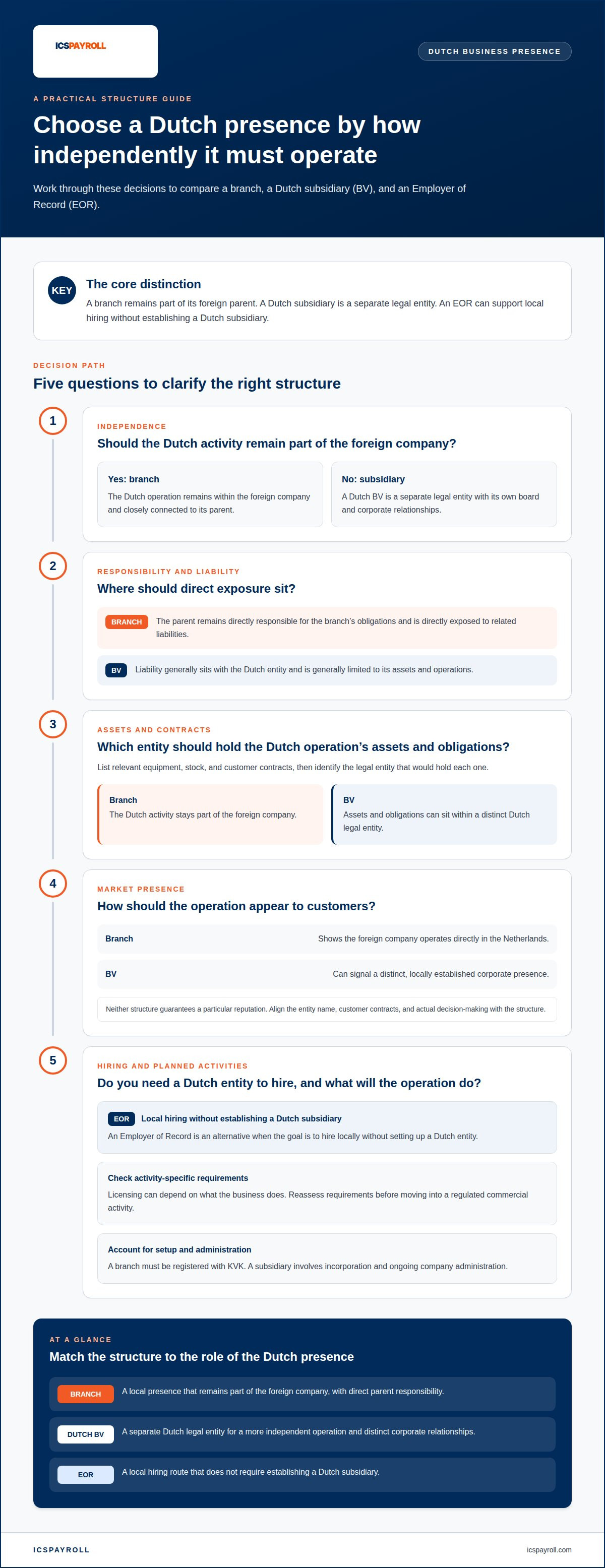
Choosing a Dutch presence based on business independence
Choose a Dutch structure by deciding how independently the operation must act. A branch keeps the Dutch activity within the foreign company; incorporating a Dutch subsidiary creates a separate legal entity. This distinction affects decision-making, commercial obligations, asset ownership and how the operation is presented to Dutch customers.
A branch suits a foreign company that wants to keep its management and operations closely connected to the parent. The parent can operate through its Dutch branch while retaining direct responsibility for the Dutch activity. A subsidiary provides a more independent Dutch foothold, with its own board and corporate relationships. Its directors still have responsibilities, even when the BV belongs to an international group.
Consider a possible sale before choosing a structure. List the assets the Dutch operation would use, such as equipment, stock or customer contracts, and identify which legal entity holds them. With a branch, the Dutch activity remains part of the foreign company. With a BV, assets and obligations can sit within a distinct Dutch legal entity. This separation can clarify what belongs to the Dutch operation, although transaction terms still depend on the assets and agreements involved.
Business reputation also depends on the role you want the Dutch presence to play. A branch can show customers that the foreign company operates directly in the Netherlands. A subsidiary can signal a distinct, locally established corporate presence. Neither structure guarantees a particular reputation. Align the entity name, customer contracts and actual decision-making with the structure you choose.
Check licensing requirements against the activities planned in the Netherlands. A Dutch subsidiary may need a business licence depending on what it does, so the company’s activities matter more than the entity label alone. For example, a business expanding from administrative support into a regulated commercial activity should reassess its requirements before starting that activity. A branch’s connection to its parent does not remove activity-specific obligations.
Corporate tax and management responsibilities also affect how independent a structure is. A Dutch BV pays corporate income tax on its profits, while a branch may be taxed on profits attributable to its Dutch activities. A subsidiary’s board has its own responsibilities, and parent-company instructions must remain compatible with Dutch corporate law, directors’ duties and the BV’s interests. This governance distinction matters when the foreign parent expects to approve local contracts or investments.
- Choose a branch when direct integration with the foreign parent is central.
- Choose a subsidiary when a separate Dutch entity and independent governance matter.
- Review assets, contracts, licences and tax treatment against the planned activities.
A company can begin Dutch operations with a branch and later establish a BV as its activities grow. If employees will work for the Dutch operation, Dutch payroll administration can support the payroll obligations associated with that presence.
Costs and time involved in setting up a subsidiary
Setting up a Dutch subsidiary involves formation, registration and continuing administration. For a BV, budget €2,000 for setup, then account for recurring accounting and filing costs. These figures help separate the initial cost of incorporation from the work required to operate the company throughout its first year.
A Dutch BV is incorporated through a notarial deed and registered with the Dutch Chamber of Commerce (KVK). The notary prepares the deed and articles of association, while the formation process includes information about shareholders and directors for KYC checks. A Dutch business address is also required for KVK registration. The exact sequence depends on whether the parent’s corporate documents and ownership details are ready for submission.
Allow approximately two weeks to incorporate a subsidiary in the Netherlands. Once the required documents are provided on time, registration is estimated to take three to five business days. These are separate stages: incorporation involves preparing and executing formation documents, while registration records the company in the Business Register. Delays in receiving information from the parent company can affect the overall timetable.
The first-year budget should include ongoing accounting and filing, typically EUR 3,000-8,000/year all-in, in addition to the €2,000 setup cost. The BV has its own books, annual accounts and corporate tax obligations. It must also register for payroll tax and handle wage tax records and periodic returns when it hires employees. A holding structure can add another company and another set of administration needs, so include each entity in the budget.
Income and tax planning should reflect the BV’s own profits. According to the Belastingdienst’s corporate income tax rates, Dutch corporate income tax in 2026 is 19% on annual profits up to €200,000 and 25.8% on profits above €200,000. These rates apply to the BV’s taxable profits, not its formation expenses or total income before tax adjustments. Forecast the Dutch entity’s expected income separately from the foreign parent’s results.
Director and shareholder arrangements also affect the work involved. Before formation, decide who will act as director, how the parent will hold shares and which contracts the BV will sign. In a wholly owned subsidiary, the parent company holds the shares, while the BV remains responsible for its own corporate administration. Record these arrangements in the formation documents and governance process.
- Plan the €2,000 setup cost separately from ongoing accounting and filing.
- Build the timeline around document preparation, not registration alone.
- Include each company in a holding structure when forecasting administration.
- Estimate the BV’s taxable profits separately from the parent’s income.
A subsidiary’s initial cost is only one factor in the decision. Compare its formation schedule and ongoing obligations with branch and Employer of Record options, considering whether you need a separate Dutch entity and how soon local operations must begin.
Employer of Record as an alternative to setting up a subsidiary
An Employer of Record (EOR) lets a foreign company hire employees in the Netherlands without incorporating a Dutch subsidiary. Dutch employment and payroll obligations still apply. The key difference is who employs the worker and administers local payroll, not whether Dutch rules matter.
Employer of Record
An EOR employs a worker in the Netherlands on behalf of a foreign parent company. The parent directs its business activity, while the EOR manages the local employment relationship and payroll administration. Unlike a branch registered with the Chamber of Commerce or a separately incorporated BV, using an EOR does not require the foreign company to establish its own Dutch legal entity.
This structure can suit a company that needs to employ someone in the Netherlands but does not need a Dutch entity for contracts, assets or broader commercial operations. For example, a European company hiring a Netherlands-based specialist may use an EOR instead of forming a BV. If the company later needs an independent Dutch operation, it can reassess whether a subsidiary better fits its activities.
The trade-off is control over the employment structure. With a BV, the Dutch entity is the employer; with an EOR, the EOR is the local employer of record. A branch remains part of its foreign parent, while an EOR arrangement separates local employment administration from the parent company’s legal structure. It does not create a Dutch subsidiary or replace any separate registration required for other business activities.
Employment, Payroll, and Social Security Obligations
Foreign employers hiring people to work in the Netherlands must account for Dutch employment law and payroll requirements. An EOR can manage local employment and payroll administration without requiring the foreign company to register a separate Dutch company with the Chamber of Commerce. By contrast, a BV must manage its own employment and payroll responsibilities.
Payroll involves more than transferring salary. Dutch wage tax must be withheld and reported through payroll, and the related administration must be maintained. According to the Belastingdienst, payroll tax returns are due by the last day of the following month. Dutch payroll records must be retained for seven years. These requirements make accurate employee and pay information important for each pay period.
Social security contributions are part of Dutch payroll administration. The applicable treatment depends on the worker’s employment and social insurance circumstances. With an EOR, local employment administration sits with the EOR; a foreign company employing directly through its own Dutch entity must arrange payroll processes for that entity.
Compare the options against the activities your Dutch presence needs to support. If the priority is local employment without a separate company, an EOR can meet that need. If the operation must contract, hold assets or conduct broader commerce independently, a branch or subsidiary may fit those activities more closely.
How do Dutch representative offices and commercial agents work, and what activities can they perform?
A representative office or commercial agent can support a foreign company’s Dutch market activity without automatically creating a Dutch subsidiary. The practical distinction is that an office provides a local base for activities, while an agent acts as an intermediary. The name alone does not determine the legal structure. The activities performed, contracts signed and authority granted shape the operation’s obligations.
Representative offices
“Representative office” describes a function, not a separate Dutch company form. A foreign business might use a local office for market research, customer communication or supplier coordination. These activities differ from operating through a Dutch BV, which is a separate legal entity. Before relying on an office arrangement, define which entity employs staff, holds assets, signs contracts and manages customer relationships.
A warehouse illustrates why the activity matters. A space used only to store goods in the Netherlands is not, by itself, a branch office or legal entity; the foreign head office remains liable for its costs and damages. If the location starts handling broader commercial activities, assess the actual operation rather than assuming the “representative office” label determines its status. Dutch tax treatment also depends on the activities carried out. The Netherlands Tax Administration considers supporting activities alone to be non-permanent-establishment activities.
Commercial agents
A commercial agent can help a foreign company reach Dutch customers by introducing potential buyers, sharing product information or assisting with sales discussions. Define the agent’s authority in the commercial agreement. For example, specify whether the agent may only refer prospects or may also negotiate terms on the company’s behalf. This clarifies who can make commitments to a Dutch customer.
An agent is not the same as a Dutch subsidiary. Simply representing the foreign company does not create a separate Dutch legal entity. The foreign company remains responsible for its own contracts and business decisions. The relationship also differs from a branch, which is a Dutch establishment of the foreign entity and must be registered with the Dutch Chamber of Commerce when applicable.
Use these models for a defined, limited role. A representative office can support local coordination; an agent can help reach customers. Neither replaces an independent Dutch company when the operation needs its own contracting entity, assets or broader commercial presence. If the business expands from introductions to direct Dutch sales, review its activities, customer contracts, staffing and tax position before changing how it operates.
- Set out the office’s activities and the entity responsible for each obligation.
- Define an agent’s authority over negotiations and customer commitments.
- Review any change from storage or support to active commercial operations.
ICSPayroll: Dutch Payroll Administration
ICSPayroll supports companies that need to manage Dutch employment and payroll. Its Dutch Payroll Administration service handles payroll operations for businesses employing staff in the Netherlands. Its Employer of Record (EOR) service enables companies to hire locally without establishing a Dutch subsidiary.
For international employees who may qualify for the Dutch 30% ruling, ICSPayroll also manages the application process. The right option depends on whether your business has its own Dutch entity or needs an employment structure without one. These services can help address payroll administration, local employment and the application process without changing the structural trade-offs described above.
Contact ICSPayroll to discuss Dutch payroll or employment support for your business.
Make your next Dutch market decision with confidence
The best alternatives to opening a Dutch subsidiary depend on what your Netherlands operation needs to do. Before committing, align your planned activities, hiring plans and desired level of independence with a structure that supports them. This decision can shape how your business manages local employment as it grows.
Where the next step involves hiring, ICSPayroll offers Employer of Record (EOR), Dutch Payroll Administration and 30% Ruling Application services. These options address local employment and payroll needs, while the right entity structure remains a separate business decision.
Share your plans and the type of Dutch presence you are considering. Contact ICSPayroll to discuss your options and identify a practical next step for your business.
Frequently Asked Questions
What are the alternatives to establishing a Dutch subsidiary for a foreign company?
Alternatives to opening a Dutch subsidiary include a branch, an Employer of Record (EOR), a representative office and a commercial agent. Each supports a different type of activity. An agent, for example, can introduce Dutch customers, while an EOR can employ a Netherlands-based worker. A branch may suit operations that remain integrated with the foreign company. Match the option to your planned activities, not just your preferred business label.
How does a Dutch branch office compare with a subsidiary in liability, tax, and administration?
A branch keeps the Dutch activity within the foreign company, while a subsidiary operates through a separate Dutch entity. For a branch, the parent remains responsible for its obligations; a BV generally limits liability to its own assets and operations. Tax treatment also differs: a branch may be taxed on profits attributable to Dutch activities, while a BV pays tax on its profits. For administration, consider which entity holds contracts and records, and which files accounts.
Can a foreign company hire employees in the Netherlands without setting up a Dutch entity?
Yes. A foreign company can hire in the Netherlands through an Employer of Record, which acts as the local legal employer without requiring the foreign company to form a Dutch entity. For example, a company hiring a Netherlands-based employee can use this arrangement while retaining its foreign company structure. The EOR handles local employment and payroll administration, while the foreign company focuses on directing its business activity.
What are the rules for using an employer of record (EOR) in the Netherlands?
In an EOR arrangement, the EOR, rather than the foreign company, is the legal employer of the Netherlands-based worker. Dutch employment and payroll requirements still apply. The parties should define responsibilities for the employee’s role, work arrangements, payroll information and ongoing communication. This differs from payroll administration, where a company with its own Dutch entity remains the employer and outsources payroll processing.
When does a foreign company create a permanent establishment for Dutch tax purposes?
A foreign company may have a Dutch permanent establishment if it conducts entrepreneurial activities through a fixed place of business in the Netherlands. Dutch corporate tax can then apply to profits attributable to those activities. A Dutch registration or local address alone does not determine the tax position. According to the Netherlands Tax Administration, a branch office engaged only in supporting activities is considered a non-permanent establishment.
What are the costs and setup times for a Dutch branch, EOR, or local subsidiary?
A Dutch BV setup costs €2,000, with accounting and filing typically EUR 3,000-8,000/year all-in. Incorporation takes approximately two weeks; registration takes approximately three to five business days when required documents are provided in time. Branch and EOR costs depend on the work and arrangement involved, so assess the activities and administration required rather than assuming one fixed price. EOR pricing is set by its service agreement.

Article by
Joost Hubregtse
Joost Hubregtse is Director of ICS Staffing & Payroll B.V., the wholly owned subsidiary of Intercompany Solutions behind ICS Payroll. He is responsible for Employer of Record and Dutch payroll services: employment contracts, wage tax and social security filings, holiday allowance, pension, sick leave and CAO compliance, with onboarding possible within 48 hours.
Frequently Asked Questions
Alternatives to opening a Dutch subsidiary include a branch, an Employer of Record (EOR), a representative office and a commercial agent. Each supports a different type of activity. An agent, for example, can introduce Dutch customers, while an EOR can employ a Netherlands-based worker. A branch may suit operations that remain integrated with the foreign company. Match the option to your planned activities, not just your preferred business label.
A branch keeps the Dutch activity within the foreign company, while a subsidiary operates through a separate Dutch entity. For a branch, the parent remains responsible for its obligations; a BV generally limits liability to its own assets and operations. Tax treatment also differs: a branch may be taxed on profits attributable to Dutch activities, while a BV pays tax on its profits. For administration, consider which entity holds contracts and records, and which files accounts.
Yes. A foreign company can hire in the Netherlands through an Employer of Record, which acts as the local legal employer without requiring the foreign company to form a Dutch entity. For example, a company hiring a Netherlands-based employee can use this arrangement while retaining its foreign company structure. The EOR handles local employment and payroll administration, while the foreign company focuses on directing its business activity.
In an EOR arrangement, the EOR, rather than the foreign company, is the legal employer of the Netherlands-based worker. Dutch employment and payroll requirements still apply. The parties should define responsibilities for the employee’s role, work arrangements, payroll information and ongoing communication. This differs from payroll administration, where a company with its own Dutch entity remains the employer and outsources payroll processing.
A foreign company may have a Dutch permanent establishment if it conducts entrepreneurial activities through a fixed place of business in the Netherlands. Dutch corporate tax can then apply to profits attributable to those activities. A Dutch registration or local address alone does not determine the tax position. According to the Netherlands Tax Administration, a branch office engaged only in supporting activities is considered a non-permanent establishment.
A Dutch BV setup costs €2,000, with accounting and filing typically EUR 3,000-8,000/year all-in. Incorporation takes approximately two weeks; registration takes approximately three to five business days when required documents are provided in time. Branch and EOR costs depend on the work and arrangement involved, so assess the activities and administration required rather than assuming one fixed price. EOR pricing is set by its service agreement.