
13th-Month Salary in the Netherlands: Customary in 2026?
By Joost Hubregtse, Director, ICS Staffing & Payroll
All blog posts are reviewed and fact checked by our labour law lawyer Zishan Hussain and our director. Editorial standards
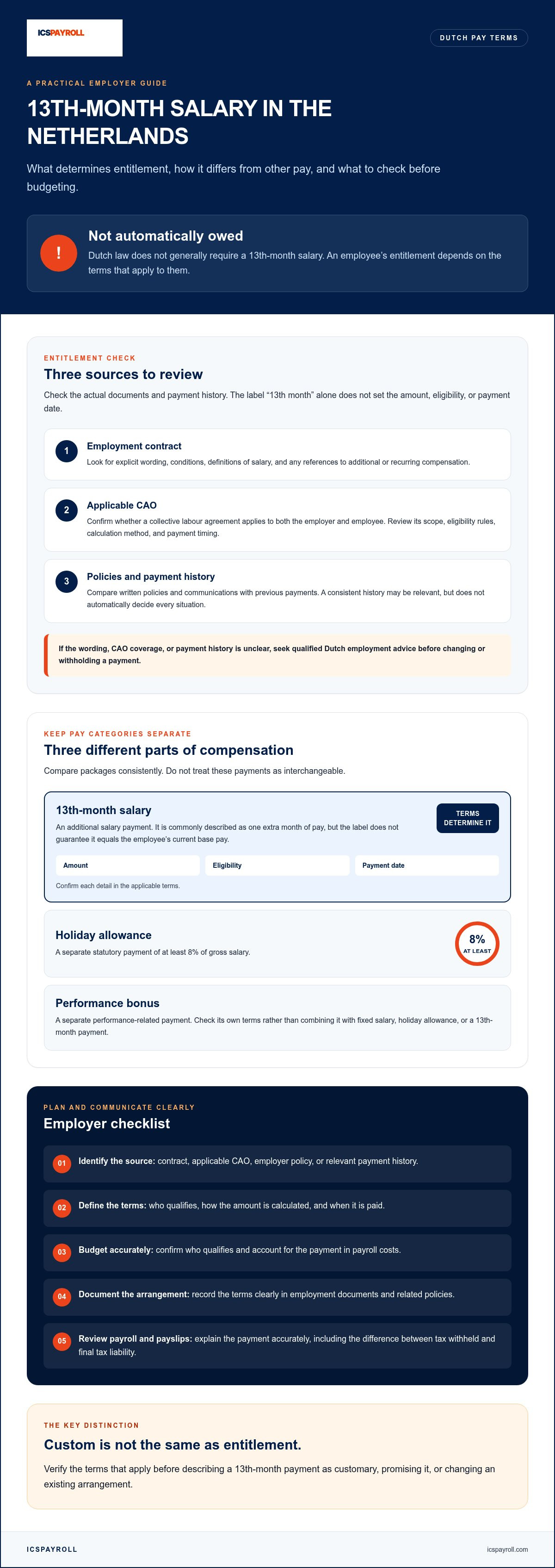
A year-end payment may be customary at a particular employer, but it is not automatically owed. For employers assessing the 13th month salary netherlands custom, the key point is that Dutch law does not generally require a 13th-month salary. An employee’s entitlement may instead depend on the applicable collective labour agreement (CAO), employment contract, or established payment practice.
This payment is easy to confuse with holiday allowance when comparing annual compensation packages, but they are separate. Holiday allowance is a statutory payment of at least 8% of gross salary. A 13th-month salary is an additional payment, and whether it is due depends on the terms that apply to the employee.
This guide explains what to check before setting or communicating Dutch pay terms. You’ll learn how a CAO, contract, or consistent payment practice can affect entitlement, how a 13th-month salary differs from holiday allowance and a performance bonus, and why payroll treatment matters when comparing gross and net compensation. Clear terms help employers budget accurately and give employees a more reliable picture of their total pay.
Key Takeaways
- Assess the 13th month salary netherlands custom by checking the employee’s applicable agreement, eligibility criteria, calculation basis, and payment schedule.
- Compare compensation packages consistently, separating fixed salary, holiday allowance, a 13th-month payment, and any performance-related bonus.
- Before budgeting, confirm who qualifies and how the payment affects payroll costs. Then record the terms clearly in employment documents.
- Review payroll and payslip treatment so the payment is processed and explained accurately, including any difference between tax withheld and final tax liability.
Is a 13th-month salary required in the Netherlands?
No, Dutch law does not generally require employers to pay a 13th-month salary. An employee’s entitlement may depend on their employment contract or an applicable collective labour agreement (CAO). Employers can check official guidance on employment contracts and collective labour agreements, then confirm which terms apply to the employee in question.
A 13th-month salary is an additional salary payment, commonly described as one extra month of pay. The label alone does not establish the amount, eligibility, or payment date. Those details depend on the applicable terms. An employer may also offer the payment as a benefit, but should state the conditions clearly. If payments have been made regularly without clear written terms, review the history and related communications before changing the arrangement. If the legal effect is uncertain, seek advice from a qualified Dutch employment professional.
What does 13th-month salary mean?
Thirteenth salary is a general term for an additional salary payment, though arrangements differ between countries and employers. In the Netherlands, do not assume every employer offers one or that it always equals one month of the employee’s current base pay. Check how the applicable terms define the amount, eligibility, and payment date.
What determines an employee’s entitlement?
Start with the individual employment contract, then check whether a CAO applies. Read the relevant documents for their scope, eligibility rules, calculation basis, and payment timing. A CAO may set different conditions for different employee groups, so verify that it covers both the employer and the employee’s role.
Also review written employer policies and previous payment records. A consistent history may be relevant when assessing which terms apply, but it does not automatically determine the outcome in every situation. Keep the documents and communications together, and ask a qualified Dutch employment professional to review any uncertainty before changing or withholding a payment.
- Check the contract for explicit wording about an additional annual payment.
- Confirm whether a CAO applies and review its scope and eligibility conditions.
- Compare written policies with how the payment has actually been administered.
- Get qualified advice if the wording or payment history is unclear.
For employers assessing the 13th month salary netherlands custom, the practical distinction is whether the payment is voluntary or required by the terms that apply. Verify the source before describing it as customary or promising it in an offer. If the contract, CAO, or payment history leaves room for interpretation, seek qualified Dutch employment advice before making a change.
How Dutch contracts and collective agreements can shape a 13th-month payment
Identify the terms that apply before comparing Dutch compensation packages. A 13th-month payment may be included in an employment contract or an applicable collective labour agreement (CAO). The agreement’s coverage and wording can affect which employees qualify. Review the actual documents rather than relying on a brief summary or assuming that similar job titles mean identical pay conditions.
For employers assessing the 13th month salary netherlands custom, confirm the source of the payment and document its conditions. Official guidance explains how collective labour agreements work. Check the current agreement and the employee’s contract before setting a compensation package.
How to check a collective labour agreement
First establish whether a CAO applies to the employer and employee. Then review the agreement’s scope and the version relevant to the employment period. Search its provisions for additional salary, annual bonuses, eligibility, calculation methods, and payment dates. Confirm the exact wording and any exceptions. If coverage or interpretation is uncertain, ask a qualified Dutch employment professional to review the agreement before finalising pay terms.
What to review in the employment contract
Check whether the contract promises a payment, makes it conditional or discretionary, or does not mention it. Read the definitions of salary and any references to performance pay or other recurring compensation. The Dutch government’s employment contract guidance can help employers identify contract information to review.
Keep written terms separate from informal workplace conversations. Gather relevant policies, communications, and previous payment records to assess the full history. Do not assume that a past payment or verbal statement settles an employee’s entitlement. If documents conflict, or you are considering changing an established arrangement, record the uncertainty and seek qualified Dutch employment advice before acting.
- Confirm the CAO’s scope and review its current wording.
- Record eligibility, calculation, and payment conditions from the applicable documents.
- Compare contract terms with written policies and payment records.
- Get professional advice before acting on unresolved or conflicting terms.
Once the terms are clear, payroll can be set up to reflect them consistently. Employers reviewing Dutch salary arrangements can explore Dutch payroll administration as part of their compliance process.
13Th-month salary vs. holiday allowance, bonuses, and other Dutch pay
These payments may all appear in a Dutch compensation package, but they have different purposes and entitlement bases. A 13th-month salary is additional pay defined by the applicable employment terms. Holiday allowance is separate, with a statutory minimum of 8% of gross salary. A performance bonus may have its own eligibility criteria or depend on employer discretion.
| Pay component | Purpose | Source of entitlement | Calculation | Payment timing |
|---|---|---|---|---|
| 13th-month salary | Additional salary, often described as one extra month of pay | Employment contract, applicable collective labour agreement, or other binding terms | As defined by the governing terms | As specified in the applicable terms |
| Holiday allowance | Pay connected with employees’ holiday entitlement | Statutory rules and applicable employment terms | At least 8% of gross salary | According to applicable rules or arrangements |
| Performance bonus | Reward linked to performance, targets, or results | Contract, bonus plan, collective agreement, or discretionary award terms | As defined by the plan or award | As set out in the plan or communicated by the employer |
| Regular salary | Pay for work under the employment agreement | Employment contract and applicable terms | Agreed wage and pay structure | According to the agreed payroll schedule |
How a 13th-month salary differs from holiday allowance
A 13th-month payment is an additional salary benefit whose amount and conditions depend on the terms governing the employee’s pay. Holiday allowance is a separate component with a statutory minimum rate. Do not assume one automatically replaces or includes the other. If an offer gives a total compensation figure, specify whether it includes holiday allowance and whether a 13th-month payment is also provided.
How bonuses and discretionary payments differ
A performance bonus may depend on targets, while a 13th-month payment may be guaranteed under the applicable terms. The contract or bonus plan should state whether payment is guaranteed, conditional, or discretionary, and explain eligibility and calculation. For payroll withholding on one-off payments, check the Belastingdienst guidance on special remuneration and confirm the correct treatment for the payment.
Assess each pay component separately instead of treating every additional payment as equivalent. Clarifying the 13th month salary netherlands custom in the applicable terms helps employers explain the package accurately and gives employees a clearer basis for comparing offers.
How employers can verify and budget for a 13th-month salary
Use a documented review before confirming a 13th-month payment. This helps distinguish an existing obligation from a benefit the employer is considering and gives payroll a clear basis for processing it. Assess the 13th month salary netherlands custom against the terms that apply to each employee, rather than assuming entitlement from a job title or informal description.
A practical checklist before confirming compensation
Collect the employee’s contract, the current applicable collective labour agreement (CAO), written compensation policies, and records of previous payments. Then verify these points:
- Applicable terms: Identify the document or established arrangement that provides for the payment.
- Eligibility: Confirm which employees qualify and whether any stated conditions apply.
- Calculation: Record the salary basis and formula, including how the terms address changes during the relevant period.
- Timing: Confirm when the payment is due and how it aligns with the payroll schedule.
- Communication: Document the decision and explain the same conditions consistently to affected employees.
Keep confirmed obligations distinct from optional benefits in internal budgets and written offers. If a contract, CAO, policy, and past practice appear inconsistent, do not resolve the conflict through assumption. Record the issue and obtain qualified advice before making a commitment or changing an established arrangement.
How to reflect the payment in payroll planning
Budget the 13th-month payment as a separate compensation item. Do not merge it with holiday allowance, which is a distinct component calculated at 8% of gross salary. Consult the Dutch holiday allowance guidance for applicable rules and calculation details. Keep any performance bonus separate too, particularly if it has different eligibility or calculation criteria.
Before processing the payment, verify its payroll classification, payslip presentation, and tax withholding against current Belastingdienst guidance. A one-off payment may have a withholding treatment that affects the net amount shown to the employee, so explain the gross payment and withholding clearly. After processing, review the payroll records to check that the amount matches the documented terms.
Complete this review before approving a budget, issuing a written offer, or changing an existing compensation arrangement. Employers who need support administering Dutch pay can explore Dutch payroll administration to help align payroll processing with documented salary terms.
Managing Dutch salary terms through compliant payroll
Before describing a 13th-month payment as customary, verify the source of the employee’s entitlement. Check the applicable contract, collective labour agreement, or other binding terms, then make sure the payment conditions are reflected consistently in payroll records and employee communications. Payroll administration can help process documented terms accurately, but it does not determine whether an employee is legally entitled to the payment.
Clear records help keep teams aligned. An employment contract should state whether the payment is guaranteed, conditional, or discretionary, and how it is calculated and scheduled. Payroll records should match those terms. Payslips should identify the payment clearly, and employees should receive a consistent explanation of how it fits into their compensation. This reduces the risk of different teams applying different assumptions.
When payroll administration support may help
Employers may need operational support with Dutch payroll processing, payslips, filings, and employer premiums. A payroll provider can administer the agreed salary components and maintain consistent records. Questions about the legal source of an entitlement should be checked against the relevant employment terms and referred for qualified advice if unclear.
An Employer of Record (EOR) may suit a business hiring staff in the Netherlands without a local entity, where the arrangement is appropriate. The EOR can act as the legal employer and administer Dutch employment and payroll. The employment terms still need to be established clearly, including whether a 13th-month payment applies.
What to prepare before discussing a payroll setup
Gather the documents and decisions payroll will need to apply the agreed terms:
- Employment contracts and any applicable collective labour agreements.
- A clear breakdown of salary, holiday allowance, bonuses, and any 13th-month payment.
- Eligibility conditions, calculation rules, and intended payment dates.
- Unresolved questions about entitlement or payroll treatment for professional review.
For employers assessing the 13th month salary netherlands custom, this preparation helps turn a general compensation promise into terms that can be administered consistently. ICSPayroll provides Dutch payroll administration and Employer of Record services for hiring in the Netherlands. If you’re preparing to employ staff in the country, discuss Dutch payroll support with ICSPayroll.
Set Dutch salary terms with clarity
A 13th-month salary is not a general statutory entitlement in the Netherlands. Whether an employee is owed one depends on the applicable contract, collective labour agreement, or other binding terms. Verify those terms before describing the payment as customary or promising it in an offer.
Keep the payment distinct from holiday allowance, a separate compensation component, and from bonuses that may have different conditions. Clear contract wording, accurate payroll records, and consistent payslips help employers budget correctly and give employees a transparent view of their compensation. That is the practical answer to the 13th month salary netherlands custom: check the source of entitlement, then administer and explain the payment accordingly.
ICSPayroll provides full-service Dutch payroll administration, including payslips and filings, with one clear monthly invoice covering payroll-related employment costs. If your organisation needs support administering Dutch payroll, discuss Dutch payroll support with ICSPayroll. With the applicable terms documented and payroll aligned, you can set compensation with greater confidence.
Frequently Asked Questions
Is a 13th-month salary mandatory in the Netherlands?
No, Dutch law does not generally require employers to pay a 13th-month salary. An employee may be entitled to one if it is included in their employment contract, an applicable collective labour agreement (CAO), or another binding employment term. Check the specific documents and arrangements that apply. A payment’s common name or appearance in another employer’s package does not, by itself, establish entitlement.
Is a 13th-month salary customary in the Netherlands?
Some employers offer one, but there is no universal practice that means every Dutch employee should expect it. An applicable CAO, contract, or established compensation arrangement may determine whether it is provided in a particular case. For employers assessing 13th month salary netherlands custom, the useful approach is to check the relevant sector terms and employee documents rather than present the payment as a standard feature of Dutch compensation.
Is holiday allowance the same as a 13th-month salary in the Netherlands?
No. Holiday allowance and a 13th-month salary are separate compensation components. The statutory minimum holiday allowance is 8% of gross salary. A 13th-month salary is an additional payment whose eligibility, calculation, and timing depend on the applicable employment terms. Do not assume holiday allowance replaces a 13th-month payment, or that a 13th-month payment automatically includes holiday allowance. Check how each item is defined in the contract or CAO.
Can an employment contract promise a 13th-month salary?
Yes. An employment contract can set out a 13th-month payment as an agreed employment term. The wording should clarify whether it is guaranteed, conditional, or discretionary, who qualifies, how the amount is calculated, and when it is paid. Employers should also check whether a CAO applies. If contract terms conflict with workplace policies or previous payment practice, seek qualified Dutch employment advice before changing the arrangement.
How is a 13th-month salary calculated in the Netherlands?
There is no single calculation that applies to every Dutch employee. The contract, CAO, or other applicable terms should specify the calculation basis and conditions. A 13th-month payment is often described as one extra month of pay, but the actual amount may depend on how the governing terms define salary and eligibility. Check whether those terms address changes in working hours, employment for only part of a period, or other relevant conditions.
Does a 13th-month salary affect Dutch payroll taxes?
Yes. A 13th-month salary is treated as employment income for tax purposes. Payroll may withhold wage tax using the special rate for one-off payments, based on the employee’s income. This can make the net amount on the payslip seem lower than expected, but the withholding method is not a separate final tax rate. The employee’s final tax liability is determined through the annual income tax assessment, so verify current payroll treatment with official guidance.
What should employers check before offering a 13th-month salary?
First, identify any applicable CAO and review the employee’s contract and written compensation policies. Confirm who qualifies, how the payment is calculated, when it is due, and whether conditions apply. Decide whether the benefit is guaranteed or discretionary, document the terms clearly, and budget for it separately from holiday allowance and other bonuses. Before processing payment, confirm payroll classification and tax withholding using current official guidance, and resolve unclear legal terms with a qualified professional.

Article by
Joost Hubregtse
Joost Hubregtse is Director of ICS Staffing & Payroll B.V., the wholly owned subsidiary of Intercompany Solutions behind ICS Payroll. He is responsible for Employer of Record and Dutch payroll services: employment contracts, wage tax and social security filings, holiday allowance, pension, sick leave and CAO compliance, with onboarding possible within 48 hours.
Frequently Asked Questions
Thirteenth salary is a general term for an additional salary payment, though arrangements differ between countries and employers. In the Netherlands, do not assume every employer offers one or that it always equals one month of the employee’s current base pay. Check how the applicable terms define the amount, eligibility, and payment date.
Start with the individual employment contract, then check whether a CAO applies. Read the relevant documents for their scope, eligibility rules, calculation basis, and payment timing. A CAO may set different conditions for different employee groups, so verify that it covers both the employer and the employee’s role. Also review written employer policies and previous payment records. A consistent history may be relevant when assessing which terms apply, but it does not automatically determine the outcome in every situation. Keep the documents and communications together, and ask a qualified Dutch employment professional to review any uncertainty before changing or withholding a payment. For employers assessing the 13th month salary netherlands custom, the practical distinction is whether the payment is voluntary or required by the terms that apply. Verify the source before describing it as customary or promising it in an offer. If the contract, CAO, or payment history leaves room for interpretation, seek qualified Dutch employment advice before making a change. Identify the terms that apply before comparing Dutch compensation packages. A 13th-month payment may be included in an employment contract or an applicable collective labour agreement (CAO). The agreement’s coverage and wording can affect which employees qualify. Review the actual documents rather than relying on a brief summary or assuming that similar job titles mean identical pay conditions. For employers assessing the 13th month salary netherlands custom, confirm the source of the payment and document its conditions. Official guidance explains how collective labour agreements work. Check the current agreement and the employee’s contract before setting a compensation package.
No, Dutch law does not generally require employers to pay a 13th-month salary. An employee may be entitled to one if it is included in their employment contract, an applicable collective labour agreement (CAO), or another binding employment term. Check the specific documents and arrangements that apply. A payment’s common name or appearance in another employer’s package does not, by itself, establish entitlement.
Some employers offer one, but there is no universal practice that means every Dutch employee should expect it. An applicable CAO, contract, or established compensation arrangement may determine whether it is provided in a particular case. For employers assessing 13th month salary netherlands custom, the useful approach is to check the relevant sector terms and employee documents rather than present the payment as a standard feature of Dutch compensation.
No. Holiday allowance and a 13th-month salary are separate compensation components. The statutory minimum holiday allowance is 8% of gross salary. A 13th-month salary is an additional payment whose eligibility, calculation, and timing depend on the applicable employment terms. Do not assume holiday allowance replaces a 13th-month payment, or that a 13th-month payment automatically includes holiday allowance. Check how each item is defined in the contract or CAO.
Yes. An employment contract can set out a 13th-month payment as an agreed employment term. The wording should clarify whether it is guaranteed, conditional, or discretionary, who qualifies, how the amount is calculated, and when it is paid. Employers should also check whether a CAO applies. If contract terms conflict with workplace policies or previous payment practice, seek qualified Dutch employment advice before changing the arrangement.
There is no single calculation that applies to every Dutch employee. The contract, CAO, or other applicable terms should specify the calculation basis and conditions. A 13th-month payment is often described as one extra month of pay, but the actual amount may depend on how the governing terms define salary and eligibility. Check whether those terms address changes in working hours, employment for only part of a period, or other relevant conditions.
Yes. A 13th-month salary is treated as employment income for tax purposes. Payroll may withhold wage tax using the special rate for one-off payments, based on the employee’s income. This can make the net amount on the payslip seem lower than expected, but the withholding method is not a separate final tax rate. The employee’s final tax liability is determined through the annual income tax assessment, so verify current payroll treatment with official guidance.
First, identify any applicable CAO and review the employee’s contract and written compensation policies. Confirm who qualifies, how the payment is calculated, when it is due, and whether conditions apply. Decide whether the benefit is guaranteed or discretionary, document the terms clearly, and budget for it separately from holiday allowance and other bonuses. Before processing payment, confirm payroll classification and tax withholding using current official guidance, and resolve unclear legal terms with a qualified professional.