
Reporting Payroll Taxes in the Netherlands: A 2026 Employer Guide
By Joost Hubregtse, Director, ICS Staffing & Payroll
All blog posts are reviewed and fact checked by our labour law lawyer Zishan Hussain and our director. Editorial standards
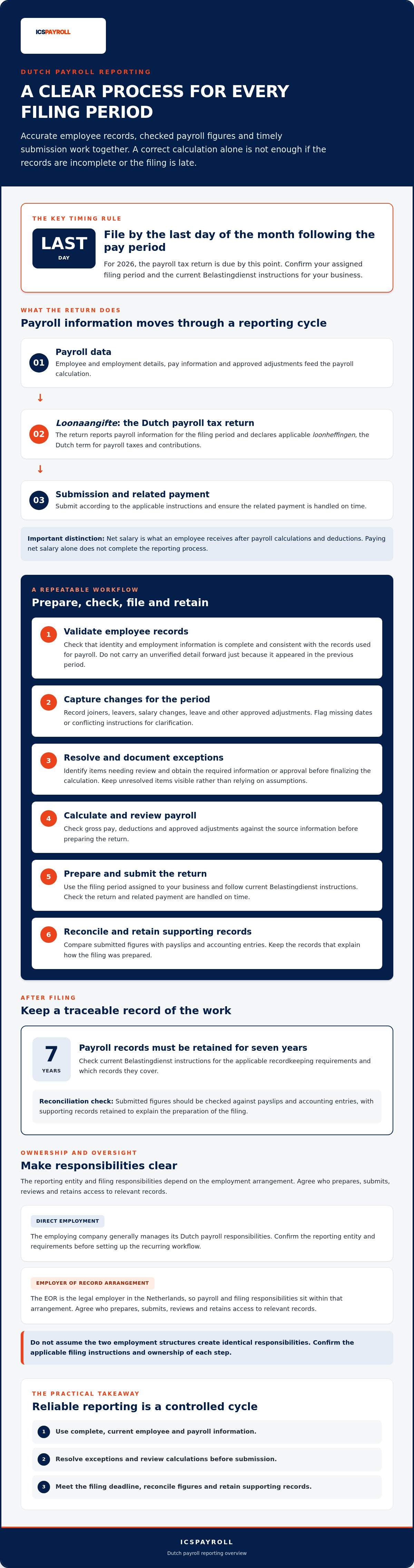
A Dutch payroll tax return can be accurate in its calculations and still fail if employee records are incomplete or the filing is late. Reporting payroll taxes in the netherlands is a recurring process that relies on accurate data, clear checks, and timely submission. For 2026, the return is due by the last day of the month following the pay period, as explained in the Belastingdienst payroll tax guidance.
Employers need to coordinate payroll calculations, employee information, reporting, payment, and supporting records. Payroll records must be retained for seven years. Check current Belastingdienst instructions for the applicable recordkeeping requirements and the records they cover.
This guide explains how to prepare, file, check, and manage Dutch payroll tax reports, and how to decide whether internal administration or specialist support is a better fit for your company.
By Joost Hubregtse, Payroll Director.
Joost Hubregtse is Payroll Director at ICSPayroll, the Dutch payroll and EOR specialist of Intercompany Solutions. A career payroll specialist and former Head of Payroll, he oversees wage tax filings, 30% ruling applications, and employment compliance for international employers.
Reviewed by Joost Hubregtse, Payroll Director, on 30 September 2026.
Key Takeaways
- Understand what the Dutch payroll tax return covers and how it fits into payroll processing, beyond paying employees’ net salaries.
- Use a structured preparation workflow to validate employee details, employment changes, gross pay, deductions, and approved adjustments before submission.
- When reporting payroll taxes in the netherlands, check your assigned filing period and current Belastingdienst instructions, then confirm that the return and related payment are handled on time.
- Reconcile submitted figures against payslips and accounting entries, and retain the supporting records that explain how you prepared the filing.
- Compare in-house administration with specialist Dutch payroll support, including who reviews submissions and how your company retains access and oversight.
Reporting Payroll Taxes in the Netherlands: What Employers File and Why
What does Dutch payroll tax reporting cover?
The Dutch payroll tax return is called the loonaangifte. Employers use it to report payroll information for the relevant filing period and declare applicable loonheffingen, the Dutch term for payroll taxes and contributions. Which components apply depends on the employer’s and employee’s circumstances. Consult the Belastingdienst guidance on payroll taxes for official terminology and reporting instructions.
In practice, reporting can include wage tax and national insurance contributions withheld from employees, as well as applicable employer contributions. Payroll calculations determine these amounts, while the return reports payroll information to the Dutch Tax Administration. The return is not simply a record of what each employee received in their bank account.
Net salary is the amount paid after payroll calculations and deductions. The loonaangifte reports underlying payroll information and applicable tax and contribution amounts. Transferring net pay alone does not complete the reporting process. For broader context on the Dutch tax system, see Taxation in the Netherlands. Use Belastingdienst instructions, rather than a general overview, to determine reporting requirements.
The Dutch Payroll Administration guide explains how payroll processing fits together.
Which employers need a recurring filing process?
This guidance is for employers paying staff through Dutch payroll and responsible for related reporting. Filing obligations and periods depend on the employer’s circumstances and the instructions issued by the Belastingdienst. Confirm the instructions that apply to your business instead of assuming another employer’s process or schedule is the same.
Employment structure also matters. With direct employment, the employing company generally manages its Dutch payroll responsibilities. Under an Employer of Record arrangement, the EOR is the legal employer in the Netherlands, so payroll and filing responsibilities sit within that arrangement. The company and EOR should agree who prepares, submits, reviews, and retains access to relevant records. Don’t assume the two structures create identical responsibilities.
Reporting payroll taxes in the netherlands is a controlled extension of payroll processing: employee and pay data feed the return, while applicable Belastingdienst instructions determine what must be reported. Confirm the reporting entity and requirements before setting up the recurring workflow.
How to Prepare a Dutch Payroll Tax Return: A Step-by-Step Workflow
A reliable filing starts before the return is submitted. Use a repeatable sequence to collect payroll inputs, resolve discrepancies, review the calculations, and prepare the return. A documented workflow also helps identify where an error entered the process and who needs to address it.
Gather and validate payroll data before calculation
Start with controlled source records for the relevant pay period. Confirm employee identity and employment details against current records, then check for changes that affect payroll. Don’t carry an unverified detail forward simply because it appeared in the previous period’s file.
- 1. Confirm employee records. Check that identity and employment information is complete and consistent with the records used for payroll.
- 2. Capture period changes. Record joiners, leavers, salary changes, leave, and other approved adjustments that apply to the period. Flag missing dates or conflicting instructions for clarification.
- 3. Resolve exceptions. Document what needs review and obtain the required information or approval before finalizing the payroll calculation. Keep unresolved items visible rather than relying on assumptions.
Calculate, review, and prepare the return
Once the inputs are checked, process payroll using the applicable instructions. Standard payroll calculations and employee-specific tax treatment are not always the same question. If a special tax treatment or ruling may affect an employee’s payroll, verify its status and application before including it in the calculation. Consult the Belastingdienst’s current payroll tax guidance for official instructions and figures, rather than relying on a previously used rate or assumption.
Accurate Dutch payroll tax returns depend on validated payroll data.
- 4. Reconcile the payroll output. Compare payroll totals with payslips and the employer’s payroll records. Check that gross pay, deductions, and approved adjustments are reflected consistently, and investigate differences before submission.
- 5. Prepare and submit the return. Use the reviewed payroll data to prepare the return for the correct filing period. Check the entries against the payroll output and follow the submission instructions that apply to the employer.
Retain a clear trail connecting source records, approved changes, payroll calculations, payslips, and the submitted return. If a figure is questioned later, that trail helps the responsible person trace it to the relevant input. Employers that want help connecting monthly payroll processing with Dutch tax filings can review Dutch payroll administration support.
Dutch Payroll Tax Filing Deadlines, Submission Checks, and Corrections
A filing calendar is useful only when it reflects the employer’s assigned reporting period. Confirm the period and instructions in current Belastingdienst communications, then schedule preparation, review, submission, and payment as distinct tasks. This makes it clear whether a return has been prepared, filed, and paid, rather than treating those steps as one action.
How should employers manage the filing calendar?
For 2026, the loonaangifte is due by the last day of the month following the relevant pay period. For example, the return for April is due by 31 May. The return and payment are due by that deadline, so check the applicable instructions and allow time to complete both steps. See the Belastingdienst payroll tax guidance and confirm your assigned filing period and current instructions directly with the Tax Administration.
In 2026, submit the Dutch payroll tax return and complete the related payment by the last day of the month following the pay period.
Build reminders around the confirmed period and deadline, with enough time to check the return before submission. Assign clear responsibility for each stage:
- Preparation: compile the payroll data and draft return.
- Review: check the return against approved payroll records.
- Submission: file using the applicable instructions and retain evidence of completion.
- Payment: arrange and verify payment separately from the return submission.
After submission, record that the filing process is complete and confirm that the payment has been handled. Don’t assume that filing the return automatically completes the payment step.
What should happen when a return contains an error?
Address a discrepancy through a documented review, not an informal adjustment. First identify the employee or payroll group affected, the reporting period, the source record, and the figure that appears incorrect. Compare those details with the approved payroll calculation and submitted return to establish where the mismatch arose.
Then consult current Belastingdienst instructions before choosing a correction route. The appropriate action can depend on the error and filing circumstances, so don’t assume that one process applies in every case. Record the issue, the guidance consulted, the action taken, who reviewed it, and its final status. If the correction affects payment, verify the applicable payment instructions as well.
For employers reporting payroll taxes in the netherlands, a controlled calendar and a traceable correction record help keep deadlines, submission, and payment visible. They also make it easier for the responsible team member or payroll specialist to confirm what remains outstanding.
How to Reconcile Payroll Tax Reports and Keep Compliant Records
Reconciliation connects the payroll calculation to the figures reported to the Belastingdienst. Compare the approved payroll output with payslips, accounting entries, and the submitted return for the same period. If values differ, identify the source of the difference before treating the return as complete.
What should a payroll tax reconciliation compare?
Use the following as a practical control framework, not an official Dutch tax form. Compare like with like: check the same employees and reporting period, and distinguish payroll totals from individual payslip amounts.
| Record | What to compare | What to investigate if figures differ |
|---|---|---|
| Approved payroll output | Gross pay, deductions, and approved adjustments | Source data, employment changes, or processing issues |
| Payslips | Employee-level pay and deductions against payroll output | Missing or inconsistent employee-level entries |
| Accounting entries | Payroll totals and related amounts recorded for the period | Posting timing, mapping, or an unrecorded adjustment |
| Submitted return | Reported figures against the approved payroll output | Transcription errors, period mismatch, or an incorrect source figure |
Trace each variance back to its source. For example, a difference may reflect a late-approved payroll adjustment or a timing mismatch between records. Record the explanation and any follow-up instead of changing a figure solely to make the totals agree.
Which records support a clear audit trail?
Keep the records that show how reported figures were produced and checked. The applicable retention period for payroll records is seven years. Confirm current requirements in Belastingdienst guidance on payroll administration and record retention before applying them to your record schedule.
A useful file connects payroll calculations to employee changes, payslips, the filed return, and relevant submission or payment confirmations. Include approvals and explanations for adjustments so a reviewer can understand both the final amount and how it was reached. Where employee-specific tax treatment affects payroll, retain the relevant supporting information and verify the treatment against the applicable decision or official instructions. The 30% ruling employer guide explains that specific payroll context.
A consistent audit trail makes reporting payroll taxes in the netherlands easier to review and explain. For support connecting payroll processing, tax filings, and employee records, explore Dutch payroll administration support.
In-House Filing or Dutch Payroll Support: Choose a Reliable Reporting Model
The right reporting model depends on more than who enters payroll data. Consider whether your company has the Dutch payroll knowledge, review capacity, and continuity to prepare and check each filing consistently. Outsourcing can provide specialist support, but it doesn’t remove the need to agree who is responsible for each task or ensure your company can access filing information.
When might internal payroll reporting be workable?
In-house administration may fit when the employer has current Dutch payroll expertise and enough capacity to prepare and independently review payroll information. Check that each part of the process has an owner, including employee record updates, the filing calendar, submission, and confirmation that the filing is complete.
Continuity matters. If one person holds all the process knowledge, leave or a role change can disrupt the workflow. Document key steps and ensure another appropriate team member can locate the records, understand outstanding items, and identify the next filing deadline.
What should employers confirm with a payroll provider?
Before engaging a provider, agree how the workflow operates and how oversight will work. Confirm who prepares, reviews, submits, and monitors each payroll tax return. Ask how the provider shares payslips, filing status, confirmations, and payroll records, and how your company can access information if responsibilities change.
Clarify the division of responsibilities in writing. The arrangement should identify who supplies and approves employee changes, who follows up on missing information, and how filing questions or corrections are escalated. If your company also needs a legal employer in the Netherlands, review the Employer of Record Netherlands guide to understand how that model differs from payroll administration.
How can ICSPayroll support Dutch payroll reporting?
ICSPayroll provides Dutch payroll administration, including monthly payroll processing, payroll tax filings, and social security and employer premium handling. Its Employer of Record service is a separate option for international companies that need a legal employer in the Netherlands. Before choosing either model, establish which party handles each responsibility and what reporting information your company can access.
Use this short checklist to assess your next step:
- Confirm who owns payroll data, review, filing, and payment coordination.
- Check that filing status, payslips, and supporting records remain accessible.
- Identify any gaps in Dutch payroll knowledge or process continuity.
- Decide whether internal administration, payroll support, or an EOR arrangement fits your employment structure.
If you’re assessing reporting payroll taxes in the netherlands, share your payroll setup, current process, and areas where responsibilities need clarification. Discuss your Dutch payroll administration requirements with ICSPayroll.
Make Your Dutch Payroll Reporting Process Reliable
Reliable reporting payroll taxes in the netherlands starts with validated employee and payroll data, followed by a careful review of the return and a clear record of what was filed. Keep the filing calendar visible, confirm the applicable Belastingdienst instructions, and reconcile reported figures with payroll records and payslips.
For 2026, the loonaangifte is due by the last day of the month following the pay period. Track submission and payment as separate steps, and retain the evidence and records that support your reported figures.
If your team needs help maintaining this workflow, ICSPayroll provides monthly Dutch payroll processing and tax filing support, including social security and employer premium handling. Its service uses one clear monthly invoice covering employment-related costs. Confirm responsibilities, review arrangements, and access to filing information so oversight remains clear.
Discuss Dutch payroll reporting with ICSPayroll and outline your current payroll setup and support needs. With a defined process and the right level of expertise, your business can manage Dutch payroll reporting with greater confidence.
Frequently Asked Questions
When are Dutch payroll tax returns due?
For 2026, the loonaangifte is due by the last day of the month following the relevant pay period. Check your assigned filing period and current instructions in Belastingdienst payroll tax guidance before relying on a calendar reminder. Keep the relevant notice with your payroll calendar so the reviewer can verify the period and due date. Track any payment separately and follow its applicable instructions.
What is a loonaangifte in the Netherlands?
A loonaangifte is the Dutch payroll tax return used to report payroll information for the applicable filing period. The return relates to loonheffingen, or payroll taxes and contributions, with the exact reporting scope depending on the employer’s circumstances. Review the Belastingdienst’s current payroll tax guidance for official terminology and instructions. If your payroll structure or an employee’s circumstances need interpretation, seek specialist advice rather than assuming a standard treatment applies.
What information should employers check before filing payroll taxes?
Validate employee details and pay-period information against current source records before preparing the return. Check joiners, leavers, salary changes, and approved payroll adjustments, then compare the calculated payroll with payslips and the figures prepared for filing. For reporting payroll taxes in the netherlands, resolve conflicting or incomplete details before submission instead of carrying assumptions into the return. Confirm specific reporting requirements against current Belastingdienst instructions, since the applicable inputs can depend on the employer’s circumstances.
Can an employer correct a Dutch payroll tax return after submission?
A correction may be needed if you discover inaccurate payroll information after filing. First identify the employee, affected period, source record, and reported figure, then consult current Belastingdienst instructions for payroll tax returns to determine the appropriate correction route and timing. Don’t assume every error follows the same process. Keep evidence of the discrepancy, review, action taken, and final status with the relevant payroll records.
How long must employers keep Dutch payroll records?
The applicable retention period for payroll records is seven years. Confirm the current rule and which record categories it applies to in official Belastingdienst guidance before setting your retention schedule. Maintain an organised audit trail linking payroll calculations, employee changes, payslips, filed returns, and relevant confirmations. Don’t assume every document has an identical retention period unless official guidance confirms that treatment for the specific record.
Should a company manage Dutch payroll tax reporting in-house or outsource it?
The choice depends on your Dutch payroll expertise, review capacity, process continuity, and ability to maintain accurate records and monitor filing status. In-house reporting can work when those responsibilities have capable owners and backup. A specialist provider can support monthly payroll processing and tax filings. Before deciding, agree who prepares, reviews, submits, and monitors returns, and confirm how your company can access payslips, filing information, and supporting records.

Article by
Joost Hubregtse
Joost Hubregtse is Director of ICS Staffing & Payroll B.V., the wholly owned subsidiary of Intercompany Solutions behind ICS Payroll. He is responsible for Employer of Record and Dutch payroll services: employment contracts, wage tax and social security filings, holiday allowance, pension, sick leave and CAO compliance, with onboarding possible within 48 hours.
Frequently Asked Questions
The Dutch payroll tax return is called the loonaangifte. Employers use it to report payroll information for the relevant filing period and declare applicable loonheffingen, the Dutch term for payroll taxes and contributions. Which components apply depends on the employer’s and employee’s circumstances. Consult the Belastingdienst guidance on payroll taxes for official terminology and reporting instructions. In practice, reporting can include wage tax and national insurance contributions withheld from employees, as well as applicable employer contributions. Payroll calculations determine these amounts, while the return reports payroll information to the Dutch Tax Administration. The return is not simply a record of what each employee received in their bank account. Net salary is the amount paid after payroll calculations and deductions. The loonaangifte reports underlying payroll information and applicable tax and contribution amounts. Transferring net pay alone does not complete the reporting process. For broader context on the Dutch tax system, see Taxation in the Netherlands. Use Belastingdienst instructions, rather than a general overview, to determine reporting requirements. The Dutch Payroll Administration guide explains how payroll processing fits together.
This guidance is for employers paying staff through Dutch payroll and responsible for related reporting. Filing obligations and periods depend on the employer’s circumstances and the instructions issued by the Belastingdienst. Confirm the instructions that apply to your business instead of assuming another employer’s process or schedule is the same. Employment structure also matters. With direct employment, the employing company generally manages its Dutch payroll responsibilities. Under an Employer of Record arrangement, the EOR is the legal employer in the Netherlands, so payroll and filing responsibilities sit within that arrangement. The company and EOR should agree who prepares, submits, reviews, and retains access to relevant records. Don’t assume the two structures create identical responsibilities. Reporting payroll taxes in the netherlands is a controlled extension of payroll processing: employee and pay data feed the return, while applicable Belastingdienst instructions determine what must be reported. Confirm the reporting entity and requirements before setting up the recurring workflow. A reliable filing starts before the return is submitted. Use a repeatable sequence to collect payroll inputs, resolve discrepancies, review the calculations, and prepare the return. A documented workflow also helps identify where an error entered the process and who needs to address it.
For 2026, the loonaangifte is due by the last day of the month following the relevant pay period. For example, the return for April is due by 31 May. The return and payment are due by that deadline, so check the applicable instructions and allow time to complete both steps. See the Belastingdienst payroll tax guidance and confirm your assigned filing period and current instructions directly with the Tax Administration. In 2026, submit the Dutch payroll tax return and complete the related payment by the last day of the month following the pay period. Build reminders around the confirmed period and deadline, with enough time to check the return before submission. Assign clear responsibility for each stage: After submission, record that the filing process is complete and confirm that the payment has been handled. Don’t assume that filing the return automatically completes the payment step.
Address a discrepancy through a documented review, not an informal adjustment. First identify the employee or payroll group affected, the reporting period, the source record, and the figure that appears incorrect. Compare those details with the approved payroll calculation and submitted return to establish where the mismatch arose. Then consult current Belastingdienst instructions before choosing a correction route. The appropriate action can depend on the error and filing circumstances, so don’t assume that one process applies in every case. Record the issue, the guidance consulted, the action taken, who reviewed it, and its final status. If the correction affects payment, verify the applicable payment instructions as well. For employers reporting payroll taxes in the netherlands, a controlled calendar and a traceable correction record help keep deadlines, submission, and payment visible. They also make it easier for the responsible team member or payroll specialist to confirm what remains outstanding. Reconciliation connects the payroll calculation to the figures reported to the Belastingdienst. Compare the approved payroll output with payslips, accounting entries, and the submitted return for the same period. If values differ, identify the source of the difference before treating the return as complete.
Use the following as a practical control framework, not an official Dutch tax form. Compare like with like: check the same employees and reporting period, and distinguish payroll totals from individual payslip amounts. Trace each variance back to its source. For example, a difference may reflect a late-approved payroll adjustment or a timing mismatch between records. Record the explanation and any follow-up instead of changing a figure solely to make the totals agree.
Keep the records that show how reported figures were produced and checked. The applicable retention period for payroll records is seven years. Confirm current requirements in Belastingdienst guidance on payroll administration and record retention before applying them to your record schedule. A useful file connects payroll calculations to employee changes, payslips, the filed return, and relevant submission or payment confirmations. Include approvals and explanations for adjustments so a reviewer can understand both the final amount and how it was reached. Where employee-specific tax treatment affects payroll, retain the relevant supporting information and verify the treatment against the applicable decision or official instructions. The 30% ruling employer guide explains that specific payroll context. A consistent audit trail makes reporting payroll taxes in the netherlands easier to review and explain. For support connecting payroll processing, tax filings, and employee records, explore Dutch payroll administration support. The right reporting model depends on more than who enters payroll data. Consider whether your company has the Dutch payroll knowledge, review capacity, and continuity to prepare and check each filing consistently. Outsourcing can provide specialist support, but it doesn’t remove the need to agree who is responsible for each task or ensure your company can access filing information.
In-house administration may fit when the employer has current Dutch payroll expertise and enough capacity to prepare and independently review payroll information. Check that each part of the process has an owner, including employee record updates, the filing calendar, submission, and confirmation that the filing is complete. Continuity matters. If one person holds all the process knowledge, leave or a role change can disrupt the workflow. Document key steps and ensure another appropriate team member can locate the records, understand outstanding items, and identify the next filing deadline.
Before engaging a provider, agree how the workflow operates and how oversight will work. Confirm who prepares, reviews, submits, and monitors each payroll tax return. Ask how the provider shares payslips, filing status, confirmations, and payroll records, and how your company can access information if responsibilities change. Clarify the division of responsibilities in writing. The arrangement should identify who supplies and approves employee changes, who follows up on missing information, and how filing questions or corrections are escalated. If your company also needs a legal employer in the Netherlands, review the Employer of Record Netherlands guide to understand how that model differs from payroll administration.
ICSPayroll provides Dutch payroll administration, including monthly payroll processing, payroll tax filings, and social security and employer premium handling. Its Employer of Record service is a separate option for international companies that need a legal employer in the Netherlands. Before choosing either model, establish which party handles each responsibility and what reporting information your company can access. Use this short checklist to assess your next step: If you’re assessing reporting payroll taxes in the netherlands, share your payroll setup, current process, and areas where responsibilities need clarification. Discuss your Dutch payroll administration requirements with ICSPayroll. Reliable reporting payroll taxes in the netherlands starts with validated employee and payroll data, followed by a careful review of the return and a clear record of what was filed. Keep the filing calendar visible, confirm the applicable Belastingdienst instructions, and reconcile reported figures with payroll records and payslips. For 2026, the loonaangifte is due by the last day of the month following the pay period. Track submission and payment as separate steps, and retain the evidence and records that support your reported figures. If your team needs help maintaining this workflow, ICSPayroll provides monthly Dutch payroll processing and tax filing support, including social security and employer premium handling. Its service uses one clear monthly invoice covering employment-related costs. Confirm responsibilities, review arrangements, and access to filing information so oversight remains clear. Discuss Dutch payroll reporting with ICSPayroll and outline your current payroll setup and support needs. With a defined process and the right level of expertise, your business can manage Dutch payroll reporting with greater confidence.
For 2026, the loonaangifte is due by the last day of the month following the relevant pay period. Check your assigned filing period and current instructions in Belastingdienst payroll tax guidance before relying on a calendar reminder. Keep the relevant notice with your payroll calendar so the reviewer can verify the period and due date. Track any payment separately and follow its applicable instructions.
A loonaangifte is the Dutch payroll tax return used to report payroll information for the applicable filing period. The return relates to loonheffingen, or payroll taxes and contributions, with the exact reporting scope depending on the employer’s circumstances. Review the Belastingdienst’s current payroll tax guidance for official terminology and instructions. If your payroll structure or an employee’s circumstances need interpretation, seek specialist advice rather than assuming a standard treatment applies.
Validate employee details and pay-period information against current source records before preparing the return. Check joiners, leavers, salary changes, and approved payroll adjustments, then compare the calculated payroll with payslips and the figures prepared for filing. For reporting payroll taxes in the netherlands, resolve conflicting or incomplete details before submission instead of carrying assumptions into the return. Confirm specific reporting requirements against current Belastingdienst instructions, since the applicable inputs can depend on the employer’s circumstances.
A correction may be needed if you discover inaccurate payroll information after filing. First identify the employee, affected period, source record, and reported figure, then consult current Belastingdienst instructions for payroll tax returns to determine the appropriate correction route and timing. Don’t assume every error follows the same process. Keep evidence of the discrepancy, review, action taken, and final status with the relevant payroll records.
The applicable retention period for payroll records is seven years. Confirm the current rule and which record categories it applies to in official Belastingdienst guidance before setting your retention schedule. Maintain an organised audit trail linking payroll calculations, employee changes, payslips, filed returns, and relevant confirmations. Don’t assume every document has an identical retention period unless official guidance confirms that treatment for the specific record.
The choice depends on your Dutch payroll expertise, review capacity, process continuity, and ability to maintain accurate records and monitor filing status. In-house reporting can work when those responsibilities have capable owners and backup. A specialist provider can support monthly payroll processing and tax filings. Before deciding, agree who prepares, reviews, submits, and monitors returns, and confirm how your company can access payslips, filing information, and supporting records.