
Netherlands Remote Hiring Guide: 2026 Compliance and Payroll Standards
By Joost Hubregtse, Director, ICS Staffing & Payroll
All blog posts are reviewed and fact checked by our labour law lawyer Zishan Hussain and our director. Editorial standards
By Joost Hubregtse, Payroll Director.
Joost Hubregtse is Payroll Director at ICSPayroll, the Dutch payroll and EOR specialist of Intercompany Solutions. A career payroll specialist and former Head of Payroll, he oversees wage tax filings, 30% ruling applications, and employment compliance for international employers.
Reviewed by Joost Hubregtse, Payroll Director, on October 2, 2026.
A quick hire can become a costly compliance problem if Dutch employment, payroll, or tax rules are missed. This netherlands remote hiring guide explains the decisions international employers should make before hiring remote staff, including how to assess worker classification and permanent establishment risk.
Dutch labor law can be difficult to interpret from abroad, and changes to the 30% ruling add another planning step. Employers also need a clear view of 2026 statutory costs before setting compensation and choosing a hiring model. The right approach depends on whether you establish a Dutch entity, use an Employer of Record, or engage a worker under a different arrangement.
This guide provides a practical compliance roadmap for employment requirements, payroll administration, employer costs, and the 30% ruling’s 2026 rules. It also explains how an EOR can support hiring in the Netherlands without first setting up a local BV, helping you move from planning to employment in weeks rather than months while keeping local obligations in focus.
Key Takeaways
- Use this netherlands remote hiring guide to map employment, payroll, and workplace obligations before onboarding remote staff.
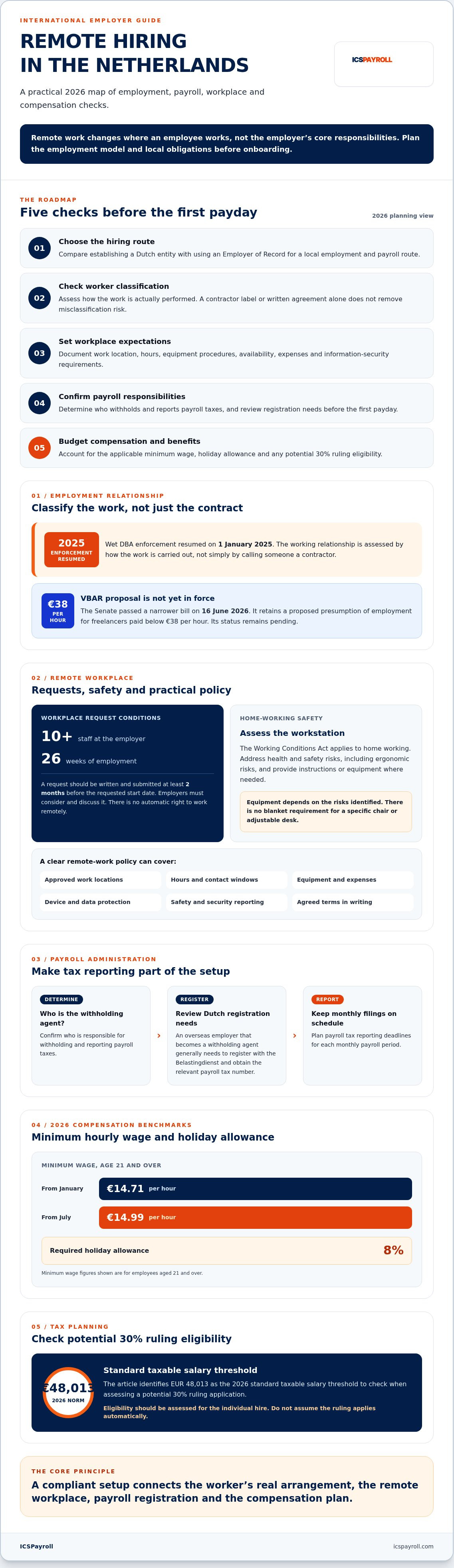
- Budget for the 2026 hourly minimum wage of EUR 14.71 from January and EUR 14.99 from July, plus the required 8% holiday allowance.
- Plan payroll tax registration and monthly loonaangifte deadlines so wage reporting stays on schedule.
- Check whether an international hire may qualify for the 30% ruling, including the 2026 standard taxable salary threshold of EUR 48,013.
- Compare establishing a Dutch entity with using an Employer of Record to see how you can hire without first setting up a local BV.
The Legal Framework for Remote Work in the Netherlands
Remote work changes where an employee performs their duties, not the employer’s core responsibilities. Under the Wet flexibel werken, employees at employers with at least 10 staff can request a change to their working hours, schedule, or workplace after 26 weeks of employment. A workplace request may include working from home. The employee should submit the request in writing at least two months before the requested start date. Employers must consider and discuss it, but the law does not give employees an automatic right to work remotely.
The Arbowet, or Working Conditions Act, also applies to home working. Employers must address health and safety risks, including ergonomic risks. Assess the employee’s workstation and provide appropriate instructions and equipment where needed. This is not a blanket requirement to provide every remote employee with a particular chair or adjustable desk. The appropriate setup depends on the risks identified.
Keep employment and contractor arrangements distinct. Under the Wet DBA, the working relationship is assessed by how the work is actually performed, not simply by calling someone a contractor. Enforcement of the existing rules resumed on 1 January 2025. The Senate passed a narrower VBAR bill on 16 June 2026, retaining a proposed presumption of employment for freelancers paid below EUR 38 per hour. It is not yet in force. Check the Eerste Kamer’s VBAR legislative information for its status. A written agreement alone cannot remove misclassification risk.
A written remote work policy turns these duties into practical, consistent steps. Specify approved work locations, equipment procedures, availability expectations, expense handling, and information-security requirements. Explain how employees should protect devices and confidential data, and how to report safety or security concerns. In this netherlands remote hiring guide, the policy is a practical control, not a substitute for reviewing each role and employment arrangement.
Ergonomic Requirements and Home Office Allowances
There is no single ergonomic equipment package or universal monthly internet and electricity allowance for every remote worker. Review each workstation and determine what equipment is reasonably needed to meet health and safety obligations. Don’t describe an allowance or equipment reimbursement as tax-free without checking current Belastingdienst rules and the specific arrangement. Avoid relying on unsupported “market typical” amounts.
Availability, Working Hours, and Contract Terms
Dutch law does not establish a general statutory right to disconnect outside working hours. Employers can still set clear boundaries through policy. Define contact windows, response expectations, and escalation procedures, and account for time-zone differences without implying constant availability. The Dutch work culture includes varied working patterns, so agree on actual hours rather than assuming a uniform schedule.
Remote work does not replace the employment contract. Record agreed hours, work location arrangements, and any applicable expense terms in writing. Make sure the contract reflects how the employee will work in practice.
Payroll Compliance and Employer Tax Obligations
Before paying a Dutch employee, determine who is responsible for withholding and reporting payroll taxes. An overseas employer that becomes a withholding agent generally needs to register with the Dutch Tax and Customs Administration, the Belastingdienst, and obtain the relevant payroll tax number. Review the Belastingdienst’s guidance on Dutch payroll taxes and employer registration before the first payday. An Employer of Record can provide a local employment and payroll route without first setting up a Dutch BV.
For each payroll period, the employer calculates the required wage tax and social insurance amounts, withholds employee deductions where applicable, and files the loonaangifte. The return and payment are due by the last day of the following month. Keep payroll and personnel records for seven years, including contracts, payroll calculations, payslips, and records supporting tax treatment. Check the Belastingdienst’s guidance on keeping business records and retention periods. A clear record trail helps reconcile filings and respond to questions about employment terms or payments.
Remote hiring can also raise permanent establishment questions for a foreign company. A Dutch BV is a Dutch resident taxpayer, not a permanent establishment. If a foreign entity employs someone working from the Netherlands without a local entity, assess the company’s actual activities and arrangements before deciding whether there is a tax presence risk. The Belastingdienst explains how a permanent establishment in the Netherlands may affect a foreign business. Don’t assume that a home-based role automatically creates one, or that remote work rules out the possibility. For non-EU hires, check the relevant immigration route and the Highly Skilled Migrant visa requirements; immigration sponsorship is arranged via our licensed partner.
Employer Premiums and Payroll Administration
For 2026, employer contributions include AWf unemployment insurance at 2.74% for qualifying permanent contracts or 7.74% for flexible contracts; Aof disability insurance at 6.27% for small employers or 7.63% for large employers; and the Zvw employer levy at 6.10%. These premiums are calculated up to a maximum wage base of EUR 79,409. The applicable AWf rate depends on contract conditions, so classify each employment arrangement correctly. The official Staatscourant publications portal provides the published premium rates. A payroll factor can consolidate salary and relevant employer charges into one monthly invoice, making costs easier to review while leaving the underlying employer obligations unchanged.
Contract Sequences, Probation, and Non-Competes
The ketenregeling generally converts a sequence of more than three fixed-term contracts, or contracts spanning more than 36 months, into permanent employment, subject to statutory exceptions. Probation is limited: up to two months for an indefinite contract, one month for a fixed-term contract lasting 6 to 24 months, and none for contracts of six months or less.
Non-compete reform is not in force in 2026. A bill containing proposed restrictions remains under consideration, so employers should apply current law rather than treating proposed terms as enacted requirements. For payroll administration or EOR support, review Dutch hiring and payroll options.
2026 Financial Benchmarks: Minimum Wage and Benefits
Build compensation budgets around the applicable statutory rates and leave obligations, not just a headline salary. In 2026, the gross minimum wage for employees aged 21 and over is EUR 14.71 per hour from 1 January and EUR 14.99 from 1 July. Apply the rate in effect for each pay period and check the employee’s age and hours. The Netherlands also requires holiday allowance of at least 8% of gross wages in most standard employment arrangements, so include it when calculating the full cost of pay.
There is no universal statutory employer pension contribution of 15.2% for every Dutch employee. A pension obligation may apply through a mandatory industry pension fund, collective labour agreement, or the employer’s own pension arrangement. Check the role and sector before using any percentage in your forecast. This distinction matters: a payroll arrangement’s stated pension percentage should not be presented as a legal rate that applies to all employers.
Illness creates a longer-term employer obligation. Under Dutch law, employers generally continue paying at least 70% of wages for up to 104 weeks, with a minimum-wage floor during the first year. Separate reintegration duties also apply. For international employers, this netherlands remote hiring guide recommends accounting for absence procedures and potential ongoing wage costs, not only the employee’s regular monthly salary.
Holiday Entitlements and Leave Policies
Statutory annual leave accrues at four times an employee’s weekly working hours. For a full-time employee working five days a week, that equals 20 days per year. Track accrual and requests in a shared system so remote employees and managers can check balances. Statutory leave generally expires six months after the year in which it accrued, unless the employee could not reasonably take it; additional contractual leave is subject to different carry-over rules.
Eligible partner and parental leave can involve UWV benefits, but payment rules differ by leave type. Confirm eligibility, timing, and the employer’s role in submitting claims before approving leave. Record agreed dates and keep payroll informed so salary payments and any benefit administration are handled correctly.
Transition Allowance and Termination Costs
The statutory transition payment accrues from the first day of employment, including during probation. In 2026, its maximum is EUR 102,000, or one year’s gross salary if that is higher. Include this potential liability in workforce planning, and calculate it using the employee’s service and pay details when employment ends.
Long-term sickness can extend wage and reintegration responsibilities. Review absence processes and consider how the business will manage that exposure. Minimum wage, leave, sickness, and termination rules are separate obligations, so assess each when setting a complete employment budget.
Attracting Talent: The 30% Ruling and HSM Visas
The 30% ruling can improve the net compensation package for eligible international hires by allowing an employer to pay part of qualifying remuneration as a tax-free allowance. It is separate from immigration sponsorship: the ruling is granted by the Belastingdienst, while an IND sponsor arrangement concerns residence and work authorization.
For 2026, the standard minimum taxable salary after the deduction is EUR 48,013. For eligible employees under 30 with a qualifying master’s degree, the threshold is EUR 36,497. These are taxable-salary thresholds, not gross salary figures. A gross salary of approximately EUR 68,590 is needed to receive the full 30% benefit. The allowance is capped at the 2026 WNT norm of EUR 262,000.
Plan beyond the current year. The 30% rate applies through 2026. For rulings first granted from 1 January 2024, the rate falls to 27% from 1 January 2027; holders whose rulings began before 2024 retain the 30% rate for their term. Partial non-resident status for Box 2 and Box 3 is no longer available to new holders. Only pre-2024 holders retain it, through 31 December 2026.
Highly Skilled Migrant Visas
Non-EU and non-EEA nationals may need Dutch work authorization. The Highly Skilled Migrant route requires an eligible employment arrangement, a qualifying salary, and sponsorship through an IND-recognized sponsor. Review the official Highly Skilled Migrant visa requirements before setting a start date. ICSPayroll arranges immigration sponsorship via its licensed partner, with HSM visa processing taking approximately three weeks.
Applying for the 30% Ruling
The employer and employee apply jointly to the Belastingdienst. The employee must have been recruited from abroad and lived more than 150 kilometres from the Dutch border for at least 16 of the 24 months before their first working day. Dutch payroll tax must be withheld, and the tax authority must issue a written decision.
File within four months of the employee’s start date for the ruling to apply retroactively from day one. If filed later, it generally applies from the month after filing. Once approved, configure payroll to apply the allowance and keep the decision and supporting eligibility records. Immigration approval and tax treatment follow separate processes, an important distinction when planning a remote hire in the Netherlands.
Explore 30% ruling application support to coordinate the application with Dutch payroll.
Implementing a Compliant Remote Hiring Strategy
An Employer of Record (EOR) can give a foreign company a route to employ a worker in the Netherlands before or instead of establishing a Dutch BV. The EOR becomes the local legal employer and administers the employment relationship and Dutch payroll. The client company directs the employee’s day-to-day work under the agreed arrangement, so responsibilities should be clearly set out rather than assumed to transfer in full.
This model can shorten the path from hiring decision to employment. Start by defining the role and proposed terms, then request a tailored quotation, review responsibilities and costs, and agree on the employment contract and start date. ICSPayroll states that hiring can be arranged in weeks without a local BV. Ask for a clear breakdown of salary-related costs and included administration before approving the arrangement.
ICSPayroll’s payroll factor brings employment costs together in one monthly invoice. The stated inclusions cover the 8% holiday allowance, 15.2% pension, sickness risk, social security and employer premiums, transition allowance, HR administration, online employee portal, 30% ruling application where applicable, and sick-leave support. The pension figure is part of this service’s cost model, not a universal statutory rate. Confirm how adjustments, statutory changes, leave, expenses, and other agreed items appear on the invoice.
Define the EOR Compliance Scope
Before signing, document who handles payroll processing, wage reporting, employer contributions, contract administration, and employee queries. Confirm how employees access payslips and leave balances, and whether HR administration, an employee handbook, and sick-leave support are included. Verify these details in the service agreement rather than assuming every EOR offers the same portal, handbook, or support.
Set out how workplace concerns and sickness notifications are escalated. Dutch employers have statutory obligations during employee illness and reintegration, but the practical division of tasks between the EOR and client should be explicit. Identify the contact responsible for each step and how information is shared securely.
Plan for a Future Dutch BV
An EOR can serve as a market-entry arrangement while a business evaluates its longer-term operating model. If you later establish a Dutch BV and want to employ the individual directly, treat the move as a planned employment transition, not an automatic conversion. Review the EOR agreement, agree the change with the employee and relevant parties, and coordinate contract dates, payroll records, accrued leave, benefits, and continuity of service before setting a transfer date.
A clear transition plan helps prevent gaps in pay or employment documentation. This approach lets you start with a practical hiring arrangement while keeping a compliant path to direct employment open if your Dutch operations grow.
Hire in the Netherlands with confidence with ICSPayroll through Dutch EOR or payroll support.
Put Your Netherlands Hiring Plan into Action
A sound remote hiring plan connects the employment contract, payroll, workplace arrangements, and tax treatment. Check statutory costs and employee entitlements before setting compensation, and assess 30% ruling eligibility early so the application can be coordinated with payroll. The right hiring model can also help you employ Dutch talent before or instead of establishing a local BV.
An Employer of Record can provide a local employment route and support administration, while responsibilities for compliance should be clearly agreed. ICSPayroll offers Dutch payroll and EOR support, including payroll administration and 30% ruling assistance. Immigration sponsorship is arranged via a licensed partner, and HSM visa processing can take approximately three weeks. The payroll factor consolidates employment costs into one monthly invoice.
Use this netherlands remote hiring guide as a starting point, then confirm the details that apply to your employee and business. Get a tailored Dutch payroll quotation within 24 hours and take the next step with a clearer compliance plan.
Frequently Asked Questions
Can I hire employees in the Netherlands without a local legal entity?
Yes. An Employer of Record (EOR) can employ staff in the Netherlands on your behalf, so your company can hire without first establishing a Dutch legal entity. The EOR handles local employment and payroll obligations under the agreed arrangement. Your company still directs the employee’s work, so define responsibilities clearly and check how the EOR arrangement addresses employment terms, costs, and compliance before the employee starts.
What is the minimum wage in the Netherlands for 2026?
For employees aged 21 and over, the statutory gross minimum wage is EUR 14.71 per hour from 1 January 2026 and EUR 14.99 per hour from 1 July 2026. Apply the rate in force during each pay period, and check the employee’s age because different minimum rates apply to younger workers. The Netherlands sets minimum pay by the hour, so calculate wages using the employee’s contracted hours.
How does the 30% tax ruling work for remote employees in 2026?
Eligible employees recruited from abroad may receive up to 30% of qualifying salary as a tax-free allowance through 2026, subject to a written Belastingdienst decision and Dutch payroll tax withholding. The 2026 standard taxable salary threshold after the deduction is EUR 48,013, not the gross salary threshold. For rulings first granted from 2024, the rate falls to 27% from 1 January 2027. Remote status alone does not determine eligibility.
What is the mandatory holiday allowance in the Netherlands?
Holiday allowance is generally at least 8% of gross wages. Employers usually accrue it over the year and pay it according to the employment agreement or applicable rules. Make the allowance clear in the contract and payroll records, and include it in total compensation budgeting. Check the precise wage components used for the calculation, especially where variable pay or a specific collective agreement applies.
How long does it take to get an HSM visa for a new hire?
HSM visa processing through ICSPayroll’s licensed partner typically takes approximately three weeks, though timing depends on the application and relevant authorities. The employer must use an IND-recognized sponsor for this route, and the employee must meet the applicable conditions. Review the official Highly Skilled Migrant visa requirements and coordinate the employment start date with the sponsorship process.
What are the employer obligations for a home office setup in the Netherlands?
Employers must address workplace health and safety risks for remote work under Dutch working conditions rules. Assess the employee’s home workstation, provide appropriate health and safety instructions, and determine whether equipment is needed to manage identified risks. The rules do not create a universal requirement to provide every employee with the same chair or desk. Document the assessment and explain how employees should report discomfort, hazards, or changes to their working setup.
How much are the mandatory pension contributions for Dutch employees?
There is no universal statutory pension contribution rate that applies to every Dutch employee. A pension obligation and contribution level can depend on the industry, a collective labour agreement, or the employer’s pension scheme. The 15.2% gross-salary figure used in some payroll arrangements is not a general legal rate for all employers. Check the relevant scheme and confirm how contributions are calculated before including a figure in your employment budget.
What is the transition allowance and when is it paid?
The transition allowance is statutory compensation that may be due when an employer ends an employee’s employment or does not renew a fixed-term contract, subject to the applicable rules. It accrues from the first day of employment, including probation. In 2026, the maximum is EUR 102,000, or one year’s gross salary if higher. The employer generally pays it when employment ends; calculate the amount using the employee’s service and pay details.

Article by
Joost Hubregtse
Joost Hubregtse is Director of ICS Staffing & Payroll B.V., the wholly owned subsidiary of Intercompany Solutions behind ICS Payroll. He is responsible for Employer of Record and Dutch payroll services: employment contracts, wage tax and social security filings, holiday allowance, pension, sick leave and CAO compliance, with onboarding possible within 48 hours.
Frequently Asked Questions
Yes. An Employer of Record (EOR) can employ staff in the Netherlands on your behalf, so your company can hire without first establishing a Dutch legal entity. The EOR handles local employment and payroll obligations under the agreed arrangement. Your company still directs the employee’s work, so define responsibilities clearly and check how the EOR arrangement addresses employment terms, costs, and compliance before the employee starts.
For employees aged 21 and over, the statutory gross minimum wage is EUR 14.71 per hour from 1 January 2026 and EUR 14.99 per hour from 1 July 2026. Apply the rate in force during each pay period, and check the employee’s age because different minimum rates apply to younger workers. The Netherlands sets minimum pay by the hour, so calculate wages using the employee’s contracted hours.
Eligible employees recruited from abroad may receive up to 30% of qualifying salary as a tax-free allowance through 2026, subject to a written Belastingdienst decision and Dutch payroll tax withholding. The 2026 standard taxable salary threshold after the deduction is EUR 48,013, not the gross salary threshold. For rulings first granted from 2024, the rate falls to 27% from 1 January 2027. Remote status alone does not determine eligibility.
Holiday allowance is generally at least 8% of gross wages. Employers usually accrue it over the year and pay it according to the employment agreement or applicable rules. Make the allowance clear in the contract and payroll records, and include it in total compensation budgeting. Check the precise wage components used for the calculation, especially where variable pay or a specific collective agreement applies.
HSM visa processing through ICSPayroll’s licensed partner typically takes approximately three weeks, though timing depends on the application and relevant authorities. The employer must use an IND-recognized sponsor for this route, and the employee must meet the applicable conditions. Review the official Highly Skilled Migrant visa requirements and coordinate the employment start date with the sponsorship process.
Employers must address workplace health and safety risks for remote work under Dutch working conditions rules. Assess the employee’s home workstation, provide appropriate health and safety instructions, and determine whether equipment is needed to manage identified risks. The rules do not create a universal requirement to provide every employee with the same chair or desk. Document the assessment and explain how employees should report discomfort, hazards, or changes to their working setup.
There is no universal statutory pension contribution rate that applies to every Dutch employee. A pension obligation and contribution level can depend on the industry, a collective labour agreement, or the employer’s pension scheme. The 15.2% gross-salary figure used in some payroll arrangements is not a general legal rate for all employers. Check the relevant scheme and confirm how contributions are calculated before including a figure in your employment budget.
The transition allowance is statutory compensation that may be due when an employer ends an employee’s employment or does not renew a fixed-term contract, subject to the applicable rules. It accrues from the first day of employment, including probation. In 2026, the maximum is EUR 102,000, or one year’s gross salary if higher. The employer generally pays it when employment ends; calculate the amount using the employee’s service and pay details.