
Mileage Allowance Netherlands 2026: Employer/Employee Guide
By Joost Hubregtse, Director, ICS Staffing & Payroll
All blog posts are reviewed and fact checked by our labour law lawyer Zishan Hussain and our director. Editorial standards
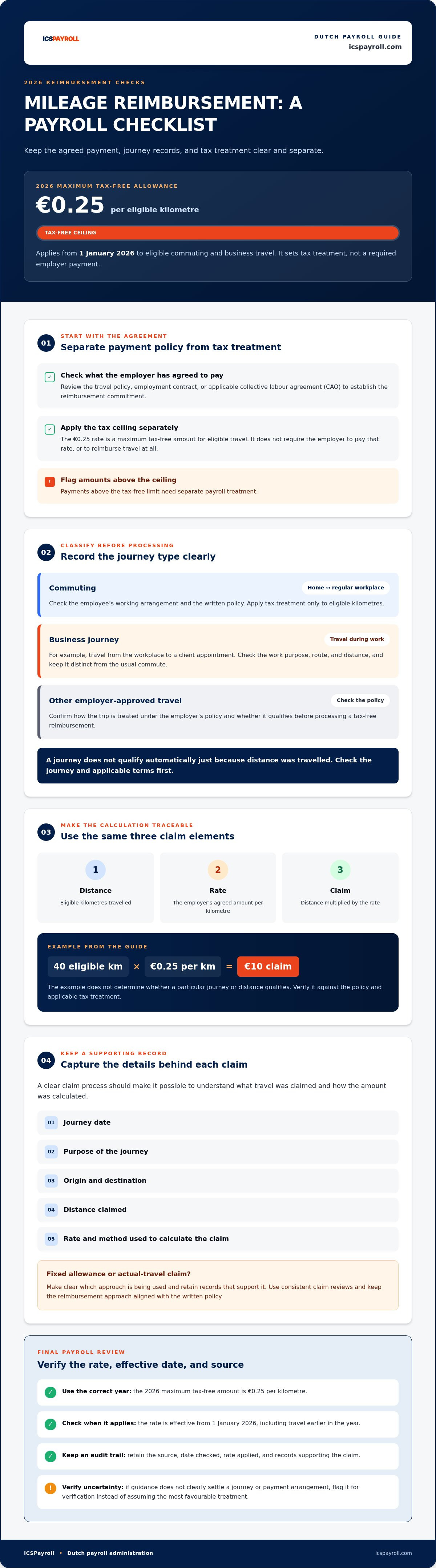
The biggest mileage-payroll mistake is treating a tax-free limit as a payment employers are automatically required to make. For kilometervergoeding 2026, the maximum tax-free allowance is €0.25 per kilometre for eligible commuting and business travel, effective from 1 January 2026, according to the Belastingdienst’s guidance on reimbursements and provisions. The limit determines tax treatment, not whether an employer must pay an allowance.
Employers and employees need to distinguish regular journeys to a workplace from business trips, check the applicable employment terms, and keep records that support each claim. A consistent process helps ensure the agreed reimbursement and its payroll treatment are both clear.
This guide explains how the 2026 tax-free mileage allowance works and how to handle fixed and variable claims, supporting records, and payroll processing.
By Joost Hubregtse, Payroll Director.
Reviewed by Joost Hubregtse, Payroll Director, on 3 October 2026.
Key Takeaways
- Separate the employer’s reimbursement policy from the tax treatment of payments under kilometervergoeding 2026.
- Classify commuting, business journeys, and other approved travel consistently before processing claims.
- Use a clear claim process that records journey dates, purposes, origins, destinations, and distances.
- Distinguish fixed allowances from claims based on actual travel, and retain records that support the approach.
- Use verified rates and consistent claim reviews as part of accurate Dutch payroll administration.
What does mileage allowance mean in the Netherlands in 2026?
A mileage allowance is an employer reimbursement for eligible travel, usually calculated by multiplying the distance travelled by an agreed amount per kilometre. The employer’s policy sets out what it will pay; Dutch tax rules determine how the payment is treated. These are separate questions. The Belastingdienst guidance on reimbursements and provisions explains the tax treatment for employers and employees in the Netherlands.
For 2026, the maximum tax-free mileage allowance is €0.25 per kilometre for eligible commuting and business travel. This is a tax-free ceiling, not a required payment rate. Employers should assess whether a journey qualifies and check the applicable employment terms or collective labour agreement (CAO) to establish what reimbursement has been agreed.
What is included when people say mileage reimbursement?
A mileage claim has three elements: the distance travelled, the reimbursement rate, and the amount claimed. For example, 40 eligible kilometres multiplied by an employer’s rate of €0.25 per kilometre gives a €10 claim. Whether the journey and distance qualify depends on the relevant policy and tax treatment. Not every trip automatically qualifies on the same basis.
Mileage reimbursement falls within the broader category of work-related expense reimbursement. The Dutch-language overview of Onkostenvergoeding (expense reimbursement) provides general context for that category.
Is an employer required to pay a mileage allowance?
The tax-free maximum does not, by itself, require an employer to reimburse travel or pay the maximum rate. A payment commitment may be set out in a CAO or individual employment contract. Employees should review their applicable terms and the employer’s travel policy. Employers should consult those documents when setting or changing reimbursement arrangements, and keep the agreed payment separate from its tax treatment.
Which Dutch mileage allowance rules and figures must employers verify for 2026?
For the 2026 payroll year, the maximum tax-free mileage allowance is €0.25 per kilometre. The Belastingdienst’s guidance on reimbursements and provisions is the reference for checking tax treatment. The €0.25 figure is a tax-free ceiling for eligible travel, not a rate every employer is legally required to pay. Employers can set a lower rate or choose another policy. Amounts above the tax-free limit need separate payroll treatment.
This rate applies to eligible business journeys and commuting using an employee’s private mode of transport. Employers should assess whether each journey meets the applicable conditions and retain supporting records. The rate alone does not establish that every kilometre claimed qualifies for tax-free reimbursement.
How should the 2026 tax-free mileage amount be explained?
State the figure with its year, scope, and status: €0.25 per kilometre is the maximum tax-free allowance for eligible commuting and business travel in 2026. It is not a mandatory employer payment or a universal entitlement. The rate concerns tax treatment; employment terms and company policy determine what the employer has agreed to reimburse.
That distinction matters when updating payroll settings. A rate change can affect the tax-free portion of a payment without automatically changing the employer’s reimbursement commitment. Review the written policy and applicable employment terms alongside the tax guidance.
Why should employers check the source and effective date?
Rates can change, and a previous-year figure may no longer be correct. The 2026 increase from €0.23 to €0.25 per kilometre applies from 1 January 2026, including travel earlier in the year. For a source check dated October 2026, compare the official guidance’s effective date with the payroll periods under review, especially if claims were first processed using an earlier rate.
Keep the source, date checked, and rate applied with the relevant payroll records. If official guidance does not clearly settle a particular journey or payment arrangement, flag it for verification rather than assuming the most favourable treatment. This creates an audit trail and supports consistent adjustments.
For international employers managing Dutch payroll, consistent source checks and recordkeeping form part of reliable processing. Dutch payroll administration can incorporate reimbursement checks into the broader payroll process.
How do commuting and business mileage affect reimbursement?
Commuting and business travel can both qualify for tax-free mileage reimbursement in Dutch payroll, but they are different types of journey and should be recorded distinctly. The Belastingdienst’s guidance on reimbursements and provisions sets out the tax context: in 2026, the maximum tax-free rate is €0.25 per kilometre for eligible commuting and business travel. This does not mean every trip qualifies or that an employer must pay the maximum. Check the journey and applicable policy before processing a claim.
| Journey category | Practical description | What the employer should verify |
|---|---|---|
| Commuting | Travel between an employee’s home and their regular workplace. | Confirm the journey fits the employee’s working arrangement and the written policy. Apply the 2026 tax treatment to eligible kilometres and retain appropriate travel records. |
| Business journey | Travel during work, such as going from the workplace to a client appointment. | Check the work purpose, route, and distance. Record the journey separately from the usual commute and apply the relevant tax treatment. |
| Other employer-approved travel | Another trip undertaken for work with the employer’s approval. | Establish the business purpose and whether the trip meets the conditions for the chosen reimbursement method. Approval alone does not determine tax treatment. |
Do not apply one reimbursement decision automatically to every journey type. An employer may set one rate in its policy, but each claim still needs consistent classification. Keep private detours separate from work-related distance; a detour does not qualify simply because the main journey does.
How should commuting mileage be assessed?
Start with the employee’s home-to-work travel pattern and the employer’s written rules. Identify the regular workplace and the days travelled, then apply the policy consistently across comparable claims. Before treating an amount as tax-free, check the current Belastingdienst guidance for the relevant year and conditions. A fixed allowance and reimbursement based on actual journeys may also need different supporting records.
How is business travel mileage different?
A business trip is a journey for a work task rather than simply travel to the regular workplace. For example, an employee might travel from the office to a client meeting and then return. Record the date, purpose, origin, destination, and distance for each leg. These details help payroll distinguish the business journey from commuting and support the claim if it is reviewed.
Applying the kilometervergoeding 2026 rate correctly depends on both the trip category and the evidence behind it. Consistent classification makes reimbursement decisions clearer for employees and easier to process through payroll.
How can employers calculate, document, and process mileage claims?
A consistent workflow helps employers assess each journey, calculate the reimbursement, and record its payroll treatment. Use the same review steps for comparable claims, while checking the travel policy and current Belastingdienst guidance on the tax treatment of reimbursements before deciding whether an amount qualifies for tax-free treatment.
What information should a mileage claim record?
Ask employees to provide enough detail for the employer to understand and review the journey. A practical record can include:
- Journey date
- Purpose of the trip
- Origin and destination, or the route taken
- Total kilometres claimed
- Travel category, such as commuting or a business journey
These are useful record fields, not a statement that each field is a separate legal requirement. Clear, consistent information helps identify duplicate claims, distinguish work travel from commuting, and resolve missing details before payroll is processed.
How should payroll process a mileage reimbursement?
Use this sequence to move a claim from submission to payroll:
- Employee submits the claim. The employee records the journey details and kilometres using the agreed process.
- Employer reviews the journey. Check that the trip is clearly described, matches the relevant travel category, and falls within the employer’s written policy. Resolve incomplete or unclear claims before approval.
- Calculate the amount. Use the formula: approved kilometres × applicable verified rate = reimbursement. For example, 18 approved kilometres at €0.25 per kilometre gives a reimbursement of €4.50. Confirm the applicable rate and tax treatment for the period before applying it.
- Record the payroll treatment. Record the approved reimbursement distinctly from salary so its nature and tax treatment are clear. If any part exceeds the applicable tax-free limit, assess that part under the relevant payroll rules rather than assuming the entire payment receives the same treatment.
- Retain supporting records. Keep the claim, review outcome, calculation, and payroll entry together under the employer’s recordkeeping process. Apply the relevant Dutch retention rules to those records.
This process makes the calculation traceable from the reported journey to the payroll entry. It also gives payroll administrators a consistent basis for handling corrections and reviewing recurring claims.
For support integrating mileage claims into compliant Dutch payroll administration, see how Dutch payroll administration fits into the process.
How can Dutch payroll administration make mileage reimbursement more consistent?
Mileage claims are easier to process when they follow a defined payroll routine. A written travel policy explains how employees submit claims and how the employer reviews them. Consistent checks help payroll distinguish approved reimbursements from salary payments and apply the appropriate tax treatment. For kilometervergoeding 2026, use the current rate and guidance for the relevant period instead of carrying forward an earlier payroll setting without review.
What should an employer review before closing payroll?
Check each claim against the approved travel policy and supporting journey details before finalising payroll. Confirm that the trip category, kilometres, and calculation are clear, and resolve incomplete or inconsistent claims before processing them.
Then verify the applicable 2026 tax treatment against current official Belastingdienst guidance. Keep the source and date of the check with your payroll procedures so the basis for applying a rate is clear. Use the same review approach across employees and pay periods, and retain the claim, approval, and payroll record according to applicable Dutch recordkeeping rules.
When can payroll support help international employers?
Employing staff in the Netherlands involves more than calculating reimbursements. Employers also need to coordinate payroll administration, payslips, filings, and employment compliance. For an international company unfamiliar with Dutch processes, connecting a travel policy with accurate, consistent payroll records can be challenging.
ICSPayroll provides Dutch payroll administration, including payslips and filings, for international employers. Its Employer of Record service enables a company to employ staff in the Netherlands without an existing Dutch entity. These services support broader payroll and employment administration; mileage claims should still be assessed against the employer’s policy and current tax guidance.
A clear policy, repeatable claim review, and verified rates give payroll a sound basis for handling travel reimbursements. International employers can include mileage processing in a broader approach to Dutch employment administration with ICSPayroll’s Dutch payroll and Employer of Record support.
Build a consistent mileage process into Dutch payroll
Managing kilometervergoeding 2026 accurately starts with keeping two decisions separate: what the employer agrees to reimburse and how the payment is treated for tax. Classify commuting and business journeys consistently, use a verified rate, and ensure each claim has clear supporting travel details.
A written policy and repeatable review process help employers apply the same approach across employees and pay periods. They also make it easier for payroll to record how each reimbursement was assessed. For international employers, mileage claims are one part of administering Dutch employment and payroll correctly.
ICSPayroll provides full-service Dutch payroll administration, including payslips and filings, and Employer of Record support for companies hiring in the Netherlands. Explore Dutch payroll and Employer of Record support to discuss your Dutch employment administration needs.
Clear records and a consistent payroll process help employers handle travel reimbursements with confidence and keep Dutch payroll administration on track.
Frequently Asked Questions
What is the tax-free mileage allowance in the Netherlands in 2026?
The maximum tax-free mileage allowance in 2026 is €0.25 per kilometre for eligible travel. The Belastingdienst guidance on reimbursements and provisions is the official reference for checking the conditions. The amount applies from 1 January 2026, including earlier travel in the year. It is a tax-free maximum, not a rate every employer is required to pay. Employers should verify the treatment before processing claims.
Is an employer required to pay mileage allowance in the Netherlands?
No. The tax-free maximum alone does not oblige an employer to pay a mileage allowance. A payment obligation may instead be set out in a collective labour agreement (CAO) or an individual employment contract. Tax rules determine how a payment is treated, while employment terms and the employer’s travel policy set out what the employer has agreed to reimburse. Review the applicable documents before deciding what is payable.
Can an employer reimburse commuting mileage tax-free in 2026?
Yes, eligible travel between an employee’s home and regular workplace can be reimbursed tax-free up to €0.25 per kilometre in 2026. The employer should distinguish commuting from other journeys and apply the current tax conditions. A written policy can clarify how claims are calculated and recorded. The tax-free limit does not mean every route or private detour qualifies, so assess the journey details before approving reimbursement.
How do you calculate mileage reimbursement?
Multiply the kilometres approved under the employer’s policy by the applicable verified rate. For example, 30 eligible kilometres at €0.25 per kilometre results in a €7.50 reimbursement. Check the rate for the relevant payroll period and confirm which kilometres qualify before calculating the total. If the employer pays above the tax-free maximum, the excess needs separate payroll treatment rather than automatically being treated as tax-free.
What information should employees include in a mileage claim?
Employees should provide the journey date, purpose, origin, destination or route, and distance claimed. They should also identify whether the trip was commuting, a business journey, or another employer-approved journey. These details help the employer review the claim, apply the travel policy consistently, and support the payroll entry. Employers should specify the information required in their claim process. The suggested fields do not, by themselves, define legal recordkeeping requirements.
Is the mileage allowance the same for commuting and business travel?
The maximum tax-free rate of €0.25 per kilometre applies to eligible commuting and business travel in 2026. However, the journeys are not interchangeable for claim review. Commuting is travel between home and a regular workplace; a business journey is made for a work-related purpose, such as visiting a client. Employers should classify each journey, assess its eligibility, and keep records that explain the claim and its payroll treatment.
Can an employer reimburse more than the 2026 tax-free mileage amount?
Yes, an employer may choose to pay more than €0.25 per kilometre. The amount above the tax-free maximum is generally treated as taxable wages, with payroll tax withheld. Alternatively, the employer may designate the excess as a final levy component under the work-related costs scheme (WKR). If the available free space is exceeded, an 80% final levy may apply to the employer. Verify the treatment and document the payroll decision.

Article by
Joost Hubregtse
Joost Hubregtse is Director of ICS Staffing & Payroll B.V., the wholly owned subsidiary of Intercompany Solutions behind ICS Payroll. He is responsible for Employer of Record and Dutch payroll services: employment contracts, wage tax and social security filings, holiday allowance, pension, sick leave and CAO compliance, with onboarding possible within 48 hours.
Frequently Asked Questions
A mileage claim has three elements: the distance travelled, the reimbursement rate, and the amount claimed. For example, 40 eligible kilometres multiplied by an employer’s rate of €0.25 per kilometre gives a €10 claim. Whether the journey and distance qualify depends on the relevant policy and tax treatment. Not every trip automatically qualifies on the same basis. Mileage reimbursement falls within the broader category of work-related expense reimbursement. The Dutch-language overview of Onkostenvergoeding (expense reimbursement) provides general context for that category.
The tax-free maximum does not, by itself, require an employer to reimburse travel or pay the maximum rate. A payment commitment may be set out in a CAO or individual employment contract. Employees should review their applicable terms and the employer’s travel policy. Employers should consult those documents when setting or changing reimbursement arrangements, and keep the agreed payment separate from its tax treatment. For the 2026 payroll year, the maximum tax-free mileage allowance is €0.25 per kilometre. The Belastingdienst’s guidance on reimbursements and provisions is the reference for checking tax treatment. The €0.25 figure is a tax-free ceiling for eligible travel, not a rate every employer is legally required to pay. Employers can set a lower rate or choose another policy. Amounts above the tax-free limit need separate payroll treatment. This rate applies to eligible business journeys and commuting using an employee’s private mode of transport. Employers should assess whether each journey meets the applicable conditions and retain supporting records. The rate alone does not establish that every kilometre claimed qualifies for tax-free reimbursement.
State the figure with its year, scope, and status: €0.25 per kilometre is the maximum tax-free allowance for eligible commuting and business travel in 2026. It is not a mandatory employer payment or a universal entitlement. The rate concerns tax treatment; employment terms and company policy determine what the employer has agreed to reimburse. That distinction matters when updating payroll settings. A rate change can affect the tax-free portion of a payment without automatically changing the employer’s reimbursement commitment. Review the written policy and applicable employment terms alongside the tax guidance.
Rates can change, and a previous-year figure may no longer be correct. The 2026 increase from €0.23 to €0.25 per kilometre applies from 1 January 2026, including travel earlier in the year. For a source check dated October 2026, compare the official guidance’s effective date with the payroll periods under review, especially if claims were first processed using an earlier rate. Keep the source, date checked, and rate applied with the relevant payroll records. If official guidance does not clearly settle a particular journey or payment arrangement, flag it for verification rather than assuming the most favourable treatment. This creates an audit trail and supports consistent adjustments. For international employers managing Dutch payroll, consistent source checks and recordkeeping form part of reliable processing. Dutch payroll administration can incorporate reimbursement checks into the broader payroll process. Commuting and business travel can both qualify for tax-free mileage reimbursement in Dutch payroll, but they are different types of journey and should be recorded distinctly. The Belastingdienst’s guidance on reimbursements and provisions sets out the tax context: in 2026, the maximum tax-free rate is €0.25 per kilometre for eligible commuting and business travel. This does not mean every trip qualifies or that an employer must pay the maximum. Check the journey and applicable policy before processing a claim. Do not apply one reimbursement decision automatically to every journey type. An employer may set one rate in its policy, but each claim still needs consistent classification. Keep private detours separate from work-related distance; a detour does not qualify simply because the main journey does.
Start with the employee’s home-to-work travel pattern and the employer’s written rules. Identify the regular workplace and the days travelled, then apply the policy consistently across comparable claims. Before treating an amount as tax-free, check the current Belastingdienst guidance for the relevant year and conditions. A fixed allowance and reimbursement based on actual journeys may also need different supporting records.
A business trip is a journey for a work task rather than simply travel to the regular workplace. For example, an employee might travel from the office to a client meeting and then return. Record the date, purpose, origin, destination, and distance for each leg. These details help payroll distinguish the business journey from commuting and support the claim if it is reviewed. Applying the kilometervergoeding 2026 rate correctly depends on both the trip category and the evidence behind it. Consistent classification makes reimbursement decisions clearer for employees and easier to process through payroll. A consistent workflow helps employers assess each journey, calculate the reimbursement, and record its payroll treatment. Use the same review steps for comparable claims, while checking the travel policy and current Belastingdienst guidance on the tax treatment of reimbursements before deciding whether an amount qualifies for tax-free treatment.
Ask employees to provide enough detail for the employer to understand and review the journey. A practical record can include: These are useful record fields, not a statement that each field is a separate legal requirement. Clear, consistent information helps identify duplicate claims, distinguish work travel from commuting, and resolve missing details before payroll is processed.
Use this sequence to move a claim from submission to payroll: This process makes the calculation traceable from the reported journey to the payroll entry. It also gives payroll administrators a consistent basis for handling corrections and reviewing recurring claims. For support integrating mileage claims into compliant Dutch payroll administration, see how Dutch payroll administration fits into the process. Mileage claims are easier to process when they follow a defined payroll routine. A written travel policy explains how employees submit claims and how the employer reviews them. Consistent checks help payroll distinguish approved reimbursements from salary payments and apply the appropriate tax treatment. For kilometervergoeding 2026, use the current rate and guidance for the relevant period instead of carrying forward an earlier payroll setting without review.
Check each claim against the approved travel policy and supporting journey details before finalising payroll. Confirm that the trip category, kilometres, and calculation are clear, and resolve incomplete or inconsistent claims before processing them. Then verify the applicable 2026 tax treatment against current official Belastingdienst guidance. Keep the source and date of the check with your payroll procedures so the basis for applying a rate is clear. Use the same review approach across employees and pay periods, and retain the claim, approval, and payroll record according to applicable Dutch recordkeeping rules.
Employing staff in the Netherlands involves more than calculating reimbursements. Employers also need to coordinate payroll administration, payslips, filings, and employment compliance. For an international company unfamiliar with Dutch processes, connecting a travel policy with accurate, consistent payroll records can be challenging. ICSPayroll provides Dutch payroll administration, including payslips and filings, for international employers. Its Employer of Record service enables a company to employ staff in the Netherlands without an existing Dutch entity. These services support broader payroll and employment administration; mileage claims should still be assessed against the employer’s policy and current tax guidance. A clear policy, repeatable claim review, and verified rates give payroll a sound basis for handling travel reimbursements. International employers can include mileage processing in a broader approach to Dutch employment administration with ICSPayroll’s Dutch payroll and Employer of Record support. Managing kilometervergoeding 2026 accurately starts with keeping two decisions separate: what the employer agrees to reimburse and how the payment is treated for tax. Classify commuting and business journeys consistently, use a verified rate, and ensure each claim has clear supporting travel details. A written policy and repeatable review process help employers apply the same approach across employees and pay periods. They also make it easier for payroll to record how each reimbursement was assessed. For international employers, mileage claims are one part of administering Dutch employment and payroll correctly. ICSPayroll provides full-service Dutch payroll administration, including payslips and filings, and Employer of Record support for companies hiring in the Netherlands. Explore Dutch payroll and Employer of Record support to discuss your Dutch employment administration needs. Clear records and a consistent payroll process help employers handle travel reimbursements with confidence and keep Dutch payroll administration on track.
The maximum tax-free mileage allowance in 2026 is €0.25 per kilometre for eligible travel. The Belastingdienst guidance on reimbursements and provisions is the official reference for checking the conditions. The amount applies from 1 January 2026, including earlier travel in the year. It is a tax-free maximum, not a rate every employer is required to pay. Employers should verify the treatment before processing claims.
No. The tax-free maximum alone does not oblige an employer to pay a mileage allowance. A payment obligation may instead be set out in a collective labour agreement (CAO) or an individual employment contract. Tax rules determine how a payment is treated, while employment terms and the employer’s travel policy set out what the employer has agreed to reimburse. Review the applicable documents before deciding what is payable.
Yes, eligible travel between an employee’s home and regular workplace can be reimbursed tax-free up to €0.25 per kilometre in 2026. The employer should distinguish commuting from other journeys and apply the current tax conditions. A written policy can clarify how claims are calculated and recorded. The tax-free limit does not mean every route or private detour qualifies, so assess the journey details before approving reimbursement.
Multiply the kilometres approved under the employer’s policy by the applicable verified rate. For example, 30 eligible kilometres at €0.25 per kilometre results in a €7.50 reimbursement. Check the rate for the relevant payroll period and confirm which kilometres qualify before calculating the total. If the employer pays above the tax-free maximum, the excess needs separate payroll treatment rather than automatically being treated as tax-free.
Employees should provide the journey date, purpose, origin, destination or route, and distance claimed. They should also identify whether the trip was commuting, a business journey, or another employer-approved journey. These details help the employer review the claim, apply the travel policy consistently, and support the payroll entry. Employers should specify the information required in their claim process. The suggested fields do not, by themselves, define legal recordkeeping requirements.
The maximum tax-free rate of €0.25 per kilometre applies to eligible commuting and business travel in 2026. However, the journeys are not interchangeable for claim review. Commuting is travel between home and a regular workplace; a business journey is made for a work-related purpose, such as visiting a client. Employers should classify each journey, assess its eligibility, and keep records that explain the claim and its payroll treatment.
Yes, an employer may choose to pay more than €0.25 per kilometre. The amount above the tax-free maximum is generally treated as taxable wages, with payroll tax withheld. Alternatively, the employer may designate the excess as a final levy component under the work-related costs scheme (WKR). If the available free space is exceeded, an 80% final levy may apply to the employer. Verify the treatment and document the payroll decision.