
Dutch Employment Law for Foreign Employees: A 2026 Guide
By Joost Hubregtse, Director, ICS Staffing & Payroll
All blog posts are reviewed and fact checked by our labour law lawyer Zishan Hussain and our director. Editorial standards
By Joost Hubregtse, Payroll Director. Joost Hubregtse is Payroll Director at ICSPayroll, the Dutch payroll and EOR specialist of Intercompany Solutions. A career payroll specialist and former Head of Payroll, he oversees wage tax filings, 30% ruling applications, and employment compliance for international employers. View Joost Hubregtse on LinkedIn.
Reviewed by Joost Hubregtse, Payroll Director, on 9 October 2026.
Hiring an international employee in the Netherlands involves more than one compliance decision. Dutch employment law for foreign employees covers three related but distinct areas: permission to work, employment protections and employer administration. Treating them as a single issue can leave important requirements unresolved before the employee’s first day.
Nationality and residence status can affect an employee’s work-authorisation route, while the employment relationship still needs to meet applicable Dutch requirements. An overseas contract or established process may not cover every local obligation. Separate the immigration check from the employment and payroll review, then coordinate them around the intended start date.
This 2026 guide explains how to assess work authorisation, identify key employment protections and organise onboarding and ongoing administration. It also shows how immigration support, employment documentation and payroll fit together, so you can plan each step with confidence.
Key Takeaways
- Check the employee’s nationality and work status before setting a start date. EEA and Swiss nationals have free movement rights, while other nationalities may need work authorisation.
- Use Dutch employment law for foreign employees to review contract terms, pay, probation and fixed-term arrangements, even when hiring through an overseas process.
- Apply the 2026 minimum wage correctly: for employees aged 21 and over, it is €14.71 per hour from 1 January and €14.99 from 1 July.
- Plan onboarding and ongoing administration in sequence, including identity checks, payroll records, absence management and contract-end steps.
- Keep sick pay and reintegration duties distinct: statutory sick pay is 70% for up to 104 weeks, with a minimum-wage floor in the first year.
When Does Dutch Employment Law Apply to Foreign Employees?
Nationality alone doesn’t determine which employment protections apply. For international hiring, consider where the employee works and whether the relationship is legally one of employment. A person who isn’t a Dutch national may still be covered by mandatory Dutch employment rules when working in the Netherlands.
In brief: Dutch employment law governs the employment relationship, while permission to work determines whether the employee is authorised to perform that work in the Netherlands. These are separate assessments. Immigration status doesn’t, by itself, decide which employment protections apply. Payroll tax treatment is another question, with its own rules.
How does cross-border work affect applicable employment law?
For cross-border employment contracts, the Rome I Regulation generally points to the country where, or from which, the employee habitually carries out their work. A temporary assignment abroad doesn’t automatically change that habitual work location. The parties may choose the law governing the contract, but that choice can’t remove protections the employee would receive under the law that would apply without the choice. See Article 8 of the Rome I Regulation on individual employment contracts.
For example, if an employee normally works in the Netherlands for an overseas employer, choosing another country’s law in the contract may not exclude mandatory Dutch protections. The answer depends on the facts, including the actual work pattern and whether an overseas assignment is temporary. Review how the role operates in practice, not just the employer’s registered location or the contract’s governing-law clause.
Employee or contractor: why the distinction matters
A contract’s label isn’t conclusive. Calling someone a contractor doesn’t determine whether the actual arrangement is employment. Dutch law defines an employment contract by the substance of the relationship, including work, pay and the employer’s authority, as set out in Article 7:610 of the Dutch Civil Code. Assess how the work is carried out rather than relying on a contract title or invoice-based setup.
The Dutch enforcement position also matters. The Belastingdienst’s guidance on employment relationships and enforcement reflects that the Wet DBA enforcement moratorium ended on 1 January 2025, with assessments retroactive to that date. The soft landing ends on 1 January 2027. Review contractor arrangements now, especially where the work may be treated as employment.
Keep that current enforcement position separate from the VBAR bill. The Senate passed a stripped version on 16 June 2026, retaining a legal presumption of employment below €38 per hour. The bill’s entry into force remains pending, with commencement expected by 31 December 2026. It isn’t current law. The Senate bill record for the Wet verduidelijking beoordeling arbeidsrelaties tracks its legislative status.
Work Authorisation for Foreign Employees in the Netherlands
Work permission is a separate pre-start check from the employment-law assessment. A person can have Dutch employment protections and still need immigration authorisation before starting work. Confirm the employee’s right to work, then prepare the employment arrangement and payroll process for the agreed start date.
What should employers check before a foreign employee starts?
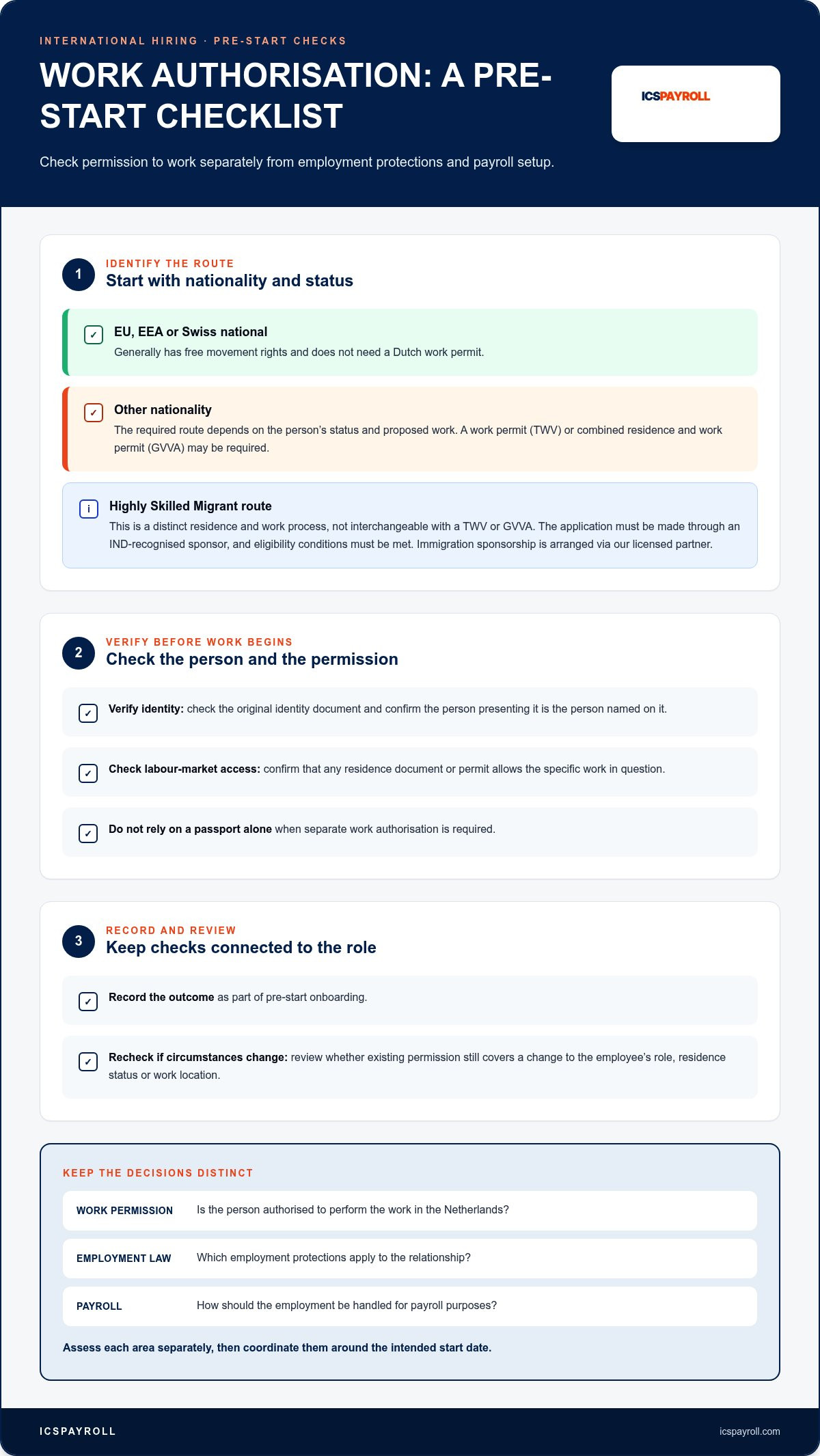
Start with nationality, residence documentation and labour-market access. Nationals of EU and EEA countries and Switzerland generally have free movement rights and don’t need a Dutch work permit. For other nationalities, the applicable route depends on the person’s status and proposed work. A permit may be required, such as a work permit (TWV) or a combined residence and work permit (GVVA). Use the Netherlands Labour Authority’s guidance on foreign nationals working in the Netherlands and current IND work-permit guidance to identify the route for the individual case.
Before work begins, establish and verify the worker’s identity. Check the original identity document and confirm that the person presenting it is the person named on it. Also check that any residence document or permit allows the work in question. A passport alone doesn’t establish labour-market access when separate authorisation is required.
Record the outcome of these checks as part of pre-start onboarding. If the employee’s role, residence status or work location changes, review whether the existing permission still covers the new arrangement. This keeps immigration checks connected to employment administration without confusing the two.
How is a Highly Skilled Migrant application different?
The Highly Skilled Migrant route is a distinct residence and work process for eligible international staff. It isn’t interchangeable with a TWV or GVVA route. The application must be made through an IND-recognised sponsor, and the applicable eligibility conditions must be met. For the 2026 route and current requirements, consult the IND’s Highly Skilled Migrant guidance.
For this route, immigration sponsorship is arranged via our licensed partner. ICSPayroll facilitates Highly Skilled Migrant applications, which are typically processed and granted in approximately three weeks. This is an indicative timeframe, not a guaranteed decision or processing period. The employee must not begin work until the required authorisation is in place.
Keep the immigration file separate from employment terms and tax decisions. In particular, IND sponsorship doesn’t determine eligibility for the 30% ruling, which is a separate tax process decided by the Belastingdienst. For employers coordinating Dutch hiring and local administration, an Employer of Record arrangement for Dutch employment can bring employment documentation and payroll administration together while immigration sponsorship is arranged through the licensed partner.
Dutch Employment Contracts, Pay and Protections for Foreign Employees
Once the role and start date are agreed, document the employment terms to reflect the work actually being performed in the Netherlands. A foreign employer’s standard contract can be a starting point, but check it against mandatory Dutch requirements. Immigration authorisation doesn’t replace the employer’s responsibility to provide compliant terms and protections.
Which employment terms should the contract set out?
A clear Dutch employment contract records the employee’s role, pay, working hours, start date, contract duration and applicable employment conditions. State whether the agreement is fixed-term or indefinite, and set out relevant arrangements such as leave, holiday allowance and any probation period. Employers must also provide required employment information in writing within the applicable statutory deadlines. Establish a process to provide and retain the full written record, including particulars that may be due after work begins.
Equal-treatment requirements apply regardless of nationality. Apply the same relevant employment standards to foreign and Dutch employees, including fair treatment in pay and working conditions. Contract terms should also match the actual arrangement. A clause that conflicts with working practice can create uncertainty rather than resolve it.
What pay and leave protections should employers account for?
For employees aged 21 and over, the statutory minimum wage in 2026 is €14.71 per hour from 1 January and €14.99 per hour from 1 July. Apply the rate that covers the period worked, and check the employee’s age and hours when calculating pay. These rates are statutory floors, not suggested salary levels for every role.
Holiday allowance is 8% of gross salary. Statutory paid vacation is at least four times the employee’s weekly working hours per year. For someone working 40 hours a week, that is 160 hours, or 20 days if each day is eight hours. Twenty-five days is common market practice, but it isn’t the statutory minimum. Keep the legal entitlement distinct from any more generous contractual or workplace policy.
How do contract duration and probation affect the agreement?
A fixed-term contract ends on its agreed end date, while an indefinite contract has no predetermined end date. In 2026, the chain rule generally allows up to three consecutive temporary contracts over 36 months before an indefinite contract is required. Track renewals and service periods rather than treating each new document as an unrelated agreement.
Probation must be agreed in writing and comply with the contract’s duration: it is two months for an indefinite contract, one month for a fixed-term contract lasting six to 24 months, and not permitted for a contract of six months or less, as set out in Article 7:652 of the Dutch Civil Code. Reviewing these terms before signature helps align the contract, payroll setup and working arrangement from day one.
Ongoing Dutch Compliance for International Employers in 2026
Compliance continues after the employee starts. Connect onboarding records, payroll, absence management and contract-end administration, and assign clear ownership for each task. For international employers, documenting the workflow helps keep Dutch employment requirements aligned with payroll operations.
- Maintain onboarding records. Keep signed employment terms and relevant employee and payroll information together. Restrict access appropriately and update the file when important employment details change.
- Run payroll and file on time. Submit payroll tax returns by the last day of the month following the relevant payroll period. Keep payroll records for seven years. The Belastingdienst guidance on payroll tax returns and records explains the employer’s filing and administration requirements.
- Manage absence promptly. Record sickness absence and start the required reintegration process. Wage payment and reintegration are separate employer duties, and neither replaces the other.
- Monitor contract changes and deadlines. Track renewals, changes to working arrangements and relevant end dates so payroll and employee records remain accurate.
- Close employment correctly. Review final pay, outstanding entitlements and any transition payment due when employment ends.
What must employers manage during employment and sickness?
Under Article 7:629 of the Dutch Civil Code, statutory sick pay is 70% of salary for up to 104 weeks, with a minimum-wage floor in the first year. This wage-payment obligation is separate from reintegration under the Gatekeeper Improvement Act (Wet verbetering poortwachter). Reintegration includes an analysis around week six, an action plan around week eight and, where required, a second-track process. Failure to meet obligations can lead to a UWV sanction extending into a third year. See UWV guidance for employers on sickness and reintegration.
A transition payment accrues from the first day of employment, including during probation. In 2026, its maximum is €102,000, or one year’s gross salary if that amount is higher. Apply the relevant rules when employment ends, including after long-term sickness. The official transition payment guidance explains the entitlement and calculation.
Which 2026 legal developments are not yet current law?
Keep proposed changes out of current policies until they take effect. The Senate passed the stripped VBAR bill on 16 June 2026. It retains a legal presumption of employment below €38 per hour, but commencement remains pending. The non-compete reform is also a bill, not current law. Check the Dutch Senate’s legislative information for status updates.
The Wtta takes effect on 1 January 2027, with enforcement from 1 January 2028. It concerns the admission of temporary-work providers, not equal-pay rules. Accurate payroll and absence administration are part of the same compliance system. Explore Dutch payroll administration support as part of your ongoing process.
How an Employer of Record Can Simplify Dutch Hiring
An Employer of Record (EOR) can provide a practical way to employ staff in the Netherlands when an international company doesn’t yet have a Dutch entity. The model brings local employment documentation and administration together with payroll processing, while the client focuses on the employee’s role and day-to-day work. It doesn’t remove statutory employee protections or work-authorisation requirements.
When can a Netherlands EOR be useful to a foreign employer?
A Netherlands EOR can support hiring before a Dutch BV is established or when the employer chooses to operate without one. A Dutch BV is a Dutch resident taxpayer, not a Permanent Establishment. The EOR provides a local employment and administration model for the Dutch hire. The employment relationship must still be documented properly, and applicable Dutch protections continue to apply.
Payroll administration involves more than calculating gross salary. Employers need to account for Dutch payroll tax and applicable employer social-security and insurance contributions, alongside accurate employee records and timely filings. An EOR can coordinate these local administration tasks as part of the employment process, reducing the number of separate steps an overseas employer needs to manage directly while keeping the underlying obligations clear.
The service scope is Dutch employment administration. It doesn’t include recruitment or talent sourcing, or employing staff in other countries through a global EOR model. This distinction helps international employers match the arrangement to a Dutch hire without confusing local employment support with finding candidates or managing employment abroad.
What support can ICSPayroll provide for international hires?
ICSPayroll’s Netherlands EOR service combines local employment documentation with payroll administration. A tailored quotation is provided within 24 hours of receiving employee details, and the service agreement and employment contract can be prepared within days. These are process timelines, not a guarantee of a start date or immigration decision.
Immigration sponsorship is arranged via our licensed partner where required. This is separate from EOR employment administration. Assistance with a 30% ruling application is also a distinct tax process for eligible employees, not an immigration outcome. Keeping each workstream clear helps employers plan the hire without treating one approval or service as a substitute for another.
The payroll-factor model consolidates employment costs into a single monthly invoice. The factor incorporates holiday allowance, pension, sickness risk coverage, social security and employer premiums, transition allowance, HR administration, online portal access, 30% ruling assistance where applicable, and sick-leave support. This provides one recurring billing point for employment costs while payroll administration handles Dutch calculations and processing. It doesn’t change the employee’s rights or remove the need for accurate employment information.
For businesses applying Dutch employment law for foreign employees, an EOR connects local employment documentation and payroll administration in one operating model. Hire in the Netherlands with confidence with Dutch employment administration, payroll and any separate immigration steps clearly coordinated.
Build a Reliable Framework for Your Next Dutch Hire
Make the next step operational: assign an owner to each hiring decision, define when internal review is needed and record the reasoning behind the employment arrangement. This structure helps your team act consistently as roles, working patterns or business needs change. It also makes Dutch employment law for foreign employees part of workforce planning, rather than a one-off research task.
As your Dutch team grows, use each hire to improve the process. Review what caused delays or uncertainty, update internal guidance and make sure decision-makers know when to revisit an arrangement. A clear framework supports confident hiring and keeps responsibility for employment decisions visible. Plan your Dutch hiring approach with ICSPayroll for support with local employment and payroll administration.
Frequently Asked Questions
Do foreign employees have the same employment rights in the Netherlands as Dutch employees?
Generally, foreign employees working in the Netherlands receive mandatory Dutch employment protections on the same basis as Dutch employees. The specific rules can depend on the work arrangement, applicable contract terms and individual circumstances, so nationality alone doesn’t determine the answer. Keep employment rights separate from immigration permission and tax treatment. A worker may need authorisation to work and still be entitled to Dutch protections.
Can a foreign employee work in the Netherlands without a work permit?
Yes, some can. EU and EEA nationals and Swiss nationals generally don’t need a Dutch work permit. Other foreign nationals may need a work permit or a combined residence and work permit, depending on their residence status and access to the labour market. A Dutch residence document doesn’t automatically grant permission for every kind of work. Confirm the individual’s work rights before their first working day.
What documents must an employer check before hiring a foreign worker in the Netherlands?
Check the worker’s identity document and establish whether their nationality or residence status gives them access to the Dutch labour market. If they’re not entitled to work freely, review the relevant work permit, combined permit or residence-document endorsement for any work restrictions. Make sure the documents relate to the person starting the job and cover the proposed employment. The required evidence depends on the worker’s route, so make the checks status-specific.
How quickly can a Highly Skilled Migrant application be processed?
Highly Skilled Migrant applications facilitated by ICSPayroll are typically processed and granted in approximately three weeks. This is an indicative timeframe, not a guaranteed outcome or a universal IND processing standard. The application must follow the correct route and meet its requirements. Set the employee’s start date around the necessary authorisation rather than assuming an application will be decided by a particular date.
Does an IND sponsor arrangement automatically qualify an employee for the 30% ruling?
No. Immigration sponsorship and the 30% ruling are separate processes. The ruling is a tax decision made by the Belastingdienst, and sponsorship doesn’t establish eligibility. Among other conditions, the employee must have been recruited from abroad, have lived more than 150 km from the Dutch border for 16 of the 24 months before starting, be subject to Dutch payroll tax withholding and meet the applicable taxable-salary requirement. A written Belastingdienst decision is required.
What is the minimum wage in the Netherlands in 2026?
For employees aged 21 and over, the statutory minimum wage is €14.71 per hour from 1 January 2026 and €14.99 per hour from 1 July 2026. Apply the rate in force during the period worked and check the employee’s age when assessing the applicable minimum. These are hourly amounts, so calculate pay against the employee’s working hours and the relevant rate period.
Can an international company hire employees in the Netherlands before setting up a Dutch BV?
Yes. An international company can use a Netherlands Employer of Record arrangement to employ staff before establishing a Dutch BV, or without setting one up for that hire. The EOR acts as the local employer and handles employment and payroll administration. This provides an employment route, not an exemption from employee protections or applicable work-authorisation requirements.

Article by
Joost Hubregtse
Joost Hubregtse is Director of ICS Staffing & Payroll B.V., the wholly owned subsidiary of Intercompany Solutions behind ICS Payroll. He is responsible for Employer of Record and Dutch payroll services: employment contracts, wage tax and social security filings, holiday allowance, pension, sick leave and CAO compliance, with onboarding possible within 48 hours.
Frequently Asked Questions
For cross-border employment contracts, the Rome I Regulation generally points to the country where, or from which, the employee habitually carries out their work. A temporary assignment abroad doesn’t automatically change that habitual work location. The parties may choose the law governing the contract, but that choice can’t remove protections the employee would receive under the law that would apply without the choice. See Article 8 of the Rome I Regulation on individual employment contracts. For example, if an employee normally works in the Netherlands for an overseas employer, choosing another country’s law in the contract may not exclude mandatory Dutch protections. The answer depends on the facts, including the actual work pattern and whether an overseas assignment is temporary. Review how the role operates in practice, not just the employer’s registered location or the contract’s governing-law clause.
Start with nationality, residence documentation and labour-market access. Nationals of EU and EEA countries and Switzerland generally have free movement rights and don’t need a Dutch work permit. For other nationalities, the applicable route depends on the person’s status and proposed work. A permit may be required, such as a work permit (TWV) or a combined residence and work permit (GVVA). Use the Netherlands Labour Authority’s guidance on foreign nationals working in the Netherlands and current IND work-permit guidance to identify the route for the individual case. Before work begins, establish and verify the worker’s identity. Check the original identity document and confirm that the person presenting it is the person named on it. Also check that any residence document or permit allows the work in question. A passport alone doesn’t establish labour-market access when separate authorisation is required. Record the outcome of these checks as part of pre-start onboarding. If the employee’s role, residence status or work location changes, review whether the existing permission still covers the new arrangement. This keeps immigration checks connected to employment administration without confusing the two.
The Highly Skilled Migrant route is a distinct residence and work process for eligible international staff. It isn’t interchangeable with a TWV or GVVA route. The application must be made through an IND-recognised sponsor, and the applicable eligibility conditions must be met. For the 2026 route and current requirements, consult the IND’s Highly Skilled Migrant guidance. For this route, immigration sponsorship is arranged via our licensed partner. ICSPayroll facilitates Highly Skilled Migrant applications, which are typically processed and granted in approximately three weeks. This is an indicative timeframe, not a guaranteed decision or processing period. The employee must not begin work until the required authorisation is in place. Keep the immigration file separate from employment terms and tax decisions. In particular, IND sponsorship doesn’t determine eligibility for the 30% ruling, which is a separate tax process decided by the Belastingdienst. For employers coordinating Dutch hiring and local administration, an Employer of Record arrangement for Dutch employment can bring employment documentation and payroll administration together while immigration sponsorship is arranged through the licensed partner. Once the role and start date are agreed, document the employment terms to reflect the work actually being performed in the Netherlands. A foreign employer’s standard contract can be a starting point, but check it against mandatory Dutch requirements. Immigration authorisation doesn’t replace the employer’s responsibility to provide compliant terms and protections.
A clear Dutch employment contract records the employee’s role, pay, working hours, start date, contract duration and applicable employment conditions. State whether the agreement is fixed-term or indefinite, and set out relevant arrangements such as leave, holiday allowance and any probation period. Employers must also provide required employment information in writing within the applicable statutory deadlines. Establish a process to provide and retain the full written record, including particulars that may be due after work begins. Equal-treatment requirements apply regardless of nationality. Apply the same relevant employment standards to foreign and Dutch employees, including fair treatment in pay and working conditions. Contract terms should also match the actual arrangement. A clause that conflicts with working practice can create uncertainty rather than resolve it.
For employees aged 21 and over, the statutory minimum wage in 2026 is €14.71 per hour from 1 January and €14.99 per hour from 1 July. Apply the rate that covers the period worked, and check the employee’s age and hours when calculating pay. These rates are statutory floors, not suggested salary levels for every role. Holiday allowance is 8% of gross salary. Statutory paid vacation is at least four times the employee’s weekly working hours per year. For someone working 40 hours a week, that is 160 hours, or 20 days if each day is eight hours. Twenty-five days is common market practice, but it isn’t the statutory minimum. Keep the legal entitlement distinct from any more generous contractual or workplace policy.
A fixed-term contract ends on its agreed end date, while an indefinite contract has no predetermined end date. In 2026, the chain rule generally allows up to three consecutive temporary contracts over 36 months before an indefinite contract is required. Track renewals and service periods rather than treating each new document as an unrelated agreement. Probation must be agreed in writing and comply with the contract’s duration: it is two months for an indefinite contract, one month for a fixed-term contract lasting six to 24 months, and not permitted for a contract of six months or less, as set out in Article 7:652 of the Dutch Civil Code. Reviewing these terms before signature helps align the contract, payroll setup and working arrangement from day one. Compliance continues after the employee starts. Connect onboarding records, payroll, absence management and contract-end administration, and assign clear ownership for each task. For international employers, documenting the workflow helps keep Dutch employment requirements aligned with payroll operations.
Under Article 7:629 of the Dutch Civil Code, statutory sick pay is 70% of salary for up to 104 weeks, with a minimum-wage floor in the first year. This wage-payment obligation is separate from reintegration under the Gatekeeper Improvement Act (Wet verbetering poortwachter). Reintegration includes an analysis around week six, an action plan around week eight and, where required, a second-track process. Failure to meet obligations can lead to a UWV sanction extending into a third year. See UWV guidance for employers on sickness and reintegration. A transition payment accrues from the first day of employment, including during probation. In 2026, its maximum is €102,000, or one year’s gross salary if that amount is higher. Apply the relevant rules when employment ends, including after long-term sickness. The official transition payment guidance explains the entitlement and calculation.
Keep proposed changes out of current policies until they take effect. The Senate passed the stripped VBAR bill on 16 June 2026. It retains a legal presumption of employment below €38 per hour, but commencement remains pending. The non-compete reform is also a bill, not current law. Check the Dutch Senate’s legislative information for status updates. The Wtta takes effect on 1 January 2027, with enforcement from 1 January 2028. It concerns the admission of temporary-work providers, not equal-pay rules. Accurate payroll and absence administration are part of the same compliance system. Explore Dutch payroll administration support as part of your ongoing process. An Employer of Record (EOR) can provide a practical way to employ staff in the Netherlands when an international company doesn’t yet have a Dutch entity. The model brings local employment documentation and administration together with payroll processing, while the client focuses on the employee’s role and day-to-day work. It doesn’t remove statutory employee protections or work-authorisation requirements.
A Netherlands EOR can support hiring before a Dutch BV is established or when the employer chooses to operate without one. A Dutch BV is a Dutch resident taxpayer, not a Permanent Establishment. The EOR provides a local employment and administration model for the Dutch hire. The employment relationship must still be documented properly, and applicable Dutch protections continue to apply. Payroll administration involves more than calculating gross salary. Employers need to account for Dutch payroll tax and applicable employer social-security and insurance contributions, alongside accurate employee records and timely filings. An EOR can coordinate these local administration tasks as part of the employment process, reducing the number of separate steps an overseas employer needs to manage directly while keeping the underlying obligations clear. The service scope is Dutch employment administration. It doesn’t include recruitment or talent sourcing, or employing staff in other countries through a global EOR model. This distinction helps international employers match the arrangement to a Dutch hire without confusing local employment support with finding candidates or managing employment abroad.
ICSPayroll’s Netherlands EOR service combines local employment documentation with payroll administration. A tailored quotation is provided within 24 hours of receiving employee details, and the service agreement and employment contract can be prepared within days. These are process timelines, not a guarantee of a start date or immigration decision. Immigration sponsorship is arranged via our licensed partner where required. This is separate from EOR employment administration. Assistance with a 30% ruling application is also a distinct tax process for eligible employees, not an immigration outcome. Keeping each workstream clear helps employers plan the hire without treating one approval or service as a substitute for another. The payroll-factor model consolidates employment costs into a single monthly invoice. The factor incorporates holiday allowance, pension, sickness risk coverage, social security and employer premiums, transition allowance, HR administration, online portal access, 30% ruling assistance where applicable, and sick-leave support. This provides one recurring billing point for employment costs while payroll administration handles Dutch calculations and processing. It doesn’t change the employee’s rights or remove the need for accurate employment information. For businesses applying Dutch employment law for foreign employees, an EOR connects local employment documentation and payroll administration in one operating model. Hire in the Netherlands with confidence with Dutch employment administration, payroll and any separate immigration steps clearly coordinated. Make the next step operational: assign an owner to each hiring decision, define when internal review is needed and record the reasoning behind the employment arrangement. This structure helps your team act consistently as roles, working patterns or business needs change. It also makes Dutch employment law for foreign employees part of workforce planning, rather than a one-off research task. As your Dutch team grows, use each hire to improve the process. Review what caused delays or uncertainty, update internal guidance and make sure decision-makers know when to revisit an arrangement. A clear framework supports confident hiring and keeps responsibility for employment decisions visible. Plan your Dutch hiring approach with ICSPayroll for support with local employment and payroll administration.
Generally, foreign employees working in the Netherlands receive mandatory Dutch employment protections on the same basis as Dutch employees. The specific rules can depend on the work arrangement, applicable contract terms and individual circumstances, so nationality alone doesn’t determine the answer. Keep employment rights separate from immigration permission and tax treatment. A worker may need authorisation to work and still be entitled to Dutch protections.
Yes, some can. EU and EEA nationals and Swiss nationals generally don’t need a Dutch work permit. Other foreign nationals may need a work permit or a combined residence and work permit, depending on their residence status and access to the labour market. A Dutch residence document doesn’t automatically grant permission for every kind of work. Confirm the individual’s work rights before their first working day.
Check the worker’s identity document and establish whether their nationality or residence status gives them access to the Dutch labour market. If they’re not entitled to work freely, review the relevant work permit, combined permit or residence-document endorsement for any work restrictions. Make sure the documents relate to the person starting the job and cover the proposed employment. The required evidence depends on the worker’s route, so make the checks status-specific.
Highly Skilled Migrant applications facilitated by ICSPayroll are typically processed and granted in approximately three weeks. This is an indicative timeframe, not a guaranteed outcome or a universal IND processing standard. The application must follow the correct route and meet its requirements. Set the employee’s start date around the necessary authorisation rather than assuming an application will be decided by a particular date.
No. Immigration sponsorship and the 30% ruling are separate processes. The ruling is a tax decision made by the Belastingdienst, and sponsorship doesn’t establish eligibility. Among other conditions, the employee must have been recruited from abroad, have lived more than 150 km from the Dutch border for 16 of the 24 months before starting, be subject to Dutch payroll tax withholding and meet the applicable taxable-salary requirement. A written Belastingdienst decision is required.
For employees aged 21 and over, the statutory minimum wage is €14.71 per hour from 1 January 2026 and €14.99 per hour from 1 July 2026. Apply the rate in force during the period worked and check the employee’s age when assessing the applicable minimum. These are hourly amounts, so calculate pay against the employee’s working hours and the relevant rate period.
Yes. An international company can use a Netherlands Employer of Record arrangement to employ staff before establishing a Dutch BV, or without setting one up for that hire. The EOR acts as the local employer and handles employment and payroll administration. This provides an employment route, not an exemption from employee protections or applicable work-authorisation requirements.