
How to Offer Competitive Benefits in the Netherlands in 2026
By Joost Hubregtse, Director, ICS Staffing & Payroll
All blog posts are reviewed and fact checked by our labour law lawyer Zishan Hussain and our director. Editorial standards
A benefits package can undermine trust if it offers attractive extras but overlooks Dutch employment obligations. For international employers, understanding how to offer competitive benefits in the Netherlands starts with separating the legal baseline from the choices that help attract and retain employees.
It’s understandable to balance employee expectations, predictable costs and the details of Dutch payroll compliance. A strong package doesn’t need every possible perk. It should meet applicable requirements, make additional benefits clear and reflect what employees value.
This article explains how to distinguish statutory employment terms from optional benefits, assess options against employee needs, and administer the package transparently. With a clear structure, employers can make benefits easier to understand and manage while building a competitive offer in the Netherlands.
By Joost Hubregtse, Payroll Director.
Joost Hubregtse is Payroll Director at ICSPayroll, the Dutch payroll and EOR specialist of Intercompany Solutions. A career payroll specialist and former Head of Payroll, he oversees wage tax filings, 30% ruling applications, and employment compliance for international employers.
Reviewed by Joost Hubregtse, Payroll Director, on 12 October 2026.
Key Takeaways
- Build your benefits package on a compliant foundation, then distinguish required employment terms from optional additions employees may value.
- To decide how to offer competitive benefits in the Netherlands, assess workforce priorities by role, career stage, family circumstances and international-hire status.
- Compare each benefit by the need it addresses, who is eligible, how it will be administered and how its costs will appear in payroll.
- Use a consistent rollout process to document policies, payroll setup, enrollment, changes and employee questions.
- Understand how Dutch payroll and EOR administration can support benefits such as holiday allowance, pension, sickness risk coverage and transition allowance management.
How competitive employee benefits in the Netherlands begin with the legal baseline
A competitive package has two layers: employment terms employers are required to provide and additional benefits chosen to support recruitment, retention or employee wellbeing. The first layer establishes a compliant starting point. The second is where employers can respond to what their workforce values. Keeping the two distinct makes offers clearer and payroll administration easier to manage.
This section is a planning guide, not individualized legal or tax advice. Dutch requirements can depend on the employment arrangement and applicable rules. Use official guidance to understand the baseline, and assess specific circumstances before setting or changing employment terms.
Which Dutch employment terms form the starting point?
Start by checking the core terms that affect pay and leave. In 2026, the statutory minimum wage for employees aged 21 and over is €14.99 gross per hour from 1 July, according to Dutch government guidance on the minimum wage. Establish each employee’s applicable leave entitlement and record it accurately, rather than treating leave as an optional enhancement.
Holiday allowance is a distinct employment term, not an optional perk. The minimum is 8% of gross annual salary, subject to the applicable rules. Show it separately from base pay in your offer and explain how it is handled. The government’s holiday allowance guidance sets out the general requirement.
These examples are a starting point, not a complete legal checklist. The applicable employment terms may also be affected by the contract and any relevant collective arrangements. Keep employment documentation, payroll setup and employee communications aligned. This gives decision-makers a clearer view of the obligations to account for before choosing additional benefits.
Why statutory compliance is not the same as a competitive package
Meeting legal obligations is essential, but it doesn’t automatically make an offer stand out. Required employment terms are the core package, not an extra discretionary reward. A supplementary pension contribution, additional leave or a development budget may add value, but only if it addresses a need that matters to employees and fits the role.
Statutory terms set the minimum standard; optional benefits distinguish your offer when they meet employees’ needs.
For example, one team may value flexibility, while another may place greater importance on long-term financial planning. Assess additions against workforce needs, eligibility, total cost and administrative capacity instead of choosing them simply because they appear on a generic list. That distinction is central to how to offer competitive benefits in the Netherlands: establish the compliant foundation first, then make deliberate choices about what to add.
How to choose Dutch employee benefits around workforce needs
Once the legal baseline is clear, choose additional benefits by identifying the needs they should meet. A package designed around assumptions can spend budget on options employees rarely use while overlooking practical support that matters to particular teams. A structured assessment helps you make choices that are relevant, accessible and manageable.
Assess employee priorities before selecting benefits
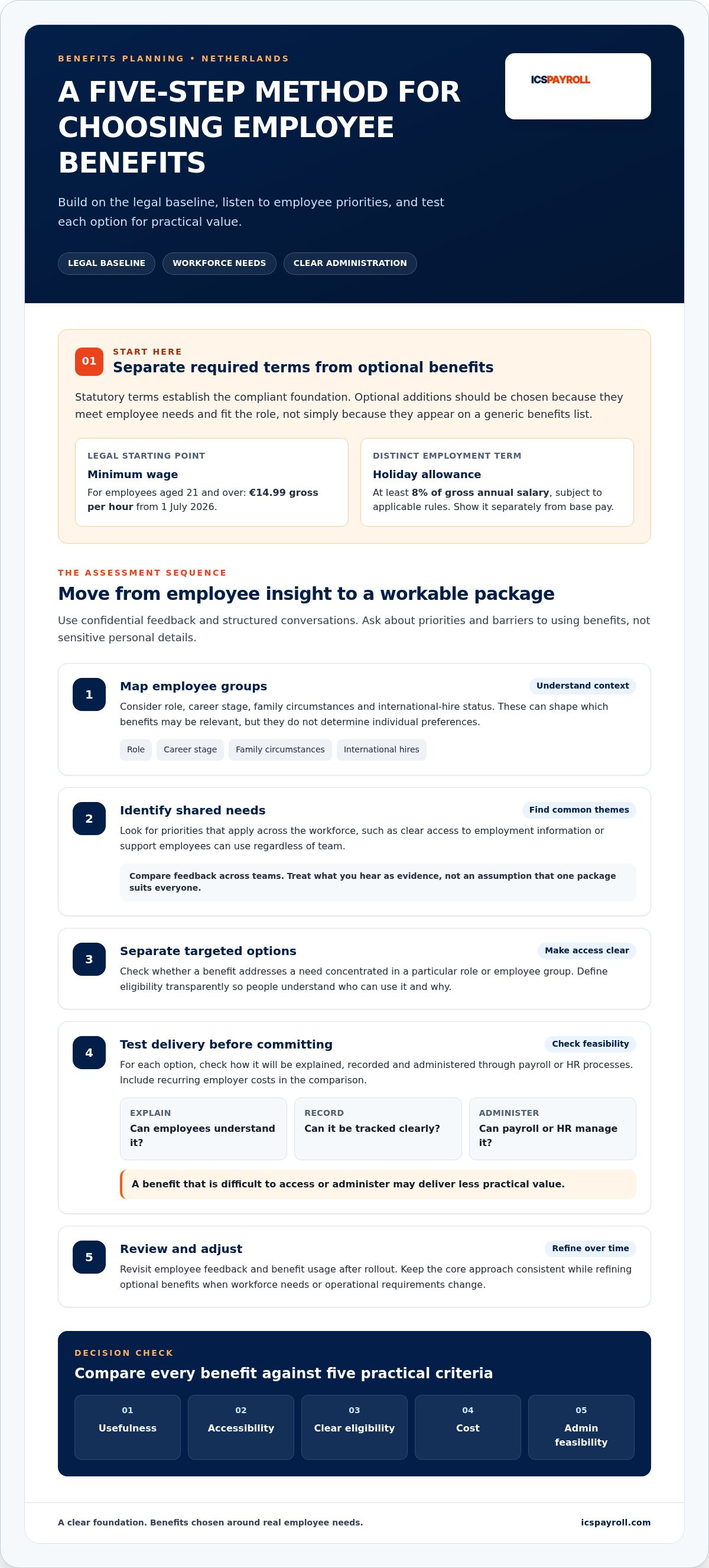
Use confidential employee feedback and structured onboarding conversations to learn what people value. Ask about priorities and barriers to using benefits, not sensitive personal details. Compare responses across teams, and treat feedback as evidence rather than assuming one package will suit everyone. Set decision criteria before comparing options: usefulness, accessibility, clarity of eligibility, cost and administrative feasibility.
Follow a consistent sequence:
- Map employee groups. Consider role, career stage, family circumstances and whether employees are internationally hired. These factors can affect which benefits are relevant, but they do not determine an individual’s preferences.
- Identify common needs. Look for themes that apply across the workforce, such as clear access to employment information or support employees can use regardless of team.
- Separate targeted options. Consider whether a benefit addresses a need concentrated in a particular role or employee group. Define eligibility transparently so employees understand who can use it and why.
- Test delivery before committing. Check how each option will be explained, recorded and administered through payroll or HR processes. Include any recurring employer costs in your comparison. A benefit that is difficult to access or administer may deliver less practical value.
- Review and adjust. Revisit feedback and usage after rollout. Keep the core approach consistent while refining optional benefits when workforce needs or operational requirements change.
For instance, employees at different career stages may place different emphasis on time off, development or longer-term financial planning. International hires may also need clear explanations of Dutch employment terms and payroll documents. These are prompts for consultation, not substitutes for asking employees directly. The Dutch Employment & Labour Laws and Regulations guide provides a deeper legal reference. Employers should also consider how employment terms will be documented and processed through Dutch payroll.
Treat tax advantages as conditional, not guaranteed benefits
A tax facility should not be presented as a guaranteed part of every international hire’s package. Assistance with the 30% ruling applies only to employees who meet the conditions, and the Belastingdienst makes the decision. Eligibility is not automatic. For rulings first granted from 2024, the rate changes to 27% from 1 January 2027; explain this timing when discussing future compensation. Consult the dedicated 30% ruling guide for current criteria and 2026 changes.
A needs-led benefits approach works best when choices are paired with reliable Dutch payroll administration. Employers can explore payroll administration support when planning how benefits will be managed and communicated. This connects workforce feedback to a package employees can understand and the business can administer consistently.
How to compare benefit options without relying on generic market claims
After identifying workforce priorities, compare specific options against the same criteria. Avoid claims that a benefit is popular or standard unless you have relevant evidence from your own workforce. A structured comparison makes trade-offs visible and helps decision-makers distinguish employee value from the effort and cost of providing it.
Compare benefits by value, access, and administration
Assess each option by the need it addresses, who can use it, how employees access it, what it costs and what it takes to administer. Include payroll treatment and communication from the start. A benefit that sounds valuable may have limited practical impact if eligibility is unclear, employees cannot access it easily, or the process creates avoidable administration.
Use a matrix like this as a working document. The examples are prompts, not recommendations for every employer:
Option: Cash compensation
- Purpose: Increase direct compensation through salary or a bonus.
- Employee group and eligibility: Define which roles or performance conditions apply, and explain the rules consistently.
- Administration: Confirm how the payment is approved, recorded and processed through payroll.
- Communication: State whether the amount is fixed, variable or conditional, and when employees can expect it.
Option: Employment benefit
- Purpose: Address a specific need, such as retirement provision, additional leave or professional development.
- Employee group and eligibility: Identify whether it is available broadly or applies only to a defined group, with a clear rationale.
- Administration: Document enrollment, changes and the records needed to manage the benefit.
- Communication: Explain what the benefit provides, how to access it and any relevant conditions.
Option: Administrative service
- Purpose: Make employment information or processes easier to manage, rather than provide extra compensation.
- Employee group and eligibility: Identify who uses the service and what information or support it covers.
- Administration: Assign responsibility for maintaining accurate records and handling requests.
- Communication: Tell employees where to find information and how to follow the process.
Make trade-offs clear to decision-makers
Review the completed matrix side by side. Mark each option as addressing a broad workforce need or a defined circumstance, and note unresolved questions instead of assigning unsupported scores. This lets leaders compare practical value, access, cost and operational demands without implying that every benefit serves the same purpose.
For example, an option available to most employees may support consistency, while a targeted option may address a clearly identified need for one group. Neither is automatically better. Document why eligibility differs, how comparable employees are treated and what managers should say when explaining the offer.
A benefit’s value depends on how well it fits employee needs and how clearly people can access it. That principle keeps the comparison grounded in evidence from your workforce rather than generic market claims. It also gives employers a practical basis for deciding how to offer competitive benefits in the Netherlands while keeping compensation, employment benefits and administrative services distinct.
How to implement and communicate a competitive benefits package
A well-chosen benefit only works if employees understand it and the business can administer it accurately. Set a clear process before announcing the package. Turn each decision into written terms, payroll instructions, accessible employee information and a review plan.
Set up clear policies, records, and employee information
Write down what each benefit provides, who is eligible, how employees access it and any relevant limits or conditions. Use consistent language across contracts, policy documents and internal communications. If eligibility differs between employee groups, explain the criteria and apply them consistently to comparable roles.
Use this rollout sequence to move from policy decisions to employee communication:
- Confirm the policy. Record the benefit, its purpose, eligibility criteria, enrollment steps and the process for changes or questions.
- Prepare payroll and HR administration. Translate the policy into clear instructions for the people responsible for processing pay and maintaining employment records. Specify what information is needed and when changes take effect.
- Check the employee record. Make sure the relevant contract or employment documentation reflects the agreed terms, and that payroll records match the policy. Keep a record of enrollment, eligibility decisions and updates.
- Publish employee guidance. Explain the benefit in plain English, including where to find details, how to enroll or request a change, and whom to approach with questions.
- Confirm access before launch. Check that employees can locate the information and understand the steps. Resolve gaps before relying on the policy as the main source of guidance.
Accessible records matter. Employees should be able to find essential employment information, including payslips, contracts and holiday balances, without piecing details together from scattered messages. An online employee portal can make these records easier to access. For employers, consistent documentation helps connect a policy change to accurate payroll processing and a reliable record of what was communicated.
Review whether the package works as intended
Set a regular review point and use the same measures each time. Track recurring employee questions, enrollment or usage where relevant, and feedback about access or clarity. Low uptake does not automatically mean a benefit lacks value; employees may not know it exists or may find the process difficult. Investigate the cause before deciding whether to revise it.
Revisit the package when workforce composition, roles or business requirements change. Keep a record of the decision, the effective date and any employee communication so that policy, payroll setup and employment records stay aligned. When planning how a benefit will appear in payroll, confirm the process and responsibilities in advance.
A disciplined rollout supports transparency, but it cannot guarantee recruitment or retention outcomes. If your business needs support administering Dutch employment and benefits obligations, explore Dutch payroll administration support.
How ICSPayroll supports Dutch benefits and employment administration
Designing benefits is only part of the work. Each term must also be reflected in employment documentation, payroll processes and employee records. ICSPayroll’s Employer of Record (EOR) service employs staff in the Netherlands, allowing international businesses to focus on operations while local employment and benefits administration is handled as part of the arrangement.
This can suit businesses that want to hire in the Netherlands without first establishing a Dutch BV. The employment package should still be clear to employees: they need to understand what their benefits provide, how those benefits are administered and where to find their employment information.
What the documented employment support covers
ICSPayroll’s support brings together Dutch payroll administration and key employment obligations. It includes a pension scheme set at 15.2% of gross salary and holiday allowance of 8% of gross salary, alongside sickness risk coverage documented for up to two years and transition allowance management.
- Payroll and employer administration: Support includes payroll filings, employer premiums and social security administration, helping align payroll records with employment terms.
- HR and sick-leave support: HR administration and sick-leave support help employers manage employee matters through established local processes.
- Employee access: An online employee portal provides access to payslips, contracts and holiday balances, giving employees a practical place to find essential information.
- Cost visibility: The payroll-factor model consolidates employment costs into one clear monthly invoice. The factor covers items such as holiday allowance, pension, sickness risk, social security and employer premiums, transition allowance, HR administration, portal access and sick-leave support. This gives the client a single monthly overview instead of separate charges for these items.
Consolidated administration can make it easier for employers to keep agreed benefits, payroll records and employee information aligned. For employees, accessible documents help clarify what has been agreed and where to find the details. Consistent records and clear communication support both sides.
Start hiring without waiting for a Dutch BV
An international business can use the EOR model to employ staff in the Netherlands without first establishing a Dutch BV. Employment and benefits administration can then be organized through the local arrangement, while the client focuses on its business priorities.
The process begins with employee details. ICSPayroll provides a tailored quotation within 24 hours of receiving them, and prepares the service agreement and employment contract within days. These steps give the employer a defined basis for reviewing the arrangement and documenting employment terms.
For companies planning how to offer competitive benefits in the Netherlands, the practical advantage is a connection between package design and local administration. The benefits selected for employees can be supported by payroll processes, records and accessible documentation rather than remaining policy statements alone.
Request a tailored Dutch employment quotation to plan your Netherlands hiring and benefits administration.
Make your next Dutch hiring decision with confidence
The next step is to turn your benefits policy into a clear employment offer that employees can understand and your business can administer. Treat each benefit as an ongoing commitment: define who it serves, keep its terms accessible and review whether it remains relevant as your workforce changes. This gives your package room to evolve without losing clarity or consistency.
For international employers, how to offer competitive benefits in the Netherlands is an operational decision as well as a people decision. Local employment administration can connect the terms you choose with the processes and records needed to put them into practice.
ICSPayroll supports hiring and employment administration in the Netherlands. Get a tailored quotation for hiring in the Netherlands and take a practical next step toward building your team. A clear plan can make entering the Dutch market more manageable and help you move forward with confidence.
Frequently Asked Questions
Is private health insurance an employer-provided benefit in the Netherlands?
Generally, no. Employees arrange and pay for their own basic health insurance with a Dutch insurer. This is separate from the employer’s income-related healthcare contribution, which is handled through payroll. Employers may choose to offer additional health-related support, but it doesn’t replace an employee’s responsibility to arrange basic insurance. The Dutch government explains the individual requirement in its guidance on standard health insurance.
Are employer-provided benefits taxable in the Netherlands?
Some benefits are taxable, while others may qualify for an exemption or be treated under the Dutch work-related costs scheme. The correct treatment depends on the benefit and applicable conditions. Before offering one, determine how it should be recorded and processed through payroll, and explain whether it affects taxable pay. Don’t assume a benefit is tax-free simply because it’s provided in addition to salary.
Can employers offer additional pension benefits in the Netherlands?
Yes. Employers can offer a workplace pension, including benefits beyond a basic arrangement, but first establish whether a sector pension scheme or collective labour agreement applies. Those requirements can affect the pension arrangement an employer must use. Explain the employer and employee contributions, who is eligible and how participation works. A clear description helps employees distinguish pension benefits from immediate cash compensation and understand the longer-term value.
Does the 30% ruling apply automatically to international employees?
No. An employee must meet the eligibility conditions, and the ruling requires a written decision from the Belastingdienst. The employer and employee should assess eligibility and provide the required information rather than treating the tax benefit as guaranteed compensation. For example, an international hire’s recruitment circumstances and previous residence history may affect eligibility. The Belastingdienst’s 30% facility guidance explains the conditions.
Can employees receive the 30% ruling if they already live in the Netherlands?
Possibly, but living in the Netherlands now doesn’t establish eligibility by itself. The employee generally must have been recruited from abroad and have lived more than 150 kilometres from the Dutch border for at least 16 of the 24 months before starting work, alongside the other requirements. Someone recruited locally may not meet the conditions. Assess the employee’s circumstances before including the ruling in compensation calculations.
How can a company make benefits accessible to employees with different needs?
Make access clear and consistent. Explain each benefit in plain English, state who can use it, and give practical instructions for enrollment, changes and questions. Provide information in a format employees can readily find, such as a central benefits guide, and invite confidential feedback about barriers to access. Regular review can reveal whether employees understand the options and can use them as intended.
Can a company hire employees in the Netherlands before establishing a Dutch BV?
Yes. A company can use an Employer of Record arrangement in which the EOR employs staff in the Netherlands and manages local employment administration, without the client first establishing a Dutch BV. This gives an international business a route to hire while it focuses on its operations. The employment agreement identifies the employer, so ensure responsibilities and employment terms are clear to the employee from the outset.

Article by
Joost Hubregtse
Joost Hubregtse is Director of ICS Staffing & Payroll B.V., the wholly owned subsidiary of Intercompany Solutions behind ICS Payroll. He is responsible for Employer of Record and Dutch payroll services: employment contracts, wage tax and social security filings, holiday allowance, pension, sick leave and CAO compliance, with onboarding possible within 48 hours.
Frequently Asked Questions
Start by checking the core terms that affect pay and leave. In 2026, the statutory minimum wage for employees aged 21 and over is €14.99 gross per hour from 1 July, according to Dutch government guidance on the minimum wage. Establish each employee’s applicable leave entitlement and record it accurately, rather than treating leave as an optional enhancement. Holiday allowance is a distinct employment term, not an optional perk. The minimum is 8% of gross annual salary, subject to the applicable rules. Show it separately from base pay in your offer and explain how it is handled. The government’s holiday allowance guidance sets out the general requirement. These examples are a starting point, not a complete legal checklist. The applicable employment terms may also be affected by the contract and any relevant collective arrangements. Keep employment documentation, payroll setup and employee communications aligned. This gives decision-makers a clearer view of the obligations to account for before choosing additional benefits.
Generally, no. Employees arrange and pay for their own basic health insurance with a Dutch insurer. This is separate from the employer’s income-related healthcare contribution, which is handled through payroll. Employers may choose to offer additional health-related support, but it doesn’t replace an employee’s responsibility to arrange basic insurance. The Dutch government explains the individual requirement in its guidance on standard health insurance.
Some benefits are taxable, while others may qualify for an exemption or be treated under the Dutch work-related costs scheme. The correct treatment depends on the benefit and applicable conditions. Before offering one, determine how it should be recorded and processed through payroll, and explain whether it affects taxable pay. Don’t assume a benefit is tax-free simply because it’s provided in addition to salary.
Yes. Employers can offer a workplace pension, including benefits beyond a basic arrangement, but first establish whether a sector pension scheme or collective labour agreement applies. Those requirements can affect the pension arrangement an employer must use. Explain the employer and employee contributions, who is eligible and how participation works. A clear description helps employees distinguish pension benefits from immediate cash compensation and understand the longer-term value.
No. An employee must meet the eligibility conditions, and the ruling requires a written decision from the Belastingdienst. The employer and employee should assess eligibility and provide the required information rather than treating the tax benefit as guaranteed compensation. For example, an international hire’s recruitment circumstances and previous residence history may affect eligibility. The Belastingdienst’s 30% facility guidance explains the conditions.
Possibly, but living in the Netherlands now doesn’t establish eligibility by itself. The employee generally must have been recruited from abroad and have lived more than 150 kilometres from the Dutch border for at least 16 of the 24 months before starting work, alongside the other requirements. Someone recruited locally may not meet the conditions. Assess the employee’s circumstances before including the ruling in compensation calculations.
Make access clear and consistent. Explain each benefit in plain English, state who can use it, and give practical instructions for enrollment, changes and questions. Provide information in a format employees can readily find, such as a central benefits guide, and invite confidential feedback about barriers to access. Regular review can reveal whether employees understand the options and can use them as intended.
Yes. A company can use an Employer of Record arrangement in which the EOR employs staff in the Netherlands and manages local employment administration, without the client first establishing a Dutch BV. This gives an international business a route to hire while it focuses on its operations. The employment agreement identifies the employer, so ensure responsibilities and employment terms are clear to the employee from the outset.