Dutch Payroll Requirements for Employers: A 2026 Guide
By Joost Hubregtse, Director, ICS Staffing & Payroll
All blog posts are reviewed and fact checked by our labour law lawyer Zishan Hussain and our director. Editorial standards
Dutch payroll compliance is a hiring lifecycle, not a task that begins with the first payslip. The dutch payroll requirements for employers start before an employee joins and continue through payroll processing, reporting, recordkeeping and employment changes. Missing a step can create avoidable costs and disputes, particularly for companies unfamiliar with local rules.
A practical checklist helps separate established obligations from changes that are proposed or scheduled for a future date. Treating a pending measure as current law can be as problematic as overlooking a requirement already in force.
This guide covers the steps to take before and after hiring, key payroll deadlines and employer responsibilities that affect budgeting and day-to-day administration. It also distinguishes current rules from pending legislative changes and explains how Dutch payroll administration or an Employer of Record can support compliant hiring without first establishing a Dutch entity.
By Joost Hubregtse, Payroll Director. Joost Hubregtse is Payroll Director at ICSPayroll, the Dutch payroll and EOR specialist of Intercompany Solutions. A career payroll specialist and former Head of Payroll, he oversees wage tax filings, 30% ruling applications, and employment compliance for international employers.
Reviewed by Joost Hubregtse, Payroll Director, on 15 October 2026.
Key Takeaways
- Use a clear hiring-to-recordkeeping workflow to manage Dutch payroll requirements for employers before an employee’s first payday and throughout employment.
- Check the minimum hourly wage for employees aged 21 and over against the date worked, because the 2026 rate changes during the year.
- Separate rules already in force from proposed or future changes, and verify each measure’s status before changing employment practices.
- Build a monthly control for payroll data, salary payment and the loonaangifte deadline to keep recurring duties on schedule.
- Use Dutch payroll administration or an Employer of Record to organise local payroll responsibilities, including when hiring without first establishing a Dutch entity.
Dutch payroll requirements for employers begin before the first payday
Compliance starts when a company decides how a person will work, not when payroll is first processed. For employees working in the Netherlands, employers need to consider employment terms, applicable workplace rules, payroll obligations and records as connected responsibilities. This applies to local employers and international companies hiring staff to work in the Netherlands. Specific duties depend on the agreed employment terms, whether a collective labour agreement (CAO) applies and the employee’s circumstances.
Which Dutch employer obligations apply to your hire?
Start by defining the employment arrangement and documenting the terms that apply to the role. An employment contract should reflect the actual agreement, including the role, pay and working arrangements. A CAO may also set or supplement employment conditions for a sector or employer. Check whether one applies before finalising the offer. A standard contract template may not include relevant sector terms. The Dutch government’s CAO guidance explains how collective agreements can affect employment conditions.
Employee hiring and contractor engagement are different routes. A contract label alone does not determine the relationship. Record the intended arrangement and assess how the work will actually be carried out before deciding which onboarding and payment processes apply.
What changes when the employer is based abroad?
An international company still needs to address Dutch employment and payroll duties when hiring employees to work in the Netherlands. Being based elsewhere does not remove the need to establish suitable employment terms and organise local payroll administration. The Employer of Record Netherlands guide explains how an EOR can support hiring without the company first establishing a Dutch BV. Under this arrangement, the EOR acts as the legal employer for staff in the Netherlands.
Payroll involves more than transferring net salary. Employers need to organise the relevant withholding and reporting processes. For general background on the system, see Taxation in the Netherlands. Use this as context and rely on current Dutch requirements for operational decisions.
Separate statutory duties from internal practices that help prevent errors. The law sets the obligations, while a consistent process helps ensure they are met. Before the first payday, organise the employee’s agreed terms, payroll inputs and recordkeeping process. Then review the information regularly, especially when pay, working arrangements or personal circumstances change.
- Legal requirements: Identify the employment terms and any applicable CAO, then meet relevant Dutch payroll and recordkeeping duties.
- Helpful controls: Keep clear records of agreed terms, payroll changes and supporting employee information.
- International hiring: Decide how Dutch employment and payroll responsibilities will be handled before the employee starts.
The core Dutch pay, tax, and employment duties employers must manage
Once employment terms are agreed, employers need a reliable process to turn them into accurate payroll. This means calculating gross pay, applying the relevant withholding, reporting payroll information and accounting for employer-paid contributions. These steps are connected: incorrect employee details can affect both the pay calculation and the information submitted to the tax authority. The Belastingdienst payroll tax guidance outlines employer withholding and reporting responsibilities.
Use the employee’s details and agreed terms to calculate each payroll period. Keep employee deductions distinct from employer contributions in both calculations and budgeting. Reconcile the payroll inputs with approved employment terms before processing, so that changes to salary or working arrangements are not carried forward incorrectly.
Payroll reporting, payslips, and employer records
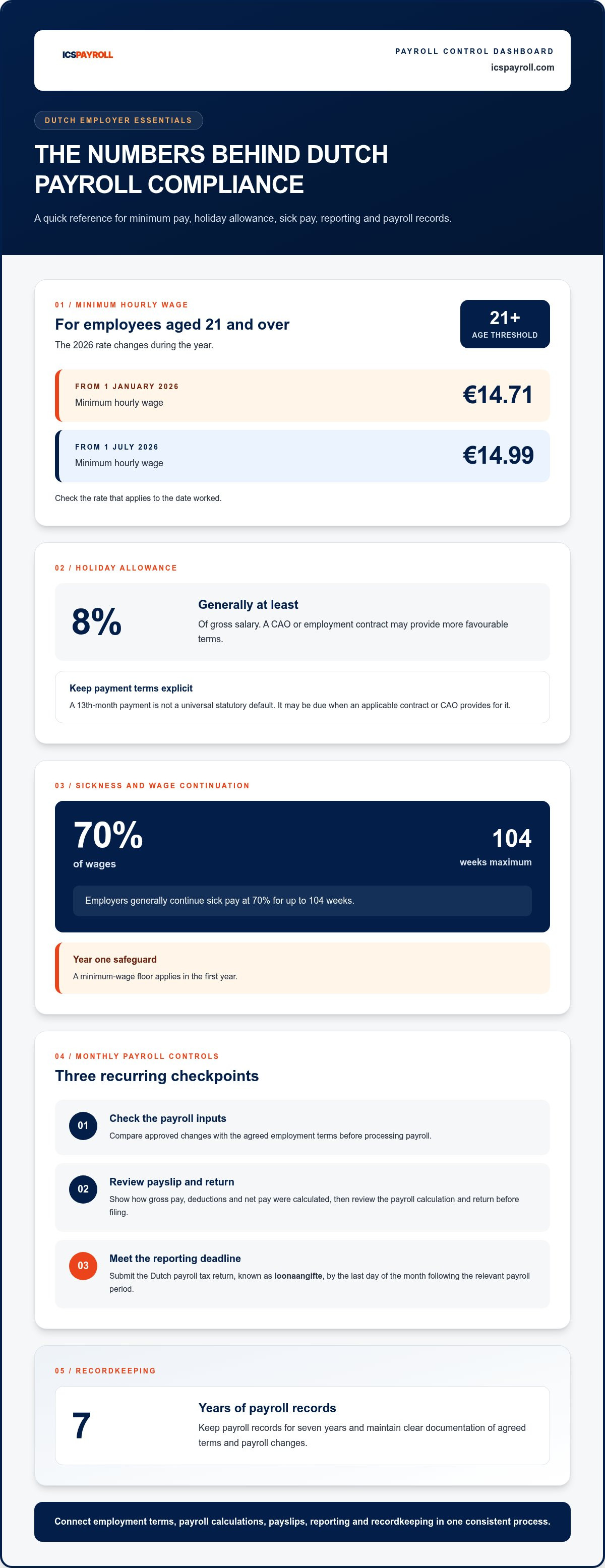
Give employees a payslip that shows how gross pay, deductions and net pay were calculated. Submit the Dutch payroll tax return, known as loonaangifte, by the last day of the month following the relevant payroll period. Keep payroll records for seven years. A monthly review should compare approved changes with the payroll calculation, payslip and return before filing. For employees aged 21 and over, the 2026 minimum hourly wage is €14.71 from 1 January and €14.99 from 1 July. Check the government’s minimum-wage guidance for the applicable rate.
Holiday allowance, sick pay, and transition payment
Holiday allowance is generally at least 8% of gross salary. A CAO or employment contract may provide more favourable terms, and any exception to the statutory minimum must be lawful. A 13th-month payment is not a universal statutory default. It may be due if an applicable contract or CAO provides for it, so set out the relevant payment basis in the employment terms and payroll records.
Sickness involves both wage continuation and reintegration responsibilities. Employers generally continue sick pay at 70% of wages for up to 104 weeks, with a minimum-wage floor in the first year. Track the payment obligation separately from the reintegration process so that each responsibility is addressed.
Include the transition payment in employment-cost planning. In 2026, the maximum is €102,000, or one year’s gross salary if higher. Accrual begins on the first day of employment, including probation. Reflect these obligations in payroll processes and consider them alongside the employee’s contract and any applicable CAO.
Consistent payroll administration helps organise calculations, filings, premiums and records. Learn about Dutch payroll administration support and how recurring tasks can be managed in a structured monthly process.
Current rules and pending Dutch employment changes are not the same
For Dutch payroll requirements for employers, a proposed rule is not an active obligation. Separate what applies now from measures with a future start date, and check their status before changing contracts, payroll processes or workforce plans. The snapshot below reflects the stated position in October 2026.
Wet DBA and VBAR: what is in force and what is pending?
The Wet DBA enforcement moratorium ended on 1 January 2025. The Belastingdienst can assess employment relationships and make assessments retroactive to that date. A soft-landing approach remains in place during 2026, but it ends on 1 January 2027. This is not an extension of the moratorium. Employers engaging freelancers should review how the working relationship operates rather than relying only on the contract label.
The VBAR bill passed the Senate in stripped form on 16 June 2026. The remaining measure is a legal presumption of employment for workers paid below €38 per hour. Its entry into force is still pending, so employers should not apply the presumption as though it were current law. The expected date is no later than 31 December 2026, but that expectation does not confirm that the measure has commenced.
Wtta: prepare for the dates without treating it as current law
The Wtta is scheduled to enter into force on 1 January 2027, with enforcement beginning on 1 January 2028. Transitional registration is scheduled for 1 November to 31 December 2026. These are future milestones, not current Wtta duties. The law concerns admission requirements for businesses supplying workers, not the source of general equal-pay rules. Employers should assess whether their staffing arrangements are affected and follow updates from the Dutch labour-market admission authority.
| Measure | Status in October 2026 | Effective date | Employer action |
|---|---|---|---|
| Wet DBA enforcement | Moratorium ended; soft landing remains during 2026 | Enforcement resumed 1 January 2025; soft landing ends 1 January 2027 | Review freelancer working arrangements and retain relevant records. |
| VBAR legal presumption | Stripped bill passed by Senate; entry into force pending | Pending, expected by 31 December 2026 | Track the commencement date; do not treat the presumption as current law. |
| Wtta | Future legislation; transitional registration dates set | In force 1 January 2027; enforcement from 1 January 2028 | Assess whether worker-supply arrangements require preparation for registration. |
Use a change log to record each measure’s status, the person responsible and the next review date. The Dutch employment law compliance guide provides further context for international employers. Recheck official updates before implementation so a future proposal is not mistaken for a rule already in force.
A practical sequence for meeting Dutch employer requirements
A repeatable process connects the employment agreement to accurate payroll and reliable records. Use the steps below for each employee, then repeat the monthly controls consistently. This turns Dutch payroll requirements for employers into an operational workflow rather than a collection of disconnected tasks.
Before the employee starts
- Confirm the employment terms. Record the agreed role, pay, working arrangements and start date. Identify whether a CAO applies and capture any relevant terms that affect pay or leave.
- Set up payroll inputs. Collect the information needed to process pay and apply the correct withholding. Make sure the payroll setup reflects the agreed salary, holiday allowance and applicable employment terms. A Dutch payroll setup guide for remote teams can help organise these steps.
- Review the working arrangement. If the person will work as a contractor rather than an employee, assess the actual working relationship and keep the reasoning and supporting documents on file. Don’t rely on the contract label alone to determine the classification.
- Check immigration needs where relevant. For a non-Schengen hire who requires immigration sponsorship, immigration sponsorship is arranged via our licensed partner. Treat this as a separate onboarding workstream alongside employment terms and payroll setup.
- Prepare employee records. Create a secure record of the signed agreement, applicable CAO terms, payroll information and approved arrangements that affect pay or leave. Assign responsibility for updating the record when details change.
Monthly and annual compliance controls
Before each payroll run, reconcile approved changes against the prior period. Check salary, deductions, employer premiums, holiday allowance, leave information and employee status changes. Resolve differences before processing, and record the review so corrections can be traced.
- Validate payroll data. Confirm changes such as a salary adjustment, start or end date, or leave-related update against approved documentation.
- Review the calculation and payment. Compare the payroll result with the agreed terms and resolve discrepancies before salary is paid.
- File on time. Schedule the loonaangifte for no later than the last day of the month following the payroll period. Build in time to review the return before submission.
- Retain and review. Keep payroll records for seven years. At least annually, review internal procedures against current rules and update them only after confirming a legal change is in force.
Clear ownership matters. Assign someone to approve employee changes, another person to review payroll outputs where practical, and a responsible contact for filing deadlines. For local support with payroll administration or Dutch EOR hiring, see ICSPayroll’s Dutch payroll and EOR services.
How ICSPayroll supports compliant Dutch employment
Managing Dutch employment involves more than calculating monthly pay. ICSPayroll provides Employer of Record (EOR) and Dutch payroll administration for companies hiring staff in the Netherlands. The EOR route provides a local legal employer for the employee, while payroll administration organises recurring payroll processes. The hiring company selects its candidate and provides the employee and compensation details needed to set up the arrangement.
Hiring without first establishing a Dutch BV
A company can use an EOR to hire an employee in the Netherlands without first establishing a Dutch BV. The EOR becomes the legal employer and manages local employment administration, including payroll, tax filings and relevant employer insurance obligations. This gives an international business a route to employ Dutch-based staff while it evaluates its wider operating plans. A Dutch BV remains a separate option for companies that choose to establish a local legal entity.
Employment arrangements still need to reflect the role and agreed terms. The EOR employment contract and payroll setup provide the framework for administering the hire, while the business supplies employee and compensation details needed to coordinate the arrangement. For non-Schengen staff who need immigration sponsorship, immigration sponsorship is arranged via our licensed partner.
One coordinated route for payroll and employment administration
ICSPayroll’s payroll factor brings employment-related costs and administration together in one monthly invoice. It gives the hiring company a consolidated view of payroll-related costs without separate invoices for each recurring item. The factor is based on the employee details and agreed employment arrangement, so the quotation provides a tailored view rather than a universal rate.
The service includes an 8% holiday allowance and a pension scheme stated as 15.2% of gross salary. These service details do not replace a review of the employee’s applicable contract terms or CAO. The payroll process also organises filings, premiums, employee records and regular payroll tasks in a consistent administrative cycle. Clear employer inputs, including salary changes and other approved updates, help keep the cycle aligned with the employment arrangement.
30% ruling assistance is a separate service for employees who meet the applicable eligibility conditions and receive a ruling from the Belastingdienst. It is not a condition of EOR employment, and immigration sponsorship does not determine eligibility.
To begin, provide the employee details needed for a tailored quotation. ICSPayroll provides the quotation within 24 hours of receiving those details. The proposed scope sets out the employment arrangement and payroll administration before the hire begins, so the company can understand the service and recurring invoice structure.
Explore ICSPayroll’s EOR and payroll services to see how a coordinated route can support hiring in the Netherlands.
Put a clear plan behind your next Dutch hire
Before opening a role, decide who owns each part of the employment process, how payroll changes will be approved and how regulatory updates will be reviewed. That preparation turns Dutch payroll requirements for employers into a manageable operating process, rather than a set of urgent tasks after someone has started. It also gives your team a consistent way to handle future hires and changes in employment terms.
For international companies, choosing how to employ staff is an important part of that plan. ICSPayroll supports Dutch employment through EOR and payroll administration, with 30% ruling assistance available separately for eligible employees. A clear overview of your hiring plans and employee details helps establish the right employment and payroll setup.
With the right local process in place, your team can focus on building its presence and supporting employees with confidence. Contact ICSPayroll to plan your next hire in the Netherlands.
Frequently Asked Questions
Is a 13th-month salary mandatory for every Dutch employee?
No. A 13th-month salary is not a universal statutory entitlement in the Netherlands. It may be required by an applicable collective labour agreement (CAO), an employment contract or another arrangement that applies to the employee. Check those terms before making a compensation offer, and record any agreed additional payment clearly. This is separate from holiday allowance, generally at least 8% of gross salary. See the Dutch government’s holiday allowance guidance.
What is the Dutch minimum wage for employees aged 21 and over in 2026?
The hourly minimum wage is €14.71 from 1 January 2026 and €14.99 from 1 July 2026. Apply the rate that was in force during the relevant work period, and check the official minimum-wage guidance for current requirements. Don’t convert the hourly rate into a monthly amount without accounting for the employee’s contracted hours and working pattern.
When is Dutch payroll tax reporting due?
The loonaangifte is due by the last day of the month following the payroll period. For example, a payroll period ending in March has a filing deadline of 30 April. Add the return to the payroll calendar and verify the relevant period and payment instructions using the Belastingdienst payroll tax guidance. The filing deadline is distinct from the date employees must be paid under their employment terms.
How long must Dutch employers keep payroll records?
Employers must retain payroll records for seven years. Organise records so authorised staff can retrieve the documents needed to support payroll calculations and reporting, and apply suitable access controls because employee information is sensitive. Confirm the retention rule against current Belastingdienst recordkeeping guidance. Don’t assume the same period automatically applies to every category of employment document.
Can a foreign company hire an employee in the Netherlands without a Dutch BV?
Yes. A foreign company can use an Employer of Record (EOR) to employ staff in the Netherlands without first setting up its own Dutch BV. Under ICSPayroll’s EOR service, ICSPayroll acts as the local legal employer and manages Dutch employment and payroll obligations. For Dutch payroll requirements for employers, this route provides a local employment structure while the foreign company focuses on directing its business activities.
What must an employer pay when an employee is sick?
Employers generally continue sick pay at 70% of wages for up to 104 weeks, with a minimum-wage floor in the first year. This payment duty is separate from reintegration responsibilities under the Gatekeeper Improvement Act. Employers must manage both workstreams, including appropriate contact and reintegration steps. Consult UWV guidance on sickness and reintegration for process information. Reintegration does not replace the obligation to pay sick wages.
Is the VBAR bill already in force in the Netherlands?
No. As of October 2026, the stripped VBAR bill has passed the Senate, but its entry into force remains pending. The remaining measure concerns a legal presumption of employment for work paid below €38 per hour. The expected date is 31 December 2026, not confirmation that the law has commenced. Check the Senate’s legislative information for the latest status before changing contracts or procedures.

Article by
Joost Hubregtse
Joost Hubregtse is Director of ICS Staffing & Payroll B.V., the wholly owned subsidiary of Intercompany Solutions behind ICS Payroll. He is responsible for Employer of Record and Dutch payroll services: employment contracts, wage tax and social security filings, holiday allowance, pension, sick leave and CAO compliance, with onboarding possible within 48 hours.
Frequently Asked Questions
Start by defining the employment arrangement and documenting the terms that apply to the role. An employment contract should reflect the actual agreement, including the role, pay and working arrangements. A CAO may also set or supplement employment conditions for a sector or employer. Check whether one applies before finalising the offer. A standard contract template may not include relevant sector terms. The Dutch government’s CAO guidance explains how collective agreements can affect employment conditions. Employee hiring and contractor engagement are different routes. A contract label alone does not determine the relationship. Record the intended arrangement and assess how the work will actually be carried out before deciding which onboarding and payment processes apply.
An international company still needs to address Dutch employment and payroll duties when hiring employees to work in the Netherlands. Being based elsewhere does not remove the need to establish suitable employment terms and organise local payroll administration. The Employer of Record Netherlands guide explains how an EOR can support hiring without the company first establishing a Dutch BV. Under this arrangement, the EOR acts as the legal employer for staff in the Netherlands. Payroll involves more than transferring net salary. Employers need to organise the relevant withholding and reporting processes. For general background on the system, see Taxation in the Netherlands. Use this as context and rely on current Dutch requirements for operational decisions. Separate statutory duties from internal practices that help prevent errors. The law sets the obligations, while a consistent process helps ensure they are met. Before the first payday, organise the employee’s agreed terms, payroll inputs and recordkeeping process. Then review the information regularly, especially when pay, working arrangements or personal circumstances change. Once employment terms are agreed, employers need a reliable process to turn them into accurate payroll. This means calculating gross pay, applying the relevant withholding, reporting payroll information and accounting for employer-paid contributions. These steps are connected: incorrect employee details can affect both the pay calculation and the information submitted to the tax authority. The Belastingdienst payroll tax guidance outlines employer withholding and reporting responsibilities. Use the employee’s details and agreed terms to calculate each payroll period. Keep employee deductions distinct from employer contributions in both calculations and budgeting. Reconcile the payroll inputs with approved employment terms before processing, so that changes to salary or working arrangements are not carried forward incorrectly.
The Wet DBA enforcement moratorium ended on 1 January 2025. The Belastingdienst can assess employment relationships and make assessments retroactive to that date. A soft-landing approach remains in place during 2026, but it ends on 1 January 2027. This is not an extension of the moratorium. Employers engaging freelancers should review how the working relationship operates rather than relying only on the contract label. The VBAR bill passed the Senate in stripped form on 16 June 2026. The remaining measure is a legal presumption of employment for workers paid below €38 per hour. Its entry into force is still pending, so employers should not apply the presumption as though it were current law. The expected date is no later than 31 December 2026, but that expectation does not confirm that the measure has commenced.
No. A 13th-month salary is not a universal statutory entitlement in the Netherlands. It may be required by an applicable collective labour agreement (CAO), an employment contract or another arrangement that applies to the employee. Check those terms before making a compensation offer, and record any agreed additional payment clearly. This is separate from holiday allowance, generally at least 8% of gross salary. See the Dutch government’s holiday allowance guidance.
The hourly minimum wage is €14.71 from 1 January 2026 and €14.99 from 1 July 2026. Apply the rate that was in force during the relevant work period, and check the official minimum-wage guidance for current requirements. Don’t convert the hourly rate into a monthly amount without accounting for the employee’s contracted hours and working pattern.
The loonaangifte is due by the last day of the month following the payroll period. For example, a payroll period ending in March has a filing deadline of 30 April. Add the return to the payroll calendar and verify the relevant period and payment instructions using the Belastingdienst payroll tax guidance. The filing deadline is distinct from the date employees must be paid under their employment terms.
Employers must retain payroll records for seven years. Organise records so authorised staff can retrieve the documents needed to support payroll calculations and reporting, and apply suitable access controls because employee information is sensitive. Confirm the retention rule against current Belastingdienst recordkeeping guidance. Don’t assume the same period automatically applies to every category of employment document.
Yes. A foreign company can use an Employer of Record (EOR) to employ staff in the Netherlands without first setting up its own Dutch BV. Under ICSPayroll’s EOR service, ICSPayroll acts as the local legal employer and manages Dutch employment and payroll obligations. For Dutch payroll requirements for employers, this route provides a local employment structure while the foreign company focuses on directing its business activities.
Employers generally continue sick pay at 70% of wages for up to 104 weeks, with a minimum-wage floor in the first year. This payment duty is separate from reintegration responsibilities under the Gatekeeper Improvement Act. Employers must manage both workstreams, including appropriate contact and reintegration steps. Consult UWV guidance on sickness and reintegration for process information. Reintegration does not replace the obligation to pay sick wages.
No. As of October 2026, the stripped VBAR bill has passed the Senate, but its entry into force remains pending. The remaining measure concerns a legal presumption of employment for work paid below €38 per hour. The expected date is 31 December 2026, not confirmation that the law has commenced. Check the Senate’s legislative information for the latest status before changing contracts or procedures.