Dutch Employee Dismissal Laws: The 2026 Employer Compliance Guide
By Joost Hubregtse, Director, ICS Staffing & Payroll
All blog posts are reviewed and fact checked by our labour law lawyer Zishan Hussain and our director. Editorial standards
By: Joost Hubregtse, Payroll Director
Reviewed by: September 15, 2026
Joost Hubregtse is the Payroll Director at ICSPayroll with over 15 years of experience in international labor compliance and Dutch employment legislation. He specializes in helping foreign entities navigate the complexities of the Dutch tax system and employment procedures via licensed partners.
What if your standard global termination procedure was legally invalid before you even issued notice? In the Netherlands, the concept of "at-will" employment does not exist, and failing to understand dutch employee dismissal laws can lead to immediate court rejections and severe financial penalties. You likely understand that the Dutch labor market is highly protective, which often creates a sense of administrative paralysis for international firms attempting to manage local staff. This guide removes that uncertainty by providing a definitive compliance roadmap for 2026.
Navigating these procedures requires a precise understanding of preventive dismissal testing and statutory severance requirements. We'll explore the 2026 transition payment cap of EUR 102,000, the dual-track system involving the UWV and the Sub-district court, and the mandatory 14-day reconsideration period for settlement agreements. You'll also learn how EOR services arranged via licensed partners provide a secure bridge for managing these risks without the need for a local legal entity.
Key Takeaways
- Understand the preventive dismissal testing system that requires prior permission from the UWV or a sub-district court before most terminations.
- Master the 2026 financial benchmarks for severance, including the statutory transition payment cap of EUR 102,000 gross.
- Identify valid legal grounds for termination, ranging from economic redundancy to long-term disability after 104 weeks of illness.
- Navigate the complexities of dutch employee dismissal laws to avoid heavy fines and ensure all procedures meet current statutory standards.
- Learn how Employer of Record (EOR) services arranged via licensed partners provide a secure bridge for managing local labor law compliance.
The Foundation of Dutch Dismissal Law: Preventive Testing and Protection
The Netherlands operates under a unique legal framework known as "preventive dismissal testing" (preventieve ontslagtoets). Unlike many other jurisdictions where termination is handled post-facto through courts, the Dutch system requires employers to obtain permission before they can end an employment relationship. This system makes the Netherlands one of the few jurisdictions where the validity of the dismissal is verified by an external body before the notice is even served. Dutch employee dismissal laws are rooted in the belief that employees require structural protection against arbitrary or sudden loss of income.
The Dutch Civil Code serves as the primary anchor for these protections. It mandates that a dismissal is only valid if there's a "reasonable ground" and if reassignment to another suitable position is not possible within a reasonable timeframe. This proactive approach aims to prevent unnecessary litigation by ensuring that only legally sound terminations proceed. For international businesses, this means that dutch employee dismissal laws require a higher level of documentation and procedural precision than they might encounter in "at-will" employment markets. The Foundation of Dutch Dismissal Law establishes that the burden of proof rests entirely on the employer to justify the end of the contract.
The Hierarchy of Dutch Labor Protections
Understanding the hierarchy of labor rules is vital for compliance. While statutory law provides a national baseline, many employees are covered by a Collective Labor Agreement (CAO). These agreements are negotiated between trade unions and employer organizations and often contain specific rules regarding notice periods and dismissal procedures. The "most favourable principle" dictates that if a CAO offers better protection than the law, the CAO takes precedence. Employers must always consult official government guidelines on dismissal to verify if a specific sector CAO applies to their workforce, as these rules can significantly alter termination requirements.
Dismissal Bans and Absolute Protections
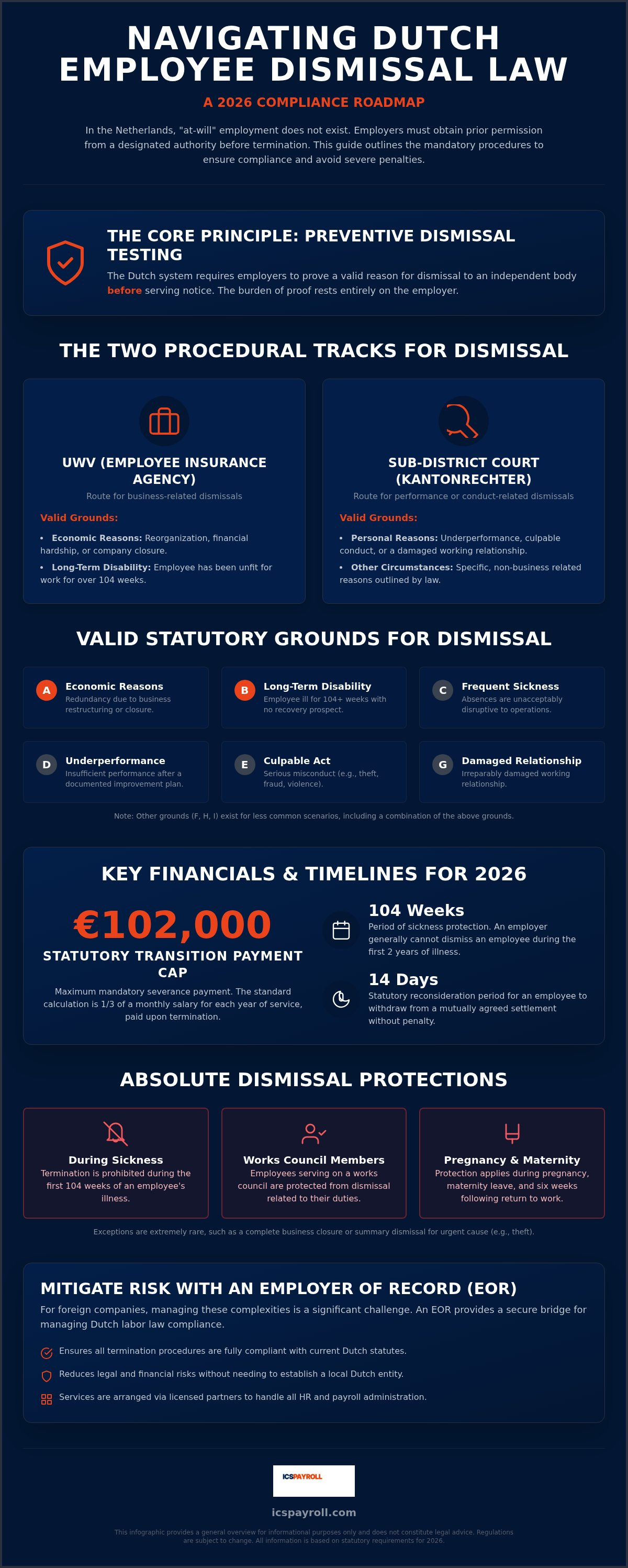
Dutch law identifies specific scenarios where a dismissal is strictly prohibited, regardless of the employer's reasons. These are known as dismissal bans. One of the most significant is the protection during sickness. An employer generally can't terminate an employee during the first 104 weeks of illness. This two year period is designed to allow for recovery and reintegration. If an employer attempts to dismiss a sick worker without meeting strict exceptions, the dismissal is legally void.
Other absolute protections apply during pregnancy, maternity leave, and for employees serving on a works council. These bans ensure that workers aren't penalized for their personal circumstances or for representing their colleagues. Exceptions are rare and typically limited to the closure of an entire business department or summary dismissal for "urgent cause." In cases of summary dismissal, the employer must act immediately upon discovering a severe violation, such as theft or physical violence, which makes the continuation of the contract impossible.
Statutory Grounds for Termination: What Qualifies as a Valid Reason?
To terminate an employment relationship in the Netherlands, an employer must satisfy at least one of the specific statutory grounds for dismissal. These grounds ensure that dutch employee dismissal laws provide a predictable framework for both parties. Each ground requires a different burden of proof and follows a specific procedural path. The primary grounds include:
- Economic reasons (a-ground): This applies during reorganizations or company closures where positions are no longer viable.
- Long-term disability (b-ground): Termination is permitted once an employee has been sick for 104 continuous weeks and reintegration is impossible.
- Frequent sickness (c-ground): This requires evidence that the absences significantly disrupt business operations and cannot be resolved by adjusting working conditions.
- Underperformance (d-ground): Employers must demonstrate that the employee is unsuitable for the role through a documented process.
- Culpable conduct (e-ground): This covers serious misconduct, such as theft or persistent refusal to follow reasonable instructions.
The i-Ground: Combining Multiple Reasons for Dismissal
The i-ground, or "combination ground," allows a court to terminate a contract when several grounds are partially met but none are sufficient on their own. This provides a necessary degree of flexibility within dutch employee dismissal laws, especially when a working relationship has broken down alongside minor performance issues. However, this flexibility comes with a financial cost. Courts can award an additional payment of up to 50% of the transition payment when using the i-ground to compensate the employee for the lack of a single, full ground for dismissal.
Performance Management and the Improvement Plan
Underperformance claims are strictly scrutinized by Dutch courts. You cannot dismiss an employee for poor results without first initiating a formal "improvement plan" (verbetertraject). This plan must be documented in writing and provide the employee with a reasonable period to improve their performance. It's also mandatory to offer training or explore reassignment to another suitable position within the company before moving toward termination. For international firms, managing employment law in the Netherlands for remote staff requires maintaining detailed digital records of these interventions to ensure they meet statutory standards. If you find these administrative requirements overwhelming, consider how expert payroll administration can streamline your compliance documentation.
Procedural Tracks: Navigating the UWV and the Sub-District Court
The Dutch system follows a dual-track procedure where the specific reason for termination dictates the legal path. Unlike jurisdictions with a single labor tribunal, dutch employee dismissal laws split authority between the Employee Insurance Agency (UWV) and the Sub-district court (Kantonrechter). Choosing the wrong track or failing to follow the prescribed steps leads to the immediate rejection of the dismissal request. It's a rigid system designed to ensure every termination is vetted by a neutral third party before it takes effect.
The UWV handles terminations based on economic redundancies or long-term sickness exceeding 104 weeks. This administrative procedure is primarily conducted in writing and doesn't involve an oral hearing. Conversely, the Sub-district court handles personal grounds, such as underperformance, culpable conduct, or a damaged working relationship. This track involves a formal court hearing where both parties present their case to a judge. Regardless of the track, employers must observe statutory notice periods. These are based on the employee's length of service: one month for less than five years, two months for five to ten years, three months for ten to fifteen years, and four months for fifteen years or more. You can often deduct the duration of the legal procedure from the notice period, provided at least one month of notice remains.
Dismissal by Mutual Consent and Settlement Agreements
Most employment terminations in the Netherlands are resolved through a Settlement Agreement (Vaststellingsovereenkomst or VSO). This route avoids the uncertainty of UWV or court proceedings and allows both parties to part ways on agreed terms. A critical component of dutch employee dismissal laws is the mandatory 14-day reconsideration period. After signing a VSO, an employee has two weeks to revoke their consent in writing without providing a reason. If the employer fails to mention this right in the agreement, the period extends to 21 days. It's also vital to ensure the VSO is "WW-proof." This means the wording must clearly state that the employer took the initiative and no "urgent cause" exists, which preserves the employee's right to unemployment benefits.
Summary Dismissal for Urgent Cause
Summary dismissal (ontslag op staande voet) is the most extreme measure available. It results in immediate termination without a notice period or transition payment. This is only permitted for an "urgent cause," such as theft, fraud, or physical threats. The burden of proof is exceptionally high. The employer must act immediately once the cause is known. Any delay in the investigation or the dismissal itself can lead to a court reversal. This forces the employer to reinstate the employee and pay back-dated wages plus heavy penalties. Because of these risks, many firms rely on a local partner to ensure their evidence meets the strict standards of Dutch labor courts.
Severance and Transition Payments: Calculating 2026 Statutory Obligations
Every employee in the Netherlands is entitled to a transition allowance (transitievergoeding) from their first day of employment. This remains a core pillar of dutch employee dismissal laws. The calculation is based on one-third of the gross monthly salary for each full year of service. For periods shorter than a year, the payment is pro-rated to the day. For 2026, the statutory cap for this payment is set at EUR 102,000 gross. If an employee's annual salary exceeds this amount, the cap is equal to one gross annual salary, as specified in the official calculation rules for transition allowances. This payment is mandatory regardless of whether the contract is permanent or temporary, provided the employer initiates the termination.
2026 Financial Benchmarks for Employers
International firms must understand how the 30% ruling impacts these calculations. The "gross salary" used for the transition allowance includes the tax-free component provided under the ruling. For 2026, the standard salary threshold for highly skilled migrants is EUR 48,013. Employers must ensure their payroll accounting aligns with Belastingdienst rules on defining wages to avoid undercalculating severance. Accurate reporting is essential; errors lead to retroactive claims and penalties from tax authorities. Maintaining a transparent accrual system for these payments helps prevent sudden cash-flow disruptions during reorganizations or individual terminations.
Additional Compensation and Fair Labor Practices
The final settlement must also include the 8% statutory holiday allowance and any accrued, untaken leave days. In cases where an employer is found to have acted with serious culpability, a judge may award a "billijke vergoeding" (fair compensation). This is an additional sum on top of the standard transition payment and isn't subject to the EUR 102,000 cap. Managing Dutch payroll administration during the termination phase requires clinical precision. Adhering to dutch employee dismissal laws ensures all tax and social security premiums are correctly withheld from the final payment. Ensuring your financial benchmarks are accurate protects your business from unnecessary legal exposure. If you need assistance calculating complex severance packages, contact ICSPayroll for expert guidance on local compliance.
Mitigating Dismissal Risks via an Employer of Record (EOR)
For international firms, navigating dutch employee dismissal laws without a local entity is a significant operational risk. Employer of Record (EOR) services, arranged via licensed partners, provide a secure framework for both compliant hiring and termination. By utilizing an EOR, the licensed partner acts as the legal employer. This shifts the administrative and legal burden of dismissal procedures, such as managing complex communications with the UWV or the Sub-district court, to local experts who understand the nuances of Dutch labor law. This partnership provides peace of mind by ensuring that every procedural step is followed with clinical precision.
One of the primary benefits is the consolidation of financial risks. Instead of facing a sudden EUR 102,000 transition payment at the end of a contract, an EOR model often incorporates these accruals into a transparent monthly payroll factor. This ensures that the necessary funds are always available and that the final settlement includes all statutory requirements, such as the 8% holiday allowance and accrued leave. Expert handling of sickness reintegration is another critical feature. Local partners manage the intensive reintegration requirements mandated by the Gatekeeper Improvement Act, ensuring all steps are documented to prevent the UWV from imposing a third year of mandatory wage payments due to a dismissal ban.
Compliance as a Service for International Firms
International firms often face Permanent Establishment risks when hiring directly. EOR services mitigate this by providing compliant Dutch contracts that adhere to all local regulations. During termination, the management of Highly Skilled Migrant (HSM) visa status is vital. Licensed partners arrange expedited HSM processing and 30% ruling applications, ensuring that the legal status of the employee is protected or transitioned correctly according to the 2026 salary threshold of EUR 48,013. You can find more details on these requirements in the IND guidelines on highly skilled migrants. This structure allows foreign entities to focus on their core business while the technicalities of dutch employee dismissal laws are managed by specialists.
Why a Local EOR Partner is Essential
Choosing a no-nonsense local partner provides direct access to Joost Hubregtse and the payroll team for comprehensive compliance audits. This human-centric approach ensures that all "loonaangifte" filings and social security premiums are handled correctly and on time. For a deeper look at these structures, consult our Employer of Record Netherlands guide. This partnership acts as a stabilizing force, allowing you to scale your business while we manage the complexities of termination and payroll logistics through our network of licensed partners. Transparency regarding costs and processes remains our priority, ensuring you never feel lost in technical details.
Securing Your Business Future in the Dutch Market
Mastering dutch employee dismissal laws requires a proactive approach to legal compliance. You've seen that the Netherlands prioritizes employee protection through preventive testing and mandatory transition payments capped at EUR 102,000 for 2026. Successfully navigating these regulations ensures your international expansion remains sustainable and free from the administrative friction that often accompanies entry into foreign labor markets. It's about turning a complex legal requirement into a predictable business process.
Partnering with a local expert allows you to focus on growth while we manage the complex technicalities. Through our network of licensed partners, we provide full Dutch compliance and expedited HSM visa processing in approximately 3 weeks. You'll benefit from transparent payroll factor pricing that accounts for all statutory accruals from day one, removing the risk of unexpected financial burdens during a termination phase. This approach provides the reliability and security your business needs to thrive.
Hire in the Netherlands with confidence; get your tailored EOR quote within 24 hours. Building a compliant and resilient workforce in the Netherlands is an achievable goal when you have the right stabilization force by your side.
Frequently Asked Questions
Can I dismiss an employee in the Netherlands without a valid reason?
No, you cannot terminate an employment contract at will. Dutch employee dismissal laws require a legally valid ground, such as underperformance or economic redundancy. You must obtain prior permission from the UWV or a sub-district court unless you reach a mutual agreement with the staff member. Attempting to dismiss someone without a valid reason leads to the court rejecting your request. This often results in expensive legal fees and mandatory wage payments.
What is the statutory transition payment cap in 2026?
The statutory transition payment is capped at EUR 102,000 gross for 2026. If the employee's gross annual salary is higher than this amount, the cap is equal to one gross annual salary. This benchmark is adjusted annually to reflect economic changes. It's vital to use the correct 2026 figures in your final settlement calculations to ensure full compliance and avoid retroactive claims from former staff members or tax authorities.
Does a sick employee have absolute protection from dismissal?
Sick employees have robust protection for the first 104 weeks of their illness. During this two year period, a dismissal ban is generally in effect. Employers must focus on reintegration efforts as mandated by the Gatekeeper Improvement Act. You can only terminate a sick employee if they persistently refuse to cooperate with reintegration or if the business department where they work closes entirely. Licensed EOR partners help manage these complex reintegration steps.
What is the 14-day reconsideration period in a settlement agreement?
The 14-day reconsideration period is a statutory right for employees who sign a settlement agreement. It allows them to revoke their consent in writing without providing any justification. If the employer fails to explicitly mention this 14-day window in the written agreement, the period automatically extends to 21 days. This cooling-off period is a unique feature of dutch employee dismissal laws that prevents employees from making rushed decisions under pressure.
How is the transition allowance calculated for short-term employees?
The transition allowance is calculated from the very first day of employment, even for short-term staff. You must pay one-third of the gross monthly salary for every year of service. For shorter durations, the amount is calculated pro-rata to the day. This includes the basic salary plus the 8% holiday allowance and other fixed components. Even an employee who leaves during their probation period is legally entitled to this pro-rated severance payment.
Can I terminate a remote employee in the Netherlands without a local entity?
You can terminate a remote employee, but the process must follow Dutch labor law if they are based in the Netherlands. If you don't have a local entity, using an Employer of Record (EOR) is the most compliant route. The EOR provider, through its licensed partners, handles the legal termination process on your behalf. This includes managing the UWV or court filings and ensuring all severance payments meet the 2026 statutory requirements.
What happens to the 30% ruling if an employee is dismissed?
If an employee with the 30% ruling is dismissed, they have a three-month window to find a new employer to retain the benefit. The new role must also meet the 2026 salary threshold of EUR 48,013 for highly skilled migrants. If they don't find a qualifying position within this period, the ruling expires. The employer must ensure the final payslip correctly processes the tax-free allowance for the remaining duration of the employment contract.
What is the difference between dismissal by mutual consent and termination with consent?
Dismissal by mutual consent involves a settlement agreement where both parties agree to end the contract without involving third parties. Termination with consent occurs when an employer initiates a procedure through the UWV or court, and the employee subsequently agrees to the request in writing. Mutual consent via a settlement agreement is generally the preferred route for international firms because it's faster, more predictable, and avoids the costs of formal legal proceedings.

Article by
Joost Hubregtse
Joost Hubregtse is Director of ICS Staffing & Payroll B.V., the wholly owned subsidiary of Intercompany Solutions behind ICS Payroll. He is responsible for Employer of Record and Dutch payroll services: employment contracts, wage tax and social security filings, holiday allowance, pension, sick leave and CAO compliance, with onboarding possible within 48 hours.
Frequently Asked Questions
No, you cannot terminate an employment contract at will. Dutch employee dismissal laws require a legally valid ground, such as underperformance or economic redundancy. You must obtain prior permission from the UWV or a sub-district court unless you reach a mutual agreement with the staff member. Attempting to dismiss someone without a valid reason leads to the court rejecting your request. This often results in expensive legal fees and mandatory wage payments.
The statutory transition payment is capped at EUR 102,000 gross for 2026. If the employee's gross annual salary is higher than this amount, the cap is equal to one gross annual salary. This benchmark is adjusted annually to reflect economic changes. It's vital to use the correct 2026 figures in your final settlement calculations to ensure full compliance and avoid retroactive claims from former staff members or tax authorities.
Sick employees have robust protection for the first 104 weeks of their illness. During this two year period, a dismissal ban is generally in effect. Employers must focus on reintegration efforts as mandated by the Gatekeeper Improvement Act. You can only terminate a sick employee if they persistently refuse to cooperate with reintegration or if the business department where they work closes entirely. Licensed EOR partners help manage these complex reintegration steps.
The 14-day reconsideration period is a statutory right for employees who sign a settlement agreement. It allows them to revoke their consent in writing without providing any justification. If the employer fails to explicitly mention this 14-day window in the written agreement, the period automatically extends to 21 days. This cooling-off period is a unique feature of dutch employee dismissal laws that prevents employees from making rushed decisions under pressure.
The transition allowance is calculated from the very first day of employment, even for short-term staff. You must pay one-third of the gross monthly salary for every year of service. For shorter durations, the amount is calculated pro-rata to the day. This includes the basic salary plus the 8% holiday allowance and other fixed components. Even an employee who leaves during their probation period is legally entitled to this pro-rated severance payment.
You can terminate a remote employee, but the process must follow Dutch labor law if they are based in the Netherlands. If you don't have a local entity, using an Employer of Record (EOR) is the most compliant route. The EOR provider, through its licensed partners, handles the legal termination process on your behalf. This includes managing the UWV or court filings and ensuring all severance payments meet the 2026 statutory requirements.
If an employee with the 30% ruling is dismissed, they have a three-month window to find a new employer to retain the benefit. The new role must also meet the 2026 salary threshold of EUR 48,013 for highly skilled migrants. If they don't find a qualifying position within this period, the ruling expires. The employer must ensure the final payslip correctly processes the tax-free allowance for the remaining duration of the employment contract.
Dismissal by mutual consent involves a settlement agreement where both parties agree to end the contract without involving third parties. Termination with consent occurs when an employer initiates a procedure through the UWV or court, and the employee subsequently agrees to the request in writing. Mutual consent via a settlement agreement is generally the preferred route for international firms because it's faster, more predictable, and avoids the costs of formal legal proceedings.
Related articles