
EOR vs. Entity in the Netherlands: The 2026 Cost and Compliance Guide
By Joost Hubregtse, Director, ICS Staffing & Payroll
All blog posts are reviewed and fact checked by our labour law lawyer Zishan Hussain and our director. Editorial standards
By Joost Hubregtse, Payroll Director. Joost specializes in Dutch tax law, international payroll structures, and 30% ruling optimization for global firms. Reviewed on October 14, 2026.
Establishing a Dutch BV is often viewed as the gold standard for market entry, yet the 2026 regulatory environment suggests that direct incorporation might actually be the riskier path for your initial expansion. While owning an entity provides long-term control, the immediate administrative burden and legal liabilities can stall your momentum before you've hired your first team member. You're likely feeling the pressure to choose between the perceived stability of a local entity and the rapid deployment offered by an Employer of Record. Deciding on eor vs entity netherlands requires a cold, hard look at the financial and legal realities of the current Dutch labor market.
We understand that the 2-year sickness pay obligation and the complexities of permanent establishment risk create significant uncertainty. This guide promises to clear that confusion by providing a detailed financial break-even analysis and a compliant hiring roadmap for 2026. You'll gain a precise understanding of the 30% ruling benefits, including the EUR 48,013 salary threshold, and the impact of the EUR 14.99 minimum hourly wage. We'll examine the timelines for setup and compare the total cost of employment to ensure your Dutch expansion is both profitable and secure.
Key Takeaways
- Analyze the 2026 statutory minimum hourly wages of EUR 14.71 or EUR 14.99 and the mandatory 8 percent holiday allowance required for all Dutch employees.
- Mitigate high-impact risks like the unique Dutch requirement to pay at least 70 percent of wages during 104 weeks of employee illness.
- Determine the most efficient financial path for your 2026 expansion by comparing the costs and timelines of eor vs entity netherlands.
- Follow a structured five-step roadmap for compliant hiring while adhering to the mandatory seven-year record-keeping requirement for all payroll documents.
- Leverage the 30 percent ruling and its specific 2026 salary threshold of EUR 48,013 to attract and retain highly skilled international talent.
Navigating the Choice: Dutch BV vs. Employer of Record in 2026
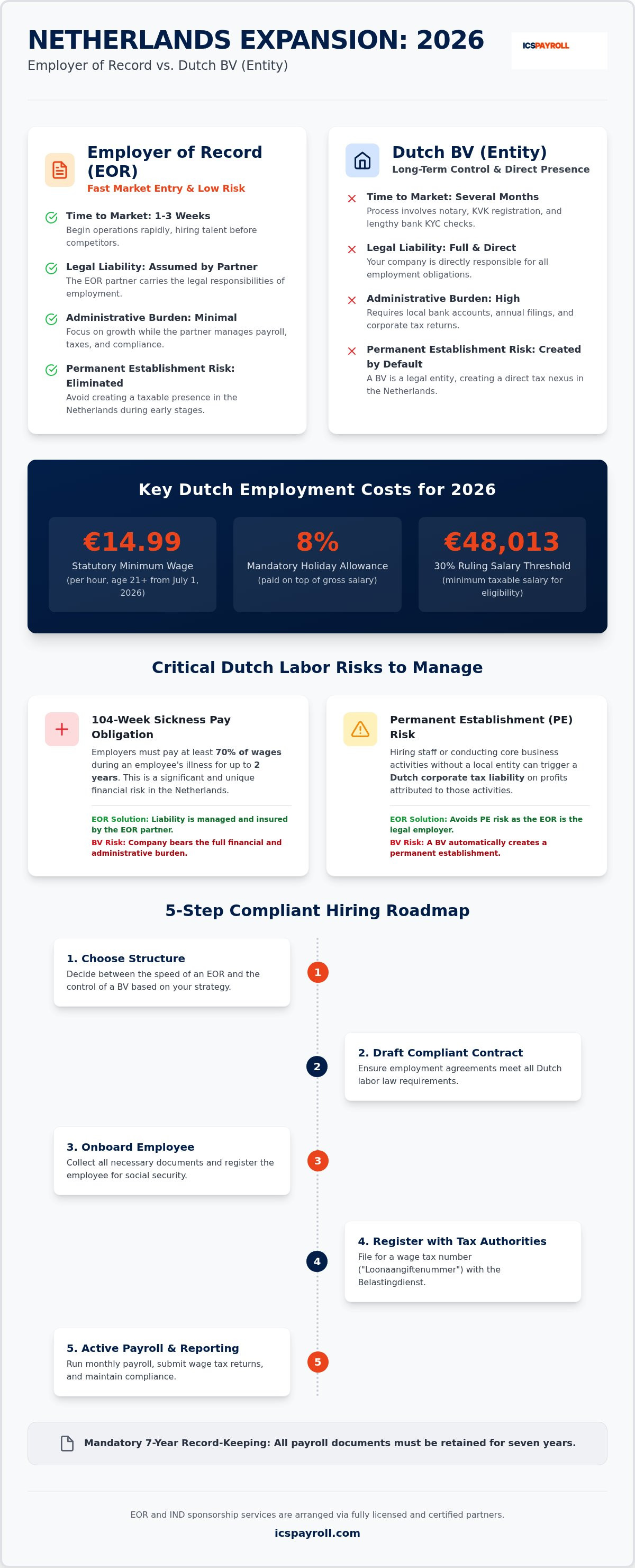
Expanding into the Netherlands requires a choice between long-term infrastructure and immediate market access. A Dutch BV (Besloten Vennootschap) is a private limited liability company that exists as a separate legal entity. It demands formal incorporation through a notary and registration with local authorities. In contrast, an Employer of Record (EOR) is a professional service where a local partner assumes all legal employer responsibilities for your workforce. When evaluating the financial and operational impact of eor vs entity netherlands, the primary differentiator is the time to market. A BV setup often stretches over several months because of rigorous banking "Know Your Customer" (KYC) checks and notary schedules. An EOR allows you to begin operations in just weeks. These services are arranged via licensed partners to maintain total compliance with Dutch labor standards.
The Legal Reality of Permanent Establishment
Hiring Dutch residents without a local entity can lead to a "Permanent Establishment" (PE) risk. This occurs when the Dutch tax authorities determine that your business activities have created a fixed place of business. The result is a requirement to pay Dutch corporate tax on profits attributed to that location. The Dutch Chamber of Commerce (KVK) manages the commercial register, and every BV must maintain an active listing. An EOR eliminates this specific risk by becoming the legal employer. Since the EOR provider is the entity on record with the tax office, the foreign parent company avoids a direct nexus. This provides a protective layer against unforeseen tax liabilities during the early stages of expansion.
Operational Control and Speed to Market
A local subsidiary carries a heavy administrative weight. You'll need to manage local bank accounts, file annual accounts, and handle complex corporate tax returns. This burden often requires hiring local specialists or expensive consulting firms. Choosing an EOR shifts these burdens to a local expert. When you compare eor vs entity netherlands for a small team, the EOR model is significantly more efficient. Operational setup for Dutch hires is typically achieved in under three weeks, ensuring you don't lose candidates to faster competitors. Contracts and service agreements are usually ready for signature within days. This efficiency allows you to focus on growth while your partner manages the technical payroll details. It's a methodical, secure approach to hire in the Netherlands without the immediate overhead of a full corporate structure.
Financial Breakdown: Statutory Costs and the Payroll Factor
The financial commitment of expansion depends heavily on your choice of infrastructure. When comparing eor vs entity netherlands, the statutory wage requirements serve as the baseline for all calculations. As of July 1, 2026, the statutory minimum wage for employees aged 21 and older is EUR 14.99 gross per hour. This followed the EUR 14.71 rate effective during the first half of the year. Unlike many other jurisdictions, the Netherlands mandates an additional 8 percent holiday allowance on top of the gross salary. These figures are strictly enforced by the Dutch Tax Administration (Belastingdienst).
Managing these costs via a local entity requires deep administrative oversight. If you choose the path of setting up a Dutch BV, you must account for every premium individually. Alternatively, the EOR model utilizes a consolidated payroll factor. This single multiplier covers gross salary, social premiums, and administrative fees, providing a predictable monthly cost. This approach removes the complexity of local accounting while ensuring your business remains fully compliant with Dutch fiscal standards.
Employer Premiums and Social Security
Dutch employers are responsible for several social security contributions that significantly increase the total cost of employment. These include the AWf (unemployment fund) and Aof (disability fund) premiums. For 2026, the AWf rate varies depending on the contract type, while the Aof premium supports the national disability insurance system. The Zvw (Healthcare Insurance Act) contribution is also a mandatory employer-paid levy. These premiums, alongside industry-standard pension contributions of approximately 15.2 percent, typically add 18 to 27 percent to the gross salary. To help you budget accurately, you can request a detailed cost breakdown with a 24-hour quotation turnaround.
Transition Allowance and Termination Costs
Termination in the Netherlands carries specific financial risks that depend on whether you choose eor vs entity netherlands. The statutory transition allowance, or transitievergoeding, is mandatory for almost all contract terminations. For 2026, this payment is capped at EUR 102,000, or one annual salary if the employee earns more. Additionally, the Ketenregeling (chain rule) limits employers to three consecutive fixed-term contracts over a three-year period before a permanent contract is required. An EOR includes the management and accrual of these potential costs within the payroll factor. This prevents the sudden financial shocks that often hit companies managing their own local entities without sufficient reserves.
High-Impact Risks: Sickness and Pension Obligations
The Dutch social security system imposes significant liabilities on legal employers that often surprise international firms. When weighing eor vs entity netherlands, the obligation to pay sick employees is a critical factor. Employers must pay at least 70 percent of an employee's salary for up to 104 weeks (two years) in the event of long term illness. This financial burden is accompanied by strict administrative requirements to facilitate the employee's return to work. This rule applies regardless of the company size or the employee's tenure, making it one of the most substantial risks for small subsidiaries.
A professional EOR service includes sickness risk coverage as a standard feature, protecting your business from the volatility of long term medical leave. For businesses managing their own entity, this risk must be insured separately, often at a high premium. You must also contract an Arbodienst, a certified occupational health service, to monitor sick leave and provide medical assessments. For a deeper look at these requirements and how they impact your expansion, consult our Employment Law Netherlands Guide.
The 15.2 Percent Pension Benchmark
Pension administration in the Netherlands is rarely optional. For 2026, the mandatory pension contribution benchmark stands at 15.2 percent of the gross salary. Most Dutch industry sectors are governed by mandatory industry wide pension funds (Bedrijfstakpensioenfondsen). If your business falls under a Collective Labor Agreement (CAO), you are legally bound to these contributions. Managing these filings requires precise monthly reporting to the relevant fund. Modern EOR solutions simplify this by providing employees with an online portal to track their balances, ensuring transparency and statutory compliance without increasing your internal HR workload.
Compliance with the Gatekeeper Improvement Act
The Gatekeeper Improvement Act (Wet Verbetering Poortwachter) dictates a rigid schedule for reintegrating sick employees. This process starts as early as the first week of illness and involves mandatory milestones, such as a problem analysis by a company doctor in week six and an evaluation of the reintegration plan in week 52. When deciding on eor vs entity netherlands, consider that EOR partners handle all reintegration guidance and support. This expertise is vital because the Dutch Social Security Institute (UWV) can impose a penalty of a third year of mandatory wage payments if the reintegration efforts are deemed insufficient. Relying on a local expert ensures every deadline is met, removing the risk of costly legal sanctions. You can find more details on these statutory sick leave requirements on official government portals.
The Compliance Roadmap: From Onboarding to Active Payroll
Implementing a compliant hiring structure involves five distinct phases: drafting a Dutch-compliant contract, performing physical identity verification, registering with the tax authorities, submitting visa or tax ruling applications, and commencing the active payroll cycle. When choosing between eor vs entity netherlands, the speed and efficiency of this roadmap is a primary differentiator. A new entity often faces delays while waiting for corporate tax registration and bank account approvals. An EOR allows you to move through these steps in parallel. To maintain local alignment, we provide comprehensive HR administration and employee handbooks that cover essential Dutch labor standards. All payroll documents and employee records are subject to a strict seven-year record-keeping requirement. You can explore the full operational details in our Employer of Record Netherlands Guide.
Mandatory ID Verification and Right to Work
Dutch law requires a physical ID verification before an employee's first working day. This is not a digital-only process; the employer must inspect and store a copy of the original document to comply with labor inspections. The Immigration and Naturalisation Service (IND) sets rigorous standards for work permits and residence rights. While EU nationals enjoy free movement, non-EU experts require Highly Skilled Migrant (HSM) visas. A major advantage of the EOR model is the expedited processing time. When managed through our licensed partners, HSM visas are typically granted within three weeks. This rapid turnaround is essential for securing global talent in a competitive market where candidates often have multiple offers.
Setting Up the Monthly Payroll Cycle
The monthly payroll cycle revolves around the Loonaangifte (payroll tax return) filing deadlines. These submissions to the Tax Administration must be accurate and punctual to avoid significant penalties. Using an EOR simplifies this by consolidating all employer premiums, gross wages, and administrative costs into a single monthly invoice. This eliminates the need for your finance team to manage multiple local payments or navigate the Dutch banking system. Every employee receives a compliant payslip that details their social security contributions, holiday allowance accrual, and tax withholdings. This methodical approach ensures that your workforce is paid on time and in full compliance with local fiscal laws. If you're ready to start your Dutch expansion, you can request a compliant payroll quote today.
Attracting Talent: The 30% Ruling and HSM Visas
Recruiting international experts for a Dutch expansion requires a competitive edge; the 30% ruling remains the most effective tool for this purpose. This tax facility allows employers to provide a tax-free allowance to cover extraterritorial costs, significantly increasing the net take-home pay for qualified staff. When comparing eor vs entity netherlands, the administrative complexity of managing these applications is often a deciding factor. Assistance with the 30% ruling application is included within the standard payroll factor for EOR services, ensuring that both the employer and employee benefit from day one. It is essential to recognize that the partial non-resident status for tax purposes was abolished for new applicants as of January 1, 2025. By 2026, expats are taxed on their global wealth in Box 2 and Box 3, making the primary tax-free allowance even more critical for high-level compensation packages. Detailed insights are available in our 30% Ruling Comprehensive Guide.
Eligibility and 2026 Salary Thresholds
To qualify for the benefit in 2026, an employee must meet specific criteria regarding their recruitment from abroad and their annual taxable income. The standard salary threshold for 2026 is EUR 48,013. For employees under the age of 30 who hold a qualifying Master's degree, a lower threshold of EUR 36,497 applies. You must also account for the legislative transition in the tax-free rate. While older rulings may still benefit from the full 30 percent, rulings that commenced after January 1, 2024, are scheduled to transition to a flat 27 percent rate starting in 2027. Maintaining compliance with these evolving thresholds is a statutory requirement that professional partners manage on your behalf to avoid retroactive tax corrections.
Expedited Highly Skilled Migrant (HSM) Visas
Hiring talent from outside the Schengen area usually requires the employer to be a recognized sponsor with the Immigration and Naturalisation Service (IND). Establishing a Dutch BV and obtaining this status is a multi-month process involving significant capital and administrative hurdles. The EOR model provides a faster alternative by enabling you to hire non-Schengen staff without a local entity. These visa services are arranged via licensed partners who already hold the necessary sponsor status. HSM visa applications are typically granted within approximately three weeks, allowing for rapid deployment of key personnel. This speed is a significant advantage when evaluating eor vs entity netherlands for time-sensitive projects. It ensures that immigration logistics do not become a barrier to your 2026 growth objectives while maintaining full legal compliance with Dutch immigration law.
Securing Your Dutch Market Entry in 2026
Choosing between eor vs entity netherlands is a strategic decision that balances long term control with immediate operational agility. While a Dutch BV offers a permanent footprint, the 2026 regulatory landscape makes the Employer of Record model a safer and faster entry point for most international firms. You avoid the immediate burden of entity incorporation while still accessing the 30% ruling and expedited HSM visa processing for your key hires. This approach effectively mitigates the high impact risks of sickness pay obligations and complex pension administration from day one.
Our methodology ensures your expansion remains fully compliant with Dutch labor laws. We provide an operational setup in weeks, not months, and consolidate all employer premiums into one clear monthly invoice with no surprises. This removal of administrative friction allows you to focus on your core business objectives in the Netherlands. Hire in the Netherlands with confidence: Get your 24-hour quote from ICSPayroll. We look forward to supporting your professional success in this vibrant market.
Frequently Asked Questions
How quickly can I hire an employee in the Netherlands in 2026?
You can begin the hiring process in weeks rather than months when using a local partner. A tailored quotation is typically provided within 24 hours of submitting employee details, with service agreements and employment contracts ready within days. This rapid timeline is a significant advantage when comparing eor vs entity netherlands, as incorporating a private limited company involves notary appointments and banking hurdles that often delay your first hire by several months.
Can I hire Dutch employees without setting up a local legal entity?
Yes, you can hire staff in the Netherlands without establishing a Dutch BV by using an Employer of Record service. This model allows a local partner to act as the legal employer, managing all payroll, tax, and social security obligations on your behalf. It provides a compliant bridge for international firms to enter the market quickly while avoiding the administrative overhead and permanent establishment risks associated with direct entity incorporation.
What is the 2026 minimum wage in the Netherlands?
As of July 1, 2026, the statutory minimum hourly wage for workers aged 21 and older is EUR 14.99 gross. From January 1 to June 30, 2026, the rate was EUR 14.71 per hour. The Netherlands has moved away from a fixed monthly minimum wage, meaning pay is calculated based on actual contracted hours. Employers must also remember that these rates do not include the mandatory 8 percent holiday allowance required by law.
What are the mandatory employer costs in the Netherlands for 2026?
Mandatory employer costs include the 8 percent holiday allowance and a standard pension contribution benchmark of 15.2 percent. Additionally, employers must pay social security premiums such as the AWf (unemployment), Aof (disability), and Zvw (healthcare) levies. These contributions generally add 18 to 27 percent to the gross salary. When evaluating eor vs entity netherlands, these costs are often consolidated into a single payroll factor to simplify your monthly budgeting and financial reporting.
How long does it take to get a Highly Skilled Migrant (HSM) visa?
Highly Skilled Migrant visa applications are typically processed and granted within approximately three weeks when managed through expert channels. These services are arranged via licensed partners who are recognized sponsors with the Immigration and Naturalisation Service (IND). This expedited timeline allows you to relocate international experts quickly without waiting for your own company to achieve recognized sponsor status, which is a rigorous and time consuming process for new Dutch entities.
What are the sickness pay requirements for Dutch employers?
Dutch law requires employers to continue paying at least 70 percent of an employee's gross salary for up to 104 weeks of illness. This two year obligation is accompanied by strict reintegration duties under the Gatekeeper Improvement Act. Employers must also contract a certified occupational health service (Arbodienst). Professional EOR services include sickness risk coverage and reintegration support as standard features, protecting your business from the significant financial and administrative impact of long term sick leave.
How does the 30% ruling work in 2026?
The 30% ruling allows eligible expats recruited from abroad to receive 30 percent of their gross salary as a tax free allowance. For 2026, the standard taxable salary threshold is EUR 48,013. It is important to note that the partial non-resident taxpayer status was abolished for new applicants starting in 2025. This benefit is a primary tool for attracting international talent, and the application process is managed as part of comprehensive Dutch payroll administration under the Dutch Tax Administration.
What is a payroll factor and what does it cover?
A payroll factor is a consolidated pricing model where the employee's gross salary is multiplied by a single figure to determine the total monthly cost. This transparent invoice covers the 8 percent holiday allowance, 15.2 percent pension, social security premiums, and sickness risk coverage. It also includes transition allowance management, HR administration, and 30% ruling assistance. This approach eliminates separate billing items and provides a predictable, one stop solution for all Dutch employment expenses.

Article by
Joost Hubregtse
Joost Hubregtse is Director of ICS Staffing & Payroll B.V., the wholly owned subsidiary of Intercompany Solutions behind ICS Payroll. He is responsible for Employer of Record and Dutch payroll services: employment contracts, wage tax and social security filings, holiday allowance, pension, sick leave and CAO compliance, with onboarding possible within 48 hours.
Frequently Asked Questions
You can begin the hiring process in weeks rather than months when using a local partner. A tailored quotation is typically provided within 24 hours of submitting employee details, with service agreements and employment contracts ready within days. This rapid timeline is a significant advantage when comparing eor vs entity netherlands, as incorporating a private limited company involves notary appointments and banking hurdles that often delay your first hire by several months.
Yes, you can hire staff in the Netherlands without establishing a Dutch BV by using an Employer of Record service. This model allows a local partner to act as the legal employer, managing all payroll, tax, and social security obligations on your behalf. It provides a compliant bridge for international firms to enter the market quickly while avoiding the administrative overhead and permanent establishment risks associated with direct entity incorporation.
As of July 1, 2026, the statutory minimum hourly wage for workers aged 21 and older is EUR 14.99 gross. From January 1 to June 30, 2026, the rate was EUR 14.71 per hour. The Netherlands has moved away from a fixed monthly minimum wage, meaning pay is calculated based on actual contracted hours. Employers must also remember that these rates do not include the mandatory 8 percent holiday allowance required by law.
Mandatory employer costs include the 8 percent holiday allowance and a standard pension contribution benchmark of 15.2 percent. Additionally, employers must pay social security premiums such as the AWf (unemployment), Aof (disability), and Zvw (healthcare) levies. These contributions generally add 18 to 27 percent to the gross salary. When evaluating eor vs entity netherlands, these costs are often consolidated into a single payroll factor to simplify your monthly budgeting and financial reporting.
Highly Skilled Migrant visa applications are typically processed and granted within approximately three weeks when managed through expert channels. These services are arranged via licensed partners who are recognized sponsors with the Immigration and Naturalisation Service (IND). This expedited timeline allows you to relocate international experts quickly without waiting for your own company to achieve recognized sponsor status, which is a rigorous and time consuming process for new Dutch entities.
Dutch law requires employers to continue paying at least 70 percent of an employee's gross salary for up to 104 weeks of illness. This two year obligation is accompanied by strict reintegration duties under the Gatekeeper Improvement Act. Employers must also contract a certified occupational health service (Arbodienst). Professional EOR services include sickness risk coverage and reintegration support as standard features, protecting your business from the significant financial and administrative impact of long term sick leave.
The 30% ruling allows eligible expats recruited from abroad to receive 30 percent of their gross salary as a tax free allowance. For 2026, the standard taxable salary threshold is EUR 48,013. It is important to note that the partial non-resident taxpayer status was abolished for new applicants starting in 2025. This benefit is a primary tool for attracting international talent, and the application process is managed as part of comprehensive Dutch payroll administration under the Dutch Tax Administration.
A payroll factor is a consolidated pricing model where the employee's gross salary is multiplied by a single figure to determine the total monthly cost. This transparent invoice covers the 8 percent holiday allowance, 15.2 percent pension, social security premiums, and sickness risk coverage. It also includes transition allowance management, HR administration, and 30% ruling assistance. This approach eliminates separate billing items and provides a predictable, one stop solution for all Dutch employment expenses.