Netherlands New Hire Paperwork: The 2026 Employer Compliance Guide
By Joost Hubregtse, Director, ICS Staffing & Payroll
All blog posts are reviewed and fact checked by our labour law lawyer Zishan Hussain and our director. Editorial standards
By Joost Hubregtse, Payroll Director. Joost is a recognized expert in Dutch labor law and international payroll compliance, holding advanced certifications in Dutch tax legislation and cross-border social security. Reviewed by Joost Hubregtse on August 25, 2026.
The Dutch Tax Administration conducted over 800 company inspections related to the Wet DBA in 2025. This aggressive oversight signals a new era where handling netherlands new hire paperwork with absolute precision is the only way to avoid serious fault penalties. Starting in 2026, authorities have the power to issue these penalties immediately, making it essential to align your administrative processes with the latest EUR 14.71 minimum hourly wage standards.
You likely feel the weight of Dutch administrative complexity, from the specific 30% ruling thresholds to mandatory pension calculations. It's a valid concern, as a single filing error can lead to costly delays and significant legal exposure. This guide provides a definitive path through the bureaucracy, ensuring your onboarding process is both fast and fully compliant with all 2026 requirements.
We will break down the mandatory document checklist, verify the EUR 48,013 salary threshold for tax benefits, and explain how to hire Dutch talent without establishing a local entity.
Key Takeaways
- Learn how to conduct mandatory identity checks under the Wet op de identificatieplicht and secure high quality document copies for your personnel files.
- Understand the statutory requirements for Dutch employment contracts, including the mandatory 8% holiday allowance and the limits of the Ketenregeling chain rule.
- Master the 2026 financial benchmarks, including the EUR 48,013 salary threshold for the 30% ruling and mandatory employer premiums like AWf and Zvw.
- Follow a precise step by step checklist for netherlands new hire paperwork to guarantee compliance with 2026 administrative deadlines and the 15.2% pension contribution requirement.
- Discover how to hire local talent without establishing a Dutch BV by utilizing Employer of Record services arranged through licensed partners.
Mandatory Identity Verification and the BSN
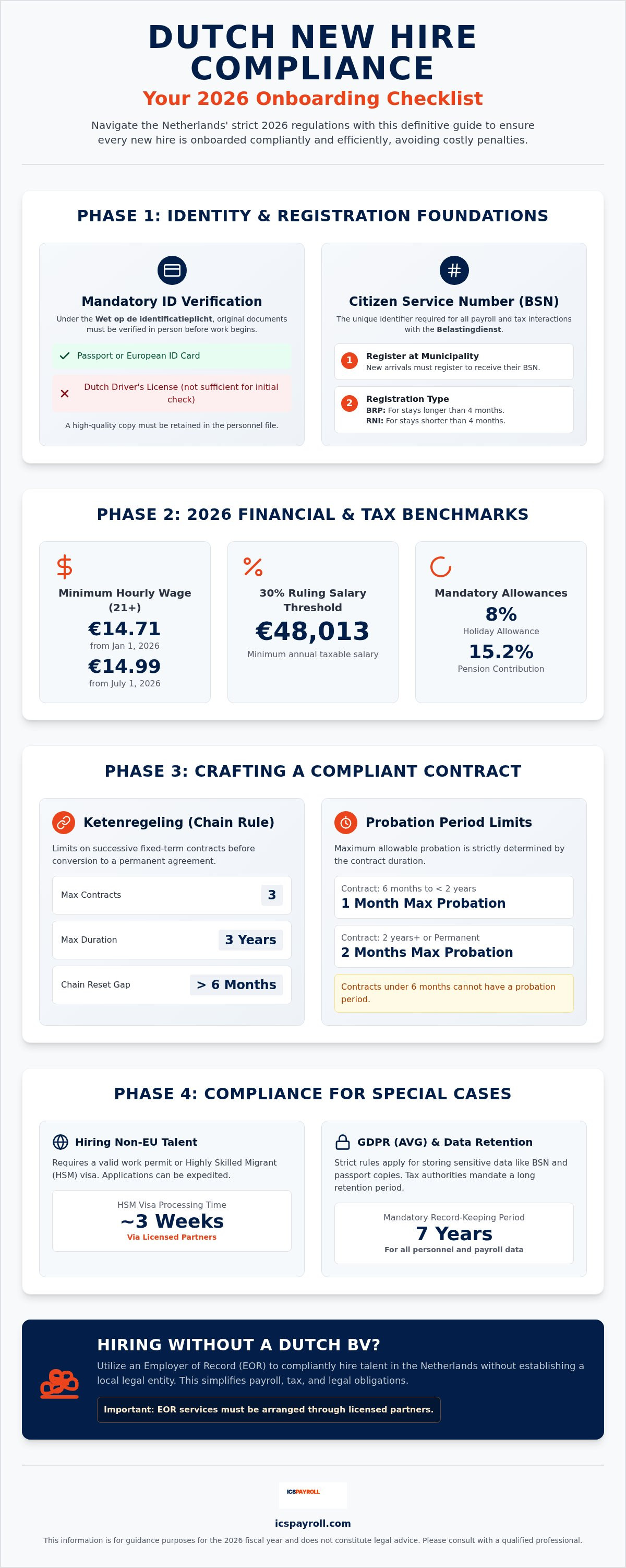
The first phase of onboarding in the Netherlands is strictly regulated by the Wet op de identificatieplicht. This law mandates that every employer performs a thorough identity check before a new hire begins their duties. You are legally required to verify the original identity document in person. This process ensures that the individual has the right to work in the country and prevents administrative errors during tax registration. Verify the original document. Legibility is key.
After verification, you must retain a high-quality, clear copy of the employee's passport or European ID card. A common mistake is accepting a Dutch driver's license; however, for the initial employment identity check, a passport or national ID card is required. These documents contain essential information regarding the holder's nationality and residency status that a license lacks. This document must remain in the personnel file throughout the duration of employment.
The Citizen Service Number (BSN) serves as the foundation for all netherlands new hire paperwork. It is the unique identifier used for every interaction with the Belastingdienst (Tax Administration). The BSN is mandatory. If an employee is moving from abroad, they must register at a local municipality to obtain this number. For those staying longer than four months, registration in the Personal Records Database (BRP) is required. If the stay is shorter, they may register as a non-resident (RNI) to receive their BSN and initiate payroll setup.
Identity Requirements for Non-EU Staff
Hiring talent from outside the European Union or Schengen area introduces additional legal hurdles. These individuals must hold a valid work permit or qualify for the Highly Skilled Migrant (HSM) program. To facilitate a smooth transition, HSM visa applications can be arranged via licensed partners, often resulting in an expedited processing time of approximately three weeks. Confirm specific eligibility criteria on the Immigration and Naturalisation Service (IND) website before drafting an offer letter. Ensuring the employee has the correct residence title is a prerequisite for a compliant payroll setup.
GDPR Compliance and Data Storage
Storing sensitive identifiers like the BSN and passport copies triggers strict obligations under the Dutch AVG. Employers must implement robust security measures to prevent data breaches and unauthorized access. Additionally, the Dutch tax authorities enforce a seven-year record-keeping requirement for all personnel and payroll data. This means you must maintain accessible, secure archives for nearly a decade after a document is generated. ICSPayroll provides a secure online employee portal to centralize your netherlands new hire paperwork. This digital infrastructure ensures that your data storage remains compliant with both GDPR and tax audit standards while removing the burden of manual file management.
The Dutch Employment Contract and Statutory Clauses
Drafting a compliant employment contract is the next critical phase in your netherlands new hire paperwork. Every agreement must clearly specify the job title, primary work location, and the gross salary. In the Netherlands, verbal agreements are technically binding, but written terms are mandatory for specific statutory clauses to be enforceable. Precision in these documents prevents future disputes and ensures your business aligns with the strict requirements of Dutch labor law.
The Ketenregeling, or chain rule, is a fundamental pillar of Dutch employment law that employers must respect. This regulation limits the number of successive fixed-term contracts to three within a total period of three years. If you exceed three contracts or the three-year duration, the agreement automatically converts into a permanent (indefinite) contract. A gap of more than six months between contracts is required to reset this chain. Additionally, probation periods are restricted; for contracts longer than six months but less than two years, the maximum allowable probation is one month. Permanent contracts or those for two years or more allow for a maximum of two months.
Statutory wages have seen significant adjustments for 2026. The minimum hourly wage for employees aged 21 and over is set at EUR 14.71 as of January 1, 2026. This figure increases to EUR 14.99 per hour on July 1, 2026. Your netherlands new hire paperwork must reflect these updated benchmarks to remain compliant with the Wet minimumloon. Partnering with an expert for Dutch payroll services ensures these statutory requirements are met with clinical precision.
Mandatory Benefits and Allowances
The 8% holiday allowance (vakantiegeld) is a statutory requirement in the Netherlands. It's calculated on the employee's gross annual salary and is typically paid out in May or June. Pension schemes are also a standard expectation for Dutch employees. ICSPayroll manages a 15.2% employer contribution of the gross salary to ensure your benefits package is competitive and compliant. Employers must also account for the transition allowance (transitievergoeding), which is a mandatory severance payment. For 2026, this payment is capped at EUR 102,000, or one year's gross salary if the annual salary exceeds that amount.
Recent Reforms in Non-Compete Clauses
Non-compete agreements are undergoing significant legislative shifts. Proposed 2026 reforms require employers to provide a written "heavy business interest" justification to include a non-compete clause in a contract. These clauses must be strictly limited in both duration and geographical scope to remain enforceable in a Dutch court. Contracts must be drafted in accordance with current belastingdienst.nl guidelines regarding tax and employment status. Distinguishing between established law and pending legislation is vital to avoid drafting unenforceable terms that could leave your intellectual property unprotected.
Payroll Registration and 2026 Tax Thresholds
Registering your business with the Belastingdienst (Tax Administration) is a non-negotiable step in the netherlands new hire paperwork process. This registration must be finalized before you process the first salary payment. Once the registration is complete, you'll receive a unique payroll tax number. This number is essential for submitting the monthly Loonaangifte (payroll tax return). Accurate registration ensures that the Dutch authorities can correctly attribute tax payments and social security contributions to your entity or your licensed partner.
As an employer, you're responsible for several mandatory social security premiums that fund the Dutch social safety net. These include the AWf (unemployment fund), Aof (disability fund), and the Zvw (Healthcare Insurance Act) contribution. These percentages are subject to annual adjustments and must be calculated with clinical precision. For 2026, these premiums represent a significant portion of the total labor cost beyond the gross salary. Ensuring these are handled correctly protects your business from the serious fault penalties that the Tax Administration may impose starting in 2026.
The 30% ruling remains the most significant tax advantage for attracting highly skilled migrants to the Netherlands. This facility allows employers to provide a tax-free allowance of up to 30% of the gross salary to cover extraterritorial expenses. In 2026, the standard taxable salary threshold to qualify for this ruling is EUR 48,013. This figure is the taxable amount required after the 30% deduction has been applied. Miscalculating this threshold is a common reason for application rejection, which can complicate your netherlands new hire paperwork and frustrate new hires.
Applying for the 30% Tax Ruling
The criteria for the 30% ruling vary based on the employee's age and education. For professionals under the age of 30 who hold a qualifying Master's degree, the 2026 salary threshold is lower, set at EUR 36,497. It's also vital to account for the scheduled transition in tax rates. While the rate is 30% throughout 2026, it will drop to 27% starting January 1, 2027, for rulings that began on or after January 1, 2024. ICSPayroll manages this entire application process through licensed partners, ensuring that all filings align with these technical shifts and the recent abolition of partial non-resident status for new applicants.
Consolidated Monthly Invoicing
Managing a Dutch payroll involves coordinating payments to the tax office, pension funds, and insurance providers. Our 'Payroll Factor' model simplifies this by consolidating the gross salary, social security premiums, and the 15.2% pension contribution into one clear monthly invoice. This transparency eliminates surprise administrative charges and ensures that all Loonaangifte filings meet the strict Belastingdienst deadlines. These returns and payments are typically due by the last day of the month following the pay period. This methodical approach allows foreign companies to maintain full compliance without the need for a local internal payroll department.
Step-by-Step 2026 New Hire Checklist
Executing a flawless onboarding process requires a methodical approach to netherlands new hire paperwork. With the Dutch Tax Administration increasing its oversight in 2026, missing a single administrative step can lead to significant financial exposure. This checklist ensures your business remains compliant while moving at the speed of modern recruitment. Follow these five essential steps for every new hire:
- Verify Identity and HSM Status: You must confirm the employee's right to work. For non-EU candidates, Highly Skilled Migrant (HSM) visa processing can be arranged via licensed partners and typically takes approximately three weeks. Refer to the Immigration and Naturalisation Service (IND) for the latest residency requirements.
- Draft a Compliant Contract: Ensure the agreement includes the mandatory 8% holiday allowance and the 15.2% employer pension contribution. Verify that probation periods and the Ketenregeling limits align with the 2026 standards discussed previously.
- Register for Payroll Taxes: Submit the necessary filings to the Belastingdienst before the first salary payment. This includes setting up the Loonaangifte process for monthly returns.
- Enroll in an Arbodienst: Dutch law mandates that every employer has a contract with an Occupational Health Service. This service provides the medical expertise required for sick-leave management.
- Apply for the 30% Ruling: If the hire is an international recruit meeting the EUR 48,013 taxable salary threshold, initiate the application immediately to secure the tax benefit for both the employer and employee.
Pre-Onboarding Administration
Efficiency starts before the employee's first day. You can request a tailored quotation for the total cost of employment within 24 hours to ensure your budget is accurate. Once the candidate is selected, finalize the service agreement and employment contract within days. We provide employees with access to a secure online portal where they can view their payslips and real-time holiday balances. This transparency reduces administrative inquiries and builds trust from day one.
Managing Sickness and Reintegration
One of the most complex aspects of netherlands new hire paperwork involves the Wet Verbetering Poortwachter. Dutch law requires employers to pay up to 70% of the salary for up to two years of sick leave. This represents a massive financial risk for small and medium entities. To mitigate this, ICSPayroll includes sickness risk coverage in our service model. This protects your financial stability while we provide the detailed reintegration guidance necessary to comply with statutory requirements. If you're looking to simplify your administrative burden, you can outsource your Dutch payroll administration to our expert team today.
Compliant Hiring Without a Dutch Entity
Establishing a local Dutch BV or a Permanent Establishment is a significant undertaking that often requires months of legal and administrative preparation. For many international businesses, the need to secure top talent in the Netherlands outpaces the timeline for corporate incorporation. You can bypass these delays by utilizing an Employer of Record (EOR) model. This structure allows you to hire Dutch staff legally and quickly while a local partner manages the technical netherlands new hire paperwork and payroll obligations.
In this arrangement, the EOR acts as the legal employer for your Dutch workers. They assume responsibility for tax withholdings, social security contributions, and statutory insurance. You maintain full control over the employee's daily tasks, performance management, and professional output. This model effectively mitigates the risk of inadvertently creating a Permanent Establishment for tax purposes, which can lead to complex corporate tax liabilities. By leveraging an EOR, you can transition from candidate selection to an active employment relationship in weeks rather than months.
Why Choose a Local EOR Partner
Precision is vital when managing Dutch employment relationships, especially given the strict enforcement of the Wet DBA. Starting in 2025, the Dutch Tax Administration ended its moratorium on enforcement, and in 2026, it has the authority to impose serious-fault penalties for "false self-employment." A local expert ensures that your contracts are drafted to withstand these audits. Additionally, the VBAR legislation, which introduces a rebuttable presumption of an employment contract for low hourly rates, takes effect on December 31, 2026. Your netherlands new hire paperwork must be prepared with these specific dates and legal thresholds in mind.
ICSPayroll provides a comprehensive solution that covers the entire employment lifecycle. We manage everything from visa sponsorship, arranged via licensed partners, to the monthly payroll return. Our transparent pricing model uses a consolidated monthly invoice. This single document covers the gross salary, the 8% holiday allowance, pension contributions, and all mandatory employer premiums. This level of administrative precision removes the burden of managing multiple Dutch vendors and ensures your expansion remains financially predictable.
Next Steps for International Expansion
Expanding into the Dutch market requires a clear understanding of local financial benchmarks and statutory requirements. We recommend requesting a consultation to determine if an EOR or a direct payroll administration model best suits your team's structure. You should also review our 2026 Fact Sheet to confirm your offers meet the updated EUR 48,013 taxable salary threshold for the 30% ruling. For a deeper analysis of these strategies, read our detailed article on Employer of Record Netherlands: The 2026 Guide to Compliant Hiring. Our team is ready to provide the local expertise and security your business needs to thrive in the Dutch market.
Secure Your Expansion with Expert Payroll Administration
Mastering netherlands new hire paperwork requires a precise understanding of the 2026 salary thresholds, the 8% statutory holiday allowance, and mandatory identity verification under the Wet op de identificatieplicht. Whether you are navigating the 30% ruling application for international talent or ensuring compliance with the Ketenregeling contract limits, technical accuracy is your primary defense against administrative penalties. The Dutch Tax Administration has signaled a clear intent to enforce these regulations with greater rigor starting in 2026.
Entering the Dutch market doesn't have to be a bureaucratic ordeal that delays your business goals. We provide an operational set-up in weeks and a tailored quotation within 24 hours to give you immediate financial clarity. Our services ensure your administrative processes align with the latest legal standards, including the updated EUR 14.71 minimum hourly wage and mandatory social security premiums. Hire in the Netherlands with confidence — Contact ICSPayroll today. With full Dutch compliance guaranteed through our expert-led administration, you can focus on scaling your team while we secure your legal standing in the local market.
Frequently Asked Questions
What is the mandatory holiday allowance in the Netherlands for 2026?
The mandatory holiday allowance in the Netherlands is 8% of the employee's gross annual salary. This payment is a statutory requirement under Dutch law and is typically disbursed in May or June. While most employers pay this as a lump sum, it's possible to distribute it monthly if specified in the employment contract. This allowance ensures workers have the financial means for their annual leave.
Can I hire an employee in the Netherlands without a local legal entity?
You can hire employees in the Netherlands without a local legal entity by using an Employer of Record (EOR) service. The EOR acts as the legal employer of your staff, handling all netherlands new hire paperwork, tax filings, and social security obligations. This model allows you to start operations in weeks rather than months. You maintain control over daily tasks while the EOR ensures full compliance with Dutch labor regulations.
What are the 2026 salary requirements for the 30% ruling?
For 2026, the standard taxable salary threshold for the 30% ruling is EUR 48,013. This figure excludes the tax-free allowance itself. Employees under the age of 30 who hold a qualifying Master's degree benefit from a lower threshold of EUR 36,497. Precise calculations are essential to ensure the application is granted by the Tax Administration. These thresholds are adjusted annually based on inflation and wage trends.
How long does it take to get a Highly Skilled Migrant visa?
Obtaining a Highly Skilled Migrant (HSM) visa typically takes approximately three weeks when processed via licensed partners. This expedited timeline is available to employers who work with recognized sponsors of the Immigration and Naturalisation Service (IND). Without this status, the process can take significantly longer. Ensuring all documentation is complete before submission is the most effective way to avoid delays in the onboarding process.
What is the minimum hourly wage in the Netherlands for 2026?
The minimum hourly wage for employees aged 21 and over is EUR 14.71 as of January 1, 2026. This rate increases to EUR 14.99 per hour on July 1, 2026. Dutch law no longer uses daily or monthly minimums; instead, it enforces a strict hourly standard to ensure fairness across different workweeks. Employers must update their netherlands new hire paperwork and payroll systems twice a year to maintain compliance with these statutory adjustments.
What employer premiums are mandatory for Dutch payroll?
Employers in the Netherlands are responsible for several mandatory premiums that fund the national social security system. These include the Algemeen Werkloosheidsfonds (AWf) for unemployment, the Arbeidsongeschiktheidsfonds (Aof) for disability, and the Zorgverzekeringswet (Zvw) for healthcare. The specific percentages for these premiums are set by the Belastingdienst and are updated annually. These costs are consolidated into a single monthly invoice for our clients.
Is a pension scheme mandatory for employees in the Netherlands?
While a pension scheme is not strictly mandatory under general Dutch law, it's a standard expectation and often required by Collective Labor Agreements (CAOs). Providing a pension is essential for attracting and retaining talent in the Dutch market. Our service model includes a 15.2% employer contribution of the gross salary to ensure your benefits package remains competitive. This contribution is managed directly as part of our comprehensive payroll administration service.
How long must I keep personnel records under Dutch law?
Under Dutch tax law, employers are required to keep personnel and payroll records for at least seven years. This includes copies of identity documents, employment contracts, payslips, and tax filings. These records must be stored securely and remain accessible for potential audits by the Belastingdienst. Digital storage in a secure online portal is the most efficient way to comply with this long term administrative obligation.

Article by
Joost Hubregtse
Joost Hubregtse is Director of ICS Staffing & Payroll B.V., the wholly owned subsidiary of Intercompany Solutions behind ICS Payroll. He is responsible for Employer of Record and Dutch payroll services: employment contracts, wage tax and social security filings, holiday allowance, pension, sick leave and CAO compliance, with onboarding possible within 48 hours.
Frequently Asked Questions
The mandatory holiday allowance in the Netherlands is 8% of the employee's gross annual salary. This payment is a statutory requirement under Dutch law and is typically disbursed in May or June. While most employers pay this as a lump sum, it's possible to distribute it monthly if specified in the employment contract. This allowance ensures workers have the financial means for their annual leave.
You can hire employees in the Netherlands without a local legal entity by using an Employer of Record (EOR) service. The EOR acts as the legal employer of your staff, handling all netherlands new hire paperwork, tax filings, and social security obligations. This model allows you to start operations in weeks rather than months. You maintain control over daily tasks while the EOR ensures full compliance with Dutch labor regulations.
For 2026, the standard taxable salary threshold for the 30% ruling is EUR 48,013. This figure excludes the tax-free allowance itself. Employees under the age of 30 who hold a qualifying Master's degree benefit from a lower threshold of EUR 36,497. Precise calculations are essential to ensure the application is granted by the Tax Administration. These thresholds are adjusted annually based on inflation and wage trends.
Obtaining a Highly Skilled Migrant (HSM) visa typically takes approximately three weeks when processed via licensed partners. This expedited timeline is available to employers who work with recognized sponsors of the Immigration and Naturalisation Service (IND). Without this status, the process can take significantly longer. Ensuring all documentation is complete before submission is the most effective way to avoid delays in the onboarding process.
The minimum hourly wage for employees aged 21 and over is EUR 14.71 as of January 1, 2026. This rate increases to EUR 14.99 per hour on July 1, 2026. Dutch law no longer uses daily or monthly minimums; instead, it enforces a strict hourly standard to ensure fairness across different workweeks. Employers must update their netherlands new hire paperwork and payroll systems twice a year to maintain compliance with these statutory adjustments.
Employers in the Netherlands are responsible for several mandatory premiums that fund the national social security system. These include the Algemeen Werkloosheidsfonds (AWf) for unemployment, the Arbeidsongeschiktheidsfonds (Aof) for disability, and the Zorgverzekeringswet (Zvw) for healthcare. The specific percentages for these premiums are set by the Belastingdienst and are updated annually. These costs are consolidated into a single monthly invoice for our clients.
While a pension scheme is not strictly mandatory under general Dutch law, it's a standard expectation and often required by Collective Labor Agreements (CAOs). Providing a pension is essential for attracting and retaining talent in the Dutch market. Our service model includes a 15.2% employer contribution of the gross salary to ensure your benefits package remains competitive. This contribution is managed directly as part of our comprehensive payroll administration service.
Under Dutch tax law, employers are required to keep personnel and payroll records for at least seven years. This includes copies of identity documents, employment contracts, payslips, and tax filings. These records must be stored securely and remain accessible for potential audits by the Belastingdienst. Digital storage in a secure online portal is the most efficient way to comply with this long term administrative obligation.