Employer of Record vs. Dutch BV: Choosing the Right Path for Your Netherlands Expansion
By Joost Hubregtse, Director, ICS Staffing & Payroll
All blog posts are reviewed and fact checked by our labour law lawyer Zishan Hussain and our director. Editorial standards
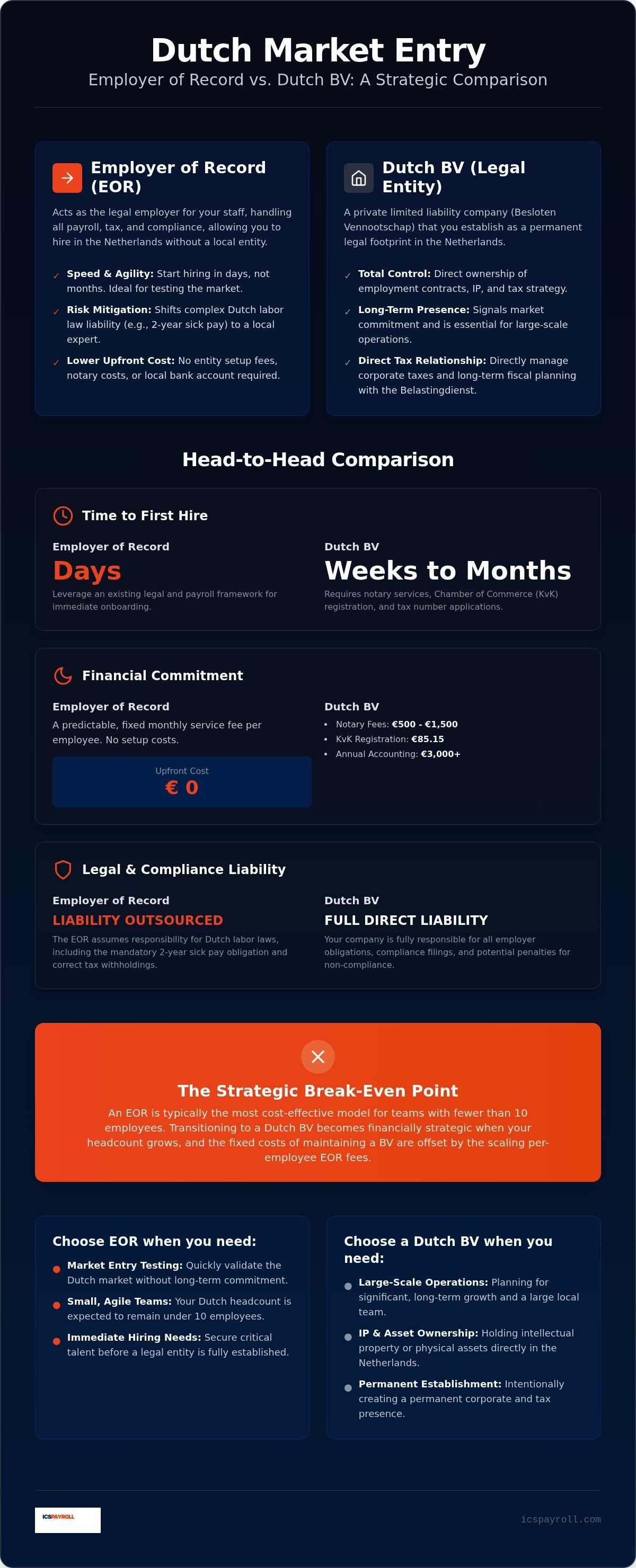
In the Netherlands, a single employee's long-term illness can cost a company up to two years of mandatory salary payments, and up to three if the authorities find your reintegration efforts fell short. It's a liability that often catches foreign businesses completely off guard. You want to tap into the Dutch talent pool quickly, but the choice between an employer of record vs Dutch BV determines how much of that legal and financial risk stays on your books. Establishing a BV offers total control, yet it requires upfront investment in notary fees ranging from €500 to €1,500 and ongoing accounting obligations that can exceed €3,000 annually.
You're likely weighing the prestige of a local entity against the agility of a specialized partner. This guide provides a comprehensive comparison of Dutch market entry strategies to help you decide between establishing a legal entity or leveraging a local Employer of Record. We'll define the financial break-even point between these models and explain how to secure the expat scheme (better known as the 30% ruling) for your highly skilled migrants correctly, including the 2026 salary thresholds and the changes already scheduled for 2027. You'll gain a fast, compliant path to start operations without the heavy administrative debt of a traditional incorporation.
Key Takeaways
- Compare the long-term operational impact of an employer of record vs Dutch BV to determine which model suits your current headcount and growth plans.
- Evaluate the mandatory costs of entity incorporation, including notary fees and annual accounting, against the fixed monthly service fees of a local partner.
- Gain clarity on how an EOR manages complex Dutch labor laws, such as the two-year sick pay obligation and the 30% ruling application process, including the 2026 income norms and the 2027 rate reduction.
- Identify the Permanent Establishment risks that can lead to unforeseen tax consequences when hiring in the Netherlands without a local legal presence.
- Learn the strategic break-even point where transitioning from an outsourced payroll model to a full Dutch BV makes financial sense for your business.
Market Entry Strategies: Defining the EOR and the Dutch BV
In 2026, the Netherlands continues to attract international firms looking for a stable, pro-business environment. Its strategic location and the expat scheme for highly skilled migrants make it a primary hub for European expansion. However, entering this market requires a clear choice between two distinct paths: an employer of record vs Dutch BV. The right decision depends on whether you prioritize immediate operational speed or long-term corporate autonomy.
The core problem for most expanding businesses is the trade-off between control and administrative burden. Establishing a local entity provides total authority but requires significant time and legal maintenance. Conversely, using an outsourced partner allows you to hire in days rather than months. Understanding the technical definitions of these models is the first step in de-risking your Dutch expansion.
The Dutch BV: Total Autonomy
A Dutch BV, or Besloten Vennootschap, is a private limited liability company. It exists as a separate legal entity from your parent organization. This structure ensures your company maintains direct ownership of all local employment contracts and intellectual property. You'll have a direct relationship with the Dutch Tax Administration (Belastingdienst), which is vital for long-term tax planning and corporate reporting.
Operating a BV requires formal registration with the Chamber of Commerce (KVK), which carries a one-off registration fee of €85.15 in 2026, indexed annually for inflation. You must also maintain a registered local business address and appoint a director. While this model offers the highest level of control, it also means your business is fully liable under complex Dutch labor law and for mandatory social security contributions. It's a permanent commitment to the local landscape.
The EOR Model: Outsourced Compliance
An Employer of Record (EOR) acts as the legal employer for your staff in the Netherlands. They handle all payroll, wage tax withholdings, and social security filings on your behalf. This model shifts the administrative burden, and much of the compliance risk, to a local expert. You retain the right to manage the employee's daily tasks and performance, but you don't need to manage the bureaucracy of the Dutch system.
This approach eliminates the need for a local bank account or a registered entity. It's an ideal solution for companies testing the Dutch market or those with a headcount under ten employees. By leveraging an existing compliant payroll infrastructure, you avoid the €500 to €1,500 in notary fees typically required for BV incorporation. It's a faster, lower-risk way to secure talent without the immediate overhead of a full legal presence.
Establishing a Dutch BV: The Cost of Total Control
Opting for a Dutch BV provides your business with a permanent footprint in the Netherlands. It's a signal of long-term commitment to the market. However, this autonomy is not free. When evaluating the employer of record vs Dutch BV, you must look beyond the initial setup and consider the ongoing administrative debt. Maintaining a legal entity requires a constant cycle of filings, tax representations, and legal oversight that can drain resources if not managed correctly.
The financial commitment begins with incorporation. While there's no minimum share capital requirement, you'll face notary fees typically ranging from €500 to €1,500, plus the €85.15 KVK registration fee, putting realistic total setup costs at roughly €600 to €1,600, before any legal or tax advice. These figures only represent the price of entry. The real weight lies in the annual accounting obligations. Most small BVs spend between €1,500 and €3,000 per year on bookkeeping, VAT filings, and corporate tax returns. Corporate income tax in 2026 is levied at 19% on taxable profits up to €200,000 and 25.8% on everything above that threshold, a competitive fiscal environment, but one that requires meticulous reporting to avoid penalties.
Steps to Incorporate a BV in 2026
Incorporation is a multi-step legal process. First, a Dutch notary must draft and execute the deed of incorporation. Once the KVK registration is complete, your business must apply for a VAT (BTW) number and a payroll tax number from the Belastingdienst. You'll also need to appoint a director. If the director is also a major shareholder (a DGA), specific rules apply: holding 5% or more of the shares triggers the substantial-interest regime and the mandatory customary-salary rules, while the exemption from employee insurance schemes depends on whether the director effectively controls their own dismissal, a control test, not simply a shareholding percentage. This complexity is why many expanding firms find that Dutch payroll administration is a necessary support pillar for their local entity.
The Burden of Dutch Labor Law Compliance
The most significant risk of owning a BV is the direct liability under Dutch labor law, which is famously protective of employees. A critical example is the continued-payment-during-illness obligation of Article 7:629 of the Dutch Civil Code. This obliges you to pay at least 70% of an employee's salary for up to two years (104 weeks) if they fall ill, and in the first year, the payment may not fall below the statutory minimum wage. Alongside this, the Wet verbetering poortwachter imposes a structured reintegration process, with mandatory involvement of a company doctor or occupational health service. If the UWV (Employee Insurance Agency) finds that you did too little on reintegration, it can extend your wage-payment obligation by up to a third year.
Furthermore, you must navigate the "ketenregeling" or chain-of-contracts rule. This regulation limits you to three consecutive fixed-term contracts within a 36-month period (with gaps of no more than six months between them). If you exceed either limit, the contract automatically converts into a permanent one, unless an applicable Collective Labour Agreement provides otherwise. Many industries also fall under Collective Labour Agreements (CAO), which may mandate higher wages, more vacation days, or better sick pay than the statutory minimums. Managing these nuances requires a level of local expertise that goes far beyond standard HR practices. Choosing the employer of record vs Dutch BV often comes down to whether you're prepared to handle these legal complexities yourself or whether you'd prefer to offload them to a specialized partner.
The Employer of Record Alternative: Speed and Risk Mitigation
For many international firms, the choice of an employer of record vs Dutch BV is driven by the need for immediate market entry. While a BV requires weeks or months of legal preparation, an EOR allows you to hire and onboard Dutch talent in just a few business days. This model bypasses the need for local incorporation entirely. You avoid the logistical hurdles of finding a physical office and opening a Dutch bank account, which has become increasingly difficult for foreign entities due to stringent "Know Your Customer" (KYC) regulations.
The primary advantage of an EOR is the shift in legal employer responsibility. The EOR serves as the official legal employer, assuming responsibility for payroll accuracy, social security contributions, and wage tax filings with the Belastingdienst. If a payroll compliance error occurs, the primary exposure rests with the EOR, not your parent company. This arrangement provides a protective buffer, allowing your team to focus on business growth while a local expert manages the complexities of Dutch labor regulations and administrative precision.
Simplifying the Expat Scheme (30% Ruling) Application
The expat scheme, still widely known as the 30% ruling, is arguably the most significant tax incentive for attracting international talent to the Netherlands. In 2024 through 2026, it allows employers to pay up to 30% of a qualified employee's salary tax-free for a maximum of five years. Two important limits apply. First, the ruling is capped at the WNT norm, set at €262,000 of salary for 2026. This cap has applied to new cases since 2024 and, from 1 January 2026, applies to all employees using the ruling, making the maximum tax-free reimbursement €78,600 per year. Second, for employees whose ruling started on or after 1 January 2024, the tax-free percentage drops to 27% from 1 January 2027, and the income norms rise at the same time.
Eligibility depends on specific salary thresholds and proof that the employee was recruited from abroad, including the 150-kilometre residence test: the employee must have lived more than 150 km from the Dutch border for more than 16 of the 24 months before their first working day in the Netherlands. For 2026, the employee's taxable annual salary, excluding the tax-free allowance, must exceed €48,013. A reduced norm of €36,497 applies to employees who hold a qualifying master's degree, up to and including the month in which they turn 30. When comparing an employer of record vs Dutch BV, it's vital to note that a specialized EOR handles this entire application process, files the request with the Belastingdienst within the required window, and monitors the income norm every year, because if the salary drops below the norm, the ruling is lost. This prevents the costly retroactive tax adjustments that often plague companies trying to manage the ruling through an in-house BV setup.
Managing Dutch Employee Benefits
Dutch employment contracts carry mandatory benefits that differ significantly from other European markets. A core requirement is the 8% holiday allowance (vakantiegeld), which accrues over the year and is typically paid out in May or June. An EOR ensures this calculation is precise and compliant with the relevant sector's standards. Beyond statutory requirements, a local partner helps you structure competitive pension contributions and insurance packages that resonate with Dutch professionals. This human-led approach ensures your employees receive support in their native language, creating a seamless, localized experience that a faceless global platform cannot replicate.
Direct Comparison: When to Choose EOR vs. Dutch BV
Choosing between an employer of record vs Dutch BV requires a clinical look at your projected headcount and tax exposure. While previous sections detailed the setup costs and legal obligations of each, the strategic decision often hinges on risk tolerance. A Dutch BV is a Dutch tax resident in its own right: your local operations become subject to Dutch corporate income tax from day one, at 19% on profits up to €200,000 and 25.8% above that. Hiring through an EOR, by contrast, means you have no local entity, and provided your employees' activities don't create a Permanent Establishment (for example, by habitually concluding contracts on your behalf), you can typically avoid triggering Dutch corporate tax filings altogether. If your presence is experimental, the EOR is the safer harbor.
Flexibility is the primary driver for firms in the early stages of expansion. Testing the Dutch market with a local team allows you to validate your business model before committing to the legal "administrative debt" of a BV. If the market entry is successful, you can transition from an EOR to your own entity later. This staged approach ensures you don't waste capital on notary fees and registration if your strategic direction shifts. It's about maintaining agility while ensuring your staff remains fully protected by local standards.
The Headcount Break-Even Point
Small teams, typically between one and ten employees, often find the EOR model more cost-effective. When you factor in the €1,500 to €3,000 annual accounting costs and roughly €600 to €1,600 in incorporation expenses for a BV, the per-employee overhead for a tiny team is disproportionately high. The break-even point usually occurs when your team grows beyond ten people. At this stage, the cumulative monthly service fees of an EOR may begin to exceed the fixed costs of maintaining a self-managed legal entity and local payroll infrastructure.
Operational Complexity and Risk
Control over HR policies is a significant differentiator. With a Dutch BV, you have total autonomy to draft custom handbooks and internal regulations. However, this autonomy comes with the burden of staying current with Dutch employment law. You must personally manage the nuances of dismissal law, where the route depends on the ground: economic dismissals and dismissals after two years of illness run through the UWV, while other grounds require the district court or a settlement agreement.
In the EOR model, you rely on the provider's established legal framework. This reduces your administrative burden but means you operate within their compliant templates. For companies that prioritize speed and risk mitigation over granular HR control, the EOR is the logical choice. If you're ready to evaluate which model fits your current hiring plan, our specialist team can calculate your specific break-even point.
Strategic Decision-Making: Scaling with ICSPayroll
Deciding between an employer of record vs Dutch BV is a milestone in your international growth. While global generalist platforms offer broad coverage, they often lack the technical depth required to navigate the specificities of the Dutch market. ICSPayroll operates as a specialized local expert. We provide a human-led approach that ensures your expansion is built on a foundation of administrative precision and legal security. Our team doesn't rely on automated tickets; we provide direct access to specialists who understand the local landscape intimately.
The transition from an EOR model to a full Dutch BV is a natural progression for many scaling businesses. When your team reaches the break-even point discussed in the previous section, you may decide to plant permanent roots. ICSPayroll facilitates this evolution. We can transition from being the legal employer to providing professional Dutch payroll administration for your newly incorporated entity. This ensures continuity for your employees and maintains the integrity of your expat scheme decisions and pension contributions during the corporate shift.
Why Local Expertise Matters in the Netherlands
Success in the Dutch market requires more than just processing payments. It involves active communication with the Belastingdienst and the IND (Immigration and Naturalisation Service). Our deep focus on the Netherlands allows us to manage these relationships effectively. We stay ahead of the 2026 income norms for the expat scheme, the scheduled 2027 changes, and the salary thresholds for highly skilled migrants, which, importantly, are separate IND figures and not the same numbers as the expat scheme's income norm. Every employment contract we issue reflects current market standards for benefits and allowances. We act as your protective guardian, removing the administrative burdens that often stall international operations.
Next Steps for Your Dutch Expansion
The path you choose today will dictate your operational agility for years to come. To make an informed choice, you must assess your current hiring timeline and long-term headcount goals. We recommend a structured approach to your market entry:
- Evaluate your immediate hiring needs and the seniority of your Dutch staff.
- Request a customized cost comparison to see the financial impact of an EOR versus a self-managed BV.
- Review our Employer of Record Netherlands 2026 guide for a deeper dive into compliant hiring practices.
- Consult with our team to verify your employees' eligibility for the expat scheme under the 2026 income norms, and to model the impact of the 2027 reduction to 27% on your compensation planning.
Our goal is to provide the clarity you need to move from curiosity to confidence. Whether you require the rapid deployment of an EOR or the administrative support for a new Dutch BV, we ensure your business remains compliant, efficient, and ready to scale.
Accelerating Your Dutch Market Entry with Confidence
The decision between an employer of record vs Dutch BV marks the transition from planning to execution. As explored, the EOR model provides a rapid, lower-risk entry point for teams under ten, while the Dutch BV serves as a permanent vehicle for larger operations. By understanding the financial break-even point and the operational burden of local compliance, you can choose a path that aligns with your specific growth timeline and risk tolerance. This choice is about more than just paperwork; it's about building a sustainable presence in a competitive market.
ICSPayroll acts as your local guardian in this complex landscape. We offer a specialized Dutch market focus and expert management of the expat scheme to ensure your highly skilled migrants are supported from day one. Our processes are fully compliant with 2026 Dutch labor regulations, giving you the security to focus on your core business goals. Consult with ICSPayroll to find the best hiring strategy for your Dutch team and take the first step toward a successful expansion.
Sources and references
Every rule and figure above is traceable to the sources below: the exact statutory articles, the regulator pages that publish the amounts, the statistical datasets, and the specific court rulings that settle the point. Always check the current text for your own situation.
- Article 7:610 Dutch Civil Code, definition of the employment contract
- Article 7 Minimum Wage Act, entitlement to the statutory minimum wage
- Article 3 Corporate Income Tax Act 1969, foreign taxpayers with a Dutch permanent establishment
- KVK Netherlands Chamber of Commerce, registration and legal form requirements
- Belastingdienst, registering as an employer and obtaining a wage tax number
- IND, required gross monthly salary amounts for 2026 per permit category
- CBS, Compensation of employees and employment by economic activity (national accounts dataset 84165ENG)
- Eurostat, hourly labour cost levels by NACE activity (dataset lc_lci_lev), for cross-country comparison
- Supreme Court 24 March 2023, ECLI:NL:HR:2023:443 (Deliveroo): the test for qualifying a relationship as an employment contract under art. 7:610 BW
- Supreme Court 6 June 2025, ECLI:NL:HR:2025:850: profit attribution and permanent establishment under arts. 7 and 23 of the Netherlands-Belgium tax treaty

Article by
Joost Hubregtse
Joost Hubregtse is Director of ICS Staffing & Payroll B.V., the wholly owned subsidiary of Intercompany Solutions behind ICS Payroll. He is responsible for Employer of Record and Dutch payroll services: employment contracts, wage tax and social security filings, holiday allowance, pension, sick leave and CAO compliance, with onboarding possible within 48 hours.

Frequently Asked Questions
Yes. The EOR acts as the official legal employer and manages the entire application process with the Belastingdienst, filing the joint request within the required period after the employment starts. They verify that the employee was genuinely recruited from abroad and meets the 150-kilometre residence test. This setup provides a significant tax advantage for highly skilled migrants without requiring your company to manage the administrative complexity of the application yourself.
Hiring in the Netherlands without a local legal entity is perfectly legal when leveraging an EOR. The EOR assumes all legal employer responsibilities, including payroll and tax compliance. This model is a recognized method for international companies to enter the Dutch market quickly. It allows you to maintain a compliant workforce while the EOR serves as the local bridge to the Dutch authorities.
Setting up a Dutch BV involves several mandatory costs. Notary fees for the deed of incorporation typically range from €500 to €1,500. Registration with the Chamber of Commerce (KVK) costs €85.15 in 2026; this fee is indexed annually. Beyond setup, you should budget €1,500 to €3,000 annually for mandatory accounting and tax filings. These fixed costs apply regardless of your team size, making it a significant long-term commitment.
Onboarding an employee through a Dutch EOR typically takes just a few business days. Unlike a BV setup, which requires weeks of legal preparation, the EOR has a compliant payroll infrastructure ready for immediate use. Once the employment contract is signed, the EOR handles the registration with the tax authorities. This speed allows you to secure top talent and start operations almost instantly.
If an employee falls ill long-term, the EOR manages the mandatory sick pay obligation: at least 70% of salary for up to two years, with a minimum-wage floor in the first year. They also run the reintegration process required by the Wet verbetering poortwachter, working with occupational health experts to ensure all legal steps are followed on time, which matters, because inadequate reintegration can extend the wage obligation by up to a third year. The EOR remains the responsible legal employer throughout the illness.
Yes, at any time. This is a common strategy for companies that have reached their financial break-even point. When you're ready, the employment relationships are transferred to your new legal entity. A specialized partner can assist in this transition and coordinate with the Belastingdienst so that benefits like the expat scheme continue correctly under the new employer.
Using an EOR significantly reduces Permanent Establishment (PE) risk compared to operating in the Netherlands yourself. Since the EOR is the legal employer and you have no local entity, you typically avoid triggering Dutch corporate income tax. However, PE risk ultimately depends on the specific activities your employees perform: for example, habitually negotiating and concluding contracts on your behalf can still create a taxable presence. It's essential to consult a local expert to evaluate your operational structure.
For 2026, the expat scheme requires a taxable annual salary, excluding the tax-free allowance, of more than €48,013. A reduced norm of more than €36,497 applies to employees with a qualifying master's degree, up to and including the month in which they turn 30; from the following month, the general norm applies. Scientific researchers at designated institutions and doctors in specialist training are exempt from the salary norm. The norm must be met every year, not just at the start, and from 2027 both norms rise (to €50,436 and €38,388) alongside the reduction of the tax-free percentage to 27% for rulings that began in 2024 or later.