Multi-Country EOR vs. Local EOR in the Netherlands: 2026 Comparison Guide
By Joost Hubregtse, Director, ICS Staffing & Payroll
All blog posts are reviewed and fact checked by our labour law lawyer Zishan Hussain and our director. Editorial standards
Scaling your team into the Netherlands in 2026 requires more than a sleek dashboard; it demands a defensive shield against some of the most protective labor laws in Europe. When deciding between a multi-country EOR vs local EOR NL, you likely recognize that while global platforms offer broad convenience, they often struggle with the granular nuances of Dutch compliance. Navigating dismissal procedures, the payroll regime under Dutch law, or the 2026 30% ruling salary thresholds requires specialized local knowledge that automated "bot-wall" support simply cannot provide.
This comparison guide demonstrates why a specialized local partner provides superior security for your Dutch operations. You'll discover how to manage the €48,013 taxable salary norm for the 30% ruling and why direct access to experts ensures onboarding happens in weeks rather than months. We provide a transparent look at the 2026 landscape, from the €14.99 minimum hourly wage (in force since 1 July 2026) to the complexities of the Wet DBA and the upcoming Wtta admission system, ensuring your expansion remains compliant and operationally efficient.
Key Takeaways
- Understand how an Employer of Record (EOR) removes the need to incorporate a local Dutch BV while keeping your workforce legally employed under Dutch law.
- Learn why local expertise is essential for managing the "Ketenregeling" (chain rule) and the equal-treatment rules that apply to Dutch payroll arrangements.
- Master the 2026 tax updates, including the €48,013 taxable salary norm for the 30% ruling and the cap on the tax-free allowance that applies to all users from 2026.
- Analyze the strategic differences between a multi-country EOR vs local EOR NL to identify which provider type offers the security your business model requires.
- Prepare for the Wtta admission system: registration with the new Dutch labour-market authority opens in late 2026, the law takes effect on 1 January 2027, and enforcement starts on 1 January 2028.
Defining the EOR Landscape in the Netherlands for 2026
An Employer of Record (EOR) functions as the formal, legal employer of your staff within a specific jurisdiction. In the Netherlands, this model is effective for international companies that want to hire talent without the administrative burden of establishing a Dutch BV. The EOR takes on the legal employer obligations, including payroll processing, wage tax withholding, and compliance with the Dutch Tax and Customs Administration (Belastingdienst). It's a strategic solution that allows you to start operations in weeks while local employment rules are met.
The structure relies on a triangular relationship. You maintain operational control over the employee's daily tasks, performance and project deadlines; the EOR manages the legal employment framework. Important to know: under Dutch law, an EOR arrangement generally qualifies as making workers available to a third party, and in most configurations as a payroll agreement. That means the worker is entitled to at least the same employment conditions as comparable employees at your organization, including, since 2021, an adequate pension arrangement. A serious local EOR builds this into the contract and the quote from day one, rather than working from a standardized global template.
Record-keeping is also regulated in layers: the payroll administration falls under the general fiscal retention obligation of 7 years, specific wage-tax documents such as the employee's ID copy and wage-tax statement must be kept for 5 full calendar years after the employment ends, while under the GDPR most other personnel-file items should not be kept longer than roughly 2 years after exit. A blanket "keep everything for 7 years" approach is neither required nor privacy-compliant; precision matters here too.
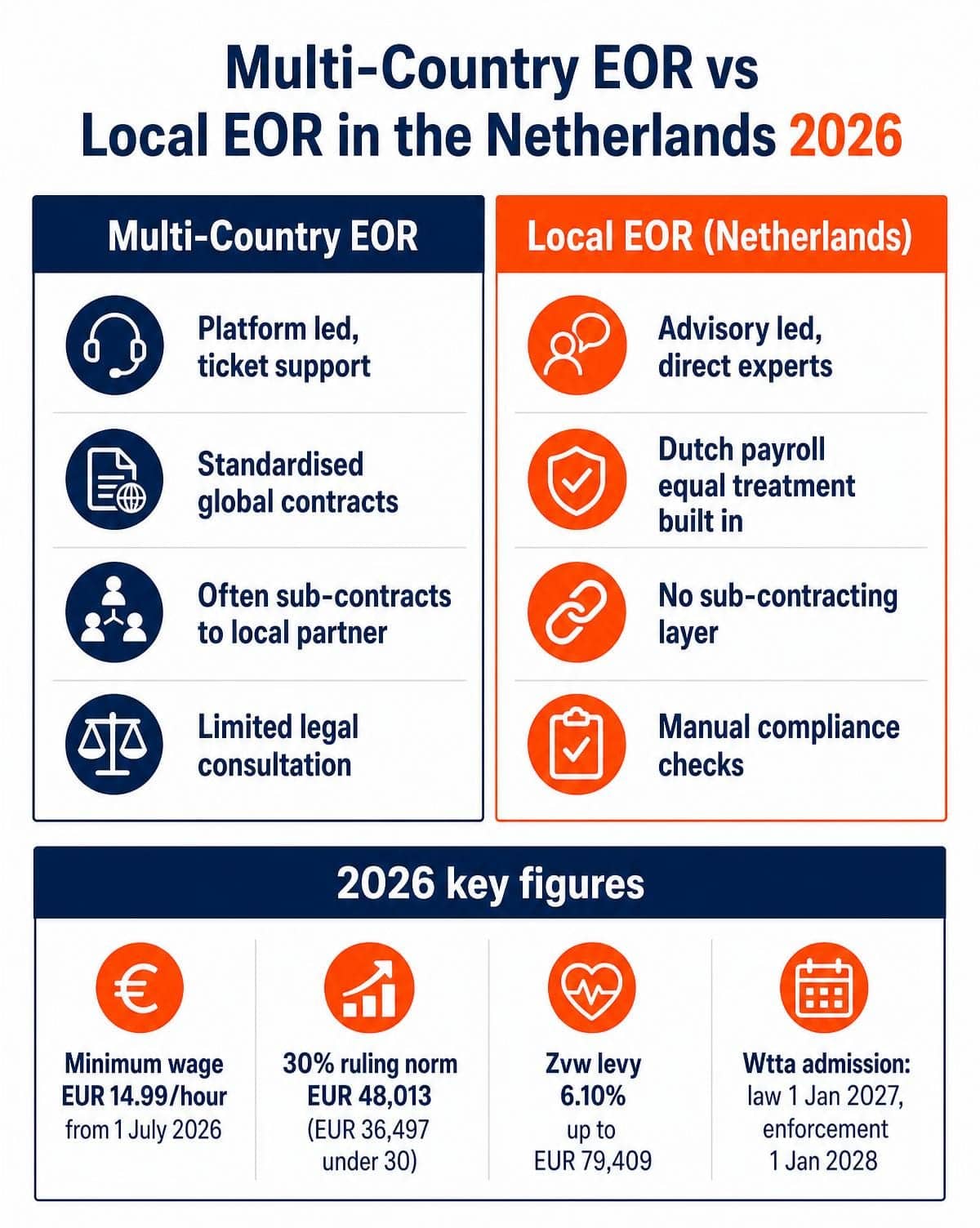
For 2026, the EOR must ensure all statutory requirements are met with precision. This includes the minimum hourly wage of €14.99 for workers aged 21 and over, which applies since 1 July 2026 (it was €14.71 from 1 January to 30 June 2026; the amount is indexed every 1 January and 1 July). The statutory holiday allowance of 8% of the wage is a further core requirement (for salaries above three times the minimum wage, written deviation is possible). Employer contributions, such as AWf (WW premium, 2.74% low / 7.74% high rate), Aof (6.27% / 7.63%), the Whk premium and the employer Zvw levy of 6.10%, calculated up to the 2026 maximum contribution wage of €79,409, must be handled correctly. Errors lead to correction obligations and additional assessments from the Belastingdienst, and minimum-wage violations can result in fines from the Netherlands Labour Authority (Nederlandse Arbeidsinspectie).
Multi-Country EOR: The Generalist Approach
These providers focus on scale and are designed for firms hiring across dozens of countries simultaneously. They prioritize dashboard automation and standardized global contracts. However, they often rely on third-party aggregators in the Netherlands, which can cause delays when resolving complex local issues. Standardized global contracts also sit uneasily with the Dutch payroll regime, where employment conditions must track those of the client, a nuance generalists frequently miss.
Local EOR: The Specialist Approach
A local specialist operates directly within the Dutch system. They provide immediate access to experts who understand the nuances of the 30% ruling and the 2026 taxable salary norm of €48,013. Because they don't use sub-contractors, communication is faster. For those requiring highly skilled migrant support, immigration sponsorship is arranged via our licensed partner. This ensures that specialized tax advantages and visas are managed without the friction of a global helpdesk.
The Risks of Global Generalism vs. Local Expertise
Choosing between a multi-country EOR vs local EOR NL often comes down to the depth of local risk management. Global generalists provide a single dashboard for dozens of countries, but typically function as aggregators: they sub-contract the actual employment of your Dutch staff to a third-party partner. This hidden layer creates communication friction and leaves you behind a "bot-wall" when urgent legal questions arise. A local specialist removes this barrier by providing direct, human-led support.
Compliance with 2026 Dutch Labor Laws
Precision is vital when managing the "Ketenregeling" or chain rule. Dutch law currently allows a maximum of three consecutive fixed-term contracts within a 36-month period before an indefinite contract arises by operation of law; a new chain only starts after an interval of more than six months between contracts. Note that reform is coming: under the pending "Wet meer zekerheid flexwerkers," that interval is set to be extended substantially (the equal-treatment rules for agency workers are expected first, with the amended chain rule to follow, current planning points to 2027-2028). Local specialists track these timelines and the legislative pipeline.
For the second half of 2026, ensure your hourly rates meet the minimum wage of €14.99 (21 and over). The transition payment (transitievergoeding) accrues from the first day of employment, a rule in force since 2020, at one-third of a gross monthly salary per year of service, and is capped in 2026 at €102,000 gross, or one gross annual salary if that is higher. Probation periods are strictly regulated: no probation at all is permitted in contracts of six months or shorter; a maximum of 1 month applies to fixed-term contracts of more than six months but less than two years; and a maximum of 2 months applies to indefinite contracts and fixed-term contracts of two years or longer. Managing these details correctly requires a partner who isn't distracted by the laws of fifty other nations.
There is also a structural change every user of an EOR must prepare for: the Wet toelating terbeschikkingstelling van arbeidskrachten (Wtta). From 1 January 2027, companies that make workers available, which includes EOR and payroll providers, must operate under an admission system supervised by the new Nederlandse Autoriteit Uitleenmarkt. Providers must register in late 2026 to benefit from the transitional regime, apply for admission in 2027, and from 1 January 2028 the Labour Inspectorate will enforce the rules, with fines for both non-admitted providers and the clients who use them. Ask any prospective EOR, global or local, how they are preparing.
The Sickness and Disability Challenge
The Netherlands has some of the world's most protective sickness laws. Employers must continue to pay at least 70% of the employee's wages for up to 104 weeks of illness. In the first 52 weeks, if 70% falls below the statutory minimum wage, the employer must top up to that minimum. Be aware of two further exposures: most CAOs and market practice provide 100% in the first year, and if the UWV finds the re-integration efforts insufficient, it can extend the wage-continuation obligation by up to 52 additional weeks (the "loonsanctie"), effectively a third year. Global platforms often struggle to integrate insurance coverage against this risk; a local EOR provides better-integrated solutions and handles sickness notifications and re-integration reporting toward the UWV. For companies recruiting abroad, the Highly Skilled Migrant (HSM) route requires strict salary adherence; since immigration sponsorship is arranged via our licensed partner, IND requirements are managed carefully.
Compliance Deep-Dive: HSM Visas and the 30% Ruling
The 30% ruling (now formally the "expatregeling") remains one of the most effective tools for attracting international talent. It allows employers to pay a tax-free allowance for extraterritorial costs of, in 2026, up to 30% of the wage including the allowance (in practice: 30/70 of the taxable wage). Two important changes frame 2026:
- The tapering model (30%/20%/10%) that was briefly introduced for 2024 entrants has been reversed. For 2025 and 2026, the maximum remains a flat 30%. From 1 January 2027, the percentage drops to a flat 27% for the full term, and the salary norms rise; transitional rules protect employees who already used the ruling in December 2023.
- Since 1 January 2026, the cap on the ruling applies to all users without exception: the allowance may only be calculated over salary up to the WNT norm of €262,000, giving a maximum tax-free allowance of €78,600 in 2026. The transitional protection against this cap expired at the end of 2025.
Navigating the 2026 Salary Norms
For 2026, the standard taxable salary norm for the 30% ruling is €48,013. This is the taxable wage after the tax-free allowance has been applied: if the salary is too low to pay a full 30% and still meet the norm, the allowance must be reduced accordingly. For employees younger than 30 who hold a qualifying academic master's degree, a lower norm of €36,497 applies in 2026. Both figures are indexed annually. Note that the 30% ruling salary norms (Belastingdienst) and the highly skilled migrant salary criteria (IND) are two separate tests, assessed by two separate authorities, a common source of confusion that a local specialist untangles before the contract is signed. The 150 km distance requirement (the employee must have lived more than 150 km from the Dutch border for most of the 24 months before the first working day) also needs to be verified up front.
Fast-Track Hiring and Immigration
Hiring a Highly Skilled Migrant requires coordination with the Immigration and Naturalisation Service (IND). Because ICSPayroll prioritizes speed and compliance, immigration sponsorship is arranged via our licensed partner. Applications submitted by a recognized sponsor benefit from the IND's target processing time of two weeks for a complete application; the statutory decision period is 90 days. The 2026 monthly salary criteria (gross, excluding 8% holiday allowance) are: €5,942 for highly skilled migrants aged 30 and over; €4,357 for those under 30; and €3,122 under the reduced criterion for recent graduates in the Netherlands or from qualifying top international universities (the reduced criterion is not age-dependent). The criterion applicable on the application date governs the permit.
Decision Framework: When to Choose Local over Global
Choosing between a multi-country EOR vs local EOR NL depends on your expansion strategy. If you're hiring one or two individuals for basic roles in ten countries simultaneously, a global platform offers broad convenience. If the Netherlands is a strategic hub, the risks of non-compliance outweigh the benefits of a global dashboard.
Comparing the Service Models
Global platforms are predominantly platform-led: self-service onboarding, automated payroll, limited legal consultation, ticket-based support. A local EOR like ICSPayroll is advisory-led: tailored service agreements, manual compliance checks, and direct access to experts.
Risk management also extends to workforce classification. For structural, full-time roles, an employment model via an EOR is generally safer than freelance contracts. The Belastingdienst resumed enforcement on false self-employment under the Wet DBA on 1 January 2025. For 2026, a partially extended "soft landing" applies: enforcement in principle starts with a company visit rather than a books investigation, no default penalties (verzuimboetes) are imposed in 2026, and back-assessments cannot reach further back than 1 January 2025, but penalties for demonstrable intent or gross negligence are possible, and enforcement is scheduled to normalize from 2027. Waiting is not a strategy.
On permanent establishment: using an EOR significantly reduces, but does not automatically eliminate, the risk that your company is deemed to have a taxable presence in the Netherlands. PE depends on the applicable tax treaty and the facts, particularly whether staff in the Netherlands habitually conclude contracts or exercise authority on your behalf. A local specialist will flag the configurations that create risk rather than promise a blanket outcome.
Cost Transparency and Invoicing
Financial predictability is a major factor. Global providers frequently hide FX markups or gate legal support behind "enterprise" tiers. ICSPayroll provides a single monthly invoice covering all employment costs: gross salary, the 8% holiday allowance, pension, and the 2026 employer contributions (AWf, Aof, Whk, Zvw over the maximum contribution wage of €79,409). These figures are reflected in your quote from day one, and our administration is maintained in line with the statutory retention rules described above.
ICSPayroll: The Local Specialist for the Dutch Market
ICSPayroll operates as a dedicated partner for businesses that prioritize precision over volume. Led by Joost Hubregtse, our team provides payroll and compliance oversight tailored to the Dutch regulatory environment, including the equal-treatment obligations that apply to Dutch payroll employment. We remove the administrative burden of the 30% ruling and HR administration. For visa support, immigration sponsorship is arranged via our licensed partner in full compliance with IND regulations. We deliver tailored quotations within 24 hours.
Our Commitment to Compliance and Speed
Your operations in the Netherlands can begin before, or entirely without, a Dutch BV. We manage the employment lifecycle including the 8% holiday allowance, sickness risk coverage, and payroll at or above the applicable minimum wage (€14.99 per hour for 21+, second half of 2026). Employees access a secure portal for payslips, contracts and holiday balances. Our administration meets the Belastingdienst's retention standards and the GDPR's limitation principles.
A Collaborative Partnership for Lasting Success
You receive one monthly invoice covering all employment costs, including pension contributions and the employer levies for 2026. Unlike global providers, you won't face bot-walls when navigating technical updates such as the €48,013 salary norm, the 2026 cap on the 30% ruling, or the Wtta preparation timeline. We handle sickness and re-integration reporting toward the UWV and wage-tax filings toward the Belastingdienst so you don't have to.
Secure Your Dutch Expansion with Local Expertise
Success in the Dutch market in 2026 requires a partner that prioritizes technical compliance over global volume. Global platforms lack the specialized depth needed to manage the €48,013 salary norm, the payroll equal-treatment rules, or the "Ketenregeling." Choosing a local specialist means every payroll detail adheres to current Dutch law, including the mid-year changes a global dashboard is slow to pick up, like the 1 July 2026 minimum wage increase.
ICSPayroll facilitates fast-track hiring in weeks rather than months, expert support for the 30% ruling, and immigration sponsorship via our licensed partner. One clear monthly invoice, all statutory obligations, no hidden fees.
Frequently Asked Questions
What is the difference between a global EOR and a local Dutch EOR?
A global EOR manages employees across multiple countries through a standardized platform; a local Dutch EOR focuses exclusively on the Netherlands. Global providers often rely on third-party aggregators and automated helpdesks. Local specialists provide direct access to experts who handle Dutch-specific rules, the 30% ruling, the chain rule, the payroll equal-treatment regime, with higher precision.
How much does it cost to use an Employer of Record in the Netherlands in 2026?
The total cost includes the gross salary, the 8% holiday allowance, pension, and employer contributions (AWf, Aof, Whk and the Zvw employer levy, calculated up to the maximum contribution wage of €79,409). Depending on contract type and sector, employer charges typically add roughly 20-25% to the gross wage. The service fee depends on contract complexity and whether specialized tax applications are needed. We provide transparent single-invoice billing.
Can a local EOR help with the 30% ruling application?
Yes. A local EOR verifies the recruitment-distance criterion (150 km) and ensures the 2026 taxable salary norm of €48,013 (or €36,497 for qualifying under-30 master's graduates) is met and maintained, including the reduction mechanics when a salary sits close to the norm. The application must be filed with the Belastingdienst within four months of the first working day for retroactive effect.
Is ICSPayroll a licensed IND sponsor for highly skilled migrants?
No. Immigration sponsorship is arranged via our licensed partner. This structure allows us to facilitate international hiring while all IND requirements are met by a recognized sponsor.
What are the 2026 salary requirements for hiring internationally in the Netherlands?
Two separate tests apply. For the IND highly skilled migrant permit: €5,942 gross per month (30 and over), €4,357 (under 30), or €3,122 under the reduced criterion for recent graduates, all excluding 8% holiday allowance, paid monthly to the migrant's bank account. For the 30% ruling: a taxable annual salary of at least €48,013 (or €36,497 for under-30 master's graduates). Meeting one test does not automatically satisfy the other.
How long does it take to onboard an employee via a local EOR?
For EU/EER nationals, onboarding typically takes days to a few weeks once documentation is complete. Where an HSM permit is needed, the IND's target processing time for a complete application from a recognized sponsor is two weeks (the statutory maximum is 90 days); allow additional time for MVV collection and travel where applicable.
Does using an EOR in the Netherlands create a Permanent Establishment risk?
An EOR substantially reduces PE risk because the EOR is the legal employer handling all local withholdings, but it does not eliminate it in every scenario. PE is assessed under the applicable tax treaty and depends on the facts, notably whether Netherlands-based staff habitually conclude contracts on your behalf. For most support, delivery and non-sales roles, the EOR model provides a robust framework; for senior commercial roles, seek specific advice.
What is the 2026 minimum wage for employees in the Netherlands?
Since 1 July 2026, the statutory minimum hourly wage for employees aged 21 and over is €14.99 gross (from 1 January to 30 June 2026 it was €14.71). It is indexed every 1 January and 1 July; lower youth rates apply under 21, and a CAO may set higher minimums. The 8% holiday allowance comes on top. Underpayment can lead to fines from the Netherlands Labour Authority.
Sources and references
Every rule and figure above is traceable to the sources below: the exact statutory articles, the regulator pages that publish the amounts, the statistical datasets, and the specific court rulings that settle the point. Always check the current text for your own situation.
- Article 7:692 Dutch Civil Code, the statutory definition of payrolling
- Article 7:690 Dutch Civil Code, the agency work (uitzend) contract
- Article 8 Waadi, equal pay for hired-in workers (loonverhoudingsnorm)
- Stichting Normering Arbeid, the NEN 4400-1 register of audited payroll and staffing companies
- Belastingdienst, low and high AWf unemployment contribution rates and when each applies
- Netherlands Labour Authority, enforcement, inspections and penalty policy
- CBS, Compensation of employees and employment by economic activity (national accounts dataset 84165ENG)
- Eurostat, hourly labour cost levels by NACE activity (dataset lc_lci_lev), for cross-country comparison
- Supreme Court 11 April 2025, ECLI:NL:HR:2025:543: the agency work contract of art. 7:690 BW in a triangular platform-work relationship
- Supreme Court 21 November 2025, ECLI:NL:HR:2025:1733: misuse of successive agency contracts under art. 5(5) Directive 2008/104/EC and the Waadi

Article by
Joost Hubregtse
Joost Hubregtse is Director of ICS Staffing & Payroll B.V., the wholly owned subsidiary of Intercompany Solutions behind ICS Payroll. He is responsible for Employer of Record and Dutch payroll services: employment contracts, wage tax and social security filings, holiday allowance, pension, sick leave and CAO compliance, with onboarding possible within 48 hours.

Frequently Asked Questions
A global EOR manages employees across multiple countries through a standardized platform; a local Dutch EOR focuses exclusively on the Netherlands. Global providers often rely on third-party aggregators and automated helpdesks. Local specialists provide direct access to experts who handle Dutch-specific rules, the 30% ruling, the chain rule, the payroll equal-treatment regime, with higher precision.
The total cost includes the gross salary, the 8% holiday allowance, pension, and employer contributions (AWf, Aof, Whk and the Zvw employer levy, calculated up to the maximum contribution wage of €79,409). Depending on contract type and sector, employer charges typically add roughly 20-25% to the gross wage. The service fee depends on contract complexity and whether specialized tax applications are needed. We provide transparent single-invoice billing.
Yes. A local EOR verifies the recruitment-distance criterion (150 km) and ensures the 2026 taxable salary norm of €48,013 (or €36,497 for qualifying under-30 master's graduates) is met and maintained, including the reduction mechanics when a salary sits close to the norm. The application must be filed with the Belastingdienst within four months of the first working day for retroactive effect.
No. Immigration sponsorship is arranged via our licensed partner. This structure allows us to facilitate international hiring while all IND requirements are met by a recognized sponsor.
Two separate tests apply. For the IND highly skilled migrant permit: €5,942 gross per month (30 and over), €4,357 (under 30), or €3,122 under the reduced criterion for recent graduates, all excluding 8% holiday allowance, paid monthly to the migrant's bank account. For the 30% ruling: a taxable annual salary of at least €48,013 (or €36,497 for under-30 master's graduates). Meeting one test does not automatically satisfy the other.
For EU/EER nationals, onboarding typically takes days to a few weeks once documentation is complete. Where an HSM permit is needed, the IND's target processing time for a complete application from a recognized sponsor is two weeks (the statutory maximum is 90 days); allow additional time for MVV collection and travel where applicable.
An EOR substantially reduces PE risk because the EOR is the legal employer handling all local withholdings, but it does not eliminate it in every scenario. PE is assessed under the applicable tax treaty and depends on the facts, notably whether Netherlands-based staff habitually conclude contracts on your behalf. For most support, delivery and non-sales roles, the EOR model provides a robust framework; for senior commercial roles, seek specific advice.
Since 1 July 2026, the statutory minimum hourly wage for employees aged 21 and over is €14.99 gross (from 1 January to 30 June 2026 it was €14.71). It is indexed every 1 January and 1 July; lower youth rates apply under 21, and a CAO may set higher minimums. The 8% holiday allowance comes on top. Underpayment can lead to fines from the Netherlands Labour Authority.