Permanent Establishment Risk Netherlands: 2026 Compliance Guide
By Joost Hubregtse, Director, ICS Staffing & Payroll
All blog posts are reviewed and fact checked by our labour law lawyer Zishan Hussain and our director. Editorial standards
Your remote sales manager in the Netherlands might be doing more than hitting targets. Depending on what they actually do, they could create a taxable presence for your foreign company. In 2026 the line between a straightforward remote hire and a Dutch permanent establishment is narrower than most directors assume, but it is also better mapped than it was a year ago: the OECD published a substantial revision to its Article 5 Commentary in November 2025, and it introduces the first quantitative test the profession has had for home-office cases.
This guide sets out how permanent establishment risk Netherlands actually works in 2026: where the thresholds sit, which of the OECD's post-BEPS agency rules apply to Dutch treaties and which do not, what a Dutch permanent establishment costs if one is found, and what an Employer of Record can and cannot do about it. We have been deliberate about the last point: an EOR is a genuine risk-reduction tool, but it is regularly oversold.
Key Takeaways
- A Dutch permanent establishment is taxed on the profits attributable to it, not on your worldwide profit.
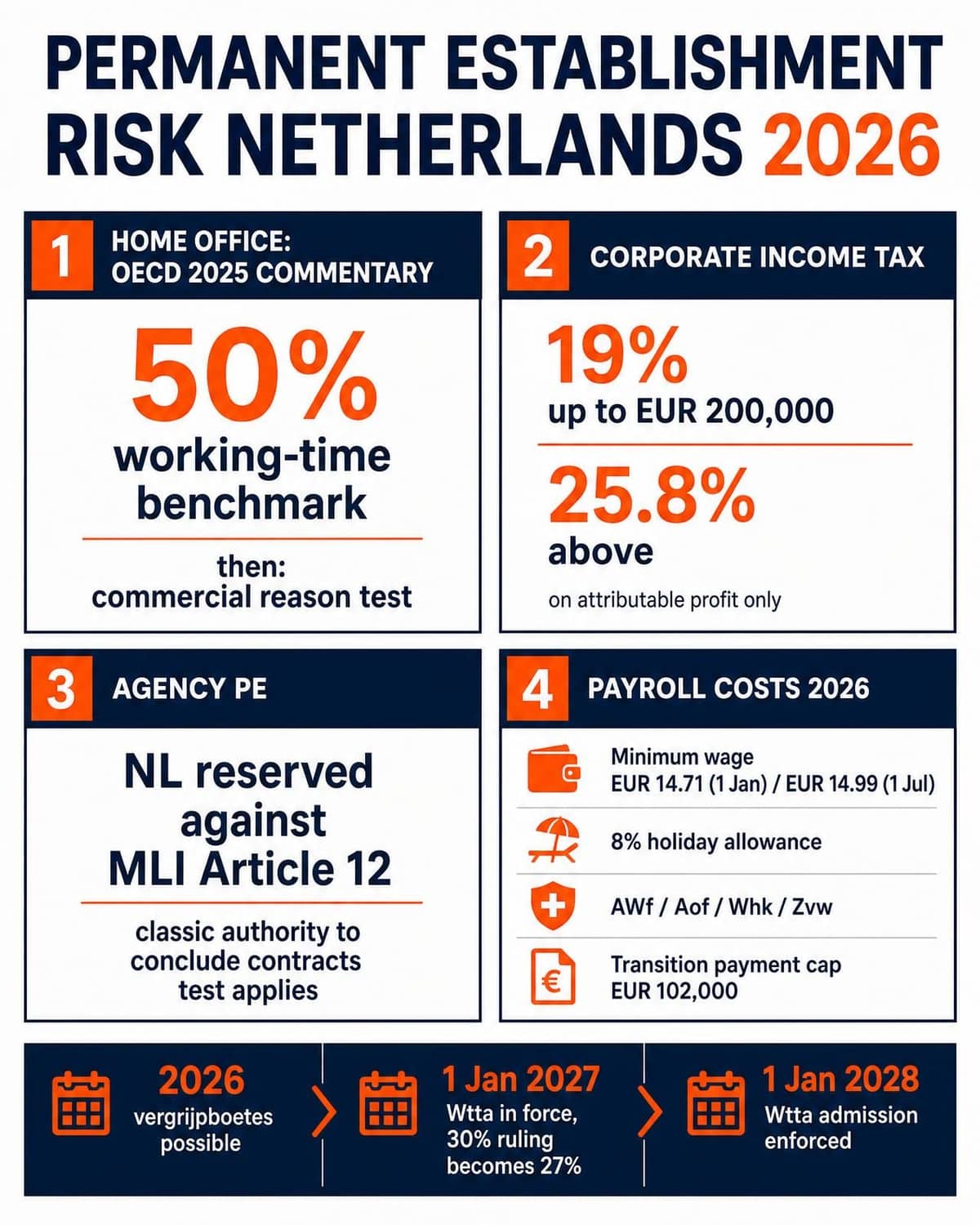
- The OECD's 2025 Commentary update introduces a 50% working-time benchmark and a commercial reason test for home offices, a safe harbour most 2025-era guidance does not reflect.
- The Netherlands reserved against MLI Article 12, so the broadened "principal role" agency test does not reach most Dutch treaties through the MLI. The classic authority-to-conclude-contracts test usually still governs.
- Hiring a ZZP freelancer is not a shield: misclassification is assessed on the real working relationship, and the Belastingdienst has been able to impose vergrijpboetes since 1 January 2026.
- An EOR removes the fixed-place-of-business trigger and the direct employment relationship. It does not by itself defeat a dependent-agent permanent establishment.
Defining Permanent Establishment Risk in the Netherlands
A permanent establishment (PE) is the treaty threshold at which the Netherlands acquires the right to tax part of a foreign company's profit. Historically this meant bricks and mortar. In 2026 the analysis is functional as much as physical: what is being done in the Netherlands, by whom, and with what degree of permanence. Defining Permanent Establishment (primary source: Wet op de vennootschapsbelasting 1969, wetten.overheid.nl) today is a question about function, not only about real estate.
Two consequences follow from PE status. First, Dutch corporate income tax on the attributable profit. For 2026 the rates are 19% on taxable profit up to €200,000 and 25.8% above that, unchanged since 2023. Second, and often more expensive in practice, wage tax and social security obligations.
It is worth being precise about the tax base, because this is where a great deal of published commentary goes wrong. A Dutch PE does not expose your global profit to Dutch tax. Under Article 7 of the applicable treaty and the OECD's authorised approach to profit attribution, the Netherlands may tax only the profit that would be earned by the PE if it were a separate and independent enterprise performing the same functions, using the same assets and bearing the same risks. For a small sales or support presence, that figure is usually modest, but the compliance burden that comes with it is not.
The Fixed Place of Business Test
The classic test asks whether there is a place of business, at the enterprise's disposal, with sufficient permanence, through which the business is carried on. Construction and installation sites are treated separately and are treaty-dependent; most Dutch treaties use a twelve-month threshold, though some run shorter.
The "at the disposal of the enterprise" concept has long been the difficult limb in remote-work cases, and it is precisely the point the OECD addressed in its 2025 Update to the Model Tax Convention, published on 19 November 2025. This was the first comprehensive revision of the Article 5 Commentary since 2017, and it replaced two thin paragraphs on home working with a structured framework.
The 2026 Home Office Framework
The revised Commentary sets out a two-stage analysis.
Stage one, the 50% benchmark. A home or other non-traditional location will generally not be regarded as a place of business of the enterprise where the individual works from it for less than 50% of their total working time for that enterprise, measured over any twelve-month period commencing or ending in the fiscal year concerned. The test is applied to actual conduct, not to what the contract says.
Stage two, the commercial reason test. Where the 50% threshold is met or exceeded, no PE arises automatically. The analysis turns on the facts, and the prominent question is whether the enterprise has a genuine commercial reason for the work to be performed in that country, whether the person's presence there advances the business there, as opposed to reflecting a purely personal choice of residence.
The preparatory-or-auxiliary exception survives both stages. The Commentary expressly notes that home-office activity will often fall within it.
This matters for two reasons. It gives employers a workable safe harbour that did not exist in earlier guidance, and it means a good deal of the alarmist commentary written before late 2025 now overstates the risk for genuinely hybrid arrangements. It remains Commentary rather than treaty text, and some jurisdictions have entered observations, so it informs interpretation rather than binding it.
Withholding Agent Obligations
A PE brings registration as a Dutch withholding agent (inhoudingsplichtige). From that point you withhold Dutch wage tax and employee social security contributions, and you owe employer contributions including AWf (unemployment), Aof (occupational disability), Whk (the differentiated Werkhervattingskas premium) and the Zvw employer levy.
You also take on Dutch employment law in full. That includes Dutch holiday allowance rules: at least 8% of the wage as defined in the Wet minimumloon en minimumvakantiebijslag, payable at least once a year. Note the two qualifications the shorter guides omit: the 8% is calculated on the WML wage concept rather than on every element of gross pay, and for employees earning more than three times the statutory minimum wage it can be reduced or excluded by written agreement.
Payroll administration must be retained for seven years under Article 52 of the Algemene wet inzake rijksbelastingen. A separate clock applies to certain items: the copy of the identity document and the employee's payroll-tax data must be kept for at least five full calendar years after the end of employment. Retaining the entire personnel file for seven years by default is not required and sits awkwardly with GDPR data minimisation.
Myth vs. Reality: Common Misconceptions About Dutch Tax Presence
"No lease, no problem." Not reliable. The absence of a corporate lease does not end the analysis, though after the 2025 Commentary update the position for genuinely hybrid employees is considerably more comfortable than it was.
"A freelancer is a safe buffer." No. Under Dutch law the classification of a working relationship is determined by how the parties actually work together, not by the label on the contract. If the elements of an employment contract under Article 7:610 of the Burgerlijk Wetboek are present, the relationship is an employment relationship. The Hoge Raad's Deliveroo judgment sets out the holistic weighing exercise, and the Belastingdienst has published its own assessment framework built on it. The Ministry of Social Affairs and Employment published a further toetsingskader beoordeling arbeidsrelaties in July 2026.
"A foreign payroll provider solves it." Usually not. A provider without Dutch withholding-agent registration cannot discharge Dutch wage tax and social security obligations on your behalf. If you are unsure where your own arrangement sits, it is worth taking the time to consult with a Dutch payroll specialist.
"A Dutch BV is a permanent establishment." No. A BV is a separate legal person with its own corporate income tax filing obligations. Two caveats: incorporating a BV is not capital-intensive (minimum share capital has been €0.01 since the 2012 Flex-BV reform, so cost is administrative rather than capital), and under Article 5(7) of the OECD Model the mere existence of a subsidiary does not create a PE of the parent, but the subsidiary's activities can still constitute an agency PE of the parent if it habitually concludes contracts on the parent's behalf.
The Home Office in Practice
Applying the 2026 framework: an employee working from a Dutch residence three days in ten for a foreign employer, with the rest of the time at customer sites or abroad, sits below the 50% benchmark and will generally not create a fixed place of business. A senior manager working four or five days a week from a Dutch home, where the employer has a commercial interest in Dutch presence such as a Dutch customer base or Dutch market development, is squarely in stage-two territory and needs a documented analysis. The intermediate case is where the employee lives in the Netherlands purely for personal reasons and the employer has no business interest in the location; the Commentary treats that as pointing away from a place of business.
Misclassification and the Enforcement Timeline
The dates matter, and most 2026 guides get them wrong.
- Until 1 January 2025: the handhavingsmoratorium applied. The Belastingdienst issued instructions rather than assessments except in cases of kwaadwillendheid.
- 1 January 2025: the moratorium ended. Correction obligations and additional wage tax assessments became available immediately, with no prior instruction required. Retroactive collection is limited to periods from 1 January 2025 onward, subject to narrow exceptions.
- During 2025: a "soft landing", with no verzuimboetes and no vergrijpboetes.
- From 1 January 2026: the soft landing is only partly extended. Vergrijpboetes are now possible where there is intent or gross negligence. Verzuimboetes are still not imposed in 2026, and the Belastingdienst in principle still opens with a company visit rather than a books examination. A company visit can produce a warning; an assessment requires a books examination.
- From 1 January 2027: the remaining soft-landing elements lapse.
Model agreements approved by the Belastingdienst remain usable through 31 December 2029, though they only assist to the extent the parties actually work in accordance with them.
Reclassification produces liability for wage tax and social security contributions. Civil claims for CAO terms, pension and minimum wage sit outside the tax authority's remit and are not extinguished by settling with the Belastingdienst.
The Dependent Agent Question: What the MLI Did and Did Not Change
A person acting in the Netherlands on your behalf can create a PE without a square metre of leased space. This is the agency PE, and it is where the most consequential errors appear in published guidance.
Under Article 5(5) of the treaty in its classic form, an agency PE arises where a person, other than an independent agent, habitually exercises authority to conclude contracts in the name of the enterprise. BEPS Action 7 proposed broadening this to catch persons who habitually play the principal role leading to the conclusion of contracts routinely concluded without material modification, the "rubber-stamping" scenario, and that broadening was carried into MLI Article 12.
The Netherlands entered a full reservation against MLI Article 12. Dutch parliament required the reservation on the basis that the profit-attribution rules for agency PEs and the available dispute-resolution mechanisms were not yet adequate. The reservation has not been withdrawn.
The practical consequence is important and widely misstated. For most Dutch treaties, the classic agency test still governs: the question remains whether the person habitually exercises authority to conclude contracts binding the enterprise. The broadened principal-role test reaches Dutch treaties only where it has been introduced bilaterally through renegotiation, and the new Netherlands-Belgium treaty is the clearest example.
The Netherlands did not reserve against the other MLI permanent establishment provisions. The narrowed specific-activity exemptions, the anti-fragmentation rule and the splitting-up-of-contracts rule apply to covered Dutch treaties. So the space for arguing that a Dutch presence is "merely auxiliary" is narrower than it was pre-BEPS, and splitting activities across related entities to stay below thresholds does not work.
Defining Authority to Conclude Contracts
The Belastingdienst looks past the signature block, but under the classic test it is looking for something stronger than participation in a sales process. The question is whether the individual has the functional power to bind the company: to set price, agree commercial terms, or commit to a course of action that headquarters implements as a matter of routine. A representative who generates leads, demonstrates product and passes qualified opportunities to a foreign sales team that genuinely negotiates and decides is in a materially better position than one who agrees terms and sends them home for countersignature.
Job titles are scrutinised but are not determinative. Contemporaneous evidence of where commercial decisions are actually taken, such as approval workflows, pricing authority matrices and CRM records, is what carries weight in an audit.
Preparatory vs. Auxiliary Activities
Market research, information gathering and storage generally remain outside PE status, subject to the narrowed exemptions described above. The line is crossed when the Dutch activity becomes part of the core revenue-generating function rather than support for it. For a sales-led business, a local representative who both originates and closes is performing a core function.
Financial and Legal Consequences of an Unintentional Dutch PE
Where a PE is established retrospectively, exposure runs on two tracks.
Corporate income tax on the attributable profit at 19% up to €200,000 and 25.8% above, plus interest. The attributable profit is determined functionally, not as a share of global profit.
Wage tax and social security, which is usually the larger figure. Failure to register as withholding agent triggers assessments and interest, and potentially penalties. You also become fully bound by employment law in the Netherlands for foreign employers, regardless of what your original foreign contracts stated.
Payroll Tax and Social Security Liabilities
The statutory minimum wage is a single hourly rate applying uniformly across all sectors and to all working patterns; it is indexed on 1 January and 1 July. It rose to €14.71 per hour on 1 January 2026 and to €14.99 per hour from 1 July 2026 for employees aged 21 and over, with youth rates as a percentage of that figure. A CAO can set a higher floor, never a lower one.
On top of base pay sit the 8% holiday allowance and employer contributions to AWf, Aof, Whk and Zvw. Where a CAO or a mandatory sectoral pension fund applies, pension contributions are compulsory as well. There is no universal statutory pension obligation in the Netherlands, so this is fact-specific.
Termination exposure accrues from day one. The transition payment is one third of a month's salary per full year of service, and the 2026 statutory maximum is €102,000 gross, or one gross annual salary where that is higher.
Sickness is the largest single liability and is frequently overlooked in cost modelling. Under Article 7:629 BW the employer continues paying wages for up to 104 weeks of incapacity, at a statutory minimum of 70% (with the first 52 weeks at no less than the applicable minimum wage), together with extensive reintegration obligations under the Wet verbetering poortwachter.
The 30% Ruling and PE Status
The expatriate scheme, formally the expatregeling since 2026 and still widely called the 30% ruling, can only be applied by a Dutch withholding agent, so a PE both creates the obligation and unlocks the facility.
For 2026 the taxable salary norm, measured excluding the tax-free allowance, is €48,013. For employees under 30 holding a Dutch academic master's degree or a verified foreign equivalent, the norm is €36,497 until the month in which they turn 30. Scientific researchers at designated institutions and doctors in specialist training are exempt from the salary norm. The scheme may be applied to salary up to the WNT cap of €262,000, giving a maximum tax-free reimbursement of €78,600 for a full year. A ruling requires a decision from the Belastingdienst and runs for a maximum of five years, reduced by prior periods of residence or work in the Netherlands.
Two forward-looking points for anyone planning 2027 hires: the percentage falls from 30% to a flat 27% from 1 January 2027, with higher salary norms, subject to transitional protection for employees who were already using the scheme in 2024; and 2026 is the final year of the transitional partial non-resident taxpayer status. If you want the numbers modelled for a specific role, you can request a tailored compliance quotation.
What an Employer of Record Does, and Does Not, Solve
An Employer of Record becomes the legal employer of your Dutch staff. The employment relationship exists between the EOR and the worker, and the EOR carries the Dutch payroll, wage tax, social security and employment law obligations.
We want to be precise about what this achieves, because the market routinely overstates it.
What an EOR does address. It removes the direct employment relationship between your foreign entity and the worker. It removes the need for you to register as a Dutch withholding agent for that person. It substantially reduces fixed-place-of-business exposure, because the worker is not your employee working at a location at your disposal. It removes the administrative, and time-consuming, step of incorporating and maintaining a Dutch BV for a small team.
What an EOR does not address. An EOR does not, on its own, defeat a dependent-agent permanent establishment. The agency test in Article 5(5) asks who the person acts on behalf of, not who pays them. If the worker habitually exercises authority to conclude contracts binding your foreign company, the analysis reaches your company whether the payslip says ICS Payroll or not. Nor does an EOR help if you lease dedicated office space in the Netherlands, or if the arrangement is documented one way and operated another. Substance has to match form.
In practice this means the EOR and the commercial mandate have to be designed together. Where a Dutch hire is a sales role, we look at pricing authority, approval workflow and contract execution as part of onboarding, and we document it. That is the part of the exercise that actually manages agency PE risk.
EOR vs. Incorporating a Dutch Entity
For small and medium teams an EOR is frequently the better route than a Dutch BV, but not because a BV is expensive to form. It is because a BV brings its own annual accounts, corporate tax return, filing deadlines and directorship obligations, and because unwinding one is slower than ending a service contract. An EOR is also faster: onboarding is typically possible within days rather than the weeks a KVK and Belastingdienst registration cycle takes.
Where an EOR is the wrong answer: if you need a genuine local balance sheet, if you are hiring at scale, if you require an entity to hold local contracts, IP or regulatory permissions, or if you intend to give Dutch staff genuine contracting authority, in which case you likely have a PE regardless and an entity is the cleaner structure.
Regulatory Context You Should Ask Any Dutch EOR About
Payrolling and secondment constitute the making available of labour under the Wet allocatie arbeidskrachten door intermediairs. Two developments matter.
The Wtta (Wet toelating terbeschikkingstelling van arbeidskrachten) enters into force on 1 January 2027 and introduces a mandatory admission regime. Payrolling, secondment and EOR arrangements fall within scope, as do foreign lenders placing workers in the Netherlands. The admission requirement applies from 1 January 2028, and the Nederlandse Arbeidsinspectie enforces from that date. Critically, penalties fall on hirers as well as lenders: engaging a non-admitted provider from 2028 is itself an offence. Ask any Dutch EOR provider directly about SNA certification and Wtta readiness.
The Wet meer zekerheid flexwerkers was approved by the Eerste Kamer on 7 July 2026. Equivalent terms of employment for agency workers apply from 31 December 2026 (already implemented in the ABU and NBBU CAOs from 1 January 2026). The remaining elements, the tightened ketenregeling and the bandbreedtecontract replacing zero-hours and min-max contracts, are scheduled for 1 January 2028.
On the current ketenregeling: a maximum of three fixed-term contracts within 36 months, after which an indefinite contract arises by operation of law. The chain currently breaks after an interruption of six months (three months for seasonal work). From 2028 that interruption period extends to 36 months, which will make revolving fixed-term arrangements substantially harder. If you are structuring contract chains now, structure them for the 2028 rule.
Immigration
For nationals of countries outside the EU, EEA and Switzerland, a residence permit is required. Under the highly skilled migrant scheme the IND requires the recognised sponsor (erkend referent) to be the entity holding the employment contract. This is a genuine constraint on EOR structures, and the government has signalled an intention to restrict payroll and agency companies from acting as recognised sponsors. We confirm in writing, before onboarding, which entity will hold recognised sponsor status for a given hire and whether the structure works for that nationality and role. Where it does not, incorporating an entity and obtaining recognition directly is the correct route, and we will say so.
Securing Your Dutch Expansion Against Future Tax Audits
Managing permanent establishment risk in the Netherlands in 2026 comes down to three things: knowing where the thresholds actually sit, including the 50% home-office benchmark that most guidance still omits, knowing which agency rules apply to your specific treaty, and documenting where commercial decisions are genuinely taken.
An EOR is a good answer to the fixed-place and direct-employment limbs. It is not an answer to the agency limb, and any provider telling you otherwise is selling rather than advising. The structure has to be paired with a mandate that keeps contracting authority outside the Netherlands, or with an honest acknowledgement that a PE exists and should be registered and priced properly.
We are happy to run a written assessment of a specific role against the 2026 framework and tell you which of those two positions you are in.
Frequently Asked Questions
Does hiring one remote employee in the Netherlands create a permanent establishment?
There is no minimum headcount. Whether a single hire creates a PE depends on what they do and how much time they spend doing it in the Netherlands. Under the OECD's 2025 Commentary a home office will generally not be a fixed place of business where the individual works from it for less than 50% of total working time over a twelve-month period. Above that, the analysis turns on whether the enterprise has a commercial reason for the work being performed in the Netherlands, and whether the activity is more than preparatory or auxiliary. Separately, a single employee with authority to conclude contracts can create an agency PE regardless of time spent. The Belastingdienst assesses the facts rather than the headcount.
What activities of a sales representative trigger PE risk in the Netherlands?
Under the classic agency test that applies to most Dutch treaties, the trigger is habitual exercise of authority to conclude contracts binding the foreign company, including where terms are agreed locally and headquarters signature is a formality. Generating leads, demonstrating product and supporting a foreign sales team that genuinely negotiates and decides sits on the safer side of the line. The broader "principal role" test from BEPS Action 7 does not apply to most Dutch treaties, because the Netherlands reserved against MLI Article 12.
Can a home office be a permanent establishment in 2026?
Yes, but the test is now more structured. The OECD's November 2025 Commentary update provides that a home will generally not be a place of business below 50% of total working time. At or above 50%, the facts decide, with the prominent question being whether there is a commercial reason for the person's presence in the Netherlands. Purely personal reasons for living there point away from a PE. The preparatory-or-auxiliary exception applies at every stage.
Does an Employer of Record eliminate permanent establishment risk?
It substantially reduces it, but it does not eliminate it. An EOR removes the direct employment relationship and the fixed-place-of-business trigger. It does not defeat a dependent-agent PE, because that test looks at who the individual acts on behalf of rather than who employs them. An EOR arrangement paired with a Dutch worker holding contracting authority for the foreign client can still produce a PE for the client.
What are the 2026 salary requirements for the 30% ruling?
For 2026 the taxable salary norm, measured excluding the tax-free allowance, is €48,013. For employees under 30 with a Dutch academic master's degree or a verified equivalent, it is €36,497 until the month they turn 30. The scheme applies to salary up to €262,000, giving a maximum tax-free reimbursement of €78,600 for a full year. From 1 January 2027 the percentage falls to 27% with higher norms, subject to transitional protection for employees already covered in 2024.
What happens if the Belastingdienst determines my company has a PE?
You register as taxpayer and as withholding agent, and face assessments for corporate income tax on the profit attributable to the PE at 19% up to €200,000 and 25.8% above, plus wage tax and employer contributions for AWf, Aof, Whk and Zvw, with interest. Note that corporate income tax attaches to attributable profit, not worldwide profit, a distinction that materially changes the exposure figure.
Is a Dutch BV a permanent establishment of its foreign parent?
No. A BV is a separate legal person with its own corporate income tax obligations, and Article 5(7) of the OECD Model confirms that control alone does not make a subsidiary a PE of its parent. However, a subsidiary's activities can constitute an agency PE of the parent if it habitually concludes contracts on the parent's behalf.
How long must Dutch payroll records be retained?
The payroll administration must be kept for seven years under Article 52 AWR. A copy of the identity document, the employee's payroll-tax data and related declarations must be kept for at least five full calendar years after the end of employment. Other personnel documents should not be retained by default for the full seven years, since GDPR data minimisation requires retention to be limited to what is necessary.
Sources and references
Every rule and figure above is traceable to the sources below: the exact statutory articles, the regulator pages that publish the amounts, the statistical datasets, and the specific court rulings that settle the point. Always check the current text for your own situation.
- Article 3 Corporate Income Tax Act 1969, foreign taxpayers with a Dutch permanent establishment
- Article 52 General Tax Act, the 7-year payroll record-keeping obligation
- Article 20a Wage Tax Act 1964, the wage tax bracket rates
- Belastingdienst, registering as an employer and obtaining a wage tax number
- KVK Netherlands Chamber of Commerce, registration and legal form requirements
- Belastingdienst, filing the payroll tax return (aangifte loonheffingen) and its deadlines
- CBS, Compensation of employees and employment by economic activity (national accounts dataset 84165ENG)
- CPB Netherlands Bureau for Economic Policy Analysis, wage and contract-cost projections
- Supreme Court 6 June 2025, ECLI:NL:HR:2025:850: profit attribution and permanent establishment under arts. 7 and 23 of the Netherlands-Belgium tax treaty
- Supreme Court 24 March 2023, ECLI:NL:HR:2023:443 (Deliveroo): the test for qualifying a relationship as an employment contract under art. 7:610 BW

Article by
Joost Hubregtse
Joost Hubregtse is Director of ICS Staffing & Payroll B.V., the wholly owned subsidiary of Intercompany Solutions behind ICS Payroll. He is responsible for Employer of Record and Dutch payroll services: employment contracts, wage tax and social security filings, holiday allowance, pension, sick leave and CAO compliance, with onboarding possible within 48 hours.

Frequently Asked Questions
There is no minimum headcount. Whether a single hire creates a PE depends on what they do and how much time they spend doing it in the Netherlands. Under the OECD's 2025 Commentary a home office will generally not be a fixed place of business where the individual works from it for less than 50% of total working time over a twelve-month period. Above that, the analysis turns on whether the enterprise has a commercial reason for the work being performed in the Netherlands, and whether the activity is more than preparatory or auxiliary. Separately, a single employee with authority to conclude contracts can create an agency PE regardless of time spent. The Belastingdienst assesses the facts rather than the headcount.
Under the classic agency test that applies to most Dutch treaties, the trigger is habitual exercise of authority to conclude contracts binding the foreign company, including where terms are agreed locally and headquarters signature is a formality. Generating leads, demonstrating product and supporting a foreign sales team that genuinely negotiates and decides sits on the safer side of the line. The broader "principal role" test from BEPS Action 7 does not apply to most Dutch treaties, because the Netherlands reserved against MLI Article 12.
Yes, but the test is now more structured. The OECD's November 2025 Commentary update provides that a home will generally not be a place of business below 50% of total working time. At or above 50%, the facts decide, with the prominent question being whether there is a commercial reason for the person's presence in the Netherlands. Purely personal reasons for living there point away from a PE. The preparatory-or-auxiliary exception applies at every stage.
It substantially reduces it, but it does not eliminate it. An EOR removes the direct employment relationship and the fixed-place-of-business trigger. It does not defeat a dependent-agent PE, because that test looks at who the individual acts on behalf of rather than who employs them. An EOR arrangement paired with a Dutch worker holding contracting authority for the foreign client can still produce a PE for the client.
For 2026 the taxable salary norm, measured excluding the tax-free allowance, is €48,013. For employees under 30 with a Dutch academic master's degree or a verified equivalent, it is €36,497 until the month they turn 30. The scheme applies to salary up to €262,000, giving a maximum tax-free reimbursement of €78,600 for a full year. From 1 January 2027 the percentage falls to 27% with higher norms, subject to transitional protection for employees already covered in 2024.
You register as taxpayer and as withholding agent, and face assessments for corporate income tax on the profit attributable to the PE at 19% up to €200,000 and 25.8% above, plus wage tax and employer contributions for AWf, Aof, Whk and Zvw, with interest. Note that corporate income tax attaches to attributable profit, not worldwide profit, a distinction that materially changes the exposure figure.
No. A BV is a separate legal person with its own corporate income tax obligations, and Article 5(7) of the OECD Model confirms that control alone does not make a subsidiary a PE of its parent. However, a subsidiary's activities can constitute an agency PE of the parent if it habitually concludes contracts on the parent's behalf.
The payroll administration must be kept for seven years under Article 52 AWR. A copy of the identity document, the employee's payroll-tax data and related declarations must be kept for at least five full calendar years after the end of employment. Other personnel documents should not be retained by default for the full seven years, since GDPR data minimisation requires retention to be limited to what is necessary.