Dutch Holiday Allowance Rules: A 2026 Guide for Foreign Employers
By Joost Hubregtse, Director, ICS Staffing & Payroll
All blog posts are reviewed and fact checked by our labour law lawyer Zishan Hussain and our director. Editorial standards
Would you risk a Netherlands Labour Authority audit over a simple calculation error? For foreign employers, the 8 percent holiday allowance is a mandatory statutory requirement that often causes unexpected budget friction when entering the Dutch market. Mastering the Dutch holiday allowance rules is essential to ensure your payroll remains compliant and your labor costs are accurately projected for 2026. Failing to account for this accrual from day one can lead to significant financial penalties and unnecessary administrative setbacks.
We understand that managing international compliance feels complex, especially when faced with specific local mandates that differ from your home jurisdiction. This guide provides the exact framework you need to calculate, tax, and pay this allowance with precision. You'll learn the 2026 calculation rules, the tax treatment applied to these payments, and the legal timing requirements. By the end of this article, you will have a clear path to managing Dutch payroll without the risk of non-compliance or unexpected fiscal surprises.
Key Takeaways
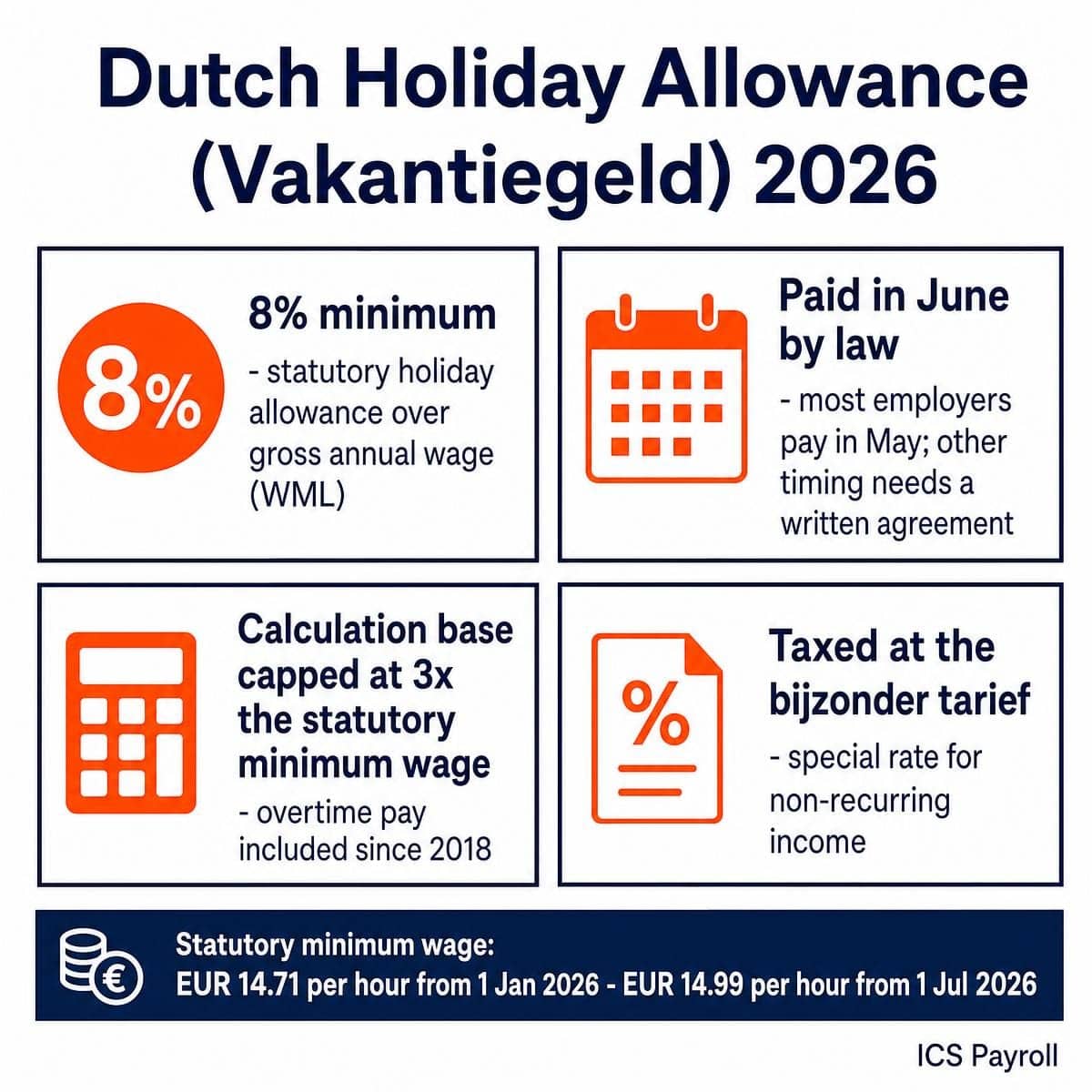
- Identify the specific components of the gross annual salary, including structural overtime and fixed allowances, that must be included in the mandatory 8% calculation, and know that the statutory calculation base is capped at three times the minimum wage.
- Understand the application of the special tax rate (bijzonder tarief) to ensure accurate withholding and prevent year-end reconciliation issues for your employees.
- Master the statutory accrual and payment cycle: payment is due in June by law unless a different arrangement is agreed in writing, so your business remains fully compliant with 2026 labor regulations.
- Factor the 2026 statutory minimum wage into your labor cost projections: EUR 14.71 per hour from 1 January 2026, rising to EUR 14.99 per hour from 1 July 2026. These are nationwide rates, adjusted every six months, not sector-dependent.
- Learn how an Employer of Record (EOR) automates these complex administrative processes and eliminates the requirement for establishing a local Dutch legal entity.
What is the Dutch Holiday Allowance (Vakantiegeld) in 2026?
The Dutch holiday allowance is a non-negotiable statutory payment. It represents a mandatory addition of at least 8 percent of an employee's gross annual wage. This requirement is codified in the Minimum Wage and Minimum Holiday Allowance Act (Wet minimumloon en minimumvakantiebijslag, WML). The primary legislative intent is to ensure that all workers have the financial means to take an annual vacation. For foreign employers, understanding these Dutch holiday allowance rules is the first step toward maintaining a compliant payroll operation in the Netherlands.
This entitlement extends to every member of your workforce. It applies regardless of their contract structure:
- Indefinite employment contracts
- Fixed-term agreements
- Zero-hour or on-call arrangements
Neglecting this obligation is a serious compliance breach. The Netherlands Labour Authority (Nederlandse Arbeidsinspectie) actively monitors payroll records and can issue substantial fines for underpayment or failure to pay the allowance correctly. If the Labour Authority establishes underpayment, back payment must generally be made within four weeks, and employees themselves can claim unpaid holiday allowance through the civil courts for up to five years. You don't want to face these consequences due to a simple administrative oversight.
Legal Entitlement and 2026 Minimum Wage Context
The calculation of this allowance is inextricably linked to the statutory minimum wage. The Netherlands operates a single, nationwide statutory minimum hourly wage for all employees aged 21 and over, which is indexed twice a year and published on rijksoverheid.nl. For 2026, the rate is EUR 14.71 gross per hour from 1 January 2026 and EUR 14.99 gross per hour from 1 July 2026. Reduced youth rates apply to employees aged 15 to 20. Note that many collective labor agreements (CAOs) set pay scales above the statutory minimum; the CAO applicable to your sector always deserves a separate check.
If your base salary is at the legal minimum, the 8 percent must be paid as an additional amount on top. It can't be structured in a way that brings the effective base hourly rate below the statutory floor. There is one further nuance foreign employers should know: under the WML, the mandatory holiday allowance only needs to be calculated over wages up to three times the statutory minimum wage. Anything above that ceiling is a matter of contract or CAO, not statute.
Exceptions and Collective Labor Agreements (CAO)
While the 8 percent rate is the legal minimum, many sectors follow a Collective Labor Agreement (CAO) that mandates a higher percentage. For example, the CAO for temporary agency workers applies 8.33 percent, which equates to roughly one month of salary. A CAO may also provide that no separate holiday allowance is paid, but in that case total pay must amount to at least 108 percent of the minimum wage. For employees earning more than three times the statutory minimum wage, the employer and employee may agree in writing to reduce or waive the holiday allowance. Absent such a written agreement or deviating CAO, the statutory 8 percent applies.
Foreign companies often operate through a local subsidiary such as a Dutch BV. A BV is a distinct Dutch legal entity and is fully subject to local labor law, including strict adherence to Dutch holiday allowance rules; operating through a subsidiary does not exempt you from any of these obligations. Using an Employer of Record Netherlands partner allows you to manage these requirements without the administrative burden of direct entity management.
How to Calculate Holiday Allowance for Dutch Employees
Precision is non-negotiable. While the calculation starts with the gross base salary, several additional components must be factored in to satisfy the standards applied by the Netherlands Labour Authority in 2026. Strict adherence to Dutch holiday allowance rules requires a methodical approach to identifying what counts as "wage" for accrual purposes. Use the following four steps to establish a compliant calculation base.
- Step 1: Determine the total gross annual wage. This includes the monthly base pay and fixed allowances that form part of the agreed wage.
- Step 2: Add overtime pay. Since the 2018 amendment of the WML, pay for overtime counts as wage for holiday allowance purposes, so structural overtime earnings must accrue the 8 percent as well.
- Step 3: Include wages paid over vacation days and, where applicable under CAO or case law, structural shift and irregular-hours allowances that form part of the employee's normal remuneration.
- Step 4: Exclude non-wage components. Profit distributions and genuine expense reimbursements are excluded by law; incidental performance bonuses are typically excluded unless your employment contract or CAO dictates otherwise. Remember also the statutory cap: the mandatory calculation base does not extend beyond three times the minimum wage.
Included and Excluded Salary Components
One of the most common errors for foreign employers is the omission of overtime. Since 1 January 2018, overtime pay falls under the WML wage definition, meaning it accrues holiday allowance. If an employee consistently works beyond their contract hours, those earnings must accrue the 8 percent. Conversely, you must exclude genuine expense reimbursements, such as home office stipends or travel allowances, as these are not wage for this calculation. For businesses looking to mitigate the risk of calculation errors, professional Dutch payroll administration provides a secure, automated solution.
Calculating for Part-Time and Zero-Hour Staff
The 8 percent rule applies equally to all staff, but the execution differs based on contract type. For part-time employees, the outcome is automatically pro-rata, because the allowance is calculated over actual gross earnings. Zero-hour contracts require more administrative diligence: the holiday allowance is accrued over every hour actually worked, so the employee receives 8 percent of their total realized earnings. This prevents complex reconciliation at the end of the year. If you are scaling a flexible workforce, an Employer of Record can manage these contract structures while maintaining full compliance with 2026 labor regulations.
Payment Timing and Logistics for Foreign Employers
The timing of the 8 percent distribution is regulated as strictly as the calculation itself. Under the WML, holiday allowance must in principle be paid in June, although in practice most Dutch employers pay it in May, ahead of the summer holiday season. Any other payment schedule, whether earlier, later, or in instalments, requires a written agreement with the employee or a basis in the CAO. The distribution cycle conventionally covers the accrual period from June 1 of the preceding year to May 31 of the current year. If a staff member joins your organization mid-cycle, you pay a pro-rata amount based on their actual period of service.
Termination of employment requires immediate action regarding these accruals. When a contract ends, whether initiated by the employer or the employee, all accrued but unpaid holiday allowance must be settled in full. This payment forms a critical part of the final settlement (eindafrekening). Accurate record-keeping is vital here: every euro accrued since the last payout must be accounted for to avoid post-employment disputes or claims, which employees can bring for up to five years.
The Annual Lump Sum vs. Monthly Payout
While the annual May/June payout is the cultural and legal norm, alternative structures exist for specific workforce needs. A monthly payout of the 8 percent allowance is often preferred for flexible workers or short-term contractors on fixed-term agreements. This "all-in" approach is legally permissible in the Dutch market, but it carries strict transparency requirements. To remain compliant, the employment contract must explicitly provide for monthly payment, and the 8 percent must appear as a distinct, identifiable line item on every payslip. Failure to separate this amount from the base salary can lead to claims that the allowance was never paid, potentially forcing the employer to pay it a second time.
Holiday Allowance and Sickness
Employee health status does not pause your financial obligations. Under Dutch law, an employer must continue paying at least 70 percent of the employee's last-earned wages during illness, for a maximum of 104 weeks (two years). In the first year of illness, this payment may not fall below the statutory minimum wage; in the second year, that floor no longer applies. Many CAOs and individual contracts improve on this statutory minimum, with 100 percent in year one being common practice, but 70 percent is the legal baseline from the first day of illness. Reintegration obligations during this period are administered together with uwv.nl.
Crucially for this guide: holiday allowance continues to accrue during sickness, calculated over the wages you are obliged to continue paying. Accrual consistency also applies during pregnancy, birth-related and paternity leave netherlands and parental leave. Maintaining these accruals during periods of absence is a cornerstone of Dutch employment compliance.
Taxation and Compliance: Understanding the Costs
The fiscal impact of holiday pay extends beyond the gross 8 percent payout. Employers must account for mandatory employer contributions that apply to this additional wage. These include the Unemployment Insurance Fund contribution (AWf), the Disability Insurance Fund contribution (Aof), and the employer's Health Insurance Act (Zvw) contribution, in each case up to the annual maximum contribution wage. When calculating the total cost of employment under Dutch holiday allowance rules, you should expect the actual employer cost to be meaningfully higher than the 8 percent gross figure alone. Precise budgeting for these secondary costs is vital for accurate 2026 financial projections.
The Special Tax Rate (Bijzonder Tarief) Explained
Employees often express surprise when their net holiday allowance is proportionally lower than their standard monthly net pay. This occurs because the allowance is subject to the bijzonder tarief (special rate) for wage tax withholding. The bijzonder tarief is the withholding mechanism used for non-recurring income, such as bonuses and holiday pay, to prevent under-withholding on annual earnings. Because the Netherlands uses a progressive tax system, this additional income is withheld at the rate corresponding to the employee's projected annual income, including an adjustment for the phase-out of tax credits. While this can feel like a heavy burden in May, any over- or under-withholding is corrected in the employee's annual income tax assessment.
Employer Obligations and Audit Risks
Maintaining accuracy in these calculations is the only way to mitigate audit risks. The Netherlands Labour Authority prioritizes minimum wage and holiday pay compliance during inspections, specifically looking for under-accrual or missing payslip itemization. On the fiscal side, the general retention obligation for your business administration, including payroll records, is seven years (ten years for records relating to immovable property), while certain payroll tax documents, such as payroll tax statements and identity document copies, must be retained for at least five years after the end of the employment. This documentation must be readily available for inspection to prove that all statutory obligations have been met, as set out in the wider framework of employment law Netherlands for foreign employers.
Effective financial planning requires setting aside both the 8 percent gross accrual and the corresponding employer contributions on a monthly basis. This practice prevents cash flow strain when the lump sum payment becomes due in the second quarter. For the most accurate 2026 withholding data, consult the current wage tax tables published by the Dutch Tax Administration at belastingdienst.nl. Managing these tax mechanics and retention requirements can be an administrative burden for international HR teams; a specialized payroll partner can take this over entirely.
How an EOR Simplifies Dutch Holiday Allowance Management
Establishing a local Dutch legal entity is a significant undertaking that many foreign firms wish to avoid. An Employer of Record (EOR) provides a streamlined alternative by acting as the legal employer for your Dutch workforce. This model eliminates the need for complex corporate registration while ensuring that your business remains fully aligned with Dutch holiday allowance rules. By transferring the legal employer responsibilities to a local specialist, you remove the administrative burden of calculating accruals and managing withholding from your internal HR team.
The EOR model automates the mandatory 8 percent accrual from the very first hour an employee works. It ensures that the bijzonder tarief is applied correctly to every payout, whether you choose the statutory June cycle, the customary May payment, or a contractually agreed monthly distribution for flexible staff. You receive a single, transparent monthly invoice that covers the total cost of employment: base salary, holiday pay, and all employer contributions such as AWf, Aof, and Zvw. It's a no-nonsense approach that provides financial predictability for your 2026 budget.
Zero Compliance Hassle for International Firms
A competent EOR handles all local tax and labor obligations with precision. This includes the ketenregeling, which limits successive fixed-term contracts to a maximum of three contracts within 36 months before an indefinite contract arises by law. It also covers the strict probation period rules: no probation is permitted for contracts of six months or shorter; a maximum of one month applies to fixed-term contracts longer than six months but shorter than two years; and a maximum of two months applies to fixed-term contracts of two years or longer and to indefinite contracts.
For eligible international hires, the EOR can facilitate the expat scheme (30% ruling). For 2026, the taxable salary norm, that is the salary remaining after the tax-free allowance is applied, is EUR 48,013, or EUR 36,497 for employees under 30 holding a qualifying master's degree. The tax-free allowance can only be applied up to the WNT remuneration cap of EUR 262,000 in 2026. Employers should also plan ahead: 2026 is the final year at the 30 percent rate for employees who entered the scheme from 2024 onward, as the maximum tax-free percentage drops to 27 percent from 1 January 2027, alongside a structurally higher salary norm. If your talent requires a visa or work permit, immigration sponsorship can be arranged via a licensed sponsor.
Strategic Payroll Administration
Operational efficiency is enhanced through integrated digital tooling and human-led support. Your employees gain access to a secure online portal where they can track their payslips, employment contracts, and accrued holiday balances in real time. This transparency fosters trust and reduces the volume of administrative inquiries directed at your management team. Expert guidance on drafting Dutch employment contracts, fully compliant with local standards for both remote and office-based staff, bridges the gap between your corporate goals and the complexities of the Dutch labor market.
Secure Your Compliance in the Dutch Market
Managing the 8% statutory accrual is a fundamental requirement for any international business hiring in the Netherlands. By strictly following the 2026 Dutch holiday allowance rules, you ensure that your payroll remains accurate while avoiding the financial penalties associated with under-withholding or missed payments. It's vital to remember that including structural overtime in your calculation base, itemizing the allowance on every payslip, and applying the bijzonder tarief correctly are non-negotiable steps for legal adherence. These technical details often represent the difference between a seamless expansion and a costly audit from the labor authorities.
With the right specialist support from ICSPayroll for Dutch payroll administration, you can navigate these regulations without the administrative burden of local entity setup, guarantee full compliance with 2026 Dutch labor law, and fast-track your hiring process in weeks, not months. Get a tailored Dutch payroll quotation within 24 hours.
Sources and references
Every rule and figure above is traceable to the sources below: the exact statutory articles, the regulator pages that publish the amounts, the statistical datasets, and the specific court rulings that settle the point. Always check the current text for your own situation.
- Article 15 Minimum Wage Act, the 8% holiday allowance (vakantiebijslag)
- Article 7:641 Dutch Civil Code, payment for untaken holiday on termination
- Article 7 Minimum Wage Act, entitlement to the statutory minimum wage
- Rijksoverheid, statutory minimum hourly wage amounts per 1 January 2026
- Belastingdienst, payroll tax tables 2026 (white and green tables with the actual withholding percentages)
- Belastingdienst, filing the payroll tax return (aangifte loonheffingen) and its deadlines
- CBS, Compensation of employees and employment by economic activity (national accounts dataset 84165ENG)
- CBS StatLine, the open statistical database behind the wage and employment figures cited here
- Supreme Court 23 June 2023, ECLI:NL:HR:2023:955: payment of accrued but untaken holiday and the employer duty to inform and warn
- Supreme Court 17 November 2023, ECLI:NL:HR:2023:1603: whether an employer may deduct holiday days under art. 7:638(8) BW when the employee falls ill during scheduled leave

Article by
Joost Hubregtse
Joost Hubregtse is Director of ICS Staffing & Payroll B.V., the wholly owned subsidiary of Intercompany Solutions behind ICS Payroll. He is responsible for Employer of Record and Dutch payroll services: employment contracts, wage tax and social security filings, holiday allowance, pension, sick leave and CAO compliance, with onboarding possible within 48 hours.

Frequently Asked Questions
Yes, the payment of at least 8 percent is a statutory requirement for every employee working in the Netherlands, applying to indefinite, fixed-term, and zero-hour contracts alike. There are two main exceptions: a CAO may provide for no separate holiday allowance, in which case total pay must be at least 108 percent of the minimum wage; and employees earning more than three times the statutory minimum wage may agree in writing to reduce or waive the entitlement. Absent such arrangements, the 8 percent applies in full.
You can pay the allowance monthly, provided the employment contract explicitly permits this structure. This "all-in" model is frequently used for flexible or temporary staff. To remain compliant, the 8 percent must be displayed as a separate, identifiable line item on every payslip. Failure to clearly distinguish this payment from the base salary can lead to legal claims for unpaid holiday money, payable a second time.
For part-time staff, the calculation is strictly proportional to their actual gross earnings. You apply the 8 percent rate to the total gross wage received throughout the accrual period. An employee working 20 hours per week therefore receives exactly half the allowance of a full-time colleague on the same hourly rate. This pro-rata outcome follows automatically from calculating over actual earnings.
The allowance is subject to wage tax withholding at the bijzonder tarief (special rate) for non-recurring income. Because this payment comes on top of the employee's regular annual earnings, it is withheld at the rate matching their highest applicable bracket, adjusted for the phase-out of tax credits. This prevents a large tax bill at year-end. While it results in a lower net payout in May, the total annual tax burden remains correct and any difference is settled in the annual income tax assessment.
Yes, accrual does not stop during illness. During sickness, you must continue paying at least 70 percent of the employee's last-earned wages for up to 104 weeks (in the first year, never less than the statutory minimum wage; many CAOs require 100 percent in year one). Holiday allowance continues to accrue over the wages you actually continue to pay throughout this period.
Under the WML, holiday allowance must be paid in June, unless a different schedule is agreed in writing or provided for in the CAO. In practice, the vast majority of Dutch employers pay the lump sum in May, ahead of the summer holiday season. The payment conventionally covers the accrual period from June 1 of the previous year through May 31 of the current year.
Yes. The salary norm for the expat scheme is tested against the employee's taxable wage, and holiday allowance, like bonuses and most benefits, is part of that taxable wage. For 2026, the taxable salary after applying the tax-free allowance must exceed EUR 48,013 (or EUR 36,497 for qualifying employees under 30 with a master's degree). The tax-free allowance itself also applies over the holiday allowance, up to the EUR 262,000 remuneration cap. Note that from 1 January 2027, the percentage drops to 27 percent for employees who entered the scheme in 2024 or later, with a higher salary norm.
All accrued but unpaid holiday allowance must be settled in the final payroll cycle. This final settlement, known as the eindafrekening, includes the 8 percent calculated on all gross wages earned since the last payout date. Keep in mind that employees can claim unpaid holiday allowance for up to five years, and your payroll administration must be retained for the applicable statutory periods to prove correct settlement. This ensures a clean transition and prevents post-employment legal disputes.