Paternity Leave in the Netherlands: A 2026 Guide for Foreign Employers
By Joost Hubregtse, Director, ICS Staffing & Payroll
All blog posts are reviewed and fact checked by our labour law lawyer Zishan Hussain and our director. Editorial standards
Uptake of birth-related leave among partners in the Netherlands has risen sharply since the entitlements were expanded in 2020 and 2022, and most new fathers now use at least part of their statutory leave. This means foreign employers must be prepared to manage a multi-tiered system that balances employer-paid and state-subsidized time off. Navigating the distinctions between birth leave, additional birth leave, and paid parental leave is often a source of administrative friction. It's difficult to manage UWV benefit applications while ensuring monthly payslips remain accurate and compliant with Dutch labor law.
This 2026 guide simplifies the process. You'll gain a clear understanding of paternity leave in the Netherlands, including the specific timelines for each leave category and the financial split between your company and the state. We'll cover the essential mechanics of the maximum daily wage cap, €309.91 as of 1 July 2026, and the exact steps for securing UWV benefits. This article provides a functional framework for maintaining a compliant payroll process that supports your Dutch workforce while removing the administrative burden from your internal teams.
Key Takeaways
- Identify the three distinct tiers of partner leave to correctly distinguish between employer-funded and state-subsidized entitlements.
- Master the statutory deadlines for each leave type to ensure all leave requests remain compliant with the Work and Care Act (WAZO).
- Learn how to navigate the UWV employer portal to apply for the 70% benefit for additional birth leave and paid parental leave.
- Understand how the maximum daily wage cap, indexed twice a year on 1 January and 1 July, affects benefit calculations and the resulting impact on your monthly payroll filings.
- Discover how partnering with a local Employer of Record (EOR) removes the administrative burden of managing complex Dutch-only social security interfaces.
Understanding the Tiers of Paternity and Partner Leave in the Netherlands
Dutch labor law doesn't officially recognize the term "paternity leave." Instead, regulations refer to birth leave (geboorteverlof) for the partner of the person who gives birth. For international companies, this terminology shift is the first step in maintaining compliance with the Work and Care Act, known locally as the WAZO (Wet arbeid en zorg). This act sets out a layered structure of leave entitlements that ensures partners can support their families without facing immediate financial instability. While parental leave policies vary significantly across Europe, the Netherlands has established a multi-tiered framework that shifts the financial responsibility from the employer to the state as the leave period extends. Understanding these requirements is essential for maintaining a compliant payroll and avoiding legal friction with your local workforce.
The Definition of a "Partner" Under Dutch Law
The Dutch legal system adopts a broad definition of a partner. For the purposes of birth leave, the partner of the mother is her spouse, her registered partner, a person who cohabits with her without a formal contract, or a person who has legally acknowledged (erkend) the child. There is no requirement for a traditional marriage certificate: cohabitation or acknowledgement of the child is sufficient. In practice, employers rely on the employee's declaration of partner status and the child's date of birth; when applying for UWV benefits, the employer confirms the relevant details, including the child's date of birth, as part of the application. This inclusive approach ensures that all family structures are protected under the WAZO framework.
The Three Pillars of Partner Support
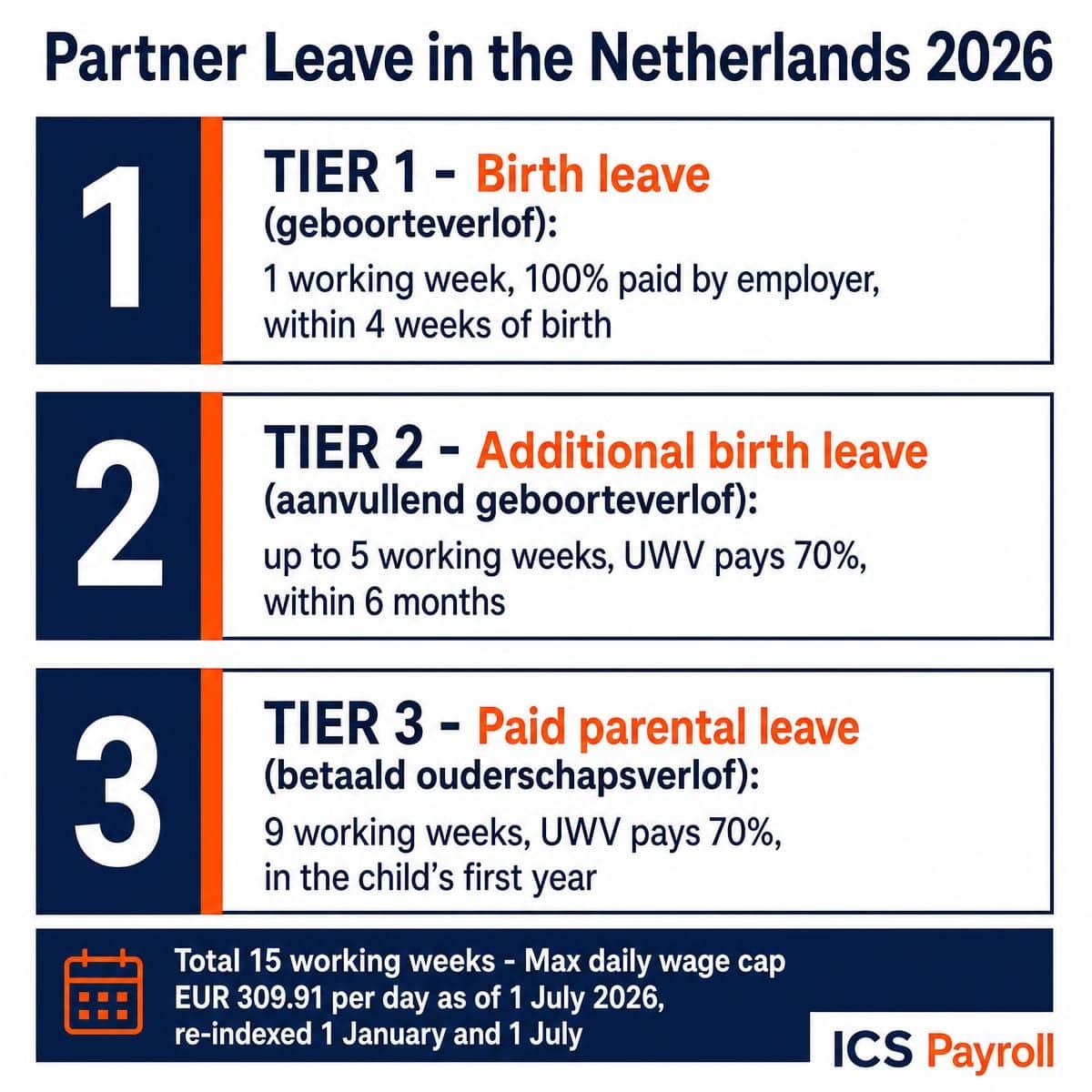
Managing partner leave in the Netherlands requires an understanding of three distinct pillars. Each has its own funding model and duration. Together, the system provides a total of 15 working weeks of paid or subsidized leave during the child's first year, but the administrative burden on the employer changes at each stage.
- Tier 1: Standard Birth Leave (Geboorteverlof). This consists of one working week of leave, equal to the employee's contractual weekly hours. The employer must pay 100% of the salary during this period. It must be taken within four weeks of the birth.
- Tier 2: Additional Birth Leave (Aanvullend geboorteverlof). Employees can take up to five additional working weeks. During this leave, UWV pays a benefit of 70% of the employee's daily wage, capped at 70% of the statutory maximum daily wage (€309.91 as of 1 July 2026; the cap is re-indexed every 1 January and 1 July). This leave must be used within six months of the child's birth.
- Tier 3: Paid Parental Leave (Betaald ouderschapsverlof). This provides nine working weeks of leave during the child's first year, available to both parents for each child. Like Tier 2, UWV pays a benefit of 70% of the daily wage, subject to the same cap.
Compliance isn't just about granting time off. It involves precise payroll administration. While the first week is a direct cost to your business, the subsequent 14 weeks are financed through UWV benefits that must be applied for through the UWV employer portal. The employer is not legally required to supplement these benefits or to advance them before UWV pays out, unless a collective labor agreement (CLA/cao) or the employment contract says otherwise, but the employer is responsible for submitting the applications correctly and on time. Miscalculating these tiers or missing application deadlines can mean the employee's benefit is reduced or lost, which can be costly and damaging for foreign entities without a local administrative presence.
Tier 1: Standard Birth Leave (Geboorteverlof) Requirements
The first tier mandates that employees receive one full working week of leave following the birth of a child. This entitlement is strictly based on the employee's contractual hours. If a staff member works 40 hours per week, they receive 40 hours of leave. If they work 24 hours, they receive 24. This leave is a statutory right. Employers have no legal grounds to refuse the request or deduct these hours from the employee's statutory holiday balance. During this week, the employer is responsible for 100% of the salary payment. It's a direct cost of doing business in the Dutch market that cannot be avoided or deferred.
Timing and Notification Deadlines
Dutch labor law requires employees to notify their employer of the birth and the intended leave in advance where possible, or as soon as possible after the birth. Notification may be verbal, but best practice is a written confirmation via email or a digital HR portal, which creates a clear audit trail. The leave must be taken within the first four weeks following the child's birth. It doesn't need to be taken as a single block; the employee may spread the hours across the four-week window. Note an important point that is frequently stated incorrectly: if the child is hospitalized after birth, the four-week window does not shift or pause. The period runs from the birth regardless of hospitalization, and the law expressly allows the partner to take the leave while the child is still in hospital. Employers should make employees aware of this so the entitlement is not inadvertently forfeited.
Salary Obligations for the First Week
Calculating the correct payment for this week is critical for payroll accuracy. You must base the payment on the gross salary and contractual hours. Dutch holiday allowance rules remain unaffected during this period: the employee continues to accrue their 8% holiday allowance and their statutory vacation days as if they were working their normal schedule. Structural salary components must remain intact, and an employee may not be disadvantaged in bonus eligibility or career progression for taking statutory birth leave. Managing these details ensures your business remains compliant with the WAZO and avoids labor disputes. For international companies, partnering with a Dutch payroll expert provides the security that these calculations and accruals are handled with professional precision.
Tier 2 & 3: Additional Birth Leave and Paid Parental Leave in 2026
The progression from initial birth leave to extended support represents a significant shift in financial responsibility. While the first week is a direct employer expense, Tiers 2 and 3 are financed by the Employee Insurance Agency (UWV). For both tiers, the benefit equals 70% of the employee's daily wage, and never more than 70% of the statutory maximum daily wage. That maximum is €309.91 per day as of 1 July 2026 (it was €304.25 in the first half of 2026) and is adjusted every 1 January and 1 July in line with minimum wage indexation, so always verify the current figure before running payroll. UWV pays the benefit to the employer by default, and the employer then passes it on to the employee; alternatively, the employer can indicate in the application that UWV should pay the employee directly. The employer is not obliged to top the benefit up to full salary or to advance it before UWV pays, unless a CLA or the employment contract requires this. Managing these tiers correctly is the most demanding aspect of Dutch partner leave compliance for foreign entities.
Additional Birth Leave (Aanvullend geboorteverlof)
This entitlement allows partners to take up to five additional working weeks of leave, requested in whole weeks (a minimum of one and a maximum of five). The employee must first have taken the full standard week of birth leave before this tier can begin. The five weeks must be used within six months of the child's birth. Flexibility is a core feature: in consultation with the employer, the weeks do not have to be taken consecutively and can be spread across the six-month window, for example as part-time weeks over a longer period. The employee must request the leave in writing at least four weeks before it starts (or as soon as possible if the child arrives early). The employer may not refuse the leave itself; only the scheduling can be adjusted for compelling business interests, and any change must be finalized no later than two weeks before the leave begins.
Paid Parental Leave (Betaald ouderschapsverlof)
Separate from partner-specific leave, paid parental leave offers nine working weeks of subsidized time off during the child's first year. This leave is available to both parents, per child. The total statutory parental leave entitlement is 26 times the weekly working hours per child, of which up to nine weeks attract a UWV benefit if taken in the first twelve months. The employee must request parental leave in writing at least two months before it starts. During the paid weeks, the employee continues to accrue statutory vacation days. It's also worth understanding the wider interaction with Dutch social security for employers. If an employee does not use the nine paid weeks within the first twelve months, the entitlement doesn't vanish: the unused weeks remain available as unpaid parental leave until the child's eighth birthday. However, the 70% UWV benefit is permanently lost for any weeks not taken within the first year. Employers must track these deadlines carefully so employees don't lose their financial entitlement to administrative oversight.
Employer Compliance: Applications, Deadlines, and UWV Benefits
Securing UWV benefits requires a proactive administrative approach. For additional birth leave, the application cannot be submitted until after the child is born, and the employer must confirm in the application that the employee has taken the standard week of birth leave within one month of the birth. The application covers, in one go, the total number of additional weeks the employee will take within the six-month window, even if taken spread out. If the employer only applies after the leave has ended, UWV will pay out only for the leave period falling within one year before the application date, so late filing can permanently reduce the benefit. For foreign companies, the primary practical barrier is the technical interface: the UWV employer portal is exclusively in Dutch and requires eHerkenning login credentials at an assurance level that many international firms do not possess.
The UWV Application Process
Applications require specific data, including the employee's Citizen Service Number (BSN), the child's date of birth, the number of weeks of leave, and the start date. For paid parental leave, the benefit application can only be submitted after the employee has taken leave equal to at least one full working week, applications can only be made for whole working weeks, and the benefit must be applied for within fifteen months after the first day of leave. UWV pays the benefit in one payment or in installments; after the first payment request, the employer can submit up to two further payment requests as the employee takes more leave. UWV issues its decision within four weeks of receiving a complete application, after which payment follows. If your company lacks a Dutch legal entity or the necessary digital credentials, you cannot access the portal directly. This is where professional Dutch payroll administration becomes a necessity rather than an option.
Managing Payroll Calculations
Reflecting these payments on a Dutch payslip involves specific accounting entries. You must clearly distinguish between the 100% employer-paid week and the weeks in which the UWV benefit (70%, capped) is passed through to the employee. Note that the UWV daily wage used for the benefit already includes the 8% holiday allowance component, so it should not be added on top of the benefit in payroll. If your employee is a highly skilled migrant benefiting from the 30% ruling (formally the expat ruling), be aware of two points. First, the tax-free reimbursement is applied to the taxable wage actually paid in the period, so during a 70% period the absolute tax-free amount is lower. Second, and this is often stated incorrectly, a salary dip caused by birth leave or parental leave does not endanger the ruling: the law provides that the minimum salary norm is reduced pro rata for periods of parental, maternity, and comparable leave, so the employee does not lose the 30% ruling merely because their pay temporarily falls below the threshold during statutory leave. Pension accrual during leave is governed by the applicable pension scheme and any CLA; many schemes continue accrual during these leave periods, but this is not an automatic statutory rule, so verify what your scheme requires and administer contributions accordingly. Mismanaging these calculations can lead to tax and pension corrections and employee dissatisfaction. Our experts can manage your Dutch payroll filings to ensure every leave claim is processed accurately and on time.
Navigating Dutch Leave Compliance with an EOR Partner
Operating as a foreign entity without a local Dutch presence introduces significant administrative barriers. UWV requires Dutch digital credentials and Dutch-language documentation to process benefit applications. For many international businesses, the risk of mismanaging these filings is real: late or incorrect applications can reduce or forfeit benefits and create violations of the Work and Care Act. By utilizing an Employer of Record (EOR), your business offloads the legal complexities of leave administration. The EOR acts as the legal employer, ensuring full Dutch labor law compliance while you retain daily management of your team. This structure allows you to offer compliant Dutch partner leave benefits without the overhead of establishing a local BV (private limited company).
Eliminating Administrative Friction
ICSPayroll serves as the bridge between your business and the Dutch authorities. We possess the necessary eHerkenning credentials to communicate directly with UWV, removing the language barrier and technical hurdles. Our system automates the required payroll adjustments for the benefit-covered leave periods, ensuring that both the employee's net pay and the company's social security position are calculated with precision. We also provide guidance on non-standard cases. For instance, in the event of multiple births such as twins, the entitlement to paid parental leave applies per child, so parents of twins can take eighteen paid weeks, while standard and additional birth leave are granted once per birth event, not per child. Our team manages these nuances, from the initial notification of birth to the final settlement of UWV benefits.
Peace of Mind for International HR Teams
Managing a distributed workforce requires more than just a payroll provider; it requires a partner that mitigates legal risk. Engaging an EOR helps reduce the risk of permanent establishment issues by providing a compliant local framework for your staff. Your international employees benefit from having access to local experts who can explain their rights and entitlements in clear terms. This local expertise ensures they feel supported during significant life events, which is vital for talent retention. When you partner with ICSPayroll, every aspect of leave, from standard birth leave to paid parental leave, is handled with precision. Contact ICSPayroll today to secure your Dutch employment compliance and streamline your administrative processes.
Future-Proofing Your Dutch Workforce Strategy
Managing partner leave requirements in the Netherlands is a critical component of maintaining a compliant and attractive workplace. Success depends on distinguishing between the initial employer-funded week and the subsequent 14 weeks of state-subsidized support, adhering to the statutory windows and application deadlines, and applying the correct maximum daily wage cap, which changes every 1 January and 1 July, to prevent payroll discrepancies. These administrative layers are complex, but they offer a significant opportunity to support your international staff during vital life transitions. Professional management ensures your business remains a top-tier employer while avoiding claim reductions, forfeited benefits, or legal friction.
ICSPayroll acts as your local expert, removing the burden of Dutch-only portals and UWV interactions. We provide expert Dutch payroll management and full WAZO administrative support, ensuring every benefit is secured and every payslip is accurate. Our compliant EOR services allow you to scale your team with confidence and legal security. Ensure your Dutch team's leave is fully compliant with ICSPayroll.
Sources and references
Every rule and figure above is traceable to the sources below: the exact statutory articles, the regulator pages that publish the amounts, the statistical datasets, and the specific court rulings that settle the point. Always check the current text for your own situation.
- Article 4:2 Work and Care Act, one week of paid birth leave for partners
- Article 6:1 Work and Care Act, 26 weeks of parental leave
- Article 7:629 Dutch Civil Code, 70% wage continuation for up to 104 weeks of illness
- Rijksoverheid, birth leave and additional partner leave: weeks and benefit percentages
- UWV, maximum daily wage 2026 used to cap sickness and WIA benefits
- UWV, sickness, reintegration obligations and the WIA application in week 93
- CBS, Compensation of employees and employment by economic activity (national accounts dataset 84165ENG)
- CBS StatLine, the open statistical database behind the wage and employment figures cited here
- Supreme Court 23 June 2023, ECLI:NL:HR:2023:955: payment of accrued but untaken holiday and the employer duty to inform and warn
- Court of Justice of the EU 20 January 2009, C-350/06 (Schultz-Hoff): accrual and carry-over of paid annual leave during long-term sickness

Article by
Joost Hubregtse
Joost Hubregtse is Director of ICS Staffing & Payroll B.V., the wholly owned subsidiary of Intercompany Solutions behind ICS Payroll. He is responsible for Employer of Record and Dutch payroll services: employment contracts, wage tax and social security filings, holiday allowance, pension, sick leave and CAO compliance, with onboarding possible within 48 hours.

Frequently Asked Questions
Only the first week of birth leave is fully paid by the employer at 100% of the employee's salary. The subsequent tiers, additional birth leave and paid parental leave, carry a UWV benefit of 70% of the employee's daily wage, capped at 70% of the statutory maximum daily wage (€309.91 per day as of 1 July 2026, indexed twice yearly). Some employers top this up to 100% under a collective labor agreement or the employment contract, but topping up is not a statutory requirement.
Partners are entitled to a total of 15 working weeks of paid or subsidized leave during the child's first year: one week of standard birth leave, up to five weeks of additional birth leave, and nine weeks of paid parental leave. Each category has its own window: birth leave within four weeks of the birth, additional birth leave within six months, and the paid portion of parental leave within the first twelve months.
No. These entitlements are statutory rights under the Work and Care Act (WAZO), and the leave itself cannot be refused. The employer may only adjust the scheduling of additional birth leave for compelling business interests, after consultation with the employee, and any change must be fixed no later than two weeks before the leave begins. The employee's total entitlement always remains intact.
Birth leave (standard and additional) is specifically for the partner of the person giving birth and is concentrated around the birth. Parental leave is a separate entitlement of 26 times the weekly working hours per child, available to both parents until the child turns eight. Nine of those weeks carry a UWV benefit if taken within the child's first year; the remainder, and any paid weeks not used in year one, are unpaid unless a CLA provides otherwise.
The employer applies via the UWV employer portal after the child is born, using eHerkenning credentials, confirming the child's date of birth, the number of weeks, the start date, and that the standard week of birth leave has been taken. UWV pays the benefit, 70% of the (capped) daily wage, to the employer by default, who passes it on to the employee, or directly to the employee if the employer selects that option in the application. The employer is not obliged to advance or supplement the benefit unless a CLA requires it. Applying too late can reduce the payout, since a retroactive application only covers leave within one year before the application date.
Yes, on a pro-rata basis. All the entitlements are expressed in multiples of the employee's contractual weekly hours: an employee working 24 hours per week gets 24 hours of standard birth leave, up to five times 24 hours of additional birth leave, and so on. The 70% benefit is calculated on the employee's own daily wage, subject to the statutory cap.
The ruling continues to apply, and the tax-free reimbursement is calculated on the taxable wage actually paid, so the absolute benefit is lower during a 70% period. Importantly, the employee does not lose the 30% ruling if their salary temporarily drops below the minimum salary norm because of birth leave or parental leave: the regulations reduce the salary norm pro rata for these statutory leave periods. Employers should still document the leave properly in payroll so the reduced income is clearly attributable to statutory leave.
Yes. The location of the birth does not affect the entitlement. If the employee works under a Dutch employment contract and is socially insured in the Netherlands, they are fully covered by the WAZO. They must follow the standard notification procedures and provide the child's date of birth to trigger the leave and benefit process, ensuring international staff receive the same protections as local employees.