Top Payroll Company in Amsterdam & The Netherlands
By Joost Hubregtse, Director, ICS Staffing & Payroll
All blog posts are reviewed and fact checked by our labour law lawyer Zishan Hussain and our director. Editorial standards
Why should a three-week onboarding take three months because of local administration? Expanding into the Dutch market requires more than a recruitment strategy; it requires a working understanding of Dutch employment law, wage tax and social security. Many businesses underestimate the complexity of the Dutch system and the permanent establishment risk that can arise when hiring without a local entity. Choosing the right payroll company amsterdam or elsewhere in the Netherlands is the first step to making sure your international hires are compliant from day one.
The Netherlands remains competitive for talent, but 2026 and 2027 bring a dense set of changes: a new statutory minimum hourly wage from 1 July 2026, the end of the partial non-resident taxpayer transitional rule, the reduction of the expat facility to 27% from 2027, and a new admission regime for anyone who lends out staff. This article sets out where the law actually stands today, and what is coming.
Key Takeaways
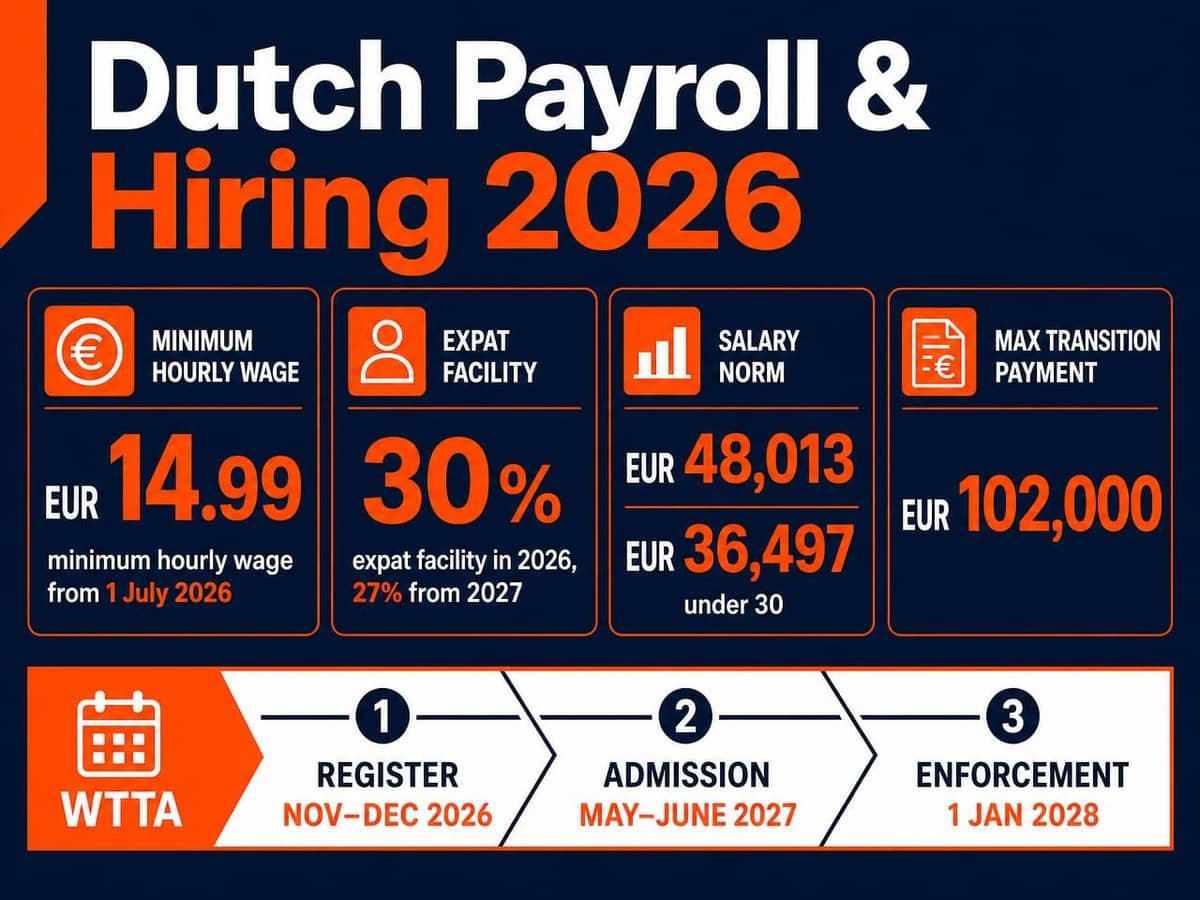
- The statutory minimum hourly wage is EUR 14.99 gross from 1 July 2026 (it was EUR 14.71 from 1 January 2026). It is uniform for all employees aged 21 and over, in every sector.
- The expat facility (30% ruling) remains at 30% throughout 2026. It falls to 27% from 1 January 2027, and only for employees who first applied the ruling from 1 January 2025 onward.
- The 2026 salary norm for the ruling is EUR 48,013, or EUR 36,497 for employees under 30 with a recognised master's degree, capped at the WNT norm of EUR 262,000.
- The maximum transition payment in 2026 is EUR 102,000, or one gross annual salary if that is higher.
- Employer of Record and Highly Skilled Migrant sponsorship are arranged through licensed partners; a new statutory admission regime for all lenders of staff (Wtta) enters into force on 1 January 2027.
Navigating Dutch Payroll Compliance for International Businesses
Entering the Dutch market in 2026 requires administrative precision. The Netherlands has a detailed regulatory framework in which employee rights are strongly protected. Many international firms begin by searching for a payroll company amsterdam because of the city's position as a commercial gateway. Compliance itself, however, is national: the same statutes apply from Rotterdam to Groningen. Failing to meet them can lead to additional assessments, administrative fines and, in the case of unlawfully lending out staff, an outright prohibition on doing so from 2028 onward.
International businesses choose between establishing a Dutch BV and using an external employment or payroll provider. A Dutch BV gives a permanent presence but requires direct management of wage tax, social security premiums and, where applicable, mandatory sector pension participation. Where speed matters more, a compliant employment or payroll arrangement allows onboarding in weeks rather than months.
The Role of the Belastingdienst and Loonaangifte
The Belastingdienst administers all wage-related levies. Every Dutch employer files a loonaangifte (payroll tax return) for each filing period, which is normally a calendar month but may be a four-week period. The return reports gross wages, wage tax and national insurance withheld, employee insurance premiums and the Zvw contribution for each employee. Deadlines are fixed and late filing or late payment triggers a default penalty.
Payroll records must be kept for seven years under the general tax retention rule. That archive includes signed employment contracts, identity documents, wage calculations and evidence that the statutory minimum wage has actually been paid. For 2026, that means demonstrating EUR 14.71 per hour for periods up to 30 June and EUR 14.99 per hour from 1 July.
Permanent Establishment Risk for Foreign Employers
Permanent establishment (PE) arises when a foreign company has sufficient presence in the Netherlands to become liable for Dutch corporate income tax, typically through a fixed place of business, or through a person who habitually concludes or plays the principal role in concluding contracts on the company's behalf.
It is important to be precise here. Using a Dutch payroll provider or an Employer of Record does not, by itself, eliminate permanent establishment risk. PE follows from what the foreign company and its people actually do in the Netherlands, not from who appears on the employment contract. Where a Dutch-based worker only performs support, back-office or non-contracting activities, PE risk is generally low and an external employment structure removes the separate need to register a Dutch entity as an employer. Where that worker negotiates or closes deals, holds a power of attorney, or operates from a fixed office the company controls, PE risk exists regardless of the employment structure and should be assessed with a tax adviser before the first hire.
A further point that is often missed: a hirer of staff can be held liable for wage tax and social premiums that the lender fails to remit, and for underpayment of the statutory minimum wage, under the chain and hirer liability rules. Contracting with a properly administered and, from 2027, admitted provider is the practical mitigation.
Employer of Record vs. Payroll Administration: Selecting the Right Model
The choice turns on whether you already hold a Dutch legal entity. Companies without one generally need an Employer of Record (EOR); companies with a Dutch BV or branch need payroll administration. Some organisations combine the two, hiring key staff through an EOR while their BV is being incorporated.
Two disclosures belong here. First, ICSPayroll arranges EOR services through a certified Dutch partner that acts as the legal employer. Second, ICSPayroll is not itself an IND recognised sponsor; Highly Skilled Migrant sponsorship is arranged through a licensed partner that holds that status.
Employer of Record: Hiring Without a Local Entity
Under an EOR arrangement the partner entity is the legal employer, issues the employment contract, withholds wage tax and pays social security premiums. You direct the work. The main advantage is speed: operations can begin in weeks rather than months.
Dutch law regulates this model specifically. Where the arrangement qualifies as payrolling under the Waadi, the worker is entitled to at least the same employment terms as comparable employees of the hirer, or, where the hirer has no comparable employees, those applying in the hirer's sector, and to an adequate pension scheme. For 2026 the statutory norm premium for an adequate payroll pension is 15.2% of the pension base (15.0% in 2025), set annually by the Minister of Social Affairs and Employment. This is not optional and cannot be reduced by collective agreement, and it should be built into your cost model from the outset. If you need to scale quickly, you can request a tailored quotation to see how this fits your budget.
Traditional Payroll Administration for Dutch BVs
If you already hold a KVK registration, you remain the legal employer and the provider executes the payroll cycle: monthly payslips, loonaangifte filings, holiday allowance accrual, pension registration and CAO application. In 2026 that means applying the correct differentiated premiums, which vary with contract type and employer size. For a deeper dive into these technical requirements, consult our Dutch Payroll Administration: The 2026 Complete Reference Guide.
A Change Both Models Must Plan For: the Wtta
The Wet toelating terbeschikkingstelling van arbeidskrachten (Wtta) introduces a mandatory admission regime for every business that lends out staff, including temporary work agencies, secondment firms and payroll companies, and including foreign providers operating in the Netherlands.
- The law enters into force on 1 January 2027.
- Lenders wishing to use the transitional arrangement must register with the Nederlandse Arbeidsautoriteit between 1 November 2026 and 31 December 2026.
- Admission applications run from 1 May to 30 June 2027, supported by an inspection against the published standards framework and a EUR 100,000 deposit.
- Enforcement by the Nederlandse Arbeidsinspectie begins 1 January 2028. From that date, hirers may only engage lenders listed in the public register, and hirers that do not face substantial fines.
If you use an EOR, secondment or payroll provider, ask now whether they have registered for the transitional arrangement and where they stand on the standards framework.
Maximising Tax Efficiency with the 30% Ruling in 2026
The expat facility, still widely called the 30% ruling, allows an employer to pay part of an employee's salary as a tax-free allowance for extraterritorial costs. It remains the most significant incentive for attracting international talent, and any specialised payroll company amsterdam should be able to administer it correctly.
The percentage in 2026 is 30%. The reduction to a flat 27% takes effect on 1 January 2027, and the transitional rules matter:
- Employees for whom the ruling was applied in the final pay period of 2023 keep 30% and the existing salary norms for the full duration of their ruling.
- Employees who first used the ruling during 2024 move to 27% from 2027, but keep the existing salary norms.
- Employees who first used the ruling from 1 January 2025 move to 27% and to the higher 2027 salary norms.
Employers must also make an annual choice, per employee, between applying the fixed percentage and reimbursing actual extraterritorial costs. That choice should be documented each calendar year.
2026 Salary Thresholds and Eligibility Criteria
To qualify in 2026, taxable salary after application of the allowance must be at least EUR 48,013. For employees under 30 holding a recognised academic master's degree, the reduced norm is EUR 36,497; the diploma must be evaluated by IDW or approved in advance by the Belastingdienst. Scientific researchers are exempt from the salary norm.
Because the norm is tested on salary after the tax-free allowance, the contractual gross must be materially higher. The thresholds are indexed annually; if salary drops below the norm, for example after a reduction in working hours, the ruling is lost for that year and generally cannot be reinstated.
Two further limits apply in 2026. The allowance may only be applied to salary up to the WNT norm of EUR 262,000; the transitional relief that exempted certain long-standing rulings from this cap expired on 1 January 2026. The indicative 2027 norms announced in the Belastingplan 2025 are EUR 50,436 and EUR 38,338 at 2024 price level, subject to indexation.
The End of Partial Non-Resident Taxpayer Status
The option to be treated as a partial non-resident taxpayer for Box 2 and Box 3 was abolished with effect from 1 January 2025. Transitional law preserves it through the 2026 tax year for employees for whom the ruling was applied in the last pay period of 2023. From 1 January 2027 the option disappears entirely and those employees are taxed as full resident taxpayers on worldwide substantial interest income and on savings and investments. Affected employees should take advice during 2026, not after.
Highly Skilled Migrant (HSM) Visas and Sponsorship
Recruiting from outside the EU/EEA and Switzerland involves a separate immigration process. Since ICSPayroll is not itself a recognised sponsor, these applications are arranged through a licensed partner that holds recognised sponsor status. The 2026 gross monthly salary criteria, excluding the 8% holiday allowance, are EUR 5,942 for highly skilled migrants aged 30 and over, EUR 4,357 for those under 30, and EUR 3,122 under the reduced criterion, for recent graduates of Dutch institutions or designated top international universities, and after the orientation year.
The salary must also be market-conform, contractually fixed, and paid monthly into a bank account in the employee's own name. On timing: the IND's service standard for applications filed by a recognised sponsor is two weeks, while the statutory decision period is 90 days. Adding document collection, any MVV appointment at the embassy and municipal registration, a realistic planning window from offer to first working day is one to two months. Supporting documentation typically includes:
- A valid passport and, where the reduced criterion is used, verified educational qualifications.
- An employment contract meeting the 2026 salary criterion and the market-conformity test.
- Proof of the employer's recognised sponsor status.
- For family members, evidence of a sustainable independent income.
One clarification worth making, because it is frequently confused: the 150-kilometre rule, the requirement to have lived more than 150 km from the Dutch border for more than 16 of the 24 months before employment, is a condition of the expat facility, not of the residence permit. Likewise, the 30% ruling addendum is a tax document, not an IND requirement.
Statutory Requirements and Dutch Labour Law in 2026
Employers pay several premiums on top of gross salary. The main 2026 figures are the AWf (unemployment) premium at 2.74% for written indefinite-term non-on-call contracts and 7.74% otherwise, the Aof (disability) premium at 6.27% for small employers and 7.63% for other employers, the differentiated Whk premium set individually by the Belastingdienst, a 0.50% childcare surcharge, and the Zvw employer levy at 6.10%. Premiums are calculated up to a maximum contribution wage of EUR 79,409 per year.
Dutch law also requires a holiday allowance of at least 8% of gross annual salary, normally paid as a lump sum in May or June. It is statutory rather than discretionary, with two qualifications: employees earning more than three times the minimum wage may agree in writing to a different arrangement for the excess, and an all-in salary that includes the allowance is only valid if the contract states this explicitly and separately. Pension is not universally mandatory by statute, but participation is compulsory where a mandatory sector pension fund applies, and, as noted above, an adequate scheme is mandatory for payroll workers.
Minimum Wage and Hourly Rates in 2026
The statutory minimum hourly wage is EUR 14.99 gross from 1 July 2026, having been EUR 14.71 from 1 January 2026. It is uniform for all employees aged 21 and over, in every sector.
The Ketenregeling limits successive fixed-term contracts to a maximum of three within 36 months. Exceeding either limit converts the relationship into an indefinite-term contract by operation of law; no employer decision is required. A gap of more than six months currently starts a new chain, and certain CAOs may extend the limits to six contracts in 48 months for designated functions.
This is changing. The Wet meer zekerheid flexwerkers was adopted by the Senate on 7 July 2026. Once in force, the six-month interval becomes three years, zero-hours contracts are replaced by a bandbreedte contract, and the agency work phases are revised. Most provisions are expected to apply from 1 January 2028; the equivalent-terms rules for agency workers apply earlier, from 31 December 2026. Until those dates, the rules described above remain the law.
Sick Pay Obligations
Employers must continue paying at least 70% of wages for up to 104 weeks of illness. In the first year that amount may not fall below the statutory minimum wage; in the second year it may. Many CAOs and contracts provide 100% in year one. Full wages are payable in cases of pregnancy, childbirth and organ donation. Holiday allowance continues to accrue over the wage that is paid.
Both parties must follow the reintegration steps of the Wet verbetering poortwachter. If the UWV concludes the employer has done too little, it can impose a wage sanction extending the payment obligation by up to a further year.
Transition Payments and Termination Compliance
Termination at the employer's initiative generally requires prior permission from the UWV (redundancy or long-term incapacity) or dissolution by the subdistrict court (personal grounds), unless the parties agree a settlement agreement, the probationary period applies, or there is summary dismissal for urgent cause.
Where the contract ends at the employer's initiative, the employee is in principle entitled to a transitievergoeding from the first day of employment, calculated at one third of a gross monthly salary per full year of service. In 2026 the maximum is EUR 102,000 gross, or one gross annual salary where that is higher.
On non-competition clauses, the position today is that a clause is valid in an indefinite-term contract if agreed in writing with an adult employee, and in a fixed-term contract only if the employer sets out in writing the compelling business interests that make it necessary. A bill to modernise the regime, capping duration at 12 months, requiring a geographic scope, extending the motivation requirement, and obliging employers to pay compensation when they invoke the clause, was sent to the Council of State on 29 June 2026, with submission to Parliament targeted for late 2026. It is not in force, and the current rules continue to apply until it is.
Why ICSPayroll is Your Partner for Compliant Dutch Hiring
ICSPayroll uses a Payroll Factor model: instead of tracking individual premium lines that change every January, you receive a single all-inclusive coefficient covering gross salary, employer levies, holiday allowance reservation, pension and our fee. You receive one consolidated monthly invoice and a Total Cost of Employment quoted before you contract.
We provide tailored quotations within 24 hours of an enquiry, and employment contracts and service agreements are normally ready for signature within a few business days.
Speed and Efficiency in Onboarding
Operational set-up is typically completed in weeks rather than the months an entity incorporation requires. For EU/EEA nationals, onboarding can be completed within 48 hours of a signed master services agreement. For non-EU hires the timeline is governed by the IND and our licensed partner, as set out above. Clients have direct access to Joost Hubregtse, Payroll Director, and to our labour law lawyer.
Comprehensive Employee Support and Portals
Employees access payslips, annual statements and leave balances through a secure portal. We manage sick-leave reporting, coordination with the occupational health service and Poortwachter documentation, and CAO application where a collective agreement is generally binding. For a complete overview of how we manage these responsibilities, read our Employer of Record Netherlands: The 2026 Guide to Compliant Hiring.
On our own status, to be precise rather than promotional: ICS Staffing & Payroll B.V. is KVK-registered in Rotterdam, our NEN 4400 audit is in progress and SNA registration is pending. EOR and recognised-sponsor services are delivered through certified and IND recognised partners. We will update this page when that status changes.
Securing Your Dutch Market Presence for 2026
Expanding into the Netherlands in 2026 means working with a moving target: a minimum hourly wage of EUR 14.99 since July, an expat facility that stays at 30% this year and drops to 27% next, a transitional Box 2 and Box 3 regime that ends on 31 December 2026, and an admission regime for staffing providers whose first deadline falls on 1 November 2026. Further background on the wider framework is set out in our guide to Employment Law in the Netherlands for Foreign Employers: 2026 Compliance Guide.
Choosing between an Employer of Record and payroll administration depends on whether you hold a Dutch entity, and both routes require the same discipline on wage tax, social premiums and employment terms. Get your tailored Dutch payroll quotation within 24 hours on your specific case, and we will set out the total cost and the compliance steps before you commit.
Frequently Asked Questions
How quickly can I start hiring employees in the Netherlands?
For EU/EEA nationals, within weeks rather than months. Once the service agreement and employment contract are signed, onboarding can be completed in 48 hours. Documentation is usually ready for signature within a few business days of your enquiry. Non-EU hires depend on IND processing and typically take one to two months from offer to first working day.
What is the standard 30% ruling salary threshold for 2026?
EUR 48,013 in taxable salary after the tax-free allowance is applied, meaning the contractual gross must be higher. For employees under 30 with a recognised academic master's degree the reduced norm is EUR 36,497. Both are indexed annually, and the allowance may only be applied to salary up to EUR 262,000 in 2026.
Is the 30% ruling becoming a 27% ruling?
Yes, but not in 2026. The maximum remains 30% throughout 2026 and becomes a flat 27% from 1 January 2027. Employees who used the ruling in the final pay period of 2023 keep 30% for the remainder of their term.
Can I hire Dutch staff without having a local private limited company (BV)?
Yes, through an Employer of Record. A licensed partner acts as the legal employer and handles withholding and social security. Note that the worker is entitled to at least the same terms as comparable employees at your organisation, plus an adequate pension, and that this does not by itself remove permanent establishment risk arising from your own activities in the Netherlands.
What is included in the ICSPayroll "Payroll Factor" pricing?
Gross salary, employer social security premiums including AWf, Aof, Whk and the Zvw levy, holiday allowance reservation, pension where applicable and our service fee, expressed as a single coefficient. It is quoted per role as a Total Cost of Employment.
How long does the Highly Skilled Migrant (HSM) visa process take?
The IND aims to decide within two weeks on applications filed by a recognised sponsor; the statutory maximum is 90 days. With document preparation, any MVV appointment and municipal registration, plan for one to two months overall. These applications are arranged through our licensed partner.
What are the employer obligations for sick pay in the Netherlands?
At least 70% of wages for up to 104 weeks, and in the first year not less than the statutory minimum wage. Full pay applies for pregnancy, childbirth and organ donation. Both parties must follow the Poortwachter reintegration steps; insufficient effort by the employer can result in a UWV wage sanction of up to one additional year.
Is the 8% holiday allowance mandatory for all Dutch employees?
Yes, as a statutory minimum of 8% of gross annual salary, normally paid in May or June. Employees earning more than three times the minimum wage may agree in writing to a different arrangement for the part above that level, and an all-in monthly payment is only valid if the contract states it explicitly.
How does the Ketenregeling affect fixed-term employment contracts?
A maximum of three fixed-term contracts within 36 months; a fourth contract, or exceeding 36 months, converts the relationship into an indefinite-term contract automatically. A gap of more than six months currently starts a new chain. Under the Wet meer zekerheid flexwerkers, adopted in July 2026, that interval becomes three years, expected from 1 January 2028.
Sources and references
Every rule and figure above is traceable to the sources below: the exact statutory articles, the regulator pages that publish the amounts, the statistical datasets, and the specific court rulings that settle the point. Always check the current text for your own situation.
- Article 7:692 Dutch Civil Code, the statutory definition of payrolling
- Article 7:690 Dutch Civil Code, the agency work (uitzend) contract
- Article 8 Waadi, equal pay for hired-in workers (loonverhoudingsnorm)
- Stichting Normering Arbeid, the NEN 4400-1 register of audited payroll and staffing companies
- Belastingdienst, low and high AWf unemployment contribution rates and when each applies
- Netherlands Labour Authority, enforcement, inspections and penalty policy
- CBS, Compensation of employees and employment by economic activity (national accounts dataset 84165ENG)
- Eurostat, hourly labour cost levels by NACE activity (dataset lc_lci_lev), for cross-country comparison
- Supreme Court 11 April 2025, ECLI:NL:HR:2025:543: the agency work contract of art. 7:690 BW in a triangular platform-work relationship
- Supreme Court 21 November 2025, ECLI:NL:HR:2025:1733: misuse of successive agency contracts under art. 5(5) Directive 2008/104/EC and the Waadi

Article by
Joost Hubregtse
Joost Hubregtse is Director of ICS Staffing & Payroll B.V., the wholly owned subsidiary of Intercompany Solutions behind ICS Payroll. He is responsible for Employer of Record and Dutch payroll services: employment contracts, wage tax and social security filings, holiday allowance, pension, sick leave and CAO compliance, with onboarding possible within 48 hours.

Frequently Asked Questions
For EU/EEA nationals, within weeks rather than months. Once the service agreement and employment contract are signed, onboarding can be completed in 48 hours. Documentation is usually ready for signature within a few business days of your enquiry. Non-EU hires depend on IND processing and typically take one to two months from offer to first working day.
EUR 48,013 in taxable salary after the tax-free allowance is applied, meaning the contractual gross must be higher. For employees under 30 with a recognised academic master's degree the reduced norm is EUR 36,497. Both are indexed annually, and the allowance may only be applied to salary up to EUR 262,000 in 2026.
Yes, but not in 2026. The maximum remains 30% throughout 2026 and becomes a flat 27% from 1 January 2027. Employees who used the ruling in the final pay period of 2023 keep 30% for the remainder of their term.
Yes, through an Employer of Record. A licensed partner acts as the legal employer and handles withholding and social security. Note that the worker is entitled to at least the same terms as comparable employees at your organisation, plus an adequate pension, and that this does not by itself remove permanent establishment risk arising from your own activities in the Netherlands.
Gross salary, employer social security premiums including AWf, Aof, Whk and the Zvw levy, holiday allowance reservation, pension where applicable and our service fee, expressed as a single coefficient. It is quoted per role as a Total Cost of Employment.
The IND aims to decide within two weeks on applications filed by a recognised sponsor; the statutory maximum is 90 days. With document preparation, any MVV appointment and municipal registration, plan for one to two months overall. These applications are arranged through our licensed partner.
At least 70% of wages for up to 104 weeks, and in the first year not less than the statutory minimum wage. Full pay applies for pregnancy, childbirth and organ donation. Both parties must follow the Poortwachter reintegration steps; insufficient effort by the employer can result in a UWV wage sanction of up to one additional year.
Yes, as a statutory minimum of 8% of gross annual salary, normally paid in May or June. Employees earning more than three times the minimum wage may agree in writing to a different arrangement for the part above that level, and an all-in monthly payment is only valid if the contract states it explicitly.
A maximum of three fixed-term contracts within 36 months; a fourth contract, or exceeding 36 months, converts the relationship into an indefinite-term contract automatically. A gap of more than six months currently starts a new chain. Under the Wet meer zekerheid flexwerkers, adopted in July 2026, that interval becomes three years, expected from 1 January 2028.