Employer of Record Netherlands Cost: 2026 Pricing and Compliance Guide
By Joost Hubregtse, Director, ICS Staffing & Payroll
All blog posts are reviewed and fact checked by our labour law lawyer Zishan Hussain and our director. Editorial standards
The initial quote you receive for a Dutch hire often hides the true financial reality of operating in Northern Europe. Most international businesses budgeting for an expansion fail to account for the total employer of record netherlands cost by a margin of nearly 20 percent due to overlooked statutory obligations. You likely recognize that gross salary is only the starting point; however, the layering of mandatory holiday pay, industry-specific pensions, and shifting social security premiums creates a complex financial landscape that demands local precision.
This guide provides a definitive breakdown of the 2026 Dutch employment landscape to ensure you can calculate a precise monthly budget per employee. You'll discover how the 8 percent holiday allowance and specific social security caps impact your bottom line, alongside the latest 30 percent ruling salary thresholds of EUR 48,013. We will also examine the transparent payroll factor model used by local experts to consolidate these variables into a single, predictable monthly invoice. By the end of this article, you will have the clarity needed to maintain total compliance with Dutch tax and labor authorities while maximizing your cost efficiency.
Key Takeaways
- Understand the 8 percent statutory holiday allowance and how it integrates into the total gross salary calculation for 2026.
- Learn how to calculate the total employer of record netherlands cost using a transparent payroll factor model that consolidates taxes, social security, and pension into one invoice.
- Compare the financial implications of utilizing an EOR versus the significant administrative overhead and incorporation fees required to establish a Dutch BV.
- Identify the 2026 salary threshold of EUR 48,013 and the transition to a 27 percent tax-free allowance for new 30 percent ruling applications.
- Secure 24-hour tailored cost breakdowns and compliant employment contracts to streamline your expansion into the Dutch market.
Breakdown of Mandatory Employer Costs in the Netherlands
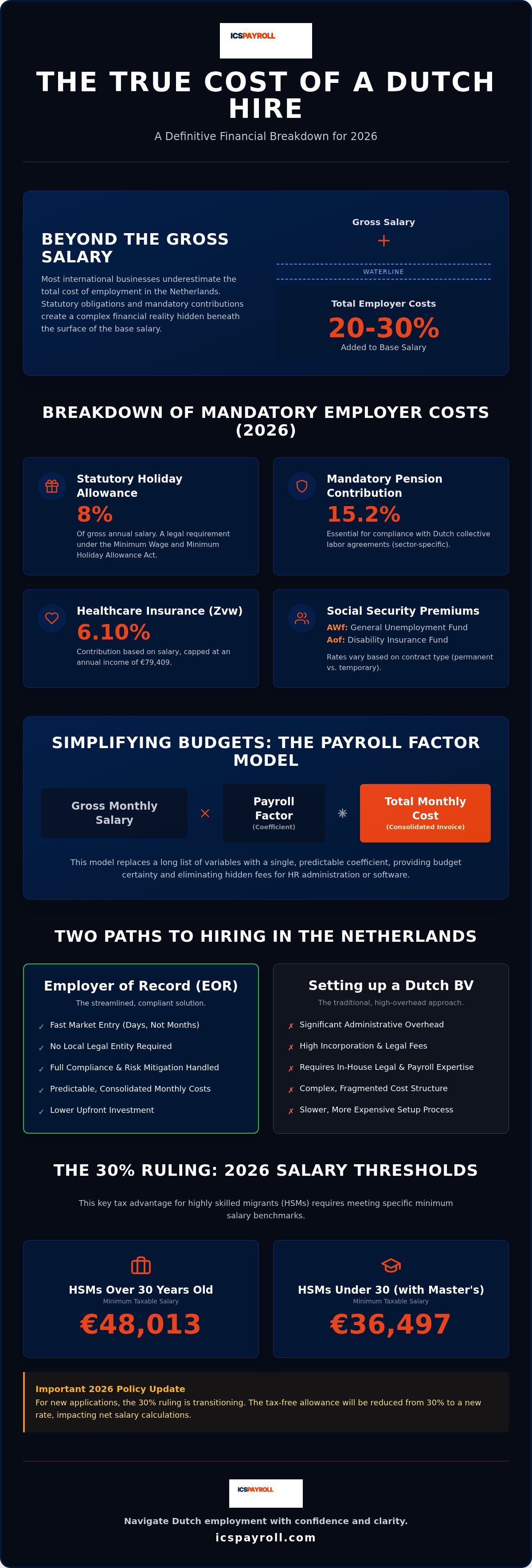
Calculating the total employer of record netherlands cost requires looking far beyond the gross monthly salary. In the Dutch system, the employer's financial obligation is a combination of statutory benefits, insurance premiums, and specific sector requirements. These costs generally add between 20 percent and 30 percent to the base salary. Using an Employer of Record (primary source: Wet financiering sociale verzekeringen (Wfsv), wetten.overheid.nl) provides a structured way to manage these variables without the need to establish a local legal entity. It ensures that every statutory premium is calculated with precision to avoid penalties from the Dutch Tax Authority (Belastingdienst).
Every employee in the Netherlands is entitled to a statutory holiday allowance of 8 percent of their gross annual salary. This is a legal requirement under the Minimum Wage and Minimum Holiday Allowance Act. While traditionally paid as a lump sum in May, it represents a fixed accrual that you must include in your monthly budget. Gross salary is only the baseline. You must also account for the mandatory pension contribution, which reaches 15.2 percent in 2026. This specific pension requirement is often overlooked by generic global providers, yet it's essential for maintaining compliance with Dutch collective labor agreements.
Employer premiums also include contributions to the General Unemployment Fund (AWf) and the Disability Insurance Fund (Aof). These rates vary based on the nature of the employment contract. Permanent contracts typically benefit from lower AWf rates compared to flexible or temporary arrangements. Managing these fluctuating percentages requires a deep understanding of local labor law to ensure your cost projections remain accurate throughout the fiscal year.
Statutory Benefits and Insurance Premiums
Employers must contribute to the Healthcare Insurance Act (Zvw), which is set at 6.10 percent for 2026 and capped at a maximum income level of €79,409. Beyond healthcare, you must budget for the transition allowance (transitievergoeding). This is a mandatory payment that accrues from the first day of employment, currently capped at €102,000 or one annual salary for higher earners. Sickness risk is another critical factor; Dutch law requires employers to pay at least 70 percent of wages for up to 104 weeks if an employee is unable to work due to illness.
2026 Minimum Wage and Salary Standards
The Dutch labor market operates on a mandatory minimum hourly wage, which ranges from €14.71 to €14.99 in 2026. For companies hiring international talent, these floors are often superseded by Highly Skilled Migrant (HSM) requirements. The 2026 salary threshold for the 30% ruling is €48,013 for employees over 30 years old. If you're hiring younger professionals with a qualifying Master's degree, a lower threshold of €36,497 applies. Meeting these specific benchmarks is vital for securing work permits and maintaining tax advantages for your international staff.
Understanding the Payroll Factor Pricing Model
The payroll factor is the most reliable method to determine the total employer of record netherlands cost without encountering unexpected financial burdens. It functions as a fixed coefficient multiplied by the employee's gross monthly salary. This single figure encapsulates the base pay, the 8 percent statutory holiday allowance, social security premiums, and the mandatory 15.2 percent pension contribution for 2026. For international finance teams, this model provides vital budget certainty. It replaces a fragmented list of expenses with one consolidated line item, simplifying global accounting and tax reconciliation.
Local pricing models are inherently more accurate than the generic flat-fee estimates provided by multi-country platforms. A payroll factor accounts for the specific industry risk and the exact premium percentages required by the Dutch authorities. This approach ensures that your business remains compliant with local labor laws while maintaining a clear, predictable monthly expenditure for every Dutch hire. It eliminates the guesswork often associated with international expansion by providing a comprehensive view of the total cost of employment from day one.
The Transparency of a Single Monthly Invoice
Managing Dutch payroll administration involves more than just monthly tax filings. It includes providing secure employee portals, managing holiday balances, and facilitating sickness reintegration processes. A factor-based invoice eliminates hidden charges for HR administration or software access. It also covers the complex administrative costs associated with mandatory sick-leave support. Under Dutch law, employers must actively manage the reintegration of ill employees for up to two years. The payroll factor ensures these professional services and the associated sickness risk coverage are pre-funded and managed by local experts.
Comparing Factor-Based Pricing to Flat Fees
Global EOR providers often market a low, flat monthly fee per employee. While this sounds appealing, these flat fees frequently exclude the actual cost of statutory premiums like the Zvw healthcare contribution (6.10 percent) or sector-specific pension funds. This creates a significant risk of budget variance. You might receive a separate, unexpected bill for employer taxes that wasn't clearly defined in the initial sales quote. Local experts use the factor model because it incorporates the specific 2026 Dutch fiscal landscape into the primary calculation. To gain a precise view of your potential expenses, you can request a tailored Dutch EOR quotation which provides a full cost breakdown within 24 hours.
Cost Comparison: EOR Services vs. Setting Up a Dutch BV
Deciding between a local entity and an EOR is a choice between long-term infrastructure and immediate operational efficiency. Setting up a standard Dutch BV in 2026 involves initial incorporation costs ranging from €600 to €2,500. This includes a mandatory €85.15 Chamber of Commerce (KVK) registration fee and notary charges between €500 and €1,500. While the minimum share capital is a symbolic €0.01, the true employer of record netherlands cost is often lower than the cumulative administrative overhead of a BV for small to medium teams.
A Dutch BV requires continuous maintenance. You'll need to manage periodic VAT filings, annual accounts, and corporate income tax, which is 19 percent for profits up to €200,000. There's also the significant risk of creating a "Permanent Establishment." This legal status triggers full Dutch tax liability and demands specialized tax counsel to manage cross-border profit allocation. For most international firms, the break-even point where a BV becomes more economical than an EOR doesn't occur until the local team exceeds five to seven full-time employees over a two-year period.
Administrative Burden and Legal Compliance
Operating a BV means you're responsible for direct compliance with the "Ketenregeling." This Dutch contract chain rule limits the number of fixed-term contracts you can offer before a permanent one is legally required. Managing this without a dedicated HR department or local legal counsel is risky and expensive. Utilizing an Employer of Record Netherlands removes this burden. It ensures all contracts are compliant with the latest 2026 reforms while protecting you from misclassification penalties under the Wet DBA and VBAR regulations.
Speed to Market and Operational Flexibility
Speed is a critical factor in a competitive talent market. Establishing a Dutch BV and opening a local bank account can take between five and nine months. This delay often results in losing top-tier candidates to more agile competitors. In contrast, an EOR allows you to become operational in approximately three weeks. This model also offers superior exit flexibility. If market conditions change, you can scale down or exit without the complex and costly liquidation process required to close a Dutch legal entity. This agility is a primary reason why fast-growing firms prefer the EOR model for their initial Dutch expansion.
Impact of the 30% Ruling on Total Employment Costs in 2026
The 30 percent ruling remains a primary driver for reducing the total employer of record netherlands cost when hiring international talent. In 2026, the landscape of this tax incentive is undergoing a significant transition. While the immediate tapering plan was reversed, the tax-free allowance is scheduled to reduce to 27 percent starting January 1, 2027. For the 2026 tax year, the standard taxable salary threshold is fixed at EUR 48,013. For younger professionals under 30 with a qualifying Master's degree, the threshold is EUR 36,497. This ruling doesn't only benefit the employee; it significantly lowers the employer's social security burden. Because the tax-free portion is not subject to social premiums, the overall cost to company (CTC) is reduced while the employee's net take-home pay increases. This benefit is capped at the "Balkenende norm," which is EUR 262,000 for 2026.
Eligibility and Application Costs
Eligibility depends on the employee being recruited from a distance of more than 150 kilometers from the Dutch border for at least 16 out of 24 months before their first working day. ICSPayroll facilitates these applications through licensed legal partners as part of our comprehensive service. It's vital to recognize that the partial non-resident status has been abolished. All employees residing in the Netherlands are now subject to Dutch tax on their global wealth in Box 2 and Box 3. This change necessitates precise tax planning to ensure the total employment package remains competitive. Our team handles the administrative burden of these filings to ensure your business stays compliant with the Belastingdienst while maximizing available tax advantages.
Expedited Visa Processing for Non-Schengen Staff
Hiring from outside the Schengen area often introduces administrative delays that increase the effective employer of record netherlands cost. We mitigate this through expedited Highly Skilled Migrant (HSM) visa processing via our partners. The industry benchmark for these applications is approximately three weeks. This speed allows you to secure talent quickly without the five-month wait times often associated with direct entity sponsorship. Additionally, employers must budget for the transition payment cap, which is set at EUR 102,000 for 2026. This cap applies to all employees, including those utilizing the 30 percent ruling. Managing these statutory limits alongside immigration requirements requires a partner who understands the nuances of Dutch labor law. You can apply for the 30% ruling today to optimize your international hiring budget.
Optimizing Your Dutch Hiring Budget with ICSPayroll
Partnering with a local specialist is the most effective way to control your employer of record netherlands cost while ensuring high-level operational standards. ICSPayroll provides more than just a payment mechanism; we offer a complete HR infrastructure. This includes access to a tailored Dutch HR handbook and employment contracts that are fully compliant with 2026 labor reforms. By using our online employee portal, your staff can manage payslips and holiday balances independently. This reduces your internal administrative burden and improves the employee experience.
Sick-leave management is a significant cost variable in the Netherlands. Unlike global platforms that often offer generic support, we provide specific reintegration guidance through our specialized service partners. This proactive approach helps you manage the mandatory two-year pay requirement for ill employees and avoids the financial risks of non-compliance. You can also begin your hiring process immediately, even before a Dutch BV is established. This allows you to capture market opportunities without waiting for the five to nine months often required for local incorporation and bank account setup.
Compliance as a Cost-Avoidance Strategy
Strategic compliance is the foundation of budget protection. Failing to meet the strict standards of the Belastingdienst or labor inspectors can result in punitive fines that far exceed the cost of professional EOR services. We ensure your business adheres to the mandatory seven-year record-keeping requirement for all payroll and personnel files in the Netherlands. Navigating Employment law in the Netherlands requires a partner who understands the nuances of Wet DBA enforcement and the latest non-compete reforms. Our expertise acts as a shield, protecting your company from the legal and financial fallout of misclassification or administrative errors.
How to Get an Accurate Quote in 24 Hours
Securing a precise view of your potential employer of record netherlands cost shouldn't be a time-consuming task. To provide a tailored payroll factor, we only require basic information such as the employee's gross salary, age, and whether they qualify for the 30 percent ruling. Our "no surprise" guarantee ensures that the single invoice you receive covers every statutory obligation, from Zvw contributions to sector-specific pensions. This transparency allows your finance team to budget with absolute certainty. You can reach our team directly via phone or email for immediate budget planning and a comprehensive cost breakdown delivered within 24 hours.
Securing Your Financial Footprint in the Dutch Market
Hiring in the Netherlands for 2026 demands a precise understanding of statutory premiums and shifting tax regulations. You've seen how the 15.2 percent pension requirement and the 8 percent holiday allowance form the foundation of every compliant contract. Utilizing a transparent payroll factor model allows you to consolidate these variables into a single monthly invoice with no hidden charges. This approach provides the budget certainty necessary for successful international expansion while ensuring full 2026 Dutch labor law and tax compliance from day one.
Managing the total employer of record netherlands cost is about more than just gross salary; it's about speed and administrative precision. We facilitate expedited HSM visa processing in approximately 3 weeks via our licensed partners. This allows you to secure top talent without the delays of entity incorporation. You don't have to navigate this complex bureaucracy alone. Our team is ready to provide the local expertise required to streamline your Dutch operations. Request a tailored Dutch EOR quote within 24 hours to finalize your 2026 hiring budget. We look forward to supporting your growth in the Netherlands.
Frequently Asked Questions
What is the average cost of an Employer of Record in the Netherlands?
The service fee is only one component of the total employer of record netherlands cost. While industry-wide service fees range from €175 to over €650 per month, you must also budget for mandatory employer premiums. These statutory costs typically add 20 percent to 30 percent to the employee's gross salary. A local factor-based model ensures these variables are consolidated into a single, predictable monthly invoice for your finance team.
Is the 8% holiday allowance mandatory for all Dutch employees?
Yes, the 8 percent holiday allowance is a statutory requirement under the Minimum Wage and Minimum Holiday Allowance Act. All employees are entitled to this payment, which is usually paid as a lump sum in May. It is calculated based on the employee's gross annual salary. Failure to pay or accrue this allowance can lead to significant fines from the Dutch Labor Inspectorate, so it must be included in every budget.
How does the 30% ruling affect the employer cost in 2026?
The 30 percent ruling reduces the total employer of record netherlands cost by lowering the taxable base for social security premiums. In 2026, the standard salary threshold is EUR 48,013. Since the tax-free portion of the salary is not subject to employer social premiums, the cost to company (CTC) decreases while the employee's net take-home pay increases. This makes the ruling a powerful tool for optimizing your international hiring budget.
Are pension contributions mandatory for employees in the Netherlands?
Pension contributions are mandatory if the employment falls under a specific sector-wide collective labor agreement (CAO). In 2026, many of these schemes require an employer contribution of approximately 15.2 percent. Even without a mandatory CAO, providing a pension is a standard market practice. It is generally necessary to attract top talent in the competitive Dutch labor market and is usually included in the all-inclusive payroll factor.
What are the employer social security rates in the Netherlands for 2026?
Employer social security rates for 2026 include the Healthcare Insurance Act (Zvw) at 6.10 percent, capped at an income of EUR 79,409. You must also account for the General Unemployment Fund (AWf) and the Disability Insurance Fund (Aof). These rates vary based on the contract type. Total employer premiums generally range between 15 percent and 20 percent of the gross salary, forming a major part of the employer of record netherlands cost.
Can I hire in the Netherlands without a local legal entity?
You can legally hire Dutch staff without incorporating a local legal entity by utilizing an Employer of Record. The EOR serves as the legal employer on paper, handling all payroll, tax filings, and compliance with the Belastingdienst. This allows your business to become operational within weeks rather than the months required to set up a Dutch BV and open a local bank account, providing significant speed to market.
What happens if an employee on an EOR contract falls ill?
If an employee falls ill, the EOR manages the mandatory two-year salary continued payment requirement. Under the Gatekeeper Improvement Act, employers must pay at least 70 percent of the wage for up to 104 weeks. The EOR handles the complex reintegration process and coordinates with occupational health services (Arbodienst). This ensures full compliance with Dutch labor law and protects your business from the administrative burden of long-term sickness management.
How quickly can an EOR start the onboarding process in the Netherlands?
Onboarding can typically begin within one to two weeks once the service agreement is finalized. If you are hiring a non-Schengen professional, Highly Skilled Migrant (HSM) visa processing takes approximately three weeks via our licensed partners. This speed provides a significant advantage over the five to nine month timeline often associated with direct entity sponsorship and IND recognition, allowing you to secure top-tier talent quickly and efficiently.
Sources and references
Every rule and figure above is traceable to the sources below: the exact statutory articles, the regulator pages that publish the amounts, the statistical datasets, and the specific court rulings that settle the point. Always check the current text for your own situation.
- Article 7:692 Dutch Civil Code, the statutory definition of payrolling
- Article 7:690 Dutch Civil Code, the agency work (uitzend) contract
- Article 8 Waadi, equal pay for hired-in workers (loonverhoudingsnorm)
- Stichting Normering Arbeid, the NEN 4400-1 register of audited payroll and staffing companies
- Belastingdienst, low and high AWf unemployment contribution rates and when each applies
- Netherlands Labour Authority, enforcement, inspections and penalty policy
- CBS, Compensation of employees and employment by economic activity (national accounts dataset 84165ENG)
- Eurostat, hourly labour cost levels by NACE activity (dataset lc_lci_lev), for cross-country comparison
- Supreme Court 11 April 2025, ECLI:NL:HR:2025:543: the agency work contract of art. 7:690 BW in a triangular platform-work relationship
- Supreme Court 21 November 2025, ECLI:NL:HR:2025:1733: misuse of successive agency contracts under art. 5(5) Directive 2008/104/EC and the Waadi

Article by
Joost Hubregtse
Joost Hubregtse is Director of ICS Staffing & Payroll B.V., the wholly owned subsidiary of Intercompany Solutions behind ICS Payroll. He is responsible for Employer of Record and Dutch payroll services: employment contracts, wage tax and social security filings, holiday allowance, pension, sick leave and CAO compliance, with onboarding possible within 48 hours.

Frequently Asked Questions
The service fee is only one component of the total employer of record netherlands cost. While industry-wide service fees range from €175 to over €650 per month, you must also budget for mandatory employer premiums. These statutory costs typically add 20 percent to 30 percent to the employee's gross salary. A local factor-based model ensures these variables are consolidated into a single, predictable monthly invoice for your finance team.
Yes, the 8 percent holiday allowance is a statutory requirement under the Minimum Wage and Minimum Holiday Allowance Act. All employees are entitled to this payment, which is usually paid as a lump sum in May. It is calculated based on the employee's gross annual salary. Failure to pay or accrue this allowance can lead to significant fines from the Dutch Labor Inspectorate, so it must be included in every budget.
The 30 percent ruling reduces the total employer of record netherlands cost by lowering the taxable base for social security premiums. In 2026, the standard salary threshold is EUR 48,013. Since the tax-free portion of the salary is not subject to employer social premiums, the cost to company (CTC) decreases while the employee's net take-home pay increases. This makes the ruling a powerful tool for optimizing your international hiring budget.
Pension contributions are mandatory if the employment falls under a specific sector-wide collective labor agreement (CAO). In 2026, many of these schemes require an employer contribution of approximately 15.2 percent. Even without a mandatory CAO, providing a pension is a standard market practice. It is generally necessary to attract top talent in the competitive Dutch labor market and is usually included in the all-inclusive payroll factor.
Employer social security rates for 2026 include the Healthcare Insurance Act (Zvw) at 6.10 percent, capped at an income of EUR 79,409. You must also account for the General Unemployment Fund (AWf) and the Disability Insurance Fund (Aof). These rates vary based on the contract type. Total employer premiums generally range between 15 percent and 20 percent of the gross salary, forming a major part of the employer of record netherlands cost.
You can legally hire Dutch staff without incorporating a local legal entity by utilizing an Employer of Record. The EOR serves as the legal employer on paper, handling all payroll, tax filings, and compliance with the Belastingdienst. This allows your business to become operational within weeks rather than the months required to set up a Dutch BV and open a local bank account, providing significant speed to market.
If an employee falls ill, the EOR manages the mandatory two-year salary continued payment requirement. Under the Gatekeeper Improvement Act, employers must pay at least 70 percent of the wage for up to 104 weeks. The EOR handles the complex reintegration process and coordinates with occupational health services (Arbodienst). This ensures full compliance with Dutch labor law and protects your business from the administrative burden of long-term sickness management.
Onboarding can typically begin within one to two weeks once the service agreement is finalized. If you are hiring a non-Schengen professional, Highly Skilled Migrant (HSM) visa processing takes approximately three weeks via our licensed partners. This speed provides a significant advantage over the five to nine month timeline often associated with direct entity sponsorship and IND recognition, allowing you to secure top-tier talent quickly and efficiently.