Managing Dutch Employment Contracts: A 2026 Compliance Checklist for Employers
By Joost Hubregtse, Director, ICS Staffing & Payroll
All blog posts are reviewed and fact checked by our labour law lawyer Zishan Hussain and our director. Editorial standards
Could a single oversight in your contract template trigger a payroll tax audit by the Dutch Tax and Customs Administration? Enforcement against false self-employment resumed on 1 January 2025, and while 2026 remains a transitional year, the risk for international firms is rising on a fixed schedule. Successfully managing Dutch employment contracts in 2026 requires more than administrative diligence. It requires knowing which rules are actually in force today, which have been adopted but not yet commenced, and which are still only proposals, because a great deal of published commentary conflates the three.
We understand that the "Ketenregeling" rules for temporary contracts, the shifting expat scheme thresholds, and a pipeline of flexible-work legislation create real administrative pressure. This guide sets out the position as it stands, and flags dated changes ahead so you can plan against them rather than react. You will learn how to structure mandatory clauses correctly, meet social security obligations, and hire locally without establishing a Dutch BV.
Key Takeaways
- The Ketenregeling currently permits three consecutive fixed-term contracts across a maximum of 36 months before a permanent contract arises by operation of law.
- The statutory minimum wage is €14.99 gross per hour as of 1 July 2026, and the mandatory holiday allowance is 8% of gross wage, capped at three times the annual minimum wage.
- Zero-hour contracts remain lawful in 2026. The act that replaces them with bandwidth contracts has been adopted but is not expected to commence until 1 January 2028.
- Misclassification is assessed under existing case law, not under the VBAR clarification framework, which the government withdrew in 2026.
- Under Dutch payroll law, a payroll employee is entitled to the same terms of employment as the client's own comparable staff, plus an adequate pension.
- An Employer of Record can carry local compliance and payroll obligations through a single monthly invoice, within those statutory constraints.
Table of Contents
- Navigating Dutch Labor Law for Foreign Employers in 2026
- Choosing the Right Contract Structure, Fixed-Term vs. Indefinite
- Management Agreements vs. Employment Contracts, Avoiding Misclassification
- The 2026 Compliance Checklist for Managing Dutch Employment Contracts
- Streamlining Dutch Contract Management with ICSPayroll
Navigating Dutch Labor Law for Foreign Employers in 2026
The Dutch labour market is heavily regulated and strongly protective of employees. For international businesses, managing Dutch employment contracts means meeting standards that generally favour the worker, and non-compliance leads to financial exposure or litigation before a Dutch court. A verbal employment agreement is valid under Dutch Labor Law (primary source: Burgerlijk Wetboek Boek 7 (employment contract law), wetten.overheid.nl), but several clauses, probation, non-competition, and non-solicitation among them, are only enforceable if agreed in writing and signed. Without a written instrument, those protections are effectively unavailable to you.
Beyond hiring, employers must maintain a disciplined administrative trail. The payroll administration is subject to a seven-year fiscal retention requirement. A narrower set of items, the copy of the identity document, the employee's payroll tax details, and any request to apply or not apply the payroll tax credit, must be retained for at least five full calendar years after the end of the employment relationship. Note that this is a fiscal obligation, not a licence to retain everything: personnel file contents such as employment contracts, appraisals and correspondence are personal data under the GDPR and should be retained only as long as necessary, which in practice is considerably shorter. Applying a blanket seven-year rule to the whole personnel file creates a data-minimisation problem of its own.
The Role of the Dutch Civil Code and CAOs
Employment relations are primarily governed by Book 7, Title 10 of the Dutch Civil Code. This sets the baseline for everything from termination procedure to sick pay. Many sectors are additionally covered by a Collective Labour Agreement (CAO), which may improve on statutory minimums and, in defined cases, may permit deviation from them. Determining whether a mandatory CAO applies to your activity is a threshold question, not a detail: a CAO can dictate pay scales, working hours, pension contributions and notice periods, and a generally binding CAO applies whether or not you are a member of the signatory employers' association. For a broader perspective on these legal layers, consult our 2026 Compliance Guide.
Statutory Minimums and 2026 Wage Standards
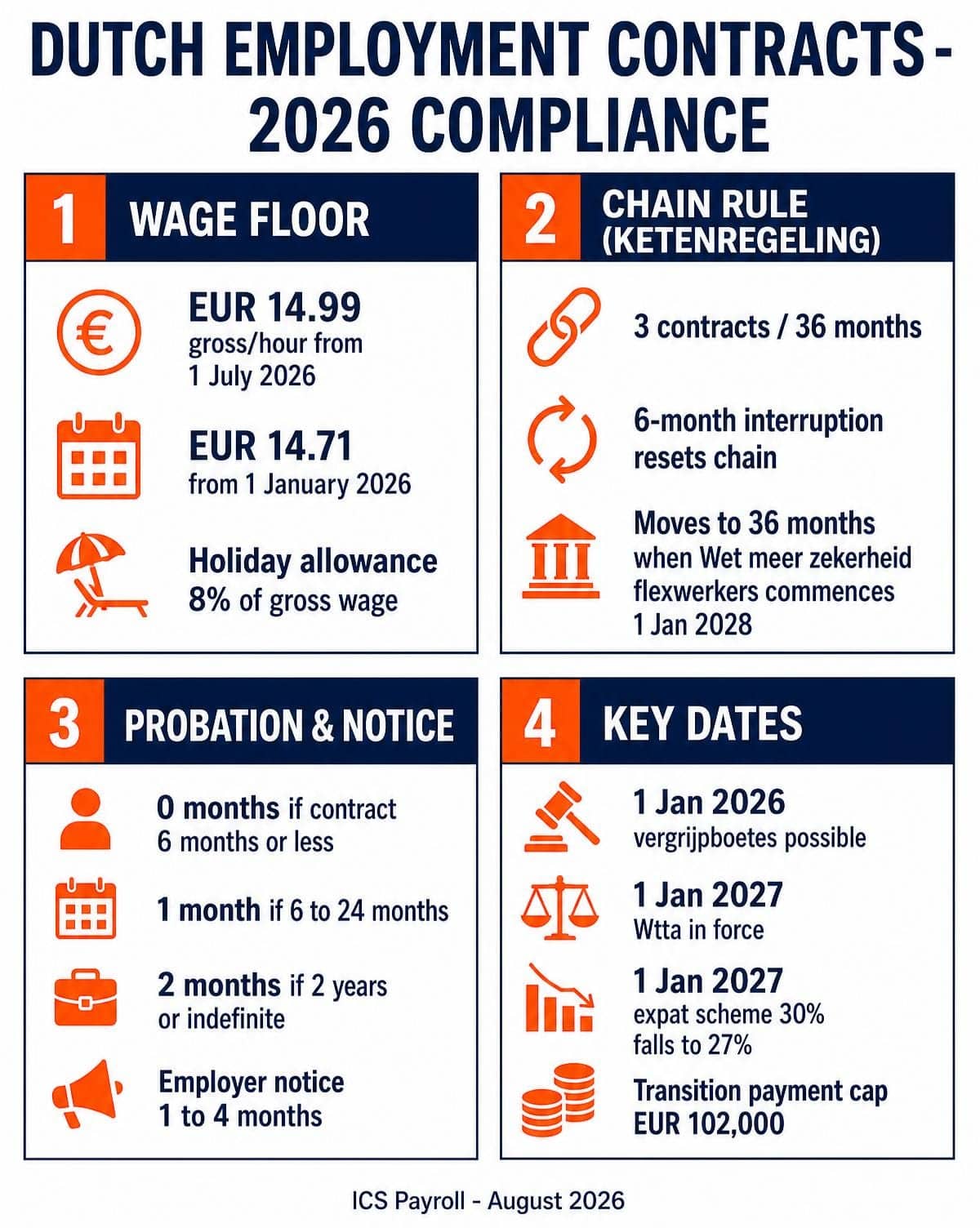
Financial compliance starts with the wage floor. As of 1 July 2026 the statutory minimum wage for employees aged 21 and older is €14.99 gross per hour, following €14.71 per hour from 1 January 2026. The rate is indexed twice a year, on 1 January and 1 July. Since 2024 the Netherlands has operated a statutory minimum hourly wage: there are no longer fixed statutory minimum monthly, weekly or daily wages, so the monthly figure follows from contracted hours. Separate minimum youth rates apply to employees aged 15 to 20, and separate scales apply to BBL apprentices. You can find the most recent tax norms and contribution rates on the official belastingdienst.nl website.
On top of base salary, employees are entitled to a holiday allowance (vakantiebijslag) of at least 8% of gross wage, calculated over wage up to three times the annual minimum wage. By statutory default it is paid at least once a year in June, though a different payment moment can be agreed in writing. The entitlement exists by operation of law whether or not the contract mentions it, but the wage components should still be set out in the written statement of terms you are obliged to provide.
Choosing the Right Contract Structure, Fixed-Term vs. Indefinite
The Dutch system uses the "Ketenregeling" or chain rule to limit the sequential use of temporary agreements. Under the rule in force in 2026, you may conclude a maximum of three consecutive fixed-term contracts within a total period of 36 months, counting intervals. Exceed either limit and the relationship converts to an indefinite contract by operation of law. An interruption of more than six months currently breaks the chain and resets the count.
Plan against a scheduled change here. Under the Wet meer zekerheid flexwerkers, adopted by the Tweede Kamer on 12 May 2026 and approved by the Eerste Kamer on 7 July 2026, the interruption period lengthens from six months to 36 months, with exceptions for students in side jobs and for seasonal work. Most provisions of that act are expected to commence on 1 January 2028; the component on equivalent terms of employment for agency workers is scheduled earlier, at 31 December 2026. Until commencement, the current six-month interval continues to apply. Employers who rely on rotating temporary staff should model the impact now, because the change makes the reset route effectively unusable.
Two related points on flexible contracts. First, zero-hour and min-max contracts remain lawful in 2026; the bandwidth contract that replaces them, with an agreed minimum and a maximum no higher than 130% of that minimum, arrives with the same commencement date, not before. Second, for fixed-term contracts of six months or longer you owe an aanzegging: written notice at least one month before the end date stating whether you will renew and on what terms. Failure carries a penalty of up to one month's salary, and it is one of the most common and most avoidable claims against foreign employers.
For companies hiring highly skilled migrants, indefinite contracts are frequently preferred. A permanent agreement supports immigration applications and helps attract senior talent. It also interacts with the expat scheme, still widely called the 30% ruling: for 2026, the employee's taxable annual salary after application of the tax-free allowance must be at least €48,013, or €36,497 for an employee under 30 holding a qualifying master's degree verified by the Dutch diploma evaluation body or approved in advance by the Tax Administration.
Mandatory Clauses for Dutch Compliance
Every Dutch employment agreement should identify the parties, the work location, the job title and duties, the start date, whether the term is fixed or indefinite, contracted hours, gross salary and payment interval, the holiday allowance, holiday entitlement, applicable notice periods, any applicable CAO, and the pension arrangement or its absence. If you need assistance structuring these complex agreements, you can request a tailored quotation to ensure your templates meet all local standards.
On notice: statutory notice for the employer runs from one to four months depending on length of service, and one month for the employee. You may extend the employee's notice period in writing, up to a maximum of six months, but if you do, the employer's notice period must then be at least double the employee's. The employer's statutory notice period can only be shortened by CAO, not by individual agreement.
Probation and Non-Compete Reforms in 2026
Probation must be agreed in writing, must be identical for both parties, and is capped by the contract's duration. No probation may be agreed in a contract of six months or less; any clause purporting to do so is void. For a fixed-term contract longer than six months but shorter than two years, the maximum is one month. For a fixed-term contract of two years or more, and for an indefinite contract, the maximum is two months. A probation clause in a successive contract with the same employer is void unless the new role clearly demands different skills or responsibilities.
Non-compete clauses are governed by Article 7:653 of the Civil Code. The clause must be in writing and agreed with an adult employee. In a fixed-term contract it is valid only if the employer sets out in writing, within the clause itself, the compelling business or service interests that make it necessary; this requirement has applied since 2015. In an indefinite contract there is currently no statutory maximum duration and no statutory motivation requirement, though a court may set aside or limit a clause that is unreasonably burdensome relative to the employer's interest, and courts do so regularly. Beyond these structural elements, you must also ensure the timing of specific payments, such as the 8% holiday allowance, aligns with the Dutch Holiday Allowance Rules to avoid late-payment penalties.
Reform is coming but is not law. The Wetsvoorstel modernisering concurrentiebeding was sent to the Council of State on 29 June 2026, with the government aiming to submit it to parliament at the end of 2026. It would cap non-competes at one year, require written motivation for indefinite contracts as well, require the geographic scope to be specified, require the employer to invoke the clause expressly and in time, and require compensation to the employee when it is invoked. None of this binds you today. Drafting to the proposed standard now is nevertheless sensible, because transitional provisions are expected to apply the invocation and compensation rules to pre-existing clauses.
Management Agreements vs. Employment Contracts, Avoiding Misclassification
Distinguishing a management or services agreement from an employment contract is the most consequential judgement in this area. Many international firms engage local talent as contractors to avoid payroll administration. The Dutch Tax and Customs Administration is actively examining these arrangements, and if the working relationship functions as employment, it will be reclassified, producing retroactive wage tax and social insurance assessments.
The Deliveroo judgment of the Supreme Court on 24 March 2023 governs the assessment. The label the parties put on the contract is not decisive; what matters is how the relationship is actually performed. Critically, the Court did not reduce this to one or two tests. It confirmed a holistic weighing of all circumstances in conjunction and then listed circumstances that may be relevant, including the nature and duration of the work, how the work and working hours are determined, the embedding of the work and the worker in the organisation, whether there is an obligation to perform personally, how the contractual arrangement came about, how remuneration is determined and paid, the level of that remuneration, the commercial risk borne, and whether the worker behaves or can behave as an entrepreneur in economic traffic. That list is not exhaustive. In its Uber judgment the Supreme Court subsequently held that the entrepreneurship factor is neither decisive nor subordinate: it is weighed fully and equally alongside the others.
The practical consequence is that no single contractual clause immunises an arrangement, and no single factor condemns it. ICSPayroll offers an alternative through Employer of Record services: by acting as the legal employer, we remove the classification question while the worker receives full protection under Dutch law.
Understanding Wet DBA and VBAR in 2026
The enforcement moratorium under the Wet DBA ended on 1 January 2025. Since that date the Tax Administration can impose payroll tax assessments for false self-employment, in principle only for work performed from 1 January 2025 onward; corrections for earlier years remain possible where there was bad faith or where earlier instructions were not followed. 2026 is a partially extended transitional year, and the detail matters. No verzuimboetes are being imposed in 2026. Vergrijpboetes, which require intent or gross negligence, proved by the inspector, became possible from 1 January 2026, which is the genuinely new exposure. In practice an investigation typically begins with a company visit, which may result in a warning; a payroll tax assessment requires a books investigation. From 2027 enforcement normalises further under a phase-in model running to 2030, when the ordinary five-year look-back period returns.
On legislation, be careful with commentary published before spring 2026. The Wet VBAR was intended to replace the Wet DBA on 1 July 2026, but the government withdrew the clarification component in March and April 2026. What survived was the presumption of employment at low hourly rates, split into a standalone act: a worker paid below €38 per hour (reference date 1 January 2026) may invoke a presumption of an employment contract, shifting the burden to the client to demonstrate genuine self-employment. That act was adopted by the Tweede Kamer on 21 April 2026 and the Eerste Kamer on 16 June 2026 and published in the Staatsblad on 29 June 2026, but it has not yet entered into force; commencement will be set by royal decree and the applicable rate will be fixed separately. The statutory clarification of the authority criterion has been deferred to a planned Zelfstandigenwet, which has not yet been introduced in parliament.
Until then, assessment proceeds under existing law and case law. Foreign entities should also note the separate risk that individuals performing core business activities in the Netherlands may trigger a Permanent Establishment Risk for corporate tax purposes.
When to Use a Management BV Structure
A management agreement is generally appropriate only for senior executives or directors operating through their own private limited company (Management BV), where genuine entrepreneurship and commercial risk exist. For Director-Major Shareholders (DGAs), employee insurance obligations differ. The uwv.nl website clarifies that exclusion from mandatory employee insurance turns on actual control within the company rather than on a bare shareholding percentage, and in particular on whether the director can be dismissed against their will. Absent that control and genuine entrepreneurial risk, an employment contract remains the compliant route.
The 2026 Compliance Checklist for Managing Dutch Employment Contracts
Work through the following. Verify that base pay meets the €14.99 gross hourly minimum applicable from 1 July 2026, and that your July payroll reflects the increase from €14.71. Confirm the 8% holiday allowance is provided for, calculated over wage up to three times the annual minimum wage, and paid at least annually. Check that temporary arrangements stay within three contracts and 36 months, and that any reliance on the six-month reset is documented, while noting the interval moves to 36 months when the flexible work act commences.
Diarise the aanzegging date for every fixed-term contract of six months or more. Confirm probation clauses match the contract duration, and that any non-compete in a fixed-term contract carries written motivation. For international hires, submit the expat scheme request within four months of the first working day: applied for in time, the scheme applies retroactively from the start of employment; applied for later, it applies only from the first day of the month following receipt of the request by the Tax Administration. Two further expat scheme points for 2026. The transitional relief lapsed on 1 January 2026, so the scheme is now capped for every employee at the WNT norm of €262,000, meaning no tax-free extraterritorial allowance can be calculated above that figure. And from 1 January 2027 the maximum reimbursement falls from 30% to 27%, with higher salary norms, so employees close to the threshold should be reviewed before year-end. The scheme, incidentally, is now officially termed the expat scheme, or expatregeling; the older name persists in practice.
Sick Pay and Reintegration Obligations
Dutch law places long-term illness risk with the employer. You must pay at least 70% of the employee's wage for a maximum of 104 weeks. Two statutory boundaries are frequently missed. During the first 52 weeks the amount may not fall below the applicable statutory minimum wage, so for lower-paid staff the 70% figure is often topped up by operation of law. Conversely, the 70% obligation applies only up to the maximum daily wage under the social insurance financing legislation; there is no statutory entitlement to 70% of the excess. Illness related to pregnancy, childbirth or organ donation attracts 100%. Many CAOs and contracts improve on the statutory floor, commonly 100% in year one and 70% in year two.
You must also follow the Gatekeeper (Poortwachter) process: engage an occupational health service, prepare and maintain a reintegration file and plan of action, and keep the case moving. Insufficient reintegration effort can result in UWV imposing a wage sanction of up to 52 weeks, effectively a third year of wage payment, and blocking the dismissal route. Beyond illness, you should also account for other statutory entitlements like Paternity Leave, additional partner leave and paid parental leave in your leave policy.
Termination and Transition Payments
Termination in the Netherlands is rarely unilateral. Absent an urgent cause justifying summary dismissal, termination by the employer generally requires prior permission from UWV, for redundancy or long-term incapacity, or dissolution by the subdistrict court on one of the statutory grounds. Termination during probation, expiry of a fixed-term contract, and mutual consent fall outside that requirement. The statutory transition payment accrues from the first day of employment and is capped in 2026 at €102,000 gross, or one gross annual salary if the employee earns more than that. It is not owed in every case: it does not arise where the employee resigns without seriously culpable conduct by the employer, nor on summary dismissal for an urgent cause attributable to the employee's seriously culpable conduct.
Most employers prefer a settlement agreement (vaststellingsovereenkomst), which avoids proceedings and, if drafted correctly, preserves the employee's unemployment benefit position. Note the trade-off honestly: under a settlement agreement the statutory transition payment is not owed by operation of law, so the severance figure is a negotiated term, and in practice the negotiated amount often exceeds the statutory calculation. The employee also has a statutory reflection period of 14 days after signature, three weeks if the agreement does not mention the right, during which they may revoke without reasons. Build that into your timelines. If you're concerned about your current liability levels, contact ICSPayroll for a comprehensive compliance audit.
Streamlining Dutch Contract Management with ICSPayroll
Managing Dutch employment contracts as a foreign entity involves tax registrations, social security obligations and employment law liabilities. ICSPayroll acts as your local legal employer through our Employer of Record (EOR) service, assuming responsibility for contract compliance while you direct the day-to-day work. You receive one monthly invoice consolidating gross wages, the 8% holiday allowance, and employer social security contributions including AWf, Aof, and the Zvw healthcare contribution.
One point of law we set out openly, because it defines the service. Under the Dutch Civil Code provisions on payrolling, a payroll employee is entitled to the same terms of employment as the client's own comparable employees, and to an adequate pension scheme. An EOR arrangement is therefore a compliance and administration solution, not a route to a lower cost base than direct employment. Any provider suggesting otherwise is describing a structure that will not survive scrutiny.
Two regulatory dates matter for anyone using a payroll or secondment provider in the Netherlands. Lending out workers requires registration in the Trade Register for that activity. And under the Wtta, the admission regime for firms that make workers available to third parties, including employment agencies, secondment firms and payroll companies, the act enters into force on 1 January 2027. Providers wishing to use the transitional regime must register between 1 November and 31 December 2026, with admission applications running from 1 May to 30 June 2027, and the Netherlands Labour Authority enforcing from 1 January 2028. From that point clients may only engage admitted providers, and penalties can fall on the client as well as the provider. When selecting an EOR partner, ask directly about its Wtta trajectory.
Fast-Track Hiring in the Netherlands
You can begin operations in the Netherlands within weeks without incorporating a Dutch BV, avoiding the setup and ongoing administration of a local entity. We advise on the expat scheme and the 2026 taxable salary threshold of €48,013, and manage the application within the four-month window. Both employer and employee receive portal access to signed contracts, monthly payslips and annual tax statements.
On immigration, one clarification worth making because it is often blurred in the market. The highly skilled migrant scheme requires the employer to be a recognised sponsor with the Immigration and Naturalisation Service, and the IND applies specific conditions to payroll and secondment constructions. Where sponsorship is arranged through a licensed partner rather than by the payroll employer itself, the structure needs to be set up so that the sponsoring entity and the legal employer align with IND requirements. We will walk you through how that works for your specific case rather than presenting it as automatic.
Your Partner for Lasting Success
We work as a collaborative partner for technology companies and international firms entering the Dutch market, combining fast digital onboarding with conservative legal standards. We provide a tailored quotation within 24 hours of your request, so you can plan costs with confidence. Contact us today to secure your local compliance.
Secure Your Dutch Expansion with Expert Compliance
Managing Dutch employment contracts in 2026 requires distinguishing what is in force from what is scheduled. Your agreements must reflect the €14.99 hourly minimum, the current chain rule limits, and probation caps that follow contract duration. With enforcement against false self-employment normalising through 2030, and the Wtta admission regime arriving on 1 January 2027, the case for getting the structure right now is stronger than the case for waiting.
Get your tailored Dutch employment quote within 24 hours.
This article provides general information on Dutch employment and payroll law as at August 2026 and does not constitute legal or tax advice. Legislation, thresholds and commencement dates change; verify current figures before acting, or contact us for advice on your specific situation.
Frequently Asked Questions
What are the mandatory elements of a Dutch employment contract in 2026?
The agreement should identify both parties, the work location, job title and duties, start date, whether the term is fixed or indefinite, contracted hours, gross salary and payment interval, the 8% holiday allowance, holiday entitlement, notice periods, any applicable CAO, and the pension arrangement. Clauses on probation, non-competition and non-solicitation are only enforceable if agreed in writing. Separately, your payroll administration is subject to a seven-year fiscal retention requirement, with certain payroll tax items retained at least five full calendar years after employment ends.
How many times can I renew a fixed-term contract in the Netherlands?
Currently a maximum of three consecutive fixed-term contracts within 36 months, intervals included. A fourth contract, or exceeding 36 months, produces an indefinite contract by operation of law. An interruption of more than six months breaks the chain. Under the Wet meer zekerheid flexwerkers, adopted in 2026, that interruption period lengthens to 36 months, with most provisions expected to commence on 1 January 2028.
What is the 2026 minimum wage for employees in the Netherlands?
€14.99 gross per hour for employees aged 21 and over as of 1 July 2026, following €14.71 from 1 January 2026. The rate is indexed on 1 January and 1 July. There are no fixed statutory monthly minimums; the monthly figure follows from contracted hours. Lower statutory rates apply to employees aged 15 to 20.
Do I need a Dutch entity to hire someone in the Netherlands?
No. With an Employer of Record such as ICSPayroll, the EOR becomes the legal employer and handles payroll, wage tax and employment law obligations while you direct the work. Note that under Dutch payrolling rules the employee is entitled to the same terms of employment as your own comparable staff, plus an adequate pension.
What is the transition payment cap in 2026?
€102,000 gross, or one gross annual salary if the employee earns more. It accrues from the first working day. It is not owed where the employee resigns without seriously culpable conduct by the employer, nor on summary dismissal for an urgent cause attributable to the employee's seriously culpable conduct. Under a settlement agreement the statutory payment does not apply by operation of law and severance becomes a negotiated term.
How does the 30% ruling affect the employment contract?
The employer and employee must agree in writing, in the contract or an addendum, that part of the wage is designated as a tax-free extraterritorial cost allowance; the entitlement itself follows from a joint request and a decision from the Tax Administration. For 2026 the taxable salary threshold after the allowance is €48,013, or €36,497 for a qualifying employee under 30 with a master's degree, and the scheme is capped at the WNT norm of €262,000. Submit the request within four months of the first working day to obtain retroactive effect. From 1 January 2027 the maximum falls to 27% with higher salary norms.
Sources and references
Every rule and figure above is traceable to the sources below: the exact statutory articles, the regulator pages that publish the amounts, the statistical datasets, and the specific court rulings that settle the point. Always check the current text for your own situation.
- Article 7:668a Dutch Civil Code, the chain rule (ketenregeling): 3 contracts, 36 months, 6-month break
- Article 7:610 Dutch Civil Code, definition of the employment contract
- Article 15 Minimum Wage Act, the 8% holiday allowance (vakantiebijslag)
- Rijksoverheid, statutory minimum hourly wage amounts per 1 January 2026
- Netherlands Labour Authority, enforcement, inspections and penalty policy
- UWV, sickness, reintegration obligations and the WIA application in week 93
- CBS, Compensation of employees and employment by economic activity (national accounts dataset 84165ENG)
- CBS StatLine, the open statistical database behind the wage and employment figures cited here
- Supreme Court 21 February 2020, ECLI:NL:HR:2020:312: application of the chain rule of art. 7:668a BW to successive fixed-term contracts
- Supreme Court 28 November 2025, ECLI:NL:HR:2025:1808: the aggregation rule for the transition payment under art. 7:673(4) BW

Article by
Joost Hubregtse
Joost Hubregtse is Director of ICS Staffing & Payroll B.V., the wholly owned subsidiary of Intercompany Solutions behind ICS Payroll. He is responsible for Employer of Record and Dutch payroll services: employment contracts, wage tax and social security filings, holiday allowance, pension, sick leave and CAO compliance, with onboarding possible within 48 hours.

Frequently Asked Questions
The agreement should identify both parties, the work location, job title and duties, start date, whether the term is fixed or indefinite, contracted hours, gross salary and payment interval, the 8% holiday allowance, holiday entitlement, notice periods, any applicable CAO, and the pension arrangement. Clauses on probation, non-competition and non-solicitation are only enforceable if agreed in writing. Separately, your payroll administration is subject to a seven-year fiscal retention requirement, with certain payroll tax items retained at least five full calendar years after employment ends.
Currently a maximum of three consecutive fixed-term contracts within 36 months, intervals included. A fourth contract, or exceeding 36 months, produces an indefinite contract by operation of law. An interruption of more than six months breaks the chain. Under the Wet meer zekerheid flexwerkers, adopted in 2026, that interruption period lengthens to 36 months, with most provisions expected to commence on 1 January 2028.
€14.99 gross per hour for employees aged 21 and over as of 1 July 2026, following €14.71 from 1 January 2026. The rate is indexed on 1 January and 1 July. There are no fixed statutory monthly minimums; the monthly figure follows from contracted hours. Lower statutory rates apply to employees aged 15 to 20.
No. With an Employer of Record such as ICSPayroll, the EOR becomes the legal employer and handles payroll, wage tax and employment law obligations while you direct the work. Note that under Dutch payrolling rules the employee is entitled to the same terms of employment as your own comparable staff, plus an adequate pension.
€102,000 gross, or one gross annual salary if the employee earns more. It accrues from the first working day. It is not owed where the employee resigns without seriously culpable conduct by the employer, nor on summary dismissal for an urgent cause attributable to the employee's seriously culpable conduct. Under a settlement agreement the statutory payment does not apply by operation of law and severance becomes a negotiated term.
The employer and employee must agree in writing, in the contract or an addendum, that part of the wage is designated as a tax-free extraterritorial cost allowance; the entitlement itself follows from a joint request and a decision from the Tax Administration. For 2026 the taxable salary threshold after the allowance is €48,013, or €36,497 for a qualifying employee under 30 with a master's degree, and the scheme is capped at the WNT norm of €262,000. Submit the request within four months of the first working day to obtain retroactive effect. From 1 January 2027 the maximum falls to 27% with higher salary norms.