30% Ruling Application: A 2026 Guide for Employers
By Joost Hubregtse, Director, ICS Staffing & Payroll
All blog posts are reviewed and fact checked by our labour law lawyer Zishan Hussain and our director. Editorial standards
Submitting a 30% ruling application is a binding legal commitment that begins with the specific wording of your employment contract, not a simple administrative formality. You likely recognize that offering this significant tax incentive is essential for attracting top tier international talent to the Netherlands. However, the increasing complexity of the 30% ruling application process often leads to technical rejections that frustrate both employers and their new hires. Mistakes in calculating the required taxable salary or missing the strict four month filing deadline can result in the permanent loss of the benefit.
This comprehensive 2026 guide provides the authoritative clarity you need to navigate the latest Dutch Tax Administration requirements. You'll learn how to secure the 30% tax free allowance while ensuring your international hires meet the updated €48,013 standard salary threshold or the €36,497 threshold for younger professionals with a Master's degree. We will examine the critical eligibility criteria, including the 150km residency rule and the recent abolition of partial non resident taxpayer status for new applicants. By following this step by step breakdown, you can establish a compliant payroll setup and provide your employees with the financial peace of mind they expect when relocating.
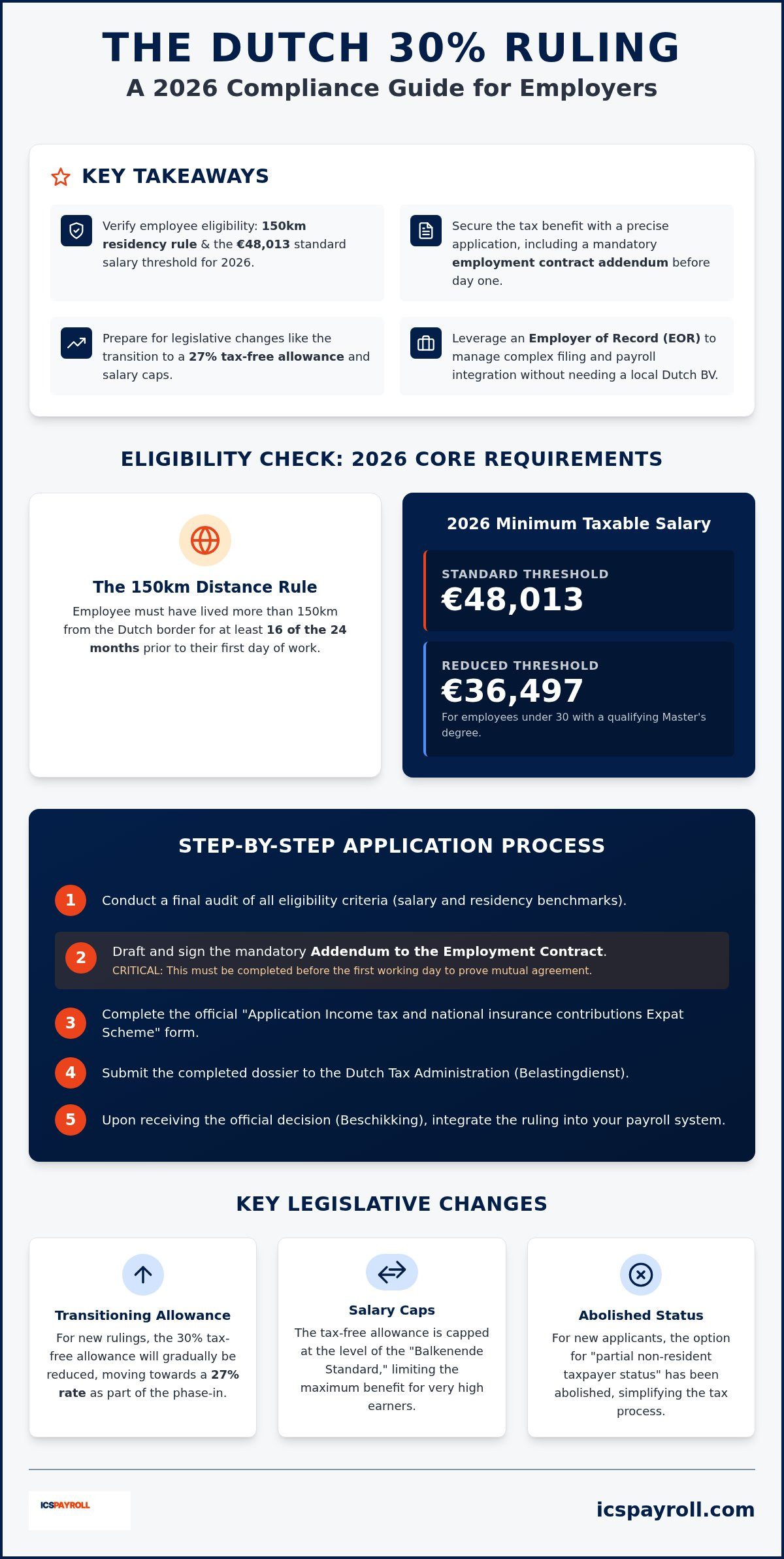
Key Takeaways
- Confirm employee eligibility by verifying the 150km residency requirement and the mandatory 2026 standard salary threshold of €48,013.
- Secure the tax benefit through a precise 30% ruling application process that includes a mandatory employment contract addendum before the first working day.
- Prepare for legislative changes including the transition to a 27% tax-free allowance and the salary caps dictated by the Balkenende Standard.
- Ensure payroll compliance following the abolition of partial non-resident taxpayer status for new international hires in the Netherlands.
- Leverage an Employer of Record to manage the complex filing and payroll integration requirements without the need to establish a local Dutch BV.
Eligibility Check: Requirements for the 30% Ruling in 2026
Success in the 30% ruling application process begins with a rigorous validation of eligibility before the employee even arrives in the Netherlands. The Dutch Tax Administration (Belastingdienst) does not grant exceptions for technical oversights or administrative delays. You must confirm that your hire possesses specific expertise that is scarce or unavailable in the local Dutch labor market. This expertise is primarily validated through residency history and specific salary benchmarks that are adjusted annually to reflect current economic conditions.
The 150km Distance Rule Explained
The "recruited from abroad" criterion is strictly defined by geography. An employee must have lived more than 150 kilometers from the Dutch border for at least 16 of the 24 months immediately preceding their first day of work. You should verify these official 30% ruling residency conditions to ensure the candidate meets the requirement. This distance is measured "as the crow flies" from the nearest point of the Dutch border. This requirement effectively excludes residents of Belgium and Luxembourg, as well as those living in the border regions of Germany and northern France. If a candidate has previously lived or worked in the Netherlands, those years may be deducted from the total five year duration of the ruling.
2026 Salary Requirements and Scrutiny
For 2026, the standard taxable salary threshold is set at €48,013. This figure represents the minimum taxable amount that must remain after the tax free allowance has been applied. If your hire is under 30 years old and holds a qualifying Master's degree, a reduced threshold of €36,497 applies. It is vital to consult a detailed guide on 30% ruling salary requirements to ensure your compensation packages remain compliant throughout the full five year term. Falling below these thresholds at any point, even due to a mid year salary adjustment or part time work, results in the immediate and permanent cancellation of the benefit.
Scientific researchers and medical doctors in training qualify for the ruling regardless of these specific salary levels. However, for the majority of international hires, the 30% ruling remains a central pillar of the Dutch income tax system intended to attract high value skills. A critical gap in many applications is the failure to align the employment contract with these 2026 benchmarks before the first working day. Without this specific contractual alignment, the ruling cannot be legally applied to the payroll, regardless of whether the employee meets the geographic residency criteria.
Step-by-Step: The 30% Ruling Application Process
The 30% ruling application process is a technical administrative sequence that requires absolute coordination between your HR department and the new hire. It isn't merely a request for a tax discount; it's a formal petition to the Dutch Tax Administration to recognize an employee as a "scarce expert." To ensure a successful outcome, you must follow a specific operational workflow:
- Step 1: Conduct a final audit of the 30 percent ruling eligibility criteria to confirm the hire meets all 2026 salary and residency benchmarks.
- Step 2: Draft and sign the mandatory Addendum to the Employment Contract.
- Step 3: Complete the "Application Income tax and national insurance contributions Expat Scheme" form, ensuring all personal and corporate details match official records.
- Step 4: Submit the completed dossier to the Belastingdienst expertise center.
- Step 5: Integrate the ruling into your payroll system once the provisional or final decision (Beschikking) is received.
The Mandatory Contract Addendum
A frequent point of failure in the 30% ruling application process is the omission of a legally sound contract addendum. The Belastingdienst requires proof that the employer and employee have reached a "mutual agreement" to restructure the compensation package. This addendum must explicitly state that the employee agrees to a reduction of their gross taxable salary in exchange for the tax free allowance. This "salary sacrifice" is the legal mechanism that allows the benefit to function. The wording must be precise to satisfy the official 30% ruling conditions and protect the employer from future claims regarding holiday pay or pensionable earnings.
Filing Deadlines and Retroactive Effect
Timing is the most unforgiving element of the application. You must submit the request within four months of the employee's first working day. If you file within this window, the ruling applies retroactively to the start of the employment contract. This allows you to correct previous months' tax deductions in a single payroll run. However, if the application is submitted after the four month deadline, the benefit only applies from the first day of the month following the application date. This results in a permanent loss of tax advantages for the initial months of employment. If managing these strict timelines alongside other onboarding tasks is difficult, outsourcing the complexity to a specialist in Dutch payroll administration ensures every deadline is met with clinical precision.
Navigating the 2026 Legislative Changes: 27% and Caps
The legislative framework for the 30% ruling has undergone significant refinement following extensive political negotiations in the Dutch parliament. While earlier proposals suggested a complex tapering model that would reduce the benefit every twenty months, the current law for 2026 has reverted to a more stable structure. For employers navigating the 30% ruling application process this year, it's vital to understand that the 30% flat rate remains in effect for the entire five year duration for rulings granted in 2026. This provides a predictable tax environment for international talent and simplifies long term compensation planning for HR departments.
A critical limitation to monitor is the cap on the tax free allowance, often referred to as the Balkenende Standard. For the 2026 tax year, the 30% ruling can only be applied to gross salaries up to €262,000. You can verify the specific salary cap for the 30% facility on the official Belastingdienst website. Any income earned above this €262,000 threshold is taxed at the standard Dutch income tax rates without the benefit of the tax free reimbursement. This ensures the incentive remains a targeted tool for attracting expertise rather than a broad tax reduction for ultra high earners. The maximum untaxed allowance for 2026 is therefore capped at €78,600 per year.
Looking ahead, a planned transition to a 27% tax free allowance is scheduled for January 1, 2027. This change will only apply to new rulings granted from that date forward. Rulings secured in 2026 are not affected by this future reduction, but you must remain transparent with candidates who may be joining later in the transition period. Clear communication regarding these future shifts is a key part of maintaining professional standards during the 30% ruling application process. This distinction allows international hires to calculate their future net take home pay with accuracy and confidence.
Finally, the abolition of the partial non resident taxpayer status represents a major shift for all new applicants. As of January 1, 2025, new hires are subject to Dutch taxation on their global savings and investments in Box 3. This change removed the previous exemption that allowed expats to be treated as non residents for tax purposes regarding their worldwide assets. While transitional rules protect those who held a ruling prior to 2024 until the end of 2026, all new hires in 2026 must account for full Box 3 compliance from their first day of Dutch residency. This makes early financial planning and professional tax advice essential for high net worth international hires entering the Dutch market.
Post-Approval: Integrating the Ruling into Payroll
Receiving the final grant (Beschikking) from the Belastingdienst is a milestone, but the operational work of the 30% ruling application process continues throughout the employment term. You must now configure your payroll software to handle the gross-to-net conversion accurately. This involves reducing the taxable gross salary by up to 30% and adding that same amount back as a tax free reimbursement for extraterritorial costs. This adjustment must be reflected in the monthly "Loonaangifte" (wage tax return) to ensure the Tax Office reconciles the reduced tax revenue with the approved ruling.
Administrative precision is required to avoid triggering automated audits. You must flag the employee as a 30% ruling beneficiary in your reporting system. Failure to report this status correctly can lead to inquiries from the tax authorities, even if the application was previously approved. Consistency between the approved ruling and the monthly payroll filing is the only way to maintain long term compliance.
Payslip Compliance and Reporting
The payslip must serve as a transparent record of the tax advantage. The tax free portion should be clearly labeled as an "extraterritorial cost reimbursement" or a similar specific designation. It is vital to remember that social security premiums are calculated based on the reduced gross salary. This lowering of the social security base can affect the employee's future benefits, which is why the initial contract addendum discussed in previous sections is so legally significant. Additionally, Dutch law requires you to maintain all records related to the ruling, including the original application and monthly calculations, for a mandatory seven year administrative period. For expert assistance in managing these complex filings, you can rely on our specialized Dutch payroll administration services.
Managing Salary Indexation and Thresholds
Compliance is not a static task. The Belastingdienst updates salary thresholds annually, and you must monitor these changes closely. For 2026, you must ensure the taxable salary remains above €48,013 for standard applicants or €36,497 for those under 30 with a Master's degree. If a salary indexation or a change in working hours pushes the taxable pay below these benchmarks, the ruling becomes invalid immediately. This loss is permanent; you cannot reapply for the same employee if they fail the salary test mid-term.
What Happens When an Employee Changes Jobs?
The 30% ruling is tied to the specific employment relationship. If an employee moves to a new company, the ruling does not automatically follow them. The new employer must initiate a new 30% ruling application process to confirm the benefit remains valid. To maintain continuity, the gap between the old and new employment must not exceed three months. While the 150km residency rule is not re-tested for a transfer, the new employer must prove the employee still meets the relevant 2026 salary requirements. The original end date of the five year term remains unchanged regardless of how many times the employee switches employers.
How an EOR Facilitates the 30% Ruling Process
Hiring international talent often feels like a choice between expensive legal entity incorporation or skipping the Dutch market entirely. Utilizing an Employer of Record (EOR) removes this barrier. You don't need to establish a local Dutch BV to offer competitive tax incentives to your hires. The EOR acts as the legal employer, allowing your business to leverage the 30% ruling application process without the administrative overhead of a foreign subsidiary. ICSPayroll facilitates these services by arranging the application through licensed partners. This structure ensures that every legal requirement, from the initial "recruited from abroad" check to the final filing with the Belastingdienst, is handled by local experts.
The EOR model provides a secure bridge for foreign companies to enter the Netherlands with full compliance. Because the EOR is already a registered and recognized employer, the application for the tax benefit is often processed with greater efficiency. This setup is particularly beneficial for businesses that need to move fast but lack the local infrastructure to manage complex Dutch labor laws and tax filings. It allows you to focus on your core business operations while we manage the technicalities of the Dutch tax system.
The Local Partner Advantage
Speed is a critical factor in competitive recruitment. By using an EOR, you can get your international hire started in weeks rather than months. We manage the mandatory contract addendum and ensure it aligns with the latest Dutch payroll administration standards. You receive one consolidated monthly invoice that includes the gross salary, social security premiums, and the specific tax free ruling adjustments. This transparency eliminates the need for complex internal accounting for extraterritorial costs. Our licensed partners handle the direct communication with the Dutch Tax Administration, reducing the time spent on administrative back and forth.
Reducing Risk for International Employers
Operating in the Netherlands without a local entity often raises concerns about "Permanent Establishment" (PE) risks. An EOR eliminates this risk by taking on the legal and tax responsibilities of the employer. This includes professional representation before the Dutch tax authorities and ongoing compliance monitoring. We ensure the employee's taxable salary never breaches the 2026 standard threshold of €48,013. If legislation changes or thresholds increase, the EOR adjusts the payroll automatically to maintain the benefit. The EOR also manages the mandatory seven year record keeping requirement for all 30% ruling documentation. Your employees benefit from direct support via an online portal, where they can access their payslips and track their ruling status. This combination of technological efficiency and human expertise provides the stabilizing force necessary for successful international expansion.
Securing Your Competitive Edge in the Dutch Labor Market
Successfully managing the 30% ruling application process is a critical component of a robust international recruitment strategy. You've learned that compliance hinges on meeting the €48,013 salary threshold and executing a legally sound contract addendum within strict deadlines. While the legislative landscape for 2026 remains stable, the removal of partial non-resident status means that your hires need clear, professional guidance from their first day in the Netherlands. These administrative burdens shouldn't prevent you from accessing top-tier global talent.
ICSPayroll acts as your stabilizing partner by arranging all necessary filings and payroll adjustments via our licensed partners. We provide expert guidance on 2026 salary thresholds and ensure full compliance with Dutch labor and tax law. Our consolidated monthly billing model eliminates hidden fees and simplifies your expansion into the Dutch market. Secure the 30% ruling for your Dutch hires with ICSPayroll today. We're ready to help you build a compliant, high-performing team in the Netherlands.
Frequently Asked Questions
How long does the 30% ruling application process take in 2026?
The Belastingdienst typically processes applications within eight to ten weeks from the submission date. While the official statutory period allows for longer reviews, most decisions are issued within this timeframe. You should ensure all documentation is complete upon filing to avoid unnecessary delays. Decisions are issued according to the official 30% ruling application guidelines. If approved, the benefit applies retroactively to the employee's start date provided the application was submitted within the first four months of employment.
Can I apply for the 30% ruling if the employee is already in the Netherlands?
An employee must be recruited from abroad to qualify for the tax benefit. If a candidate is already living in the Netherlands at the time of recruitment, they generally do not meet the recruited from abroad criteria. Limited exceptions exist for those who were previously in the Netherlands for study or short term assignments, but strict residency history checks apply to every 30% ruling application process to verify the 150km distance rule.
What happens if the employee's salary falls below the 2026 threshold?
The 30% ruling is immediately and permanently terminated if the employee's taxable salary falls below the mandatory 2026 threshold of €48,013. This requirement is tested continuously throughout the year. You cannot reapply for the ruling for the same employee once it has been lost due to a salary drop. This is confirmed by the salary criteria for the 30% facility. Careful monitoring of part time work or unpaid leave is essential for maintaining compliance.
Is the 30% ruling still 30% in 2026 or has it changed to 27%?
For all rulings granted in 2026, the tax free allowance remains at a flat 30% for the full five year duration. The previously proposed tapering model was scrapped in favor of a stable rate. The shift to a 27% rate is currently scheduled to take effect only for new applications submitted from January 1, 2027, according to the latest tax rate updates. This provides significant financial certainty for your 2026 hires.
Does the 30% ruling apply to social security contributions?
The 30% ruling reduces the gross taxable salary, which in turn lowers the base for social security contributions. This results in lower premiums for both the employer and the employee. However, it also means the employee may build up lower entitlements for future social security benefits. These rules are detailed in the national insurance contribution guidelines. You should clearly communicate these implications to employees during the initial contract negotiation and onboarding phase.
Can remote employees working for a Dutch company qualify for the 30% ruling?
Remote employees living outside of the Netherlands do not qualify for the 30% ruling. The facility is specifically designed to reimburse the extraterritorial costs associated with moving to and living in the Netherlands for work. To be eligible, the employee must be a resident of the Netherlands and be subject to Dutch wage tax. The 150km residency rule is strictly enforced based on their location prior to relocation and their official registration in the Dutch municipal database.
What documents does the employee need to provide for the application?
Employees must provide proof of their residency history for the 24 months prior to their hire, such as utility bills or bank statements. They also need to submit a comprehensive CV and a copy of their passport. These documents are essential for the 30% ruling application process to verify the 150km rule and the employee's scarce expertise. The full list of requirements is available via the Dutch Tax Administration checklist. The employer must also include the signed contract addendum.
Is an EOR allowed to apply for the 30% ruling on behalf of my staff?
An Employer of Record is permitted to apply for the 30% ruling because they serve as the legal employer in the Netherlands. ICSPayroll arranges these services via licensed partners to ensure full compliance with Dutch labor and tax regulations. This allows international companies without a local BV to provide tax advantages to their staff. The licensed partner manages the entire application and ensures the payroll is configured correctly to reflect the tax free allowance. This provides a compliant and efficient path for hiring international experts.

Article by
Joost Hubregtse
Joost Hubregtse is Director of ICS Staffing & Payroll B.V., the wholly owned subsidiary of Intercompany Solutions behind ICS Payroll. He is responsible for Employer of Record and Dutch payroll services: employment contracts, wage tax and social security filings, holiday allowance, pension, sick leave and CAO compliance, with onboarding possible within 48 hours.
Sources and further reading
- Article 31a Wage Tax Act 1964, the statutory basis of the extraterritorial costs rule and the 30% ruling
- Belastingdienst, extraterritorial costs and the 30% ruling: conditions and salary norms
- Business.gov.nl, official summary of the 30% facility for incoming employees
- Rijksoverheid, income tax policy and announced changes
- IND, highly skilled migrant salary thresholds that interact with the ruling

Frequently Asked Questions
The 30% ruling is tied to the specific employment relationship. If an employee moves to a new company, the ruling does not automatically follow them. The new employer must initiate a new 30% ruling application process to confirm the benefit remains valid. To maintain continuity, the gap between the old and new employment must not exceed three months. While the 150km residency rule is not re-tested for a transfer, the new employer must prove the employee still meets the relevant 2026 salary requirements. The original end date of the five year term remains unchanged regardless of how many times the employee switches employers. Hiring international talent often feels like a choice between expensive legal entity incorporation or skipping the Dutch market entirely. Utilizing an Employer of Record (EOR) removes this barrier. You don't need to establish a local Dutch BV to offer competitive tax incentives to your hires. The EOR acts as the legal employer, allowing your business to leverage the 30% ruling application process without the administrative overhead of a foreign subsidiary. ICSPayroll facilitates these services by arranging the application through licensed partners. This structure ensures that every legal requirement, from the initial "recruited from abroad" check to the final filing with the Belastingdienst, is handled by local experts. The EOR model provides a secure bridge for foreign companies to enter the Netherlands with full compliance. Because the EOR is already a registered and recognized employer, the application for the tax benefit is often processed with greater efficiency. This setup is particularly beneficial for businesses that need to move fast but lack the local infrastructure to manage complex Dutch labor laws and tax filings. It allows you to focus on your core business operations while we manage the technicalities of the Dutch tax system.
The Belastingdienst typically processes applications within eight to ten weeks from the submission date. While the official statutory period allows for longer reviews, most decisions are issued within this timeframe. You should ensure all documentation is complete upon filing to avoid unnecessary delays. Decisions are issued according to the official 30% ruling application guidelines. If approved, the benefit applies retroactively to the employee's start date provided the application was submitted within the first four months of employment.
An employee must be recruited from abroad to qualify for the tax benefit. If a candidate is already living in the Netherlands at the time of recruitment, they generally do not meet the recruited from abroad criteria. Limited exceptions exist for those who were previously in the Netherlands for study or short term assignments, but strict residency history checks apply to every 30% ruling application process to verify the 150km distance rule.
The 30% ruling is immediately and permanently terminated if the employee's taxable salary falls below the mandatory 2026 threshold of €48,013. This requirement is tested continuously throughout the year. You cannot reapply for the ruling for the same employee once it has been lost due to a salary drop. This is confirmed by the salary criteria for the 30% facility. Careful monitoring of part time work or unpaid leave is essential for maintaining compliance.
For all rulings granted in 2026, the tax free allowance remains at a flat 30% for the full five year duration. The previously proposed tapering model was scrapped in favor of a stable rate. The shift to a 27% rate is currently scheduled to take effect only for new applications submitted from January 1, 2027, according to the latest tax rate updates. This provides significant financial certainty for your 2026 hires.
The 30% ruling reduces the gross taxable salary, which in turn lowers the base for social security contributions. This results in lower premiums for both the employer and the employee. However, it also means the employee may build up lower entitlements for future social security benefits. These rules are detailed in the national insurance contribution guidelines. You should clearly communicate these implications to employees during the initial contract negotiation and onboarding phase.
Remote employees living outside of the Netherlands do not qualify for the 30% ruling. The facility is specifically designed to reimburse the extraterritorial costs associated with moving to and living in the Netherlands for work. To be eligible, the employee must be a resident of the Netherlands and be subject to Dutch wage tax. The 150km residency rule is strictly enforced based on their location prior to relocation and their official registration in the Dutch municipal database.
Employees must provide proof of their residency history for the 24 months prior to their hire, such as utility bills or bank statements. They also need to submit a comprehensive CV and a copy of their passport. These documents are essential for the 30% ruling application process to verify the 150km rule and the employee's scarce expertise. The full list of requirements is available via the Dutch Tax Administration checklist. The employer must also include the signed contract addendum.
An Employer of Record is permitted to apply for the 30% ruling because they serve as the legal employer in the Netherlands. ICSPayroll arranges these services via licensed partners to ensure full compliance with Dutch labor and tax regulations. This allows international companies without a local BV to provide tax advantages to their staff. The licensed partner manages the entire application and ensures the payroll is configured correctly to reflect the tax free allowance. This provides a compliant and efficient path for hiring international experts.