Netherlands Sick Pay: 2026 Employer Compliance Guide
By Joost Hubregtse, Director, ICS Staffing & Payroll
All blog posts are reviewed and fact checked by our labour law lawyer Zishan Hussain and our director. Editorial standards
By Joost Hubregtse, Director, ICS Staffing & Payroll B.V. Legally reviewed by Zishan Hussain, employment lawyer, on 5 August 2026. Wage rates, benefit ceilings and tax thresholds in the Netherlands change on 1 January and 1 July; all figures below are stated as at 6 August 2026.
An employee's long-term illness in the Netherlands is a statutory financial commitment that can run for 104 weeks, and in some cases 156. Dutch labour law is built around worker protection, which makes extended leave both a cost exposure and an administrative process with fixed deadlines. Balancing the 70% wage obligation against the prohibition on dismissal during the first two years requires planning that begins on day one of the absence, not in month twelve.
This guide sets out what employers must do in 2026 under the Netherlands sick pay regulations for employers: the statutory basis in Article 7:629 of the Dutch Civil Code, the current benchmarks (€14.99 statutory minimum hourly wage for employees aged 21 and over, and a €309.91 maximum daily wage), the deadlines under the Gatekeeper Improvement Act, and the situations in which the UWV rather than the employer carries the cost. It also explains, accurately, what an Employer of Record arrangement can and cannot transfer.
Key Takeaways
- The 104-week wage continuation obligation applies for the duration of the employment contract: the full two years for permanent employees, until expiry for fixed-term employees, and six weeks for employees who have reached AOW age.
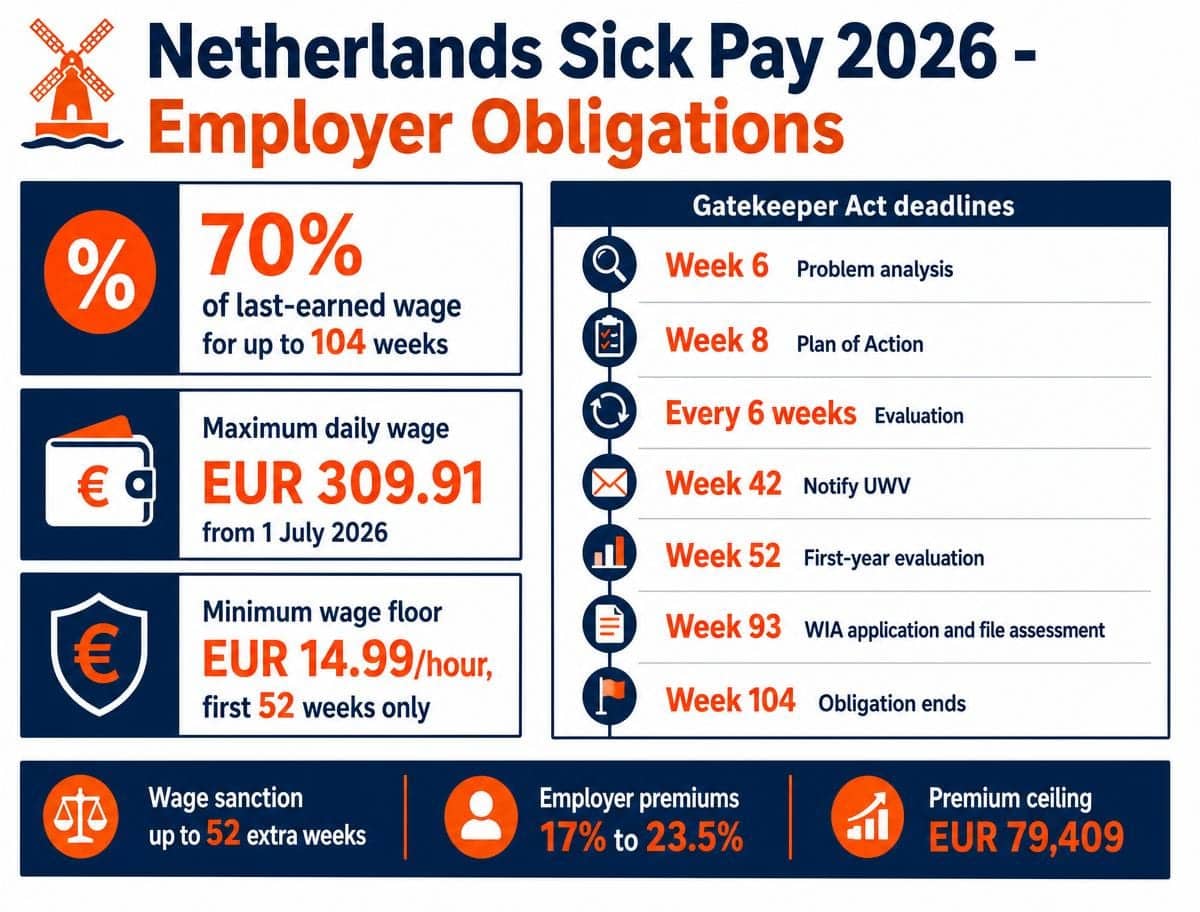
- The statutory minimum is 70% of the last-earned wage, capped at the maximum daily wage of €309.91 (from 1 July 2026), with a floor at the statutory minimum wage during the first 52 weeks only.
- Employer social security charges add roughly 17% to 23.5% on top of gross sick pay, depending on contract type and employer size, up to the €79,409 annual premium ceiling.
- Missing a Gatekeeper deadline exposes you to a wage sanction of up to 52 additional weeks, assessed at the WIA application in week 93, not at the end of week 104.
- Article 7:629 also gives employers two remedies most foreign employers never use: suspension of wages and cessation of wages where the employee obstructs the process.
- The Ziektewet and the no-risk policy shift the cost to the state in defined cases, but never the administrative duties. An EOR arrangement moves the employer role to the service provider; it does not eliminate the client's exposure under Dutch hirer-liability rules.
The 104-Week Rule: Understanding Continued Payment Obligations
Article 7:629 of the Dutch Civil Code obliges an employer to continue paying wages (loondoorbetaling bij ziekte (primary source: Burgerlijk Wetboek Boek 7 (employment contract law), wetten.overheid.nl)) for up to 104 weeks when an employee cannot perform the agreed work because of illness, pregnancy or childbirth. The obligation starts on the first day of reported illness and applies whether or not the illness is work-related.
The financial risk does not stop at the wage payments themselves. If the UWV concludes that your reintegration effort was inadequate, it can impose a wage sanction (loonsanctie) of up to 52 additional weeks under Article 25(9) of the Work and Income (Capacity for Work) Act. That extends the maximum exposure to three years and simultaneously extends the dismissal prohibition. In practice this penalty is imposed for documentation failures far more often than for genuine unwillingness to reintegrate. Two mechanisms limit the exposure and are frequently overlooked. First, the employment contract or collective agreement may provide for up to two unpaid waiting days (wachtdagen) at the start of each period of illness. Second, Article 7:629 permits the employer to suspend wages where the employee fails to comply with reasonable written rules on providing the information needed to assess entitlement, and to stop wages where the employee refuses suitable work, obstructs recovery, or refuses to cooperate with the plan of action. Both remedies require that you notify the employee immediately upon discovering the ground; if you fail to give that notice, you lose the right to rely on it. Where the parties disagree, typically about whether the employee is fit for suitable work, either party can request an expert opinion (deskundigenoordeel) from the UWV. This matters procedurally: under Article 7:629a, a court will dismiss an employee's wage claim outright if it is not accompanied by such an opinion.
Whom to Pay: Contract Types and Eligibility
The obligation applies to nearly all employees, but the duration varies. Permanent employees are covered for the full 104 weeks. Fixed-term employees are covered only until the contract reaches its agreed end date; you must report the employee as sick to the UWV on the last working day of the contract, and from the day after, the UWV takes over under the Sickness Benefits Act (Ziektewet). Missing that notification is itself a fineable omission. On-call and zero-hours workers with an employment contract are entitled to continued payment: where the worker falls ill during a call-up period, you continue to pay until that period ends, and where the working pattern has stabilised, Article 7:610b creates a rebuttable presumption that the contracted hours equal the average of the preceding three months, with the sick pay base following from that presumption. Employees who have reached AOW (state pension) age are a separate category: the continued payment obligation is limited to six weeks, after which dismissal on grounds of illness is permitted. Foreign employers routinely apply the 104-week assumption here and overpay. Two costs continue regardless of category: statutory holiday allowance of 8% accrues on the sick pay actually paid, and under Article 7:635 the employee accrues statutory holiday entitlement in full throughout the illness, a liability that crystallises as a payout on termination.
Dismissal Protection During the First Two Years
The opzegverbod in Article 7:670 prohibits termination during the first two years of illness. You cannot terminate because an employee is unwell, and in most cases you cannot terminate for unrelated reasons either while the illness runs. The exceptions are narrower than commonly assumed, but there are more of them than most guides state: summary dismissal for urgent cause (gross misconduct) unrelated to the illness; termination during a valid probationary period; termination by mutual consent through a settlement agreement, always possible but carrying real risk, because an employee who signs away a Ziektewet entitlement may lose benefit eligibility and turn on the agreement; complete cessation of the employer's business activities; and cases where the illness began after the UWV received the dismissal application. Once 104 weeks have elapsed and the reintegration file is sound, dismissal on grounds of long-term incapacity becomes available, subject to a transition payment covering the entire employment period including the sick leave. For the wider statutory context, see our Employment Law in the Netherlands for Foreign Employers: 2026 Compliance Guide.
Calculating Statutory Sick Pay and 2026 Wage Benchmarks
The statutory minimum is 70% of the employee's last-earned wage, but the calculation is capped. Article 7:629 pays 70% only over the part of the wage that does not exceed the maximum daily wage referred to in Article 17 of the Social Insurance (Financing) Act. That ceiling is €309.91 gross per day from 1 July 2026, equivalent to roughly €6,740 per month on the standard 21.75-day convention. For an employee earning above that ceiling, the statutory obligation caps at 70% of €309.91, about €216.94 per day, unless the employment contract or a collective agreement provides more. The 70% is calculated on the full wage the employee would have received, not on base salary alone: structural components such as a thirteenth month, fixed shift allowances, personal allowances and regular overtime form part of the base.
Around three quarters of employees in the Netherlands are covered by a collective labour agreement (CAO), and coverage has been declining. Where a CAO applies, it commonly improves on the statutory minimum, a widespread pattern being 100% during the first 52 weeks and 70% during the second year, though many CAOs use a stepped schedule instead. Check the applicable CAO before relying on 70%. Pension accrual normally continues during illness, and most schemes provide for premium-free continuation or continued contribution on the pre-illness salary. Note the base: pension premium is levied on the pensioengrondslag, pensionable salary minus the franchise, not on gross salary. Total premiums vary widely by scheme and sector, so budget from the actual scheme rules rather than a rule-of-thumb percentage.
First Year vs Second Year Obligations
During the first 52 weeks, the 70% payment may not fall below the statutory minimum wage applicable to the employee. If 70% produces a lower figure, you must top it up. The statutory minimum hourly wage for employees aged 21 and over was €14.71 from 1 January 2026 and rose to €14.99 from 1 July 2026, an increase of 1.90%. Statutory minimum youth wages apply on a fixed scale below age 21. During the second year, that floor falls away: you pay 70% even where the result is below minimum wage. The employee may in that situation apply to the UWV for a supplementary benefit (toeslag) to reach the applicable social minimum, a point worth raising with the employee, because it reduces friction without cost to you.
Employer Premiums and Social Security
Continued payment does not suspend social security obligations. You continue to file the monthly payroll tax return and to pay employer contributions on the wage actually paid. For 2026 the rates are: Aof (Disability Fund) 6.27% for small employers and 7.63% for medium and large employers; AWf (Unemployment Fund) 2.74% for written, indefinite-term, non-on-call contracts and 7.74% otherwise; Whk (Return to Work Fund), individually assessed, with a 2026 average rate of 1.52%; the childcare surcharge of 0.50%; and the Zvw (Health Insurance Act) employer levy of 6.10%. The realistic total is therefore around 17.1% for a permanent contract at a small employer, rising to roughly 23.5% for a flexible contract at a large employer. All of these are capped at the 2026 maximum premium wage of €79,409 per year. Employers who are self-insurers (eigenrisicodrager) for the WGA or the Ziektewet carry a different profile and should model separately. Payroll records must be retained for seven years to satisfy Dutch tax audit requirements.
Navigating the Gatekeeper Improvement Act (Wet Verbetering Poortwachter)
The Gatekeeper Improvement Act sets a procedural framework for reducing long-term incapacity through active reintegration. Under it you are not only a payer of wages but a manager of the process, working with a certified occupational health service (arbodienst) or company doctor. The UWV assesses your file and can extend your payment obligation by up to 52 weeks where the effort or the documentation falls short.
You must maintain a reintegration file (re-integratiedossier) recording the course of the absence and every action taken by both parties. That file becomes the reintegration report (re-integratieverslag) submitted with the WIA application, and it is the primary evidence in the UWV's assessment. Sanctions are usually imposed for gaps in the file rather than for absence of good faith.
The Reintegration Timeline: Key Milestones
Week 1: report the absence to your arbodienst or company doctor. You may not ask about the nature of the illness; you may ask about expected return and about what work remains possible. Week 6: where the company doctor or arbodienst expects the absence to become long-term, a problem analysis (probleemanalyse) must be obtained within six weeks of the first day of incapacity; if long-term absence only becomes apparent later, the assessment must be requested without delay at that point, and short absences with no expectation of duration do not trigger this step. Week 8: working from the problem analysis, employer and employee jointly draw up a Plan of Action (Plan van Aanpak) setting out the concrete steps toward return to work, and appoint a case manager, with both parties recording their own view of the reintegration in the plan. Every six weeks thereafter: evaluate and, where necessary, revise the plan, and record each evaluation. Week 42: notify the UWV that the employee is on long-term sick leave, no later than the first working day after the 42nd week of illness; a late notification carries an administrative fine of up to €455 and can delay the employee's eventual WIA application. Week 52: conduct the first-year evaluation (eerstejaarsevaluatie), documenting both parties' views, which is the decision point at which reintegration with a different employer must be seriously considered. Around week 88 the UWV writes to the employee about the WIA application. Week 93: the employee applies for WIA and submits the reintegration report, and the UWV's assessment of your file, the RIV-toets, happens here, not at week 104; if the UWV identifies a deficiency, you receive an opportunity to repair it during the remaining weeks, and if you cannot, the wage sanction follows. Week 104: the statutory payment obligation ends, unless a sanction has been imposed.
First Track vs Second Track Reintegration
First Track (Spoor 1) aims at return to the employee's own role or a suitable alternative within your organisation. You must exhaust internal options: adjusted hours, adapted duties, workplace modification, redeployment. Second Track (Spoor 2) begins where the company doctor concludes that internal return is no longer realistic. You are then required to fund and organise support for the employee to find suitable work with another employer, typically outplacement coaching and job placement. In practice the second track should be initiated no later than the first-year evaluation where internal prospects are weak; late initiation of Spoor 2 is among the most common grounds for a wage sanction.
Exceptions and Sickness Benefits: When the UWV Pays
The Sickness Benefits Act (Ziektewet) provides a safety net in defined situations, shifting the wage cost from the employer to the state. Financial relief does not carry administrative relief: where you remain the legal employer, the Gatekeeper obligations continue to run in full.
In most of these cases the UWV pays the benefit to the employer as a reimbursement, so the employee's pay cycle is unaffected and you offset the benefit against the wage you continue to pay. Payment depends on timely notification: a late filing can leave the cost with you despite the employee's eligibility.
Pregnancy, Childbirth, and Organ Donation
Where an employee is unable to work because of pregnancy or childbirth, or because of illness arising from pregnancy or childbirth before or after statutory maternity leave, she is entitled to sickness benefit at 100% of the daily wage, subject to the €309.91 ceiling. Notification to the UWV must be made no later than the fourth day after it becomes reasonably clear to you that entitlement exists. Employees recovering from organ donation are likewise entitled to sickness benefit at 100% of the daily wage. Note that maternity and childbirth leave itself is a separate entitlement under the Work and Care Act, paid at 100% of the daily wage up to the same ceiling, and is not sick leave.
The No-Risk Policy for Disabled Employees
The no-riskpolis applies to employees with a recognised work limitation or a relevant benefit history, including those with a WIA, WAO, WAZ or Wajong background, and to certain other protected categories. If such an employee falls ill, the UWV covers the sick pay under the Ziektewet, removing the two-year wage risk from the employer. The policy exists to remove the financial disincentive to hiring people with a disability. Employees are generally not obliged to disclose their status during the first two months of employment, but may be asked afterwards. Related schemes, including the compensation arrangement for older employees, operate on comparable logic.
Mitigating Sickness Risk via Employer of Record (EOR) Services
Operating in the Netherlands without a local entity creates a real compliance gap when an employee falls ill: the Gatekeeper timeline requires local, dated, documented action that a distant HR function cannot reliably supply. Under an EOR arrangement, a Dutch entity becomes the legal employer, holds the employment contract, and carries the statutory obligations under Article 7:629 and the Gatekeeper Improvement Act.
It is important to be precise about what this does and does not do, because the market frequently overstates it. What transfers is the employer role: the wage continuation obligation, the arbodienst relationship, the Gatekeeper file, the UWV notifications, the Ziektewet and no-risk applications, and exposure to the wage sanction. What does not transfer is the client's own position. Where the client directs the employee's work, the arrangement constitutes the provision of labour under Dutch law. That brings the Waadi registration requirement, the statutory equal-pay entitlement for hired workers, and, where the arrangement qualifies as payrolling under Article 7:692 of the Civil Code, an obligation to grant the employee terms equivalent to comparable staff at the client and an adequate pension. The client also retains exposure under hirer's liability for unpaid wage tax and social security contributions, and under chain liability for unpaid wages. Any provider suggesting the client is fully insulated is describing something Dutch law does not provide. From 1 January 2027 the Act on the Admission of the Provision of Labour (Wtta) enters into force, introducing a mandatory admission regime administered by a new supervisory authority; from 1 January 2028 it will be prohibited to supply labour in the Netherlands without admission, and hirers who engage a non-admitted supplier will themselves be exposed to fines. Employers selecting an EOR or payroll partner in 2026 should be asking, now, about that partner's admission trajectory.
How ICSPayroll Handles Sickness Risk
We build sickness risk into the payroll factor rather than requiring you to source separate absence cover. Our team manages the arbodienst and company doctor relationship, and maintains the Gatekeeper file to UWV standards: the problem analysis, the Plan of Action, the six-weekly evaluations, the 42nd-week notification, the first-year evaluation, and the reintegration report submitted at week 93. We also apply the statutory wage remedies where they are warranted, with the immediate written notice the law requires, rather than allowing an obstructed case to run unaddressed for two years. We retain payroll and absence documentation for the statutory seven-year period.
Consolidated Compliance for International Teams
We consolidate employment costs, gross wage, the 8% holiday allowance, accrued holiday entitlement, pension contribution, employer social security charges and any transition payment provision, into a single monthly invoice, so total cost of employment is visible before an absence occurs rather than after. Employees receive a handbook and a digital portal for absence reporting, and each account has a named contact for complex cases. For the wider setup picture, see our Outsource Payroll in the Netherlands: The 2026 Setup and Compliance Template. For a tailored quotation for a Netherlands-based workforce, contact our team. Quotations are normally provided within one business day.
Securing Your Dutch Workforce for 2026 and Beyond
The two-year wage continuation obligation is the defining employment cost risk for international businesses in the Netherlands. Managing it well is less about the payments than about the file: the week-6 analysis, the week-8 plan, the week-42 notification, the week-52 evaluation, and the week-93 assessment. Employers who miss those dates pay for a third year.
The rules are stable in structure and volatile in the numbers. Minimum wage and the maximum daily wage change every six months; social security rates change annually; the expatriate scheme changes materially on 1 January 2027; and the admission regime for labour providers changes the market on 1 January 2028. Whether you manage this internally or through an EOR, verify the figures against the current official rates each half-year rather than against a guide written in a previous period. Request a tailored quotation if you would like us to model your exposure.
Frequently Asked Questions
How much is sick pay in the Netherlands for 2026?
At least 70% of the employee's last-earned wage, for a maximum of 104 weeks, calculated only over the part of the wage up to the maximum daily wage of €309.91 (from 1 July 2026). During the first 52 weeks the payment may not fall below the statutory minimum wage, €14.71 per hour from 1 January 2026 and €14.99 per hour from 1 July 2026 for employees aged 21 and over. Around three quarters of Dutch employees are covered by a CAO, and many CAOs improve on the statutory minimum, commonly with 100% in the first year.
Can I dismiss an employee who is on long-term sick leave?
Generally not during the first two years, because of the statutory dismissal prohibition. Exceptions include summary dismissal for urgent cause unrelated to the illness, termination during a valid probationary period, complete cessation of business activities, illness that began after the UWV received the dismissal application, and termination by mutual consent, the last of which carries benefit-eligibility risk for the employee and should not be used without advice. For employees who have reached AOW age, dismissal becomes possible after six weeks of illness.
What is the Gatekeeper Improvement Act?
The legal framework governing long-term absence. It prescribes a sequence of steps: a problem analysis by week 6 where long-term absence is expected, a Plan of Action by week 8, evaluations at least every six weeks, notification to the UWV by the first working day after week 42, a first-year evaluation at week 52, and submission of the reintegration report with the WIA application in week 93. The UWV assesses the file at that point and can impose a wage sanction of up to 52 additional weeks.
Who pays for the company doctor in the Netherlands?
The employer. Engagement of a certified arbodienst or company doctor is mandatory, and the cost sits with the employer. The same applies to Second Track outplacement and reintegration coaching where internal return is no longer realistic.
What can I do if the employee will not cooperate?
Article 7:629 provides two distinct remedies. Wage payment may be suspended where the employee does not follow reasonable written rules on supplying the information needed to assess entitlement, and stopped where the employee refuses suitable work, obstructs recovery, or refuses to cooperate with the plan of action. You must notify the employee immediately on discovering the ground, in writing, or you forfeit the right to rely on it. Where the parties disagree on fitness for work, either can request an expert opinion from the UWV; a court will dismiss an employee's wage claim brought without one.
Does the 30% ruling apply to sick pay?
It can, provided the employee continues to meet the conditions. In 2026 the maximum tax-free allowance remains 30%, and the taxable salary after applying the allowance must exceed €48,013 (or €36,497 for employees under 30 holding a qualifying master's degree). The benefit is capped at the WNT norm of €262,000. Because sick pay at 70% can push taxable salary below the threshold, the ruling can lapse, so this needs to be modelled before the absence rather than discovered at year end. From 1 January 2027 the rate falls to 27% for most beneficiaries and the salary norms rise (indicatively to about €50,436 and €38,338), with grandfathering for employees who were already using the scheme in 2023. Partial non-resident taxpayer status was abolished with effect from 2025, with transitional relief ending after 2026.
What happens after 2 years of sick leave?
The statutory wage obligation ends after 104 weeks and the employee applies to the UWV for WIA benefit, an application filed in week 93. If the UWV concludes at that point that your reintegration effort or documentation was inadequate, it imposes a wage sanction extending your payment obligation, and the dismissal prohibition, by up to 52 weeks. Where the file is sound, dismissal on grounds of long-term incapacity becomes available, subject to a transition payment calculated over the whole employment period including the two years of illness.
Sources and references
Every rule and figure above is traceable to the sources below: the exact statutory articles, the regulator pages that publish the amounts, the statistical datasets, and the specific court rulings that settle the point. Always check the current text for your own situation.
- Article 7:629 Dutch Civil Code, 70% wage continuation for up to 104 weeks of illness
- Article 23 WIA, the 104-week waiting period before WIA benefit
- Article 29 Sickness Benefits Act, UWV sickness benefit for employees without an employer
- UWV, sickness, reintegration obligations and the WIA application in week 93
- UWV, maximum daily wage 2026 used to cap sickness and WIA benefits
- Belastingdienst, low and high AWf unemployment contribution rates and when each applies
- CBS, sickness absence rate by sector and company size (dataset 80072ned)
- CBS StatLine, the open statistical database behind the wage and employment figures cited here
- Supreme Court 17 April 2020, ECLI:NL:HR:2020:723: the wage continuation obligation during incapacity under art. 7:629 BW and reintegration duties
- Court of Justice of the EU 20 January 2009, C-350/06 (Schultz-Hoff): accrual and carry-over of paid annual leave during long-term sickness

Article by
Joost Hubregtse
Joost Hubregtse is Director of ICS Staffing & Payroll B.V., the wholly owned subsidiary of Intercompany Solutions behind ICS Payroll. He is responsible for Employer of Record and Dutch payroll services: employment contracts, wage tax and social security filings, holiday allowance, pension, sick leave and CAO compliance, with onboarding possible within 48 hours.

Frequently Asked Questions
At least 70% of the employee's last-earned wage, for a maximum of 104 weeks, calculated only over the part of the wage up to the maximum daily wage of €309.91 (from 1 July 2026). During the first 52 weeks the payment may not fall below the statutory minimum wage, €14.71 per hour from 1 January 2026 and €14.99 per hour from 1 July 2026 for employees aged 21 and over. Around three quarters of Dutch employees are covered by a CAO, and many CAOs improve on the statutory minimum, commonly with 100% in the first year.
Generally not during the first two years, because of the statutory dismissal prohibition. Exceptions include summary dismissal for urgent cause unrelated to the illness, termination during a valid probationary period, complete cessation of business activities, illness that began after the UWV received the dismissal application, and termination by mutual consent, the last of which carries benefit-eligibility risk for the employee and should not be used without advice. For employees who have reached AOW age, dismissal becomes possible after six weeks of illness.
The legal framework governing long-term absence. It prescribes a sequence of steps: a problem analysis by week 6 where long-term absence is expected, a Plan of Action by week 8, evaluations at least every six weeks, notification to the UWV by the first working day after week 42, a first-year evaluation at week 52, and submission of the reintegration report with the WIA application in week 93. The UWV assesses the file at that point and can impose a wage sanction of up to 52 additional weeks.
The employer. Engagement of a certified arbodienst or company doctor is mandatory, and the cost sits with the employer. The same applies to Second Track outplacement and reintegration coaching where internal return is no longer realistic.
Article 7:629 provides two distinct remedies. Wage payment may be suspended where the employee does not follow reasonable written rules on supplying the information needed to assess entitlement, and stopped where the employee refuses suitable work, obstructs recovery, or refuses to cooperate with the plan of action. You must notify the employee immediately on discovering the ground, in writing, or you forfeit the right to rely on it. Where the parties disagree on fitness for work, either can request an expert opinion from the UWV; a court will dismiss an employee's wage claim brought without one.
It can, provided the employee continues to meet the conditions. In 2026 the maximum tax-free allowance remains 30%, and the taxable salary after applying the allowance must exceed €48,013 (or €36,497 for employees under 30 holding a qualifying master's degree). The benefit is capped at the WNT norm of €262,000. Because sick pay at 70% can push taxable salary below the threshold, the ruling can lapse, so this needs to be modelled before the absence rather than discovered at year end. From 1 January 2027 the rate falls to 27% for most beneficiaries and the salary norms rise (indicatively to about €50,436 and €38,338), with grandfathering for employees who were already using the scheme in 2023. Partial non-resident taxpayer status was abolished with effect from 2025, with transitional relief ending after 2026.
The statutory wage obligation ends after 104 weeks and the employee applies to the UWV for WIA benefit, an application filed in week 93. If the UWV concludes at that point that your reintegration effort or documentation was inadequate, it imposes a wage sanction extending your payment obligation, and the dismissal prohibition, by up to 52 weeks. Where the file is sound, dismissal on grounds of long-term incapacity becomes available, subject to a transition payment calculated over the whole employment period including the two years of illness.