
How to Hire an Employee in the Netherlands: The 2026 Compliance Guide
By Joost Hubregtse, Director, ICS Staffing & Payroll
All blog posts are reviewed and fact checked by our labour law lawyer Zishan Hussain and our director. Editorial standards
By Joost Hubregtse, Payroll Director
Expert in Dutch labor law and international payroll compliance.
Reviewed by Joost Hubregtse on August 21, 2026
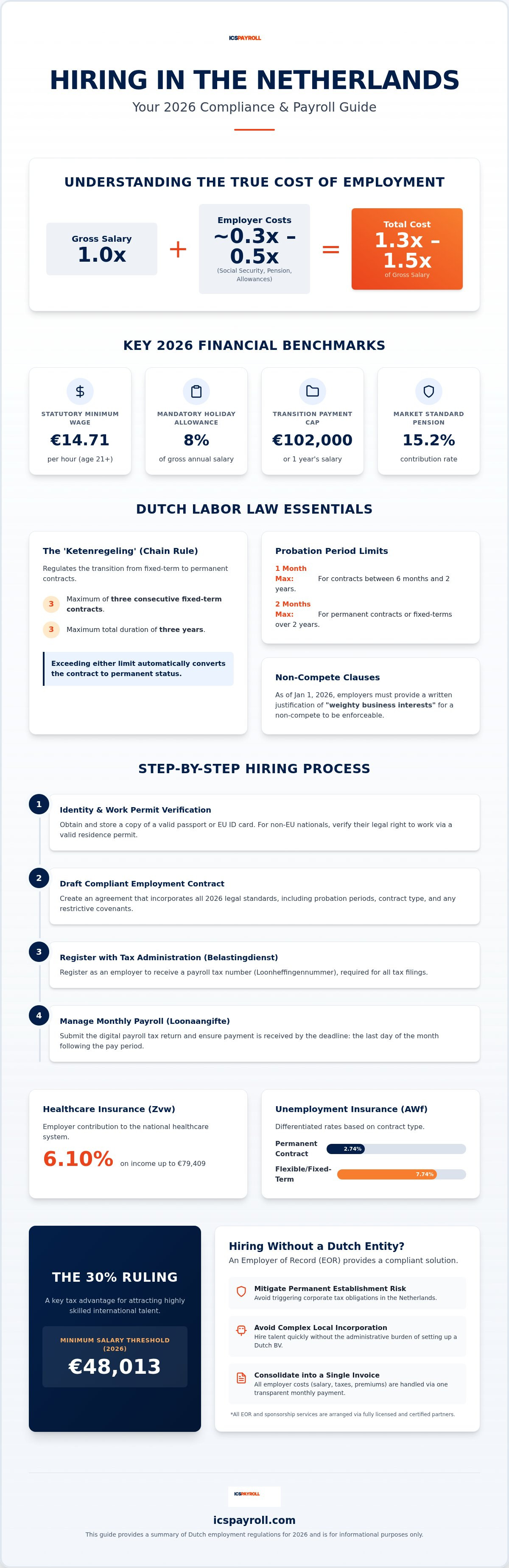
Expanding into the Dutch market requires more than just a local address; it demands a precise understanding of a system where the total cost of employment typically reaches 1.3 to 1.5 times the gross salary. For international businesses, the decision to hire an employee in the Netherlands is a strategic move to access a highly skilled workforce. However, the administrative weight of complex labor laws and high employer social security costs can create significant barriers to entry. You likely recognize that managing Dutch compliance, from the 2026 statutory minimum wage of €14.71 per hour to the intricacies of the Ketenregeling contract limits, requires specialized local expertise.
ICSPayroll provides this 2026 compliance guide as an authoritative roadmap to help you navigate these obligations with confidence. We offer a step by step breakdown of the mandatory requirements for compliant employment contracts, efficient payroll administration, and the latest 30% ruling thresholds. By following this structured approach, you'll ensure your Dutch operations remain legally sound while providing the peace of mind your organization requires to scale effectively in this competitive landscape.
Key Takeaways
- Understand the 2026 statutory minimum hourly wage of €14.71 and how it impacts the total cost of employment for your Dutch operations.
- Learn the essential administrative steps to hire an employee in the Netherlands, including mandatory identity verification and drafting contracts that adhere to current Ketenregeling limits.
- Mitigate Permanent Establishment risks and avoid the complexities of local incorporation by utilizing an Employer of Record service arranged via licensed partners.
- Master the 2026 eligibility requirements for the 30% ruling, specifically the €48,013 salary threshold necessary to secure tax-free allowances for international recruits.
- Discover how to consolidate Dutch taxes, social security premiums, and HR administration into a single monthly invoice using a transparent payroll factor model.
Navigating the Dutch Labor Market in 2026
The Dutch labor market in 2026 demands a high degree of administrative precision from international firms. To hire employee in netherlands successfully, you must navigate a system that balances employer flexibility with robust statutory protections. The landscape is currently defined by a tight supply of skilled professionals and strict adherence to a uniform hourly minimum wage. This framework ensures that all workers receive equitable compensation regardless of their sector or weekly hours, but it requires employers to be meticulous in their payroll calculations and contract drafting.
Key 2026 Financial Benchmarks
Statutory requirements are the non-negotiable starting point for any employment relationship in the Netherlands. As of January 1, 2026, the statutory minimum wage for employees aged 21 and older is €14.71 per hour. For a standard 40 hour work week, this equals a monthly gross salary of approximately €2,550.00. Certain sectors under a Collective Labor Agreement (CAO) may require a higher rate of €14.99 per hour. Beyond the base pay, employers are legally required to provide a mandatory 8% holiday allowance, which is calculated over the gross annual salary. While not strictly statutory for every sector, a 15.2% pension contribution is the current market standard to remain a competitive employer.
Dutch Labor Law Compliance
The Ketenregeling regulates the transition from fixed-term to indefinite employment status. You may offer a maximum of three consecutive fixed-term contracts over a three year period. If a fourth contract is signed or the three year duration is exceeded, the agreement automatically becomes permanent. Understanding these boundaries is vital when you hire employee in netherlands to manage long-term headcount and liability. Probation periods are also strictly limited. You can agree on a maximum of one month for contracts between six months and two years, while a two month probation is only permitted for permanent roles or fixed-term contracts of two years or more.
Significant legislative changes took effect on January 1, 2026, regarding restrictive covenants. The Wet modernisering concurrentiebeding now requires employers to provide a specific, written justification of "weighty business interests" for non-compete clauses to be enforceable. This reform aims to increase labor mobility while protecting proprietary company data. Additionally, the full enforcement of the Wet DBA and the implementation of the VBAR on January 1, 2026, have clarified the distinction between genuine employment and self-employment. Compliance is verified by the Tax Administration, and failures can result in retroactive social security premiums and transition payments, which are capped at €102,000 for 2026.
Step-by-Step Guide to Hiring in the Netherlands
The administrative journey to hire employee in netherlands begins with a mandatory identity verification process. You must obtain and store a copy of a valid passport or European ID card before the employee's first working day. For non-EU candidates, the legal right to work must be verified through a valid residence permit or sponsorship arranged via licensed partners. Current Dutch labor market trends suggest that businesses with proactive digital onboarding procedures manage these compliance hurdles with greater efficiency and lower risk of regulatory fines.
Once identity is confirmed, you must draft an employment agreement that incorporates the 2026 legal standards detailed in the previous section. This document serves as the basis for your registration with the Belastingdienst (Dutch Tax Administration). Upon registration, you will receive a payroll tax number, which is required for all statutory filings. A critical component of this administration is the monthly payroll tax return, known as the Loonaangifte. For 2026, the statutory deadline for both the submission of the digital return and the receipt of the associated payment is the last day of the month following the tax period.
Administrative and Tax Registration
Employer social security contributions represent a substantial portion of the total labor cost. In 2026, the healthcare insurance premium (Zvw) is set at 6.10% on income up to a maximum of €79,409. The unemployment insurance (AWf) involves differentiated rates: a low rate of 2.74% for permanent contracts and a high rate of 7.74% for flexible or fixed-term agreements. Disability insurance (Aof) also varies based on company size, with small employers paying 6.26% and larger entities paying 7.61%. You are legally obligated to maintain all personnel and payroll records for a minimum of seven years to comply with Dutch audit requirements.
Employee Benefits and Insurances
Managing sickness risk is a significant long-term liability for those who hire employee in netherlands. Under Dutch law, you are responsible for paying at least 70% of an employee's salary for up to 104 weeks in the event of illness. This responsibility includes mandatory reintegration efforts as dictated by the Gatekeeper Improvement Act. Additionally, while employees are responsible for their own basic health insurance, you must verify that they have a policy in place. Most employers also provide a collective pension scheme, typically benchmarked at 15.2% of the gross salary. If the complexity of these requirements is a concern, you can outsource your Dutch payroll administration to ensure every filing and insurance obligation is met with clinical precision.
Hiring Without a Dutch BV: EOR vs. Direct Entity
Establishing a local presence often presents a significant financial and administrative hurdle for international firms. To hire employee in netherlands through a traditional route, you must incorporate a Dutch BV. This process typically requires between €5,500 and €22,000 in initial investment, covering share capital, notary fees, and legal consultancy. Beyond the setup cost, maintaining a local entity involves ongoing corporate tax filings, annual account preparation, and local director requirements. For many businesses, the time investment of two to six weeks for incorporation is a delay they can't afford when talent is ready to start immediately.
The Employer of Record (EOR) Advantage
An Employer of Record (EOR) provides a streamlined alternative by serving as the legal employer for your Dutch staff. This model allows you to maintain day to day management while the EOR handles all statutory obligations, including payroll, social security contributions, and insurance. It effectively eliminates the need for local incorporation and transfers the burden of compliance to a local specialist. This is particularly beneficial for companies testing the market or those without the resources to manage a Dutch branch. For a deep dive into this model, see our Employer of Record Netherlands: The 2026 Guide to Compliant Hiring.
Direct Hiring Risks and Mitigation
Hiring directly without a local entity or an EOR carries the risk of creating a Permanent Establishment (PE). If the Dutch Tax Administration determines that your business activities in the Netherlands constitute a fixed place of business, your foreign company could become liable for Dutch corporate income tax on profits attributed to that location. This creates a complex tax nexus that often outweighs the perceived savings of avoiding a BV or EOR setup. Managing Dutch contracts through specialized partners ensures that your employment agreements remain compliant with current reforms, such as the 2026 non-compete changes and Wet DBA enforcement. You can learn more about these legal nuances in our Employment Law in the Netherlands for Foreign Employers: 2026 Compliance Guide.
Choosing between an EOR and a Dutch BV depends on your long term strategy and the number of staff you intend to hire. If your goal is to hire employee in netherlands quickly with minimal risk, the EOR model arranged via licensed partners provides the necessary speed and security. It allows for rapid market entry while ensuring that every tax and social premium is calculated with precision, protecting your brand from the financial penalties associated with non-compliance. This approach removes the administrative anxiety of local entity maintenance, allowing you to focus on your core business growth.
Managing HSM Visas and the 30% Ruling
Attracting global talent requires a competitive compensation strategy that leverages specific tax incentives. When you hire employee in netherlands, the 30% ruling is the most significant fiscal tool available for international recruits. It allows you to pay up to 30% of the employee's gross salary as a tax-free allowance to cover extraterritorial expenses. For 2026, the taxable salary threshold is €48,013 for standard applicants. Employees under 30 with a qualifying Master's degree benefit from a reduced threshold of €36,497.
The 30% Ruling Application Process
Eligibility for this tax advantage is strictly controlled by the 150km rule. The recruit must have resided more than 150 kilometers from the Dutch border for at least 16 out of the 24 months preceding their first day of work. Note that for rulings issued after January 1, 2024, the tax-free rate will transition to a flat 27% starting January 1, 2027. The 2026 abolition of partial non-resident status means expats are now taxed on their global Box 2 and Box 3 assets. This change makes the tax-free salary allowance even more vital for talent retention and international mobility.
Highly Skilled Migrant (HSM) Sponsorship
Hiring non-EU talent involves navigating the Highly Skilled Migrant (Kennismigrant) program. To utilize this pathway, the employer must be a recognized sponsor with the Immigration and Naturalisation Service (IND). For companies without this status, sponsorship can be arranged via licensed partners. This route offers an expedited processing timeline of approximately three weeks for visa approval. You must ensure the employee's salary remains above the monthly HSM threshold throughout their employment to maintain visa validity. We can help you secure the 30% ruling and manage HSM visas through our network of expert partners, ensuring every application is filed with technical accuracy and speed.
Streamlining Dutch Payroll with ICSPayroll
Managing the financial and legal complexities of a new market requires a partner that prioritizes transparency over technical jargon. When you choose to hire employee in netherlands, the administrative burden of calculating social security premiums and managing local tax filings can quickly become overwhelming. Our transparent "payroll factor" model simplifies this process by applying a single, fixed percentage to the employee's gross salary. This approach provides immediate cost clarity, allowing you to forecast your expansion budget with precision and without the fear of hidden administrative fees.
Speed is a critical component of international recruitment. We understand that once you've identified the right talent, you need to act quickly to secure them. ICSPayroll provides tailored quotations within 24 hours of your request, ensuring you can present a compliant offer to your candidate without delay. This efficiency extends to the employee experience as well. Every staff member receives access to a secure online employee portal where they can manage their employment contracts, view payslips, and download annual tax statements with ease.
The ICSPayroll "One Invoice" Solution
The payroll factor is a comprehensive multiplier that consolidates all statutory and secondary labor costs into one clear monthly invoice. It covers the mandatory 8% holiday allowance, pension contributions, and the employer social security premiums discussed in earlier sections, such as the AWf, Aof, and Zvw. By using this model, you eliminate the risk of surprise charges at the end of the fiscal year. The fixed percentage also accounts for sickness risk coverage, protecting your business from the financial liability of the two-year salary continuation requirement. This level of consolidation reduces your internal HR workload to a single payment, providing the peace of mind needed to scale your Dutch operations.
Local Expertise for Global Success
While technology drives our speed, human expertise ensures our accuracy. You have direct access to Dutch payroll specialists and our Payroll Director, Joost Hubregtse, to resolve complex queries regarding local labor reforms. We ensure your employment structures remain fully compliant with the latest enforcement of Wet DBA and the upcoming VBAR regulations, which are essential for distinguishing between genuine employment and self-employed status. Our team also manages the 3-week expedited HSM visa processing and the 30% ruling applications via our licensed partners, ensuring your international recruits are legally authorized to work from day one. Hire in the Netherlands with confidence with ICSPayroll and let us bridge the gap between your global strategy and local compliance.
Building Your Dutch Presence with Compliance and Speed
Expanding into the Netherlands in 2026 offers immense growth potential, provided you manage the high employer social security costs and specific salary thresholds for the 30% ruling. Success requires a meticulous approach to local labor standards, from drafting compliant employment contracts to managing the seven year record keeping requirement. Whether you choose to incorporate a local BV or utilize an Employer of Record model via licensed partners, maintaining total compliance with the Ketenregeling and current statutory minimum wages is essential for long term stability.
ICSPayroll acts as your protective guardian in this complex landscape. We provide full 2026 Dutch labor law compliance and facilitate expedited three week HSM visa processing via our partners. Our payroll factor model consolidates all taxes and premiums into one transparent monthly invoice, removing the administrative burden from your internal team. We're ready to help you navigate this transition with precision and speed. Get a tailored Dutch payroll quotation within 24 hours and take the first step to hire employee in netherlands with complete peace of mind. We look forward to supporting your international growth.
Frequently Asked Questions
What is the minimum wage in the Netherlands for 2026?
The statutory minimum wage for employees aged 21 and older is €14.71 per hour as of January 1, 2026. This rate applies to all sectors unless a Collective Labor Agreement (CAO) specifies a higher amount, such as €14.99. Employers must calculate this based on actual hours worked to ensure compliance with the Dutch Labor Inspectorate. This hourly focus ensures pay equity across various contract types and work schedules.
Can I hire an employee in the Netherlands without a local legal entity?
You can hire employee in netherlands without establishing a local Dutch BV by using an Employer of Record (EOR). An EOR acts as the legal employer, managing all payroll and tax obligations while you retain day to day management. This approach eliminates the high costs of incorporation and mitigates Permanent Establishment risks. It is the most efficient way for international companies to enter the Dutch market quickly and securely.
How does the 30% ruling work for international employees in 2026?
The 30% ruling allows employers to pay a tax-free allowance of 30% of an employee's gross salary to cover extraterritorial costs. For 2026, the minimum taxable salary requirement is €48,013. If the recruit is under 30 with a Master's degree, the threshold is €36,497. Note that the rate will decrease to 27% in 2027 for rulings issued after January 1, 2024, but the 2026 rate remains at 30%.
What is the salary threshold for a Highly Skilled Migrant visa in the Netherlands?
To hire employee in netherlands under the Highly Skilled Migrant (HSM) scheme, the salary must meet specific thresholds that typically align with the 30% ruling requirements. For 2026, the standard threshold is €48,013. These figures are indexed annually by the IND. Maintaining this salary level is a mandatory condition for the validity of the residence permit and must be reported accurately in monthly payroll filings.
How long does it take to get a Dutch work permit for an expat?
A standard work permit application (TWV or GVVA) typically takes five weeks or more to process through the IND. However, using the Highly Skilled Migrant pathway via licensed partners allows for expedited processing. This faster route can reduce the timeline to approximately three weeks. This efficiency is critical for businesses that need to onboard international talent quickly to meet project deadlines or fill urgent roles.
What are the mandatory employer contributions for Dutch payroll?
Mandatory employer contributions include the Healthcare Insurance Act (Zvw) at 6.10% and Unemployment Insurance (AWf) at either 2.74% or 7.74%. You must also pay Disability Insurance (Aof) at 6.26% or 7.61% and a 0.50% childcare surcharge. These premiums are capped at an income of €79,409 for 2026. Total hiring costs generally range between 1.3 and 1.5 times the gross salary when these premiums are included.
What is an Employer of Record and how does it help with Dutch hiring?
An Employer of Record (EOR) is a local entity that assumes all legal and administrative responsibilities for your staff in the Netherlands. The EOR manages employment contracts, social security filings, and 30% ruling applications via licensed partners. This service allows foreign companies to hire without a local branch. It provides a stabilized, compliant bridge between your global headquarters and the specific requirements of the Dutch tax system.
How do I handle sick pay for an employee in the Netherlands?
Dutch law requires employers to pay at least 70% of an employee's salary for up to two years during illness. This obligation starts on the first day of sick leave unless a waiting day is specified in the contract. Employers must also follow the Gatekeeper Improvement Act, which mandates specific reintegration steps. Many companies secure private insurance to cover these significant salary continuation and reintegration costs.

Article by
Joost Hubregtse
Joost Hubregtse is Director of ICS Staffing & Payroll B.V., the wholly owned subsidiary of Intercompany Solutions behind ICS Payroll. He is responsible for Employer of Record and Dutch payroll services: employment contracts, wage tax and social security filings, holiday allowance, pension, sick leave and CAO compliance, with onboarding possible within 48 hours.
Sources and further reading
- Article 7:610 Dutch Civil Code, the statutory definition of an employment contract
- Article 7:668a Dutch Civil Code, the chain rule (ketenregeling) for fixed-term contracts
- Business.gov.nl, official government guidance on hiring staff in the Netherlands
- Belastingdienst, payroll tax obligations for employers
- Rijksoverheid, current statutory minimum wage amounts
- IND, highly skilled migrant salary criteria and sponsorship requirements
Frequently Asked Questions
The statutory minimum wage for employees aged 21 and older is €14.71 per hour as of January 1, 2026. This rate applies to all sectors unless a Collective Labor Agreement (CAO) specifies a higher amount, such as €14.99. Employers must calculate this based on actual hours worked to ensure compliance with the Dutch Labor Inspectorate. This hourly focus ensures pay equity across various contract types and work schedules.
You can hire employee in netherlands without establishing a local Dutch BV by using an Employer of Record (EOR). An EOR acts as the legal employer, managing all payroll and tax obligations while you retain day to day management. This approach eliminates the high costs of incorporation and mitigates Permanent Establishment risks. It is the most efficient way for international companies to enter the Dutch market quickly and securely.
The 30% ruling allows employers to pay a tax-free allowance of 30% of an employee's gross salary to cover extraterritorial costs. For 2026, the minimum taxable salary requirement is €48,013. If the recruit is under 30 with a Master's degree, the threshold is €36,497. Note that the rate will decrease to 27% in 2027 for rulings issued after January 1, 2024, but the 2026 rate remains at 30%.
To hire employee in netherlands under the Highly Skilled Migrant (HSM) scheme, the salary must meet specific thresholds that typically align with the 30% ruling requirements. For 2026, the standard threshold is €48,013. These figures are indexed annually by the IND. Maintaining this salary level is a mandatory condition for the validity of the residence permit and must be reported accurately in monthly payroll filings.
A standard work permit application (TWV or GVVA) typically takes five weeks or more to process through the IND. However, using the Highly Skilled Migrant pathway via licensed partners allows for expedited processing. This faster route can reduce the timeline to approximately three weeks. This efficiency is critical for businesses that need to onboard international talent quickly to meet project deadlines or fill urgent roles.
Mandatory employer contributions include the Healthcare Insurance Act (Zvw) at 6.10% and Unemployment Insurance (AWf) at either 2.74% or 7.74%. You must also pay Disability Insurance (Aof) at 6.26% or 7.61% and a 0.50% childcare surcharge. These premiums are capped at an income of €79,409 for 2026. Total hiring costs generally range between 1.3 and 1.5 times the gross salary when these premiums are included.
An Employer of Record (EOR) is a local entity that assumes all legal and administrative responsibilities for your staff in the Netherlands. The EOR manages employment contracts, social security filings, and 30% ruling applications via licensed partners. This service allows foreign companies to hire without a local branch. It provides a stabilized, compliant bridge between your global headquarters and the specific requirements of the Dutch tax system.
Dutch law requires employers to pay at least 70% of an employee's salary for up to two years during illness. This obligation starts on the first day of sick leave unless a waiting day is specified in the contract. Employers must also follow the Gatekeeper Improvement Act, which mandates specific reintegration steps. Many companies secure private insurance to cover these significant salary continuation and reintegration costs.