How to get a BSN as a foreign employee
By Joost Hubregtse, Director, ICS Staffing & Payroll
All blog posts are reviewed and fact checked by our labour law lawyer Zishan Hussain and our director. Editorial standards
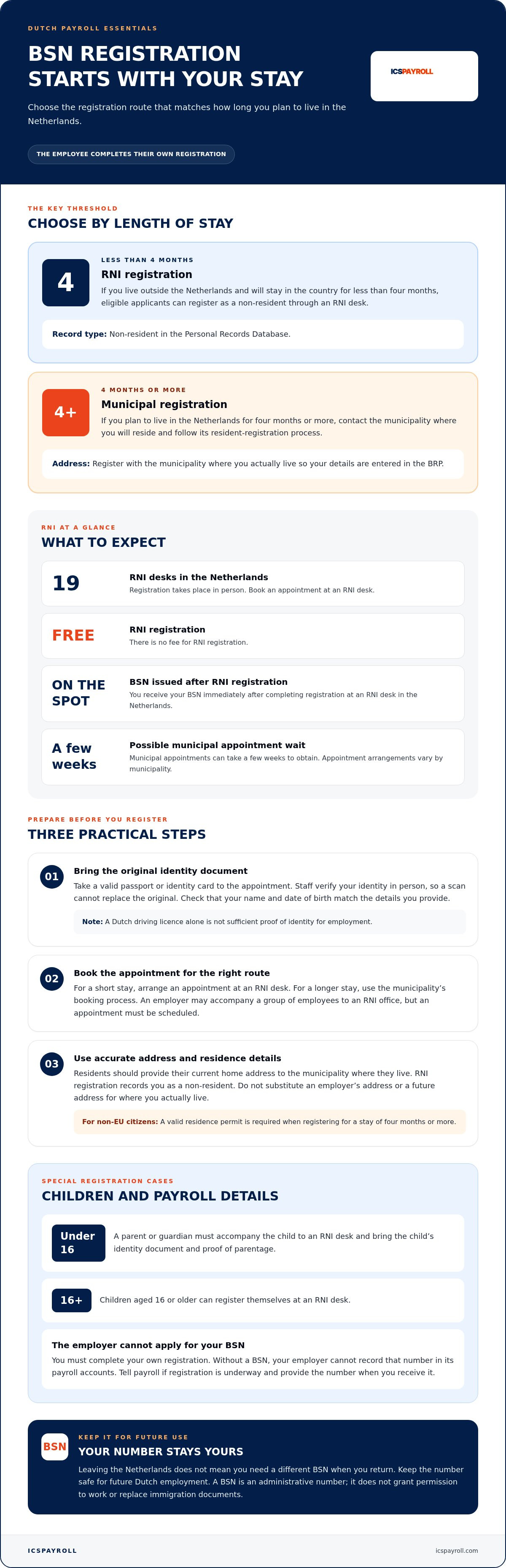
A Dutch employer cannot apply for a BSN on an employee’s behalf. However, a foreign employee living abroad who will work for a Dutch employer can apply through the Dutch Tax Administration, which handles RNI registration. The right route depends on the planned stay: less than four months calls for RNI registration, while a longer stay requires municipal registration. An existing BSN remains yours after you leave the Netherlands.
It makes sense to arrange this before your first day, particularly because payroll setup depends on accurate details. This guide explains how to apply from abroad or in person, choose the right registration route, and find a BSN you may already have.
By Joost Hubregtse, Payroll Director.
Joost Hubregtse is Payroll Director at ICSPayroll, the Dutch payroll and EOR specialist of Intercompany Solutions. A career payroll specialist and former Head of Payroll, he oversees wage tax filings, 30% ruling applications, and employment compliance for international employers.
Reviewed by Joost Hubregtse, Payroll Director, on 27 October 2026.
Key Takeaways
- Choose the registration route that matches your planned stay: RNI for a short stay or municipal registration for a longer stay.
- Prepare to register in person and bring a valid passport or identity card for identity verification.
- Your employer may need your BSN for payroll, but you should check the appropriate registration route and complete the required steps yourself.
- Before applying, look for an existing BSN on official documents, payslips, or through MijnOverheid.
- Once you have your BSN, keep it safe: it remains associated with you even if you leave the Netherlands.
How can I get a citizen service number (BSN) if I live abroad?
Choose your registration route based on where you live and how long you plan to stay in the Netherlands. For a short stay, eligible applicants can register through the RNI.
-
Prepare the required registration documents
Have a valid passport or identity card ready before arranging registration. RNI registration takes place in person, so bring the original document for identity verification. Check that your name and date of birth match the details you provide. A scan cannot replace the document used to verify your identity at the appointment.
If you live outside the Netherlands and stay in the country for less than 4 months, you can register at an RNI desk and receive a BSN, according to NederlandWereldwijd. The RNI records you as a non-resident. This route is relevant when you keep your residence abroad while working temporarily for a Dutch employer.
-
Book a municipality or RNI appointment
For a short stay, arrange an appointment at an RNI desk. The Netherlands has 19 RNI desks, and registration takes place in person. Follow the appointment instructions for your chosen desk and bring your identity document. If you plan to live in the Netherlands for four months or more, contact the municipality where you will reside about resident registration instead.
For a longer stay, use the municipality’s own booking process, as appointment arrangements vary. An employer may accompany a group of employees to an RNI office, but an appointment must be scheduled. A Dutch employer cannot apply for a BSN on your behalf, so you must complete your own registration.
If you do not provide a BSN, your employer cannot record that number in its payroll accounts. Tell payroll if registration is underway and provide the number when you receive it. The Tax Administration has specific rules for documented delays beyond the parties’ control.
-
Allow time to receive the BSN and check for fees
Attend your RNI appointment with your identity document. You receive your BSN immediately after completing registration at an RNI desk in the Netherlands. RNI registration is free. Municipal appointments can take a few weeks to obtain, so arrange resident registration promptly if you plan to stay longer.
Keep the number for future Dutch employment. Leaving the Netherlands does not mean you need a different BSN when you return. If your residence plans change, contact the appropriate municipality about updating your registration details. For general information on residence registration, consult the Dutch Government.
In-person identification and home-address requirements
Prepare your identity document and address details before registering. The information you need depends on whether you are registering as a resident or through the non-resident route.
- Bring an accepted identity document to the appointment. RNI registration takes place in person so staff can verify your identity. Bring your valid passport or identity card and present the original, not a scan. A Dutch driving licence alone is not sufficient proof of identity for employment under the Identification Obligation Act. Check that your name and date of birth match the details you give the registration office.
Identity checks apply to the person being registered. A parent or guardian must accompany a child under 16 and bring the child’s identity document and proof of parentage. Children aged 16 or older can register themselves at an RNI desk. A correct document helps staff connect the registration to the right personal records.
- Use address details that match where you live. If you live in the Netherlands, register with the municipality where you reside so your details are entered in the Personal Records Database (BRP). Provide your current home address and follow the municipality’s registration instructions. With RNI registration, you are recorded as a non-resident, so the process differs from registering as someone living at a Dutch address.
Your housing arrangements can affect which address details you provide. If you are staying temporarily, establish where you will actually live before choosing the municipality responsible for your registration. Do not use an employer’s address or a future address instead of your residential details. Your registration should reflect your living situation, not simply where you work.
- Check whether your residence status requires additional documents. A non-EU citizen registering for a stay of four months or more must have a valid residence permit. A BSN is an administrative number; it does not grant permission to work or replace immigration documents. Keep your identity document and residence permit separate, as they serve different purposes in the registration process.
Follow the document instructions provided by the municipality or RNI desk for your appointment. The registration office verifies your identity in person, while your chosen route determines whether you are registered as a resident or non-resident. Booking at the wrong type of office can leave your address or residence record unresolved.
- Keep your BSN separate from other personal and business details. Self-employed professionals may need to provide their BSN to a client required to withhold payroll taxes if they invoice without a VAT statement or do not invoice. If they invoice with a VAT statement, or the client is not required to withhold payroll taxes, they do not have to provide it to that client. A bank account number is separate from a BSN, so never use one in place of the other.
For foreign employees, the BSN supports payroll administration but does not replace identity verification or residence records. Keep the number secure and share it for appropriate administrative purposes. Accurate identity and address details help keep your Dutch government records consistent.
Getting a BSN through the Tax Administration when employed by a Dutch employer
You may need to complete the registration yourself to obtain a BSN. If you live abroad and will work for a Dutch employer, you can apply through the Tax Administration, which handles RNI registration.
-
Apply for a BSN in the Netherlands
Start by identifying where you will live and how long you expect to stay. If you live abroad and will stay in the Netherlands for less than four months, apply through the Tax Administration for RNI registration. If you will live in the Netherlands for longer, register as a resident with your municipality in the Personal Records Database (BRP). The registration route determines how the government records your residence.
Complete the application yourself. Your Dutch employer cannot register you or request your personal number for you. Prepare your valid passport or identity card, and use consistent personal details in your application and employment paperwork. RNI registration requires an in-person identity check, so plan to attend the appointment yourself.
Tell your employer which route applies and whether you already have a BSN. Your employer may need your BSN for payroll administration, but you should complete your own registration. If you are unsure whether you are registered in the RNI or BRP, clarify your registration status before submitting another application.
A residence permit and a BSN serve different purposes. The BSN is an administrative identifier, while a residence permit concerns permission to reside. Do not treat an application for a personal number as an application for a permit or as proof that you have permission to work.
-
Confirm when work can begin
Discuss your start date with your Dutch employer and treat the BSN separately from work authorisation. A BSN does not establish that you have permission to work in the Netherlands. Your relevant immigration documents and status determine that, not whether a personal number has been issued.
A missing BSN does not automatically determine whether you can start work. The Tax Administration has specific rules for cases where the number is missing, including documented delays beyond the parties’ control. Keep evidence of your registration steps, such as appointment details or correspondence, and promptly inform payroll if the number is delayed.
Ask your employer to record the reason for the delay and manage payroll under the applicable Tax Administration rules. Do not guess a number or use another person’s identifier. Once your BSN is issued, give the correct number to payroll so the employer can update its records.
If you move from living abroad to living in the Netherlands, use the registration route that matches your intended stay. For a longer stay, contact your municipality about BRP registration; for a short stay, follow the RNI route. Keep your employer informed as your personal records are updated.
Finding an existing BSN
Before starting a new registration, search your Dutch records for a personal number that may already have been assigned to you. Your BSN stays with you after you leave the Netherlands.
- Search the Dutch documents you already have. Check official letters, payslips, annual salary statements, and health insurance records for your BSN. The number has nine digits, so distinguish it from a document number, policy number, or bank account number. A passport issued by another country does not automatically show your Dutch BSN.
If you previously worked in the Netherlands, review paperwork from that employment and any payroll correspondence. The former SOFI number was replaced by the BSN in 2007, and most people’s SOFI numbers carried over unchanged. An older Dutch payroll record may therefore contain the identification number you need now.
- Inspect Dutch identity documents carefully. On Dutch identity cards issued in 2014 or later, the BSN appears on the back as the personal number. On a Dutch passport, check field 1 on the back of the holder page, where the number appears under “personal number.” Don’t mistake the passport or identity-document number for the BSN, since document numbers identify the document.
A Dutch driving licence can also show the BSN on its back, in section 13. Read the number before the slash, not the driving-licence number after it. These document locations make a practical first check for anyone who has previously registered in the Netherlands.
- Check MijnOverheid if you can access it. Sign in using an accepted means of identification, then review your personal details. MijnOverheid may display your BSN, allowing you to retrieve it when paper records are unavailable. Use your own account and keep the number private while viewing it.
If you cannot sign in, check official documents or earlier payroll records. A new account or contract does not automatically create a new BSN. The number belongs to you, not to an employer, municipality, or particular period of residence.
- Give the existing number to the relevant payroll contact. Once you find it, compare the digits across records before sharing them. Provide your BSN directly to the employer or payroll contact handling your employment administration. Do not send it to unrelated parties or use a passport number as a substitute.
If you cannot find the number in the documents available to you, do not apply for a second one. Contact the municipality where you registered or the relevant administration to retrieve your existing records. Leaving the Netherlands does not mean you need a different BSN when you return. Use the same personal number.
How can a foreign employee apply for a BSN in the Netherlands?
Choose your registration route according to how long you plan to live in the Netherlands. The BSN number process for foreign employees begins by establishing whether you will register as a resident or non-resident.
- Decide whether you plan to live in the Netherlands for more than four months. This determines whether you should register in the Personal Records Database (BRP) or use the non-resident route. If you plan to stay longer, contact the municipality where you will live. The municipality records your residential details in the BRP.
Base your choice on your expected residence, not just the length of your employment contract. For example, if you have a long-term job but plan a short stay, establish your actual residence plans before applying. If those plans change, follow the registration process that matches your revised stay.
- Arrange your municipal registration appointment promptly. Foreign workers making their first municipal registration must make an appointment within five days of arrival. Use the municipality’s booking process and select resident registration. Each municipality manages its own appointments, so follow the instructions for where you will live.
Appointment availability can affect the timing. In some cases, it takes a few weeks to get a municipal registration appointment. Book as soon as your residence plans are clear and keep the confirmation. Making the appointment within five days means booking it during that period, not assuming the appointment itself will take place by then.
- Attend the appointment and complete your BRP registration. Bring the identity documents requested by your municipality and provide accurate personal and residential details. The municipality enters your information in the BRP. Anyone registering as a resident in the BRP automatically receives a BSN if they do not already have one.
Check the personal details recorded during registration, especially your name and home address. These details link your identity to your Dutch residence record. If you move or your circumstances change, contact the relevant municipality about updating your registration rather than applying for another BSN.
- Keep your BSN for payroll and future administration. Municipal registration for a BSN is free. Once you receive the number, provide it to your employer for payroll administration and keep your registration documents. Your BSN remains yours if you later leave the Netherlands.
If you plan to stay for less than four months, use the RNI route rather than registering as a resident in the BRP. A short stay does not follow the same process as municipal resident registration. If you later decide to stay longer, contact the municipality where you live to update your registration status. Keeping your residence details accurate is the first step in the BSN number process for foreign employees.
ICSPayroll: Employer of Record (EOR)
ICSPayroll supports the Dutch employment and payroll arrangements that follow BSN registration. If your company is hiring in the Netherlands without its own local employing structure, our Employer of Record (EOR) service provides an employment route in the country. Employees still complete their own BSN registration.
For companies with an existing Dutch employment structure, Dutch Payroll Administration supports payroll compliance and processing. International employees who may qualify for the 30% ruling can also receive help with the application process. These services address employment administration, not the employee’s personal registration appointment.
To discuss Dutch employment or payroll support, contact ICSPayroll.
Make your Dutch employment setup the next step
Once your personal registration is underway, align the remaining onboarding tasks with your planned start date. Keep your identity and residence records consistent, tell your employer where your BSN application stands, and share the number through the appropriate payroll channel when you receive it. This gives both parties a clear reference for completing employment administration.
The BSN number process for foreign employees is one part of preparing to work in the Netherlands. Companies hiring internationally also need a practical approach to employment and payroll administration. Map out who handles each task, what information the employee must provide, and how updates will reach payroll. Clear ownership helps prevent registration questions from causing wider onboarding delays.
For support with Dutch employment arrangements, explore how ICSPayroll can support your Netherlands hiring plans. A well-organized next step can help you move forward with greater clarity.
Frequently Asked Questions
How does it work?
Registration links your identity details to Dutch government records and provides a personal number if you do not already have one. A BSN is not a DigiD: DigiD is used to log in to participating online services. A BSN is also not proof of work authorisation. Treat it as an administrative identifier, distinct from login credentials and identity document numbers.
Where can I get a BSN?
A BSN is issued through registration in the Netherlands, either as a resident or a non-resident. If you have worked or lived in the country before, check your existing Dutch records before beginning a new application. Your BSN stays with you after you leave the Netherlands, so returning does not require a replacement number.
What documents are required to obtain a BSN as a foreign employee?
Bring a valid passport or identity card to identify yourself at registration. Check that the personal details you provide match the document, including the spelling of your name. If registering a child under 16, the accompanying parent or guardian must also bring proof of parentage. Keep the document used for registration available if your employer later needs to verify your identity for employment records.
Where do foreign employees register to get a BSN: municipality or RNI desk?
The registration route depends on whether you will live in the Netherlands or remain resident abroad. A municipality handles resident registration, while an RNI desk handles non-resident registration. For RNI appointments, eligibility can affect which desks you may use: non-EU, non-EEA and non-Swiss nationals have a restricted choice of desks. Check the relevant desk’s appointment process before making travel arrangements.
How do employees staying in the Netherlands for less than four months get a BSN?
They register as non-residents through the RNI. NederlandWereldwijd explains that someone living abroad and staying in the Netherlands for less than four months can register at an RNI desk and receive a BSN. Keep the number with your employment records after registration. It remains yours if you leave the country and later return for another job or assignment.
How do employees staying in the Netherlands for more than four months register for a BSN?
They register as residents with the municipality, which adds their details to the Personal Records Database. For a first registration, make the appointment within five days of arrival. A non-EU citizen registering for a stay of four months or more must have a valid residence permit. Keep the municipality’s registration confirmation with your employment documents after the appointment.
Can an employer arrange a BSN for a foreign employee?
No. Employees generally need to take part in registration and identity checks themselves. An employer can help coordinate practical arrangements, including accompanying a group to an RNI office once an appointment has been scheduled, but cannot apply on an employee’s behalf. After the number is issued, the employee should give it to payroll for the employer’s records.

Article by
Joost Hubregtse
Joost Hubregtse is Director of ICS Staffing & Payroll B.V., the wholly owned subsidiary of Intercompany Solutions behind ICS Payroll. He is responsible for Employer of Record and Dutch payroll services: employment contracts, wage tax and social security filings, holiday allowance, pension, sick leave and CAO compliance, with onboarding possible within 48 hours.
Frequently Asked Questions
Registration links your identity details to Dutch government records and provides a personal number if you do not already have one. A BSN is not a DigiD: DigiD is used to log in to participating online services. A BSN is also not proof of work authorisation. Treat it as an administrative identifier, distinct from login credentials and identity document numbers.
A BSN is issued through registration in the Netherlands, either as a resident or a non-resident. If you have worked or lived in the country before, check your existing Dutch records before beginning a new application. Your BSN stays with you after you leave the Netherlands, so returning does not require a replacement number.
Bring a valid passport or identity card to identify yourself at registration. Check that the personal details you provide match the document, including the spelling of your name. If registering a child under 16, the accompanying parent or guardian must also bring proof of parentage. Keep the document used for registration available if your employer later needs to verify your identity for employment records.
The registration route depends on whether you will live in the Netherlands or remain resident abroad. A municipality handles resident registration, while an RNI desk handles non-resident registration. For RNI appointments, eligibility can affect which desks you may use: non-EU, non-EEA and non-Swiss nationals have a restricted choice of desks. Check the relevant desk’s appointment process before making travel arrangements.
They register as non-residents through the RNI. NederlandWereldwijd explains that someone living abroad and staying in the Netherlands for less than four months can register at an RNI desk and receive a BSN. Keep the number with your employment records after registration. It remains yours if you leave the country and later return for another job or assignment.
They register as residents with the municipality, which adds their details to the Personal Records Database. For a first registration, make the appointment within five days of arrival. A non-EU citizen registering for a stay of four months or more must have a valid residence permit. Keep the municipality’s registration confirmation with your employment documents after the appointment.
No. Employees generally need to take part in registration and identity checks themselves. An employer can help coordinate practical arrangements, including accompanying a group to an RNI office once an appointment has been scheduled, but cannot apply on an employee’s behalf. After the number is issued, the employee should give it to payroll for the employer’s records.