
Understanding Dutch payslips for employers: costs and pay
By Joost Hubregtse, Director, ICS Staffing & Payroll
All blog posts are reviewed and fact checked by our labour law lawyer Zishan Hussain and our director. Editorial standards
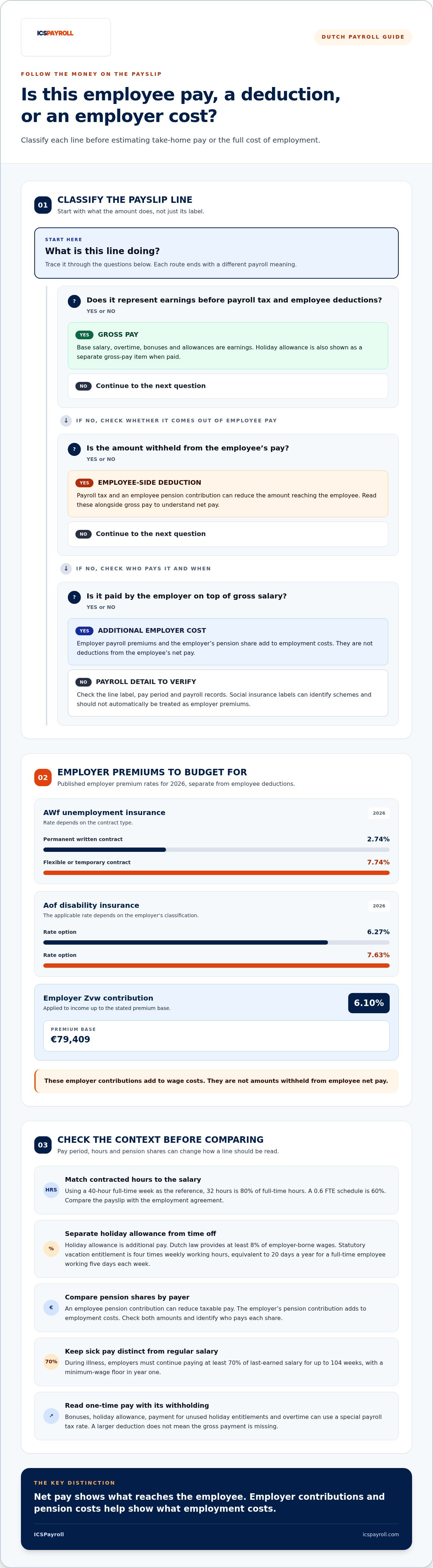
The net amount is only one part of a Dutch payslip. Understanding Dutch payslips for employers means distinguishing gross salary and payroll deductions from the net pay transferred to an employee. Employer contributions increase employment costs, but they are not deductions from the employee’s pay.
Payslip figures can look complex, especially when they include tax credits, allowances, pension details or year-to-date totals. Read each item in context: identify what makes up gross pay, what reduces take-home pay, and what represents an additional cost for the employer.
This article explains the main fields on a Dutch payslip, how wage tax and other deductions affect net pay, and which employer contributions to budget for beyond salary. It also covers how holiday allowance and overtime appear, and why the amount paid to an employee does not show the full cost of employing them in the Netherlands.
Key Takeaways
- Separate gross salary, taxable pay and net pay to understand how the payslip amount relates to the employee’s bank transfer.
- Review tax credits and special-pay items together to see why bonuses, overtime or holiday allowance can affect deductions differently.
- Distinguish amounts withheld from an employee’s pay from employer contributions, which add to the total cost of employment.
- Use the pay period, hours, personal details and cumulative totals to interpret the figures and spot inconsistencies.
- Include salary components, employer premiums and applicable pension contributions when assessing wage costs, rather than relying on net pay alone.
Employer payroll costs and social contributions
A Dutch payslip separates employee pay from the employer’s additional payroll costs. Read gross salary, deductions and employer-paid contributions as distinct amounts.
Employer Statutory Contributions
Employer statutory contributions are payroll premiums paid on top of an employee’s gross salary. They matter because net pay alone does not show the employer’s total wage cost.
For 2026, the AWf unemployment insurance premium is 2.74% for a permanent written contract and 7.74% for a flexible or temporary contract. The Aof disability insurance premium is 6.27% or 7.63%, depending on the employer’s classification. The employer Zvw contribution is 6.10% on income up to the €79,409 premium base. The published employer premium rates are separate from deductions taken from employee net pay.
Review the payslip alongside the employment contract. The contract sets out agreed hours and employment terms, while the employer’s name, address and Chamber of Commerce registration number help identify the payroll record. Account for rates and contributions in your budget, even when they do not appear as employee deductions.
Pension and Social Insurance Contributions
A workplace pension is a retirement arrangement that may show employee and employer contributions on the payslip. It matters because the employee’s share can reduce taxable pay, while the employer’s share adds to employment costs.
Social insurance labels identify schemes connected with Dutch payroll. National insurance covers state pensions, surviving dependants and long-term care through AOW, Anw, AKW and Wlz. Employee insurance includes WW, WIA, ZW and WAO. Do not treat every label as an employer premium: distinguish payroll tax and employee deductions from contributions paid by the employer.
When pension information appears, compare the contribution amounts and note which party pays each share. This clarifies both the employee’s deductions and the employer’s payroll expenditure.
Base Salary and Part-Time Contracts
Base salary is the agreed regular wage before variable payments and deductions. Contracted hours matter because they determine how a part-time salary compares with a full-time reference.
Using a 40-hour full-time week as the reference, a 32-hour contract represents 80% of full-time hours. A 0.6 FTE schedule represents 60%. Check the payslip’s contractual hours against the employment agreement, then compare the stated salary with the agreed working fraction. Overtime, allowances or leave adjustments can change period pay without changing base salary.
Vacation and Sick Pay
Holiday allowance is additional pay, holiday entitlement is time off, and sick pay is salary continued during illness. Keep these separate when estimating annual compensation and payroll obligations.
According to Overheid.nl’s statutory minimum-wage and holiday-allowance legislation, Dutch law gives employees a holiday allowance of at least 8% of their employer-borne wages. Statutory vacation entitlement is four times weekly working hours, equivalent to 20 days annually for a full-time employee working five days each week. Under article 7:629 BW, employers must continue paying at least 70% of last-earned salary for up to 104 weeks of sickness, with a minimum-wage floor in year one, as explained by the Dutch government’s sick-pay guidance. Check whether the payslip records accrued or paid allowance separately from regular salary.
Gross salary components
Understanding Dutch payslips for employers starts with separating gross salary, taxable wages and net pay. Gross salary records earnings before payroll tax and employee deductions. Net salary is generally the amount transferred to the employee’s bank account, though other deductions or reimbursements can affect the final payment.
Show base salary, overtime, bonuses and allowances as separate gross-pay components. For example, list overtime separately from contractual salary, and give travel allowances or bonuses their own lines. This helps employees see what increases earnings and what deductions reduce the payment. Use clear labels and pay periods so each item can be compared with payroll records.
According to Overheid.nl, Dutch law gives employees a holiday allowance of at least 8% of their employer-borne wages. Show this allowance separately when it is paid, so it isn’t mistaken for regular monthly salary. A period that includes a holiday allowance payment may therefore show different gross earnings and deductions from an ordinary pay period.
One-time payments can have different withholding from regular salary. In the Netherlands, a special payroll tax rate is used for payments such as bonuses, holiday allowance, payment for unused holiday entitlements and overtime. A larger deduction on a bonus line does not mean the payment is missing from gross pay. Read the gross amount together with its withholding.
The pay-period basis matters too. A payslip may show gross wages for a four-week period if salary is calculated that way. Contracted hours, overtime and leave adjustments can change earnings for the period. Compare like periods rather than treating a four-week amount as a monthly figure.
A practical step in understanding Dutch payslips for employers is reconciling earnings with the bank payment. Add salary and variable gross-pay components, then distinguish taxable wages from separately identified reimbursements. Review payroll tax and employee deductions, and compare the resulting net salary with the transfer. Account for any other deduction or reimbursement shown.
If gross salary changes, identify whether the reason is a base-salary adjustment, extra hours, a bonus, an allowance or a leave adjustment. If gross earnings stay the same but net salary changes, review withholding, tax-credit application and deductions. Separate payslip lines help pinpoint the change and keep payroll records accurate.
Personal and salary details on a Dutch payslip
A Dutch payslip identifies the employer, employee, pay period and salary calculation. Employers must include required details, though layouts can differ. Common fields include the employer’s name, address and Chamber of Commerce registration number, plus the employee’s name, address, date of birth and payroll identification number.
These details link the payment to the correct employee and payroll record. Compare the name and payroll identification number with the employment file, then check the period shown. A payslip may also list contracted hours, hours worked, gross pay, payroll tax, insurance contributions, deductions and net salary. The net figure is generally the amount transferred to the employee’s account.
Salary can include more than cash wages. A company car, for example, can create a taxable benefit in kind. Its notional addition to taxable wages is calculated using the car’s catalogue value and an emission-dependent percentage. This changes the taxable salary shown, but is not extra cash paid to the employee. Keep taxable benefits separate from the bank payment when reconciling payroll.
Some payslips also show year-to-date totals, which can include gross salary, tax payments and contributions. Compare these annual figures with the current period’s amounts: the period figure records one payroll run, while the cumulative figure adds amounts across the year. This explains why a deduction can look modest for one period but larger in the annual total.
Pay frequency and deadlines should match the agreed payment arrangement. Employers usually pay monthly, but weekly or four-weekly payment terms can be agreed in writing. For monthly wages, the payment period may not extend beyond one quarter; for weekly wages, it may not extend beyond one month. Record the agreed period clearly so employees can see which work and adjustments each payment covers.
Late salary payment can create additional compensation for the employee. In the Netherlands, the statutory increase is 5% per day for the fourth to the eighth working day after wages were due. After the eighth working day, it is 1% for each subsequent working day, capped at 50%. These amounts relate to late payment, not ordinary payroll tax or insurance contributions.
For an accurate review, first match the payslip’s period and employee details. Then compare gross salary, taxable benefits, deductions and net payment with payroll records. If an annual total changes unexpectedly, trace it to the relevant period and payment entry.
Checking payslip deductions and net pay
Net pay is what remains after payroll applies tax withholding and relevant employee deductions. For a useful review, compare taxable wages, each deduction and the final payment for the same pay period.
Errors that can lead to tax or employee disputes include applying the wage tax credit at more than one employer, recording the wrong taxable benefit or deducting an incorrect pension amount. Missing salary components can also make the payslip differ from the agreed pay.
Tax and Social Insurance Deductions
Payroll tax withholding covers wage tax, including income tax and national insurance contributions. The tax-credit setting matters because it affects how much tax is withheld from an employee’s salary.
An employee can use wage tax credits at only one employer at a time. Check the payslip’s tax-credit indicator against the employee’s payroll details. WW, WIA and ZW identify employee insurance schemes, while AOW and Anw relate to national insurance. These labels help distinguish tax withholding from employer-paid premiums.
Taxable pay may differ from cash salary when a payslip includes a benefit in kind, such as a company car. Check that taxable additions are included in the tax calculation without treating them as cash transferred to the employee. An incorrect addition can change withholding and prompt questions about net pay.
Review the relevant period and hours rather than comparing a monthly net payment directly with an hourly minimum.
Workplace Pension Deductions
A workplace pension deduction is the employee’s share of contributions to a pension arrangement. It affects take-home pay and can reduce taxable income.
Compare the pension line with the applicable payroll arrangement and identify whether it shows the employee’s or employer’s contribution. In the Netherlands, income tax is not paid on salary set aside for workplace pension contributions. The payslip should show pension amounts separately from wage tax and insurance deductions.
Reconcile the figures in a consistent order: confirm gross taxable wages, check the tax-credit setting, review pension and other employee deductions, then match net pay with the bank payment. For example, if gross wages are unchanged but net pay falls, inspect deduction lines and tax-credit status before assuming salary changed.
A clear audit trail also supports corrections. Compare the payslip with the employment terms, payroll records and payment for that period. If a correction changes taxable wages or deductions, update the relevant payroll calculation and explain the changed line to the employee. This makes the difference between gross pay, withholding and net payment traceable.
Employer wage costs and additional costs
Employer wage costs include salary and employer contributions, while wage tax withholding affects the employee’s take-home pay. Separate these amounts when assessing payroll expenditure and reviewing a payslip.
Digital payslips in the Netherlands require employee agreement, and employees must be able to save them as documents. Keep payslips in wage administration with supporting payroll records for seven years. This preserves a record for each period, including salary, tax credit, holiday pay and deductions. Payroll tax returns are due by the last day of the following month.
Statutory Hourly Minimum Wage
The statutory hourly minimum wage sets the lowest hourly pay for covered employees. Check it against the employee’s age and pay period to assess whether the agreed salary meets the minimum.
Compare the applicable rate with hours paid, not just the monthly net amount. Part-time schedules or unpaid absences can change period totals, so use the hours and dates recorded for that pay period.
Progressive Wage Tax Rates
Progressive wage tax rates apply different percentages across taxable income bands. An employee’s marginal rate can differ from the effective rate across their total income.
Employment income is taxed at different rates across income bands. Income from €38,883 to €79,137 is taxed at 37.56%, and income above €79,137 is taxed at 49.50%. These bands help explain withholding, but a single payslip’s deduction isn’t calculated by multiplying all salary by the highest applicable rate.
Wage Tax Withholding
Wage tax withholding is the amount an employer deducts from salary for payroll tax, including income tax and national insurance contributions. It matters because it reduces the employee’s net payment while meeting payroll tax obligations.
Check taxable pay for the period, the withholding shown and any special payment separately. Bonuses, holiday pay and overtime can use the special-remuneration wage-tax table. According to Overheid.nl, overtime pay may be taxed at the rate specified by that table. As a result, withholding on an additional payment can differ from withholding on regular salary.
Tax Credits and Wage Tax Tables
A tax credit reduces the wage tax withheld from an employee’s salary, while wage tax tables set withholding for the relevant pay and payment type. Together, they shape the payslip’s taxable-pay calculation and net result.
Apply the employee’s tax-credit setting consistently: an employee can use wage tax credits at only one employer at a time. When reviewing a payslip, compare the tax-credit indicator with payroll records, then distinguish regular salary from special payments. This helps explain why two employees with similar gross pay may have different net amounts.
ICSPayroll: Employer of Record (EOR)
ICSPayroll provides Employer of Record (EOR) services for companies hiring employees in the Netherlands. This suits businesses that need a local employment arrangement and support managing Dutch payroll requirements.
For employers with an existing employment structure, Dutch Payroll Administration supports the ongoing calculation and processing of employee pay. Clear payroll records help connect gross salary, deductions, net payments and employer contributions. For eligible international employees, ICSPayroll also manages the 30% Ruling Application process, which is separate from routine payslip calculations.
Choose the support that matches your hiring and payroll setup: EOR for employment in the Netherlands, payroll administration for Dutch employees, or assistance with a 30% ruling application. To discuss your Dutch payroll requirements, contact ICSPayroll or visit icspayroll.com.
Make payroll review part of your operating rhythm
Understanding Dutch payslips for employers is most useful as part of a consistent payroll review, not just when resolving queries. Treat each pay run as a control point: compare approved changes with payroll inputs, review unusual entries and record corrections clearly. This helps your team identify where a difference arose and carry the right information into the next cycle.
As your Dutch workforce grows or employment arrangements change, payroll coordination can become more demanding. A defined process for salary changes, employee questions and payroll records gives finance and people teams a reliable basis for decisions. It also helps keep employee communication precise, especially when a payslip amount changes between pay periods.
If you want support with Dutch payroll administration or employing staff in the Netherlands, contact ICSPayroll for payroll support. A clear process is a practical next step toward confident, well-managed payroll.
Frequently Asked Questions
By Joost Hubregtse, Payroll Director.
Joost Hubregtse is Payroll Director at ICSPayroll, the Dutch payroll and EOR specialist of Intercompany Solutions. A career payroll specialist and former Head of Payroll, he oversees wage tax filings, 30% ruling applications, and employment compliance for international employers.
Reviewed by Joost Hubregtse, Payroll Director, on 26 October 2026.
What does a Dutch payslip look like?
Dutch payslips do not all share the same visual layout. Start by identifying the pay period, then distinguish current-period figures from year-to-date totals. For example, if a cumulative amount changes unexpectedly, compare it with earlier payslips to find when the difference began. This makes an employee query more specific and easier to investigate.
How do you comply with the rules for the statutory minimum wage?
Build a documented check around each employee’s age, paid hours and applicable rate. If a pay period crosses a rate change, separate hours worked before and after the effective date rather than applying one rate to the entire period. Keep the hours and calculation with payroll records. This makes it easier to explain the pay assessment if an employee raises a query.
Is a payslip mandatory?
Yes. Employers must give employees a payslip for each pay period. Assign responsibility for issuing it and retain a record linking the payslip to the relevant payroll run. If an employee reports a discrepancy, use that period’s payroll calculation and payment record to investigate. A consistent process helps prevent missing documents when payroll responsibilities are shared across teams.
What are other wage costs?
Other wage costs are employment expenses beyond the amount an employee receives in their bank account. They depend on the employment arrangement and the employer’s obligations. For budgeting, separate recurring costs from items that arise when circumstances change, such as a salary adjustment or a period of sickness. This gives finance teams a more complete estimate than using net pay alone.
What is a sample payslip?
A sample payslip illustrates how payroll information may be presented and can help a new employee understand the layout before receiving an individual document. Treat it as a guide to format, not a calculation template: actual figures depend on the employee’s pay, contract and payroll settings. Do not use another employee’s payslip as a sample, as it may disclose personal information.
What is the difference between gross and net wage?
Gross wage is an employee’s pay before employee-side withholding and deductions; net wage is the take-home amount after them. For a practical comparison, use the same pay period and check whether a one-time payment or correction appears in either calculation. Do not compare salary offers using net pay alone, because payroll settings and individual deductions can affect the amount received.
What Dutch payroll taxes and social security contributions do employers pay?
Employers withhold payroll tax from employee wages and account for employer-paid insurance premiums separately. The practical distinction is who bears each amount: withholding reduces the employee’s payment, while employer premiums add to employment expenditure. When reviewing a payroll return, reconcile withheld amounts and employer contributions with their respective payroll records rather than treating the combined total as one employee deduction.
What are the 2026 Dutch minimum wage and holiday allowance rules?
The holiday allowance is at least 8% of employer-borne wages under the applicable rule. For payroll periods around the July rate change, use the rate that applies to each work date and keep the calculation period identifiable.

Article by
Joost Hubregtse
Joost Hubregtse is Director of ICS Staffing & Payroll B.V., the wholly owned subsidiary of Intercompany Solutions behind ICS Payroll. He is responsible for Employer of Record and Dutch payroll services: employment contracts, wage tax and social security filings, holiday allowance, pension, sick leave and CAO compliance, with onboarding possible within 48 hours.
Frequently Asked Questions
Dutch payslips do not all share the same visual layout. Start by identifying the pay period, then distinguish current-period figures from year-to-date totals. For example, if a cumulative amount changes unexpectedly, compare it with earlier payslips to find when the difference began. This makes an employee query more specific and easier to investigate.
Build a documented check around each employee’s age, paid hours and applicable rate. If a pay period crosses a rate change, separate hours worked before and after the effective date rather than applying one rate to the entire period. Keep the hours and calculation with payroll records. This makes it easier to explain the pay assessment if an employee raises a query.
Yes. Employers must give employees a payslip for each pay period. Assign responsibility for issuing it and retain a record linking the payslip to the relevant payroll run. If an employee reports a discrepancy, use that period’s payroll calculation and payment record to investigate. A consistent process helps prevent missing documents when payroll responsibilities are shared across teams.
Other wage costs are employment expenses beyond the amount an employee receives in their bank account. They depend on the employment arrangement and the employer’s obligations. For budgeting, separate recurring costs from items that arise when circumstances change, such as a salary adjustment or a period of sickness. This gives finance teams a more complete estimate than using net pay alone.
A sample payslip illustrates how payroll information may be presented and can help a new employee understand the layout before receiving an individual document. Treat it as a guide to format, not a calculation template: actual figures depend on the employee’s pay, contract and payroll settings. Do not use another employee’s payslip as a sample, as it may disclose personal information.
Gross wage is an employee’s pay before employee-side withholding and deductions; net wage is the take-home amount after them. For a practical comparison, use the same pay period and check whether a one-time payment or correction appears in either calculation. Do not compare salary offers using net pay alone, because payroll settings and individual deductions can affect the amount received.
Employers withhold payroll tax from employee wages and account for employer-paid insurance premiums separately. The practical distinction is who bears each amount: withholding reduces the employee’s payment, while employer premiums add to employment expenditure. When reviewing a payroll return, reconcile withheld amounts and employer contributions with their respective payroll records rather than treating the combined total as one employee deduction.
The holiday allowance is at least 8% of employer-borne wages under the applicable rule. For payroll periods around the July rate change, use the rate that applies to each work date and keep the calculation period identifiable.