
Dutch payroll for small business: costs and obligations
By Joost Hubregtse, Director, ICS Staffing & Payroll
All blog posts are reviewed and fact checked by our labour law lawyer Zishan Hussain and our director. Editorial standards
Payroll compliance in the Netherlands is a monthly responsibility, not just a salary transfer. Managing Dutch payroll for a small business involves employer registration, payslips and payroll tax returns, as well as statutory holiday allowance.
This article explains how tax registration, payroll declarations, holiday allowance and compliance duties fit together, giving small employers a practical overview of the work involved.
By Joost Hubregtse, Payroll Director.
Joost Hubregtse is Payroll Director at ICSPayroll, the Dutch payroll and EOR specialist of Intercompany Solutions. A career payroll specialist and former Head of Payroll, he oversees wage tax filings, 30% ruling applications, and employment compliance for international employers.
Reviewed by Joost Hubregtse, Payroll Director, on 21 October 2026.
Key Takeaways
- Budget for the statutory 8% holiday allowance and understand how it fits into an employee’s total compensation.
- Build monthly payslips and payroll tax declarations into your regular payroll schedule, including a zero return when applicable.
- Complete employer tax registration before your first employee starts work, then keep payroll records and filings organized.
- Separate gross salary from employer contributions to understand the broader cost of employing staff in the Netherlands.
- Track changes to Dutch payroll rules so minimum wage, sick pay, and other compliance duties stay on your radar.
Holiday allowance
In the Netherlands, employers must provide statutory holiday allowance equal to 8% of an employee’s annual gross base salary, according to Business.gov.nl. It is separate from paid holiday leave. Employers usually accrue the allowance monthly and pay it in May. For a small business, that means recording the accrual during the year, then including the payment in payroll when it is due. A foreign employer hiring in the country needs to account for this Dutch requirement alongside regular salary.
Record holiday allowance as a separate payroll item rather than treating it as part of ordinary monthly salary. Calculate the accrual against the employee’s gross base salary and keep a running balance in payroll records. When you pay the allowance, show it clearly on the payslip. This makes the amount easy to understand and creates a traceable record of what accrued and what was paid.
May is a typical payment month, but accruing the allowance monthly helps prevent the full obligation from being left until then. Update the accrual when changes affect an employee’s base salary. When someone leaves, reconcile the accrued allowance against amounts already paid in the final payroll. Keeping the calculation, accrual history and payment together makes it easier to spot any outstanding balance.
Holiday allowance is not the same as holiday entitlement. In the Netherlands, a full-time employee is entitled to at least 20 statutory holiday days, according to Business.gov.nl’s guidance on holiday entitlement. The statutory minimum leave entitlement is calculated at four times the employee’s weekly working hours. For example, the entitlement for someone working five days each week is expressed in days, while a different weekly schedule is measured against that employee’s hours. Track leave separately from the 8% allowance.
Sickness coverage is another distinct payroll responsibility. Under Article 7:629 of the Dutch Civil Code, employers must continue paying at least 70% of an employee’s last-earned salary for up to 104 weeks, with a minimum-wage floor in the first year, according to Article 7:629 of the Dutch Civil Code. The Gatekeeper Improvement Act concerns reintegration duties. It includes an occupational health analysis in week six and a reintegration plan in week eight. These duties sit alongside holiday allowance, not in place of it.
Review pension arrangements before finalizing employment terms. Pension contributions may be required by law or under an applicable collective labour agreement, known as a CAO. Identify the relevant CAO and pension obligations when preparing the employment package, then include any required deductions or contributions in payroll. Businesses hiring from abroad should consider holiday allowance, sick pay, leave and pension together to understand their Dutch employment responsibilities.
Monthly payslips and payroll tax declarations
Employers in the Netherlands generally pay salaries monthly and issue a payslip for each pay period. They must also file a monthly payroll tax return, including a zero return when applicable.
Payroll Pay Cycles and Payslips
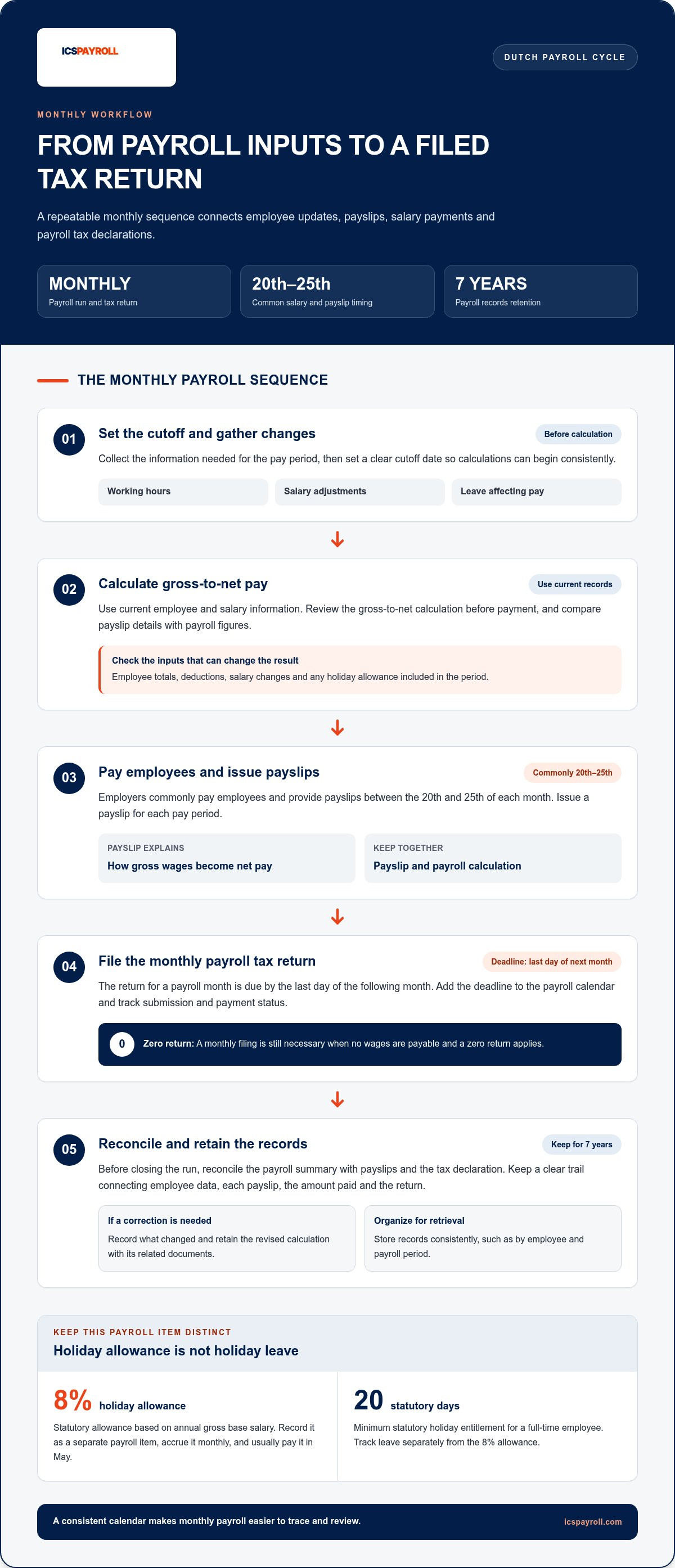
A payroll pay cycle is the recurring process of calculating monthly wages, paying employees, issuing payslips, and reporting payroll taxes. Dutch employers commonly pay employees and provide payslips between the 20th and 25th of each month. A consistent calendar helps coordinate salary payments with payroll calculations and tax filings. Set cut-off dates for gathering working hours and payroll changes before calculations begin.
Each payroll run should use current employee and salary information. Record changes such as new working hours, salary adjustments, or leave that affects pay. Then review gross-to-net calculations before payment and compare the resulting payslip details with the payroll figures. This sequence helps catch input errors before they affect both the employee’s payment and the tax declaration.
Payslips and Payroll Records
A payslip records an employee’s salary calculation for a pay period. It shows how gross wages translate into net pay and which payroll items apply. Keep payslips with the corresponding payroll calculations and declaration records. Organized documentation makes it easier to trace a correction to its source and pay period.
Payroll records should preserve a clear link between employee data, each payslip, the amount paid, and the tax return. Dutch employers must retain payroll records for 7 years, according to the Dutch government guidance on business records. Store records in a consistent structure, such as by employee and payroll period, so the administration remains searchable. If a correction is needed, record what changed and preserve the revised calculation with its related documents.
The payroll tax return is due by the last day of the month following the payroll month, according to the Belastingdienst’s payroll tax return guidance. For example, the return for a given month is due by the final day of the next month. A monthly filing remains necessary even when no wages are payable and a zero return applies. Add the filing deadline to the same payroll calendar as salary processing, then record submission and payment status.
Before closing each monthly payroll run, reconcile the payroll summary with the payslips and tax declaration. Check employee totals, deductions and any holiday allowance included in the period. Keep a record of the review with the payroll documents. This gives a small business a practical way to investigate discrepancies without piecing the calculation back together from scattered files.
For employers who want support with these recurring tasks, Dutch Payroll Administration can help manage payroll processing and compliance administration.
Dutch tax registration and payroll obligations
Before employment starts in the Netherlands, arrange employer registration and payroll tax administration. Employers register with the Dutch Tax and Customs Administration, known as the Belastingdienst, and need a payroll tax number before the employee’s first working day. A Dutch business also registers with the Kamer van Koophandel (KvK) and receives a KvK number. The registrations serve different purposes, so a KvK number alone does not replace payroll tax registration.
Keep employer wage tax duties separate from the business’s VAT position. Wage tax concerns employee payroll; VAT concerns the business’s taxable activities and customer invoices. The small businesses scheme, or KOR, may be available to an established Dutch business with turnover of no more than €20,000 per calendar year, if it meets the other eligibility conditions. Businesses using the KOR don’t charge customers VAT and can’t deduct VAT on business costs or investments.
Track turnover across the calendar year. If it exceeds €20,000, the business must notify the Belastingdienst immediately and becomes subject to VAT. A business using the KOR should therefore monitor sales and understand the point at which its VAT treatment changes. The scheme applies across the business’s activities, including activities registered under different VAT sub-numbers. This matters if one small company operates more than one line of business.
VAT filing obligations depend on the business’s VAT status. Businesses outside the KOR follow the applicable VAT return requirements, while KOR participants do not charge VAT on covered sales. They also cannot reclaim input VAT on costs. Compare the impact on customer prices and business purchases before choosing the scheme. For a business selling mainly to other businesses, unrecoverable input VAT may affect costs differently than for one selling mainly to private customers.
Review pension obligations separately during employment setup. Contributions may be required by law or by a collective labour agreement, known as a CAO. Determine whether a CAO applies to the employer’s activities and whether it sets pension requirements. A small headcount does not automatically remove a pension obligation. If contributions apply, include them in employment administration and payroll calculations, and explain relevant deductions to employees.
A practical starting checklist is to distinguish each obligation and assign its records:
- Keep KvK registration details separate from the Belastingdienst payroll tax registration.
- Track monthly wage tax administration separately from VAT returns and KOR turnover.
- Record the applicable CAO and pension decision with the employee’s payroll information.
Keeping these obligations separate helps a small employer identify which filing or contribution relates to payroll, VAT or pension rules, rather than treating every Dutch tax duty as one process.
Payroll Services in the Netherlands for Your Small Business: How Does This Work?
Payroll brings together employee data, wage tax withholding, employer contributions, payslips and monthly reporting. From hiring through payday, register for payroll tax before the employee’s first working day, collect the details needed for payroll, calculate gross-to-net pay and contributions, issue a payslip and file the monthly declaration.
Wage Tax and Social Contributions
Wage tax and social contributions are amounts withheld from employees or paid by the employer for Dutch employees. Classifying them correctly matters because each contribution has its own rate and calculation base.
For 2026, employer Zvw healthcare contributions are 6.10% of wages, up to the €79,409 maximum premium wage. The AWf unemployment insurance premium is 2.74% for qualifying permanent written contracts and 7.74% for flexible or temporary contracts. The applicable rate depends on the employment contract, so enter contract details accurately before calculating payroll.
The Aof disability insurance premium also applies to employer payroll. Its 2026 rate is 6.27% or 7.63%, depending on the employer category. These employer premiums are separate from the wage tax withheld from an employee’s pay. Payroll calculations should therefore show gross salary, employee deductions, net payment, and employer-side contributions distinctly.
Payroll Costs and Contribution Ceilings
Payroll costs include gross salary and employer contributions, while contribution ceilings limit the wage base for specified premiums. This distinction helps businesses estimate employment costs without treating every premium as unlimited.
For 2026, the maximum premium wage for mandatory social insurance contributions is €79,409. The Zvw employer contribution also uses that annual ceiling. If an employee’s annual wage exceeds the cap, the relevant contributions are calculated only up to the applicable wage base, rather than continuing on every euro above it.
For planning, separate recurring salary from employer premiums and check which rates apply to each employee. Contract type affects AWf, while employer category affects Aof. Changes in salary or contract status can alter the calculation, so update payroll records whenever employment terms change. This gives a more accurate cost picture than applying one flat percentage to everyone.
Payroll Steps from Hiring to Payment
The hiring-to-payment sequence links registration, employee setup, monthly calculations, payment and reporting. Following the same process helps prevent missing information from carrying into later payroll periods.
Before the first working day, arrange payroll tax registration and collect the employee and contract details needed for an accurate calculation. Each month, process salary and applicable contributions, prepare the payslip, pay the employee and submit the payroll tax declaration. The declaration is due by the last day of the following month.
After payment, reconcile the payroll summary with the amounts paid and reported. Retain payroll records for 7 years. This final control helps identify whether a difference arose from employee data, a contribution rate, or the monthly declaration.
Dutch payroll compliance and rule changes
For 2026 payroll compliance, track changes to minimum wage, premiums, and employment rules alongside monthly reporting. Late or incorrect declarations can leave payroll tax underpaid or misstated, creating correction work and outstanding payments; correct errors through amended declarations and settle any resulting balance.
The Netherlands adjusts its statutory hourly minimum wage on 1 January and 1 July each year. Review employee rates at both points, then update payroll calculations and employment records when a change applies.
Premiums also need an annual review. For 2026, the employer Zvw contribution is 6.10%, and the maximum premium wage is €79,409. The Aof rate is 6.27% or 7.63%, depending on employer category. AWf is 2.74% for qualifying permanent written contracts and 7.74% for flexible or temporary contracts. Check the employee’s contract and the employer’s category before applying these rates.
Some labour changes are not yet current requirements. On 16 June 2026, the Senate passed a stripped VBAR bill retaining a legal presumption of employment below €38 per hour. Its entry into force remains pending, with implementation expected by 31 December 2026. Treat the proposal as a development to monitor, not as a rule already in force when classifying workers.
The Wtta also has a defined future timetable. It comes into force on 1 January 2027, with enforcement starting on 1 January 2028. Transitional registration with the NAU runs from 1 November through 31 December 2026. These dates matter for businesses using temporary labour, but the Wtta should not be confused with payroll tax filing or treated as a source of equal-pay rules.
For payroll reporting, keep a clear audit trail for each monthly declaration. Retain payroll records for 7 years, reconcile declared wages and premiums against payroll calculations, and document corrections. A practical review should cover employee status, contract type, wage changes, applicable premiums, and payment records. This helps identify whether a discrepancy came from employee data, a rate update, or a missed filing.
Separate immigration compliance from payroll reporting. The Wav fine is approximately €8,000 per worker, but it relates to violations of the Foreign Nationals Employment Act, not an ordinary late payroll declaration. Businesses hiring international employees should treat work authorization checks as a distinct compliance control. Get support with Dutch payroll administration to manage payroll calculations and reporting duties.
ICSPayroll: Employer of Record (EOR)
ICSPayroll provides Employer of Record (EOR) services for companies hiring in the Netherlands without a local entity. Its EOR service supports local employment, while Dutch Payroll Administration helps businesses manage payroll calculations, payslips and payroll tax reporting for Dutch employees.
Choose the arrangement that fits your hiring structure. An EOR can be relevant when your company wants to employ someone in the Netherlands without establishing its own local entity. If your business already employs staff locally, Dutch Payroll Administration supports the recurring payroll duties described above. For eligible international employees, ICSPayroll also manages the 30% Ruling Application process.
Visit icspayroll.com to discuss the Dutch payroll support that fits your business.
Set up a payroll model that can grow with your plans
Your next step is to decide who will carry the Dutch employment and payroll responsibilities as your business develops. Map the work to your structure: consider an Employer of Record arrangement if you need to employ someone in the Netherlands without a local entity, or payroll administration if you already employ staff there. For international hires, also consider whether a 30% Ruling Application is relevant to the employee’s circumstances.
A clear operating model helps your team assign responsibility for employee data, payroll inputs, approvals and reporting. It also provides a basis for reviewing responsibilities when hiring plans or your Dutch presence change. The right Dutch payroll for a small business fits how you employ people and manage compliance, not just how you process salaries.
ICSPayroll can help you assess the Dutch payroll support that fits your employment setup. Contact ICSPayroll about Dutch payroll to discuss your next step. With a defined approach, you can move forward with greater clarity as you hire in the Netherlands.
Frequently Asked Questions
What are the Dutch payroll obligations for small businesses with employees?
Dutch payroll for a small business involves employee registration, wage calculations, payslips, payroll tax declarations and applicable employer contributions. Assign clear responsibility for employee changes, payroll approval and filing deadlines. For example, document who reports a new employee’s contract terms and when those details must enter the payroll process. This helps prevent incomplete information from affecting calculations or monthly reporting.
How do you register as an employer with the Dutch Tax Administration (Belastingdienst)?
Register with the Belastingdienst for payroll tax and obtain a payroll tax number before the employee’s first working day. A Dutch business’s KvK registration serves a separate purpose and does not replace payroll tax registration. Keep both registration details accessible to the person responsible for payroll. For example, store them in the payroll setup file so they are available when preparing declarations.
What payroll taxes and social security contributions do Dutch employers pay in 2026?
Employers withhold wage tax and calculate applicable employer premiums. In 2026, the employer Zvw rate is 6.10% up to a €79,409 premium wage. AWf is 2.74% for qualifying permanent written contracts or 7.74% for flexible or temporary contracts. Aof is 6.27% or 7.63%, depending on employer category. Apply the relevant rates to the employee’s contract and the employer’s circumstances.
What is the minimum wage in the Netherlands in 2026, and how is holiday allowance calculated?
Statutory holiday allowance is 8% of annual gross base salary. Review employee rates when the minimum wage changes, and calculate holiday allowance separately from ordinary pay. Update payroll records when an employee’s hours or base salary changes.
What Dutch payroll records, payslips, and annual statements must employers provide?
Provide employees with payslips and retain payroll records for 7 years. Keep each payslip connected to its calculation, payment record, and related declaration, so a query can be traced to the correct period. An annual statement gives employees a year-level overview of pay and withholding. Reconcile it with monthly payroll records, especially when a correction has changed figures from an earlier period.
What are the deadlines for filing payroll tax returns and paying wage taxes in the Netherlands?
File payroll tax returns monthly. The return and payment are due by the last day of the following month. When applicable, a zero return is required even if no wages were paid during the period. Add filing and payment tasks to the calendar when closing each payroll month, and keep the submission confirmation and proof of payment with that period’s records.
How much do Dutch payroll services and software cost for a small business?
There is no single price for every small business. Costs depend on the service scope, employee count, payroll complexity and whether the business needs software, processing support or broader administration. Compare what each option covers, including payslips, declarations, employer contributions and year-end records. For in-house processing, factor in the staff time needed to maintain employee data and manage payroll changes.
How do Dutch payroll providers compare with handling payroll in-house?
In-house processing gives a business direct control over employee data and payroll decisions, but staff must maintain calculations and records and meet deadlines. A provider can handle agreed processing and declaration tasks, while the employer supplies accurate employee and contract information. When choosing Dutch payroll for a small business, compare who handles approvals, corrections and employee questions, then choose a workflow your team can sustain.

Article by
Joost Hubregtse
Joost Hubregtse is Director of ICS Staffing & Payroll B.V., the wholly owned subsidiary of Intercompany Solutions behind ICS Payroll. He is responsible for Employer of Record and Dutch payroll services: employment contracts, wage tax and social security filings, holiday allowance, pension, sick leave and CAO compliance, with onboarding possible within 48 hours.
Frequently Asked Questions
Dutch payroll for a small business involves employee registration, wage calculations, payslips, payroll tax declarations and applicable employer contributions. Assign clear responsibility for employee changes, payroll approval and filing deadlines. For example, document who reports a new employee’s contract terms and when those details must enter the payroll process. This helps prevent incomplete information from affecting calculations or monthly reporting.
Register with the Belastingdienst for payroll tax and obtain a payroll tax number before the employee’s first working day. A Dutch business’s KvK registration serves a separate purpose and does not replace payroll tax registration. Keep both registration details accessible to the person responsible for payroll. For example, store them in the payroll setup file so they are available when preparing declarations.
Employers withhold wage tax and calculate applicable employer premiums. In 2026, the employer Zvw rate is 6.10% up to a €79,409 premium wage. AWf is 2.74% for qualifying permanent written contracts or 7.74% for flexible or temporary contracts. Aof is 6.27% or 7.63%, depending on employer category. Apply the relevant rates to the employee’s contract and the employer’s circumstances.
Statutory holiday allowance is 8% of annual gross base salary. Review employee rates when the minimum wage changes, and calculate holiday allowance separately from ordinary pay. Update payroll records when an employee’s hours or base salary changes.
Provide employees with payslips and retain payroll records for 7 years. Keep each payslip connected to its calculation, payment record, and related declaration, so a query can be traced to the correct period. An annual statement gives employees a year-level overview of pay and withholding. Reconcile it with monthly payroll records, especially when a correction has changed figures from an earlier period.
File payroll tax returns monthly. The return and payment are due by the last day of the following month. When applicable, a zero return is required even if no wages were paid during the period. Add filing and payment tasks to the calendar when closing each payroll month, and keep the submission confirmation and proof of payment with that period’s records.
There is no single price for every small business. Costs depend on the service scope, employee count, payroll complexity and whether the business needs software, processing support or broader administration. Compare what each option covers, including payslips, declarations, employer contributions and year-end records. For in-house processing, factor in the staff time needed to maintain employee data and manage payroll changes.
In-house processing gives a business direct control over employee data and payroll decisions, but staff must maintain calculations and records and meet deadlines. A provider can handle agreed processing and declaration tasks, while the employer supplies accurate employee and contract information. When choosing Dutch payroll for a small business, compare who handles approvals, corrections and employee questions, then choose a workflow your team can sustain.