
Overtime Pay Rules in the Netherlands: 2026 Employer Guide
By Joost Hubregtse, Director, ICS Staffing & Payroll
All blog posts are reviewed and fact checked by our labour law lawyer Zishan Hussain and our director. Editorial standards
An overtime dispute in the Netherlands often starts with a simple mistake: treating working-time limits as rules for extra pay. The overtime pay rules in the netherlands address two separate questions: how long an employee may work, and what compensation applies to additional hours. Dutch government guidance on working hours and overtime clarifies the distinction.
Employers may look for one clear rule, especially when the employment contract, a collective labour agreement (CAO) and recorded hours don’t appear to match. Dutch law doesn’t set one universal overtime premium. The applicable contract or CAO generally determines whether approved overtime is paid, attracts a premium or is compensated with time off.
This guide explains how working-time limits differ from overtime compensation, when extra hours may need to be paid, and what employers should agree with employees. It also covers practical steps for approving and recording hours, checking CAO terms and processing pay accurately to help reduce compliance risks and payroll disputes.
By Joost Hubregtse, Payroll Director. Joost Hubregtse is Payroll Director at ICSPayroll, the Dutch payroll and EOR specialist of Intercompany Solutions. A career payroll specialist and former Head of Payroll, he oversees wage tax filings, 30% ruling applications, and employment compliance for international employers.
Reviewed by Joost Hubregtse, Payroll Director, on 20 October 2026.
Key Takeaways
- Apply the overtime pay rules in the netherlands by checking the employee’s contract and applicable CAO before setting compensation terms.
- Assess proposed schedules against statutory working-time limits, averaging requirements and rest periods.
- Set a clear process for approving extra hours, recording time worked and passing verified hours to payroll.
- Check that overtime pay does not bring an employee’s average hourly wage below the applicable minimum wage.
- Choose Dutch Payroll when your company remains the legal employer, or consider EOR or Full Payrolling when ICSPayroll becomes the legal employer. For non-EU hires, immigration sponsorship is arranged via our licensed partner.
Overtime Pay Rules in the Netherlands: Separate Working-Time Limits from Pay Rights
Must an employer pay a premium whenever an employee works beyond their scheduled hours? Not automatically. The overtime pay rules in the netherlands depend on the employee’s applicable employment arrangements, while the Working Hours Act sets limits for working time and rest. These are related compliance questions, but they are not the same rule.
The Dutch government guidance on working hours and rest times explains the statutory boundaries for work and rest. Those boundaries do not establish a general overtime rate. A schedule may comply with working-time limits while still raising a separate question about the compensation the employer has agreed to provide. Conversely, a contract’s overtime terms cannot permit working hours that breach statutory limits. For wider context, working time regulations also distinguish standard hours from overtime across different legal systems.
For employers, start by identifying the hours the worker is contracted to perform, the hours actually worked, and how the applicable documents classify and compensate additional time. Don’t assume that every hour beyond a daily schedule receives the same overtime treatment.
What counts as overtime under Dutch employment arrangements?
Contractual hours are the working hours agreed for the role. Additional hours are hours worked beyond an employee’s agreed schedule. Overtime is a term whose meaning and consequences may be set out in a contract, personnel handbook or applicable collective labour agreement (CAO). These labels are not interchangeable, and there is no single definition that applies identically across every sector and arrangement.
A part-time employee who works beyond their contracted schedule may have additional hours without those hours being treated as overtime under the relevant terms. The full-time threshold can matter: a CAO or other applicable agreement may distinguish extra hours up to the normal full-time schedule from hours beyond it. Check the definitions that apply to the employment relationship before calculating a premium or time off.
Does Dutch law require an overtime premium?
No general statutory rule requires employers to pay a specific overtime premium, such as time-and-a-half. The contract and applicable CAO are key references for whether overtime is compensated and how. Depending on those terms, agreed compensation may take the form of additional pay, paid time off in lieu, or another documented arrangement. Don’t assume a premium applies simply because work took place outside an employee’s usual schedule.
Review the relevant CAO text alongside the contract and handbook, including rules on eligibility, approval and calculation. If the documents use different definitions or appear inconsistent, resolve that before processing the hours. Clear written terms help managers apply compensation consistently and help payroll distinguish ordinary scheduled hours, additional hours and overtime from statutory working-time limits.
Dutch Working Hours Act Limits: How Overtime Counts Toward Maximum Hours
The Working Hours Act sets boundaries for working time, not a separate allowance for overtime. Every hour worked counts when assessing those boundaries, whether it falls within contractual hours or is additional work. Assess the employee’s full working pattern instead of treating overtime as hours outside the statutory calculation.
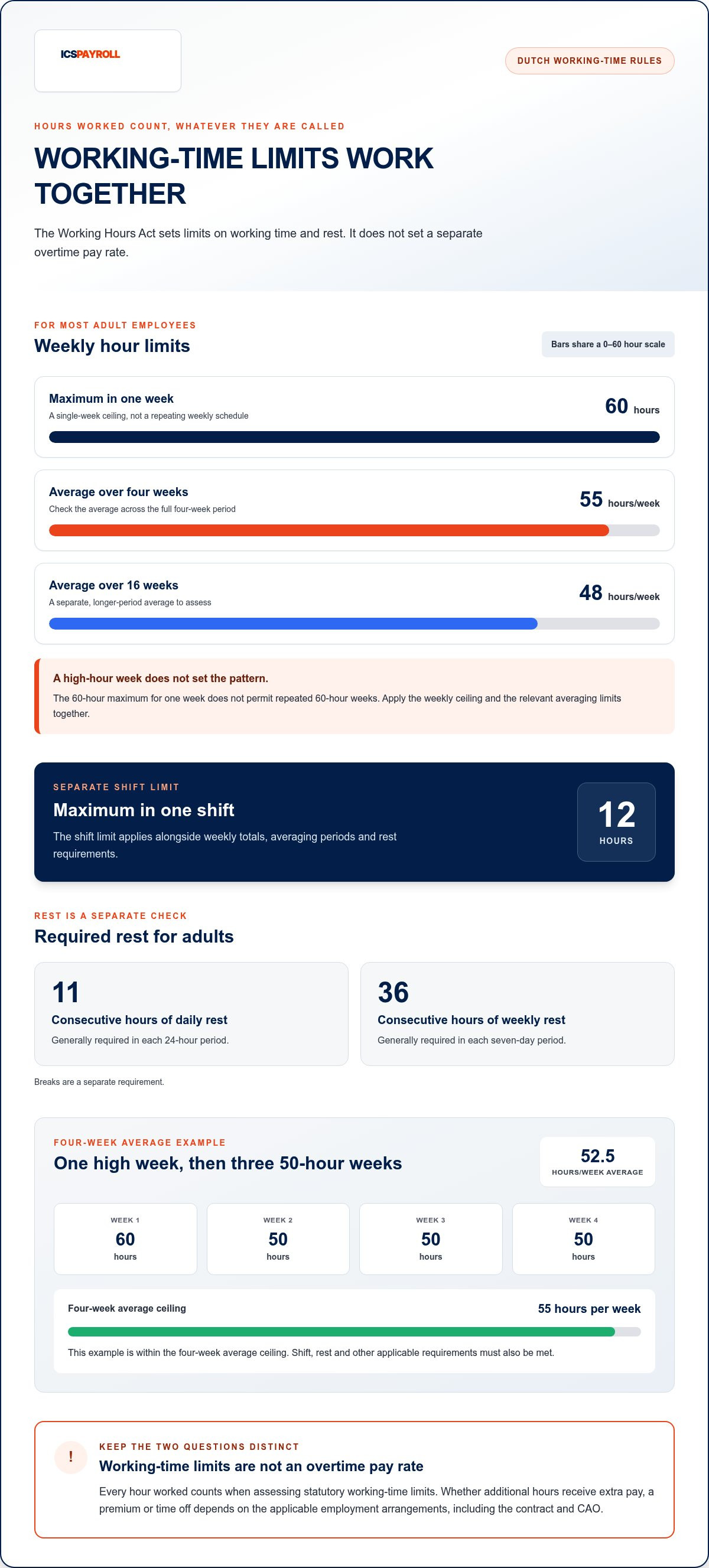
For most adult employees, the current limits are set out in the Dutch government’s guidance on working hours and rest times. The maximum for a single shift or week does not permit employers to maintain that pattern indefinitely. Average limits and required rest still apply.
| Working-time measure | Adult limit |
|---|---|
| Maximum in one shift | 12 hours |
| Maximum in one week | 60 hours |
| Average over four weeks | 55 hours per week |
| Average over 16 weeks | 48 hours per week |
Daily, weekly, and averaging-period limits
Apply the figures together. An employee may work up to 60 hours in a particular week, but that does not make repeated 60-hour weeks compliant. For example, one 60-hour week followed by three 50-hour weeks gives a four-week average of 52.5 hours per week. That is within the four-week average ceiling, provided shift, rest and other applicable requirements are also met.
The 16-week average is a separate check. A schedule that passes the four-week calculation can still exceed the longer-period limit if high-hour weeks continue. Review actual hours across both periods, not just the roster for the coming week. A quieter week later does not remove the need to meet each applicable average over its relevant period.
Rest periods, breaks, and scope of the Act
Under the same government guidance, adult employees generally must receive at least 11 consecutive hours of daily rest in each 24-hour period. Weekly rest is generally at least 36 consecutive hours in each seven-day period. Breaks are a separate requirement: an employee working more than 5.5 hours is generally entitled to a break of at least 30 minutes. The guidance sets out the detailed conditions and exceptions.
Monitor rest and break compliance alongside working hours, but remember that neither determines the overtime payment rate. The official guidance also describes exceptions and rules for specific work and worker categories. Don’t assume an exception applies based only on a job title or industry. Confirm the relevant category and conditions in the official guidance before relying on a different limit.
A reliable review pairs the roster with recorded hours, checks daily and weekly totals, and tracks both averaging periods. When agreed extra hours are processed through Dutch payroll, payroll administration for Dutch employers can support accurate handling. Payroll processing complements clear agreements and complete time records, but it doesn’t replace working-time checks.
How Dutch Contracts and CAOs Determine Overtime Compensation
Once you’ve recorded the hours, identify the terms that govern compensation. The overtime pay rules in the netherlands are not set by one universal premium. Read the employee’s contract alongside the personnel handbook and any applicable collective labour agreement (CAO), then apply the relevant provisions consistently.
Start with the contract, then check whether a CAO applies to the employer, sector and role. Read its scope and overtime provisions. A handbook may explain how the organisation handles approval or time recording, but it should be read in context with the contract and CAO. If provisions appear inconsistent, resolve how they relate before calculating or promising compensation.
Which document sets the overtime arrangement?
Use the documents to establish who qualifies for overtime compensation, whether prior approval is required, how hours are counted, and how compensation is delivered. The applicable CAO may contain relevant terms, so identify its coverage rather than assuming every employee in a sector has identical conditions. Record the conclusion for each role or employee group, especially where arrangements differ.
| Source | What to check | Employer action |
|---|---|---|
| Employment contract | Agreed working hours, overtime eligibility, approval requirements and compensation terms | Use it as the employee-specific starting point and compare it with other applicable documents. |
| Personnel handbook | Operational rules for requests, authorisation, time recording and claims | Keep procedures aligned with the contract and CAO, and communicate updates clearly. |
| Applicable CAO | Coverage, definitions, rates or time-off arrangements, thresholds and calculation procedures | Confirm that it applies to the role and follow its terms alongside the individual agreement. |
| Established workplace practice | How extra hours have been requested, accepted and compensated in practice | Review patterns and communications as evidence, not as automatic proof of a universal entitlement. |
Consistent practice matters. If managers regularly request extra hours and employees reasonably understand that a particular arrangement applies, those facts may be relevant when interpreting the employment relationship. That does not make every repeated practice an automatic entitlement. Review the circumstances, written terms and communications, and document any agreed policy so employees and managers have a shared reference.
Money, time off, and part-time additional hours
Where the governing terms allow it, compensation may be additional pay, time off in lieu, or another documented method. Don’t assume a familiar premium or standard conversion applies. Follow the agreement’s calculation method, including its thresholds and approval rules. For part-time employees, hours above the individual schedule may be treated differently from hours beyond a full-time norm. Check the relevant terms before classifying or compensating those hours.
Payroll should also verify that total pay for hours worked meets the applicable minimum-wage requirements. Keep the calculation with its supporting time records. Clear terms reduce disputes, while accurate payroll administration helps apply those terms consistently. Dutch payroll administration can support processing agreed overtime, but it cannot replace clear agreements or complete records.
A Practical Employer Process for Approving, Recording, and Paying Overtime
A dependable overtime process connects three records: the employee’s agreed terms, the hours actually worked, and the compensation entered for payroll. The overtime pay rules in the netherlands depend on the applicable arrangements, so managers should know how extra work will be recorded and handled before approving it.
Set a clear overtime approval and recording process
Use a consistent sequence for each request. This clarifies responsibilities and helps managers identify scheduling concerns before extra hours are worked.
- Review the employee’s terms. Confirm the contracted schedule and overtime provisions in the relevant contract, handbook and applicable CAO. Identify the authorised approver and compensation route before a request is made.
- Assess the proposed schedule. Compare scheduled and recorded hours with the Working Hours Act limits, including applicable daily, weekly and averaging-period requirements. Consider the employee’s recent hours, not only the proposed shift.
- Approve the request in advance. Have the designated manager document the reason, expected dates and hours, and any limits on the approval. If the work changes, update the approval rather than relying on an informal assumption.
- Record actual time worked. Require employees to enter the date, start and finish times, and any relevant break information in the organisation’s chosen record. The manager should review and approve the submitted hours against the schedule.
- Flag exceptions for review. Escalate unapproved hours, discrepancies or schedules that approach a statutory limit. Keep the decision and any correction with the time record so the reason for the payroll treatment is traceable.
For example, if an employee works later than the manager approved, record the actual hours rather than changing the entry to match the original request. The manager can then review the difference, assess its working-time impact and determine the appropriate treatment under the applicable terms.
Check payroll treatment before each pay run
Before payroll closes, reconcile the approved time record with the employee’s contract, handbook or CAO. Confirm that the recorded hours meet the relevant definition and that the documented compensation method is applied correctly. If the arrangement provides time off instead of additional pay, record the hours and resulting time-off balance clearly. Don’t silently substitute one method for another.
Keep an audit trail connecting the request, approval, time entry, manager review and payroll result. Resolve missing approvals or mismatches before finalising the pay run, and document any correction. Payroll administration can support accurate processing of agreed overtime, but it doesn’t decide disputed contractual rights or replace a review of the governing terms.
Employer control sequence: review the applicable terms, assess the proposed hours, approve and record actual time, reconcile it to the compensation method, then process payroll with supporting records.
For support processing agreed overtime alongside salary and other payroll items, use Dutch payroll administration for your business.
Choose a Dutch Payroll or EOR Route for Reliable Overtime Administration
Your payroll operating model determines who processes wages and who employs the worker. It doesn’t change the applicable working-time limits or remove the need for clear overtime terms, accurate hour records and a consistent approval process. Those controls remain essential under either route.
When Dutch Payroll or EOR may fit
Dutch Payroll may suit a company with an existing Dutch entity, such as a BV or branch, that remains the legal employer and needs payroll administration. ICS Payroll processes payroll, while the company retains its employer role and responsibility for setting and communicating employment arrangements.
EOR or Full Payrolling may suit a business that needs a legal employer in the Netherlands. For EU/EEA and Dutch-resident hires, ICS Staffing & Payroll B.V. is the legal employer. For non-EU hires, immigration sponsorship is arranged via our licensed partner, which is the legal employer. The operating model changes, but it does not create a different overtime premium or override the Working Hours Act, a valid CAO or the agreed employment terms.
- Choose Dutch Payroll when your Dutch entity employs the worker and needs support processing salary and related payroll administration.
- Consider EOR or Full Payrolling when you need a legal employer for a Dutch-based hire.
- In either case, establish how overtime is approved, recorded and compensated, and ensure managers provide complete and accurate time information.
Payroll processing is an operational control, not a substitute for deciding which employment terms apply. Before overtime reaches payroll, the arrangement should be clear to the employee and to the managers who approve extra hours. That reduces the risk of inconsistent treatment across teams or pay periods.
What an employer can expect from ICSPayroll
ICSPayroll provides an upfront Total Cost of Employment and a single monthly fee covering payroll, taxes, insurances and service. A fixed team gives employers direct access to payroll and HR specialists for support with salary, taxes, social premiums, pension, holiday allowance and HR matters. Agreed overtime can be processed as part of payroll administration when the employer supplies the applicable terms and approved hours.
Onboarding timelines depend on the route: employment contracts are ready in two to five working days for payrolling and three to five days for EOR. A quotation is provided within two working days after receiving headcount and salary details. To support a useful quotation, prepare the number of employees and their salary details, then explain whether your company has a Dutch entity and whether it will remain the legal employer.
For help assessing the right setup and administering agreed overtime, discuss Dutch payroll and employment compliance with ICSPayroll.
Put a Consistent Overtime Framework Into Practice
Use your next planning cycle to make overtime controls part of routine workforce management. Assign responsibility for reviewing overtime arrangements, identify where teams need clearer guidance, and check that managers follow the same process when workloads change. A consistent approach helps prevent informal habits from becoming difficult-to-reconcile payroll entries.
The overtime pay rules in the netherlands are easier to administer when the employment model, documented terms and payroll workflow work together. If your organisation is reviewing how Dutch employees are engaged or how payroll is managed, ICSPayroll can help assess the operational fit. Explore payroll support for your Dutch workforce with ICSPayroll and take the next step toward a process your teams can apply with confidence.
Frequently Asked Questions
Is overtime pay taxed differently in the Netherlands?
Generally, no. Overtime pay is handled through payroll as employment income, not under a separate overtime tax rate. The Belastingdienst explains how employment income is taxed; an employee’s final tax position depends on their circumstances and assessment. Tax withholding doesn’t determine whether overtime is owed. Entitlement to compensation, and whether it is paid or taken as time off, is a separate matter under the applicable contract or CAO.
Can an employee refuse to work overtime in the Netherlands?
An employee’s ability to refuse depends on the applicable agreement, the circumstances and whether the request is reasonable. There isn’t a universal answer for every role. The overtime pay rules in the Netherlands don’t, by themselves, settle whether a particular instruction must be accepted. Employers should review the contract and CAO, consider the reason for and notice given with the request, and seek case-specific employment advice before treating a refusal as misconduct or imposing a consequence.
Do overtime rules apply to employees who work remotely from the Netherlands?
Remote work from within the Netherlands doesn’t, by itself, remove the need to assess Dutch employment and working-time obligations. For example, an employee working from home may still need actual hours recorded so the employer can review the schedule. Identify the employing entity and applicable employment arrangement. If the employee works across borders, verify the relevant working-time and tax details against current official guidance rather than assuming one country’s rules apply to every aspect.
Are managers automatically exempt from overtime rules in the Netherlands?
No. A manager’s job title or seniority alone doesn’t establish an exemption from working-time limits or the employee’s overtime arrangements. Employers should assess the person’s actual employment status and duties, then identify which rules and agreements apply. If relying on a possible exception, check its conditions in official guidance instead of assuming managerial responsibility is enough. Don’t use an invented salary threshold or title-based rule to decide whether hours should be recorded.
Does travel time count as overtime in the Netherlands?
It depends on the type of journey, the employee’s working arrangement and the applicable terms. Commuting and travel between work locations may raise different questions, so don’t classify all travel time as automatically included or excluded. Before calculating working time or compensation, review the contract and CAO, identify the journey involved, and check current official guidance. Keep the classification consistent in time records, and document the reasoning where a travel arrangement is recurring.
Do Dutch overtime rules apply to temporary agency workers?
The applicable employment arrangement and collective labour agreement can affect how an agency worker’s hours and compensation are handled. Agency status alone doesn’t establish one universal overtime rate. Identify the worker’s contract and the CAO that governs the specific arrangement, then ensure actual hours are recorded and reviewed against those terms. If the applicable rules are unclear, consult current official guidance before payroll processing, particularly where the worker’s schedule or assignment changes.

Article by
Joost Hubregtse
Joost Hubregtse is Director of ICS Staffing & Payroll B.V., the wholly owned subsidiary of Intercompany Solutions behind ICS Payroll. He is responsible for Employer of Record and Dutch payroll services: employment contracts, wage tax and social security filings, holiday allowance, pension, sick leave and CAO compliance, with onboarding possible within 48 hours.
Frequently Asked Questions
Contractual hours are the working hours agreed for the role. Additional hours are hours worked beyond an employee’s agreed schedule. Overtime is a term whose meaning and consequences may be set out in a contract, personnel handbook or applicable collective labour agreement (CAO). These labels are not interchangeable, and there is no single definition that applies identically across every sector and arrangement. A part-time employee who works beyond their contracted schedule may have additional hours without those hours being treated as overtime under the relevant terms. The full-time threshold can matter: a CAO or other applicable agreement may distinguish extra hours up to the normal full-time schedule from hours beyond it. Check the definitions that apply to the employment relationship before calculating a premium or time off.
No general statutory rule requires employers to pay a specific overtime premium, such as time-and-a-half. The contract and applicable CAO are key references for whether overtime is compensated and how. Depending on those terms, agreed compensation may take the form of additional pay, paid time off in lieu, or another documented arrangement. Don’t assume a premium applies simply because work took place outside an employee’s usual schedule. Review the relevant CAO text alongside the contract and handbook, including rules on eligibility, approval and calculation. If the documents use different definitions or appear inconsistent, resolve that before processing the hours. Clear written terms help managers apply compensation consistently and help payroll distinguish ordinary scheduled hours, additional hours and overtime from statutory working-time limits. The Working Hours Act sets boundaries for working time, not a separate allowance for overtime. Every hour worked counts when assessing those boundaries, whether it falls within contractual hours or is additional work. Assess the employee’s full working pattern instead of treating overtime as hours outside the statutory calculation. For most adult employees, the current limits are set out in the Dutch government’s guidance on working hours and rest times. The maximum for a single shift or week does not permit employers to maintain that pattern indefinitely. Average limits and required rest still apply.
Use the documents to establish who qualifies for overtime compensation, whether prior approval is required, how hours are counted, and how compensation is delivered. The applicable CAO may contain relevant terms, so identify its coverage rather than assuming every employee in a sector has identical conditions. Record the conclusion for each role or employee group, especially where arrangements differ. Consistent practice matters. If managers regularly request extra hours and employees reasonably understand that a particular arrangement applies, those facts may be relevant when interpreting the employment relationship. That does not make every repeated practice an automatic entitlement. Review the circumstances, written terms and communications, and document any agreed policy so employees and managers have a shared reference.
Generally, no. Overtime pay is handled through payroll as employment income, not under a separate overtime tax rate. The Belastingdienst explains how employment income is taxed; an employee’s final tax position depends on their circumstances and assessment. Tax withholding doesn’t determine whether overtime is owed. Entitlement to compensation, and whether it is paid or taken as time off, is a separate matter under the applicable contract or CAO.
An employee’s ability to refuse depends on the applicable agreement, the circumstances and whether the request is reasonable. There isn’t a universal answer for every role. The overtime pay rules in the Netherlands don’t, by themselves, settle whether a particular instruction must be accepted. Employers should review the contract and CAO, consider the reason for and notice given with the request, and seek case-specific employment advice before treating a refusal as misconduct or imposing a consequence.
Remote work from within the Netherlands doesn’t, by itself, remove the need to assess Dutch employment and working-time obligations. For example, an employee working from home may still need actual hours recorded so the employer can review the schedule. Identify the employing entity and applicable employment arrangement. If the employee works across borders, verify the relevant working-time and tax details against current official guidance rather than assuming one country’s rules apply to every aspect.
No. A manager’s job title or seniority alone doesn’t establish an exemption from working-time limits or the employee’s overtime arrangements. Employers should assess the person’s actual employment status and duties, then identify which rules and agreements apply. If relying on a possible exception, check its conditions in official guidance instead of assuming managerial responsibility is enough. Don’t use an invented salary threshold or title-based rule to decide whether hours should be recorded.
It depends on the type of journey, the employee’s working arrangement and the applicable terms. Commuting and travel between work locations may raise different questions, so don’t classify all travel time as automatically included or excluded. Before calculating working time or compensation, review the contract and CAO, identify the journey involved, and check current official guidance. Keep the classification consistent in time records, and document the reasoning where a travel arrangement is recurring.
The applicable employment arrangement and collective labour agreement can affect how an agency worker’s hours and compensation are handled. Agency status alone doesn’t establish one universal overtime rate. Identify the worker’s contract and the CAO that governs the specific arrangement, then ensure actual hours are recorded and reviewed against those terms. If the applicable rules are unclear, consult current official guidance before payroll processing, particularly where the worker’s schedule or assignment changes.