
Mandatory Information in a Dutch Employment Contract: 2026 Checklist
By Joost Hubregtse, Director, ICS Staffing & Payroll
All blog posts are reviewed and fact checked by our labour law lawyer Zishan Hussain and our director. Editorial standards
A signed employment contract can still leave an employer uncertain about what must be provided in writing. The mandatory information in a dutch employment contract is not always the same as every clause worth including, and the distinction matters when you’re hiring in the Netherlands.
It’s reasonable to expect one complete document to cover everything. In practice, some written particulars may be provided separately, while other terms depend on the contract type, working pattern or applicable collective labour agreement (CAO). An English-language template may not address each Dutch requirement.
This 2026 checklist clarifies which core particulars to include or communicate separately, which clauses are conditional, and how to distinguish written-information requirements from broader employer duties. It also explains how to align contract preparation with payroll and ongoing employment administration. Whether you’re hiring through a Dutch entity or using an Employer of Record, the aim is the same: clear terms, accurate records and a compliant process from the start.
Key Takeaways
- Use the checklist to identify the key written particulars, from the parties’ details and role to working hours and pay.
- Understand how mandatory information in a dutch employment contract differs from rights that apply by law, even when they are not written into the agreement.
- Check which clauses depend on contract type and duration. Probation rules vary, and contracts of six months or less cannot include a probation period.
- Before issuing the contract, align its terms with the employee’s actual role, working pattern, applicable CAO and payroll setup.
- Match the hiring arrangement to your business structure: EOR can suit companies without a Dutch entity, while Payroll Administration supports an existing Dutch employer.
What Counts as Mandatory Information in a Dutch Employment Contract?
A Dutch employment contract records the arrangements between an employer and an employee, but the signed document is only part of the compliance picture. Under Article 7:655 of the Dutch Civil Code, employers must provide employees with specified employment information in writing or electronically. The general deadline is within one month after the employee starts work. An employment agreement can also be valid without a single signed written contract, but that does not remove the employer’s duty to provide the required particulars.
This distinction matters in practice. A draft may contain detailed terms yet still leave a required particular out, or provide the information in a separate written document. For the employer, a clear record supports consistent contract administration and payroll setup. For the employee, it makes essential arrangements easier to understand and refer to.
What makes an agreement an employment contract?
The document’s title does not, by itself, settle the nature of the working relationship. Calling an arrangement a consultancy agreement, for example, does not automatically determine its legal status. The way the parties work together and the specific circumstances matter. A contract’s label, template or language should therefore not be treated as a substitute for assessing the actual arrangement and its legal consequences.
Keep that assessment separate from the written-information duty. The agreement sets out the parties’ terms; Article 7:655 requires the employer to communicate specified particulars in writing. A written contract is a practical way to record them, but some information may be supplied separately in writing or electronically where permitted. Keep the documents together and make clear which employment they relate to.
Mandatory particulars versus wider employment obligations
This guide uses one distinction throughout: particulars that must be communicated in writing, and rights or duties that apply under employment law whether or not the contract repeats them. Salary is a written-information item, so the employee should be able to identify the agreed pay and relevant payment details from the contract or accompanying written information.
Statutory rights work differently. For example, sick-pay and leave protections may apply by law independently of whether every detail appears in the contract. A contract should not imply that an employee loses a statutory right because it was omitted from the document. Equally, listing a right in the contract does not replace the employer’s wider responsibility to apply the law correctly.
The checklist that follows focuses on the mandatory information in a dutch employment contract and the written particulars that may accompany it. It is designed for employers hiring in the Netherlands in 2026, including those using English-language templates. The legal references and deadlines should be verified against current official Dutch guidance before a contract is issued. Treat the checklist as a structured review, not as a substitute for assessing the specific employment arrangement or any applicable collective labour agreement.
The Core Dutch Employment Contract Information Checklist
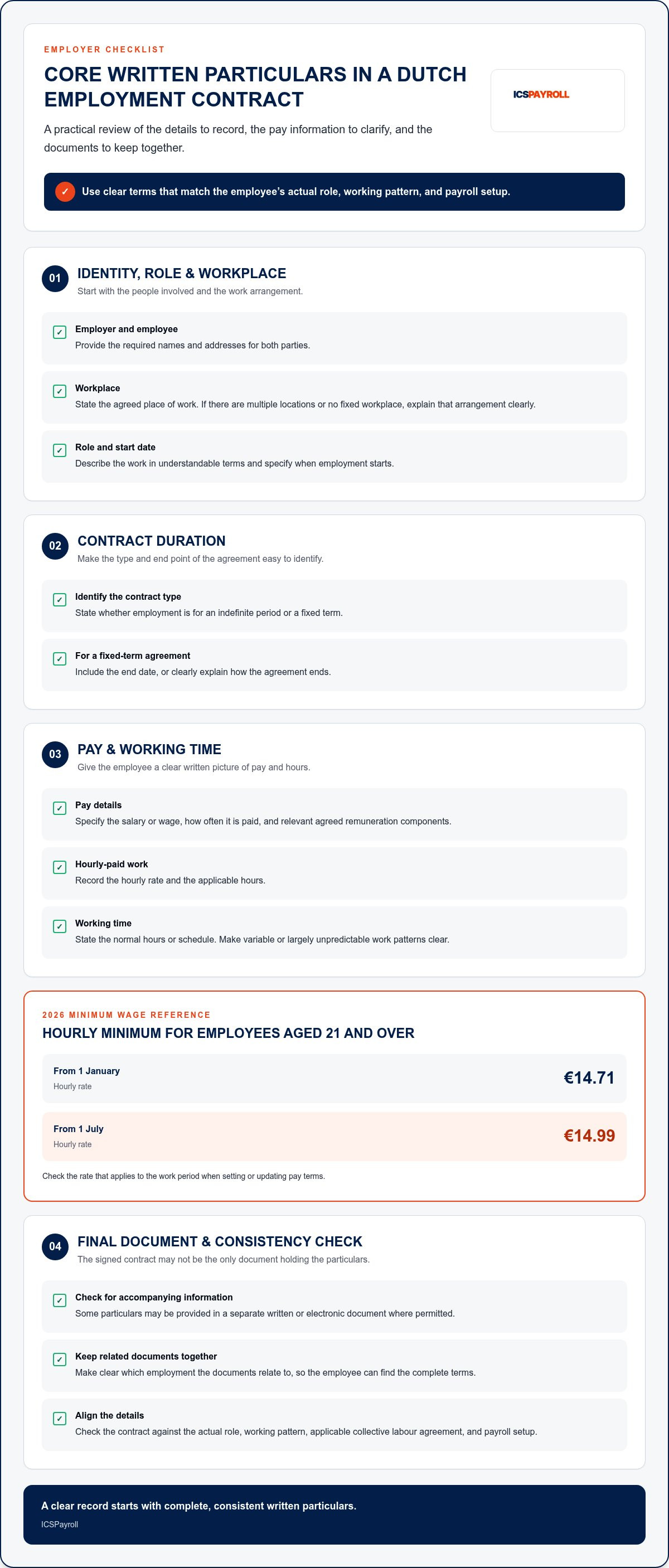
Use this checklist to review the written particulars for each hire. Article 7:655 of the Dutch Civil Code sets out information employers must provide; the required detail can vary with the working arrangement. The information may appear in the contract or, where permitted, in a separate written or electronic document. Keep any supporting documents with the contract so the employee can readily find the complete terms.
Identity, role, workplace, and contract duration
Start with the parties and the basic employment details. Use clear, consistent information that can be matched to onboarding and payroll records. A job title alone may not explain the work, so describe the role or duties in terms the employee can understand.
- Employer and employee: Identify both parties and provide the required names and addresses.
- Workplace: State the agreed place of work. If the role involves multiple locations or no fixed workplace, describe that arrangement clearly.
- Role and start date: Describe the work and specify the employment start date.
- Contract duration: State whether employment is for an indefinite or fixed term. For a fixed-term agreement, include the end date or clearly state how the agreement ends.
Pay, hours, leave, and applicable conditions
Next, check the terms that determine what the employee receives and when they work. The written particulars should let the employee understand the basis of pay and working time, rather than relying on assumptions or an informal discussion.
- Pay: Specify the salary or wage, payment frequency and relevant agreed remuneration components. For hourly-paid employees, record the hourly rate and the applicable hours.
- Minimum wage: For employees aged 21 and over, check that the rate meets the statutory minimum. In 2026, the hourly minimum is €14.71 from 1 January and €14.99 from 1 July. Use the rate applicable to the work period and check official Dutch minimum-wage guidance before issuing or updating pay terms.
- Working time: State the normal hours or schedule. If the work pattern is variable or largely unpredictable, provide the applicable information on reference days and hours, notice for work and any guaranteed paid hours, as required for that arrangement.
- Leave and holiday allowance: State the annual leave entitlement or how it is calculated. The statutory minimum holiday allowance is 8%, subject to applicable rules and exceptions; make clear how it is treated in the employee’s remuneration. Verify the holiday allowance requirements and statutory holiday entitlement against current government guidance.
- Notice and applicable terms: Include the required notice-period information and identify any applicable collective labour agreement (CAO). Verify the CAO’s current terms, including pay scales, hours, leave and allowances, against the agreement that applies to the employer and role.
- Training and social security: Include the required information on employer-provided or legally required training and the social-security institution receiving contributions, where applicable.
Use these entries to make the mandatory information in a dutch employment contract specific to the employee, not just complete on paper. Aligning contract particulars with Dutch payroll administration helps keep agreed pay, hours and allowances consistent from the start.
ICSPayroll supports employers with Dutch employment contracts and payroll administration, helping connect written terms with payroll setup.
Which Dutch Contract Clauses Depend on the Hiring Arrangement?
Some contract terms depend on the duration of employment, the employee’s working arrangement or an applicable collective labour agreement (CAO). Review these terms separately from the core written particulars. The comparison below summarises the main duration and probation distinctions; confirm the specific clause against the current rules before issuing the agreement.
| Contract point | Indefinite agreement | Fixed-term agreement |
|---|---|---|
| Duration | Employment has no agreed end date. | Record the agreed end date or the event that ends the agreement. |
| Ending the contract | Include applicable notice-period information and procedure. | Record the end date and any applicable notice or early-termination terms. The correct procedure depends on the circumstances. |
| Probation | A probation period may be agreed for up to two months. | No probation period is allowed for a term of six months or less. For a term from six months through 24 months, the maximum is one month. Check the rules for other fixed-term durations before adding a clause. |
Fixed-term and indefinite contracts, probation, and notice
Probation is optional, not an automatic feature of either contract type. The Dutch Civil Code rules on probation periods set conditions on duration and form. The clause must be agreed in writing and comply with the applicable limit. Check the contract’s exact term and any relevant CAO before relying on it. A clause that does not meet the legal conditions may be invalid.
For fixed-term agreements, also check whether the employer must notify the employee about continuation before the end date. Do not assume the end date alone resolves every duty related to the contract ending.
CAOs, training, pension, and restrictive clauses
An applicable CAO can set or supplement terms such as pay scales, hours, leave and notice. Identify the agreement that applies and compare its current provisions with the draft. Pension terms depend on the relevant arrangement, while training information should reflect the employee’s role and applicable employer obligations. These terms should be checked for the specific employment relationship rather than copied automatically into every contract.
Restrictions also need careful review. An ancillary-work clause is subject to legal conditions, and a non-compete clause in a fixed-term agreement requires a written explanation of compelling business interests under the Dutch Civil Code rules on non-compete clauses. The proposed non-compete reform is not current law. As of 29 June 2026, the bill was at the Council of State for advice; apply the existing rules unless and until legislation changes.
Separate conditional clauses from the mandatory written particulars. This helps ensure each term is included for a reason and fits the employee’s actual hiring arrangement.
How to Review a Dutch Employment Contract Before It Is Issued
A structured review catches mismatches before contract terms flow into onboarding and payroll. Work through the checks in order, record any corrections, and confirm that the final version reflects the employee’s real arrangement. This process helps turn the written particulars into usable information, not just completed fields in a template.
A practical five-step contract review
- Confirm the employment details. Check the employer and employee information, role, workplace, start date and contract type. Confirm that the stated duties match the position the employee will actually perform.
- Validate the working arrangement. Compare the contract’s hours and schedule with the hiring plan. If work is variable or unpredictable, check that the written terms describe the arrangement accurately rather than presenting a fixed schedule the role won’t follow.
- Review pay and leave particulars. Match salary or hourly pay, payment frequency, agreed remuneration components, holiday allowance and leave terms against the approved offer. Check calculations and terminology, especially if the employee’s pay is made up of more than one component.
- Check applicable and conditional terms. Establish whether a CAO applies and compare the contract against its relevant provisions. Review clauses on probation, notice, training, pension or restrictions against the employee’s contract type and actual circumstances. Don’t carry over a clause from another template without checking that it fits.
- Reconcile the contract with payroll. Compare the final salary, working hours, start date and allowances with the payroll setup. Resolve differences before onboarding so the agreed terms and payroll records use the same information.
For legal or financial details that may change, confirm the current rule and figure against official Dutch government guidance before approving the document. This is particularly important when using a template prepared for another country: familiar wording may not match the Dutch arrangement or applicable CAO.
Correcting gaps and documenting the final version
When a review finds an omission or inconsistency, identify the exact field or clause that needs correction and assign responsibility for updating it. For example, if the contract describes a weekly schedule but the payroll setup uses different hours, determine which record reflects the agreed arrangement before either is finalised. Keep a clear record of the approved correction.
Store the signed agreement with any separate written particulars provided to the employee. Use a consistent employee record so that HR and payroll teams can locate the complete set of terms and refer to the same final version. If the employee’s role or working pattern changes later, review whether the contract information and payroll setup need to be updated as well.
International employers can use an employment law guide for the Netherlands for broader compliance context, then align agreed salary terms with the Dutch payroll administration guide. For support preparing Dutch employment contracts and coordinating payroll administration, discuss your Dutch hiring and payroll requirements.
How EOR and Dutch Payroll Support Compliant Employment Contracts
A contract checklist only works if its terms match the hiring structure behind it. The legal employer, payroll responsibilities and onboarding process should be clear before the employee starts. For international companies hiring in the Netherlands, the choice often comes down to whether the company already has a Dutch entity and who will employ the worker.
Choose the employment route that matches your entity status
Employer of Record (EOR) can support a company hiring in the Netherlands without its own Dutch legal entity. Under this arrangement, ICS becomes the legal employer and prepares the employment contract, while the client directs the employee’s day-to-day work. The contract and payroll process should reflect this allocation of responsibilities.
Dutch Payroll Administration is for a company with an existing Dutch entity that remains the legal employer. Payroll administration supports the employer’s processing and compliance requirements, but does not change who employs the worker. Full Payrolling is distinct: ICS becomes the legal employer. Confirming the structure at the outset helps ensure the contract names the right employer and that payroll records reflect the same arrangement.
Companies assessing the first route can review how an Employer of Record in the Netherlands fits their hiring setup. The decision should be made before contract preparation, not after the employee’s details have already been entered into payroll.
Move from contract checklist to onboarding
Once the employment route is selected, contract preparation can be coordinated with payroll onboarding. EOR contracts are prepared in 3-5 days; payrolling contracts are prepared in 2-5 working days. A quotation is provided within 2 working days after receiving headcount and salary details. These timelines help employers plan the process, but they don’t replace the need to supply accurate role, salary, working-time and start-date information.
Contract preparation and payroll setup should use the same approved terms. For example, the agreed salary, payment frequency, working hours and holiday allowance need to be carried through consistently. Where an applicable CAO or a particular work pattern affects the terms, those details should also inform onboarding and ongoing HR administration. This alignment reduces the risk of a contract promising one arrangement while payroll is configured for another.
For eligible employees, 30% Ruling Application support can form part of the broader payroll process. The ruling is granted by the Belastingdienst, and immigration sponsorship is arranged via our licensed partner. Immigration sponsorship does not establish eligibility for the 30% ruling; these are separate matters.
When the mandatory information in a dutch employment contract is prepared alongside payroll and HR administration, employers have a clearer route from agreed terms to a working employment setup. Discuss compliant hiring in the Netherlands to review the employment and payroll route for your organisation.
Build a repeatable Dutch hiring process
Treat the contract as one part of a consistent hiring workflow, not a document to complete and file away. A reliable process for checking the mandatory information in a dutch employment contract can give hiring, HR and payroll teams a shared reference point. Record who approves the terms, which version is final and where supporting documents are stored.
Keep that process useful as the role or working arrangement evolves. When responsibilities, hours or other agreed terms change, route updates through the same review and recordkeeping steps. A clear handover helps teams keep employment documents and payroll information aligned, while making ownership easier to follow across an international organisation.
Whether your next step is selecting an employment route or improving your contract review process, ICSPayroll can support Dutch hiring and payroll administration. Plan your Dutch employment setup and move forward with greater clarity and confidence.
Frequently Asked Questions
Does a Dutch employment contract have to be in writing?
No. An employment agreement can be valid even if the parties have not signed one written contract. The employer must still provide the legally required employment particulars in writing or electronically within the applicable deadline. A written, signed agreement is the clearest way to document what was agreed and avoid disputes about terms such as pay, hours or the role. Keep any separate written particulars with the contract.
Can an employment contract in the Netherlands be written in English?
Yes, an employment contract may be prepared in English. The language doesn’t remove the employer’s duty to provide the required information, and the terms should be clear to the employee who must rely on them. Check that English wording accurately reflects Dutch employment rules and any applicable collective labour agreement (CAO). For example, translating a Dutch clause word for word may not explain how a Dutch-specific term operates in practice.
When must an employer provide written information about employment conditions?
The employer generally must provide the required particulars within one month after the employee starts work. They can be included in the employment contract or supplied in a separate written or electronic document where allowed. Set a deadline during onboarding rather than waiting for an employee to request missing details. For a start date of 1 September, for example, schedule a check that the required information has been delivered by the end of September.
Does a collective labour agreement override terms in an individual Dutch employment contract?
If a CAO applies to the employment relationship, its terms may be binding and can take precedence over conflicting individual contract terms. The outcome depends on how the CAO applies and the subject of the clause. An individual agreement may sometimes provide a more favourable term, but don’t assume that every contract variation is permitted. Check the CAO’s scope, current text and relevant provisions before finalising the employee’s terms.
Is a probation period mandatory in a Dutch employment contract?
No. A probation period is optional, not a standard term that must appear in every agreement. If the parties include one, it must comply with the rules for that contract type and duration and be agreed in writing. For example, the 2026 fact sheet allows no probation period for a fixed-term contract of six months or less. A clause that doesn’t meet the legal conditions may be invalid, so verify the specific arrangement.
What happens if a Dutch employment contract leaves out required information?
An omission doesn’t automatically make the entire employment agreement invalid, but the employer may still need to provide the missing particulars in writing. The gap can also create uncertainty about what was agreed, especially if payroll records, correspondence and the contract don’t match. Identify the missing item, provide a clear written correction or supplementary document, and retain it with the employee’s records. The consequences depend on the information omitted and the circumstances.
Can an employer change the terms of a Dutch employment contract after signing?
Usually, an employer can’t simply change an agreed term without a legal basis. A change may be made by mutual agreement, or in limited circumstances under a valid unilateral-change clause and applicable legal conditions. For example, changing agreed working hours is different from correcting an administrative error in an address. Put agreed amendments in writing, explain what changes and when, and check whether a CAO or statutory rule affects the change.

Article by
Joost Hubregtse
Joost Hubregtse is Director of ICS Staffing & Payroll B.V., the wholly owned subsidiary of Intercompany Solutions behind ICS Payroll. He is responsible for Employer of Record and Dutch payroll services: employment contracts, wage tax and social security filings, holiday allowance, pension, sick leave and CAO compliance, with onboarding possible within 48 hours.
Frequently Asked Questions
The document’s title does not, by itself, settle the nature of the working relationship. Calling an arrangement a consultancy agreement, for example, does not automatically determine its legal status. The way the parties work together and the specific circumstances matter. A contract’s label, template or language should therefore not be treated as a substitute for assessing the actual arrangement and its legal consequences. Keep that assessment separate from the written-information duty. The agreement sets out the parties’ terms; Article 7:655 requires the employer to communicate specified particulars in writing. A written contract is a practical way to record them, but some information may be supplied separately in writing or electronically where permitted. Keep the documents together and make clear which employment they relate to.
No. An employment agreement can be valid even if the parties have not signed one written contract. The employer must still provide the legally required employment particulars in writing or electronically within the applicable deadline. A written, signed agreement is the clearest way to document what was agreed and avoid disputes about terms such as pay, hours or the role. Keep any separate written particulars with the contract.
Yes, an employment contract may be prepared in English. The language doesn’t remove the employer’s duty to provide the required information, and the terms should be clear to the employee who must rely on them. Check that English wording accurately reflects Dutch employment rules and any applicable collective labour agreement (CAO). For example, translating a Dutch clause word for word may not explain how a Dutch-specific term operates in practice.
The employer generally must provide the required particulars within one month after the employee starts work. They can be included in the employment contract or supplied in a separate written or electronic document where allowed. Set a deadline during onboarding rather than waiting for an employee to request missing details. For a start date of 1 September, for example, schedule a check that the required information has been delivered by the end of September.
If a CAO applies to the employment relationship, its terms may be binding and can take precedence over conflicting individual contract terms. The outcome depends on how the CAO applies and the subject of the clause. An individual agreement may sometimes provide a more favourable term, but don’t assume that every contract variation is permitted. Check the CAO’s scope, current text and relevant provisions before finalising the employee’s terms.
No. A probation period is optional, not a standard term that must appear in every agreement. If the parties include one, it must comply with the rules for that contract type and duration and be agreed in writing. For example, the 2026 fact sheet allows no probation period for a fixed-term contract of six months or less. A clause that doesn’t meet the legal conditions may be invalid, so verify the specific arrangement.
An omission doesn’t automatically make the entire employment agreement invalid, but the employer may still need to provide the missing particulars in writing. The gap can also create uncertainty about what was agreed, especially if payroll records, correspondence and the contract don’t match. Identify the missing item, provide a clear written correction or supplementary document, and retain it with the employee’s records. The consequences depend on the information omitted and the circumstances.
Usually, an employer can’t simply change an agreed term without a legal basis. A change may be made by mutual agreement, or in limited circumstances under a valid unilateral-change clause and applicable legal conditions. For example, changing agreed working hours is different from correcting an administrative error in an address. Put agreed amendments in writing, explain what changes and when, and check whether a CAO or statutory rule affects the change.