
Company car tax rules in the Netherlands: bijtelling and tax rates
By Joost Hubregtse, Director, ICS Staffing & Payroll
All blog posts are reviewed and fact checked by our labour law lawyer Zishan Hussain and our director. Editorial standards
A company car is not tax-free simply because it’s provided for work. Under the company car tax rules in the Netherlands, private use of no more than 500 kilometres per year generally means no bijtelling; otherwise, the addition is usually at least 22% of the tax basis for cars first registered on or after 1 January 2017. That addition is treated as taxable wages, so it affects payroll tax.
It’s understandable to focus on the percentage, but the calculation also depends on the car’s value, registration date and emissions. The key is to distinguish the taxable benefit from the tax ultimately payable on it.
This guide explains how bijtelling is calculated, when reduced rates apply to electric cars, how the benefit is handled in payroll, and what happens to the car when employment ends. It also covers how private-use limits and employee contributions affect the calculation, helping you manage company-car arrangements in the Netherlands.
Key Takeaways
- Private use of a company car up to 500 kilometres per year generally avoids bijtelling; above that threshold, the taxable addition usually applies.
- For qualifying zero-emission company cars in 2026, the reduced rate is 18% on the first €30,000 of catalogue value, with the standard rate applying above that amount.
- Bijtelling is added to taxable wages, so the employee’s tax depends on the taxable benefit and their applicable tax rate.
- When employment ends, the employee must return the company car; during the notice period, the right to use it generally continues.
- Clear payroll administration helps employers apply the correct company-car treatment and manage related Dutch tax obligations.
What is the private use addition (bijtelling) for a company car in the Netherlands?
Bijtelling is the taxable benefit added when an employer-provided car is used privately. Whether it applies depends on private kilometres, the vehicle’s tax classification and the evidence kept to support that classification.
Taxable Benefit for Private Use
When an employee uses an employer-provided car privately, the value of that use is generally added to taxable wages. The employer processes the addition through payroll, where it affects the employee’s taxable income and the employer’s payroll-tax calculation, according to the Dutch Tax and Customs Administration’s company-car guidance.
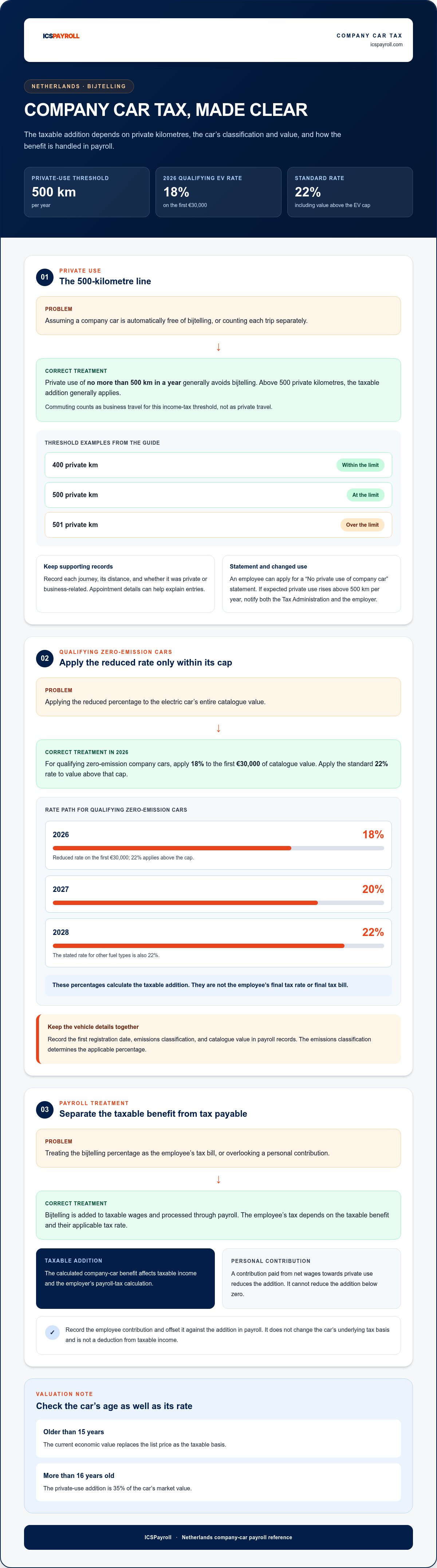
Private use of no more than 500 kilometres per year generally qualifies for an exemption from bijtelling. Commuting counts as business travel for company-car income-tax purposes, so it is not counted as private travel for this threshold. For instance, 400 private kilometres remains within the limit, while 501 exceeds it. The threshold applies to private journeys over the year, not to each trip separately.
Employees can apply to the Tax and Customs Administration for a “No private use of company car” statement. If circumstances change and expected private use rises above 500 kilometres per year, the employee must notify both the Administration and the employer. A statement does not remove the need to respond when the actual circumstances change.
To support a claim below the threshold, keep a mileage record that identifies each journey, its distance and whether it was private or business-related. Records such as appointment details can help explain entries. In specified circumstances, the Supreme Court ruled in 2017 that evidence other than a comprehensive mileage record may prove private use.
Personal Contributions and Bijtelling
A personal contribution is an amount an employee pays from net wages towards private use of a company car. The employer deducts it from the private-use addition, reducing the taxable benefit. The contribution cannot make the addition negative, so any amount exceeding the calculated benefit reduces it only to zero.
The employer should record the contribution and offset it against the addition in payroll. It does not change the car’s underlying tax basis or become a deduction from taxable income.
Tax Treatment Across Driver Types
Employees and company directors who receive a car through employment are generally assessed on private use as a taxable benefit. Self-employed people classify a car as a business or private asset for income-tax purposes, affecting which business expenses they may deduct.
A car’s income-tax classification may depend on whether it is used mainly for business or private purposes. A car used more for business than privately may also be a business asset when private use does not exceed 500 kilometres per year. Income-tax and VAT classifications can differ.
For VAT, commuting is treated as private travel, and deduction depends on kilometres used for taxable business turnover. The Tax and Customs Administration’s VAT guidance for company cars explains the separate treatment. Incorrect reporting can lead to an inaccurate taxable-income or VAT calculation and the need to correct the relevant returns.
Reduced tax rate for fully electric company cars
In 2026, qualifying zero-emission company cars receive an 18% bijtelling rate on the first €30,000 of catalogue value. The standard 22% rate applies above that cap and to other fuel types, according to the Dutch Tax and Customs Administration’s company-car guidance.
Reduced Bijtelling for Zero-Emission Cars
The reduced rate is a lower taxable addition for qualifying zero-emission cars, including fully electric vehicles. It changes the amount added to an employee’s income, not the vehicle’s list price or annual kilometres.
The rate varies by year: 18% in 2026, 20% in 2027 and 22% in 2028. The stated rate for other fuel types is 22%. These percentages are applied to calculate the taxable addition, not the employee’s final tax bill.
The vehicle’s emissions classification is central to choosing the applicable percentage. Employers should keep its first registration date and catalogue value in their records, then apply the relevant rate and cap for the year.
Rate Caps for Electric Company Cars
The cap limits the reduced rate to the first €30,000 of catalogue value; the standard rate applies to any value above it. This split means a higher-priced electric car does not receive the reduced percentage across its full list price.
That is the amount added to taxable income, not the employee’s tax payable.
Vehicle age also affects valuation. For a car older than 15 years, current economic value replaces list price as the taxable basis, according to the Tax and Customs Administration’s company-car guidance. Once a car is more than 16 years old, the private-use addition is 35% of its market value.
A company car is also remuneration in kind. Article 7:617 of the Dutch Civil Code recognises this form of remuneration, limited to its real value. This is relevant when considering the value of providing a vehicle, while bijtelling determines its tax treatment.
Keep the vehicle’s registration date, emissions classification and catalogue value together in the payroll records. Applying the cap separately from the standard-rate portion helps avoid applying the reduced percentage to the entire list price.
What happens to the company car when employment ends?
When employment ends, access to the vehicle and its payroll treatment may change. The employee generally returns the car when employment terminates, but the notice period and employment agreement can affect continued use. Consider the terms governing the car alongside the employee’s contract.
A company car is available when the employer places it at the employee’s disposal for work or private purposes. If it remains accessible outside working hours, the employer may omit bijtelling only when private use is prohibited and that prohibition is enforced, as explained in the Tax and Customs Administration’s company-car guidance. The policy and actual controls should align, with records supporting the treatment.
For payroll, the employer treats private use as wages in kind and withholds salaries tax and national insurance contributions from the taxable addition. The employer should include the benefit while the car remains available, then reflect the end of availability in payroll. The Tax and Customs Administration’s payroll tax guidance for employers is relevant to handling these wage and withholding obligations.
During the notice period, an employee generally retains the right to use the company car. At termination, the employee must return it. If the car is part of the employment conditions, an employer cannot withdraw it unilaterally without mutual agreement or a valid basis for a unilateral change. The employment agreement and any applicable change provisions therefore matter before access ends early.
Other employer-provided vehicles have separate benefit treatment. For 2022, the stated annual taxable benefit for an employer-provided bicycle or moped was 7% of its new recommended retail price. This is a historical figure, not the current company-car rate.
A separate employer tax applies to company cars that are not completely emission-free. Employers may face an additional tax for company cars that are not completely emission-free. Cars already offered to employees before 2027 are covered by a transition, so employers will not pay this extra tax until 2030 for those vehicles.
For example, if an employee retains access to the car during the notice period, it generally remains available until that period ends. Payroll records should reflect when availability actually ends, rather than assuming the benefit stops on the employee’s last working day.
Coordinate vehicle return with the payroll close and retain records supporting the car’s availability and treatment. This keeps employment records, payroll reporting and return arrangements aligned when employment ends.
Bijtelling rates by emissions and vehicle type
For 2026, qualifying zero-emission cars have an 18% rate on the first €30,000 of catalogue value. The standard 22% rate applies above that cap and to other fuel types; the rates distinguish zero-emission vehicles, not numeric CO₂ bands.
Company-Car Rates for 2025 and 2026
The annual rate depends on the vehicle’s emissions classification, registration date and applicable year. These factors determine which percentage applies and how much of the catalogue value receives a reduced rate.
In 2025, a qualifying electric company car had a 17% addition on the first €30,000 of list price, then 22% above it. In 2026, the reduced rate is 18% on the first €30,000. The ordinary rate is 22% for other fuel types and for zero-emission value above the cap.
These categories do not specify a numeric CO₂ threshold. The relevant distinction in the stated rates is whether the vehicle is zero-emission or uses another fuel type.
Calculating Bijtelling for Used and Older Cars
For a used or imported vehicle, calculate the addition using its applicable registration history and tax basis, rather than assuming its purchase price sets the rate. The first admission date matters because a reduced rate applies for 60 months, starting on the first day of the month after first admission.
For cars first registered on or after 1 January 2017, the usual addition is at least 22% of the tax basis. Cars first registered before that date usually have at least 25%. A used-car purchase does not by itself reset the original registration date.
Age changes the valuation basis. For a car older than 15 years, use current economic value rather than list price. Once a car is more than 16 years old, its private-use addition is 35% of market value. These age rules make the vehicle’s history and current value essential when calculating the taxable benefit.
For a self-employed owner, the car’s classification also affects whether car expenses can be deducted from profit. Keep the registration information, catalogue value and emissions classification together so the calculation reflects the vehicle’s history and the applicable year.
Company-car benefit as taxable wages
The taxable benefit is the amount added to an employee’s wages when an employer-provided car is available for private travel. Bijtelling is not the employee’s income tax bill. It increases taxable income, and the employee’s applicable tax rate determines the tax payable on that addition.
The calculation generally starts with the Dutch list price, including VAT and motor vehicle tax (BPM), then applies the relevant bijtelling percentage. For a car with a €30,000 list price and a 22% rate, the annual taxable addition is €6,600. That amount is added to wages for tax purposes, rather than paid to the employee as cash.
This distinction matters for budgeting. In the stated example, an employee earning an annual salary of €45,000 pays €2,465 per year in tax on a €6,600 company-car benefit, using a 37.35% tax rate. The €6,600 is the taxable salary top-up; €2,465 is the resulting tax in that example. The employee’s own applicable rate determines the actual result.
For payroll, the employer treats private use as wages in kind and pays payroll taxes on the addition. The employer withholds salaries tax and national insurance contributions from the taxable benefit. Applying the company car tax rules in the Netherlands consistently means using the correct percentage and tax basis in payroll.
Depreciation and running expenses are separate from the employee’s taxable benefit. The bijtelling calculation uses the applicable tax basis, not an employer’s annual fuel, maintenance, insurance or depreciation costs. For a car older than 16 years, the private-use addition is based on fair market value, so age changes the valuation basis.
The Civil Code also treats a company car as remuneration in kind. Article 7:617 limits that remuneration to its real value, while Article 7:621 preserves an employee’s right to claim proper wages when in-kind remuneration does not comply with applicable rules. The payroll calculation and the employment value are related, but they address different questions.
For employers, the practical control is to record the vehicle’s list price, applicable percentage and payroll treatment consistently. An employee contribution from net wages can reduce the addition, but cannot make the taxable benefit negative. Under the company car tax rules in the Netherlands, the contribution reduces the addition, not the car’s underlying value.
Accurate Dutch payroll administration helps employers record the benefit and apply the relevant payroll treatment. Review the vehicle’s tax basis and rate whenever the car or its use changes.
ICSPayroll: Employer of Record (EOR)
ICSPayroll helps international businesses manage Dutch employment and payroll obligations, including company-car benefits recorded as taxable wages. Its Employer of Record (EOR) service supports companies hiring employees in the Netherlands without employing them directly through their own Dutch entity. Dutch Payroll is relevant when a business already employs staff and needs local payroll processing, including the correct treatment of taxable benefits.
For an eligible international employee, ICSPayroll also manages the 30% Ruling Application process. These services address distinct needs: employment through an EOR, administration of Dutch payroll, or support with a ruling application. Contact ICSPayroll to discuss which option fits your Dutch employment and payroll setup, or visit icspayroll.com.
Make company-car decisions part of payroll planning
A vehicle policy works best when payroll, employment terms and day-to-day administration are aligned. Treat each change in vehicle availability or employee arrangements as a prompt to review how the benefit is recorded. This helps keep internal decisions consistent, especially when a company car is part of a wider Dutch hiring plan.
Applying the company car tax rules in the Netherlands consistently means connecting the vehicle arrangement to the employee’s payroll from the outset. Clear ownership of this process also helps international businesses manage local employment administration without treating car benefits as an isolated task.
ICSPayroll supports Dutch employment and payroll administration through its Employer of Record (EOR), Dutch Payroll Administration and 30% Ruling Application services. If you’re planning a Dutch hire or reviewing payroll arrangements, discuss your Dutch payroll needs with ICSPayroll. A considered next step can make ongoing administration easier to manage.
Frequently Asked Questions
A company car: wise or not?
A company car can be worthwhile if its convenience and business use outweigh the taxable benefit and any personal contribution. Compare the employer’s vehicle arrangement with using your own car for work, including who pays for fuel, maintenance and other car expenses. The best choice depends on private travel, work journeys and the vehicle offered. Ask for the expected payroll impact before agreeing, then compare it with your overall compensation.
How many kilometres can I drive privately without bijtelling?
You can generally drive up to 500 private kilometres per year without bijtelling. The threshold applies to private journeys across the year, so retain records that distinguish those trips from work travel. Commuting counts as business travel for company-car tax purposes, although its VAT treatment differs. If your circumstances change and you expect to exceed the threshold, notify your employer and the Tax and Customs Administration so payroll treatment can be updated.
What about bijtelling?
Bijtelling is the taxable benefit associated with private use of an employer-provided car. It is added to taxable wages, so the percentage used to calculate the addition is not the employee’s final income-tax rate. In practice, the employee has a higher taxable salary figure in payroll. Before accepting a car, ask how its tax basis and applicable rate will appear in your payroll calculation.
When is a company car more advantageous?
A company car may be more advantageous when it replaces substantial personal vehicle expenses or supports frequent work travel. Compare the value of the arrangement with the taxable addition, private-use contribution and any personal costs that remain your responsibility. An employee who makes few private journeys may assess the offer differently from someone who regularly uses the vehicle outside work. Review the employment terms as well as the estimated payroll effect.
How is company car benefit-in-kind (bijtelling) calculated in the Netherlands?
Bijtelling is calculated by applying the relevant percentage to the car’s tax basis, usually its Dutch list price including VAT and BPM. The applicable percentage depends on factors such as emissions classification and registration history. The resulting addition increases taxable wages; it is not the tax bill itself. An employee’s contribution from net wages towards private use reduces the addition, but cannot make it negative.
What penalties or tax risks apply if Dutch company car private use is reported incorrectly?
Incorrect reporting can lead to an inaccurate taxable-income or VAT calculation and require corrections to relevant returns. Employers must also apply the right benefit through payroll and withhold salaries tax and national insurance contributions from the taxable addition.

Article by
Joost Hubregtse
Joost Hubregtse is Director of ICS Staffing & Payroll B.V., the wholly owned subsidiary of Intercompany Solutions behind ICS Payroll. He is responsible for Employer of Record and Dutch payroll services: employment contracts, wage tax and social security filings, holiday allowance, pension, sick leave and CAO compliance, with onboarding possible within 48 hours.
Frequently Asked Questions
A company car can be worthwhile if its convenience and business use outweigh the taxable benefit and any personal contribution. Compare the employer’s vehicle arrangement with using your own car for work, including who pays for fuel, maintenance and other car expenses. The best choice depends on private travel, work journeys and the vehicle offered. Ask for the expected payroll impact before agreeing, then compare it with your overall compensation.
You can generally drive up to 500 private kilometres per year without bijtelling. The threshold applies to private journeys across the year, so retain records that distinguish those trips from work travel. Commuting counts as business travel for company-car tax purposes, although its VAT treatment differs. If your circumstances change and you expect to exceed the threshold, notify your employer and the Tax and Customs Administration so payroll treatment can be updated.
Bijtelling is the taxable benefit associated with private use of an employer-provided car. It is added to taxable wages, so the percentage used to calculate the addition is not the employee’s final income-tax rate. In practice, the employee has a higher taxable salary figure in payroll. Before accepting a car, ask how its tax basis and applicable rate will appear in your payroll calculation.
A company car may be more advantageous when it replaces substantial personal vehicle expenses or supports frequent work travel. Compare the value of the arrangement with the taxable addition, private-use contribution and any personal costs that remain your responsibility. An employee who makes few private journeys may assess the offer differently from someone who regularly uses the vehicle outside work. Review the employment terms as well as the estimated payroll effect.
Bijtelling is calculated by applying the relevant percentage to the car’s tax basis, usually its Dutch list price including VAT and BPM. The applicable percentage depends on factors such as emissions classification and registration history. The resulting addition increases taxable wages; it is not the tax bill itself. An employee’s contribution from net wages towards private use reduces the addition, but cannot make it negative.
Incorrect reporting can lead to an inaccurate taxable-income or VAT calculation and require corrections to relevant returns. Employers must also apply the right benefit through payroll and withhold salaries tax and national insurance contributions from the taxable addition.