
Health insurance requirements for employees in the Netherlands
By Joost Hubregtse, Director, ICS Staffing & Payroll
All blog posts are reviewed and fact checked by our labour law lawyer Zishan Hussain and our director. Editorial standards
Starting work in the Netherlands can make Dutch health insurance a legal requirement, even if you already have cover from another country. The health insurance requirements for employees in the Netherlands mean that people who live or work here must take out basic insurance under the Zorgverzekeringswet (Zvw), with cover required from the start of employment. The standard deductible in 2026 is €385.
It’s understandable to focus first on what a policy covers and what you’ll pay. Dutch basic health insurance covers essential care, but some costs count toward the deductible, and supplementary insurance is optional.
This guide explains what basic insurance covers, who must take it out, and how the rules apply to employees, including international hires. It also explains when you may qualify for healthcare benefit to help with insurance costs.
By Joost Hubregtse, Payroll Director.
Joost Hubregtse is Payroll Director at ICSPayroll, the Dutch payroll and EOR specialist of Intercompany Solutions. A career payroll specialist and former Head of Payroll, he oversees wage tax filings, 30% ruling applications, and employment compliance for international employers.
Reviewed by Joost Hubregtse, Payroll Director, on 23 October 2026.
Key Takeaways
- People who live or work in the Netherlands generally need Dutch basic health insurance, even if they already have cover from another country.
- Basic insurance covers essential care, including GP visits, hospital treatment and emergency care. The 2026 standard deductible is €385, though some care is exempt.
- Additional insurance is optional. Compare what it covers with your needs, especially for adult dental care.
- If you have a low income and qualify for Dutch public health insurance, you may be eligible to apply for healthcare benefit through the Netherlands Tax Administration.
What does basic health insurance cover?
Dutch basic health insurance covers essential medical care under the Zorgverzekeringswet (Zvw). The government decides the package each year, and insurance companies offer the same standard coverage. According to the Government of the Netherlands’ information on standard health insurance, insurers must accept applicants for basic cover, regardless of age or health status.
Basic insurance covers GP visits, hospital treatment, emergency care, and obstetric and maternity care. Nearly all hospitals in the Netherlands provide treatment covered by the basic package. However, policy conditions can affect reimbursement for planned care, so review a policy’s hospital arrangements before choosing it.
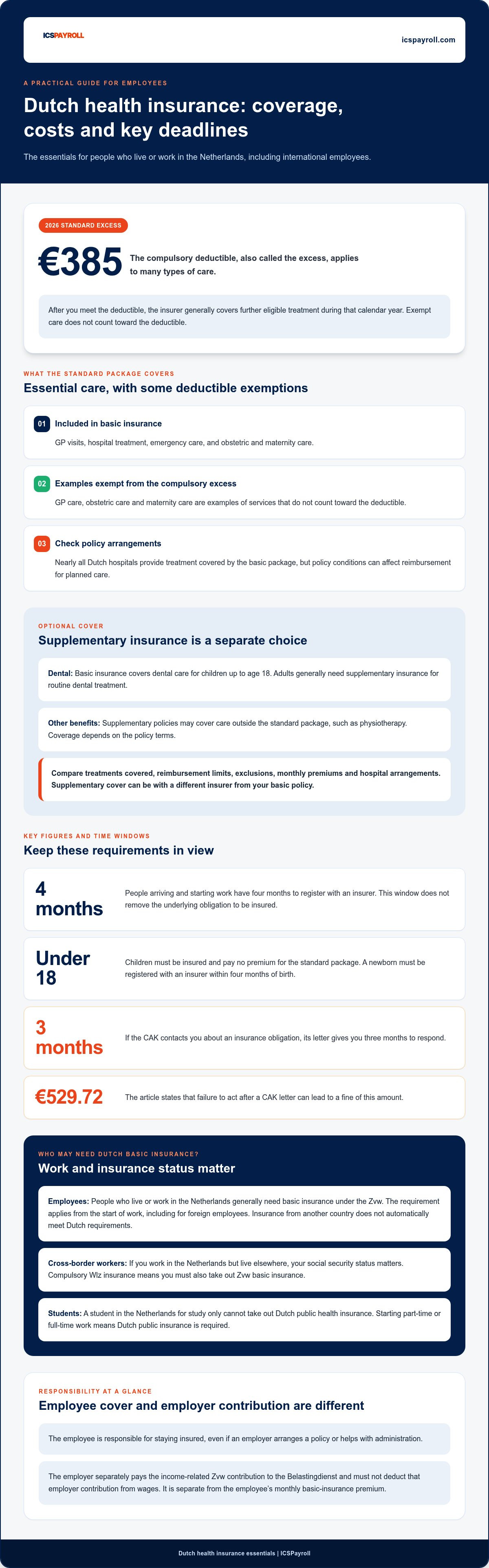
The standard deductible, called the excess, is €385 in 2026. It applies to many forms of care, including hospital treatment and prescribed medicines. GP care, obstetric care and maternity care are examples of services exempt from the compulsory excess. The Government of the Netherlands’ guidance on standard cover and the excess explains how deductible rules apply. The excess is set annually by the government.
After you meet the deductible, the insurer generally covers further eligible treatment during that calendar year. Exempt care does not count toward the deductible.
Supplementary insurance is optional and may cover care outside the standard package. You don’t have to buy it from the same insurer as your basic policy. Insurers may refuse supplementary applications or ask health questions first. This differs from basic cover, which insurers must offer to eligible applicants.
Dental cover illustrates the difference. Basic insurance covers dental care for children up to age 18. Adults generally need supplementary insurance for routine dental treatment. Physiotherapy may also be included in an additional policy, depending on its terms. Compare covered treatments, reimbursement limits and exclusions before choosing.
Compare insurers’ monthly premiums, hospital arrangements, deductible rules, and policy conditions. Then weigh supplementary benefits, such as dental or physiotherapy cover, against the care you expect to use. You can buy supplementary insurance from a different insurer than your basic policy.
Some supplementary policies offer cover related to the compulsory excess, but that is separate from the standard package. Read the policy wording to see which costs qualify, how reimbursement works and whether limits or exclusions apply. Don’t assume extra cover removes the €385 excess for every treatment.
Your social security status can also affect which insurance rules apply. People who work in the Netherlands but live elsewhere may be insured under the Long-Term Care Act (Wet langdurige zorg, Wlz). That status can determine whether they must also take out Zvw insurance.
Mandatory Dutch health insurance for people who live or work in the Netherlands
People who live or work in the Netherlands generally need health insurance under the Zorgverzekeringswet (Zvw). The requirement applies to employees from the start of work, including foreign employees. Insurance from another country does not automatically meet Dutch legal requirements. These health insurance requirements for employees in the Netherlands depend on whether Dutch social security rules apply to the worker.
People who work in the Netherlands but live elsewhere may still fall under the Dutch Long-Term Care Act (Wet langdurige zorg, Wlz). If they are compulsorily insured under the Wlz, they must take out basic health insurance under the Zvw. A cross-border worker’s residence alone does not settle the question: their work and insurance status determine the health insurance requirements for employees in the Netherlands.
International students must also distinguish study from employment. A student who is in the Netherlands for study purposes only cannot take out Dutch public health insurance. A student who starts part-time or full-time work is required to have it. EU, EEA, Swiss and treaty-country students doing paid internships can face specific Wlz rules, which changed on 1 September 2025.
To take out Dutch health insurance, register with a municipality, then apply to an insurer for the basic package. Employees should arrange cover when work begins. People arriving and starting work have four months to register with an insurer, but that window does not remove the underlying insurance obligation. Keep the policy confirmation and start date with your employment records.
Age matters for children. Everyone under 18 must be insured, but children pay no premium for the standard package. Parents must register a newborn with an insurance company within four months of birth. An employee’s own insurance remains their responsibility, even if an employer arranges a policy or helps with administration.
Employers have a separate Zvw responsibility. They pay the income-related contribution to the Belastingdienst when employing staff and must not deduct the employer’s contribution from wages. This contribution is separate from the employee’s monthly basic-insurance premium. An employer can arrange insurance for an employee, but doing so does not transfer the employee’s responsibility to stay insured.
Take action if the CAK contacts you about an insurance obligation. The letter gives you three months to respond, and failure to act can lead to a fine of €529.72. The CAK checks the insurance start date when assessing whether cover began on time. If your work, residence or student status changes, reassess whether Dutch public health insurance applies before relying on an existing policy.
Healthcare benefit eligibility
Healthcare benefit, known as zorgtoeslag, helps eligible people with the cost of Dutch basic health insurance. It is separate from the premium paid to the insurer and from the employer’s income-related Zvw contribution. Eligibility has two central tests: you must qualify for Dutch public health insurance, and your income must fall within the applicable limit for the benefit year.
For 2026, apply to the Netherlands Tax Administration, which assesses eligibility using the rules and income information for that year. The income threshold is the deciding limit, while your income determines whether you meet it. The amount of benefit depends on the assessment, so don’t assume that a low salary alone establishes eligibility. Your entitlement also depends on being eligible for Dutch public health insurance.
To apply, submit a healthcare benefit application to the Netherlands Tax Administration. Have your basic policy and income details ready, then provide the information requested. Use income that reflects your circumstances for the relevant year. Keep a copy of the application and any notices so you can track the decision and respond to requests for information.
The insurer’s nominal premium and healthcare benefit are separate. The premium is a fixed amount paid to the insurer, whether or not you receive care that month. The benefit is financial support that may help an eligible person pay that premium. It does not replace the policy, cancel the premium, or change which healthcare costs are covered.
For example, an employee may pay a monthly premium to the insurer and separately receive an assessed benefit. Payroll deductions or an employer’s Zvw payment do not, by themselves, count as a healthcare benefit application. Keep premium information separate from employer contribution records and benefit correspondence.
Employment changes can affect the information used in an application. If your income changes, ensure the Netherlands Tax Administration has current details for the relevant benefit year. Someone starting work should also establish whether they qualify for Dutch public health insurance, since benefit eligibility depends on that status. Foreign or private cover alone does not automatically meet this condition.
Follow this sequence: establish whether you’re eligible for Dutch public insurance, arrange the basic policy, and apply for healthcare benefit through the Netherlands Tax Administration. Keep your income and policy details up to date in the administration’s records. This separates three distinct matters: your duty to hold insurance, the premium payable to the insurer, and any benefit you qualify to receive.
Apply by submitting a healthcare benefit application to the Netherlands Tax Administration, with your basic policy details and income information for the relevant year. You must qualify for Dutch public health insurance and meet the applicable income threshold, but the specific 2026 income limits are not stated here.
Legal obligation to take out standard health insurance
The Zorgverzekeringswet (Zvw) requires people who live or work in the Netherlands to have Dutch basic health insurance when they fall under the national system. This legal duty is separate from the employer’s contribution and from any healthcare benefit, or zorgtoeslag. Employees remain responsible for their insurance status, even when an employer helps arrange cover.
Employees recruited locally should arrange cover when employment starts if they are subject to Dutch insurance rules. A foreign policy does not automatically replace the required Dutch policy. GP visits, hospital treatment, and prescriptions may be subject to different policy and deductible rules, but the legal obligation is to hold basic insurance, not to receive a particular treatment.
Employers have a separate financial duty under the Zvw. In 2026, the employer contribution is 6.10% of income up to the maximum premium base of €79,409. The employer pays this income-dependent contribution to the Netherlands Tax Administration. It must not deduct the employer’s Zvw contribution from the employee’s wages.
The employee’s nominal health insurance premium is separate. The employee pays it to the insurer, whether or not they receive healthcare that month. An employer may arrange a policy, including through an employment agency, but the employee remains responsible for staying insured. Any zorgtoeslag is a separate benefit, not a substitute for paying the insurer.
Self-employed workers should establish whether Dutch social security rules cover them before deciding on insurance. A self-employed person can request an assessment from the Social Insurance Bank (SVB) to determine their status under the Long-Term Care Act (Wlz). If the Netherlands Tax Administration classifies their income as income from other activities, they must pay a Zvw contribution. The Tax Administration issues the assessment after the person files a tax return.
Timing matters. Employees who arrive and begin work have four months to register with a health insurer, but should not treat that period as permission to ignore an existing insurance obligation. The CAK checks the policy start date. If it sends a letter about the obligation, the recipient must act within three months; failing to do so can result in a €529.72 fine.
If an employee lacks required insurance, the CAK can arrange cover and require the employer to withhold the monthly premium from regular wages and pay it to the CAK. This is an exceptional process, not a substitute for arranging the correct policy. Employers can reduce payroll confusion by keeping the employee’s insurance and Zvw contribution records separate.
Basic health insurance requirement for people living or working in the Netherlands
The key test is your position in the Dutch social security system, not simply your passport or current address. People who live or work in the Netherlands generally need basic health insurance under the Zorgverzekeringswet (Zvw). A policy from abroad does not automatically meet that requirement. Employees should confirm whether Dutch insurance applies when work starts, rather than assume existing cover is sufficient.
Cross-border work needs particular care. Someone can live abroad and still work in the Netherlands, with Dutch Long-Term Care Act (Wlz) insurance applying. People insured under the Wlz must also take out basic insurance under the Zvw. Residence alone does not settle the question: the employee’s work and social security status determine which national rules apply.
For employees moving from abroad, registration and insurance are separate administrative matters. Register with the municipality before applying for a Dutch basic policy. Align the policy start date with the period when Dutch insurance is required. A foreign policy, European Health Insurance Card, or employer-arranged group policy should not be treated as a substitute if the employee is legally required to join Dutch public insurance.
Students need to distinguish study from paid work. International students in the Netherlands for study purposes only cannot take out Dutch public health insurance. Students who take part-time or full-time jobs must have it. Paid internships can follow separate Wlz rules, including rules that changed on 1 September 2025 for students from EU, EEA, Swiss and treaty countries. Internship remuneration can include expenses, and room and board may count as remuneration.
Some people covered by an international organisation’s social insurance arrangements may qualify for an exemption. Eligible individuals can apply to the Social Insurance Bank (SVB) if the organisation’s scheme provides qualifying healthcare coverage. This is a specific exemption route, not general permission to rely on any foreign insurance. Family members may have separate obligations if the organisation’s headquarters agreement covers staff only.
Supplementary insurance is separate from the legally required basic policy. It may be useful for adult dental care or physiotherapy, but it does not replace required Zvw cover. Compare covered treatments and limits with the basic package. You can choose supplementary cover from a different insurer, so the legal policy and optional benefits need not be bundled together.
Reassess your position when your employment or residence changes. For example, someone who leaves a Dutch job but continues living in the Netherlands may still need to consider Dutch insurance rules. Someone who stops working and leaves the country should cancel Dutch public health insurance and deregister from the municipality. Base each decision on current work, residence, and Wlz status, not an old policy or nationality.
ICSPayroll: Employer of Record (EOR)
ICSPayroll’s Employer of Record (EOR) service supports companies hiring in the Netherlands without a Dutch entity. ICSPayroll becomes the legal employer and manages local employment compliance, so your company can hire Dutch-based staff without setting up its own Dutch entity.
Dutch Payroll Administration supports compliant payroll processing, including the employer’s Zvw contribution and related wage administration. It does not replace an employee’s responsibility to take out required basic health insurance. Employers should make that distinction clear when setting up employment in the Netherlands.
For internationally recruited employees, ICSPayroll also manages 30% Ruling Applications where relevant. If you are planning to employ someone in the Netherlands, contact ICSPayroll to discuss the appropriate payroll or EOR support.
Build insurance checks into your employee lifecycle
Make health coverage part of a wider mobility process, not an isolated onboarding task. Assign clear ownership for collecting employee information, recording decisions, and updating records when work or residence changes. This gives your team a consistent process for cross-border moves, new assignments, and departures.
Understanding the health insurance requirements for employees in the Netherlands is an opportunity to clarify responsibilities between HR, payroll, and the employee. Keep insurance administration distinct from payroll contributions, and make the relevant steps clear to everyone responsible. A documented process supports continuity when roles or an employee’s circumstances change.
For employers hiring locally or managing international staff, local employment administration can involve connected decisions beyond insurance. ICSPayroll can support businesses seeking a Dutch employment and payroll framework. Discuss your Netherlands employment requirements with ICSPayroll and identify a practical next step for your workforce.
Frequently Asked Questions
Are employees in the Netherlands required to have Dutch basic health insurance?
Employees subject to Dutch social security rules generally need Dutch basic health insurance under the Zorgverzekeringswet (Zvw). This includes many international employees, but a person’s insurance position depends on their work and social security status. For example, someone temporarily posted from abroad may remain covered by another country’s system under applicable arrangements. Establish which system applies before treating a foreign policy as a substitute.
How soon must employees arrange health insurance after starting work in the Netherlands?
Employees required to have Dutch insurance should arrange it from the start of work. People arriving and starting work have four months to register with an insurer, but that period is not a reason to delay arranging cover. Record the policy’s effective date and employment start date. If the CAK sends an insurance-obligation letter, act by the deadline in the notice.
What does the Dutch basic health insurance package cover, and what is excluded?
The basic package includes GP care, hospital treatment, emergency care, and obstetric and maternity care. The government sets the package each year, so coverage is defined nationally rather than by individual insurers. Adult routine dental care and many physiotherapy services generally require supplementary insurance. Policy conditions matter too: check whether planned hospital treatment is covered and whether it is subject to the deductible.
How much is the annual mandatory deductible (eigen risico), and which costs count toward it?
The standard mandatory deductible is €385 for 2026. It applies to many eligible healthcare costs, including hospital treatment and prescription medicines, until the deductible is used. GP care, obstetric care and maternity care are examples of services exempt from it. The deductible is annual, so eligible costs can count again in a new calendar year. Review an insurer’s policy statement to see how a specific treatment is processed.
Can employers pay or reimburse employees' health insurance premiums in the Netherlands?
An employer can arrange health insurance for an employee, but the employee remains responsible for their insurance status. The employee’s nominal premium is separate from the employer’s income-related Zvw contribution. Employers must pay their contribution to the Netherlands Tax Administration and may not deduct it from wages. If an employer helps pay the premium, payroll records should clearly identify it as the employee’s premium.
Do international employees temporarily posted to the Netherlands need Dutch health insurance or can they keep foreign coverage?
It depends on which country’s social security system covers the posted employee. Foreign cover does not automatically satisfy Dutch insurance rules if the employee must join the Dutch system. Some people connected to an international organisation may apply to the Social Insurance Bank for an exemption if its scheme provides qualifying healthcare coverage. Cross-border and temporary assignments therefore require an assessment of the employee’s applicable insurance status.

Article by
Joost Hubregtse
Joost Hubregtse is Director of ICS Staffing & Payroll B.V., the wholly owned subsidiary of Intercompany Solutions behind ICS Payroll. He is responsible for Employer of Record and Dutch payroll services: employment contracts, wage tax and social security filings, holiday allowance, pension, sick leave and CAO compliance, with onboarding possible within 48 hours.
Frequently Asked Questions
Employees subject to Dutch social security rules generally need Dutch basic health insurance under the Zorgverzekeringswet (Zvw). This includes many international employees, but a person’s insurance position depends on their work and social security status. For example, someone temporarily posted from abroad may remain covered by another country’s system under applicable arrangements. Establish which system applies before treating a foreign policy as a substitute.
Employees required to have Dutch insurance should arrange it from the start of work. People arriving and starting work have four months to register with an insurer, but that period is not a reason to delay arranging cover. Record the policy’s effective date and employment start date. If the CAK sends an insurance-obligation letter, act by the deadline in the notice.
The basic package includes GP care, hospital treatment, emergency care, and obstetric and maternity care. The government sets the package each year, so coverage is defined nationally rather than by individual insurers. Adult routine dental care and many physiotherapy services generally require supplementary insurance. Policy conditions matter too: check whether planned hospital treatment is covered and whether it is subject to the deductible.
The standard mandatory deductible is €385 for 2026. It applies to many eligible healthcare costs, including hospital treatment and prescription medicines, until the deductible is used. GP care, obstetric care and maternity care are examples of services exempt from it. The deductible is annual, so eligible costs can count again in a new calendar year. Review an insurer’s policy statement to see how a specific treatment is processed.
An employer can arrange health insurance for an employee, but the employee remains responsible for their insurance status. The employee’s nominal premium is separate from the employer’s income-related Zvw contribution. Employers must pay their contribution to the Netherlands Tax Administration and may not deduct it from wages. If an employer helps pay the premium, payroll records should clearly identify it as the employee’s premium.
It depends on which country’s social security system covers the posted employee. Foreign cover does not automatically satisfy Dutch insurance rules if the employee must join the Dutch system. Some people connected to an international organisation may apply to the Social Insurance Bank for an exemption if its scheme provides qualifying healthcare coverage. Cross-border and temporary assignments therefore require an assessment of the employee’s applicable insurance status.