
EOR vs. Entity in the Netherlands: The 2026 Cost and Compliance Guide
By Joost Hubregtse, Director, ICS Staffing & Payroll
All blog posts are reviewed and fact checked by our labour law lawyer Zishan Hussain and our director. Editorial standards
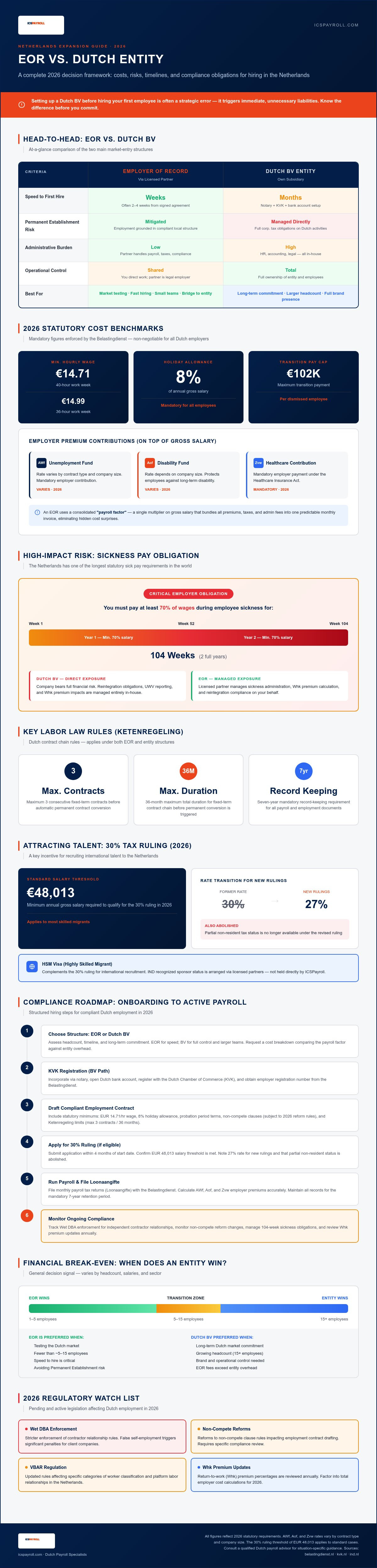
Setting up a Dutch BV before hiring your first employee in 2026 is often a strategic error that triggers immediate, unnecessary liabilities. While full ownership of a local entity sounds ideal, the administrative burden of the Netherlands' unique labor laws can quickly overwhelm a growing international business. Deciding between eor vs entity netherlands requires more than a simple fee comparison. It demands a deep understanding of permanent establishment risks and the rigorous 104-week sickness pay obligation. You need a clear path that balances speed with long-term compliance.
We agree that the Dutch market offers incredible talent, but the shifting regulatory landscape makes entry complex. This guide provides a comprehensive breakdown of the costs, risks, and timelines associated with both an Employer of Record and a Dutch BV. You'll learn how to navigate the 2026 tax ruling changes, including the specific EUR 48,013 salary threshold for the 30% ruling. We also provide a financial break-even analysis to show exactly when an entity becomes more cost-effective than an EOR. This analysis includes a detailed look at the 2026 Whk premium percentages and the impact of the new non-compete reforms. By the end of this guide, you'll have a compliant hiring roadmap to secure your first Dutch hire with total confidence.
Key Takeaways
- Evaluate the strategic trade-offs of eor vs entity netherlands to decide if a local Dutch BV or a licensed partner arrangement is the most efficient path for your 2026 expansion.
- Budget accurately for statutory labor costs by including the 2026 minimum hourly wage of EUR 14.71 and the mandatory 8 percent holiday allowance.
- Prepare for the significant 104-week sickness pay obligation which requires employers to pay at least 70 percent of wages during long-term employee illness.
- Ensure full administrative compliance by following a structured hiring roadmap and adhering to the seven-year record-keeping requirement for payroll documents.
- Utilize the 30% ruling and HSM visa programs to recruit global talent while meeting the 2026 standard salary threshold of EUR 48,013.
Navigating the Choice: Dutch BV vs. Employer of Record in 2026
Choosing between a Dutch BV and an EOR is a decision that dictates your speed to market and your long-term tax liability. A Dutch BV, or Besloten Vennootschap, is a private limited company that functions as a fully independent legal entity. Establishing one requires formal incorporation through a notary, a local bank account, and mandatory registration with the Dutch Chamber of Commerce (KVK). This path offers total control but involves a significant administrative commitment that often takes several months to finalize.
An Employer of Record (EOR) serves as a strategic alternative for businesses that need to hire quickly without the overhead of a local subsidiary. In this model, EOR services are arranged via licensed partners who act as the legal employer for your staff in the Netherlands. While you manage the employee's daily tasks, the licensed partner handles payroll, taxes, and labor law compliance. The primary advantage of the eor vs entity netherlands choice for many is speed. You can often move from a signed service agreement to an active hire in just a few weeks, whereas entity incorporation remains a long-term project.
The Legal Reality of Permanent Establishment
Hiring staff directly from a foreign company without a local entity or an EOR creates a high risk of "Permanent Establishment." The Dutch Tax Authorities may determine that your business activities in the Netherlands are sufficient to trigger local corporate tax obligations on your global profits. This can lead to unexpected tax assessments and legal complications. Utilizing an EOR mitigates this risk by ensuring that the employment relationship is grounded in a compliant, local structure. It provides a protective layer for the international parent company while ensuring all social security contributions are paid correctly to the Belastingdienst.
Operational Control and Speed to Market
Managing a Dutch subsidiary requires a dedicated infrastructure for HR, accounting, and legal compliance. You'll need to stay updated on shifting regulations, such as the upcoming Wet DBA enforcement and non-compete reforms. This administrative burden can distract from your core business goals. Choosing an EOR allows you to bypass these hurdles. Operational setup for new hires is typically achieved in weeks, not months. Service agreements and employment contracts are often finalized within days, providing the agility needed to secure top talent in a competitive market. This makes the EOR an ideal bridge for companies testing the Dutch market before committing to a full eor vs entity netherlands transition.
Financial Breakdown: Statutory Costs and the Payroll Factor
Understanding the financial implications of eor vs entity netherlands requires a precise look at statutory benchmarks. For 2026, the Dutch government has set the minimum hourly wage at EUR 14.71 for a 40-hour work week, or EUR 14.99 for a 36-hour week. On top of the base salary, every employer must pay a mandatory 8 percent holiday allowance. These requirements are strictly enforced by the Dutch Tax Administration (Belastingdienst). Failing to account for these specific percentages can lead to significant budget shortfalls during the hiring process.
While a Dutch BV requires you to manage these individual line items separately, an EOR typically uses a "payroll factor." This is a consolidated multiplier applied to the gross salary. It covers all employer premiums, social security, and administrative fees in a single monthly invoice. This model provides budget certainty and eliminates the hidden costs of local HR management. If you need a clear comparison for your specific headcount, you can request a detailed cost breakdown to see these factors in action.
Employer Premiums and Social Security
Employer costs in the Netherlands extend beyond the gross salary. You're responsible for the AWf (unemployment fund) and Aof (disability fund) premiums. For 2026, these rates vary based on contract type and company size. Additionally, the Zvw (healthcare insurance act) contribution is a mandatory employer payment. Managing these through a licensed partner ensures that every premium is calculated to the cent. Most professional providers offer a 24-hour turnaround for quotations, allowing you to compare the total cost of employment against your internal projections.
Transition Allowance and Termination Costs
The Netherlands provides strong protections for workers, including the "transitievergoeding" or transition allowance. For 2026, this statutory payment is capped at EUR 102,000 or one annual salary if the salary exceeds that amount. This allowance is due from the first day of employment. The "Ketenregeling" also limits the number of fixed-term contracts you can offer before an employee must be granted a permanent role. Using the payroll factor model helps businesses accrue for these potential liabilities, ensuring that a contract termination doesn't result in an unbudgeted financial shock.
High-Impact Risks: Sickness and Pension Obligations
Entering the Dutch market as a foreign entity introduces significant long-term liabilities that many international HR teams overlook. The most critical of these is the statutory sickness pay requirement. Unlike many jurisdictions, the Netherlands mandates that employers pay at least 70 percent of an employee's wages for 104 weeks if they are unable to work due to illness. For a small team, a single long-term illness can create a massive financial strain. This is a deciding factor when evaluating eor vs entity netherlands, as professional EOR services typically include sickness risk coverage as a standard feature of their consolidated model.
To manage this risk, employers must partner with an Arbodienst, which is a certified occupational health service. The Arbodienst monitors the recovery process and provides mandatory medical assessments. Understanding these nuances is vital for maintaining a compliant workplace and protecting your bottom line. You can find detailed breakdowns of these requirements in our Employment Law Netherlands Guide.
The 15.2 Percent Pension Benchmark
Pension administration in the Netherlands is a statutory duty for most sectors. For 2026, the mandatory pension contribution benchmark is set at 15.2 percent of the gross salary. This is a significant overhead that must be factored into any financial projection. When you use an EOR, these contributions are managed automatically; employees can track their accrued balances via a secure online portal. For a Dutch BV, you must establish and manage these pension fund relationships independently. This adds another layer of administrative complexity and ongoing reporting duties to your internal teams.
Compliance with the Gatekeeper Improvement Act
The Gatekeeper Improvement Act, known locally as Wet Verbetering Poortwachter, dictates strict reintegration timelines for long-term illness. Within six weeks of illness, a problem analysis must be completed. By week eight, a formal reintegration plan (Plan van Aanpak) must be signed by both parties. Failure to follow these bureaucratic steps can result in the Dutch Social Insurance Bank (UWV) imposing a penalty. This penalty typically forces the employer to pay a third year of wages without the ability to terminate the contract. Licensed EOR partners handle all sick leave support and reintegration guidance, protecting you from these costly procedural errors. When debating eor vs entity netherlands, the transfer of this legal and operational burden to a local expert is often the most compelling argument for the EOR model.
The Compliance Roadmap: From Onboarding to Active Payroll
Transitioning from the strategic decision of eor vs entity netherlands to an operational reality requires a structured approach. Compliant hiring in the Netherlands follows a rigorous five step process. This begins with a detailed cost consultation and the signing of a service agreement. Once the foundation is set, the process moves through employee onboarding, visa or tax ruling applications, and finally, the activation of the monthly payroll cycle. To maintain full legal standing, all payroll documents must adhere to the statutory seven year record keeping requirement. Professional EOR services, arranged via licensed partners, provide the necessary HR administration and localized employee handbooks to ensure your team remains aligned with Dutch labor standards from day one.
For a deeper look at these operational stages, you can review our Employer of Record Netherlands Guide. This resource details how to avoid the common administrative pitfalls that often delay a traditional entity setup.
Mandatory ID Verification and Right to Work
The first critical hurdle in Dutch onboarding is the mandatory physical ID verification. Dutch law requires the employer to verify the original identity document of the employee before their first working day. A simple scan or photocopy is insufficient. For international talent, you must also confirm their right to work via the Immigration and Naturalisation Service (IND). While EU nationals enjoy free movement, non-EU experts typically require a Highly Skilled Migrant (HSM) visa. One of the primary benefits of utilizing a licensed EOR partner is the speed of this process. HSM visas are typically granted within just three weeks, which is significantly faster than the timelines usually associated with a new Dutch BV application.
Setting Up the Monthly Payroll Cycle
Once onboarding is complete, the focus shifts to the monthly "Loonaangifte" filings. These are the formal salary declarations sent to the Dutch Tax Administration. Accuracy is paramount here to avoid late filing penalties or incorrect employer premium calculations. When comparing eor vs entity netherlands, many businesses find the consolidated invoice model of an EOR far more efficient. Instead of managing multiple payments for taxes, social security, and pensions, you receive a single monthly invoice. This document covers the gross salary, all statutory premiums, and the agreed service fee. It ensures that every payslip is compliant and that all employer contributions are handled with clinical precision. If you're ready to simplify your Dutch operations, you can request a custom payroll factor quote today.
Attracting Talent: The 30% Ruling and HSM Visas
Recruiting elite international talent requires more than a competitive base salary. The 30% ruling remains the most powerful incentive for attracting global experts to the Dutch market. This tax facility allows employers to provide a portion of the gross salary tax-free to cover extraterritorial costs. When considering eor vs entity netherlands, it is important to note that professional providers include 30% ruling application support within their standard payroll factor. This removes the administrative burden from your internal teams while providing a significant net-income boost for your employees. It's a strategic advantage that helps you secure talent in a high-demand environment.
Significant changes take effect in 2026. The most notable is the total abolition of partial non-resident status for tax purposes. Previously, expats could opt to be treated as non-residents for certain tax boxes, but this ends on January 1, 2026. Understanding these nuances is critical for maintaining an attractive and compliant offer. For a deeper dive into these regulations, refer to our 30% Ruling Comprehensive Guide. This resource explains how to manage the transition and protect your employees' financial interests.
Eligibility and 2026 Salary Thresholds
To qualify for the 30% ruling in 2026, the employee must meet specific criteria regarding their recruitment and income. The standard annual salary threshold is set at EUR 48,013. This figure is exclusive of the tax-free allowance itself. For employees under 30 with a Master’s degree, a lower threshold typically applies. Additionally, the legislative transition now caps the tax-free percentage at 27 percent for newer rulings. Ensuring your candidates meet these benchmarks is essential before making a formal offer. This level of technical precision is a key factor in the eor vs entity netherlands debate, as licensed partners ensure these thresholds are monitored throughout the year to prevent ruling revocation.
Expedited Highly Skilled Migrant (HSM) Visas
The ability to hire non-Schengen talent is often the primary driver for international expansion. Establishing a Dutch BV to gain IND sponsor status is a months-long process that requires significant local substance and bank account verification. The EOR model provides a faster alternative. By utilizing licensed partners, you can sponsor Highly Skilled Migrant (HSM) visas without having your own legal entity in the Netherlands. This allows you to scale your team without the wait times of traditional incorporation.
These visa applications are typically granted within approximately 3 weeks. This speed allows you to secure talent before competitors can finalize their own local registrations. The process includes the mandatory ID checks and residence permit filings required by Dutch law. This expedited path ensures that your global team can be on the ground and productive in less than a month. It provides the agility needed to lead in the Dutch market while maintaining total compliance with immigration standards.
Securing Your Dutch Market Entry in 2026
Navigating the complexities of the Dutch labor market requires a strategic choice between long-term control and immediate operational agility. This guide has demonstrated that while a Dutch BV offers a permanent presence, the eor vs entity netherlands decision often favors the EOR model for rapid, risk-free expansion. By utilizing a licensed partner, you bypass the months of administrative delay associated with entity incorporation. You also shield your business from the significant financial burdens of the 104-week sickness pay obligation and the meticulous management of the 2026 30% ruling salary thresholds.
Choosing the right path ensures that your focus remains on growth rather than bureaucratic hurdles. Operational setup can be achieved in weeks, not months, with full Dutch compliance guaranteed. You'll receive one clear monthly invoice with no surprises, allowing for predictable financial planning. Hire in the Netherlands with confidence: Get your 24-hour quote from ICSPayroll. We look forward to helping you build a successful and compliant team in the Netherlands.
Frequently Asked Questions
How quickly can I hire an employee in the Netherlands in 2026?
Operational setup through an EOR typically takes just a few weeks. This is significantly faster than establishing a Dutch BV, which involves notary visits, bank account registration, and Chamber of Commerce filings that often take several months. By choosing the EOR route, you can secure and onboard talent almost immediately. This speed allows your business to respond to market opportunities without the administrative delays inherent in a traditional legal entity setup.
Can I hire Dutch employees without setting up a local legal entity?
You can hire Dutch employees without a local entity by partnering with an Employer of Record. In the eor vs entity netherlands comparison, the EOR serves as the legal employer of record while you retain daily management of the staff. This arrangement is facilitated via licensed partners who ensure full compliance with Dutch labor laws. It provides a legal bridge for international companies to enter the market without the overhead of a permanent establishment.
What is the 2026 minimum wage in the Netherlands?
The 2026 statutory minimum hourly wage is EUR 14.71 for a 40-hour work week. For businesses operating on a 36-hour week, the rate is EUR 14.99 per hour. These figures apply to all employees aged 21 and over. Employers must ensure that every contract meets these benchmarks to remain compliant with the Dutch Labor Inspectorate. These rates are updated twice a year to reflect changes in the cost of living and national economic conditions.
What are the mandatory employer costs in the Netherlands for 2026?
Mandatory employer costs include the gross salary plus an 8 percent holiday allowance. Additionally, you must pay social security premiums such as the AWf unemployment fund and Aof disability fund. The Zvw healthcare contribution is also required. For most sectors, a pension contribution benchmark of 15.2 percent of the gross salary applies. These statutory costs are often consolidated into a single payroll factor when using professional payroll services to ensure predictable monthly budgeting.
How long does it take to get a Highly Skilled Migrant (HSM) visa?
Highly Skilled Migrant (HSM) visas are typically granted within approximately 3 weeks when arranged via licensed partners. This expedited timeline is a major advantage for companies needing to relocate international experts quickly. Obtaining IND recognized sponsor status for a new Dutch BV can take several months. Using an EOR allows you to bypass this wait time, ensuring your key staff members can begin their assignments in the Netherlands with minimal delay.
What are the sickness pay requirements for Dutch employers?
Dutch law requires employers to pay at least 70 percent of an employee's wages for 104 weeks of illness. This two year obligation is one of the highest in Europe and represents a significant financial risk for employers. You are also required to engage an Arbodienst to manage the reintegration process under the Gatekeeper Improvement Act. Professional EOR services include insurance and management for this risk, protecting your business from the costs of long-term employee sickness.
How does the 30% ruling work in 2026?
The 30% ruling allows eligible expats to receive a tax-free allowance to cover extraterritorial costs. For 2026, the standard salary threshold is EUR 48,013. Newer rulings are subject to a transition where the tax-free rate is capped at 27 percent. A critical change for 2026 is the abolition of partial non-resident status for tax purposes. These regulations are complex, so applications are typically managed as part of a comprehensive payroll or EOR service package.
What is a payroll factor and what does it cover?
A payroll factor is a consolidated multiplier applied to an employee's gross salary to cover all employment-related expenses. It includes statutory costs like the 8 percent holiday allowance, social security premiums, and pension contributions. It also covers the administrative fees for payroll processing and HR support. This model simplifies the eor vs entity netherlands financial analysis by providing one clear monthly invoice. It eliminates the need for separate payments to multiple tax and insurance authorities.

Article by
Joost Hubregtse
Joost Hubregtse is Director of ICS Staffing & Payroll B.V., the wholly owned subsidiary of Intercompany Solutions behind ICS Payroll. He is responsible for Employer of Record and Dutch payroll services: employment contracts, wage tax and social security filings, holiday allowance, pension, sick leave and CAO compliance, with onboarding possible within 48 hours.
Frequently Asked Questions
Operational setup through an EOR typically takes just a few weeks. This is significantly faster than establishing a Dutch BV, which involves notary visits, bank account registration, and Chamber of Commerce filings that often take several months. By choosing the EOR route, you can secure and onboard talent almost immediately. This speed allows your business to respond to market opportunities without the administrative delays inherent in a traditional legal entity setup.
You can hire Dutch employees without a local entity by partnering with an Employer of Record. In the eor vs entity netherlands comparison, the EOR serves as the legal employer of record while you retain daily management of the staff. This arrangement is facilitated via licensed partners who ensure full compliance with Dutch labor laws. It provides a legal bridge for international companies to enter the market without the overhead of a permanent establishment.
The 2026 statutory minimum hourly wage is EUR 14.71 for a 40-hour work week. For businesses operating on a 36-hour week, the rate is EUR 14.99 per hour. These figures apply to all employees aged 21 and over. Employers must ensure that every contract meets these benchmarks to remain compliant with the Dutch Labor Inspectorate. These rates are updated twice a year to reflect changes in the cost of living and national economic conditions.
Mandatory employer costs include the gross salary plus an 8 percent holiday allowance. Additionally, you must pay social security premiums such as the AWf unemployment fund and Aof disability fund. The Zvw healthcare contribution is also required. For most sectors, a pension contribution benchmark of 15.2 percent of the gross salary applies. These statutory costs are often consolidated into a single payroll factor when using professional payroll services to ensure predictable monthly budgeting.
Highly Skilled Migrant (HSM) visas are typically granted within approximately 3 weeks when arranged via licensed partners. This expedited timeline is a major advantage for companies needing to relocate international experts quickly. Obtaining IND recognized sponsor status for a new Dutch BV can take several months. Using an EOR allows you to bypass this wait time, ensuring your key staff members can begin their assignments in the Netherlands with minimal delay.
Dutch law requires employers to pay at least 70 percent of an employee's wages for 104 weeks of illness. This two year obligation is one of the highest in Europe and represents a significant financial risk for employers. You are also required to engage an Arbodienst to manage the reintegration process under the Gatekeeper Improvement Act. Professional EOR services include insurance and management for this risk, protecting your business from the costs of long-term employee sickness.
The 30% ruling allows eligible expats to receive a tax-free allowance to cover extraterritorial costs. For 2026, the standard salary threshold is EUR 48,013. Newer rulings are subject to a transition where the tax-free rate is capped at 27 percent. A critical change for 2026 is the abolition of partial non-resident status for tax purposes. These regulations are complex, so applications are typically managed as part of a comprehensive payroll or EOR service package.
A payroll factor is a consolidated multiplier applied to an employee's gross salary to cover all employment-related expenses. It includes statutory costs like the 8 percent holiday allowance, social security premiums, and pension contributions. It also covers the administrative fees for payroll processing and HR support. This model simplifies the eor vs entity netherlands financial analysis by providing one clear monthly invoice. It eliminates the need for separate payments to multiple tax and insurance authorities.