Netherlands EOR for UK Companies: 2026 Compliance Guide
By Joost Hubregtse, Director, ICS Staffing & Payroll
All blog posts are reviewed and fact checked by our labour law lawyer Zishan Hussain and our director. Editorial standards
The traditional belief that a UK company must incorporate a Dutch BV to hire locally is a costly misconception that often leads to unnecessary administrative burden. Utilizing a Netherlands EOR for UK companies allows you to hire top-tier Dutch talent without maintaining a local legal entity, while a specialised provider carries the day-to-day compliance load. You likely recognize the potential of the Dutch market, yet concerns about Permanent Establishment exposure and the complexity of post-Brexit immigration sponsorship often create significant barriers to entry.
This 2026 guide simplifies the transition by providing a compliant alternative to direct incorporation. You'll learn how to navigate the latest salary norms, including the EUR 48,013 taxable salary threshold for the 30% ruling (the "expat scheme"), the statutory minimum wage of EUR 14.99 per hour that applies since 1 July 2026, and the mandatory 8% holiday allowance. We'll also detail how immigration sponsorship is arranged via our licensed partner so your team can be operational within weeks rather than months.
By the end of this article, you'll have a clear understanding of the current "ketenregeling" contract rules, the 2026 employer contribution percentages for AWf, Aof and Zvw, and, critically, which frequently cited reforms are actually in force in 2026 and which are still working their way through parliament. We provide the technical precision needed to manage Dutch payroll with confidence, so your UK parent company can plan on the basis of the law as it stands, not as it is rumoured.
Key Takeaways
- Understand how a Netherlands EOR for UK companies removes the need for a local legal entity while ensuring compliance with Dutch labour law, and where residual risks such as Permanent Establishment still require attention.
- Master the 2026 financial requirements, including the EUR 48,013 taxable salary norm for the 30% ruling, the EUR 14.99 hourly minimum wage (from 1 July 2026), and the exact employer social security percentages.
- Learn the actual 2026 status of worker-classification reform: the "clarification" part of the VBAR bill has been withdrawn, while the statutory presumption of employment for low hourly rates has been adopted by parliament but is not yet in force.
- Discover how immigration sponsorship is arranged via a licensed IND recognised sponsor, with IND decisions for recognised sponsors typically issued within about two weeks of a complete application.
- Identify the nuances of the "ketenregeling," probation periods, sick pay obligations, and the mandatory 8% holiday allowance, including the statutory cap on holiday allowance for higher earners that most guides omit.
- Prepare for what's next: the Wtta admission system for labour providers (from 1 January 2027), the reduction of the 30% ruling to 27% (from 2027), and equivalent employment conditions for supplied workers (from 31 December 2026).
Navigating Post-Brexit Expansion: Why UK Firms Use a Dutch EOR
Post-Brexit regulatory shifts have reclassified British businesses as third-country entities. This status complicates direct hiring within the European Union, since British nationals now require work authorisation to be employed in the Netherlands. It also creates new hurdles for international logistics; you can find out more about navigating these shipping challenges. A Netherlands EOR for UK companies serves as the legal employer of record, managing local administrative obligations on behalf of the British firm. This arrangement allows you to hire Dutch talent without establishing a local branch or private limited company (BV).
The primary advantage is speed and reduced administrative burden. Incorporating a BV is faster than many assume: the notarial process itself can be completed in days once identification and compliance checks are done, but the ongoing obligations are what weigh. Payroll tax registration, annual accounts, corporate income tax filings, and administration must be maintained for the life of the entity. An EOR lets you onboard staff in weeks with a transparent monthly cost that scales with your team size. You maintain full operational direction over the employee's daily tasks while the EOR assumes responsibility for payroll, social security, and labour law compliance as the formal employer. For companies that eventually look to establish a physical presence, you can learn more about Schippers Bouwconsult BV for structural engineering and damage expertise to ensure your facilities are compliant and safe.
While managing your Dutch footprint, ensuring your UK-based facilities meet local standards is equally vital. For firms based in the East Midlands, Swiss Build Ltd provides comprehensive guidance on building regulations in Northamptonshire to keep your domestic headquarters compliant and safe in 2026.
The EOR vs. Entity Setup Dilemma
Choosing between an EOR and a Dutch BV depends on your long-term headcount and investment strategy. Contrary to a common myth, Dutch law does not require a BV to have locally resident directors or physical office space, but tax substance, banking, and administration in practice do require local infrastructure or paid service providers. A BV brings annual reporting duties and its own tax position; an EOR service fee is a predictable monthly cost. One point of precision: a Dutch BV is a separate legal person and should not be confused with a Permanent Establishment of the UK parent. These are distinct concepts with different tax consequences. We would add a disclosure that most comparisons omit: as an EOR provider we naturally sit on one side of this comparison. For companies planning a large, long-term Dutch operation, incorporation is often the better answer, and we say so when it is. For a detailed cost-benefit analysis, see our guide on Employer of Record vs Dutch BV.
Legal Compliance for British Employers
Dutch employment contracts follow strict rules that differ significantly from UK law. British employers must navigate the "ketenregeling" (chain rule, Article 7:668a of the Dutch Civil Code), which currently limits fixed-term employment to a maximum of three contracts within a 36-month period, with a new chain starting only after a break of more than six months. If these limits are exceeded, the contract automatically converts to an indefinite one. Be aware that the adopted (but not yet in force) Wet meer zekerheid flexwerkers will, once its relevant part takes effect, extend that six-month interruption period to five years for newly concluded contracts, so structures that rely on "resetting" the chain have a limited shelf life.
Payroll records must be retained for the Dutch tax authorities; the standard fiscal retention period is 7 years, and certain payroll data (such as wage tax statements and identity documents) must be kept for at least 5 years after the end of employment. For UK nationals moving to the Netherlands, post-Brexit residence and work authorisation requirements apply. Immigration sponsorship is arranged via our licensed partner, an IND recognised sponsor, to ensure full alignment with current requirements.
How a Netherlands Employer of Record (EOR) Operates for British Entities
The operational model of a Netherlands EOR for UK companies functions through a structured tripartite relationship. Your UK-based firm remains the operational manager, directing the employee's daily tasks, performance targets, and professional development. ICSPayroll acts as the legal employer within the Netherlands, assuming the statutory employer responsibilities. The employee performs their duties for your company while being legally contracted to the Dutch entity.
We handle the administrative lifecycle of the employment relationship: wage tax filings, social security contributions, pension administration where a mandatory sector pension fund or CAO applies, statutory sick pay administration, and the mandatory 8% holiday allowance. One important nuance for UK readers: from 1 January 2027, all parties that supply labour in the Netherlands, expressly including payroll and EOR providers, fall under the mandatory admission system of the Wet toelating terbeschikkingstelling van arbeidskrachten (Wtta), administered by a new authority. When selecting an EOR partner in 2026, ask about their preparation for admission; it will be a licence-to-operate question from 2027. Additionally, from 31 December 2026, supplied workers become entitled by law to at least equivalent employment conditions to comparable employees of the hirer, a principle already embedded in the 2026 sector CAOs.
Onboarding and Contract Management
Effective onboarding begins with a contract that adheres to Dutch civil law. Every employment agreement carries the statutory 8% holiday allowance, which accrues over the year and must by default be paid out in June (a different payment schedule, such as monthly, may be agreed in writing, provided payment occurs at least once per calendar year). For salaries above three times the statutory minimum wage, the law permits written agreement that no holiday allowance is due over the excess, a point that matters precisely for the highly paid specialists this article addresses, and one most guides silently skip.
Probation periods are strictly regulated under Article 7:652 of the Dutch Civil Code and must be agreed in writing:
- No probation is permitted in fixed-term contracts of 6 months or less.
- A maximum of 1 month applies to fixed-term contracts longer than 6 months but shorter than 2 years.
- A maximum of 2 months applies to fixed-term contracts of 2 years or longer and to indefinite contracts.
- A probation clause that exceeds these limits is void in its entirety, not merely reduced.
You must also account for the transition allowance (transitievergoeding). This accrues from the first day of employment at one-third of a gross monthly salary per year of service and is capped for 2026 at EUR 102,000 gross, or one annual salary if that is higher. If you're looking to streamline these requirements, our Dutch payroll services provide the necessary local framework to manage these accruals accurately.
Immigration and Visa Support
Post-Brexit, British staff require valid work authorisation to reside and work in the Netherlands. The Highly Skilled Migrant (kennismigrant) route is the most efficient path for professional talent. Immigration sponsorship is arranged via our licensed partner, which holds "Recognised Sponsor" status with the IND, a status that is a hard legal precondition for this route.
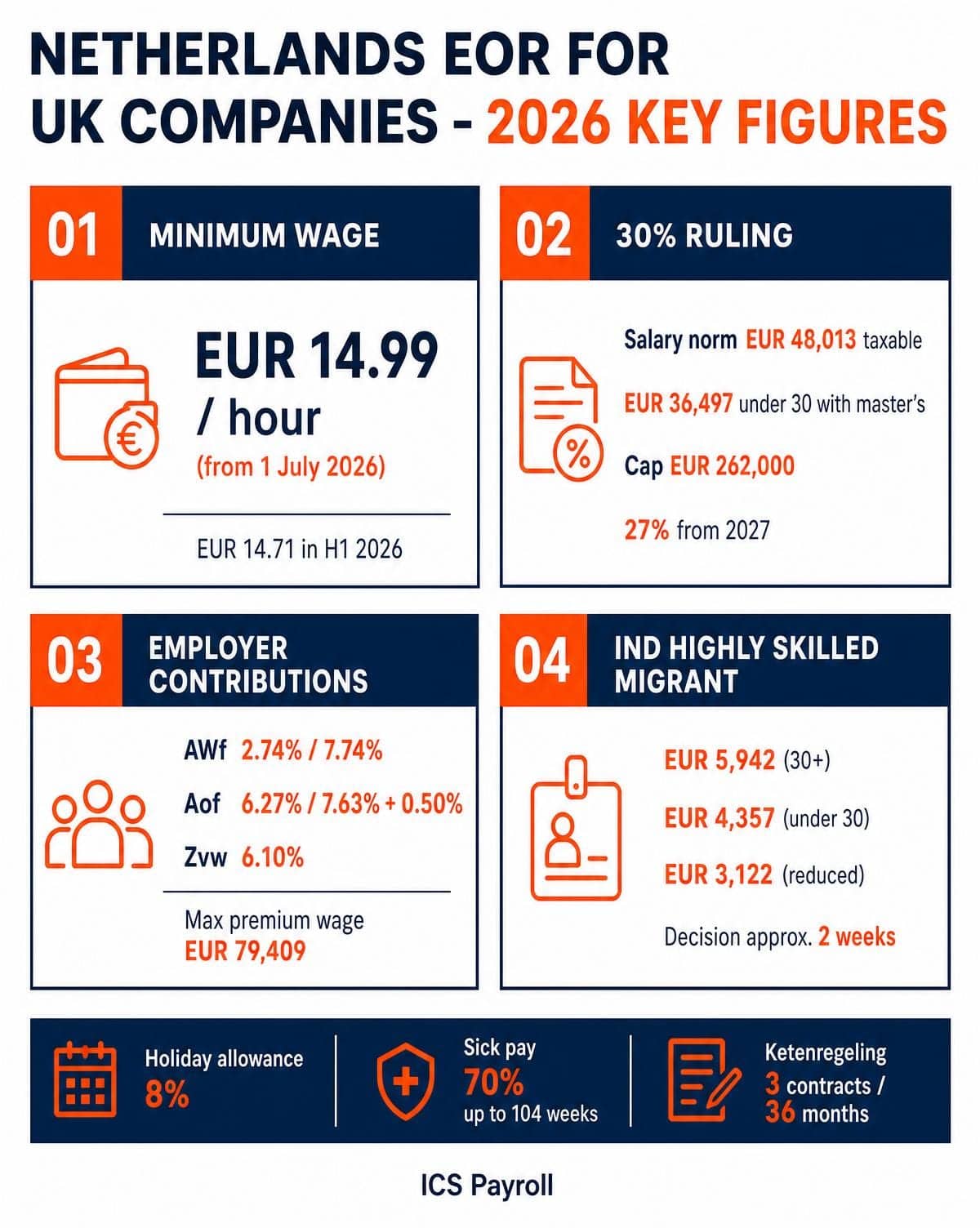
Two sets of salary rules apply and must not be confused. For the residence permit itself, the IND salary criteria for 2026 are EUR 5,942 gross per month (excluding 8% holiday allowance) for highly skilled migrants aged 30 and over, EUR 4,357 for those under 30, and EUR 3,122 under the reduced criterion for recent graduates. The salary must also be market-conform for the role. These IND thresholds are separate from the tax-side 30% ruling norm discussed below.
On timing: for recognised sponsors, the IND aims to decide on a complete application within approximately two weeks; the statutory maximum decision period is 90 days. End-to-end, including document collection, MVV issuance at the embassy where required, biometrics, and municipal registration, a realistic planning horizon from signed contract to first working day is one to two months. We do not promise three weeks door-to-door, because the parts of the process outside the IND decision are not within anyone's control.
Note also a 2026 compliance tightening: recognised sponsors must retain proof that the qualifying salary was actually paid (bank records, not payslips alone). Finally, the IND has publicly signalled scrutiny of constructions in which a supplying agency acts as recognised sponsor while the migrant works day-to-day for a client. Transparency about where the worker actually works, and on what conditions, is essential. For UK companies with global interests, Vietnamese-Evisa.Org provides expert assistance with urgent visa requirements for Vietnam travel.
2026 Financial Obligations: Payroll Taxes, 30% Ruling, and Labour Costs
Financial planning for a Netherlands EOR for UK companies requires a granular understanding of Dutch statutory costs.
Minimum wage. Since 1 January 2024 the Netherlands operates a statutory minimum hourly wage. For employees aged 21 and over it was EUR 14.71 gross per hour in the first half of 2026 and is EUR 14.99 gross per hour since 1 July 2026. The rate is uniform across sectors: a sector CAO may set a higher floor, but the statutory minimum does not vary by industry. Lower statutory youth rates apply for employees aged 15 to 20. The minimum wage is indexed every 1 January and 1 July.
Holiday allowance. The 8% holiday allowance is calculated over the wage earned in the accrual year running to 31 May and is paid in June by default (earlier or more frequent payment may be agreed in writing). On termination, accrued holiday allowance is settled immediately. As noted above, above three times the minimum wage the parties may agree in writing to limit the allowance.
Employer social security contributions (2026 rates). Beyond gross salary, UK employers must budget for:
- AWf (unemployment fund): 2.74% for written indefinite contracts that are not on-call contracts; 7.74% for fixed-term and flexible contracts. This differentiation is the single largest cost consequence of contract type.
- Aof (disability fund): 6.27% for small employers, 7.63% for other employers, plus a 0.50% childcare surcharge.
- Whk (return-to-work fund): an individually or sectorally differentiated premium set annually per employer.
- Zvw (Healthcare Insurance Act) employer levy: 6.10%.
All of these are levied by the Dutch Tax Administration (Belastingdienst) over wages up to the maximum premium wage of EUR 79,409 per year for 2026; the maximum is set by ministerial regulation, and no premiums are due over salary above it. We consolidate these variables into one clear monthly invoice, giving the UK parent predictable cash flow without managing Dutch government portals or a local bank account.
The 30% Ruling: 2026 Requirements for UK Expats
To attract specialists from the UK, the 30% ruling (formally the expat scheme) remains a vital fiscal tool. For 2026, the standard salary norm is EUR 48,013 of taxable salary, that is, the amount remaining after the 30% tax-free allowance is applied. In practice, an employee therefore needs roughly EUR 68,600 gross to use the ruling to its full 30% extent. A reduced norm of EUR 36,497 applies to employees under 30 holding a qualifying master's degree, and no salary norm applies to qualifying scientific researchers.
Eligibility requires recruitment from abroad and residence more than 150 km from the Dutch border for at least 16 of the 24 months before the first working day in the Netherlands. The application must be filed jointly by employer and employee within 4 months of the first working day to have retroactive effect to the start date; the Belastingdienst typically decides within 8 weeks. The salary norm is tested every year for the full duration of the ruling: dropping below it (for example through reduced hours) ends the benefit.
Plan for the confirmed changes ahead. From 2026, the benefit is for all users capped at the WNT norm of EUR 262,000 of salary (the transitional exemption from this cap lapsed on 1 January 2026). From 1 January 2027, the maximum tax-free percentage falls from 30% to 27% and the salary norms rise to (at least) EUR 50,436 and EUR 38,388 respectively, with transitional protection for employees who were already using the ruling before 2024. Any 2026 hiring business case for a multi-year assignment should be modelled on 27%, not 30%. Since 2025, partial non-resident taxpayer status has been abolished for new cases; only employees who applied the ruling over the last payroll period of 2023 may still use it, and 2026 is the final year. Beyond tax incentives, providing flexible payment solutions for living expenses, such as those found at gorentify.com for UAE-based staff, can further enhance your global talent acquisition strategy.
Pension and Sickness Risk Coverage
Dutch labour law places significant emphasis on protection during illness, and the rules deserve precision rather than a one-liner:
- The employer must continue paying at least 70% of salary for up to 104 weeks (2 years) of illness.
- During the first 52 weeks, the payment must additionally be topped up to at least the statutory minimum wage where 70% would fall below it; in the second year this top-up no longer applies.
- The obligation is capped: the employer need not pay more than 70% of the maximum daily wage (EUR 304.25 from 1 January 2026; EUR 309.91 from 1 July 2026), which materially limits exposure on high salaries. Many CAOs provide for 100% in year one and 70% in year two, so check the applicable CAO.
Alongside payment, the employer carries statutory reintegration obligations under the Gatekeeper Improvement Act (Wet verbetering poortwachter). Inadequate reintegration efforts can trigger a UWV wage sanction extending the payment obligation by up to 52 additional weeks. In practice, this, not the 70% figure, is the risk that requires active management, and it is a core part of our service. Mandatory pension participation frequently applies where a sector pension fund (BPF) or CAO governs the industry; this is assessed per placement. For a comprehensive breakdown of these liabilities, review our guide on Dutch social security for employers.
Compliance Safeguards: Permanent Establishment and Worker Classification in 2026
Hiring UK contractors in the Netherlands has become a genuinely high-risk strategy. Since 1 January 2025, the Belastingdienst has resumed full enforcement against deemed employment (schijnzelfstandigheid), initially with a "soft landing" and, in the course of 2026, with the return of penalty assessments. Classification is assessed under the existing statutory framework as interpreted by the Supreme Court: the holistic weighing of all circumstances from the Deliveroo case, with the 2025 Uber judgment confirming that indications of genuine entrepreneurship weigh fully in the assessment. Using an EOR establishes a formal employment relationship from day one, which removes the reclassification question entirely for the workers concerned.
While an EOR manages local payroll compliance, companies often require broader guidance on their international tax obligations. For specialized support with cross-border regulatory compliance across the UK, EU, and US, CiDATax SRL provides the technical expertise needed to secure your global operations.
The State of Classification Reform: What Is Actually Law in 2026
Here we must correct a widespread misunderstanding. The VBAR bill (Verduidelijking beoordeling arbeidsrelaties en rechtsvermoeden) was submitted to parliament in July 2025 with two components: a statutory clarification test built on "work-related and organisational direction" versus "working at one's own account and risk," and a rebuttable presumption of employment below a set hourly rate.
In March and April 2026, the government withdrew the clarification component. There is, as of mid-2026, no new statutory test of "authority and embedding" in force or forthcoming under VBAR; classification continues to be governed by existing law and case law, and a separate Zelfstandigenwet is being developed instead.
What survived is the statutory presumption of employment based on hourly rate: adopted by the Lower House on 21 April 2026 and by the Senate on 16 June 2026, but not yet in force. Entry into force is set by royal decree, and the applicable threshold (approximately EUR 38 per hour at the 1 January 2026 reference level, to be fixed by ministerial regulation and indexed) is expected to apply from a date in the second half of 2026. Once in force, a worker earning below the threshold may invoke a presumption of employment, and the hiring party bears the burden of rebutting it. Note that a rate above the threshold is not a safe harbour: classification above the line is still assessed on all the facts.
The practical conclusion is unchanged: for structurally embedded, full-time roles, engaging the person as an employee, directly or through an EOR, is the only classification-proof route, and the burden-of-proof shift makes low-rate contractor constructions even less defensible. We manage all wage tax filing and social security obligations so that your workforce is compliant with the law as it actually stands.
Permanent Establishment: Substantially Reduced, Not Abolished
A primary concern for British firms is creating a Permanent Establishment (PE) in the Netherlands, which could expose the UK parent to Dutch corporate income tax. An EOR substantially reduces this risk: the employment contract exists between the Dutch EOR and the worker, so the UK company does not become a Dutch employer and does not, through the employment itself, acquire a local legal presence.
Honesty requires the qualification most EOR marketing omits: an EOR does not make PE risk disappear, because PE under the Netherlands-UK tax treaty does not turn on who the formal employer is. A PE can still arise if the UK company has a fixed place of business at its disposal in the Netherlands, or if a Netherlands-based person habitually concludes contracts, or plays the principal role leading to their conclusion, on the UK company's behalf. A sales or business development hire with signing authority placed through an EOR therefore still warrants a PE analysis, and the employee's role description and mandate should be structured with this in mind. We flag these cases to clients rather than papering over them.
Hirer Obligations That Remain With You
A final correction to the standard EOR pitch: the model does not transfer all legal responsibility. Under Dutch law, a party that hires in supplied labour retains hirer's liability (inlenersaansprakelijkheid) for the supplier's unpaid wage tax and social security contributions, mitigated in practice by working with a certified provider and using G-account payments, as well as chain liability for payment of at least the statutory wage, and Waadi obligations regarding the equal-pay norm for supplied workers. A serious EOR partner structures its certification, G-account, and reporting precisely so that these residual exposures are controlled and demonstrable. Ask any prospective provider to show you how; if the answer is "there is no residual risk," choose another provider.
Non-Compete Clauses and Labour Market Reforms
The Dutch labour market is in a period of reform, and again precision matters. A bill to modernise the non-compete clause, with a maximum duration of one year, mandatory specification of geographic scope, mandatory motivation in all contracts, and mandatory compensation of half a month's salary per month of enforcement, was sent to the Council of State for advice on 29 June 2026, with submission to parliament targeted for the end of 2026. These rules are not yet law. Until the bill is enacted, the current regime of Article 7:653 of the Dutch Civil Code continues to apply: non-competes are in principle only valid in indefinite contracts (in fixed-term contracts only with written motivation of compelling business interests), and courts may moderate or annul overly broad clauses. We draft non-compete and relation clauses to be enforceable under current law while anticipating the proposed regime, so contracts signed now will not need wholesale revision later.
If you need to assess your Dutch arrangements against this shifting landscape, contact ICSPayroll for a technical compliance review.
Strategic Execution: Why Local Expertise Outperforms Global EOR Aggregators
Selecting a Netherlands EOR for UK companies requires a choice between large global aggregators and specialised local providers. Aggregators offer geographic breadth but often lack jurisdictional depth, and as this guide illustrates, Dutch employment law in 2026 is a moving target where the difference between "adopted," "in force," and "withdrawn" legislation is worth real money. ICSPayroll provides a direct line to local specialists who track these developments at source. This direct communication ensures that your queries aren't lost in automated ticketing systems but are handled by professionals with the authority to provide immediate solutions.
Our specialist knowledge is particularly critical when managing the 30% ruling, sick-pay and reintegration risk, and the coming Wtta admission requirement. Joost Hubregtse, our Payroll Director, oversees service delivery, and all legal content is reviewed against primary Dutch sources. We provide tailored quotations for UK businesses within 24 hours.
The ICSPayroll Difference for UK Clients
We prioritise personalised support over ticketing systems, transparent pricing without hidden administrative fees, and, importantly, accurate expectation-setting. We have an established track record in facilitating Highly Skilled Migrant arrangements; immigration sponsorship is arranged via our licensed partner, an IND recognised sponsor, and we are transparent with both clients and the IND about the tripartite structure of each placement.
Next Steps for Your Dutch Expansion
Initiating Dutch operations doesn't have to be prolonged. We can typically have a first employee onboarded within a few weeks where no visa is required, and within one to two months for sponsored hires. If you already have a team in the Netherlands, we recommend a 2026 compliance audit covering contracts, classification exposure, sick-pay files, and readiness for the 31 December 2026 equivalent-conditions rule and the 2027 Wtta and 30%-to-27% changes. To begin with a partner that values precision and local expertise, request a tailored Dutch EOR quotation for your UK company today.
Strategic Implementation for Your Dutch Workforce
Navigating the 2026 regulatory landscape requires technical precision. By leveraging a Netherlands EOR for UK companies, you substantially reduce Permanent Establishment exposure, eliminate worker-classification risk for the roles concerned, and ensure compliance with the 2026 salary norms, contribution rates, and contract rules, while keeping full operational control over your talent.
Our services are overseen by Joost Hubregtse, Payroll Director; quotations are provided within 24 hours, and sponsored hires are realistically operational within one to two months via our licensed IND recognised sponsor partner.
Secure your Dutch talent with a compliant EOR solution. Your expansion into the Netherlands is a significant milestone, and we're committed to making it a seamless and secure success.
Frequently Asked Questions
Can a UK company hire in the Netherlands without a local legal entity?
Yes. A Netherlands EOR serves as the legal employer, managing payroll, tax, and labour law obligations, while your British firm retains operational direction. This avoids the setup and ongoing administration of a Dutch BV. Note that certain hirer obligations (such as hirer's liability for the provider's unpaid taxes, mitigated via certification and G-account payments) legally remain with the client, which is why provider quality matters.
What is the 2026 salary requirement for the 30% ruling in the Netherlands?
The 2026 standard norm is EUR 48,013 of taxable salary, the amount remaining after the 30% deduction, meaning roughly EUR 68,600 gross for full use of the ruling. A reduced norm of EUR 36,497 applies to employees under 30 with a qualifying master's degree. The employee must have lived more than 150 km from the Dutch border for at least 16 of the 24 months before arrival, and the joint application must be filed within 4 months of the first working day. From 2027 the percentage drops to 27% and the norms rise.
How much is the mandatory holiday allowance in the Netherlands for 2026?
8% of gross salary, accrued over the year to 31 May and paid in June by default; a different schedule may be agreed in writing, provided payment occurs at least annually. On termination, accrued allowance is settled immediately. For salary above three times the statutory minimum wage, written agreement may limit the allowance over the excess.
What are the rules for probation periods in Dutch employment contracts?
Probation must be agreed in writing and be equal for both parties. No probation is allowed in fixed-term contracts of 6 months or less; a maximum of 1 month applies to fixed-term contracts longer than 6 months but shorter than 2 years; a maximum of 2 months applies to fixed-term contracts of 2 years or longer and to indefinite contracts. An excessive probation clause is void in its entirety.
How does the Netherlands EOR model protect UK companies from Permanent Establishment risk?
Because the EOR is the formal employer, the UK parent does not become a Dutch employer and does not, through the employment itself, create a local presence. This substantially reduces PE risk but does not abolish it: a fixed place of business at the UK company's disposal, or a Netherlands-based person habitually concluding (or leading the conclusion of) contracts on its behalf, can still constitute a PE under the Netherlands-UK treaty. Roles with commercial signing authority should be structured with this in mind.
What is the minimum wage in the Netherlands for 2026?
EUR 14.99 gross per hour for employees aged 21 and over since 1 July 2026 (EUR 14.71 in the first half of 2026). Lower statutory youth rates apply for ages 15 to 20. The rate is uniform across sectors, though a CAO may set a higher floor. Adjustment occurs every 1 January and 1 July, as published by the Dutch Government.
How long does the highly skilled migrant process take for British citizens?
For a recognised sponsor, the IND aims to decide within about two weeks of a complete application; the statutory maximum is 90 days. Including document preparation, MVV collection where required, biometrics, and municipal registration, plan one to two months from contract to first working day. The 2026 IND salary criteria are EUR 5,942 gross per month (30 and over), EUR 4,357 (under 30), and EUR 3,122 (reduced criterion), all excluding holiday allowance, and the salary must be market-conform.
What are the employer social security costs (AWf, Aof, Zvw) in 2026?
AWf: 2.74% (low rate, written indefinite non-on-call contracts) or 7.74% (high rate). Aof: 6.27% (small employers) or 7.63% (other employers), plus a 0.50% childcare surcharge. Zvw employer levy: 6.10%. A differentiated Whk premium applies per employer, as administered with UWV. All are levied by the Belastingdienst over wages up to the 2026 maximum premium wage of EUR 79,409, and we consolidate them into a single monthly invoice.
Sources and references
Every rule and figure above is traceable to the sources below: the exact statutory articles, the regulator pages that publish the amounts, the statistical datasets, and the specific court rulings that settle the point. Always check the current text for your own situation.
- Article 7:610 Dutch Civil Code, definition of the employment contract
- Article 7 Minimum Wage Act, entitlement to the statutory minimum wage
- Article 3 Corporate Income Tax Act 1969, foreign taxpayers with a Dutch permanent establishment
- KVK Netherlands Chamber of Commerce, registration and legal form requirements
- Belastingdienst, registering as an employer and obtaining a wage tax number
- IND, required gross monthly salary amounts for 2026 per permit category
- CBS, Compensation of employees and employment by economic activity (national accounts dataset 84165ENG)
- Eurostat, hourly labour cost levels by NACE activity (dataset lc_lci_lev), for cross-country comparison
- Supreme Court 24 March 2023, ECLI:NL:HR:2023:443 (Deliveroo): the test for qualifying a relationship as an employment contract under art. 7:610 BW
- Supreme Court 6 June 2025, ECLI:NL:HR:2025:850: profit attribution and permanent establishment under arts. 7 and 23 of the Netherlands-Belgium tax treaty

Article by
Joost Hubregtse
Joost Hubregtse is Director of ICS Staffing & Payroll B.V., the wholly owned subsidiary of Intercompany Solutions behind ICS Payroll. He is responsible for Employer of Record and Dutch payroll services: employment contracts, wage tax and social security filings, holiday allowance, pension, sick leave and CAO compliance, with onboarding possible within 48 hours.

Frequently Asked Questions
Yes. A Netherlands EOR serves as the legal employer, managing payroll, tax, and labour law obligations, while your British firm retains operational direction. This avoids the setup and ongoing administration of a Dutch BV. Note that certain hirer obligations (such as hirer's liability for the provider's unpaid taxes, mitigated via certification and G-account payments) legally remain with the client, which is why provider quality matters.
The 2026 standard norm is EUR 48,013 of taxable salary, the amount remaining after the 30% deduction, meaning roughly EUR 68,600 gross for full use of the ruling. A reduced norm of EUR 36,497 applies to employees under 30 with a qualifying master's degree. The employee must have lived more than 150 km from the Dutch border for at least 16 of the 24 months before arrival, and the joint application must be filed within 4 months of the first working day. From 2027 the percentage drops to 27% and the norms rise.
8% of gross salary, accrued over the year to 31 May and paid in June by default; a different schedule may be agreed in writing, provided payment occurs at least annually. On termination, accrued allowance is settled immediately. For salary above three times the statutory minimum wage, written agreement may limit the allowance over the excess.
Probation must be agreed in writing and be equal for both parties. No probation is allowed in fixed-term contracts of 6 months or less; a maximum of 1 month applies to fixed-term contracts longer than 6 months but shorter than 2 years; a maximum of 2 months applies to fixed-term contracts of 2 years or longer and to indefinite contracts. An excessive probation clause is void in its entirety.
Because the EOR is the formal employer, the UK parent does not become a Dutch employer and does not, through the employment itself, create a local presence. This substantially reduces PE risk but does not abolish it: a fixed place of business at the UK company's disposal, or a Netherlands-based person habitually concluding (or leading the conclusion of) contracts on its behalf, can still constitute a PE under the Netherlands-UK treaty. Roles with commercial signing authority should be structured with this in mind.
EUR 14.99 gross per hour for employees aged 21 and over since 1 July 2026 (EUR 14.71 in the first half of 2026). Lower statutory youth rates apply for ages 15 to 20. The rate is uniform across sectors, though a CAO may set a higher floor. Adjustment occurs every 1 January and 1 July, as published by the Dutch Government.
For a recognised sponsor, the IND aims to decide within about two weeks of a complete application; the statutory maximum is 90 days. Including document preparation, MVV collection where required, biometrics, and municipal registration, plan one to two months from contract to first working day. The 2026 IND salary criteria are EUR 5,942 gross per month (30 and over), EUR 4,357 (under 30), and EUR 3,122 (reduced criterion), all excluding holiday allowance, and the salary must be market-conform.
AWf: 2.74% (low rate, written indefinite non-on-call contracts) or 7.74% (high rate). Aof: 6.27% (small employers) or 7.63% (other employers), plus a 0.50% childcare surcharge. Zvw employer levy: 6.10%. A differentiated Whk premium applies per employer, as administered with UWV. All are levied by the Belastingdienst over wages up to the 2026 maximum premium wage of EUR 79,409, and we consolidate them into a single monthly invoice.