Employer of Record Netherlands: Your Complete Guide
By Joost Hubregtse, Director, ICS Staffing & Payroll
All blog posts are reviewed and fact checked by our labour law lawyer Zishan Hussain and our director. Editorial standards
What if your expansion into the European market didn't require months of bureaucratic delays or the risk of permanent tax exposure? For many international firms, the complexity of the Dutch Civil Code acts as a barrier to accessing high-level talent. Utilizing an Employer of Record Netherlands provides a strategic alternative, allowing you to hire legally and efficiently without the overhead of a local entity. This model removes the administrative burden while ensuring your business remains fully compliant with the latest 2026 statutory requirements.
We recognize that navigating the nuances of Dutch employment, such as the mandatory 8% holiday allowance and the technicalities of the 30% ruling, requires precision. This guide offers a comprehensive roadmap for compliant hiring in 2026. You'll learn how to maximize tax benefits for highly skilled migrants and avoid the pitfalls of misclassification. By the end of this article, you'll have a clear understanding of how to position your company for success in the Netherlands while maintaining total operational security.
Key Takeaways
- Understand how to hire Dutch employees without the cost of incorporating a local BV while eliminating Permanent Establishment tax risks.
- Discover how an Employer of Record Netherlands manages complex statutory requirements, including the 8% holiday allowance and the €102,000 transition payment cap.
- Learn the 2026 eligibility criteria for the 30% ruling, including the €48,013 standard salary threshold and the upcoming reduction to a 27% rate.
- Identify the differences between the EOR model, freelance engagements, and direct incorporation to determine the most efficient path for your business.
- Gain a clear roadmap for 2026 compliance, covering mandatory hourly wages of €14.71 and the "Ketenregeling" contract limitations.
What is an Employer of Record (EOR) in the Netherlands?
An Employer of Record Netherlands acts as the formal legal employer for your staff within the Dutch territory. While your organization retains full control over day-to-day management, assignments, and performance reviews, the EOR assumes all statutory responsibilities. This includes payroll processing, tax withholdings, and ensuring strict adherence to the Dutch Civil Code (Burgerlijk Wetboek). In 2026, the Netherlands remains a premier destination for international talent due to its economic stability and highly skilled workforce. However, the regulatory environment has become more technical. With the enforcement of Wet DBA and updated 2026 salary thresholds for highly skilled migrants, businesses need a compliant bridge to access this market without the administrative burden of a local legal entity.
The Legal Framework: EOR vs. PEO vs. Umbrella Company
Understanding specific terminology is vital for a successful expansion. While many international managers ask what is a Professional Employer Organization, the EOR model is the standard for companies that don't yet have a local Dutch presence. A PEO typically operates on a co-employment basis, which requires the client to have an established local entity. An EOR, conversely, takes on the full legal liability as the employer of record. This creates a tripartite relationship where the EOR holds the employment contract, the client directs the work, and the employee receives all Dutch statutory benefits. In the Dutch market, "Umbrella Company" is often used interchangeably with EOR, though it specifically refers to the mechanism of managing payroll and compliance for international staff or contractors.
Why Businesses Choose the EOR Model for the Netherlands
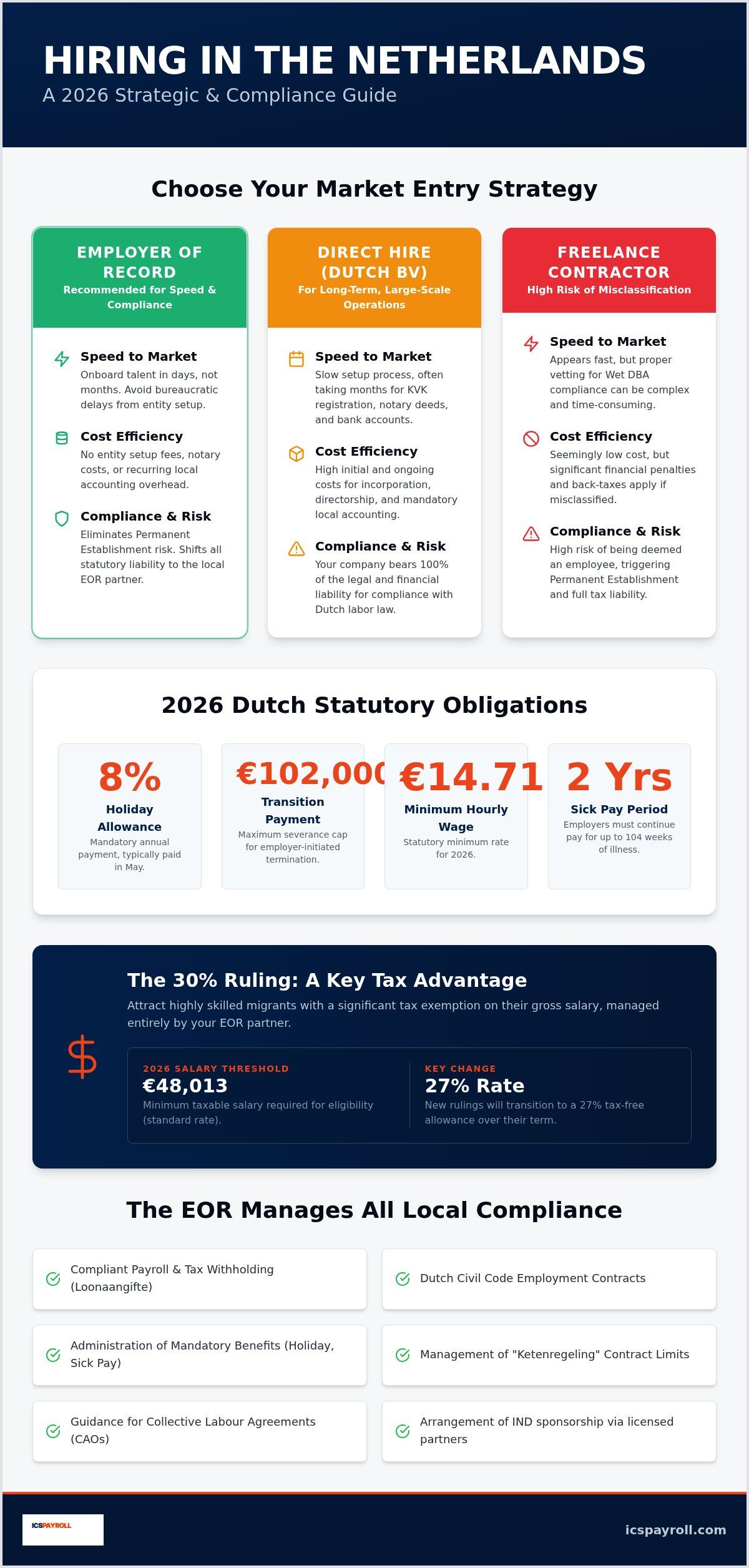
Speed to market is the primary driver for choosing an EOR. Incorporating a Dutch BV involves notary fees, KVK registration, and potentially months of administrative delays. An Employer of Record Netherlands allows you to onboard talent in just a few business days. This efficiency is critical in a competitive labor market where top candidates won't wait for a foreign company to navigate local bureaucracy.
Cost efficiency and risk mitigation also play significant roles. You avoid the recurring overhead of maintaining a Dutch legal entity, such as annual accounting and local directorship requirements. Dutch labor law is protective, featuring strict "Ketenregeling" contract limits and a mandatory two-year sick pay period. By partnering with a local specialist, you shift the burden of compliance to an expert. This ensures the correct application of the 8% holiday allowance and precise 2026 social security premiums, such as the Zvw, AWf, and Aof, ensuring every filing is accurate and legally sound.
Navigating Dutch Labor Law and Compliance Requirements in 2026
The operational framework for hiring in the Netherlands is rooted in the Dutch Civil Code. While the Code provides a statutory floor, many industries operate under Collective Labour Agreements (CAOs) that impose additional obligations. An Employer of Record Netherlands ensures your organization navigates these layers without error. A critical administrative requirement is the Loonaangifte (wage tax filing). These filings must be submitted and paid to the Tax Administration by the last day of the month following the payroll period. For example, the deadline for the January filing is February 28. Missing these windows results in immediate fines and interest charges from the Belastingdienst, making administrative precision a necessity for international firms.
Mandatory Employee Benefits in the Netherlands
Dutch law mandates specific benefits that must be factored into your total cost of employment. Every employee is entitled to a statutory 8% holiday allowance, typically paid in May, and a minimum of 20 vacation days for a full-time role. Beyond these, you must account for the statutory transition payment, which is capped at €102,000 in 2026. This payment is due if the employment is terminated at the employer's initiative, making it a vital consideration for long-term financial planning. Managing these calculations with precision is a core function of our Dutch payroll administration services, ensuring every accrual is legally sound.
The "Sick Pay" Challenge and Statutory Premiums
The Netherlands requires employers to pay 70% to 100% of an employee's wages for up to two years during illness. This is governed by the Wet Verbetering Poortwachter, which demands a rigorous reintegration process. Failure to comply can lead to a third year of mandatory salary payments. Protecting your business from this volatility requires an EOR that understands how to manage occupational health services and social security premiums. In 2026, the employer Healthcare Insurance Act (Zvw) contribution is 6.10%, capped at an income of €79,409. You must also account for the General Unemployment Fund (AWf) and the Disability Insurance Fund (Aof), which vary based on the contract's duration and type. By partnering with a local expert, you ensure these percentages are applied correctly to every payslip, maintaining full compliance with current Dutch law.
EOR vs. Freelance vs. Dutch BV: Choosing Your Model
Choosing the right engagement model is a strategic decision that determines your tax liability and operational speed. For many international firms, the choice lies between hiring freelancers, incorporating a local Dutch BV, or using an Employer of Record Netherlands. Each path carries distinct financial and legal implications. A significant concern for foreign entities is "Permanent Establishment" (PE) risk. If a foreign company conducts core business activities through an employee in the Netherlands without a local entity, the Belastingdienst may claim the parent company owes Dutch corporate tax on global profits. An EOR mitigates this risk by acting as the local legal employer, providing a compliant shield for your international operations.
The EOR model is often the "Goldilocks" solution for mid-sized teams. It provides the legal security of a local company without the high overhead. While hiring a freelancer seems easier, it often leads to regulatory scrutiny. Conversely, a Dutch BV offers full control but requires a long-term commitment and significant administrative maintenance. For businesses testing the Dutch market or scaling quickly, the EOR provides the necessary balance of speed and security.
The Hidden Risks of Using Freelancers (False Self-Employment)
Engaging talent as freelancers (ZZP'ers) in 2026 involves high stakes due to stricter enforcement of the Wet DBA and the upcoming VBAR legislation. The Dutch authorities are cracking down on "Schijnzelfstandigheid," or false self-employment. If the working relationship mirrors that of an employee, such as having a fixed schedule or working under direct supervision, the tax authorities will reclassify the relationship. In 2026, there is a legal presumption of an employment relationship for any hourly rates below €36. Reclassification results in back-dated social security premiums, unpaid wage taxes, and heavy fines. An Employer of Record Netherlands eliminates this misclassification risk by providing a valid employment contract that satisfies all Dutch labor standards.
When Should You Incorporate a Dutch BV?
Incorporating a Dutch BV (Private Limited Company) is typically reserved for organizations with a long-term strategic interest in the Netherlands or teams exceeding 10 to 15 employees. The initial setup costs in 2026 range from €600 to €2,500. This includes a mandatory Chamber of Commerce (KVK) registration fee of €85.15 and notary charges between €500 and €1,500. Beyond setup, the administrative burden is significant. You must manage corporate tax filings, appoint local directors, and handle complex annual accounting. ICSPayroll facilitates a seamless transition for clients who reach this critical mass, moving your staff from our EOR platform to your own payroll administration once your local entity is fully operational.
The 30% Ruling: A Strategic Advantage for International Employers
The 30% ruling is a fiscal incentive designed to attract high-level international expertise to the Dutch labor market. For an Employer of Record Netherlands, this ruling is more than a payroll adjustment; it's a powerful recruitment tool that allows you to offer competitive net salaries without inflating your gross employment costs. By designating 30% of an employee's gross salary as a tax-free allowance for extraterritorial expenses, the effective tax rate is significantly reduced. This benefit is crucial for maintaining a competitive edge in sectors like fintech and renewable energy where global talent is in high demand. The ruling allows your business to present a high take-home pay package while your total cost of employment remains manageable.
Eligibility Criteria for Highly Skilled Migrants in 2026
The Belastingdienst enforces strict annual salary thresholds to qualify for this tax advantage. In 2026, the standard gross annual salary requirement is €48,013. For employees under the age of 30 who hold a qualifying master's degree, the threshold is lower at €36,497. These amounts are exclusive of the tax-free allowance itself. Additionally, the "150km rule" mandates that the hire must have lived more than 150 kilometers from the Dutch border for at least 16 of the 24 months prior to their first working day. This ensures the benefit is reserved for those truly recruited from abroad.
Securing this status requires the employer to be an IND recognized sponsor. While ICSPayroll facilitates the necessary filings, these sponsorship services are arranged through our network of licensed partners. It's also vital to account for recent legislative shifts. The partial non-resident tax status was abolished on January 1, 2025. While 2026 hires currently benefit from the 30% rate, current law dictates a transition to a 27% rate for all qualifying employees starting January 1, 2027. Precise administrative handling is required to manage these transitions without compromising compliance.
Employer Benefits: Recruitment and Retention
The financial impact of the 30% ruling extends beyond the employee's take-home pay. It effectively reduces the employer's social security burden because premiums are calculated on the lower taxable salary. This allows international firms to attract top-tier management talent that might otherwise be deterred by high Dutch income tax brackets. The 30% ruling is a 5-year tax break for eligible international hires recruited from abroad. Using this incentive correctly can be the deciding factor for a candidate choosing between a Dutch role and a position in another European hub.
Using an Employer of Record Netherlands ensures that the application is filed correctly and within the strict four-month deadline from the start of employment. Missing this window results in the ruling only being applicable from the month following the application, leading to a permanent loss of tax benefits for the initial period. Our team manages the entire 30% ruling application process to ensure your staff receives their approval decree without administrative delays, providing peace of mind for both the business and the employee.
Why ICSPayroll is Your Premier Local EOR Partner
ICSPayroll operates as a dedicated specialist in the Dutch labor market. Unlike global aggregators that manage dozens of jurisdictions through automated software, we focus exclusively on the Netherlands. This specialization allows us to act as a precise bridge between your international business goals and the complexities of Dutch bureaucracy. As a subsidiary of Intercompany Solutions, we provide a unique advantage: we don't just manage payroll; we offer a path for long-term growth. If your team eventually reaches the scale where a local BV is required, our integrated corporate support ensures a seamless transition without the need to switch service providers. This continuity provides the security and reliability essential for high-level international operations.
Local Expertise vs. Global Generalists
Having "boots on the ground" in the Netherlands is a critical safeguard for your business. Global platforms often rely on standardized templates that may miss the nuances of sector-specific Collective Labour Agreements (CAOs) or updated 2026 premiums. Our human-led approach means you have direct access to experts who communicate with the Belastingdienst and the UWV on your behalf. This direct interaction is vital during tax audits or complex labor disputes. We ensure that every Loonaangifte (wage tax filing) is submitted with clinical precision, adhering to the seven-year record-keeping requirement mandated by Dutch law. While software can automate a calculation, it cannot replace the strategic oversight needed to manage the two-year sick pay obligation or the technicalities of a 30% ruling application.
Our status as an Employer of Record Netherlands means we take full accountability for local compliance. We don't hide behind automated ticketing systems. Instead, we provide personalized support to ensure your staff feels valued and legally protected. This level of care is a significant factor in talent retention, as Dutch employees prioritize stability and clear, compliant employment terms.
Getting Started: Your 48-Hour Onboarding Roadmap
We've optimized our process to move your business from initial inquiry to a signed contract within two business days. Our methodical approach eliminates the traditional delays associated with international expansion.
- Step 1: Consultation and cost calculation. We provide a transparent breakdown of total employer costs, including the 8% holiday allowance and 2026 social security premiums like the AWf and Zvw.
- Step 2: Compliant Dutch employment contract generation. We draft contracts that strictly adhere to the Dutch Civil Code, ensuring correct probation periods and "Ketenregeling" contract limits.
- Step 3: Employee onboarding and 30% ruling assessment. We assess eligibility for the €48,013 salary threshold and coordinate with licensed partners to initiate the application process immediately.
- Step 4: Monthly payroll management and compliance monitoring. We handle all recurring filings and administrative duties, providing you with peace of mind and a minimized administrative burden.
By following this structured flow, we ensure your entry into the Dutch market is fast, legal, and highly efficient. You retain the day-to-day management of your team while we maintain the rigorous legal standards required in the Netherlands.
Secure Your Future in the Dutch Labor Market
Hiring in the Netherlands offers immense strategic value, but success depends on navigating a highly protective legal landscape. We've detailed how an Employer of Record Netherlands serves as a vital bridge, allowing you to bypass the complexities of Dutch BV incorporation while eliminating "Permanent Establishment" tax risks. Your organization can now prioritize talent retention by utilizing the 30% ruling and ensuring every statutory requirement, from the 8% holiday allowance to the €14.71 minimum hourly wage, is managed with clinical precision.
ICSPayroll provides the specialized Dutch compliance expertise and comprehensive 30% ruling support needed to stabilize your international operations. While sponsorship services are arranged via our network of licensed partners, our human-led approach ensures you never feel like just another ticket in a global system. We're here to remove the administrative friction that stalls growth. Take the first step toward a compliant and efficient Dutch presence by requesting a clear breakdown of your projected expenses. Get a Customized Dutch Employment Cost Calculation to begin your expansion with total confidence. Your journey into one of Europe's most vibrant economies starts here.
Frequently Asked Questions
Can I hire an employee in the Netherlands without a local legal entity?
Yes, you can hire Dutch staff without a local BV by using an Employer of Record Netherlands. The EOR becomes the legal employer of record, handling all payroll, tax, and labor law obligations while you retain daily management of the staff. This structure bypasses the need for local incorporation and eliminates the risk of tax reclassification by Dutch authorities, providing a secure bridge for international expansion.
What is the minimum wage in the Netherlands for 2026?
The statutory minimum wage as of January 1, 2026, is €14.71 per hour for adults aged 21 and older. This rate is adjusted twice annually to reflect economic changes. Employers must also factor in the mandatory 8% holiday allowance on top of this gross salary. For specific industry standards, we recommend checking if a Collective Labour Agreement (CAO) applies to your sector, as these often mandate higher hourly rates.
How long does it take to onboard an employee via an EOR in the Netherlands?
Onboarding typically takes between 2 and 5 business days once the service agreement is finalized. This speed is a significant advantage over the months required to set up a Dutch BV and register with the Chamber of Commerce (KvK). Our streamlined process ensures that compliant employment contracts are generated and tax documentation is collected rapidly, allowing your new hire to begin their assignment without administrative delays.
What are the costs associated with using an Employer of Record?
The total cost includes the gross salary, mandatory employer premiums, and a predictable monthly service fee. Mandatory premiums, including the Healthcare Insurance Act (Zvw) and unemployment funds (AWf/Aof), generally add 20% to 30% to the gross wage. Using an Employer of Record Netherlands provides a transparent monthly invoice, which simplifies budget control and eliminates the variable overhead costs associated with maintaining a local legal entity.
Does an EOR in the Netherlands handle work permits and visas?
Yes, work permits and highly skilled migrant visas are managed through our network of licensed partners. These partners maintain the necessary IND recognized sponsor status to facilitate the entry of non-EU talent. We coordinate the entire application process to ensure that employment contracts and visa requirements are perfectly synchronized, maintaining full compliance with Dutch immigration law and the specific 2026 salary thresholds for international hires.
What happens if a Dutch employee gets sick?
Employers are legally responsible for paying 70% to 100% of an employee's wages for up to two years of illness. You must also follow the strict reintegration steps outlined by the UWV (Employee Insurance Agency). An EOR manages this complex process on your behalf, coordinating with occupational health services and company doctors to minimize the financial and legal risks of long-term sick leave under the Wet Verbetering Poortwachter.
Can I use an EOR for a single employee in the Netherlands?
Absolutely. The EOR model is designed for scalability and is perfectly suited for hiring a single specialist or a small representative team. There is no minimum headcount requirement for our services. This flexibility allows international businesses to test the Dutch market with one employee before committing to a larger local presence or transitioning to a full legal incorporation once a critical mass is reached.
How does the 30% ruling affect my total employment costs?
The 30% ruling lowers your total employment costs by reducing the taxable base for social security contributions. By paying 30% of the salary as a tax-free allowance, the employer's premiums are calculated on only 70% of the gross wage. This incentive provides a significant net salary boost for the employee while lowering the employer's total financial commitment, making it an essential tool for attracting top-tier global talent in 2026.

Article by
Joost Hubregtse
Joost Hubregtse is Director of ICS Staffing & Payroll B.V., the wholly owned subsidiary of Intercompany Solutions behind ICS Payroll. He is responsible for Employer of Record and Dutch payroll services: employment contracts, wage tax and social security filings, holiday allowance, pension, sick leave and CAO compliance, with onboarding possible within 48 hours.

Frequently Asked Questions
Incorporating a Dutch BV (Private Limited Company) is typically reserved for organizations with a long-term strategic interest in the Netherlands or teams exceeding 10 to 15 employees. The initial setup costs in 2026 range from €600 to €2,500. This includes a mandatory Chamber of Commerce (KVK) registration fee of €85.15 and notary charges between €500 and €1,500. Beyond setup, the administrative burden is significant. You must manage corporate tax filings, appoint local directors, and handle complex annual accounting. ICSPayroll facilitates a seamless transition for clients who reach this critical mass, moving your staff from our EOR platform to your own payroll administration once your local entity is fully operational. The 30% ruling is a fiscal incentive designed to attract high-level international expertise to the Dutch labor market. For an Employer of Record Netherlands, this ruling is more than a payroll adjustment; it's a powerful recruitment tool that allows you to offer competitive net salaries without inflating your gross employment costs. By designating 30% of an employee's gross salary as a tax-free allowance for extraterritorial expenses, the effective tax rate is significantly reduced. This benefit is crucial for maintaining a competitive edge in sectors like fintech and renewable energy where global talent is in high demand. The ruling allows your business to present a high take-home pay package while your total cost of employment remains manageable.
Yes, you can hire Dutch staff without a local BV by using an Employer of Record Netherlands. The EOR becomes the legal employer of record, handling all payroll, tax, and labor law obligations while you retain daily management of the staff. This structure bypasses the need for local incorporation and eliminates the risk of tax reclassification by Dutch authorities, providing a secure bridge for international expansion.
The statutory minimum wage as of January 1, 2026, is €14.71 per hour for adults aged 21 and older. This rate is adjusted twice annually to reflect economic changes. Employers must also factor in the mandatory 8% holiday allowance on top of this gross salary. For specific industry standards, we recommend checking if a Collective Labour Agreement (CAO) applies to your sector, as these often mandate higher hourly rates.
Onboarding typically takes between 2 and 5 business days once the service agreement is finalized. This speed is a significant advantage over the months required to set up a Dutch BV and register with the Chamber of Commerce (KvK). Our streamlined process ensures that compliant employment contracts are generated and tax documentation is collected rapidly, allowing your new hire to begin their assignment without administrative delays.
The total cost includes the gross salary, mandatory employer premiums, and a predictable monthly service fee. Mandatory premiums, including the Healthcare Insurance Act (Zvw) and unemployment funds (AWf/Aof), generally add 20% to 30% to the gross wage. Using an Employer of Record Netherlands provides a transparent monthly invoice, which simplifies budget control and eliminates the variable overhead costs associated with maintaining a local legal entity.
Yes, work permits and highly skilled migrant visas are managed through our network of licensed partners. These partners maintain the necessary IND recognized sponsor status to facilitate the entry of non-EU talent. We coordinate the entire application process to ensure that employment contracts and visa requirements are perfectly synchronized, maintaining full compliance with Dutch immigration law and the specific 2026 salary thresholds for international hires.
Employers are legally responsible for paying 70% to 100% of an employee's wages for up to two years of illness. You must also follow the strict reintegration steps outlined by the UWV (Employee Insurance Agency). An EOR manages this complex process on your behalf, coordinating with occupational health services and company doctors to minimize the financial and legal risks of long-term sick leave under the Wet Verbetering Poortwachter.
Absolutely. The EOR model is designed for scalability and is perfectly suited for hiring a single specialist or a small representative team. There is no minimum headcount requirement for our services. This flexibility allows international businesses to test the Dutch market with one employee before committing to a larger local presence or transitioning to a full legal incorporation once a critical mass is reached.
The 30% ruling lowers your total employment costs by reducing the taxable base for social security contributions. By paying 30% of the salary as a tax-free allowance, the employer's premiums are calculated on only 70% of the gross wage. This incentive provides a significant net salary boost for the employee while lowering the employer's total financial commitment, making it an essential tool for attracting top-tier global talent in 2026.