
Year-end payroll process in the Netherlands: tax and holiday pay
By Joost Hubregtse, Director, ICS Staffing & Payroll
All blog posts are reviewed and fact checked by our labour law lawyer Zishan Hussain and our director. Editorial standards
A payroll year isn’t complete when the final salary is paid. The year-end payroll process in the Netherlands also includes accounting for holiday allowance, handling tax withholding, preparing annual wage statements, and retaining payroll records for seven years.
It’s easy to focus on the final payment and overlook the records and reporting needed to close the year. This guide explains key Dutch year-end obligations: how holiday allowance and bonuses are treated, what employees need on their annual wage statements, and how long payroll records must be kept.
You’ll also see how these responsibilities fit into the wider payroll cycle, so you can distinguish year-end tasks from those that carry into the next calendar year.
Key Takeaways
- Include the statutory holiday allowance in year-end pay calculations. The Dutch minimum is 8% of annual gross salary.
- Process tax withholding on bonuses and 13th-month payments as special rewards, rather than treating them as ordinary salary.
- Prepare an annual wage statement that gives employees the salary and withholding information they need for their tax return.
- Keep payroll records organized and accessible. Dutch businesses generally retain their administration for seven years.
- Review payroll figures and supporting records together to help carry accurate information into the next calendar year.
Statutory holiday allowance and holiday entitlement
Dutch employers must provide holiday allowance of at least 8% of annual gross salary. Employees also accrue statutory paid leave separately, based on their weekly working hours.
Holiday allowance in year-end settlement
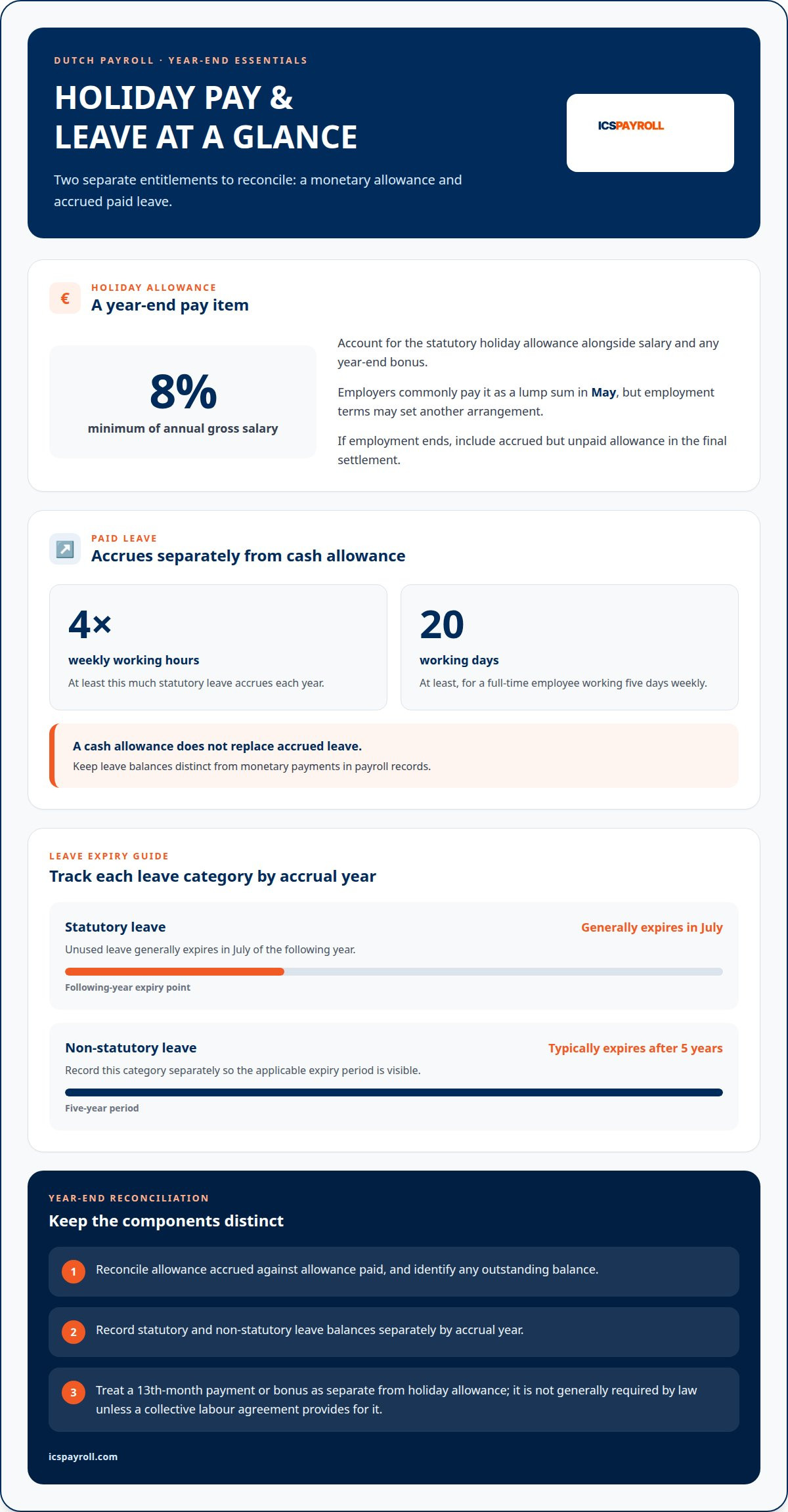
Holiday allowance is a separate pay entitlement that payroll accounts for alongside salary and any year-end bonus. According to Business.gov.nl’s holiday allowance guidance, the statutory minimum is 8% of annual gross salary. This matters when reconciling annual earnings: a 13th-month payment or year-end bonus is separate and is not generally required by law unless a collective labour agreement provides for it. If employment ends, accrued but unpaid holiday allowance must be included in the final settlement.
Holiday allowance payment timing
Employers commonly pay holiday allowance as a lump sum in May, though employment terms may set a different arrangement. Track the amount accrued and paid during the year, then include any outstanding balance in the year-end reconciliation. This helps identify amounts still due if employment ends or the agreed payment schedule differs.
The statutory allowance is calculated against annual gross salary, at a minimum rate of 8%. For example, payroll applies that percentage to the relevant salary base rather than treating the allowance as an extra month of salary. A 13th-month payment is separate: it is an additional month’s gross wages, excluding holiday allowance. Its amount and timing depend on the employment terms or applicable collective agreement.
Paid leave is a separate entitlement from holiday allowance. According to Business.gov.nl’s holiday entitlement guidance, employees accrue statutory leave equal to at least four times their weekly working hours each year. For a full-time employee working five days weekly, this amounts to at least 20 working days. A cash allowance does not replace accrued leave, so payroll records should show leave balances separately from monetary payments.
Pension treatment depends on the payment and applicable employment terms. A year-end bonus or 13th-month payment generally does not attract further holiday allowance or pension accrual unless the contract or collective labour agreement provides otherwise. Payroll should identify each payment separately and apply the relevant pensionable-pay definition, rather than automatically treating every extra payment as ordinary salary.
Review leave balances alongside holiday allowance. Statutory leave accrued in one year generally expires in July of the following year if unused; non-statutory leave typically expires after five years. Record each category by accrual year to identify leave nearing expiry. The allowance calculation, payment history, pension treatment, and leave ledger together provide a clearer year-end position.
Wage tax brackets and national insurance contributions
Payroll combines employee wage tax withholding with employer premiums and contributions. A year-end bonus or 13th-month payment also affects calculations when paid.
Wage tax brackets and withholding
Wage tax withholding is deducted from salary and reported through Dutch payroll. For 2026, the combined income tax and social-premium rate in the first Box 1 bracket is 35.75% on income from €0 to €38,883, according to the Belastingdienst. The applicable rate matters because taxable earnings and special payments affect the withholding recorded for the year.
Employers calculate wage tax on a year-end bonus or 13th-month payment using the payroll tax table for special rewards. They deduct the resulting withholding and report it through payroll. Employees generally apply the payroll tax credit with one employer at a time, so information about other employment can affect which credit is applied.
National insurance contributions
National insurance contributions are part of payroll deductions, while employer insurance premiums are separate costs. Distinguishing them helps explain why an employee’s deductions differ from the employer’s payroll costs.
For 2026, the AWf unemployment insurance rate is 2.74% for permanent written contracts and 7.74% for flexible or temporary contracts. The Aof rates are 6.27% and 7.63%, depending on employer classification, as published in the Staatscourant. These rates affect employer costs, not an employee’s net salary in the same way as wage tax withholding.
The employer Zvw health insurance contribution is 6.10% in 2026, applied to income up to the maximum premium base of €79,409. The contribution is distinct from an employee’s own health insurance premium, which employees arrange separately. Applying the contribution only within its stated base helps payroll distinguish employer charges from employee deductions.
A year-end bonus or 13th-month payment is not generally mandatory under Dutch law, although a collective labour agreement may require one. If agreed, the employment contract or collective agreement sets its conditions, including timing. Employers often pay these amounts in November or December. Payroll must apply wage tax withholding and relevant national insurance contributions when processing the payment.
For year-end reconciliation, payroll records should distinguish gross salary, special payments, employee withholding, and employer premiums. The €79,409 maximum premium base applies to employee insurance contributions; the employer Zvw contribution also has that stated ceiling. These limits matter when annual earnings approach the base. Clear payslips help employees distinguish salary and deductions from employer-paid contributions, while payroll records preserve the calculation behind each amount.
Businesses managing Dutch payroll calculations can use Dutch payroll administration for processing salary, withholding, and employer premiums.
Income tax rates and payroll tax withholding
The jaaropgave summarizes an employee’s annual payroll figures for Dutch tax purposes. Year-end closing connects monthly payroll data and tax treatment to the employee’s final statement.
To prepare annual statements, reconcile each employee’s payroll totals with the final payslip, then issue a separate statement for each income source. Provide it by the end of February following the calendar year. Check that employee and employer details, salary totals, and withholding figures match the payroll records.
The annual statement gives employees information for their Dutch income tax return. It reports total earnings, wage tax withheld, and social contributions for the previous tax year. Figures should align with year-end payroll data, including any corrections to earlier payslips. Employees with multiple income sources receive a separate statement for each source.
Payroll withholding is an advance collection of tax on employment income. The annual statement summarizes the income and deductions reported during the calendar year, which runs from January 1 to December 31. For 2026, the combined rate in the first Box 1 bracket is 35.75% on income from €0 to €38,883, according to the Belastingdienst’s Box 1 tax-rate information. Reconciling annual totals helps identify differences before they appear on employee statements.
Employers file the Dutch payroll tax return, or loonaangifte, for each payroll period, usually monthly or every four weeks. The return is due by the last day of the following month, according to the Belastingdienst’s payroll tax filing guidance. Aligning each period’s submitted figures with payroll records supports consistent annual totals.
For 2026, the statutory gross minimum wage for employees aged 21 and over was €14.71 per hour on January 1 and €14.99 per hour on July 1, according to Business.gov.nl’s minimum-wage information. These are hourly rates, so payroll checks use actual hours worked rather than an assumed fixed monthly amount.
Where an employee has an approved 30% ruling, payroll applies the written decision and relevant conditions. In 2026, the taxable salary threshold after the deduction is €48,013, or €36,497 for eligible employees under 30 with a master’s degree, according to the Belastingdienst’s 30% ruling guidance. The applicable taxable salary figure is used when assessing these thresholds.
At year-end, close the calendar-year payroll, reconcile submitted returns and employee records, resolve discrepancies, and prepare each annual statement. Link the source figures to each reported total to support accurate Dutch tax reporting and give employees a clear record for their returns.
Mandatory year-end statements include set-off life-course leave tax credit and withholding-table colour; usual Dutch tax/wage tax: 2.3% to 52%; 37.1% to 37.07% up to €69,398 annual income, 36.93% up to €73,031, 49.50% above.
Annual wage statements (jaaropgave)
The jaaropgave records an employee’s annual payroll figures for Dutch tax purposes. A consistent year-end payroll process in the Netherlands connects monthly payroll data and tax treatment to each employee’s final statement.
Taxable wage and withholding tax
Taxable wage is the income figure used to calculate payroll tax withholding and report annual earnings. Employees use the annual statement when preparing their Dutch income tax return. It shows total earnings, wage tax withheld, and social contributions for the previous tax year. Distinguish taxable salary from net pay in payroll records so employees can trace how reported income relates to payments received.
Year-end wage tax reporting
Year-end wage tax reporting reconciles payroll records with amounts reported for each payroll period. Employers file a payroll tax return for each period, usually monthly or every four weeks. The 2026 Fact Sheet sets the deadline at the last day of the following month. Annual statements should reflect the resulting yearly totals, including corrections to earlier filings.
For 2026, the statutory gross minimum wage for employees aged 21 and over was €14.71 per hour on January 1, according to the Government of the Netherlands. From July 1, the rate was €14.99 per hour. These are hourly rates, so payroll checks must account for actual hours worked rather than assume a fixed monthly minimum.
Year-end payroll closing steps
Closing payroll means finalizing calendar-year figures before issuing employee statements. Reconcile the final payroll, record corrections, confirm taxable pay and withholding, then prepare each statement. Provide it by the end of February following the calendar year. This sequence helps ensure employees receive figures aligned with the employer’s completed annual records.
For an employee covered by an approved 30% ruling, payroll applies the treatment set out in the written Belastingdienst decision and applicable conditions. Keep the decision with the employee’s payroll records, and account for its treatment when preparing the annual statement. This ensures the reported income reflects the payroll calculation used during the year.
Year-end payroll reconciliation
Reconciliation compares employee payroll records with submitted returns and annual totals. Match gross salary, taxable wage, wage tax, social contributions, and corrections across payslips and returns. This helps identify discrepancies before they carry into the jaaropgave or the next reporting period.
A well-managed year-end payroll process in the Netherlands also records why a correction was made and which reporting period it affects. Keep the 30% ruling decision connected to the relevant payroll entries, and note salary or working-hour changes that affected minimum-pay calculations. This creates a clearer audit trail for Dutch tax reporting and gives employees a consistent annual income record.
Payroll records and data retention
Dutch businesses generally retain their administration for seven years. At year-end, payroll records should provide a traceable history of salary, wage tax, social security contributions, and employee balances.
Think of the payroll file as the link between each monthly calculation and its annual result. Organize payslips, payroll reports, wage tax returns, payment records, and annual wage statements by employee and reporting period. This makes it easier to trace reported income and deductions, including national insurance and employer premiums.
Separate records for different payroll elements. Salary and taxable wage support income tax reporting; contribution details show how social security costs were calculated. Leave and holiday allowance balances provide context for payments and outstanding entitlements. Where a tax credit or the 30% ruling affects payroll treatment, retain the relevant payroll detail and decision alongside the period records.
A practical year-end review groups records by calendar year and matches payroll reports against submitted returns and payment information. Clearly identify corrections, preserving both the original figures and the revised result. This creates a readable audit trail instead of leaving reviewers to infer why an amount changed. The seven-year retention period makes consistent filing important well beyond the year-end close.
When switching payroll providers or software at year-end, preserve the complete payroll history and transfer opening balances with supporting detail. Compare employee data, year-to-date wages, withholding, national insurance, pension information, leave balances, and tax-credit treatment across the old and new records. This helps prevent incomplete totals from carrying into the first payroll run in the new system.
For example, an employee’s year-to-date taxable wage should be traceable to earlier payslips and wage tax returns. A holiday allowance balance should retain its accrual and payment history. Document unresolved corrections and the periods they concern, so the new administration doesn’t mistake them for current salary or a new credit.
Access and organization matter as much as retention. Use a consistent structure by employee and period, with clear labels for income tax, social security contributions, and supporting records. Keep each annual statement linked to the payroll data it summarizes. These practices help employers retrieve evidence during a later review and keep statutory records distinct from working notes.
For continuity through a payroll transition, discuss Dutch payroll administration and year-end record handling.
ICSPayroll: Dutch Payroll Administration
ICSPayroll supports employers with Dutch payroll obligations through Dutch Payroll and Employer of Record (EOR) services. These services can help manage payroll calculations, tax withholding, annual wage statements, and record retention, or provide an employment arrangement in the Netherlands.
For internationally recruited employees, ICSPayroll also manages the 30% Ruling Application process. Each offering addresses a different payroll need, from ongoing administration to employing staff through an EOR arrangement or handling an eligible ruling application. The right next step depends on your Dutch employment setup and the payroll responsibilities you need covered.
Contact ICSPayroll to discuss your Dutch payroll requirements and year-end process.
Build a stronger payroll cycle for the year ahead
Treat the year-end payroll process in the Netherlands as a planning checkpoint, not just an administrative close. Use the transition into the new year to clarify who owns payroll inputs, approvals, corrections, and employee communications. Clear responsibilities make recurring decisions easier to manage and reduce uncertainty when payroll information changes.
A short internal calendar can connect these responsibilities to the regular payroll cycle. Set out when teams provide updates, who reviews exceptions, and how unresolved items are recorded. This creates a consistent process for employees and finance teams, while allowing for changes in employment terms or tax treatment.
For international employers, a defined process also helps keep local payroll decisions visible across the wider business. ICSPayroll offers Dutch payroll support, Employer of Record services, and 30% Ruling Applications for relevant employment arrangements. The next step is to discuss the support that fits your Dutch payroll setup.
Contact ICSPayroll about your payroll to plan the next cycle with clarity and confidence.
Frequently Asked Questions
What are the Dutch payroll tax deadlines and year-end filing requirements?
Submit each Dutch payroll tax return by the last day of the following month, as stated in the 2026 Fact Sheet. At year-end, reconcile the reported payroll periods, record any corrections, and prepare each employee’s annual wage statement. Provide that statement by the end of February following the calendar year. For example, the 2026 statement is due by the end of February 2027.
What year-end payroll changes apply to Dutch tax brackets, tax credits, and social security rates?
For 2026, employer premium rates include AWf at 2.74% for permanent written contracts and 7.74% for flexible or temporary contracts. The employer Zvw contribution is 6.10%, up to the €79,409 maximum premium base. Tax brackets and payroll tax credits can change between tax years, so payroll settings should be updated for the applicable year. Employees generally apply the payroll tax credit with one employer at a time.
What are the rules for calculating holiday allowance, bonuses, and year-end payments in Dutch payroll?
Calculate statutory holiday allowance at a minimum of 8% of annual gross salary, and keep it distinct from any bonus or 13th-month payment. A year-end bonus is not generally mandatory under Dutch law, though a collective labour agreement can require one. If paid, payroll withholds tax using the special-reward table. For example, a December bonus should appear separately from regular salary in payroll records.
What payroll records must Dutch employers retain, and for how long?
Dutch businesses generally retain their administration for seven years. Payroll files should preserve supporting records such as payslips, wage tax returns, payment information, annual statements, and relevant employee payroll details. Organize these by employee and reporting period so each reported figure can be traced to its calculation. For example, file a correction with the return period it changes, rather than separately without context.
What are the penalties and risks for incorrect or late Dutch payroll filings?
Incorrect figures can create mismatches between payroll records and annual wage statements, or carry inaccurate information into the next calendar year. Reconcile payroll totals and supporting records to catch differences before issuing statements.

Article by
Joost Hubregtse
Joost Hubregtse is Director of ICS Staffing & Payroll B.V., the wholly owned subsidiary of Intercompany Solutions behind ICS Payroll. He is responsible for Employer of Record and Dutch payroll services: employment contracts, wage tax and social security filings, holiday allowance, pension, sick leave and CAO compliance, with onboarding possible within 48 hours.
Frequently Asked Questions
Submit each Dutch payroll tax return by the last day of the following month, as stated in the 2026 Fact Sheet. At year-end, reconcile the reported payroll periods, record any corrections, and prepare each employee’s annual wage statement. Provide that statement by the end of February following the calendar year. For example, the 2026 statement is due by the end of February 2027.
For 2026, employer premium rates include AWf at 2.74% for permanent written contracts and 7.74% for flexible or temporary contracts. The employer Zvw contribution is 6.10%, up to the €79,409 maximum premium base. Tax brackets and payroll tax credits can change between tax years, so payroll settings should be updated for the applicable year. Employees generally apply the payroll tax credit with one employer at a time.
Calculate statutory holiday allowance at a minimum of 8% of annual gross salary, and keep it distinct from any bonus or 13th-month payment. A year-end bonus is not generally mandatory under Dutch law, though a collective labour agreement can require one. If paid, payroll withholds tax using the special-reward table. For example, a December bonus should appear separately from regular salary in payroll records.
Dutch businesses generally retain their administration for seven years. Payroll files should preserve supporting records such as payslips, wage tax returns, payment information, annual statements, and relevant employee payroll details. Organize these by employee and reporting period so each reported figure can be traced to its calculation. For example, file a correction with the return period it changes, rather than separately without context.
Incorrect figures can create mismatches between payroll records and annual wage statements, or carry inaccurate information into the next calendar year. Reconcile payroll totals and supporting records to catch differences before issuing statements.