
Risks of Hiring Contractors in the Netherlands: Tax Exposure
By Joost Hubregtse, Director, ICS Staffing & Payroll
All blog posts are reviewed and fact checked by our labour law lawyer Zishan Hussain and our director. Editorial standards
A contractor agreement alone doesn’t determine worker status in the Netherlands; the way the work is actually carried out matters. The risks of hiring contractors in the Netherlands include reclassification, payroll tax liabilities and claims for employee benefits. Since 1 January 2025, the Dutch Tax Administration can impose additional assessments for misclassified work, with assessments retroactive to that date.
Contracting can offer flexibility, but that flexibility depends on a genuine independent working relationship, not just the wording of an agreement. This article explains how status is assessed, why long engagements and dependence on one client can increase exposure, and what tax and employment liabilities may follow reclassification. It also outlines how to prepare for possible legal changes and when a different hiring arrangement may be more suitable.
Key Takeaways
- Worker status depends on how the work is actually carried out, not just the label in the contract. Assess control, personal performance, payment and the practical working relationship together.
- Reclassification can bring employee protections and retroactive liabilities, including payroll taxes and claims for benefits such as sick pay.
- Since 1 January 2025, the Wet DBA enforcement moratorium has ended, and tax assessments can be retroactive to that date.
- The Senate passed a stripped-down VBAR bill on 16 June 2026. Its proposed presumption of employment below €38 per hour is not yet in force.
- Where the work functions like employment, compare contractor engagement with a compliant employment arrangement before the relationship continues.
Employee benefits and protections compared with contractors
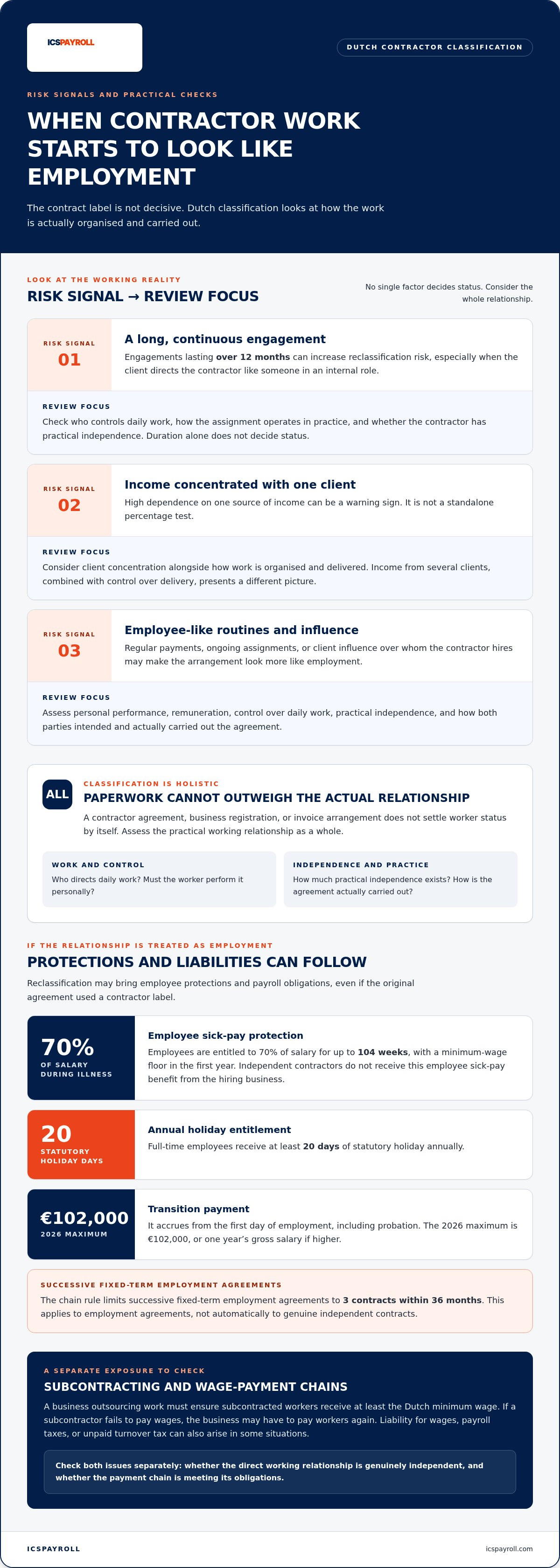
In the Netherlands, employee protections can apply when a working relationship is employment in practice, even if the agreement calls the worker a contractor. That distinction affects payroll tax, sick pay and other statutory entitlements.
Employment Status Classification Tests
Dutch classification assesses the working relationship as a whole, rather than relying on the contract’s title. The framework draws on a 2021 Supreme Court ruling involving Deliveroo.
Relevant criteria include whether the worker must perform the work personally, receives remuneration, and how both sides intended and actually carried out the agreement. Control over daily work and the worker’s practical independence also help reveal the relationship’s substance. No single factor determines status. A contractor label cannot settle the question if the arrangement operates like employment.
The DBA Act entered into force on 1 May 2016 and abolished the VAR declaration. A separate presumption applies to work performed for remuneration for at least 20 hours per month or weekly for at least three consecutive months, unless evidence rebuts it. For a business, the practical point is to assess the arrangement’s real features, not just its paperwork.
Successive Fixed-Term Agreement Limits
The Dutch chain rule limits successive fixed-term employment agreements to 3 contracts within 36 months. If work continues beyond the applicable limit, the worker may acquire an indefinite-term employment agreement.
This rule applies to employment agreements, not automatically to genuine independent contracts. But if an arrangement is treated as employment, the sequence of contracts can matter. When reviewing repeated engagements, assess both the worker’s actual status and the history of employment contracts. Changing the contract label does not, by itself, change the working relationship.
Employee protections bring practical costs as well as rights. Employees are entitled to 70% of salary during illness for a maximum of 104 weeks, with a minimum-wage floor in the first year. Independent contractors do not receive this employee sick-pay benefit from the hiring business.
Employees also receive at least 20 days of statutory holiday annually when working full time. A statutory transition payment accrues from the first day of employment, including probation, and is generally calculated at one-third of a monthly salary for each service year. In 2026, its maximum is €102,000, or one year’s gross salary if higher.
These distinctions matter when a contractor is later treated as an employee. The business may face claims for employment benefits and payroll obligations, while the worker may gain protections such as sick pay and dismissal rights. Contract wording alone does not remove those consequences.
Contractor agreement length and client-income concentration
Long engagements and dependence on one source of income can make a contractor relationship look less independent. Dutch clients remain responsible for assessing worker classification, and liability may also arise in temporary work and subcontracting arrangements.
For workplace accidents, Dutch clients share responsibility for a healthy and safe working environment with employers, employees and self-employed people. A recipient may also be liable for damage suffered by temporary workers while performing their duties. Insurance responsibilities depend on the parties’ arrangements and applicable coverage, so the contract should clearly address workplace risks and who maintains relevant insurance.
Since the VAR declaration was abolished in 2016, the client has had to assess whether the relationship is genuinely independent or should be treated as employment. A contract’s duration does not decide status by itself. However, continuous engagements lasting over 12 months increase reclassification risk, particularly when the client directs the contractor’s work like an internal role.
Client concentration is another warning sign. A high concentration of income from one client can be a warning sign, but it should be considered alongside the wider working relationship. That percentage is not a standalone test: Dutch classification considers the overall circumstances, including how the work is organised and carried out. A contractor who earns income from several clients and controls how the work is delivered presents a different picture from someone economically dependent on one business.
Dependence can also develop through routine. Regular payments, ongoing assignments and client influence over whom the contractor hires may make the arrangement look more like employment. Review the actual working pattern, not just invoice terms. Income tax treatment or a contractor’s business registration does not, on its own, settle the client’s classification responsibility.
Separate liabilities can arise when a business uses a contractor’s employees or engages a subcontracting chain. The business outsourcing the work must ensure those workers receive at least the Dutch minimum wage. If a subcontractor fails to pay wages, the business may have to pay the workers again. In some situations, clients can also be held liable for outstanding wages, payroll taxes or unpaid turnover tax.
The Tax Administration may hold a business that hires through an outsourcing arrangement liable for payroll tax owed by a contractor or subcontractor. In a subcontracting chain, liability can extend across the parties involved. This differs from deciding whether a direct contractor is actually an employee, so businesses should assess both the working relationship and the payment chain.
For each engagement, record the contract period, income concentration, payment pattern, work direction and any subcontracting links. Revisit those details when the assignment changes or extends beyond 12 months. That review helps identify whether the arrangement still reflects independent work and whether wage or tax liabilities could arise elsewhere in the chain.
Misclassification penalties and retroactive tax liabilities
The main exposure is payroll tax assessments and claims arising when a contractor is treated as an employee. Since 1 January 2025, the Dutch Tax Administration can impose additional assessments for misclassified work, retroactive to that date. These risks of hiring contractors in the Netherlands make accurate classification and records important from the start.
Misclassification in Embedded Roles
An embedded contractor works within the hiring company’s operations in a way that may resemble an internal employee. Risk can increase when the company directs daily tasks, sets working hours, integrates the person into its team and pays them like staff.
For example, a contractor following a manager’s schedule and carrying out ongoing duties alongside employees may appear less independent than a specialist delivering a defined outcome. Review who controls the work, how the role fits into operations and whether the contractor has practical autonomy. Contract wording alone does not determine status.
Financial Consequences and Fines
Misclassification can leave a business liable for payroll tax and employment-related amounts that should have been handled during the engagement. Exposure may include back taxes, benefit arrears, interest, legal disputes and the administrative work needed to correct payroll records.
A tax assessment is separate from a worker’s potential claims. The business may need to address both the tax treatment and employment entitlements arising from the classification decision. The financial consequences depend on remuneration, the period under review and the obligations attached to the actual working relationship.
When the Dutch Tax Administration determines that an independent contractor was employed, the hiring business may owe payroll taxes that should have been withheld and paid. The assessment may also involve national insurance contributions. A contractor’s invoices do not remove the employer’s withholding responsibility if the relationship was employment in substance.
Records can help establish how the work operated over time. Retain working-hour records, task instructions, deliverables, invoices and documentation of changes to the role. For example, a written record of when responsibilities shifted can help distinguish the original assignment from later working arrangements.
Assessments can be retroactive to 1 January 2025 under the current enforcement approach. Review the period covered by the engagement and compare payroll records with the actual working pattern. A signed contractor agreement is relevant, but records of day-to-day practice provide additional context for the classification.
A worker may also challenge their status, creating a dispute alongside any authority review. The company may need to explain how it classified the role and what evidence informed that decision. Businesses assessing the risks of hiring contractors in the Netherlands should review embedded roles, payroll records and changes in duties before a tax assessment or claim requires a response.
What are your options for compliant contractor engagement?
Before work starts, assess the agreement, the working arrangement, tax details and any permit requirements. These checks help establish whether the engagement operates as independent contracting and whether additional obligations apply.
For a Dutch contractor, check Chamber of Commerce registration and VAT status. Contractors must register with the Dutch Chamber of Commerce within one week of starting business activities; invoices generally include 21% VAT, although the small business scheme may apply below €20,000 annual turnover.
Reviewing Agreements and Work Arrangements
Reviewing an agreement means comparing its written terms with how the contractor will actually perform the work. This matters because a contract cannot make an employment relationship independent if daily practice points the other way.
Set out the assignment, deliverables, payment basis and responsibility for work methods. Then compare those terms with the actual arrangements, including who directs tasks and whether the contractor must use company equipment. Providing equipment can contribute to an employment relationship, so document why any supplied tools are necessary for the assignment.
Review changes during the engagement, not only at signing. A project-based arrangement may evolve into ongoing work under close supervision. If the contractor becomes part of a team’s regular schedule, reassess the agreement against the actual role and applicable classification criteria.
For tendered work, include information about work-site conditions in the tender documents. The Netherlands Labour Authority assesses clients’ tender documents, including health and safety plans, and may follow this with an assessment at the construction site. Work-site planning should also account for safe and healthy conditions throughout the assignment.
Fair-work checks apply to clients and contractors, including minimum wage, working hours and permits for foreign workers. When foreign workers are involved, determine whether a work permit or combined residence and work permit, known as a GVVA, is required. In the described arrangement, a contractor or subcontractor applies for its employees, while the hiring business applies for freelancers.
Cross-Border Tax Rules
Cross-border tax review determines which country may tax a worker or collect social security contributions. This matters because a contractor working across countries can create obligations beyond the Dutch invoice and agreement.
Assess the applicable tax treaty and social security agreement for the countries involved. The 183-day rule is one example of a cross-border issue, but it does not replace assessment of the relevant treaty and work pattern. Keep records of where services are performed and the engagement’s duration.
Review VAT treatment before approving invoices as well. Dutch businesses can generally deduct VAT on outsourced work as input tax, but some sectors require subcontractors to reverse-charge VAT. Confirm that the invoice treatment matches the transaction, especially when work crosses national borders or involves a subcontracting chain.
Potential Dutch legislation on independent contracting
Dutch contractor classification remains governed by existing rules, while proposed changes may add another test. For hiring decisions, distinguish requirements already in force from measures that have not yet taken effect.
Payroll Tax and Social Security Obligations
Payroll tax and social security obligations follow the legal relationship, not simply the payment method chosen by the parties. If a worker has an employment agreement, the employer must withhold and pay payroll taxes. A contractor invoice cannot, by itself, establish that the hiring business has no employer obligations.
For planning, map each role to its current classification and payroll treatment. Record who engages the worker, who pays them and which party handles any required withholding. Revisit the assessment if the work changes from a defined service to an ongoing role managed by the business. This helps keep tax administration aligned with the relationship actually in place.
Contractor Classification and the Wet DBA
The Wet DBA governs how Dutch businesses assess whether a working relationship is employment or independent contracting. Its enforcement moratorium ended on 1 January 2025, and the soft-landing period ends on 1 January 2027. Those dates affect enforcement practice, but they do not replace the underlying classification assessment.
The VBAR bill is a separate proposed change. On 16 June 2026, the Senate passed a stripped-down version retaining a legal presumption of employment below €38 per hour. Entry into force remains pending, expected by 31 December 2026. Until then, businesses should not treat that threshold as a current classification rule.
The proposed presumption would give workers below the threshold a basis to challenge their status and claim employee treatment. If challenged under that provision, the hiring company would need to show that the arrangement is genuinely self-employed. Existing classification criteria would continue alongside the proposed threshold, so hourly pay alone would not settle every case.
Tax Authority Enforcement
The Belastingdienst can investigate suspected misclassification and impose additional assessments under its current enforcement approach. For businesses, the practical distinction is between preparing for enforcement under existing rules and changing processes in anticipation of a bill that is not yet in force.
Set a review schedule around operational events, such as renewing an assignment, changing the reporting line or moving a contractor into recurring duties. Keep the assessment and supporting records together, with the review date and responsible decision-maker. As the proposed VBAR status develops, revisit roles near its hourly threshold without assuming the proposal has already changed their legal treatment.
From 1 January 2027, the Wet DBA soft-landing period ends. Treat that date as a planning point for reviewing unresolved contractor arrangements, not as the start date of the proposed VBAR presumption. Keeping those timelines separate helps prevent a pending legislative change from being applied prematurely while current Dutch tax and classification obligations continue to apply.
ICSPayroll: Employer of Record (EOR)
ICSPayroll’s Employer of Record (EOR) service can suit a Netherlands-based role that should be structured as employment rather than independent contracting. ICSPayroll becomes the legal employer and manages Dutch employment compliance and payroll, enabling your business to hire without establishing its own Dutch entity.
For businesses that already employ staff in the Netherlands, Dutch Payroll Administration supports payroll processing and related local requirements. ICSPayroll also manages 30% Ruling Applications for eligible international employees. These services address different needs, so the right route depends on whether the role is genuinely independent or should be employment.
Contact ICSPayroll to discuss your Netherlands hiring requirements, or visit ICSPayroll online.
Make your next Netherlands hire a deliberate choice
The risks of hiring contractors in the Netherlands are easier to manage when the engagement model matches the role from the outset. Before extending an assignment or adding another contractor, decide whether the work calls for independent delivery or an employment relationship. That decision shapes how you structure responsibilities, manage local payroll obligations and plan for changes in the working arrangement.
If the role is employment in practice, an Employer of Record arrangement offers a route to hire in the Netherlands without treating the worker as an independent contractor. For businesses with a Dutch entity and employees already in place, Dutch Payroll provides payroll administration. Choose the model that fits the actual work, rather than keeping a contractor label for convenience.
ICSPayroll can help you assess the right employment and payroll route for your Netherlands plans. Discuss your Netherlands hiring structure with ICSPayroll and take the next step with a clearer basis for your decision.
Frequently Asked Questions
How can you prepare?
Set an internal review point before each contractor starts, and assign a manager to maintain the classification record. Keep the signed agreement, project scope, invoices and change approvals together. If the role’s scope or reporting arrangements change, record what changed and when. This creates a useful timeline for explaining the business decision later, rather than relying on memory after a dispute begins.
What is a zzp’er?
A zzp’er is a Dutch self-employed person who works without staff. The term describes a person’s business situation, not an automatic ruling on their status with every client. A zzp’er may work for multiple businesses, issue invoices and manage their own business administration. For a hiring company, the key point is that this label alone does not establish whether a particular engagement is independent contracting.
What are the Dutch rules for determining whether a contractor is genuinely self-employed or an employee (false self-employment)?
Dutch authorities assess the substance of each working relationship rather than granting blanket self-employed status to a person. Compare the planned role with its actual delivery, using evidence from the assignment rather than assumptions based on the worker’s business registration. Keep the assessment specific to the engagement: a contractor’s status with one client does not automatically determine their status with another.
What penalties and back taxes can Dutch clients face for false self-employment?
There is no single amount that applies to every case. The financial result depends on the facts established about the engagement and the period under review. For budgeting, separate potential tax exposure from employment-related claims, then model the relevant period using the worker’s actual remuneration and records. This gives finance teams a more useful scenario than relying on a headline fine without case details.
What is the current status and enforcement approach of the Netherlands DBA Act (Wet DBA)?
The Wet DBA remains part of the framework for assessing contractor relationships, while proposed VBAR provisions are separate from rules already in force. Do not treat a bill as an operational rule before it takes effect. For governance, assign someone to track legislative status and keep that update separate from reviews of existing contractor arrangements.
Who is responsible for income tax, VAT, payroll taxes, and social contributions when hiring a Dutch contractor?
A genuinely self-employed contractor generally handles their own income tax and VAT reporting, while the hiring business handles payroll withholding if the relationship is employment. Cross-border work may also require determining which country has taxing rights or collects social security contributions. Finance teams should keep contractor invoices separate from employee payroll records and send any change in status to payroll for review.
What contract terms and working practices reduce contractor misclassification risk in the Netherlands?
Use a project scope that identifies the intended result, acceptance criteria and process for approving changes. Keep commercial decisions, such as adding deliverables or extending the assignment, distinct from day-to-day management of the worker. Review the actual arrangement at renewal and whenever the scope changes. This gives managers a practical way to spot when a project engagement has evolved into a different working relationship.
How do the costs and risks of hiring a Dutch contractor compare with hiring an employee?
Compare the full cost of each model against the same expected work and timeframe. For contracting, include the agreed fees and any administration needed to manage the assignment. For employment, model salary alongside employer obligations and payroll administration. Also consider continuity: a lower invoice does not necessarily mean a lower total cost if the work requires ongoing direction or later needs to move into an employment structure.

Article by
Joost Hubregtse
Joost Hubregtse is Director of ICS Staffing & Payroll B.V., the wholly owned subsidiary of Intercompany Solutions behind ICS Payroll. He is responsible for Employer of Record and Dutch payroll services: employment contracts, wage tax and social security filings, holiday allowance, pension, sick leave and CAO compliance, with onboarding possible within 48 hours.
Frequently Asked Questions
Set an internal review point before each contractor starts, and assign a manager to maintain the classification record. Keep the signed agreement, project scope, invoices and change approvals together. If the role’s scope or reporting arrangements change, record what changed and when. This creates a useful timeline for explaining the business decision later, rather than relying on memory after a dispute begins.
A zzp’er is a Dutch self-employed person who works without staff. The term describes a person’s business situation, not an automatic ruling on their status with every client. A zzp’er may work for multiple businesses, issue invoices and manage their own business administration. For a hiring company, the key point is that this label alone does not establish whether a particular engagement is independent contracting.
Dutch authorities assess the substance of each working relationship rather than granting blanket self-employed status to a person. Compare the planned role with its actual delivery, using evidence from the assignment rather than assumptions based on the worker’s business registration. Keep the assessment specific to the engagement: a contractor’s status with one client does not automatically determine their status with another.
There is no single amount that applies to every case. The financial result depends on the facts established about the engagement and the period under review. For budgeting, separate potential tax exposure from employment-related claims, then model the relevant period using the worker’s actual remuneration and records. This gives finance teams a more useful scenario than relying on a headline fine without case details.
The Wet DBA remains part of the framework for assessing contractor relationships, while proposed VBAR provisions are separate from rules already in force. Do not treat a bill as an operational rule before it takes effect. For governance, assign someone to track legislative status and keep that update separate from reviews of existing contractor arrangements.
A genuinely self-employed contractor generally handles their own income tax and VAT reporting, while the hiring business handles payroll withholding if the relationship is employment. Cross-border work may also require determining which country has taxing rights or collects social security contributions. Finance teams should keep contractor invoices separate from employee payroll records and send any change in status to payroll for review.
Use a project scope that identifies the intended result, acceptance criteria and process for approving changes. Keep commercial decisions, such as adding deliverables or extending the assignment, distinct from day-to-day management of the worker. Review the actual arrangement at renewal and whenever the scope changes. This gives managers a practical way to spot when a project engagement has evolved into a different working relationship.
Compare the full cost of each model against the same expected work and timeframe. For contracting, include the agreed fees and any administration needed to manage the assignment. For employment, model salary alongside employer obligations and payroll administration. Also consider continuity: a lower invoice does not necessarily mean a lower total cost if the work requires ongoing direction or later needs to move into an employment structure.