How to sponsor a highly skilled migrant and understand the IND fees
By Joost Hubregtse, Director, ICS Staffing & Payroll
All blog posts are reviewed and fact checked by our labour law lawyer Zishan Hussain and our director. Editorial standards
For most hires, IND sponsorship for highly skilled migrants starts with recognised-sponsor status: only an employer recognised by the IND can apply for the migrant’s residence permit under the national scheme. The exception is a highly skilled migrant with Turkish nationality. A recognised sponsor submits the residence application on the employee’s behalf through the Entry and Residence Procedure.
This requirement can make the process less straightforward, particularly for established companies assessing whether their financial position and business continuity meet the IND’s expectations. Sponsor recognition and the employee’s residence application are separate steps, each with its own requirements and fees.
This guide explains how to assess employer eligibility, apply for recognised-sponsor status, and meet ongoing sponsor duties. It also explains how IND fees fit into the process, helping you plan before committing to a hire.
Key Takeaways
- Establish whether your organisation needs IND recognised-sponsor status before beginning a highly skilled migrant’s residence application.
- For applicants aged 30 or older, the IND gross monthly salary criterion is €5,942.00.
- Review sponsor obligations as part of the hiring plan, including the consequences of non-compliance.
- Identify the applicable sponsor-recognition fee category before budgeting for the application.
- Use the IND public register to check whether an employer has recognised-sponsor status.
As a Dutch employer, how can I hire a highly skilled migrant?
Start by checking sponsor recognition, the employee’s permit route, and the applicable salary criterion. IND sponsorship for highly skilled migrants requires the employer and employee to meet the conditions for the selected route.
-
Check employer eligibility and sponsor recognition
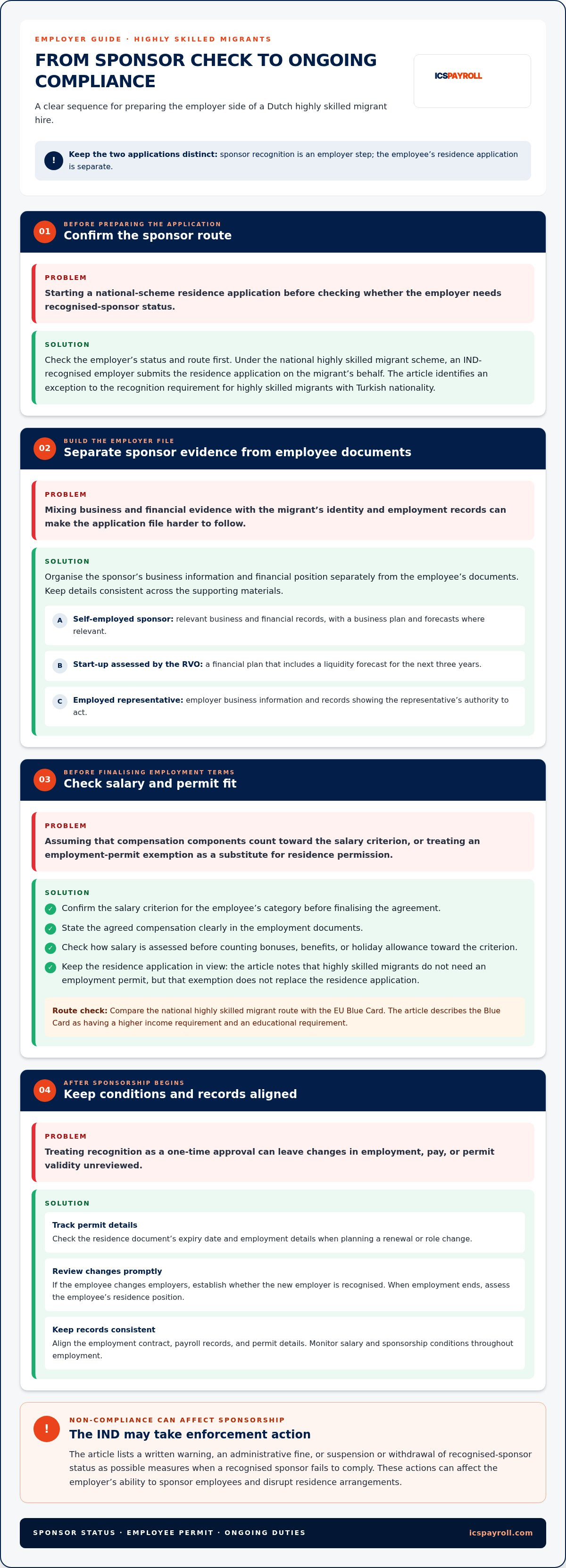
Check whether your organisation needs IND recognition before preparing the employee’s residence application. Under the national highly skilled migrant scheme, the future employer applies for residence on the migrant’s behalf, and only an IND-recognised company can submit that application. A highly skilled migrant with Turkish nationality is an exception to the recognition requirement.
The IND may require a more extensive recognition procedure for companies more than 1.5 years old but less than three years old if it has concerns about continuity or solvency. Assess the organisation’s position before beginning the application, and keep company records consistent with the information used to demonstrate its ability to act as sponsor.
-
Prepare sponsor supporting documents
Collect documents that explain the sponsor’s business and financial position. Self-employed sponsors should organise relevant business and financial records, including a business plan and forecasts where relevant. A start-up assessed by the RVO needs a financial plan with a liquidity forecast for the next three years. Ensure figures are consistent across supporting documents.
For an employed representative, organise the employer’s business information and records showing the representative’s authority to act. Keep these materials separate from the migrant’s identity and employment documents. This distinction helps you prepare a clear application file, with evidence about the sponsor separate from evidence about the employee.
-
Check salary criteria and permit exemptions
Confirm the salary criterion before finalising the employment agreement. According to the IND, highly skilled migrants aged 30 or older have a gross monthly salary criterion of €5,942.00. Don’t assume bonuses, benefits, or holiday allowance count toward the criterion without checking how the applicable salary is assessed.
Highly skilled migrants working in the Netherlands don’t need an employment permit. This exemption doesn’t replace the residence application. State the agreed compensation clearly in the employment documents and assess it against the criterion that applies to the employee’s category.
-
Choose a permit route and assess eligibility
Compare the national highly skilled migrant route with the EU Blue Card. The Blue Card has a higher income requirement and an educational requirement. Graduates from Dutch higher education institutions who are from outside the EU have one year to find a highly skilled migrant job, and eligible graduates may qualify for a reduced salary criterion.
For a recognised sponsor, the accelerated admission procedure enables a decision within two to three weeks. IND sponsorship for highly skilled migrants involves an employer application and a separate residence application for the employee. Before submitting, check that the employer, job, and salary details align.
Eligible employees may apply for the 30% ruling through the Belastingdienst, separately from immigration sponsorship. Eligibility includes recruitment from abroad, living more than 150 km from the border for 16 of 24 months before the first working day, Dutch payroll tax being withheld, and a written decision. The Belastingdienst decides the tax application.
Recognised sponsor rights and obligations
Treat sponsor recognition as an ongoing responsibility, not just an application milestone. The IND can take action if a recognised sponsor fails to meet its obligations.
-
Manage permit validity and changes
Check the residence document’s expiry date and employment details when planning a renewal or role change. The IND’s highly skilled migrant permit guidance explains the permit conditions employers and employees must consider. Use the date printed on the document to plan next steps rather than assuming renewal happens automatically.
If the employee changes employers, establish whether the new employer is recognised and can take on the sponsorship role. When employment ends, promptly assess the employee’s residence position. Changes to employment or sponsorship can affect whether the conditions for residence continue to be met.
Keep the employment contract, payroll records, and permit details aligned. For example, if a contract ends before the permit expires, review the employee’s next steps rather than relying on the remaining time shown on the permit.
-
Avoid risks to residence status
Monitor salary and sponsorship conditions throughout employment, not just when submitting the application. If the employee no longer meets the applicable salary criterion or the sponsor fails to meet its obligations, residence status may be at risk. Review pay and employment changes promptly, and keep records explaining them.
Article 2f of the Dutch Aliens Act 2000 concerns suspension and withdrawal of sponsor recognition. The IND may withdraw recognition if a company has submitted no highly skilled migrant application for three years and no longer employs any highly skilled migrants. Track application activity and sponsored employees to identify this risk.
The IND’s recognised-sponsor obligations guidance describes possible enforcement measures. The IND can issue a written warning, impose an administrative fine, or suspend or withdraw recognition when a recognised sponsor fails to comply. These measures can affect the employer’s ability to sponsor employees and disrupt their residence arrangements.
Set an internal process for flagging changes in salary, employment, and sponsor status. Assign responsibility for reviewing each case, keeping supporting records, and escalating issues. A consistent employment record helps explain changes if the IND reviews the sponsor’s conduct.
IND sponsor application fees
Budget separately for sponsor-recognition costs and the employee’s immigration process. The applicable fee depends on the employer category used for the recognition application.
- Identify the relevant fee category before submitting the application. According to the IND’s application fee information, sponsor recognition costs €5,080, with a reduced fee of €2,539 for companies less than 1.5 years old and companies with fewer than 50 employees worldwide. Use the organisation’s age and worldwide employee count to determine the category, and retain the supporting details with the application file.
- Budget for the recognition application separately from salary, payroll, and the employee’s residence application. Sponsor recognition concerns the organisation’s eligibility to act as a sponsor; the migrant’s residence application is a separate step. Keeping these costs distinct helps finance and HR teams allocate them correctly.
- Check the company information used to select the fee category before filing. For example, use the employer’s actual establishment date and worldwide employee count, not just its Dutch headcount. If those details change during preparation, update the budget and application records to keep them consistent.
- Include IND processing time in the hiring plan. The IND’s decision-period information states a 3 months decision period for sponsor recognition, which may be extended. Companies more than three years old may receive a decision within four weeks, while applications from companies less than 1.5 years old can take up to six months.
- Keep the payment record and the reason for selecting the fee category with the sponsor application. This gives finance and HR a shared reference for tracking the application and reconciling payment. For separate hiring plans, maintain distinct records for each recognition or residence procedure instead of treating every IND payment as the same fee.
The IND considers an organisation unreliable if tax authorities gave it a negligence penalty in the 4 years before the application.
What is the Netherlands IND highly skilled migrant (kennismigrant) residence permit?
Use this permit route to arrange residence in the Netherlands for a highly skilled migrant coming for work. The process connects the employee’s eligibility with the employer’s sponsorship role.
- Start by identifying the permit’s purpose. The kennismigrant residence permit is the Dutch national route for highly skilled migrants coming to the Netherlands for employment. It covers residence and work, rather than serving as a general visitor visa. The employee’s proposed role and the employer’s sponsorship position help determine whether this route is suitable.
Distinguish this permit from a short-stay visit. A visitor’s sponsorship concerns a temporary stay, while the kennismigrant process supports residence for employment. This helps HR teams choose the right application route before preparing documents or agreeing on a start date.
- Check the salary condition alongside the employee’s circumstances. Highly skilled migrants must earn above a set threshold, and the applicable criterion depends on the person’s category. The salary requirement is part of permit eligibility, not a separate benefit or optional employment term.
Some roles are exempt from the highly skilled migrant income threshold, including PhD researchers at universities or research institutes, doctors training to become specialists, and guest lecturers. For an exempt category, income still cannot fall below the minimum wage. Confirm the role classification before setting compensation.
- Confirm who submits the residence application. Under the national scheme, the future employer applies on the migrant’s behalf, and only an IND-recognised company can submit it, except for highly skilled migrants with Turkish nationality. The employer’s status is therefore central to this route.
The employer starts the Entry and Residence Procedure, known as TEV, with the IND. A recognised sponsor applies for one document covering the migrant’s work and residence. Treat sponsor recognition and the employee’s permit application as connected steps, but separate decisions.
- Plan the application around the employee’s travel requirements. If the migrant needs an MVV, they can obtain it from a Dutch embassy after a positive IND investigation and satisfaction of the other applicable conditions. The employee can then travel to the Netherlands and collect the residence permit from the IND.
If the migrant doesn’t need an MVV, the employer can start the residence permit application after the employee arrives in the Netherlands. Establish the correct sequence before setting the employment start date, as the entry route affects when the application can begin.
- Use the permit’s scope to coordinate employment and immigration administration. The combined work-and-residence document gives the employee permission under this specific route, while the employer remains responsible for following the correct sponsorship process. Keep the permit details connected to the employment record.
The national scheme has been used almost 13 thousand times in 2023. That figure reflects the route’s use, but each application still turns on individual eligibility, salary conditions, and the sponsor’s role. Build those checks into recruitment planning rather than treating the permit as an automatic result of a job offer.
Which employers can sponsor highly skilled migrants in the Netherlands, and how can I check the IND public register?
Use the IND public register to confirm whether an employer can sponsor under the national highly skilled migrant scheme. The register contains around 10 thousand recognised sponsors.
- Start by identifying the exact legal entity that will employ the migrant. Under the national scheme, only an IND-recognised company can submit the residence application on the employee’s behalf, except for highly skilled migrants with Turkish nationality. A group’s familiar trading name may differ from the employing entity’s registered name, so establish which company will sign the employment agreement.
Check the register against that entity, not just the wider corporate group. For example, if a parent company and Dutch subsidiary use similar names, confirm the subsidiary’s entry before treating it as the sponsor.
- Search the IND public register using the employer’s legal name and compare the result with its company records. Check spelling, legal suffixes, and registered trading names to avoid mistaking a similarly named organisation for the prospective sponsor. Record the matching entry and retain it with the recruitment file.
The register is a useful status check, but it doesn’t replace assessing the planned employment arrangement. Confirm that the listed organisation is the entity that will employ the migrant and act as sponsor for the hire.
- If the employer doesn’t appear, establish whether it needs to apply for recognition before proceeding under the national scheme. A company cannot submit a highly skilled migrant application through this route unless it is recognised, subject to the Turkish-nationality exception. Build recognition into the hiring sequence instead of treating the public register as a formality.
Review the employer’s application readiness before making commitments tied to a start date. The IND may refuse recognition on grounds covered by Article 2e of the Dutch Aliens Act 2000. Check the company’s compliance history and the information supporting its application.
- Recheck the entry if the employing entity changes. A newly formed subsidiary or a transfer to another group company may not have the same sponsor status as the original employer. For instance, a candidate’s offer from one legal entity doesn’t establish that a different group entity can sponsor them.
Date the register check in the hiring record and link it to the correct entity, role, and application plan. This helps HR and finance teams identify which company is responsible for sponsorship.
- Use the register as an initial screening tool, then compare the result with the employment documents. Confirm that the legal employer named in the contract matches the recognised sponsor entry. Resolve any differences in names or entities before preparing the application, so the same organisation is identified throughout.
For international businesses arranging Dutch employment, plan your Dutch employment setup around the employing entity and its sponsorship route.
ICSPayroll: Employer of Record (EOR)
ICSPayroll’s Employer of Record (EOR) service supports companies hiring employees in the Netherlands without managing local employment administration themselves. ICSPayroll acts as the Dutch employer and provides Dutch Payroll Administration, helping businesses manage payroll obligations as part of the employment arrangement.
For highly skilled migrant hires, immigration sponsorship is arranged via our licensed partner. This distinction matters: EOR employment and IND sponsorship are related operational steps, but they are not the same service or status. ICSPayroll can also manage a 30% Ruling Application for eligible employees aged 30 or older who meet the gross monthly salary criterion; the Belastingdienst decides on that tax benefit separately from immigration sponsorship.
If you’re planning a Dutch hire and need support with employment or payroll administration, contact ICSPayroll.
Plan the next hiring decision with confidence
Your next step is to turn the permit pathway into a clear internal process. Identify who is responsible for the employment agreement, payroll records, sponsor duties, and communication with the immigration partner. Aligning these roles before the candidate’s start date helps manage changes and keep employment administration connected to the immigration process.
For companies hiring in the Netherlands, IND sponsorship for highly skilled migrants is one part of a wider employment setup. ICSPayroll provides Dutch employment and payroll support, while immigration sponsorship is arranged through its licensed partner. The right support depends on what your organisation needs to manage and how the Dutch employment relationship is structured.
If you’re preparing a Dutch hire and want to discuss sponsorship support, contact ICSPayroll. A considered next step can help you move from planning to a well-organised employment arrangement.
Frequently Asked Questions
What documents must be submitted?
Prepare documents that establish the employer’s identity, the proposed employment, and the migrant’s identity. A practical file may include company registration details, relevant financial records, the signed employment agreement, salary information, and the employee’s passport details. Keep sponsor evidence separate from employee documents, and ensure names and employing-entity details match across records. The IND’s requested documents depend on the application route and the circumstances of the case.
Which documents do I need in my situation?
Your documents depend on who employs the migrant and acts as sponsor. A self-employed sponsor should organise business and financial records that explain the company’s operations and position. An employed representative should have company information and evidence of authority to act. Keep the employee’s identity details, employment agreement, and salary evidence together in a separate file. This makes it easier for HR to identify missing or inconsistent information before preparing the application.
What are the application requirements and documents for an IND highly skilled migrant permit?
The application requires a qualifying employment arrangement and the correct sponsor route. First, match the legal employer to the sponsor responsible for the application. Then prepare the contract and salary information alongside the migrant’s identity documents, and check that the role meets the applicable conditions. If the employee needs an MVV, plan the entry process accordingly. Organising the file by employer, employee, and travel documents makes the application easier to review.
What are the 2026 gross monthly salary thresholds for highly skilled migrants, by age and eligibility category?
For highly skilled migrants aged 30 or older, the gross monthly salary criterion is €5,942.00. A reduced criterion may apply to eligible graduates, and the criterion differs for those under 30, but no amounts for those categories are provided.

Article by
Joost Hubregtse
Joost Hubregtse is Director of ICS Staffing & Payroll B.V., the wholly owned subsidiary of Intercompany Solutions behind ICS Payroll. He is responsible for Employer of Record and Dutch payroll services: employment contracts, wage tax and social security filings, holiday allowance, pension, sick leave and CAO compliance, with onboarding possible within 48 hours.
Frequently Asked Questions
Prepare documents that establish the employer’s identity, the proposed employment, and the migrant’s identity. A practical file may include company registration details, relevant financial records, the signed employment agreement, salary information, and the employee’s passport details. Keep sponsor evidence separate from employee documents, and ensure names and employing-entity details match across records. The IND’s requested documents depend on the application route and the circumstances of the case.
Your documents depend on who employs the migrant and acts as sponsor. A self-employed sponsor should organise business and financial records that explain the company’s operations and position. An employed representative should have company information and evidence of authority to act. Keep the employee’s identity details, employment agreement, and salary evidence together in a separate file. This makes it easier for HR to identify missing or inconsistent information before preparing the application.
The application requires a qualifying employment arrangement and the correct sponsor route. First, match the legal employer to the sponsor responsible for the application. Then prepare the contract and salary information alongside the migrant’s identity documents, and check that the role meets the applicable conditions. If the employee needs an MVV, plan the entry process accordingly. Organising the file by employer, employee, and travel documents makes the application easier to review.
For highly skilled migrants aged 30 or older, the gross monthly salary criterion is €5,942.00. A reduced criterion may apply to eligible graduates, and the criterion differs for those under 30, but no amounts for those categories are provided.