
Netherlands Payroll Compliance: 2026 Employer Checklist and Guide
By Joost Hubregtse, Director, ICS Staffing & Payroll
All blog posts are reviewed and fact checked by our labour law lawyer Zishan Hussain and our director. Editorial standards
By Joost Hubregtse
Did you know that as of 2026, the Dutch tax authorities have officially ended the enforcement moratorium, now applying full penalties for gross negligence in worker misclassification? Managing a workforce in the Netherlands remains one of the most administratively dense challenges for international businesses. You likely already feel the pressure of balancing the mandatory 8% holiday allowance against the shifting thresholds of the 30% ruling. It's easy to see why common payroll mistakes in the netherlands often stem from the complexity of the loonheffingen system and the strict two-year sick pay obligation. Failure to align with these local standards can result in significant financial liabilities and rejected dismissal applications at the UWV.
This guide ensures your Dutch operations remain fully compliant with the definitive 2026 statutory requirements, tax thresholds, and labour law updates. We provide a clear roadmap for compliant hiring while detailing the total cost of employment, including the July 2026 minimum wage of €14.99 per hour and the EUR 48,013 threshold for the 30% ruling. You'll gain a precise understanding of the current regulatory environment as defined by official sources like business.gov.nl to remove administrative burdens and secure your local standing.
Key Takeaways
- Master the 2026 statutory hourly minimum wage requirements, which reach EUR 14.99 in July, to maintain full compliance with the Belastingdienst.
- Learn how to avoid common payroll mistakes in the netherlands by correctly navigating the loonheffingen system and the mandatory two-year sick pay obligation.
- Secure 30% ruling approvals for eligible staff by meeting the 2026 salary threshold of EUR 48, 013 and preparing for the upcoming rate transition.
- Eliminate Permanent Establishment risks and administrative complexity through the Employer of Record model and transparent payroll factor invoicing.
- Ensure legal contract compliance by adhering to the Ketenregeling limits for fixed-term agreements and the mandatory 8% holiday allowance.
Navigating the Netherlands Payroll Compliance Landscape in 2026
The Dutch regulatory framework is built on a foundation of precision and transparency. For international employers, the primary point of contact is the Belastingdienst, the Netherlands Tax and Customs Administration. This agency oversees the collection of wage tax and social security contributions through a unified system known as loonheffingen. Managing these obligations requires a deep understanding of the Dutch tax system, which integrates national insurance and income tax into a single monthly withholding. Accuracy in these filings is non-negotiable; even minor discrepancies in monthly loonaangifte returns can trigger audits or financial penalties.
2026 represents a pivotal shift in employment law enforcement. The Dutch government has moved beyond the transitional phases of the DBA Act, ending the previous enforcement moratorium on worker misclassification. Tax authorities now actively apply penalties where they identify gross negligence or intentional avoidance of employer duties. One of the most common payroll mistakes in the netherlands is the incorrect classification of contractors who, under the current strict scrutiny, should be treated as employees. This guide adheres to Your Money Your Life (YMYL) standards, providing high-accuracy data to protect your business from these avoidable legal and financial risks.
Official Source of Truth: The 2026 Fact Sheet
To maintain compliance, you must rely on the 2026 Fact Sheet as your primary data source for all payroll calculations. This document details the specific thresholds and rates that apply throughout the calendar year, such as the July minimum wage adjustment. It's vital to distinguish between current 2026 law and pending legislation, such as the scheduled reduction of the 30% ruling to 27% in 2027. We prioritize official citations from belastingdienst.nl to ensure every calculation reflects the legal reality of the current fiscal year. Relying on outdated or unverified third-party data is another of the common payroll mistakes in the netherlands that leads to non-compliance.
Byline and Regulatory Oversight
This guide is authored by Joost Hubregtse, Payroll Director at ICSPayroll, with over a decade of experience in Dutch cross-border employment. To ensure total accuracy, this content is timestamped and reviewed against the latest 2026 circulars from the Ministry of Social Affairs and Employment. ICSPayroll operates as a specialized administrative partner, arranging Employer of Record (EOR) and IND sponsorship services via licensed partners. Our role is to act as the bridge between your international objectives and the meticulous requirements of the Dutch local system, providing the security you need to hire without a local BV.
Core Statutory Requirements and 2026 Financial Benchmarks
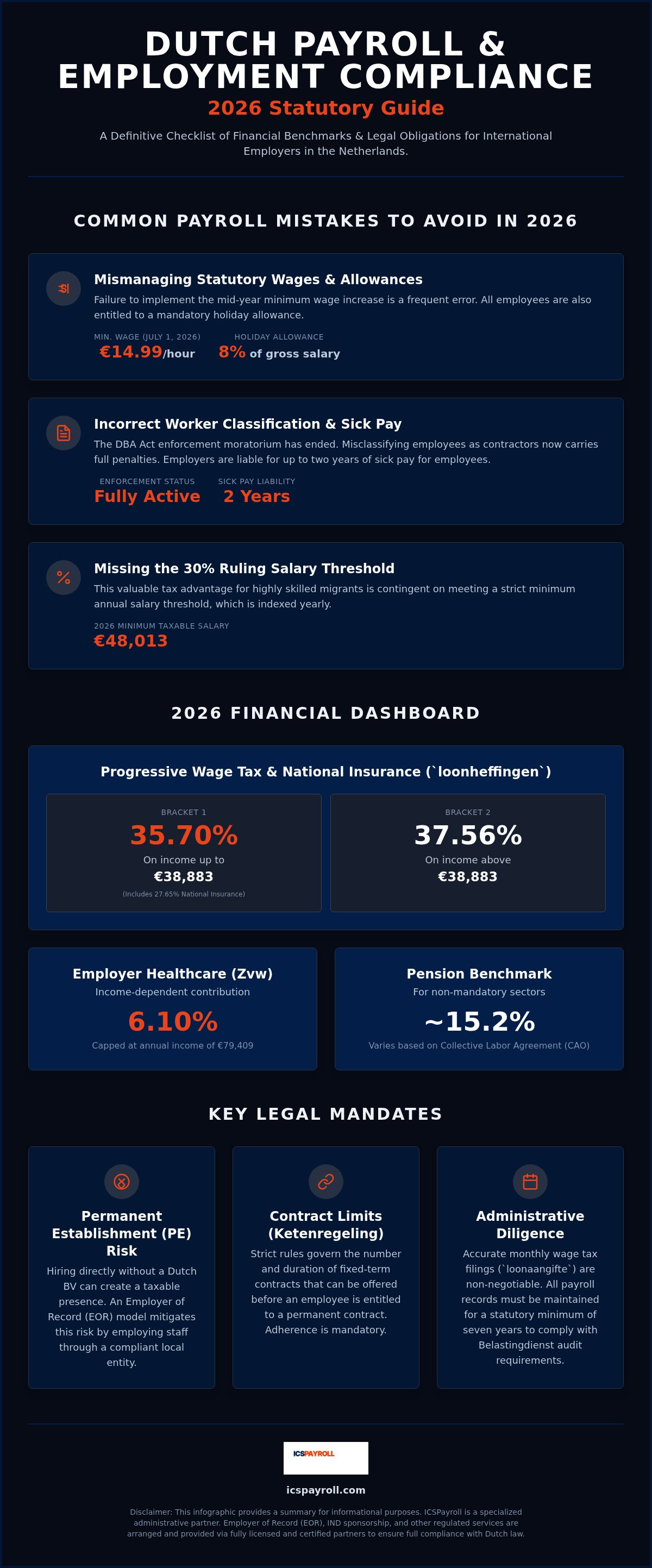
Success in the Dutch market requires strict adherence to statutory financial benchmarks that evolve throughout the fiscal year. As of January 1, 2026, the statutory hourly minimum wage is set at €14.71 for employees aged 21 and older. This rate increases to €14.99 gross per hour starting July 1, 2026. Failing to account for these mid-year adjustments is one of the most common payroll mistakes in the netherlands, often leading to retroactive payment claims and interest charges. Additionally, all employees are legally entitled to a holiday allowance of at least 8% of their gross annual salary, typically paid as a lump sum in May or June.
Employers must also factor in pension obligations and social security premiums to calculate the true cost of employment. While specific pension requirements often depend on collective labor agreements (CAOs), a 15.2% employer contribution is a standard benchmark for non-mandatory sectors. Mandatory premiums include the AWf (unemployment fund), Aof (disability fund), and the income-dependent Zvw (healthcare insurance). For 2026, the employer Zvw contribution is 6.10% of the employee’s income, capped at a maximum annual salary of €79,409.
2026 Wage Tax Brackets and Deductions
The Netherlands utilizes a progressive income tax system that combines wage tax and national insurance contributions. For 2026, the first bracket covers income up to €38,883 at a rate of 35.70%, which includes the 27.65% national insurance portion. The second bracket applies a 37.56% rate on income between €38,883 and €79,137, while earnings above this threshold are taxed at 49.50%. The statutory Loonaangifte deadline requires employers to submit their payroll declaration and settle the associated tax liability by the final day of the month following the wage period. Under Dutch law, you must maintain all payroll records for a minimum of seven years to satisfy Belastingdienst audit requirements.
Employer Premium Calculations
Calculating employer premiums requires precision to avoid unexpected overhead. Many international firms utilize a payroll factor to consolidate social security, premiums, and administrative costs into one transparent monthly figure. A significant compliance factor is the two-year sick pay obligation, requiring employers to pay at least 70% of an employee's salary for up to 104 weeks during illness. Managing these variables manually is high-risk, which is why many firms choose to outsource their Dutch Payroll Administration to ensure accuracy. Miscalculating the Work-Related Costs Scheme (WKR) allowances, which allow for tax-free reimbursements of certain expenses, remains one of the common payroll mistakes in the netherlands that attracts unnecessary scrutiny from tax authorities.
The 2026 Dutch Employment Compliance Checklist
Establishing a compliant workforce in the Netherlands requires a clear understanding of the distinction between local employment and Permanent Establishment (PE) risk. International firms often attempt to hire staff directly from abroad without a local Dutch BV. This approach frequently triggers a PE, making the foreign parent company liable for Dutch corporate income tax. Utilizing an Employer of Record (EOR) model effectively mitigates this risk by ensuring the employee is hired through a fully compliant local entity. Managing these structural details correctly prevents the administrative friction that often precedes significant legal setbacks.
To maintain a compliant HR administration in 2026, employers must adhere to the following statutory standards:
- Ketenregeling (Chain Rule): You are limited to three consecutive fixed-term contracts within a maximum period of three years. A gap of at least six months is required to reset this chain. Misunderstanding the Ketenregeling is one of the common payroll mistakes in the netherlands that results in unintended permanent employment status.
- Transition Allowance: As of 2026, the statutory transition payment (transitievergoeding) is capped at €102,000 or one year's salary, whichever is higher. This applies to all employees from their first day of employment.
- HR Standards: A mandatory employee handbook must be provided. It should clearly outline sick leave protocols, the Work-Related Costs Scheme (WKR) policies, and internal codes of conduct to ensure transparency.
Pre-Onboarding Compliance Steps
Before an employee begins work, you must secure the necessary RSIN and KVK registrations. Official guidance for these registrations is available at kvk.nl. The 2026 landscape also includes significant non-compete reforms. Non-compete clauses are now only valid if they are highly specific, geographically limited, and justified by substantial business interests. Additionally, probation period rules are strictly enforced. You cannot include a probation period in any contract with a duration of six months or less. For contracts between six months and two years, the maximum probation is one month; for permanent roles, it is two months.
Employment Status and Enforcement
2026 marks the full enforcement of Wet DBA and the new VBAR legislation. The Dutch tax authorities have shifted from a period of leniency to active monitoring of employment relationships. They now use a holistic criteria to determine if a worker is a genuine independent contractor or a "de facto" employee. Key indicators include the degree of organizational integration and whether the employer has the right to give direct instructions. Misclassifying a worker is among the most frequent common payroll mistakes in the netherlands, often leading to massive retroactive social security assessments. To navigate these complexities, refer to our Employment Law in the Netherlands for Foreign Employers: 2026 Compliance Guide for a deeper analysis of your legal obligations.
Specialised Compliance for Highly Skilled Migrants and the 30% Ruling
For international talent acquisition, the 30% ruling remains a critical incentive. In 2026, the standard salary threshold for applicants is EUR 48, 013. For those under age 30 with a qualifying Master's degree, a reduced threshold of €36,497 applies. It's also vital to prepare for the 2026 transition period as the tax-free allowance is scheduled to drop to 27% for new rulings starting in 2027. Additionally, the ruling is now capped at the "Balkenende norm" of €262,000 for 2026. The recent abolition of partial non-resident taxpayer status for new applicants means expats can't exempt worldwide assets from Box 3 wealth tax anymore. Misinterpreting these eligibility dates or the specific salary caps is among the common payroll mistakes in the netherlands that can lead to unexpected tax liabilities for both the employer and the employee.
Managing the 30% Ruling Application
To qualify for this tax benefit, the employee must be recruited from a distance of more than 150 kilometers from the Dutch border for more than 16 out of 24 months prior to their first working day. This "150km distance rule" is strictly enforced by the Belastingdienst. You must submit the application within four months of the employee's start date to ensure the ruling applies retroactively to day one. Failing to track these deadlines is another of the common payroll mistakes in the netherlands that results in lost tax savings. For a deep dive into these requirements, see The 30% Ruling in the Netherlands: A Comprehensive 2026 Employer Guide.
HSM Visa and IND Requirements
Hiring non-Schengen talent requires becoming an IND recognised sponsor. This process is often time-consuming and complex for new entities without a local presence. Licensed EOR partners bypass this hurdle by acting as the legal sponsor on your behalf. Standard document requirements, including valid passports and educational credentials, are detailed on ind.nl. We facilitate expedited HSM visa processing through our licensed partners, typically securing approval in approximately three weeks. This rapid three-week expedited processing timeline is essential for maintaining project momentum and securing high-value global talent. Attempting to onboard staff before verified sponsorship status is confirmed is a high-risk error that often results in immediate application rejection and legal complications.
Contact us to streamline your 30% Ruling Application and secure your international workforce today.
Strategic Payroll Management via the EOR Model
The administrative weight of Dutch compliance often leads to operational paralysis for international firms. One of the most common payroll mistakes in the netherlands is attempting to manage local statutory requirements through a foreign entity, which inadvertently creates a Permanent Establishment. The Employer of Record (EOR) model provides a strategic bypass. By employing your staff through a locally established, licensed entity, you eliminate the legal and tax risks associated with PE while ensuring full adherence to 2026 labor laws. This structure allows you to focus on your core business while we act as the protective bridge between your company and the local authorities.
This model simplifies financial planning through the use of a "payroll factor." This is a transparent, all-inclusive pricing mechanism that consolidates gross salary, social security contributions, the 8% holiday allowance, and administrative overhead. Instead of navigating the Belastingdienst independently, you receive one clear monthly invoice covering all employment costs. This consolidation eliminates the risk of missing Loonaangifte deadlines or miscalculating complex employer premiums. While traditional payroll setup via a new BV often takes months, our operational set-up is finalized in just a few weeks. We arrange these services via licensed partners to ensure your IND sponsorship and EOR needs are met with total legal certainty.
EOR vs Traditional Payroll Administration
Choosing an EOR allows you to hire talent before or even without establishing a Dutch BV. This is particularly valuable for testing the market or managing remote teams without the overhead of corporate incorporation. Beyond simple wage processing, the EOR model manages complex sick-leave support and reintegration guidance. Under Dutch law, you're responsible for 104 weeks of sick pay; our system ensures this is handled with clinical precision according to the Gatekeeper Improvement Act. For a detailed comparison of these hiring methods, read our Employer of Record Netherlands: The 2026 Guide to Compliant Hiring.
Next Steps for 2026 Compliance
Securing your Dutch operations shouldn't be a prolonged administrative ordeal. We provide a tailored quotation within 24 hours of your initial inquiry, detailing the exact payroll factor for your specific hires. Once you approve the figures, we finalize service agreements and compliant employment contracts within days. This rapid processing ensures your staff can begin work without delay. Avoiding common payroll mistakes in the netherlands starts with having a protective guardian for your local interests. Our human-centric support team is ready to guide you through every operational step with speed and transparency.
Contact ICSPayroll at +31 10 307 0665 or email payroll@intercompanysolutions.com to initiate your compliant Dutch setup for 2026.
Securing Your Dutch Operations for 2026 and Beyond
Maintaining payroll compliance in the Netherlands requires vigilant attention to shifting tax thresholds and rigorous labour law enforcement. We have detailed how the 2026 benchmarks, specifically the EUR 48, 013 threshold for the 30% ruling and the July minimum wage increase to €14.99 per hour, form the bedrock of a secure employment strategy. Avoiding common payroll mistakes in the netherlands is no longer just about administrative accuracy; it's about protecting your business from the Belastingdienst's renewed focus on worker classification and the strict enforcement of the VBAR legislation.
Transitioning to a professional EOR model removes these administrative burdens entirely. ICSPayroll ensures an operational set-up within weeks, providing one clear monthly invoice with no surprises. You gain full Dutch compliance, specialized 30% ruling assistance, and expedited HSM visa processing without the complexity of establishing a local BV. Our human-led approach provides the stability and transparency needed for successful international growth in a highly regulated environment.
Hire in the Netherlands with confidence by requesting a 24-hour tailored quotation from ICSPayroll. We look forward to facilitating your seamless and compliant entry into the Dutch market.
Frequently Asked Questions
What is the standard salary threshold for the 30% ruling in 2026?
The standard salary threshold for the 30% ruling in 2026 is EUR 48, 013. For employees under the age of 30 who hold a qualifying Master's degree, a reduced threshold of €36,497 applies. These figures exclude the mandatory 8% holiday allowance. Meeting these specific taxable salary requirements is essential for application approval. You must also ensure the employee was recruited from a distance of more than 150km from the Dutch border.
How long are employers required to keep payroll records in the Netherlands?
Employers in the Netherlands must retain all payroll records for a minimum of seven years. This statutory retention period applies to wage statements, tax declarations, and employment contracts required by the Belastingdienst. Failure to maintain organized archives is one of the common payroll mistakes in the netherlands that surfaces during tax audits. Keeping digital or physical copies ensures you can provide proof of social security contributions and wage tax remittances if requested by authorities.
Can I hire employees in the Netherlands without a local legal entity?
Yes, you can hire employees in the Netherlands without establishing a local Dutch BV by using an Employer of Record (EOR) model. The EOR acts as the legal employer, handling all payroll, tax, and social security obligations on your behalf. This approach eliminates Permanent Establishment risks and allows for a rapid operational set-up within weeks. It's a highly efficient solution for international firms looking to test the Dutch market without the overhead of incorporation.
What is the mandatory holiday allowance in the Netherlands for 2026?
The mandatory holiday allowance in the Netherlands for 2026 is at least 8% of the employee's gross annual salary. This is a statutory requirement for all employees and is typically paid out as a lump sum in May or June. You must include this calculation in your annual budget to avoid common payroll mistakes in the netherlands. Some collective labor agreements (CAOs) may mandate a higher percentage or different payment schedules for specific sectors.
How quickly can a Highly Skilled Migrant visa be processed?
A Highly Skilled Migrant (HSM) visa can be processed in approximately three weeks when using a licensed IND recognized sponsor. This expedited timeline is available through our specialized EOR partners who handle the sponsorship and administrative filings on your behalf. Standard applications through non-recognized entities often take significantly longer. Ensuring all documentation, such as educational credentials and valid passports, is prepared in advance is key to maintaining this rapid three-week processing speed.
What are the penalties for payroll non-compliance in the Netherlands?
Penalties for payroll non-compliance in the Netherlands vary based on the severity of the infraction. As of 2026, the tax authorities apply full penalties for gross negligence or intentional misclassification of workers under the VBAR legislation. Financial consequences include retroactive social security assessments, interest charges, and administrative fines. Consistent errors in Loonaangifte filings can also trigger comprehensive audits by the Belastingdienst, leading to significant legal and financial liabilities for the foreign entity.
Is the 13th-month bonus mandatory under Dutch law?
A 13th-month bonus is not a statutory requirement under Dutch law. However, it's often a mandatory provision within specific collective labor agreements (CAOs) or individual employment contracts. Many Dutch companies offer this as an extra month of salary, usually paid in December, to remain competitive in the labor market. If your sector is covered by a CAO, you must verify whether this bonus is a compulsory element of the total compensation package.
What is the transition allowance cap for 2026?
The statutory transition allowance (transitievergoeding) for 2026 is capped at €102,000 or one year's salary, whichever is higher. This payment is mandatory for all employees whose contracts are terminated or not renewed by the employer, starting from their first day of service. Calculating this amount correctly is vital for compliance during dismissal procedures. You can find updated details on maximum payment limits and calculation formulas through official government resources at business.gov.nl.

Article by
Joost Hubregtse
Joost Hubregtse is Director of ICS Staffing & Payroll B.V., the wholly owned subsidiary of Intercompany Solutions behind ICS Payroll. He is responsible for Employer of Record and Dutch payroll services: employment contracts, wage tax and social security filings, holiday allowance, pension, sick leave and CAO compliance, with onboarding possible within 48 hours.
Frequently Asked Questions
The standard minimum taxable salary threshold for the 30% ruling in 2026 is €48,013. For employees under the age of 30 who hold a Master's degree, a reduced threshold of €36,497 applies. These figures are indexed annually to reflect economic changes. It's vital to meet these specific salary requirements to qualify for the tax-free allowance, as failing to do so is one of the most frequent common payroll mistakes in the netherlands.
Employers in the Netherlands are legally required to keep payroll records for at least seven years. This statutory record-keeping requirement ensures that the Belastingdienst can perform audits and verify historical tax filings. Records must include payslips, annual statements, and proof of identity for all staff. Maintaining a structured digital archive is the most efficient way to ensure compliance during the mandatory seven-year period and avoid administrative complications during a government audit.
You can hire employees in the Netherlands without establishing a local Dutch BV by using an Employer of Record (EOR) model. This service, which we arrange through our network of licensed partners, allows you to onboard staff legally while the partner handles all local payroll and tax obligations. This approach effectively eliminates Permanent Establishment risks and allows for a rapid market entry, often completing the operational set-up within weeks rather than months.
The mandatory holiday allowance for 2026 remains 8% of the employee's gross annual salary. This statutory benefit is typically paid out as a lump sum in May, though it can be distributed monthly if specified in the employment contract. Employers must ensure this 8% is calculated on the total gross wage, including any overtime or bonuses, to remain fully compliant with Dutch labor law and avoid administrative penalties during the annual filing process.
A Highly Skilled Migrant (HSM) visa can be processed in approximately three weeks when arranged via an IND recognized sponsor. At ICSPayroll, we coordinate this process through our licensed partners to ensure all documentation meets official standards. This expedited timeline is significantly faster than traditional immigration routes, allowing your international talent to begin their Dutch assignments with minimal delay and full legal authorization from the Dutch Immigration and Naturalisation Service.
Penalties for payroll non-compliance include substantial administrative fines from the Belastingdienst and retroactive claims for unpaid social security premiums. For instance, misclassifying a contractor as an independent worker under Wet DBA can lead to the employer being held liable for years of back-dated taxes. These financial repercussions highlight why avoiding common payroll mistakes in the netherlands is essential for protecting your company’s financial stability and maintaining a positive relationship with local tax authorities.
The 13th-month bonus is not a statutory requirement under Dutch law. While many companies offer this as a competitive benefit to attract talent, it is only mandatory if explicitly stated in an individual employment contract or a Collective Labour Agreement (CAO). Employers should clearly define any bonus structures in writing to prevent confusion regarding total compensation packages and to ensure all voluntary benefits align with their broader recruitment strategy and budget projections.
The statutory transition allowance (transitievergoeding) is capped at €102,000 for 2026. If an employee’s gross annual salary exceeds this amount, the cap is adjusted to equal one full gross annual salary. This payment is mandatory for employees whose contracts are terminated or not renewed at the employer's initiative. Accurate calculation of this severance is critical, as it is based on the employee's years of service and monthly gross pay according to Dutch statutory rules.