
Managing long-term sick leave in the Netherlands and its costs
By Joost Hubregtse, Director, ICS Staffing & Payroll
All blog posts are reviewed and fact checked by our labour law lawyer Zishan Hussain and our director. Editorial standards
Long-term sick leave can cost Dutch employers more than two years of salary administration: they must generally continue paying at least 70% of an employee’s wages for up to 104 weeks. During the first year, sick pay must also meet the minimum-wage floor. Managing long-term sick leave in the Netherlands therefore means planning for both wage costs and a structured return-to-work process.
That financial pressure is real, and the obligations don’t end with payroll. Employers and employees must work together on reintegration, while inadequate efforts can lead to a UWV wage sanction requiring salary payments for up to 52 extra weeks.
This article explains what affects the cost of managing long-term sick leave in the Netherlands, which reintegration steps matter, and what happens when the two-year period ends. It also outlines when dismissal may be legally possible, so you can understand the limits before making decisions about an employee’s absence.
Key Takeaways
- Understand how wage components such as overtime and personal allowances can affect sick-pay calculations, beyond an employee’s base salary.
- Track reintegration milestones: the problem analysis is due by week 6, followed by a plan of action by week 8 and ongoing assessments.
- Learn how WIA eligibility depends on the employee’s assessed loss of earning capacity, and why a complete reintegration report matters to the application.
- See how a temporary contract’s expiry affects sick-pay responsibilities and the employer’s reporting duties.
- Distinguish frequent-absence dismissal from dismissal after long-term illness, and understand the role of the company doctor in protecting medical privacy.
Why is sick leave in the Netherlands costly for employers?
Employers face continuing wage costs and formal reintegration duties during an employee’s long-term illness. The obligation can last up to 104 weeks, and shortcomings in reintegration can extend the wage burden.
Salary Continuation During Sickness
Salary continuation means an employer keeps paying an ill employee under the employment contract. Under article 7:629 BW, sick pay is at least 70% of wages for up to 104 weeks. During the first year, payment must also meet the minimum-wage floor. The 70% calculation can include wage components the employee would normally receive, such as overtime and personal allowances, subject to the applicable statutory cap. These rules make absence a continuing payroll obligation, not simply a temporary staffing issue.
Cooperation and Payment Sanctions
Reintegration requires the employee to take part in reasonable return-to-work efforts and the employer to arrange and document them. Depending on the circumstances and the required steps, an employee who does not cooperate may face a temporary wage suspension or stoppage. Because sick pay and reintegration are linked, the employer should clearly explain what action is required, record the employee’s response, and follow the applicable process before changing payments. Changing payments does not end the employment contract.
Reintegration Duties Across Employment Types
Reintegration means working with the employee towards suitable work, including adjusted duties where appropriate. This process applies to permanent and temporary employees for as long as their employment continues. If an employee becomes ill during a temporary contract, the employer’s sick-pay obligation under that contract generally ends when the contract expires. For agency workers, the agency contract and the identity of the employer shape the arrangements. Contract terms affect the route, but do not remove the need to address a return to work.
Employer Follow-Up and Reintegration Consequences
Follow-up combines supportive conversations with recorded progress and practical next steps. Employers and employees should discuss work capacity, possible adjustments, and progress, rather than seeking the employee’s diagnosis. If an employee disputes the company doctor’s assessment or a reintegration decision, they can raise the disagreement in follow-up and ask the employer to seek a UWV expert opinion. If the employer’s reintegration efforts fall short, UWV can impose a wage sanction requiring up to 52 extra weeks of salary payments. This may extend costs beyond the ordinary period.
After the 104-Week Period
When the 104-week sick-pay period ends, salary continuation generally stops, but employment does not end automatically. An employer may seek dismissal through UWV when the employee is expected to remain unable to work beyond that period. Before dismissal, the employer must show adequate reintegration efforts; an incomplete record or missed steps can affect the assessment. A possible disability benefit is a separate matter from the employer’s decision about the employment contract. Reaching two years is a legal milestone, not an automatic termination date.
What happens after two years of long-term sick leave?
After 104 weeks of sickness absence, the employer’s ordinary sick-pay obligation ends, but the employment relationship does not automatically end. Managing long-term sick leave in the Netherlands also means separating the employee’s WIA benefit assessment from decisions about continued employment. The employee applies for WIA, while the employer ensures the reintegration report is complete and submitted on time.
WIA Application and Assessment
The UWV writes to the employee about applying for WIA at around week 87 of sickness absence. The employee must apply by week 93 and submit the reintegration report. It documents the steps taken during the absence and provides the UWV with information for its assessment. Applying is the employee’s responsibility; completing and submitting the employer’s contribution on time remains an employer obligation.
An UWV physician assesses the employee’s ability to work. According to the UWV’s WIA guidance, eligibility requires at least 35% loss of earning capacity; an employee assessed below that threshold receives no WIA benefit. The UWV generally makes a decision within 8 weeks after receiving the application. Its assessment considers the employee’s remaining work capacity, not only the diagnosis or the fact that sickness absence lasted two years.
WGA and IVA Benefit Levels
The WGA applies when an employee has partial work incapacity or may recover enough to work more. According to the UWV’s information on WIA benefits, its benefit is approximately 70% of the person’s previous taxable salary. The IVA applies when incapacity is 80-100% and permanent; its benefit is approximately 75% of the previous taxable salary.
Both benefits are calculated only up to the statutory maximum daily wage. If an employee’s salary exceeded that limit, the full salary is not included in the calculation. For international employees, this distinction helps set expectations about income after the employer’s salary-continuation period ends. The benefit route depends on the UWV’s assessment of the degree and permanence of incapacity.
Temporary Contracts and UWV Sickness Benefits
A temporary contract changes the timing of the employer’s responsibilities. If it expires while the employee is ill, sick-pay entitlement under that contract lasts only until its expiry, according to the Dutch government’s sick-pay guidance. When the employee has been sick for less than two years, the employer must report the illness to UWV on the contract’s last day. UWV sickness benefit is a separate stage after the employment contract ends.
For expat employees, the agreement, contract end date, and Dutch payroll records help clarify the transition. Employers should discuss the expected change with the employee and retain the reintegration report. A UWV benefit does not remove the need for accurate contract administration, and submitting an application does not itself determine whether employment continues.
Planning the Transition
At the 104-week point, the parties should distinguish a possible return to work, continued employment, a WIA benefit, and a dismissal process. A WIA application is not itself a dismissal decision. If sick pay has been extended and the employee cannot return, the employee may apply for WIA before the agreed extension ends. Employers managing long-term sick leave in the Netherlands should keep benefit administration and employment decisions distinct, with each supported by its own records.
Legal conditions for dismissal due to frequent illness
Illness alone does not give an employer a free basis for dismissal. During the first two years of sickness, dismissal because of that illness is generally prohibited under Dutch government dismissal guidance. Frequent, separate absences follow a different legal assessment: the employer must establish more than a pattern of days away. The number of episodes may prompt review, but it does not automatically prove grounds for termination.
Employees retain privacy during long-term sick leave. Employers may not ask about the nature of an illness, and the company doctor may not disclose the diagnosis or other medical information. Employers also may not share sickness information without the employee’s agreement. Discussions should therefore focus on work capacity, attendance, and possible adjustments, not private medical details.
Frequent Absence and Possible Dismissal
More than three illness-related absence episodes in a year can be a warning sign, while a third episode within 12 months is an example of a point for employer action. Neither figure creates an automatic right to dismiss. The employer must assess the impact on operations and whether the absence pattern meets the legal framework under Article 7:669 lid 3 sub c BW or sub h.
A key criterion is whether recovery within 26 weeks is expected. If it is not expected, the employer must still consider whether the work can be adjusted or reassigned. A record of separate episodes, workplace effects, discussions, and possible adjustments helps distinguish a substantiated case from a decision based only on the employee’s illness.
Protection During Long-Term Sickness
For long-term sickness, the general dismissal protection applies during the first two years. Once that period has passed, dismissal is not automatic: an employer may seek permission through UWV if the employee is expected to remain unable to work. The employer must show it made adequate reintegration efforts. If those efforts fall short, UWV can impose a wage sanction requiring up to 52 extra weeks of salary payments, delaying termination.
Dismissal protections depend on the reason and process, not simply on an employee’s absence. Employers must distinguish frequent absence from an employee who is still within the protected long-term illness period. Extending sick pay also prevents dismissal during the extension period. Reaching two years does not, by itself, end the employment relationship.
Vacation Days and Public Holidays
Record vacation and public holidays separately from sickness absence and any dismissal process. The employment agreement and applicable leave arrangements govern how requested or scheduled leave is handled. Illness alone does not establish grounds for dismissal. Separate records help prevent a holiday entry from being treated as an illness episode without proper assessment.
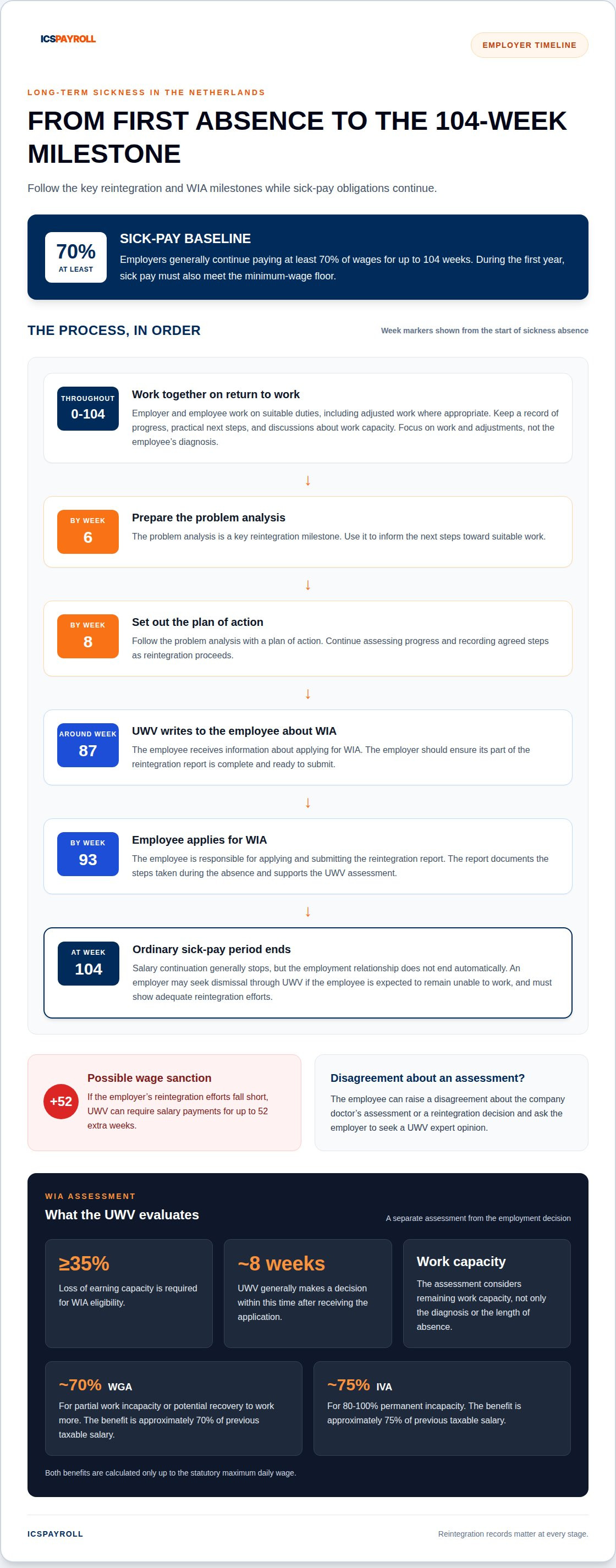
Gatekeeper Improvement Act reintegration deadlines
The Wet verbetering poortwachter, or Gatekeeper Improvement Act, sets a timetable for employer and employee reintegration. Its deadlines document progress and help identify suitable work before the sickness period ends.
Reintegration Deadlines and Requirements
The process includes defined assessments and actions during the employee’s sickness absence. By week 6, the company doctor prepares a problem analysis describing work limitations and possible return-to-work options. By week 8, the employer and employee agree a plan of action. These steps turn the medical assessment into practical reintegration measures.
The plan should link the employee’s current capacity to realistic tasks, hours, and workplace conditions. Both employer and employee have a role in carrying it out. The company doctor’s analysis informs the plan, but should address functional abilities rather than disclose a diagnosis. Clear records show how each action follows from the assessment.
Plans and Regular Evaluations
A plan of action records the agreed reintegration steps, responsibilities, and review arrangements. Regular evaluations let the employer and employee assess progress, discuss barriers, and revise actions when circumstances change. The plan is a working document, not a one-time form completed at week 8.
The first-year evaluation takes place between weeks 46 and 52 of sickness absence. At that review, the parties consider what has worked, whether the current route remains suitable, and what should happen next. For example, if adjusted duties have not increased the employee’s capacity, the plan can reflect that and set a different objective. Recording the reasons for changes keeps decisions traceable.
Reviews should link observed progress to specific next steps. An employee may gradually return to their usual duties, take on adjusted tasks, or need another approach. The employer and employee should record agreed changes and review them regularly. Dated evaluations also help distinguish a temporary obstacle from a change that calls for a revised plan.
Reintegration Routes and Workplace Adjustments
First-track reintegration focuses on returning the employee to their own work or other suitable work with the same employer. Adjustments may involve duties, working hours, or the workplace, guided by the company doctor’s assessment. The aim is to match work demands to the employee’s functional capacity.
If suitable work within the organisation is not achievable, second-track reintegration explores suitable work with another employer. This can take place alongside efforts to restore the employee to work within the current organisation. The employer should document why the route suits the employee’s situation and review progress through the action plan.
A 2026 bill proposed allowing small and medium-sized employers to focus fully on second-track reintegration from the second year. The proposed change is planned for 2030 at the earliest and is not current law. Until then, employers must follow the existing reintegration framework, maintain the agreed plan, and record workplace adjustments and evaluations.
The role of occupational health services and company doctors
In the Netherlands, the company doctor assesses work capacity during sickness, while the employer makes workplace decisions. This separation keeps absence management focused on recovery and suitable work, rather than private medical details.
Company Doctor Guidance
The company doctor advises on an employee’s functional ability and possible return-to-work arrangements. This assessment helps the employer and employee identify duties, hours, or adjustments suited to the employee’s current capacity.
For longer sickness absence, the company doctor must provide a problem analysis by week 6. Employees who are sick for six weeks or more must meet with the doctor. A case may also be referred after one week. These points give employers a basis for planning, but the employer should not make its own medical judgment when sickness is disputed.
The company doctor may not share the employee’s diagnosis or medical information with the employer. Instead, guidance should describe work-related limitations and options. For example, the doctor can advise whether reduced hours or modified tasks are appropriate without telling a manager what condition caused the absence.
Employers should follow the company doctor’s advice unless reasonable grounds justify a different approach. Ignoring it can delay reintegration or create legal difficulties. If an employer disputes whether sickness prevents an employee from working, the right response is to seek an expert opinion, not make an independent medical assessment.
Employees can also request a preventive consultation with the company doctor before becoming ill. This offers a way to discuss work-related health concerns early and consider possible workplace measures. Early advice can identify practical changes before a concern leads to sickness absence.
Occupational Health Service Support
An occupational health service, known in the Netherlands as an Arbodienst, connects employers with occupational health support. Employers must consult a working conditions service when an employee’s sickness is expected to be long-term. This helps arrange professional guidance and incorporate the company doctor’s advice into absence management.
The Arbodienst supports the process but does not replace the employer’s responsibility to maintain contact and address work arrangements. Employers can use the doctor’s assessment to discuss suitable duties, expected progress, and barriers to returning. The employee’s medical details remain confidential throughout.
When sickness is disputed, employers should ask the company doctor to assess the issue rather than decide whether an employee is sick. If the employer still disagrees after the doctor confirms that the employee is unable to work, it can request a UWV expert opinion. This provides a defined way to address disagreement without pressuring the employee to disclose a diagnosis.
For a long-term case, the practical sequence is straightforward: involve the Arbodienst when prolonged absence is expected, use the doctor’s advice on work capacity, and discuss appropriate arrangements with the employee. Keep discussions focused on duties and progress. This gives both sides a documented, medically informed basis for managing the absence.
ICSPayroll
ICSPayroll supports international employers with Dutch employment and payroll administration. If you’re hiring in the Netherlands without a local entity, its Employer of Record (EOR) service can employ staff locally. For companies with a Dutch entity, Dutch Payroll supports payroll administration, including salary processing during sickness.
Long-term absence still requires a separate reintegration process involving the employee, employer, and occupational health professionals. ICSPayroll’s role is to support the employment and payroll framework, not to replace medical assessments or reintegration decisions. For eligible international employees, its 30% Ruling Application service can also assist with the application process.
If you’re planning Dutch employment or need payroll support, contact ICSPayroll to discuss your requirements.
Set Up a Clear Process for the Next Absence
Managing long-term sick leave in the Netherlands is easier when responsibilities are clear before an employee reports sick. Decide who will maintain contact, coordinate occupational health input, record decisions, and oversee payroll. A consistent process helps managers respond thoughtfully and base employment decisions on documented information.
Use each case to improve internal practices. Review where communication slowed, which records proved useful, and whether managers understood the boundary between medical privacy and work-related updates. Then refine procedures so each new case starts with clear ownership and timely follow-up, not improvised decisions.
For support with Dutch employment arrangements and payroll administration, contact ICSPayroll about your sick-leave requirements. A clear operational framework helps your team move forward with confidence.
Frequently Asked Questions
⏰ What if I’m sick for a long time?
Tell your employer you’re sick and follow the workplace reporting procedure; you do not have to disclose your diagnosis. The company doctor can assess your work capacity and advise on suitable duties. You and your employer then follow the reintegration process while sick pay continues under the applicable rules. As the absence progresses, the UWV’s WIA application process becomes relevant, so keep employment and reintegration records complete.
What are the employer and employee obligations during long-term sick leave in the Netherlands?
The employer must continue applicable sick pay, involve occupational health support when long-term absence is expected, and take documented steps towards suitable work. The employee must cooperate with reasonable reintegration measures and attend agreed assessments. For example, if the company doctor recommends adjusted duties, both parties should discuss how those duties fit the employee’s capacity. Record decisions and changes to keep the return-to-work process clear.
How long must a Dutch employer continue paying wages during employee sickness, and what percentage is paid?
A Dutch employer generally continues sick pay for up to 104 weeks, at a minimum of 70% of wages. During the first year, the payment must also meet the statutory minimum-wage floor. The amount can depend on the employee’s normal wage components, including overtime or personal allowances, and the applicable cap. Check the employment agreement or collective labour agreement for any more favourable sick-pay terms.
What is the role of the company doctor (bedrijfsarts) and occupational health service (arbodienst)?
The company doctor assesses functional work capacity and advises on suitable adjustments, while the Arbodienst helps arrange occupational health support. The doctor does not give the employer an employee’s diagnosis. For example, advice may describe limits on hours or tasks without identifying the medical condition. An employee can also request a preventive consultation before sickness absence, allowing work-related concerns to be discussed early.
What are the steps and deadlines in the Dutch Gatekeeper Improvement Act (Wet verbetering poortwachter)?
The sequence begins with a company doctor’s problem analysis by week 6, followed by an employer-and-employee action plan by week 8. They then review progress and adapt the plan as circumstances change. A first-year evaluation takes place between weeks 46 and 52. Reintegration may include suitable work with the current employer or, where appropriate, a second-track route toward work elsewhere.
How should an employer and employee create and review a return-to-work plan (Plan van aanpak)?
Use the company doctor’s advice on work capacity to agree on practical goals, tasks, responsibilities, and review arrangements. The plan should specify what the employee will try, what workplace adjustments the employer will make, and how progress will be discussed. Review it regularly and record changes and their reasons. If agreed duties prove unsuitable, for example, document the issue and revise the next steps rather than leaving the original plan unchanged.
What happens at the 1-year sickness assessment and the 2-year WIA assessment?
Between weeks 46 and 52, the employer and employee evaluate reintegration progress and decide whether the existing approach needs revision. Around week 87, the UWV writes to the employee about applying for WIA; the application and reintegration report are due by week 93. The UWV assesses work capacity. Eligibility generally requires at least 35% loss of earning capacity, and the benefit route depends on the assessment.

Article by
Joost Hubregtse
Joost Hubregtse is Director of ICS Staffing & Payroll B.V., the wholly owned subsidiary of Intercompany Solutions behind ICS Payroll. He is responsible for Employer of Record and Dutch payroll services: employment contracts, wage tax and social security filings, holiday allowance, pension, sick leave and CAO compliance, with onboarding possible within 48 hours.
Frequently Asked Questions
Tell your employer you’re sick and follow the workplace reporting procedure; you do not have to disclose your diagnosis. The company doctor can assess your work capacity and advise on suitable duties. You and your employer then follow the reintegration process while sick pay continues under the applicable rules. As the absence progresses, the UWV’s WIA application process becomes relevant, so keep employment and reintegration records complete.
The employer must continue applicable sick pay, involve occupational health support when long-term absence is expected, and take documented steps towards suitable work. The employee must cooperate with reasonable reintegration measures and attend agreed assessments. For example, if the company doctor recommends adjusted duties, both parties should discuss how those duties fit the employee’s capacity. Record decisions and changes to keep the return-to-work process clear.
A Dutch employer generally continues sick pay for up to 104 weeks, at a minimum of 70% of wages. During the first year, the payment must also meet the statutory minimum-wage floor. The amount can depend on the employee’s normal wage components, including overtime or personal allowances, and the applicable cap. Check the employment agreement or collective labour agreement for any more favourable sick-pay terms.
The company doctor assesses functional work capacity and advises on suitable adjustments, while the Arbodienst helps arrange occupational health support. The doctor does not give the employer an employee’s diagnosis. For example, advice may describe limits on hours or tasks without identifying the medical condition. An employee can also request a preventive consultation before sickness absence, allowing work-related concerns to be discussed early.
The sequence begins with a company doctor’s problem analysis by week 6, followed by an employer-and-employee action plan by week 8. They then review progress and adapt the plan as circumstances change. A first-year evaluation takes place between weeks 46 and 52. Reintegration may include suitable work with the current employer or, where appropriate, a second-track route toward work elsewhere.
Use the company doctor’s advice on work capacity to agree on practical goals, tasks, responsibilities, and review arrangements. The plan should specify what the employee will try, what workplace adjustments the employer will make, and how progress will be discussed. Review it regularly and record changes and their reasons. If agreed duties prove unsuitable, for example, document the issue and revise the next steps rather than leaving the original plan unchanged.
Between weeks 46 and 52, the employer and employee evaluate reintegration progress and decide whether the existing approach needs revision. Around week 87, the UWV writes to the employee about applying for WIA; the application and reintegration report are due by week 93. The UWV assesses work capacity. Eligibility generally requires at least 35% loss of earning capacity, and the benefit route depends on the assessment.