
Dutch employee handbook essentials: what to include
By Joost Hubregtse, Director, ICS Staffing & Payroll
All blog posts are reviewed and fact checked by our labour law lawyer Zishan Hussain and our director. Editorial standards
A Dutch employee handbook isn’t strictly required by law, but it gives employees a clear reference for workplace rules and conditions. Dutch employee handbook essentials include policies on working arrangements, leave, conduct, safety and absence. A handbook can complement employment contracts, but its terms should align with Dutch labour regulations.
A handbook may look like a practical collection of internal policies, but its legal effect and day-to-day value also depend on how it is agreed, communicated and kept up to date. Clear, consistent rules help employees understand expectations and give employers a sound basis for applying policies fairly.
This article explains what a Dutch handbook can contain and how to address workplace policies, safety, inappropriate behaviour and employee departures. It also covers legal review and implementation, including how the handbook relates to employment agreements and when employee acknowledgement matters. Use it as a practical framework for developing a handbook that supports a well-managed Dutch workplace.
Key Takeaways
- A handbook is not strictly required by Dutch law, but it can give employees one clear reference for workplace rules and conditions.
- Set out leave procedures alongside statutory entitlements, so employees and managers understand how requests are handled.
- Make conduct, safety and inappropriate-behaviour policies clear, consistent and practical to apply.
- Include a departure process that explains how employees return company property and complete handover arrangements.
- Review the handbook regularly, align it with employment agreements and applicable rules, and record employees’ acknowledgement of updates.
What is an employee handbook and what does it contain?
A Dutch employee handbook sets out workplace rules, employment conditions, and practical procedures. It can complement employment contracts with details on pay, leave, working hours, conduct, and absence. The Dutch employee handbook essentials are the policies employees need to understand their terms and workplace responsibilities.
Pay and Benefits
Explain how pay, benefits and leave entitlements work alongside employment contracts. The handbook can summarise salary arrangements, allowances, employee benefits and any company car scheme, giving staff one place to find relevant policies. Clarify how these arrangements relate to working hours and where employees can find their individual contractual terms. This distinction helps prevent confusion between general company policies and personal employment conditions.
Leave Entitlements and Applications
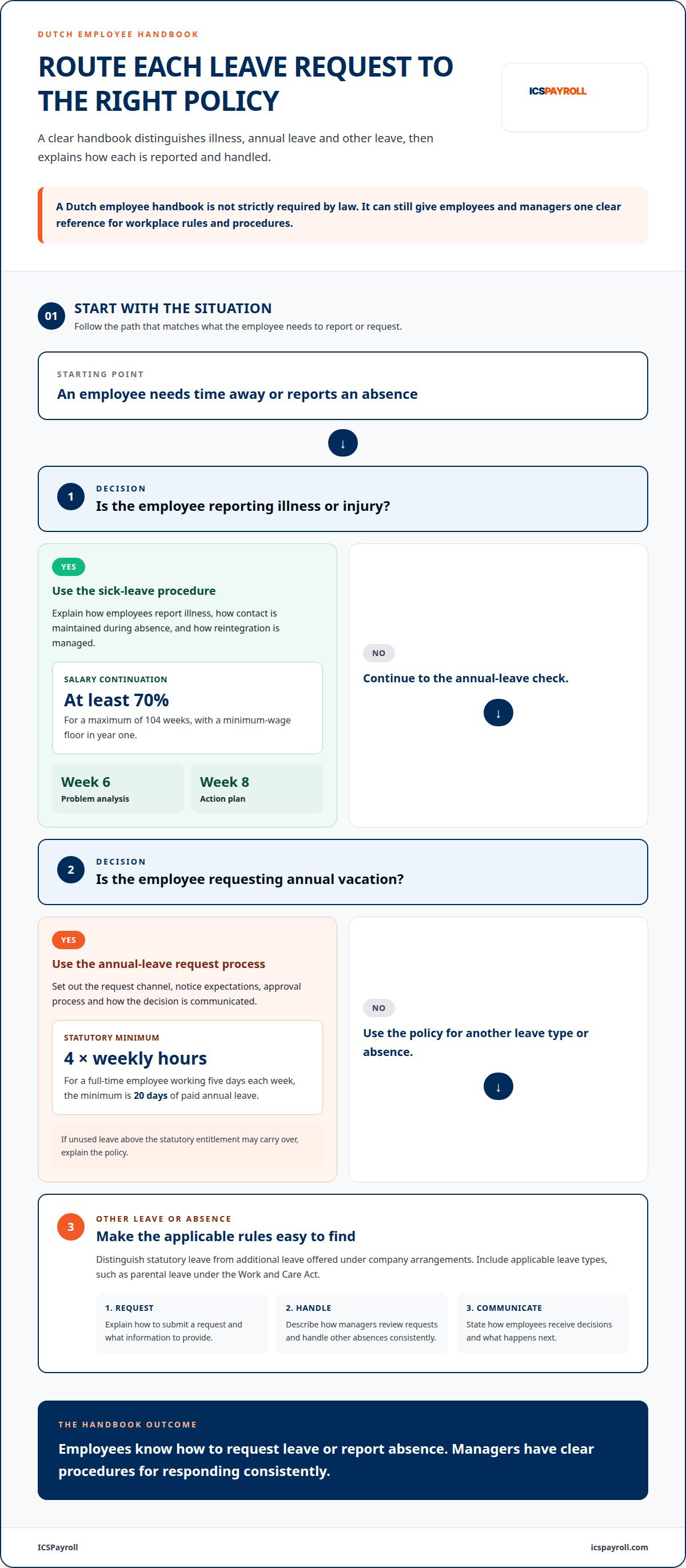
Leave policies distinguish statutory entitlements from additional leave offered under company arrangements. In the Netherlands, statutory vacation entitlement is at least four times an employee’s weekly working hours, according to Dutch government guidance on annual leave. For a full-time employee working five days each week, the minimum is 20 days of paid annual leave. The Work and Care Act sets out statutory leave arrangements, including parental leave. A handbook can explain which leave types apply, how employees submit requests, what information to provide, and how managers communicate decisions. It should also record additional leave separately from statutory leave.
Annual Leave and Absence Requests
Annual leave rules should explain how employees request time off and how the employer handles each application. Clarify the request channel, approval process, notice expectations and whether unused leave above statutory entitlement may carry over. Explain how employees report other absences so managers handle requests consistently. Because an employer may refuse a leave request, state how employees will receive the decision and what happens next. For example, specify whether requests go through a manager or an internal system.
Sick Leave and Reintegration
Sick-leave procedures explain how employees report illness and how reintegration is managed. In the Netherlands, employers must continue paying at least 70% of salary during illness or injury for a maximum of 104 weeks, with a minimum-wage floor in year one, according to Dutch government guidance on sick leave. The Gatekeeper Improvement Act, or Wet Poortwachter, covers reintegration. A useful handbook schedule identifies a problem analysis at week 6 and an action plan at week 8. It should also explain how employees and managers maintain contact during absence.
A handbook can set out company rules, staff regulations and core values. Dutch law does not strictly require an employee handbook, and employers are generally free to determine its contents. For example, explain how working hours are arranged, where employees can find leave procedures and how pay policies relate to their employment contracts. Covering Dutch employee handbook essentials gives employees a practical reference for routine decisions and helps managers apply procedures consistently.
Transparency and consistent workplace policies
A handbook makes workplace arrangements visible by explaining the rules employees and managers follow. In the Netherlands, relevant frameworks include the Working Hours Act, the Flexible Working Act, and the Transparent and Predictable Working Conditions Act. For remote work, explain how employees request flexible arrangements, agree working locations, and obtain approval before working from abroad.
Dutch-Specific Handbook Policies
Dutch-specific policies connect daily workplace rules with local employment regulations. The Working Hours Act governs working hours, maximum daily and weekly hours, rest periods and overtime policies. The Flexible Working Act is relevant to requests to work from home. The Transparent and Predictable Working Conditions Act concerns information employees must receive, including paid parental leave and termination procedures. Naming these frameworks helps staff understand which arrangements apply.
Where a works council exists, certain handbook policies require its consent under Article 27 WOR. A handbook can also explain whistleblowing procedures and how employees raise concerns. Set out the responsible contact, reporting channel, and next steps in plain language. This makes it easier to follow the procedure consistently and understand what happens after a report.
Workplace Conduct Policies
Conduct policies define acceptable behaviour and practical standards, including clothing, alcohol, drugs and smoking. A clothing rule can specify safety or role-related requirements, while an alcohol and drugs policy can explain expectations during work. State where smoking is prohibited and how workplace rules are applied. Specific examples help employees distinguish formal policy from informal custom.
Article 7:660 of the Dutch Civil Code requires employees to follow work-performance and good-order regulations. Use that framework to explain conduct expectations without relying on unwritten norms. Policies should address nondiscrimination and harassment, and identify how employees can report inappropriate behaviour. Applying the same standards across teams supports consistent treatment.
Remote and Flexible Work Policies
Remote-work policies should describe how employees request homeworking, arrange working hours and communicate with managers. The Flexible Working Act is relevant to requests to work from home, so explain the request process and how decisions are communicated. For example, state which manager receives a request and how an agreed schedule is recorded.
Working from abroad needs its own approval process. A homeworking arrangement should not be assumed to cover every location. Specify how employees request permission, identify the proposed work location and agree on the period and working arrangements. Clear steps help managers apply the policy consistently and give employees a record of the agreed terms.
Binding Policies and Unilateral Changes
A handbook becomes binding when it forms part of the employment contract and the employee has agreed to it. Refer to the handbook in employment contracts and explain how employees acknowledge its terms. Under Article 7:613 BW, an employer needs a compelling interest to change handbook conditions unilaterally.
Explain how employees receive revised policies, when changes take effect, and how acknowledgement is recorded. That process helps distinguish updated guidance from a contractual change. Article 27 WOR consent requirements also matter for certain policy changes. Keep versions and approval records together, so employees and managers can identify the rules currently in force.
Consistency depends on more than publishing a document. For example, a smoking rule should apply across comparable workplaces, while a flexible-work procedure should direct employees to the same request channel. Explain exceptions and who makes decisions instead of leaving managers to create local practices. Employees can then understand the rules, and managers have a clear basis for applying them fairly.
Workplace safety and inappropriate behaviour
A handbook can turn safety duties and behaviour expectations into clear workplace procedures. In the Netherlands, employers are responsible for employee safety under the Working Conditions Act.
Codes of Conduct
A code of conduct explains which behaviour is acceptable and how employees should respond to misconduct. It matters because specific examples make expectations easier to understand and apply consistently.
Address discrimination, harassment and other inappropriate behaviour, then identify the reporting channel and responsible contact. For example, explain how an employee can report repeated unwanted comments and what happens after a report. Employers are required to act on undesirable workplace behaviour. Clear instructions help employees understand the process and managers apply it fairly.
Safety and Risk Assessment
Safety policies explain how the organisation identifies workplace risks and protects employees. They matter because the Working Conditions Act makes employers responsible for employee safety.
Employers must have a Risk Inventory & Evaluation and a psychosocial workload policy, also known as a PSA policy. Use the handbook to explain where employees can find the applicable safety regulations and how they raise a concern. For example, tell staff how to report an unsafe workstation or excessive workload. Keep practical reporting instructions distinct from the underlying assessment documents.
Threats and Workplace Violence
A threats and violence policy defines how employees report intimidation, threats or violent incidents. Staff need a clear response process and should know whom to tell.
Set out the reporting contact, information to record and how urgent concerns are escalated internally. For example, distinguish a threatening message from an immediate physical threat, then state the appropriate reporting route for each. Address threats and acts of violence directly in workplace rules. Explain how managers document incidents and communicate relevant follow-up to affected employees.
Written Workplace Regulations
Written workplace regulations record the rules employees must follow and the procedures that support them. Accessible instructions are more reliable than verbal explanations that can vary from team to team.
An employee handbook can provide regulations that employers must give in writing. Use it to state safety responsibilities, conduct standards, and reporting procedures in direct language. For example, connect a rule against harassment with the process for reporting it. Article 7:660 of the Dutch Civil Code requires employees to comply with work-performance and good-order regulations.
Keep the document practical: name the relevant policy, explain who handles reports and describe the next step. A staff member reporting harassment should be able to find the contact and procedure without interpreting broad principles. Review how written rules work together, especially where conduct and safety overlap. This structure clarifies expectations for employees and gives managers a consistent reference when responding to reports or workplace risks.
Departing employees and return of company property
A handbook should explain departure steps, connect them to employment contracts and set expectations for returning company property. The Working Hours Act governs working hours, maximum daily and weekly hours, rest periods and overtime. Document applicable break and overtime arrangements clearly. Include a complaints route, disciplinary process and termination procedure that explains the notice periods stated in employment contracts.
Termination and Notice Periods
Termination procedures explain how employment ends and which steps employees and managers follow. Clear instructions help prevent confusion during a sensitive situation. The handbook can identify who receives a resignation, how the employer communicates a termination and where notice periods are recorded. Employment contracts must include notice periods and salary details, so point employees to their individual contract for those terms.
Disciplinary and grievance procedures should identify how employees raise concerns, who reviews them and how the outcome is communicated. For example, an employee reporting a conduct issue should know where to submit the complaint and what information to include. Explain how managers record concerns and respond consistently. Keep disciplinary steps distinct from termination rules, and avoid implying that every complaint leads to the same outcome.
Return of Company Property
A property-return procedure identifies which company items employees must hand back when leaving. A documented handover reduces uncertainty about access, equipment and outstanding responsibilities. List relevant items, such as a company laptop, access card, keys or documents, where applicable. Explain who coordinates collection and how the employee receives confirmation that each item was returned.
Set out the sequence in practical terms: the employee and manager identify assigned property, agree a handover point, and record returned items. A checklist can capture the item, its condition, and the handover date without turning the process into an informal exchange. Explain how employees return company records and remove access to workplace systems through the employer’s established process.
Keep company rules and employment-related conditions easy to find during the departure process. A departing employee may need to understand ongoing conduct expectations, confidentiality arrangements or the final handover of work. Refer to the relevant handbook policy and employment contract rather than relying on memory. This gives the employee and manager a shared reference.
Company values and the code of conduct also shape respectful departures. State that professional behaviour and appropriate communication remain expected during handover. For example, explain how employees should raise unresolved concerns and transfer work-related information to the assigned colleague. A clear process supports continuity without blurring the distinction between general conduct rules and contractual obligations.
Employee handbook legal review and implementation
A handbook works only when its procedures reflect Dutch rules and employees can access the current version. Review legal terms, approval requirements, communication processes and update records as one system.
Legal Review of the Handbook
Legal review checks whether handbook policies align with statutory requirements and the employment agreements they support. A handbook’s binding effect depends on contractual agreement.
In the Netherlands, a handbook is binding when it forms part of an employment contract and the employee has agreed to it. Employers can also ask existing employees to agree in writing to a handbook introduced after hiring. Check whether the contract refers to the handbook and whether employee agreement is documented. This makes the relationship between individual terms and general procedures clear.
Check policies involving employee information against GDPR/AVG requirements. For example, rules on monitoring and data processing should explain how workplace information is handled. Include employees’ access rights and the process for requesting a correction. Whistleblowing procedures also need clear wording: explain employees’ rights and protections when they report suspected wrongdoing in good faith.
Updating and Communicating the Handbook
An update process identifies when policies are reviewed, approved, communicated and acknowledged. Outdated procedures can conflict with statutory changes or current workplace arrangements.
Review handbook policies annually and when relevant legislation changes. The WTP pension reform is one example of a legislative development that may affect handbook content. Keep a change log that names the policy, summarises the revision, records its approval and identifies the version in effect for employees. This creates a useful record for managers and staff.
Before issuing revisions, identify whether works council consent applies to the policy. Certain employee handbook policies require consent under Article 27 WOR. Then distribute the revised document, explain what changed, and ask employees to acknowledge the update. Employers are advised to obtain signatures when employees join and whenever the handbook changes.
Align the handbook with mandatory work regulations, known as the arbeidsreglement, to support consistency and legal validity. Compare the documents for conflicts in reporting routes, workplace rules and employee procedures. If a new version changes contractual conditions, record employee agreement in writing rather than treating distribution alone as consent. A clear implementation record shows which version employees received and accepted.
For an international employer setting up Dutch employment arrangements, review Dutch employment support alongside the handbook’s implementation plan. Keep legal review, employee communication, and payroll procedures aligned, especially when policies affect pay or benefits. Clear ownership of each process helps prevent different teams from applying different handbook versions. The aim is a consistent document employees can understand and managers can implement.
ICSPayroll: Employer of Record (EOR)
ICSPayroll provides Employer of Record (EOR) services for companies hiring employees in the Netherlands. This can suit international employers that need a local employment arrangement while establishing workplace policies and processes. Dutch Payroll Administration supports payroll compliance, while a 30% Ruling Application can assist eligible international employees seeking the Dutch tax benefit. Aligning handbook provisions with employment and payroll arrangements helps keep employee information consistent. For companies hiring in the Netherlands without their own local employment structure, EOR can provide a practical route to employ staff. To discuss Dutch employment support, visit ICSPayroll’s website.
Put your handbook into practice
A handbook works best as part of daily operations, not as a document employees see only during onboarding. Treat Dutch employee handbook essentials as an ongoing management responsibility: assign ownership, make the current version easy to find and give managers a consistent way to apply its procedures. Employees are more likely to use policies when they know where to find them and how to raise questions.
Build a practical review routine around real workplace changes. A new reporting process, team structure or way of working can reveal where instructions need clarification. Record decisions and revisions so managers can explain which guidance applies. This turns the handbook into a useful operational reference and supports clearer communication as the organisation grows.
If your Dutch employment arrangements need support alongside handbook implementation, contact ICSPayroll to discuss your handbook. A clear next step can help you put the right processes into practice with confidence.
Frequently Asked Questions
Legal Enforceability: What Makes It Binding?
A handbook’s terms are binding when the employment agreement incorporates them and the employee agrees. Keep a dated record of the agreement, the handbook version and any later written acceptance. For example, if an employee joins after a policy revision, retain the version provided at hiring. A clear record helps distinguish agreed contractual terms from guidance or procedures that explain how the workplace operates.
What should a Dutch employee handbook include?
Include practical policies employees need to understand their work and the company’s procedures. Typical subjects include pay arrangements, working hours, leave, sickness reporting, conduct, safety, complaints, data handling and departures. Add the correct contact or channel for each process. For example, explain where an employee reports a concern and who handles the next step. Keep individual contractual terms distinct from general workplace rules.
What are the Dutch statutory rules for annual leave, public holidays, and holiday pay?
Statutory annual leave is at least four times an employee’s weekly working hours, and holiday allowance is 8% under the supplied 2026 fact sheet. Public holiday arrangements should be described separately: state which holidays are treated as non-working days under the applicable employment arrangements or collective labour agreement. Explain how employees request leave and how the handbook distinguishes statutory vacation from additional leave.
How should Dutch handbooks explain sick leave, sickness reporting, and reintegration duties?
Explain how employees report sickness, who receives the report, and how contact about returning to work is arranged. Dutch sick-pay rules provide at least 70% of salary for up to 104 weeks, with a minimum-wage floor in year one. Under the Gatekeeper Improvement Act, the problem analysis is scheduled at week 6 and the action plan at week 8. Describe responsibilities and reintegration steps separately from payroll reporting.
What rules apply to salary payment, payslips, pension contributions, and expense reimbursements in the Netherlands?
Set out salary terms in the employment contract and use the handbook to explain related administration. State when payroll information is provided, where employees can access payslips and whom they should contact about a discrepancy. Explain how pension arrangements apply and what documentation employees need to submit for expense claims. Distinguish reimbursable business expenses from salary and allowances, and direct employees to the relevant approval procedure.
What workplace health and safety and anti-harassment policies are required in the Netherlands?
Employers must have a Risk Inventory & Evaluation and a psychosocial workload policy. The Working Conditions Act makes employers responsible for employee safety, and employers must act on undesirable behaviour at work. Point employees to the relevant safety procedures and explain how to report harassment or another concern. For example, name the reporting route and describe who receives the report and handles follow-up.
What privacy, data protection, and monitoring rules should a Dutch employee handbook explain?
Explain how employee data is handled and how workplace monitoring is governed under GDPR/AVG requirements. Identify the types of personnel information used, the purpose of handling it and the process for employee requests. Under the GDPR, employees may inspect their personnel files, copy parts and request correction or erasure of incorrect information. Name the contact point and explain how employees submit these requests.
What are the rules for working hours, breaks, overtime, and rest periods in the Netherlands?
The Dutch Working Hours Act governs working hours, maximum daily and weekly hours, rest periods and overtime policies. Employers should set out these arrangements clearly in the handbook.

Article by
Joost Hubregtse
Joost Hubregtse is Director of ICS Staffing & Payroll B.V., the wholly owned subsidiary of Intercompany Solutions behind ICS Payroll. He is responsible for Employer of Record and Dutch payroll services: employment contracts, wage tax and social security filings, holiday allowance, pension, sick leave and CAO compliance, with onboarding possible within 48 hours.
Frequently Asked Questions
A handbook’s terms are binding when the employment agreement incorporates them and the employee agrees. Keep a dated record of the agreement, the handbook version and any later written acceptance. For example, if an employee joins after a policy revision, retain the version provided at hiring. A clear record helps distinguish agreed contractual terms from guidance or procedures that explain how the workplace operates.
Include practical policies employees need to understand their work and the company’s procedures. Typical subjects include pay arrangements, working hours, leave, sickness reporting, conduct, safety, complaints, data handling and departures. Add the correct contact or channel for each process. For example, explain where an employee reports a concern and who handles the next step. Keep individual contractual terms distinct from general workplace rules.
Statutory annual leave is at least four times an employee’s weekly working hours, and holiday allowance is 8% under the supplied 2026 fact sheet. Public holiday arrangements should be described separately: state which holidays are treated as non-working days under the applicable employment arrangements or collective labour agreement. Explain how employees request leave and how the handbook distinguishes statutory vacation from additional leave.
Explain how employees report sickness, who receives the report, and how contact about returning to work is arranged. Dutch sick-pay rules provide at least 70% of salary for up to 104 weeks, with a minimum-wage floor in year one. Under the Gatekeeper Improvement Act, the problem analysis is scheduled at week 6 and the action plan at week 8. Describe responsibilities and reintegration steps separately from payroll reporting.
Set out salary terms in the employment contract and use the handbook to explain related administration. State when payroll information is provided, where employees can access payslips and whom they should contact about a discrepancy. Explain how pension arrangements apply and what documentation employees need to submit for expense claims. Distinguish reimbursable business expenses from salary and allowances, and direct employees to the relevant approval procedure.
Employers must have a Risk Inventory & Evaluation and a psychosocial workload policy. The Working Conditions Act makes employers responsible for employee safety, and employers must act on undesirable behaviour at work. Point employees to the relevant safety procedures and explain how to report harassment or another concern. For example, name the reporting route and describe who receives the report and handles follow-up.
Explain how employee data is handled and how workplace monitoring is governed under GDPR/AVG requirements. Identify the types of personnel information used, the purpose of handling it and the process for employee requests. Under the GDPR, employees may inspect their personnel files, copy parts and request correction or erasure of incorrect information. Name the contact point and explain how employees submit these requests.
The Dutch Working Hours Act governs working hours, maximum daily and weekly hours, rest periods and overtime policies. Employers should set out these arrangements clearly in the handbook.