
Employee misclassification in the Netherlands: status tests and tax risks
By Joost Hubregtse, Director, ICS Staffing & Payroll
All blog posts are reviewed and fact checked by our labour law lawyer Zishan Hussain and our director. Editorial standards
A contractor agreement doesn’t decide whether someone is truly self-employed. Employee misclassification in the Netherlands occurs when a worker is treated as self-employed even though the actual working relationship has the characteristics of employment. Dutch authorities assess how the work is carried out, not just the label in the contract.
Assessing the distinction can be difficult for businesses. A fixed schedule, close supervision, integration into the organisation and little freedom over how work is done can all affect a worker’s status. No single contract clause settles the question.
This article explains how Dutch authorities assess employment status, who may owe back taxes if a contractor is reclassified, and what enforcement or corrective measures can follow. It also covers the role and limits of model agreements, helping you understand why the working relationship matters and what to review across a Dutch workforce.
Key Takeaways
- Assess the real working relationship, including the worker’s autonomy, supervision and place in the business, rather than relying on the contract label alone.
- A model agreement offers no protection if the parties’ day-to-day conduct differs from its terms.
- If a contractor is reclassified, the engaging company may owe payroll tax and could face other employment-related obligations.
- Active enforcement began on 1 January 2025. The applicable lookback and corrective measures depend on the circumstances, including whether formal instructions were followed.
- For a role that should be employed in the Netherlands, an Employer of Record can provide a route to local employment and payroll administration.
Who pays the back-tax if a Dutch contractor is misclassified?
If the Belastingdienst reclassifies a contractor as an employee, the engaging company may owe payroll tax that should have been withheld. The worker may also have employment-related claims, so back taxes are only one possible consequence. For employee misclassification in the Netherlands, the key question is whether the actual working relationship constitutes employment, regardless of what the parties call it.
Under the Wet DBA, clients and contractors share responsibility for assessing the relationship. The company should compare the agreement with the actual work, including who directs tasks, sets schedules and bears responsibility for delivery. A contract that describes independence is relevant evidence, but it cannot replace the conduct of the parties. Classification depends on the combined facts, not one clause or indicator.
Consider the work and how it is performed. An employee generally performs work personally under an employer’s authority. A contractor is more likely to deliver a defined project with discretion over how and when to complete it. A contract for work may focus on a specified result, while a services agreement may cover ongoing services. Neither agreement title determines status on its own.
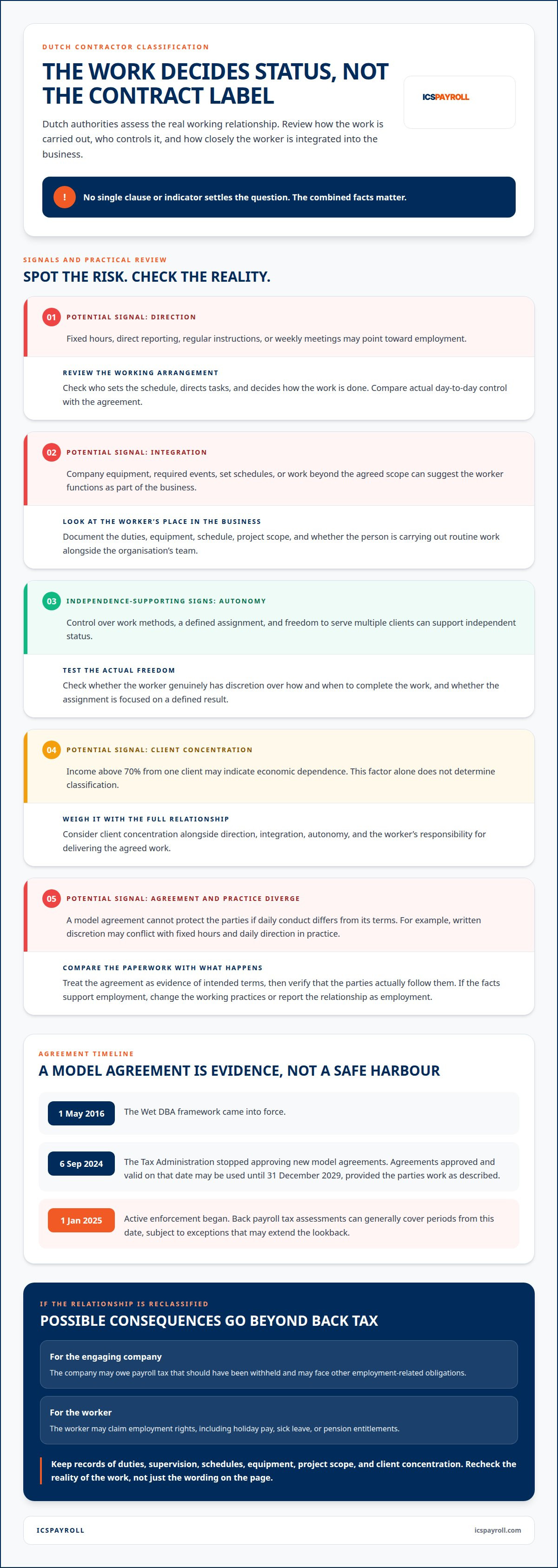
- Direction: Fixed hours, direct reporting, regular instructions or weekly meetings may indicate employment.
- Integration: Company equipment, required events, set schedules or tasks beyond the agreed scope can suggest the worker functions as part of the business.
- Autonomy: Control over work methods, a defined assignment and freedom to serve multiple clients support independence.
- Client concentration: Income above 70% from one client may indicate economic dependence, but this factor alone does not determine classification.
A long-term role involving routine tasks and close supervision presents a different picture from a short specialist project completed independently. For employee misclassification in the Netherlands, the Belastingdienst assesses the full circumstances, including the worker’s place in the business and the degree of control exercised by the client.
Worker classification rules differ across EU countries because each applies its own legal framework. In the Netherlands, the assessment focuses on the substance of the arrangement and the full working relationship, not a single contract label.
If a worker is recognized as an employee, they may claim employment rights that should have applied. These can include holiday pay, sick leave and pension entitlements. Under Article 7:629 of the Dutch Civil Code, sick pay is 70% for a maximum of 104 weeks, with a minimum-wage floor in year one. Pension obligations may also arise following reclassification.
A Dutch business should document duties, supervision, schedules, equipment, project scope and client concentration. Compare these facts with the contract, then change the working practices or report the relationship as employment where the facts support that status. According to the Belastingdienst, back payroll tax assessments can generally cover periods from 1 January 2025, subject to exceptions that may extend the lookback.
Dutch model agreements and substance-over-form assessment
Dutch model agreements can help set out how a hiring relationship is intended to work. Their value depends on whether the worker and client follow those terms in practice.
The Wet DBA Framework
The Wet DBA, in force since 1 May 2016, provides the framework for assessing whether a client-contractor relationship is employment. Model agreements were intended to help parties describe arrangements that were not employment relationships. For hiring businesses, the practical point is clear: an agreement can support the assessment, but working practices remain central.
The Dutch Tax Administration stopped approving new model agreements on 6 September 2024 and will not renew existing agreements when they expire. Agreements approved and valid on that date may be used until 31 December 2029, provided the parties work as described. The Tax Administration’s model agreement guidance explains their use. This remaining period does not make the wording a safe harbour if daily practice has changed.
For example, an agreement may say that a contractor decides how to complete a defined assignment. If the client instead sets fixed hours, directs daily tasks and integrates the worker into its team, the written terms and actual relationship diverge. Classification depends on the facts of the work, not simply the document’s title.
Presumptions and Advance Rulings
A legal presumption can shift the initial burden of showing that work is not employment. The VBAR bill retains a proposed presumption of employment for work paid below €38 per hour, but it is not yet in force. The Senate passed the stripped bill on 16 June 2026; its entry into force remains pending.
A proposed presumption should not be confused with a binding advance ruling on a specific hiring arrangement. A model agreement records the intended terms, while status assessment considers the work actually performed. Treat written agreements as evidence, not as a decision that overrides how the relationship operates.
The Dutch government also provides an anonymous online questionnaire to help assess employment relationships. It can help structure an initial review, but it does not replace examination of the actual arrangement. A separate government web-module pilot ran from January 2021 to July 2021 and has ended.
Before relying on an existing agreement, compare its clauses with the worker’s current duties, supervision, schedule and autonomy. Record any differences and update the arrangement to reflect the work being done. If the client controls daily activities, contract wording alone will not establish independent contractor status. Review the arrangement regularly as assignments change: a defined project can develop into ongoing, directed work.
Tax authority enforcement of false self-employment rules
Enforcement of Dutch false self-employment rules changed on 1 January 2025. The consequences depend on the working relationship, the period assessed and the employer’s response to correction instructions. The Belastingdienst enforcement policy sets out how authorities approach false self-employment.
False and Disguised Employment
False self-employment occurs when a worker is treated as an independent contractor even though the actual relationship is employment. Disguised employment describes the same mismatch between the contractor label and employee-like working conditions. This matters because a business may have payroll and employment obligations even when its paperwork describes the worker as self-employed.
The Belastingdienst assesses the facts of an arrangement rather than relying only on model agreements. For example, an agreement may describe independent work while the client directs daily tasks and treats the worker like staff. That mismatch can prompt authorities to examine whether the documents reflect the work actually performed. The label does not determine the outcome.
Active enforcement began on 1 January 2025, after the previous moratorium ended. During the first enforcement year, authorities prioritized severe cases. They did not impose misclassification fines during 2025, but could require corrections and assess payroll taxes. The soft-landing period runs until 1 January 2027 for businesses taking steps to address false self-employment.
Employer Liabilities
A finding of disguised employment can make the engaging company responsible for payroll tax that should have been withheld. The company may also face employee-related obligations, including sick pay or pension contributions. These liabilities can affect payroll records and business operations, not just the contract with one contractor.
For enforcement beginning in 2025, assessments generally do not look back before 1 January 2025. Exceptions apply where there is malicious intent or the business fails to follow formal instructions. In those cases, the lookback can extend to five years. A company’s response to an instruction matters alongside the original classification.
Ordinary default fines are not imposed in 2026 and resume only from 2027. Fines for willful or grossly negligent misclassification can be imposed from 2026. These are distinct enforcement categories, so businesses should distinguish an ordinary filing default from deliberate conduct.
Enforcement and Worker Challenges
Workers can challenge self-employed status by arguing that the actual relationship is employment and seeking recognition of employee rights. They can gather evidence about how work is assigned, supervised and paid, then raise the issue with the engaging company or pursue a claim for recognition or damages.
For a business, a practical response is to review the arrangement, identify differences between the documents and actual operations, then change the working relationship or report the work as employment. Keep records of corrective steps and responses to formal instructions. These records help show how the business addressed classification during the enforcement period.
Tax Administration enforcement and corrective measures
The Belastingdienst can correct payroll tax treatment when actual working conditions establish employment. For enforcement from 1 January 2025, assessments generally reach back to that date, with exceptions for malicious intent or ignored instructions.
This matters when a contractor arrangement spans several tax periods. Identify when the work began, how it operated and whether practices changed. For example, a project may start with independent delivery, then shift to fixed hours and close management. That change can affect the period and payroll taxes under review.
The general statutory period for a Dutch back-tax assessment is five years from the end of the tax period. Under current enforcement policy, the Belastingdienst generally does not look back before 1 January 2025. The five-year period can apply in cases of willful misconduct or when a company fails to follow a formal instruction. These rules address different questions: the statutory assessment period and the enforcement lookback.
Corrective measures depend on the circumstances identified by the authorities. The Tax Administration may require a company to adjust the working relationship or report the worker as an employee in wage tax filings. It may also assess unpaid payroll taxes. Deliberate false self-employment, obvious misclassification or failure to follow instructions can expose the business to additional corrective measures.
Penalty timing also depends on the type of conduct. Ordinary default fines are not imposed in 2026 and resume only from 2027. Fines for willful or grossly negligent misclassification can be imposed from 2026. A business should therefore distinguish an ordinary filing default from deliberate conduct, rather than treating all penalties as suspended.
A focused response helps establish what happened and what needs to change. Review contracts alongside schedules, instructions, invoices and records of actual duties. Then map each worker’s status to the relevant payroll periods and identify missing filings or tax payments. Keep records showing when the business found the issue and what steps it took.
If the Belastingdienst issues a formal instruction, record its requirements, who is responsible and how the business responds. Changing only the contract wording, for example, will not address a relationship that still operates as employment. Correct the practical arrangement or report the worker as an employee, then retain evidence of the changes and payroll corrections. This creates a clear record if authorities later assess compliance or the relevant period.
Dutch tests for determining employment status
Dutch status assessment has no single contract label or numerical score that automatically classifies every worker. The Belastingdienst considers the relationship as a whole, including how work is performed and organised.
Start with the work itself. An employee typically performs work personally under an employer’s authority, while an independent contractor generally has greater freedom to organise delivery. A contract describing a defined assignment supports independent status only if the actual arrangement matches it. Regular payment, ongoing duties and close direction can point toward employment when considered together.
A rebuttable presumption can also matter. Where remunerated work is performed for at least 20 hours per month or weekly for at least three consecutive months, it is presumed to be an employment agreement; contrary evidence can rebut that presumption. Treat this as a specific legal indicator, not a complete substitute for assessing the surrounding facts.
For each arrangement, examine how the client and worker divide responsibility. Ask who determines how and when work is done, whether the worker can refuse additional tasks, and whether the assignment has a defined result. A specialist engaged to deliver a discrete project independently differs from someone performing ongoing duties under the client’s regular direction.
- Authority: Compare instructions, supervision and reporting with the worker’s freedom to choose how to deliver the agreed result.
- Integration: Establish whether the worker is part of normal operations or supplies a separate, defined service.
- Personal performance: Record whether the worker must perform the tasks personally or can arrange for another person to deliver them.
- Commercial independence: Consider freedom to serve other clients and income concentration. More than 70% of income from one client can indicate dependence, but it does not decide status alone.
Then compare those findings with the agreement and payroll treatment. A mismatch deserves attention: a contract may promise project-based independence while actual operations require fixed availability and ongoing reporting. Record the evidence behind each conclusion, including instructions, schedules, invoices and changes in duties. Reassess when the arrangement changes, as a project can develop into a regular, directed role.
The practical takeaway is to classify the working situation from evidence, not wording. A Dutch business can review each role against these factors, document its reasoning and correct the arrangement where the evidence indicates employment. For support aligning Dutch payroll treatment with a role’s actual status, discuss Dutch payroll administration.
ICSPayroll: Employer of Record (EOR)
ICSPayroll provides an Employer of Record (EOR) service for companies hiring employees in the Netherlands. It can be a practical option when the relationship should be employment but your company needs a local employment arrangement. The EOR employs the worker on your behalf and handles local compliance, payroll, tax and insurance obligations.
For a company that already employs staff locally, Dutch Payroll Administration supports the ongoing payroll process. ICSPayroll also manages 30% Ruling Applications for eligible international employees. These services address employment and payroll administration; they don’t replace a case-specific assessment of whether a contractor arrangement is employment.
Contact ICSPayroll to discuss the right Dutch employment or payroll arrangement for your situation.
Make worker status part of workforce planning
Classification is not a one-time paperwork decision. A role can change as project work becomes ongoing, supervision increases or responsibilities shift. Build regular status reviews into workforce planning so changes in the actual arrangement are considered before payroll processes and contract terms fall out of alignment.
For employee misclassification in the Netherlands, the practical next step is to match each role’s working reality to the right employment and payroll structure. This gives your business a clearer basis for managing obligations as teams and assignments evolve.
ICSPayroll can discuss the classification and employment arrangements relevant to your Dutch workforce. Contact ICSPayroll to discuss classification and identify a suitable next step for your organisation.
Frequently Asked Questions
What is misclassification?
Misclassification means treating a worker as self-employed when the real relationship is employment. In the Netherlands, this can happen even when both parties have signed a freelance contract. For example, a consultant labelled an independent contractor may function like staff if the business directs daily work, sets regular hours and expects personal service. Classification follows the working arrangement, not the label in the paperwork.
Does hiring through an EOR remove misclassification risk?
An EOR employs the worker rather than engaging them as a self-employed contractor, providing an employment route instead of relying on freelance classification. The role and working practices should still match the employment arrangement. In the Netherlands, an EOR acts as the legal employer and handles local compliance, tax and insurance obligations. Changing a document alone does not turn a genuinely independent contractor engagement into employment.
What are the main risks of engaging contingent workers from an employment law perspective?
The main risk is that a worker treated as a contractor is later recognised as an employee. The business may then face payroll tax corrections and employee-related claims, including sick pay or pension obligations. This can also disrupt operations: the company may need to revise budgets, payroll records and workforce plans while addressing the relationship. The risk depends on the actual arrangement, not simply the worker’s contingent status.
What is a contractor in the Netherlands?
A contractor is generally an independently engaged professional who delivers agreed work or a defined result, rather than working as part of the client’s staff under its direction. For example, a specialist may take responsibility for completing a project and organise the work independently. A contractor may serve multiple clients. The key distinction is how the parties work together, not whether the agreement uses the word “freelancer.”
What is the Wet DBA and how does it decide status?
The Wet DBA is the Dutch law governing the assessment of employment relationships between clients and contractors. It does not classify a freelance contract by its title alone. Instead, the parties must assess whether the agreed work and actual practices amount to employment. For instance, a project contract may describe independent delivery, while daily direction by the client can point to a different status. Both parties share responsibility for assessing the relationship.
What is the risk of criminal sanctions applying?
Misclassification does not automatically mean criminal sanctions apply. Enforcement consequences for false self-employment can include tax corrections, assessments, fines and penalties. The risk is more serious where authorities identify wilful or grossly negligent conduct, which can lead to fines under the applicable enforcement framework. A classification dispute alone does not prove a criminal offence; the conduct and evidence matter.
How does the Netherlands determine whether a worker is an employee or self-employed contractor?
The assessment considers the working relationship as a whole. Relevant evidence includes who controls the work, whether personal performance is expected, how the worker is integrated into operations and how much independence they have. A useful review compares the contract with actual records, such as instructions, schedules, invoices and project deliverables. One indicator rarely determines status on its own; the combined facts point to the stronger classification.
What is the Dutch DBA Act and how does it apply to freelance contracts?
The DBA Act, also known as the Wet DBA, requires clients and freelancers to assess whether their arrangement is genuinely self-employment or employment. A freelance contract can record the parties’ intentions, but it cannot settle status if daily practice contradicts its terms. For example, a written commitment to independent work carries less weight if the client controls the worker’s routine and tasks. Review the contract whenever the role changes.

Article by
Joost Hubregtse
Joost Hubregtse is Director of ICS Staffing & Payroll B.V., the wholly owned subsidiary of Intercompany Solutions behind ICS Payroll. He is responsible for Employer of Record and Dutch payroll services: employment contracts, wage tax and social security filings, holiday allowance, pension, sick leave and CAO compliance, with onboarding possible within 48 hours.
Frequently Asked Questions
Misclassification means treating a worker as self-employed when the real relationship is employment. In the Netherlands, this can happen even when both parties have signed a freelance contract. For example, a consultant labelled an independent contractor may function like staff if the business directs daily work, sets regular hours and expects personal service. Classification follows the working arrangement, not the label in the paperwork.
An EOR employs the worker rather than engaging them as a self-employed contractor, providing an employment route instead of relying on freelance classification. The role and working practices should still match the employment arrangement. In the Netherlands, an EOR acts as the legal employer and handles local compliance, tax and insurance obligations. Changing a document alone does not turn a genuinely independent contractor engagement into employment.
The main risk is that a worker treated as a contractor is later recognised as an employee. The business may then face payroll tax corrections and employee-related claims, including sick pay or pension obligations. This can also disrupt operations: the company may need to revise budgets, payroll records and workforce plans while addressing the relationship. The risk depends on the actual arrangement, not simply the worker’s contingent status.
A contractor is generally an independently engaged professional who delivers agreed work or a defined result, rather than working as part of the client’s staff under its direction. For example, a specialist may take responsibility for completing a project and organise the work independently. A contractor may serve multiple clients. The key distinction is how the parties work together, not whether the agreement uses the word “freelancer.”
The Wet DBA is the Dutch law governing the assessment of employment relationships between clients and contractors. It does not classify a freelance contract by its title alone. Instead, the parties must assess whether the agreed work and actual practices amount to employment. For instance, a project contract may describe independent delivery, while daily direction by the client can point to a different status. Both parties share responsibility for assessing the relationship.
Misclassification does not automatically mean criminal sanctions apply. Enforcement consequences for false self-employment can include tax corrections, assessments, fines and penalties. The risk is more serious where authorities identify wilful or grossly negligent conduct, which can lead to fines under the applicable enforcement framework. A classification dispute alone does not prove a criminal offence; the conduct and evidence matter.
The assessment considers the working relationship as a whole. Relevant evidence includes who controls the work, whether personal performance is expected, how the worker is integrated into operations and how much independence they have. A useful review compares the contract with actual records, such as instructions, schedules, invoices and project deliverables. One indicator rarely determines status on its own; the combined facts point to the stronger classification.
The DBA Act, also known as the Wet DBA, requires clients and freelancers to assess whether their arrangement is genuinely self-employment or employment. A freelance contract can record the parties’ intentions, but it cannot settle status if daily practice contradicts its terms. For example, a written commitment to independent work carries less weight if the client controls the worker’s routine and tasks. Review the contract whenever the role changes.