
Dutch labor law for fixed-term contracts: how they end
By Joost Hubregtse, Director, ICS Staffing & Payroll
All blog posts are reviewed and fact checked by our labour law lawyer Zishan Hussain and our director. Editorial standards
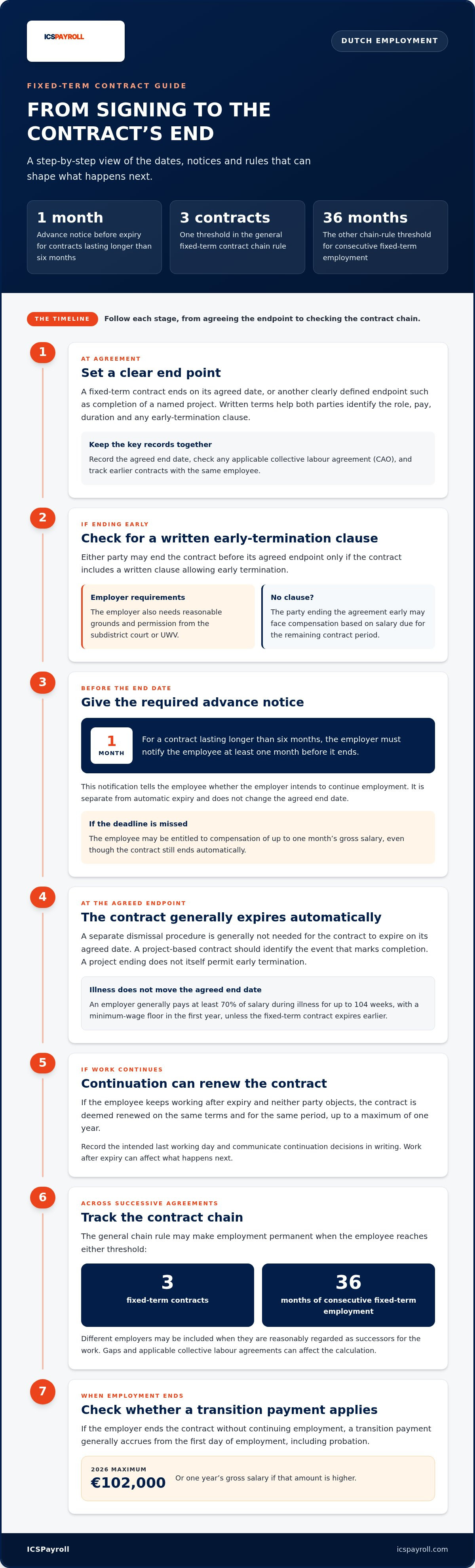
A fixed-term contract can end automatically, but its end date isn’t the only rule. Under Article 7:667 of the Dutch Civil Code, employment generally ends on the agreed date. Early termination by notice is possible only if the contract includes a written clause. If it lasts longer than six months, the employer must notify the employee at least one month before it ends.
It’s understandable to focus on the date written in the contract. Notice, early termination and successive agreements can affect what happens next, including whether employment becomes permanent. The sections below also explain how transition payments, sick pay and the minimum wage relate to fixed-term employment.
By Joost Hubregtse, Payroll Director. Joost Hubregtse is Payroll Director at ICSPayroll, the Dutch payroll and EOR specialist of Intercompany Solutions. A career payroll specialist and former Head of Payroll, he oversees wage tax filings, 30% ruling applications, and employment compliance for international employers.
Reviewed by Joost Hubregtse, Payroll Director, on 30 October 2026.
Key Takeaways
- Understand when a fixed-term contract ends automatically and when an employer must give advance notice.
- Learn why ending a contract early depends on a written termination clause and the applicable dismissal rules.
- See how contract extensions and gaps between agreements affect the fixed-term contract chain.
- Find out when a collective labour agreement can change the usual limits on temporary contracts.
- Identify how Dutch payroll and Employer of Record support can help businesses manage employment administration.
What Is a Fixed-Term Contract under Dutch Law?
A fixed-term employment contract sets an agreed end date or another defined endpoint. Under Article 7:667(1) of the Dutch Civil Code, it generally ends automatically on that date. An indefinite contract has no predetermined end date. Dutch labor law for fixed-term contracts also regulates early termination, required employee information and the limits on successive temporary agreements.
Fixed-term employees generally have the same statutory employment protections and benefits as permanent employees, including minimum-wage protection, holiday allowance and paid leave. The main difference is duration: a fixed-term contract has an end date, while a permanent contract does not.
For a fixed-term employment contract, the employer must provide written information about employment terms under Article 7:655 of the Dutch Civil Code. Oral agreements can be legally valid, but written terms help both parties identify the role, pay, duration and any early-termination clause. For recruitment compliance, record the agreed end date, check any applicable collective labour agreement (CAO), and track earlier contracts with the same employee.
For a contract lasting longer than six months, the employer must notify the employee at least one month before it ends. If the employer misses this deadline, the employee may be entitled to compensation of up to one month’s gross salary. This notification, known as the transition notice, is separate from automatic expiry: it tells the employee whether the employer intends to continue the employment.
Early termination is a separate issue. Either party may end the contract before its agreed end date only if it includes a written early-termination clause. The employer also needs reasonable grounds and permission from the subdistrict court or UWV. Without such a clause, the party ending the agreement early may face compensation based on the salary due for the remaining contract period. Before agreeing to an early exit, employers should explain its potential financial consequences clearly.
If the employer ends the contract without continuing employment, a transition payment generally accrues from the first day of employment, including probation. In 2026, the maximum is €102,000, or one year’s gross salary if that is higher.
Illness, pregnancy or parental leave doesn’t by itself change the agreed end date. Under Article 7:629 of the Dutch Civil Code, an employer generally pays at least 70% of salary during illness for up to 104 weeks, with a minimum-wage floor in the first year, unless the fixed-term contract expires earlier. Pregnancy and parental leave do not automatically convert a temporary contract into a permanent one; the contract’s end and any continuation remain separate matters.
When a contract ends, the employee’s role and performance, along with the employer’s staffing needs, may inform whether employment continues. Successive contracts matter too: after three contracts or more than three years, the chain rule may make employment permanent, subject to applicable exceptions.
Automatic end dates and project-based endings
A fixed-term contract normally expires automatically on its agreed end date under Article 7:667(1) of the Dutch Civil Code. The employer doesn’t need to dismiss the employee through a separate termination procedure for that expiry. The contract’s end date, or another clearly defined endpoint, determines when employment ends. For example, a contract that runs through 30 September ends on that date unless the parties continue the employment relationship.
Some contracts define their duration by reference to a project rather than a calendar date. The agreement should specify the project endpoint, such as completion of a named assignment, so both parties know which event ends the employment. A project ending does not itself create a right to terminate early. If the contract ends before its agreed endpoint, the early-termination rules still apply.
Automatic expiry and advance notification are separate matters. For contracts lasting longer than six months, the employer must notify the employee at least one month before the end date. The notice tells the employee whether the employer intends to continue the employment, but it does not change the agreed expiry date. If the employer misses the deadline, compensation may be due even though the fixed-term contract still ends automatically.
Continuation can change the outcome. If the employee continues working after expiry and neither party objects, the contract is deemed renewed on the same terms and for the same period, up to a maximum of one year. Employers should record the intended last working day, communicate continuation decisions in writing and avoid treating work after expiry as an informal extension.
Successive contracts may convert automatically into permanent employment under the chain rule. The general limit is three contracts or 36 months of consecutive fixed-term employment, whichever is reached first. Gaps of up to six months don’t break the chain through 31 December 2027. From 1 January 2028, gaps of up to 36 months will no longer break it. A contract chain can also involve different employers when they are reasonably regarded as successors for the work.
For example, an employee has successive agreements with the same employer, and their combined duration reaches 36 months. The next agreement may be indefinite rather than temporary. The calculation can change when a gap, a successor employer, or a collective labour agreement applies. Keep each contract’s dates and terms together so the chain is assessed across the employment history, not just the latest agreement.
Clear end-date records also support accurate final payroll processing. Dutch payroll administration can help employers manage payroll records alongside contract end dates.
Early termination clauses
A fixed-term contract can end before its agreed date only through a valid legal route. Under Article 7:667(3) of the Dutch Civil Code, either party may terminate early by notice if the contract includes a written early-termination clause. The clause makes early notice possible, but it doesn’t remove other requirements. An employer still needs reasonable grounds and permission from the subdistrict court or UWV.
Read the early-termination clause alongside the contract’s notice period and any applicable collective labour agreement (CAO). The clause should state whether both parties may terminate early and how notice must be given. For example, an employee planning to leave before the end date should first check that the clause permits employee termination, then follow its notice procedure. Before issuing notice, an employer should identify the applicable dismissal route.
Without an early-termination clause, an employee who leaves early may owe compensation based on the salary for the remaining contract period. An employer that ends the agreement early may also face liability for bypassing the required dismissal procedure. The potential amount depends on the agreement and circumstances, so both parties should document their discussions and the proposed termination date.
A Hague Court of Appeal case illustrates why communication matters. The employer sought €9,566.77 in fixed compensation after an employee ended a fixed-term agreement without an early-termination clause. The employer had not explained the financial consequences before later notifying the employee of the amount owed. The court moderated the compensation to €7,700.19 gross, equivalent to three times the employee’s gross monthly salary.
The same case involved a proposed exchange: the employer offered early termination if the employee accepted relationship and non-competition clauses lasting two years. It illustrates why employers should explain the financial and contractual consequences before seeking agreement. A written record should specify the proposed end date, compensation, any continuing obligations and whether both parties accept the terms.
Indefinite employment follows different termination rules. Under Article 7:667(6) of the Dutch Civil Code, it can end with notice, by agreement, or by court decision. Employers and employees must follow the notice period in the contract or statutory law. For employees, the statutory notice period is one month. An employer’s period is one month for service under five years, two months for more than five but fewer than ten years, three months for at least ten but fewer than fifteen years, and four months for at least fifteen years.
For an international employer, an Employer of Record (EOR) can support employment administration while contract terms and termination processes are managed. Clear written clauses help both parties understand their rights before anyone proposes an early exit.
Exceptions to fixed-term contract rules under collective labour agreements
The Dutch chain rule generally limits successive fixed-term contracts to three agreements or 36 months. A collective labour agreement, known as a CAO, can provide specific exceptions where legal conditions are met. These provisions can affect whether a new agreement remains temporary or automatically becomes permanent. The applicable CAO and its wording matter, so employers should review it before extending a contract.
Until 31 December 2027, a CAO may extend the chain to a maximum of six contracts and 48 months when the nature of the business requires it. This is a limited exception, not a general option for every employer. For example, an employer cannot assume that adding contracts is permitted simply because a CAO exists. The agreement must provide for the exception under the required conditions.
Seasonal work has a separate gap rule. If a job can be performed for no more than nine months each year, a CAO or ministerial regulation can shorten the break between contracts that resets the chain to three months. This exception applies to recurring seasonal work; fluctuating demand alone does not qualify. The type and duration of the work are central.
Some workers also fall outside ordinary chain-rule limits. The rule does not apply to contracts for a vocational work-based learning programme. It also does not apply to employees under 18 who work an average of 12 hours a week or less. For employees who have reached state pension age, the maximum chain is 48 months and six contracts. These categories turn on the employee’s status and contract purpose, not merely the employer’s preference.
A CAO may also set industry-specific terms, including wages, working hours and benefits. These can affect payroll and employment conditions even when they do not change the contract chain. Employers should identify the applicable agreement, review its rules for temporary employment and document how contracts and any gaps are counted. An exception to contract limits does not remove other employment-law requirements, including written employment terms and applicable payment obligations.
The rules change on 1 January 2028. From that date, gaps of up to 36 months will no longer break the chain, and collective agreements can no longer extend the fixed-term contract chain. Employers planning renewals across that date should assess the timing and cumulative duration of agreements under the rules that apply then, rather than relying on an existing CAO exception.
Temporary fixed-term contract limits in the Netherlands
The Dutch chain rule limits how long parties can keep employment temporary through successive contracts. In general, a maximum of three fixed-term contracts applies within a period of 36 months. If the parties continue beyond either limit, a further agreement can become a permanent contract by operation of law. The practical takeaway is to assess the complete employment history before preparing another temporary agreement.
Count the contracts and their duration together. For example, an employee’s successive agreements might total fewer than 36 months but already reach the contract limit. In that case, the number of agreements can determine the outcome before the duration limit does. Conversely, fewer agreements can still reach the duration threshold. Keep each start date, end date and extension in one record.
A gap between agreements can affect whether the chain continues. Through 31 December 2027, a gap of up to six months does not break the chain; a gap longer than six months resets it. From 1 January 2028, a gap of up to 36 months will no longer break the chain. Employers planning a new fixed-term contract should therefore consider when the gap occurs, not just the latest end date.
The chain can also span different employers. Contracts with separate employers may count together if those employers are reasonably considered successors in relation to the work. Changing the name on the employment contract is not necessarily enough to start a new chain. Before treating a new agreement as unrelated, review the work performed and the relationship between the employers.
Some specific situations have different treatment. The chain rule does not apply to a vocational work-based learning contract or to an employee under 18 who works an average of 12 hours a week or less. For employees who have reached state pension age, the limits are 48 months and six contracts. A contract of no more than three months that directly follows a contract of at least 36 months between the same parties does not trigger the chain rule’s 36-month limit.
Collective labour agreements can provide exceptions under specific legal conditions through 31 December 2027. Where the nature of the business requires it, a collective agreement can extend the chain to a maximum of 48 months and six contracts. From 1 January 2028, collective agreements can no longer extend the chain, so an older clause cannot be assumed to apply to later arrangements.
Before renewing, list every agreement, calculate its duration, identify any gap, and check whether a successor employer or exception applies. That review helps determine whether the parties can offer another temporary contract or must use a permanent contract. Review your Dutch workforce structure before planning successive hires.
ICSPayroll: Employer of Record (EOR)
ICSPayroll provides Employer of Record (EOR) services for companies hiring employees in the Netherlands. This can help a business employ someone locally and manage Dutch employment administration without handling every payroll process in-house.
For companies that already employ staff, Dutch Payroll Administration supports payroll processing and compliance with Dutch tax and employment rules. International employees may also need help with the 30% Ruling Application, which ICSPayroll manages.
These services address employment administration, payroll and the ruling application process. They don’t replace the need to apply the correct contract terms, end dates and termination procedures to each employment relationship.
Contact ICSPayroll to discuss support for hiring or payroll in the Netherlands.
Build a clear contract-management process
Use your understanding of Dutch labor law for fixed-term contracts to build a consistent employment process. Assign responsibility for recording contract terms, tracking renewal decisions and communicating with employees. Make responsibilities clear across HR, managers and payroll, especially when several teams support the same employment relationship.
A reliable process also creates a clear record of decisions. Document the reasons for contract changes and keep communications consistent with the signed agreement. Hiring in the Netherlands for the first time, or changing workforce arrangements, can make local employment administration more complex. The right support can help a company manage Dutch employment arrangements with greater clarity.
ICSPayroll supports businesses with Dutch employment administration. Contact ICSPayroll about Dutch contracts to discuss your requirements. The individual circumstances of an employment relationship can affect which rules apply, so approach each contract with care. With a consistent process and informed support, your next hiring decision can move forward on a sound footing.
Frequently Asked Questions
What About Probation and the Transition Payment?
A probation period must be agreed in writing, apply equally to both parties and stay within the legal maximum. It is not allowed for contracts lasting six months or less. Longer fixed-term contracts may allow a probation period of one month, while contracts lasting two years or more may allow two months. A transition payment can accrue from the first day of employment, including during probation, if the employer ends the employment.
What Changes in the Chain Rule from 1 January 2028?
From 1 January 2028, a gap of up to 36 months between successive fixed-term contracts will no longer break the chain. Collective agreements can no longer extend the contract chain from that date. Employers reviewing renewals should therefore consider earlier employment periods, not only recent contracts. A pause that would have reset the chain under the rules through 31 December 2027 may no longer do so.
How many consecutive fixed-term contracts are allowed under the Dutch chain rule, and over what period?
The general limit is three consecutive fixed-term contracts within 36 months. The chain converts to indefinite employment if the parties go beyond either limit, whichever comes first. For example, a fourth successive contract may trigger conversion even if the total period remains under 36 months. Count qualifying contracts and their duration together, and consider gaps and any applicable collective agreement when assessing the chain.
When does a fixed-term contract automatically become a permanent contract in the Netherlands?
A fixed-term contract becomes indefinite when the parties exceed the chain rule’s contract or duration limit. In practical terms, this can happen when an employer offers another contract after the allowed sequence, or when consecutive temporary employment passes 36 months. A qualifying chain may include contracts with successor employers. Check the employee’s full contract history, including earlier agreements, before issuing a renewal intended to remain temporary.
What is the required notice period for ending a fixed-term contract early in the Netherlands?
There is no single notice period for early termination of a fixed-term contract. Early termination is possible only if the agreement contains a written early-termination clause, and the applicable contractual or statutory notice period must then be followed. The employee’s statutory notice period is one month. The employer’s notice period depends on the employee’s length of service; the employer also needs reasonable grounds and permission from UWV or the subdistrict court.
When must a Dutch employer give written notice that a fixed-term contract will not be renewed?
For a fixed-term contract lasting longer than six months, the employer must notify the employee at least one month before it ends. The notification should state whether employment will continue. Although the law requires notification, putting it in writing gives both parties a clear record. If the employer misses the deadline, compensation of up to one month’s gross salary may be due.
When is a transition payment (transitievergoeding) owed for a fixed-term contract in the Netherlands?
A transition payment is generally owed when the employer ends a fixed-term contract without continuing the employment. It accrues from the first day of employment, including probation, and is calculated proportionally for shorter service periods. In 2026, the maximum is €102,000, or one year’s gross salary if that amount is higher. The employee’s length of service and salary determine the calculation, subject to that cap.
What are the rules for probation periods in Dutch fixed-term employment contracts?
A probation clause must be in writing and set the same period for the employer and employee. No probation period is allowed for a fixed-term contract lasting six months or less. A contract lasting longer than six months but less than two years may allow up to one month; a contract lasting two years or more may allow up to two months. During a valid probation period, either party may end the employment without notice.

Article by
Joost Hubregtse
Joost Hubregtse is Director of ICS Staffing & Payroll B.V., the wholly owned subsidiary of Intercompany Solutions behind ICS Payroll. He is responsible for Employer of Record and Dutch payroll services: employment contracts, wage tax and social security filings, holiday allowance, pension, sick leave and CAO compliance, with onboarding possible within 48 hours.
Frequently Asked Questions
A probation period must be agreed in writing, apply equally to both parties and stay within the legal maximum. It is not allowed for contracts lasting six months or less. Longer fixed-term contracts may allow a probation period of one month, while contracts lasting two years or more may allow two months. A transition payment can accrue from the first day of employment, including during probation, if the employer ends the employment.
From 1 January 2028, a gap of up to 36 months between successive fixed-term contracts will no longer break the chain. Collective agreements can no longer extend the contract chain from that date. Employers reviewing renewals should therefore consider earlier employment periods, not only recent contracts. A pause that would have reset the chain under the rules through 31 December 2027 may no longer do so.
The general limit is three consecutive fixed-term contracts within 36 months. The chain converts to indefinite employment if the parties go beyond either limit, whichever comes first. For example, a fourth successive contract may trigger conversion even if the total period remains under 36 months. Count qualifying contracts and their duration together, and consider gaps and any applicable collective agreement when assessing the chain.
A fixed-term contract becomes indefinite when the parties exceed the chain rule’s contract or duration limit. In practical terms, this can happen when an employer offers another contract after the allowed sequence, or when consecutive temporary employment passes 36 months. A qualifying chain may include contracts with successor employers. Check the employee’s full contract history, including earlier agreements, before issuing a renewal intended to remain temporary.
There is no single notice period for early termination of a fixed-term contract. Early termination is possible only if the agreement contains a written early-termination clause, and the applicable contractual or statutory notice period must then be followed. The employee’s statutory notice period is one month. The employer’s notice period depends on the employee’s length of service; the employer also needs reasonable grounds and permission from UWV or the subdistrict court.
For a fixed-term contract lasting longer than six months, the employer must notify the employee at least one month before it ends. The notification should state whether employment will continue. Although the law requires notification, putting it in writing gives both parties a clear record. If the employer misses the deadline, compensation of up to one month’s gross salary may be due.
A transition payment is generally owed when the employer ends a fixed-term contract without continuing the employment. It accrues from the first day of employment, including probation, and is calculated proportionally for shorter service periods. In 2026, the maximum is €102,000, or one year’s gross salary if that amount is higher. The employee’s length of service and salary determine the calculation, subject to that cap.
A probation clause must be in writing and set the same period for the employer and employee. No probation period is allowed for a fixed-term contract lasting six months or less. A contract lasting longer than six months but less than two years may allow up to one month; a contract lasting two years or more may allow up to two months. During a valid probation period, either party may end the employment without notice.