
How to Hire Employees in the Netherlands Without an Entity: 2026 Guide
By Joost Hubregtse, Director, ICS Staffing & Payroll
All blog posts are reviewed and fact checked by our labour law lawyer Zishan Hussain and our director. Editorial standards
What if the perceived simplicity of hiring a freelancer in the Netherlands is actually your greatest regulatory liability? As the Belastingdienst intensifies enforcement of the Wet DBA in 2026, many international firms find themselves caught between the high costs of local incorporation and the legal dangers of misclassification. Choosing between an eor vs contractor netherlands model is no longer just a matter of preference; it's a critical decision for your company's fiscal security.
You likely recognize that the Dutch market offers exceptional talent, yet the administrative burden of the 30% ruling and the risk of creating a Permanent Establishment can feel insurmountable. This guide provides a clear path to employing Dutch residents without a local BV. You'll learn how to leverage the Employer of Record model to manage 2026 salary thresholds, such as the EUR 48,013 standard for the 30% ruling, and ensure full compliance with statutory holiday allowances. We will break down the essential labor regulations and show you how to onboard staff in under three weeks with predictable, consolidated monthly costs.
Key Takeaways
- Discover how to legally employ Dutch talent without establishing a local BV by utilizing the Employer of Record model to manage wage tax and social security.
- Evaluate the risks of eor vs contractor netherlands models to ensure compliance with the 2026 Wet DBA enforcement and avoid Permanent Establishment liabilities.
- Streamline your international expansion with a five-step hiring guide that enables you to onboard staff in under three weeks through licensed local partners.
- Predict your overhead accurately using a consolidated payroll factor that simplifies all statutory employer obligations into a single monthly invoice.
- Leverage the 30% ruling as a competitive recruitment tool by meeting the 2026 standard salary threshold of EUR 48,013 for eligible employees.
Understanding the Employer of Record Model in the Netherlands
The Employer of Record model serves as a strategic bridge for international companies entering the Dutch market. An Employer of Record (EOR) functions as the formal, legal employer of your staff in the Netherlands. While your company maintains direct control over daily tasks and performance management, the EOR assumes all administrative and legal responsibilities. This includes the management of Dutch wage taxes, social security contributions, and compliance with local labor laws.
When evaluating the eor vs contractor netherlands approach, the EOR model provides a level of security that freelance agreements cannot match. It ensures that your team is fully integrated into the Dutch social insurance system. This covers essential benefits like the mandatory 8% holiday allowance. ICSPayroll facilitates these services through licensed local partners. This ensures that every contract and payroll run meets the high standards required by the Belastingdienst.
Bypassing Dutch BV Incorporation
Establishing a local Dutch BV (Besloten Vennootschap) is a time consuming process. Traditional incorporation often involves a 4 to 6 week delay. It requires managing complex notary procedures and securing local director services to meet substance requirements. For many firms, this administrative burden is a barrier to immediate growth.
The EOR model allows you to begin operations in weeks rather than months. You can onboard talent immediately while your long term entity strategy is still being finalized. It's vital for capturing top tier talent in a competitive market. It doesn't require a physical office or local bank account at the outset.
Mitigating Permanent Establishment Risks
A significant concern for foreign businesses is the risk of creating a Permanent Establishment (PE). Under Dutch tax law, having employees active in the country can lead the Belastingdienst to conclude that your firm has a taxable presence. This exposure could subject your global profits to Dutch corporate income tax.
By using an EOR, the legal employment relationship stays within a Dutch entity. This structure significantly reduces the likelihood of a PE trigger. According to KVK registration requirements, foreign employers must carefully manage their local footprint to avoid unintended tax liabilities. The EOR model provides a compliant framework. It allows you to focus on scaling your team without the fear of unforeseen fiscal audits. When comparing the eor vs contractor netherlands options, the EOR provides a robust shield against these specific corporate tax risks.
EOR vs Contractor in the Netherlands: Navigating 2026 Regulations
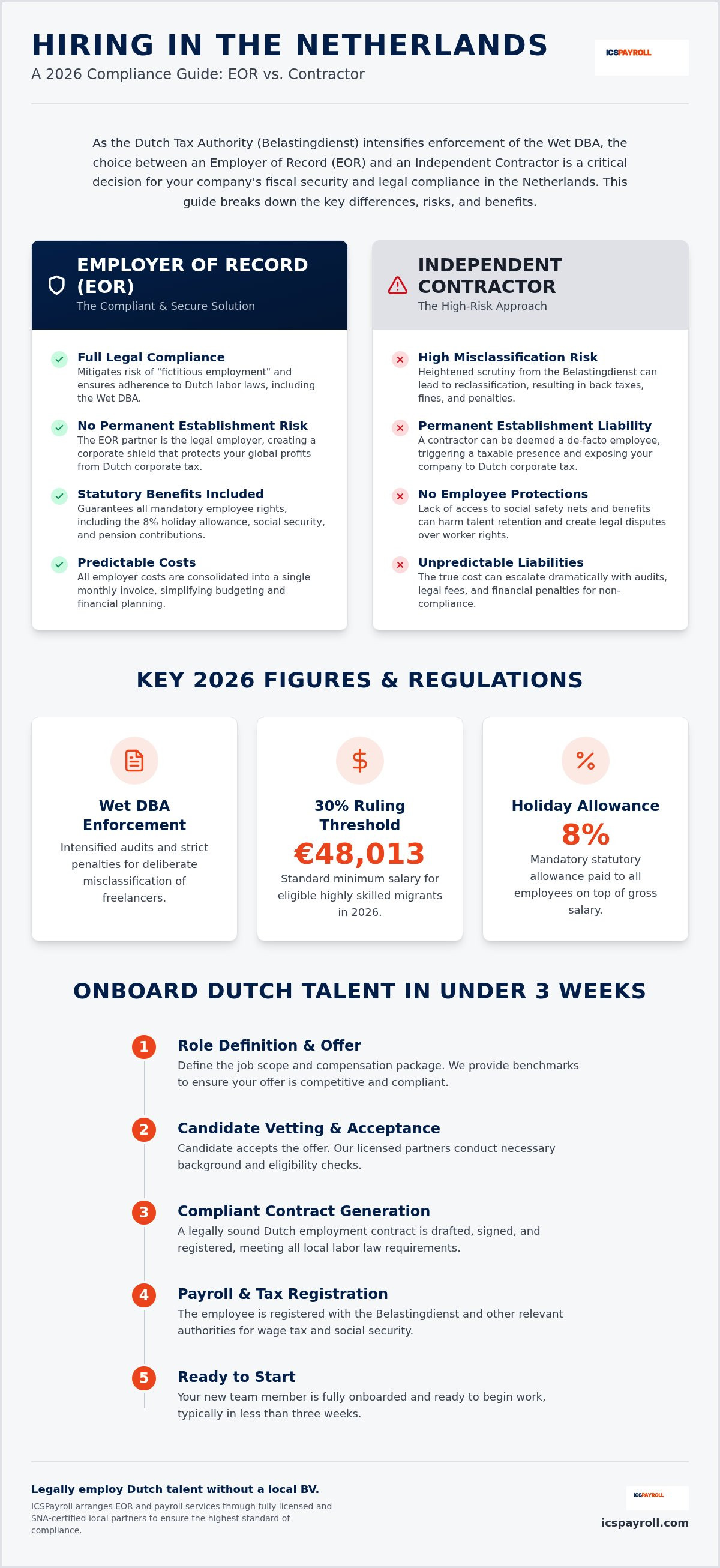
The regulatory landscape for hiring in the Netherlands has changed significantly. International firms must now weigh the administrative ease of freelancers against the growing legal risks of misclassification. Since the end of the enforcement moratorium on January 1, 2025, the Belastingdienst has intensified its scrutiny of working relationships. If a contractor performs the same duties as a permanent employee, the authorities may reclassify the relationship as "fictitious employment." This shift makes the eor vs contractor netherlands decision a matter of financial survival rather than simple HR preference.
While hiring a contractor might seem like a quick fix, it often creates a "Permanent Establishment" risk for the foreign parent company. In 2026, the Dutch Tax Administration focuses on the reality of the working relationship rather than just the written agreement. If the worker is integrated into your organization, you're likely liable for Dutch payroll taxes. Transitioning to an Employer of Record (EOR) model mitigates this by placing the worker on a fully compliant local payroll managed via licensed partners.
The Impact of Wet DBA and VBAR Enforcement
As of January 1, 2026, the Dutch Tax Administration has the power to impose serious-fault penalties (vergrijpboetes) for deliberate misclassification under the Wet DBA. While the broader VBAR bill was scrapped in March 2026, a narrower version creating a rebuttable presumption of employment for workers with lower hourly rates was passed for 2027 enforcement. This leaves a period of heightened uncertainty for firms using contractors for long-term roles. The EOR model removes this ambiguity by providing a statutory employment contract that satisfies all Belastingdienst requirements.
Intellectual Property and Legal Security
Intellectual property (IP) protection is a primary concern for tech and creative firms. Under Dutch law, IP created by an employee automatically belongs to the employer if specified correctly in the contract. Freelance agreements are often less robust. A contractor might later claim "de facto" employment to gain severance rights or challenge IP ownership in court. A local EOR provides a solid legal foundation by using standard Dutch employment contracts. These agreements are governed by local law, providing much stronger standing than a foreign contract would. It ensures that all work product remains your company's property without legal loopholes.
Comparing costs requires looking beyond the hourly rate. A contractor's fee might seem lower initially, but it lacks the security of social insurance and the mandatory 8% holiday allowance. The EOR model uses a consolidated payroll factor, typically ranging from 1.3 to 1.5 times the gross salary. This covers all statutory employer premiums and administrative fees in one predictable invoice. For long-term stability, the EOR factor provides better budgeting without the hidden costs of legal disputes. If you're looking for a clear comparison of these costs, you can request a tailored quotation to see the exact breakdown for your specific hire.
A 5-Step Guide to Hiring Dutch Talent Without a Local Entity
Scaling your business into the Netherlands doesn't require a months-long wait for entity setup. By following a structured process, you can transition from candidate selection to active employment in under three weeks. This efficiency is a primary driver when choosing between eor vs contractor netherlands models. A local specialist ensures your operations remain compliant with the latest Belastingdienst standards while you focus on core business objectives.
- Step 1: Select a Local Specialist. Partner with a firm that understands the nuances of the Dutch market. ICSPayroll coordinates with licensed partners to provide IND and SNA certified services.
- Step 2: Request a Quotation. Receive a detailed cost breakdown within 24 hours. This quotation uses a consolidated payroll factor. It covers gross salary, employer premiums, and administrative fees in one invoice.
- Step 3: Draft the Contract. Finalize a Dutch employment agreement that respects local labor laws. This includes the mandatory 8% holiday allowance and specific 2026 probation rules.
- Step 4: Process Visas and Tax Rulings. Apply for the 30% tax ruling and HSM visas simultaneously. For 2026, the standard taxable salary threshold for the 30% ruling is EUR 48,013.
- Step 5: Initiate Payroll. Grant your employee access to a transparent online portal. This ensures they can view payslips and manage leave while you receive a single monthly invoice for all costs.
Onboarding and HSM Visa Expedited Processing
Securing a Highly Skilled Migrant (HSM) visa is a streamlined process when managed correctly. Through licensed partners, you can obtain visa approval in approximately three weeks. You'll need to provide specific documentation for the IND application, including valid identification and educational credentials. ICSPayroll oversees this coordination. We ensure the candidate meets the 2026 salary requirements. This includes the EUR 48,013 threshold for the 30% ruling, which remains a vital tool for attracting international talent.
Drafting Compliant Dutch Contracts
Dutch labor law is highly protective of employees. You must adhere to the "Ketenregeling" or chain rule. This limits an employee to three consecutive fixed-term contracts or 36 months of service before a permanent contract is mandatory. For 2026, probation periods are strictly regulated. Contracts longer than six months but less than two years allow for a maximum one-month probation. Permanent contracts allow for two months. It's essential to manage these details carefully to avoid unintended permanent employment liabilities. When comparing eor vs contractor netherlands, the EOR model provides the necessary legal framework to manage these statutory requirements without risk.
Managing Employment Costs with the Dutch Payroll Factor
Understanding the financial implications of hiring in the Netherlands requires looking past the gross salary. The consolidated payroll factor is the most efficient way to manage these costs. It replaces the complex calculation of individual premiums with a single, predictable multiplier. This transparency is a significant advantage when weighing eor vs contractor netherlands options. International firms benefit from a single monthly invoice that covers all statutory obligations, removing the administrative burden of local tax filings.
ICSPayroll provides quotations within 24 hours to ensure your budget planning remains on track. This speed allows for rapid decision-making in a fast-paced market. It eliminates the guesswork often associated with foreign labor costs. By using a local specialist, you ensure that every euro spent is compliant with the latest Belastingdienst regulations.
Statutory Contributions and the 8% Holiday Allowance
Dutch employment law mandates several additional costs that don't apply to standard contractor agreements. The most prominent is the 8% holiday allowance. This is calculated on the employee's gross annual salary and is typically paid in May. Employers must also account for the mandatory pension contribution. This is fixed at 15.2% of the gross salary in our standard model. These costs are statutory and non-negotiable.
Statutory premiums are equally critical. For 2026, the AWf (Unemployment Fund) low rate for permanent contracts is 2.74%. The Aof (Disability Fund) low rate for small employers is 6.27%. The Zvw (Healthcare Insurance Act) employer levy adds another 6.10% on income up to a maximum of EUR 69,395. Additionally, you must budget for the transition allowance. This is a mandatory severance payment for nearly all contract terminations. It is capped at EUR 102,000 in 2026.
The 30% Ruling and 2026 Salary Thresholds
The 30% ruling remains the most effective recruitment tool for attracting foreign expertise. For 2026, the standard taxable salary threshold is EUR 48,013. If your hire meets this requirement, 30% of their gross salary can be paid as a tax-free allowance. Note the transition to the 27% rate for newer rulings as part of the ongoing legislative changes. This adjustment requires precise payroll processing to remain compliant.
Managing these applications is a core part of a Dutch Payroll Administration Guide. The payroll factor model naturally incorporates the support needed for these applications. It ensures your staff receive their maximum net benefit without extra administrative fees. This structure makes your offer significantly more attractive to high-level talent. To see how these numbers apply to your specific situation, you can request a detailed payroll calculation today.
Scaling Your Dutch Team with ICSPayroll
Choosing a local specialist over a multi-country provider offers a distinct advantage for your expansion into the Netherlands. Many global firms use a "one size fits all" approach that lacks the depth required to navigate specific Dutch labor laws. ICSPayroll focuses exclusively on the local market. This depth is critical for businesses resolving the eor vs contractor netherlands debate. We provide a bridge for international firms, allowing you to hire in weeks with full operational setup and service agreements. Our model relies on consolidated billing. You receive one monthly invoice with no surprise charges or separate administrative fees for standard services.
Direct, human-led support is essential for managing the high-stakes legal requirements of Dutch employment. For example, employers are obligated to pay at least 70% of an employee's salary for up to 104 weeks during sickness. ICSPayroll provides hands-on management for sick-leave and employee reintegration. We don't rely on automated ticketing systems for these complex processes. Instead, our team ensures that all Arbo-service obligations are met. This protects your firm from the financial fallout of long-term absenteeism and ensures your staff receive the personalized care they need.
Local Expertise for Long-Term Compliance
Managed by Joost Hubregtse and the ICS Staffing team, our service is built on deep knowledge of the 2026 Dutch regulatory landscape. We stay current with the exact AWf and Aof premium percentages to ensure your payroll is always accurate and compliant. Choosing a partner with local roots is often safer than a generalized firm. For a deeper look at these differences, see our Multi-Country EOR vs. Local EOR comparison guide.
Getting Started with Your Dutch Expansion
You don't need to wait for a local entity to capture the best talent in the market. You can request your 24-hour tailored EOR quotation today and begin the onboarding process immediately. This allows you to secure highly skilled migrants through our licensed partners before your Dutch BV is established. For firms still deciding on their long-term structure, our guide on Employer of Record vs. Dutch BV helps clarify the right path. By opting for an EOR, you eliminate the immediate need for local directors while ensuring full compliance with the Belastingdienst. This strategic choice simplifies the eor vs contractor netherlands decision by providing the benefits of a full employment relationship without the overhead of a permanent establishment.
Securing Your Dutch Market Entry
Entering the Dutch market in 2026 requires a precise balance between speed and legal meticulousness. The decision between the eor vs contractor netherlands models is now defined by the strict enforcement of the Wet DBA and the complexities of the 30% ruling. While independent contractors offer initial flexibility, the Employer of Record model provides the structural security needed to protect your firm from Permanent Establishment risks and misclassification penalties. You can achieve full operational setup in weeks rather than months, ensuring your business captures top tier talent without the administrative burden of a local BV.
ICSPayroll facilitates this transition through licensed partners, offering expedited HSM visa processing in approximately 3 weeks. You'll benefit from a consolidated monthly invoice that simplifies your financial reporting and ensures all statutory employer premiums are met. This approach allows you to focus on growth while we manage the technicalities of Dutch labor law. Take the next step in your international expansion today. Get a tailored Dutch EOR quotation within 24 hours and begin building your local team with complete confidence.
Frequently Asked Questions
Can I hire an employee in the Netherlands without a Dutch BV?
Yes, you can hire Dutch talent without a local BV by using an Employer of Record. The EOR model allows foreign companies to employ staff legally while the EOR assumes the role of the formal employer. This structure eliminates the need for local director requirements and physical office space. It is a strategic solution for firms wanting to enter the market quickly without the 4 to 6 week delay of traditional incorporation.
Is an EOR more expensive than hiring a contractor in the Netherlands?
Initial gross costs for an EOR are higher due to statutory premiums, but they eliminate the hidden costs of legal non-compliance. When comparing eor vs contractor netherlands models, the EOR includes the mandatory 8% holiday allowance and social security premiums like AWf and Aof. Hiring contractors carries significant misclassification risks under the Wet DBA. These risks can result in retroactive tax assessments and penalties from the Belastingdienst that far exceed EOR fees.
How long does it take to onboard a Dutch employee via an EOR?
Onboarding typically takes between one and three weeks depending on the candidate's residency status. For local Dutch residents, the process can be finalized within days once the service agreement and employment contract are signed. If the hire requires a Highly Skilled Migrant visa, the processing time via our licensed partners is approximately three weeks. This speed allows you to secure top talent in a competitive market without waiting for entity setup.
What is the 30% ruling salary threshold for 2026?
The standard taxable salary threshold for the 30% ruling in 2026 is EUR 48,013. For employees under the age of 30 who hold a recognized Master's degree, the reduced threshold is EUR 36,497. Meeting these specific benchmarks is essential for a successful application. ICSPayroll manages this process to ensure your international hires receive the maximum tax benefit while remaining fully compliant with current Dutch Tax Administration regulations.
How does ICSPayroll handle sick pay and reintegration?
We provide direct, human-led support for sick pay management and mandatory reintegration processes. In the Netherlands, employers must pay at least 70% of an employee's salary for up to 104 weeks during illness. We coordinate with licensed Arbo services to fulfill all requirements of the Gatekeeper Improvement Act. This proactive approach reduces the administrative burden on your firm and ensures that reintegration steps are documented according to strict legal standards.
Can an EOR help with Highly Skilled Migrant (HSM) visas?
Yes, an EOR facilitates the acquisition of Highly Skilled Migrant (HSM) visas through licensed partners. Since ICSPayroll is not an IND recognized sponsor, we arrange these services via certified entities to ensure full compliance. This process includes verifying salary thresholds and managing the residence permit application. Most HSM visas are processed in approximately three weeks, allowing your international talent to begin working in the Netherlands with minimal delay.
What is the difference between a PEO and an EOR in the Netherlands?
In the Dutch market, an EOR acts as the sole legal employer, whereas a PEO often implies a co-employment relationship. An EOR assumes full liability for payroll, taxes, and labor law compliance. This distinction is vital when evaluating eor vs contractor netherlands options for international firms without a local presence. The EOR model is generally preferred for foreign companies as it provides a complete shield against local administrative and legal responsibilities.
What is included in the ICSPayroll monthly invoice?
The monthly invoice is based on a consolidated payroll factor that covers all employment related costs. This includes the employee's gross salary, the mandatory 8% holiday allowance, and employer social security premiums such as AWf and Aof. It also incorporates pension contributions, which are fixed at 15.2% in our standard model, and the EOR service fee. This single invoice system provides total transparency and simplifies budget planning for your international operations.

Article by
Joost Hubregtse
Joost Hubregtse is Director of ICS Staffing & Payroll B.V., the wholly owned subsidiary of Intercompany Solutions behind ICS Payroll. He is responsible for Employer of Record and Dutch payroll services: employment contracts, wage tax and social security filings, holiday allowance, pension, sick leave and CAO compliance, with onboarding possible within 48 hours.
Frequently Asked Questions
Yes, you can hire Dutch talent without a local BV by using an Employer of Record. The EOR model allows foreign companies to employ staff legally while the EOR assumes the role of the formal employer. This structure eliminates the need for local director requirements and physical office space. It is a strategic solution for firms wanting to enter the market quickly without the 4 to 6 week delay of traditional incorporation.
Initial gross costs for an EOR are higher due to statutory premiums, but they eliminate the hidden costs of legal non-compliance. When comparing eor vs contractor netherlands models, the EOR includes the mandatory 8% holiday allowance and social security premiums like AWf and Aof. Hiring contractors carries significant misclassification risks under the Wet DBA. These risks can result in retroactive tax assessments and penalties from the Belastingdienst that far exceed EOR fees.
Onboarding typically takes between one and three weeks depending on the candidate's residency status. For local Dutch residents, the process can be finalized within days once the service agreement and employment contract are signed. If the hire requires a Highly Skilled Migrant visa, the processing time via our licensed partners is approximately three weeks. This speed allows you to secure top talent in a competitive market without waiting for entity setup.
The standard taxable salary threshold for the 30% ruling in 2026 is EUR 48,013. For employees under the age of 30 who hold a recognized Master's degree, the reduced threshold is EUR 36,497. Meeting these specific benchmarks is essential for a successful application. ICSPayroll manages this process to ensure your international hires receive the maximum tax benefit while remaining fully compliant with current Dutch Tax Administration regulations.
We provide direct, human-led support for sick pay management and mandatory reintegration processes. In the Netherlands, employers must pay at least 70% of an employee's salary for up to 104 weeks during illness. We coordinate with licensed Arbo services to fulfill all requirements of the Gatekeeper Improvement Act. This proactive approach reduces the administrative burden on your firm and ensures that reintegration steps are documented according to strict legal standards.
Yes, an EOR facilitates the acquisition of Highly Skilled Migrant (HSM) visas through licensed partners. Since ICSPayroll is not an IND recognized sponsor, we arrange these services via certified entities to ensure full compliance. This process includes verifying salary thresholds and managing the residence permit application. Most HSM visas are processed in approximately three weeks, allowing your international talent to begin working in the Netherlands with minimal delay.
In the Dutch market, an EOR acts as the sole legal employer, whereas a PEO often implies a co-employment relationship. An EOR assumes full liability for payroll, taxes, and labor law compliance. This distinction is vital when evaluating eor vs contractor netherlands options for international firms without a local presence. The EOR model is generally preferred for foreign companies as it provides a complete shield against local administrative and legal responsibilities.
The monthly invoice is based on a consolidated payroll factor that covers all employment related costs. This includes the employee's gross salary, the mandatory 8% holiday allowance, and employer social security premiums such as AWf and Aof. It also incorporates pension contributions, which are fixed at 15.2% in our standard model, and the EOR service fee. This single invoice system provides total transparency and simplifies budget planning for your international operations.