
Employer liability insurance in the Netherlands: premiums and cover
By Joost Hubregtse, Director, ICS Staffing & Payroll
All blog posts are reviewed and fact checked by our labour law lawyer Zishan Hussain and our director. Editorial standards
An insurance policy does not remove an employer’s duty of care. Under Section 7:658 (1) of the Dutch Civil Code, employers must take reasonably required measures to prevent employees from being harmed at work. Employer liability insurance in the Netherlands can help cover the financial consequences of a claim, but what it covers depends on the policy and its exclusions.
It’s sensible to look beyond the premium: the insured amount and the situations covered matter when an employee is injured or develops an occupational disease. This guide explains the distinction between an employer’s legal responsibility and insurance cover, what policies may exclude, and how premiums and insured amounts are determined. It also outlines how cancellation works, so you can understand the practical considerations before making an insurance decision.
Key Takeaways
- Separate an employer’s duty of care from insurance cover: a policy can help manage claim costs, but it doesn’t remove legal responsibility.
- Review exclusions for declared business activities, motor vehicles, and professional errors so you understand where separate cover may be relevant.
- Premiums depend on factors such as the business’s SBI code and activities, while the insured amount should reflect the risks the business needs to cover.
- Business liability insurance isn’t generally required by Dutch law, but contractual requirements or the nature of the work can make cover an important consideration.
- For employment and payroll administration in the Netherlands, ICSPayroll’s EOR service can support companies hiring employees locally.
Employer liability coverage for employee workplace injuries and occupational diseases
In the Netherlands, an employer’s duty of care and an insurance policy are separate matters. A policy may help cover the financial consequences of a claim when the circumstances are insured, subject to its terms and exclusions.
Workplace Injuries and Occupational Diseases
Workplace injury and occupational disease cover concerns claims linked to an employee’s work. Section 7:658 (1) of the Dutch Civil Code requires employers to take reasonably required measures to prevent work-related harm. That duty can matter after an obvious accident, such as a fall, and after harm develops through workplace exposure. An employer may avoid liability by proving it met its duty of care, or that the harm resulted largely from the employee’s intent or deliberate recklessness.
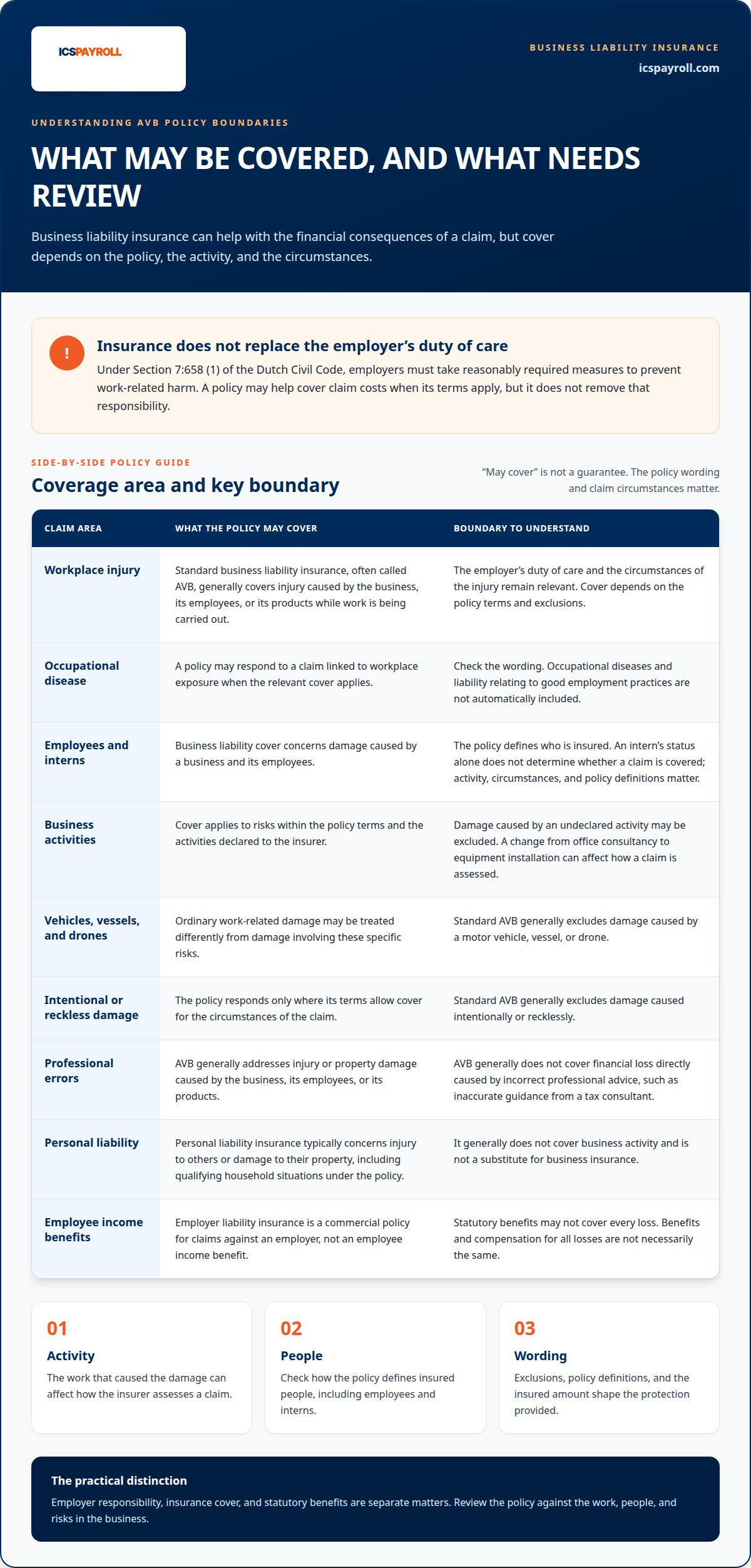
Employer liability insurance in the Netherlands can help cover the financial consequences of a claim when the policy applies. Standard business liability insurance, often called AVB, generally covers injury or property damage caused by the business, its employees, or its products while work is being carried out. The policy wording determines whether occupational diseases and liability relating to good employment practices are included.
People Included in the Coverage
Business liability cover concerns damage caused by a business and its employees, but the policy defines who is insured. Check how it treats employees and interns, particularly when interns work alongside staff. An intern’s status alone does not determine whether a claim is covered. The activity, circumstances, and policy definitions all matter.
Family members raise a separate insurance question. Dutch personal liability insurance typically extends to family members living in the same household and generally covers injury to others or damage to their property. It does not cover business activity. Some policies may cover damage caused by pets, or damage caused by an uninsured guest. These policy-specific protections are not substitutes for employer cover.
Employer Liability and Workers’ Compensation
Employer liability insurance is a commercial policy for claims against an employer, not an employee income benefit. Statutory benefits and compensation for all losses are not necessarily the same. For example, an employee injured in a commuting accident may qualify for benefits under the Work and Income (Capacity for Work) Act, but those benefits may not cover every loss.
For a workplace claim, the employer’s duty of care and the circumstances of the injury remain relevant. Insurance may help with covered liability costs, but it does not replace the employer’s duty to prevent harm. Nor should an employee assume that a statutory benefit settles every possible claim. The circumstances and policy terms determine what follows.
Choosing and Comparing Providers
Compare policies with the work, people, and risks in your business in mind. Start with the activities declared to the insurer, then review the wording on employee injuries, occupational diseases, interns, and good employment practices. Cover for ordinary property damage may still exclude a specific disease or liability claim. The insured amount and exclusions also affect the protection the policy provides.
Request the relevant policy conditions and compare the same scenarios across offers. For example, consider an employee injured while performing a declared task, then check whether each policy addresses that claim. Also review how changes to your activities could affect cover. Focus on what may be covered, what remains excluded, and how the policy responds to specific workplace risks.
Exclusions, including business activities and motor vehicles
In the Netherlands, business liability insurance (AVB) responds only to risks within its policy terms. A covered activity and an excluded activity can lead to different outcomes after similar damage.
Business-Related Activity Exclusions
An AVB policy may exclude damage caused by activities the business did not declare when arranging cover. This matters when operations change: a company insured for office consultancy may face a different coverage question after it begins installing equipment. The activity that caused the damage, not simply the company’s general line of work, can affect how the insurer assesses a claim.
Business owners should report additional activities to the Netherlands Chamber of Commerce (KVK) and their insurer. This helps keep the business activity record and insurance information aligned with the work being done. For example, adding product assembly to a sales operation may change the risks an insurer has agreed to cover. Policy conditions set out declared activities and any restrictions.
Personal liability insurance does not fill this gap in business cover. It generally excludes damage arising from professional or business activities, including work performed by a sole proprietor. If a customer’s property is damaged during a paid repair, personal cover is not a substitute for business insurance.
Common Policy Exclusions
AVB exclusions vary by policy, but some risks commonly need separate consideration. Standard business liability insurance generally excludes damage caused by a motor vehicle, vessel, or drone, as well as damage caused intentionally or recklessly. A collision involving a company vehicle, for example, is not treated like damage caused by an employee carrying out ordinary work at a customer’s premises.
Professional errors are another important distinction. AVB generally does not cover financial loss caused directly by incorrect professional advice, such as inaccurate guidance from a tax consultant. Professional indemnity insurance addresses this type of financial damage. The distinction helps identify which policy may apply: physical damage during work differs from a client’s financial loss following an advice error.
Other exclusions can affect the cost of a claim. AVB usually does not cover damage to the insured business itself or the cost of redoing a service or product. Environmental damage at business premises and product-recall costs are also commonly excluded. A recall clause or separate recall insurance may address recall costs, although some recall policies require an order from a regulatory body.
Review the policy conditions against your actual activities and relevant scenarios, including vehicle use, professional advice, and environmental incidents. Policies differ, so the wording determines what is covered in each situation. Reviewing exclusions carefully helps distinguish covered third-party damage from costs the business must manage itself.
Premiums, commission, and insurance tax
Business liability insurance premiums in the Netherlands depend on the business and its risk profile. These are examples, not a standard price or market average. A quotation reflects the insurer’s assessment of the activities and exposure described in the application, rather than a national tariff.
The business’s SBI code is one factor insurers use when calculating premiums. That code classifies the business activity and helps the insurer assess the work being insured. The actual activities matter too. A consultancy with office-based work presents a different risk profile from a business carrying out physical work at client premises. For official notices relevant to premiums, consult the Staatscourant publications.
To understand a quotation, separate the insurance premium from any other listed charges. Check whether commission and insurance tax appear as separate amounts or are included in the quoted total. Compare equivalent quotes: a lower total may have a different cost breakdown from an itemised quotation. The quotation and policy documents explain the charges for that contract.
Commission relates to arranging or distributing insurance, while insurance tax is a separate cost item when shown in a quotation. The figures and presentation depend on the offer. Don’t assume a displayed premium is the full amount payable if the quotation lists additional charges. For Dutch insurance-tax information, refer to the Belastingdienst’s guidance. Compare the premium, any stated commission, and insurance tax separately before assessing the total cost.
Business liability insurance premiums are deductible when filing an income tax or profit tax return in the Netherlands. This may affect the business’s tax calculation, but it does not change the amount charged by the insurer. Keep policy and payment records with your business tax administration so the expense can be considered when preparing the relevant return. The applicable treatment depends on the business’s tax position.
Review the policy each year to identify changes in the premium or your business circumstances. Compare the current quotation with the previous policy, noting changes to declared activities, insured risks, and the total payable. Adding a service or changing how work is performed may affect the insurer’s assessment. For example, describe work at customer premises accurately.
Business liability insurance is not generally required by law for every business, although a client, supplier, or trade association may require it. Such a requirement can influence the policy limits you seek, alongside your activities and potential exposure. Compare the premium and charges with the actual contract requirements, rather than choosing solely on the lowest quoted total.
Available insured amounts
The insured amount is the policy’s financial ceiling for covered claims. For business liability, the relevant limit appears in the AVB contract; there is no universal statutory amount for the Netherlands. Relate that ceiling to the damage an accident could cause. An injury claim with lasting effects, for example, may have different financial consequences from damage to a customer’s desk.
No single insured amount suits every business. The appropriate limit depends on the work, who could be affected, and the possible scale of damage. A company providing office-based advice faces different practical risks from a contractor working at client premises. The activity matters when assessing how much business liability cover is appropriate.
Read the policy schedule alongside the conditions. The schedule states the insured amount, while the conditions explain which claims fall within the insurance. Check how the limit applies to a claim and whether particular risks have separate restrictions. A listed business liability limit does not, by itself, mean that occupational disease or product-recall costs are covered.
Consider a realistic accident scenario before selecting a limit. If a worker damages a client’s equipment during installation, a claim could involve repair or replacement costs. If an accident causes personal injury, the potential consequences may extend beyond immediate treatment. These examples help you assess exposure, but the policy wording determines whether an event is covered.
Personal liability insurance has different insured amounts and protects individuals against damage they cause to others. That figure is not a recommended limit for an employer’s AVB. Personal liability cover generally excludes business activity, so a sole proprietor cannot rely on it for damage caused while working.
The Dutch term aansprakelijkheidsverzekering can refer to liability insurance generally, so identify whether a document concerns personal or business cover. The named policyholder, insured activities, and stated amount all matter.
When comparing insured amounts, assess the limit alongside the exclusions and the work described in the contract. A higher ceiling will not help with an excluded claim. A lower limit may leave the business exposed if covered damage exceeds it. Compare the same workplace accident or client-property scenario against each policy’s wording, then decide whether the stated ceiling fits that exposure.
Is employer liability insurance legally required in the Netherlands?
No. Dutch law does not generally require businesses to take out business liability insurance. That answer concerns the insurance policy, not the employer’s legal responsibilities. Under Section 7:658 of the Dutch Civil Code, employers must take reasonably required measures to prevent employees suffering harm while working. An employer can therefore have a duty of care without a general legal obligation to buy insurance.
This distinction matters after an accident. A company may face a claim connected to an employee’s work, while the policy that could cover its financial consequences remains optional by law. Insurance can help manage covered claims, but it does not remove the employer’s duty to prevent harm. For example, purchasing a policy cannot replace appropriate workplace precautions.
There may still be a practical requirement to arrange cover. A client, supplier, or trade association may make business liability insurance a condition of working together. A client could require proof of cover before allowing a contractor onto its premises. That is a contractual or membership requirement, not a general statutory obligation for every Dutch employer.
Read the relevant contract or membership conditions to understand the exact requirement. Check whether it calls for business liability cover, specifies an insured amount, or requires evidence before work starts. The requirement may relate to work for a particular client. It does not automatically mean every activity or claim is covered by the policy.
This distinction also matters for international companies hiring in the Netherlands. Employment administration and insurance address different questions: payroll arrangements concern employing and paying staff, while liability cover concerns insured claims. An Employer of Record arrangement does not itself make an insurance policy mandatory or replace the wording of a business liability policy. Treat each obligation separately when planning a Dutch hire.
For a practical review, separate the issue into three checks:
- Identify the employer’s workplace safety responsibilities under Section 7:658.
- Read any client, supplier, or trade association requirement for business liability insurance.
- Compare the required evidence and insured amount with the policy documents.
This approach distinguishes legal duties from contract terms and insurance protection. A business with no contractual insurance requirement still has its duty of care. A business required by a client to provide evidence must meet that contract condition, while checking the policy applies to its work. Plan your Dutch hiring setup with the employment arrangement and insurance requirements considered separately.
ICSPayroll: Employer of Record (EOR)
ICSPayroll’s Employer of Record (EOR) service supports companies hiring employees in the Netherlands. It offers a local employment route for businesses that need support with Dutch hiring alongside their own insurance arrangements.
An EOR does not replace employer liability insurance or decide whether a workplace claim is covered. Keep insurance decisions separate from employment administration, and review policy conditions against the actual work and risks. For companies managing employees directly, Dutch Payroll Administration supports payroll processes. ICSPayroll also manages 30% Ruling Applications for eligible international employees.
Consider an EOR if your company needs to employ staff in the Netherlands and wants support with the local employment arrangement. Contact ICSPayroll to discuss your Dutch hiring requirements.
Align your insurance decisions with your next hiring steps
Include insurance in your wider plan for operating in the Netherlands. As your team, services, or working arrangements change, review how those changes affect your business risks and internal processes. This keeps employer liability insurance in the Netherlands relevant to how your organisation operates, rather than treating cover as a one-time administrative decision.
For international employers, employment setup and insurance planning are related parts of entering a new market, but they address different responsibilities. A clear approach helps your team assign ownership, organise local employment administration, and plan for change as the business develops. ICSPayroll can discuss the Dutch employment arrangements that fit your hiring plans.
Discuss your Dutch employment setup with ICSPayroll, and take the next step with a clear plan.
Frequently Asked Questions
What does it cost?
There is no fixed premium for every Dutch business. Insurers use factors such as the business’s SBI code and declared activities to assess risk. The work performed, exposure to third-party claims, and requested insured amount can also affect the quotation. For a useful estimate, describe your activities accurately and compare what each quote includes, rather than judging by the headline premium alone.
What does this mean for the employer?
An employer remains responsible for workplace safety, with or without liability insurance. If an employee claims harm, the employer’s conduct and the circumstances of the incident matter. A policy may respond to covered claims, but it does not take over the employer’s duty of care. For example, written safety instructions alone may not be enough if employees are not supervised in practice.
What should I do if my company is held liable?
Record the incident and preserve relevant documents, including the employee’s account, work instructions, and maintenance records. Notify the insurer using the process set out in the policy, and provide a factual timeline rather than assumptions about fault. Keep correspondence with the employee and any affected third party together. If the incident involved a workplace hazard, document the steps taken to address it and prevent a recurrence.
What does business liability cover in the Netherlands?
Business liability insurance may cover claims for personal injury or property damage caused by the business, its employees, or its products during work. For example, a customer could claim after an employee damages property while completing a job. Employer liability insurance in the Netherlands depends on the policy’s wording and scope. Check who qualifies as insured and whether the relevant work activity is included.
How does Dutch employer liability law treat workplace accidents and occupational diseases?
Section 7:658 of the Dutch Civil Code concerns employer responsibility for employee harm connected with work. A claim can involve a sudden accident or a condition linked to occupational exposure. A common accident, such as slipping while cleaning a floor, may still raise an employer-liability issue if preventive measures were readily available. The facts, precautions, and connection to the work all matter.
What exclusions and limitations apply to employer liability insurance in the Netherlands?
Policy exclusions can leave specific losses uncovered even when an incident occurs during work. Examples include damage caused by a motor vehicle, intentional or reckless conduct, or financial loss caused directly by incorrect professional advice. Distinguish damage to another party from the cost of repairing your own work. The relevant policy conditions determine how each situation is treated.
How much does business liability insurance cost in the Netherlands?
The premium depends on the insurer’s assessment of the business, not just its employee count. The SBI code, declared activities, and requested insured amount can influence the quotation. Two businesses with similar turnover may receive different premiums if one performs higher-risk work. Ask for the total payable and a clear breakdown of listed charges before comparing employer liability insurance in the Netherlands.
What coverage limits are typical for Dutch employer liability policies?
There is no single policy limit for every Dutch business. The policy schedule states the insured amount, while the conditions explain which claims and activities are covered. Choose a limit by considering the possible scale of injury or property damage resulting from the company’s work. Do not use a household personal-liability limit as a substitute, because personal cover generally excludes business activity.

Article by
Joost Hubregtse
Joost Hubregtse is Director of ICS Staffing & Payroll B.V., the wholly owned subsidiary of Intercompany Solutions behind ICS Payroll. He is responsible for Employer of Record and Dutch payroll services: employment contracts, wage tax and social security filings, holiday allowance, pension, sick leave and CAO compliance, with onboarding possible within 48 hours.
Frequently Asked Questions
There is no fixed premium for every Dutch business. Insurers use factors such as the business’s SBI code and declared activities to assess risk. The work performed, exposure to third-party claims, and requested insured amount can also affect the quotation. For a useful estimate, describe your activities accurately and compare what each quote includes, rather than judging by the headline premium alone.
An employer remains responsible for workplace safety, with or without liability insurance. If an employee claims harm, the employer’s conduct and the circumstances of the incident matter. A policy may respond to covered claims, but it does not take over the employer’s duty of care. For example, written safety instructions alone may not be enough if employees are not supervised in practice.
Record the incident and preserve relevant documents, including the employee’s account, work instructions, and maintenance records. Notify the insurer using the process set out in the policy, and provide a factual timeline rather than assumptions about fault. Keep correspondence with the employee and any affected third party together. If the incident involved a workplace hazard, document the steps taken to address it and prevent a recurrence.
Business liability insurance may cover claims for personal injury or property damage caused by the business, its employees, or its products during work. For example, a customer could claim after an employee damages property while completing a job. Employer liability insurance in the Netherlands depends on the policy’s wording and scope. Check who qualifies as insured and whether the relevant work activity is included.
Section 7:658 of the Dutch Civil Code concerns employer responsibility for employee harm connected with work. A claim can involve a sudden accident or a condition linked to occupational exposure. A common accident, such as slipping while cleaning a floor, may still raise an employer-liability issue if preventive measures were readily available. The facts, precautions, and connection to the work all matter.
Policy exclusions can leave specific losses uncovered even when an incident occurs during work. Examples include damage caused by a motor vehicle, intentional or reckless conduct, or financial loss caused directly by incorrect professional advice. Distinguish damage to another party from the cost of repairing your own work. The relevant policy conditions determine how each situation is treated.
The premium depends on the insurer’s assessment of the business, not just its employee count. The SBI code, declared activities, and requested insured amount can influence the quotation. Two businesses with similar turnover may receive different premiums if one performs higher-risk work. Ask for the total payable and a clear breakdown of listed charges before comparing employer liability insurance in the Netherlands.
There is no single policy limit for every Dutch business. The policy schedule states the insured amount, while the conditions explain which claims and activities are covered. Choose a limit by considering the possible scale of injury or property damage resulting from the company’s work. Do not use a household personal-liability limit as a substitute, because personal cover generally excludes business activity.