
Dutch Work Permit and Payroll: The 2026 Employer FAQ Guide
By Joost Hubregtse, Director, ICS Staffing & Payroll
All blog posts are reviewed and fact checked by our labour law lawyer Zishan Hussain and our director. Editorial standards
In 2026, a single administrative error in your Dutch work permit and payroll setup can trigger an immediate audit from the Belastingdienst or the IND. Many international employers find that the transition to the 2026 salary thresholds and the tightening of the 30% ruling have turned a routine hiring process into a high-stakes compliance challenge. You likely recognize that securing top-tier talent requires more than just a job offer; it requires a deep understanding of local labor law and precise financial reporting.
This guide provides the definitive roadmap to mastering these complexities, ensuring your business remains fully compliant while securing the best global professionals. We'll break down the specific EUR 48,013 taxable salary threshold for the 30% ruling and the updated EUR 5,942 monthly requirement for Highly Skilled Migrants aged 30 and over. This FAQ overview previews the essential steps for HSM visa applications and compliant payroll administration, allowing you to onboard international staff in weeks rather than months.
Key Takeaways
- Identify the 2026 salary requirements for Highly Skilled Migrants, including the EUR 5,942 monthly threshold for professionals aged 30 and over.
- Understand the critical link between a Dutch work permit and payroll compliance to ensure your records withstand formal IND inspections.
- Master the 2026 30% ruling application process, focusing on the EUR 48,013 annual taxable salary requirement and the scheduled transition to a 27% allowance.
- Prepare for statutory employer obligations such as the two year sick pay requirement and the EUR 102,000 cap on transition payments.
- Explore how to utilize an Employer of Record service, arranged via licensed partners, to hire international staff rapidly without incorporating a local Dutch BV.
Understanding Dutch Work Permits: TWV, GVVA, and HSM
Recruiting international talent into the Economy of the Netherlands requires a precise understanding of various immigration tiers. EU, EEA, and Swiss nationals enjoy the right to work without restrictions; however, all other nationalities require specific legal authorization before their start date. For these individuals, the Dutch work permit and payroll setup must align with the duration and nature of the assignment.
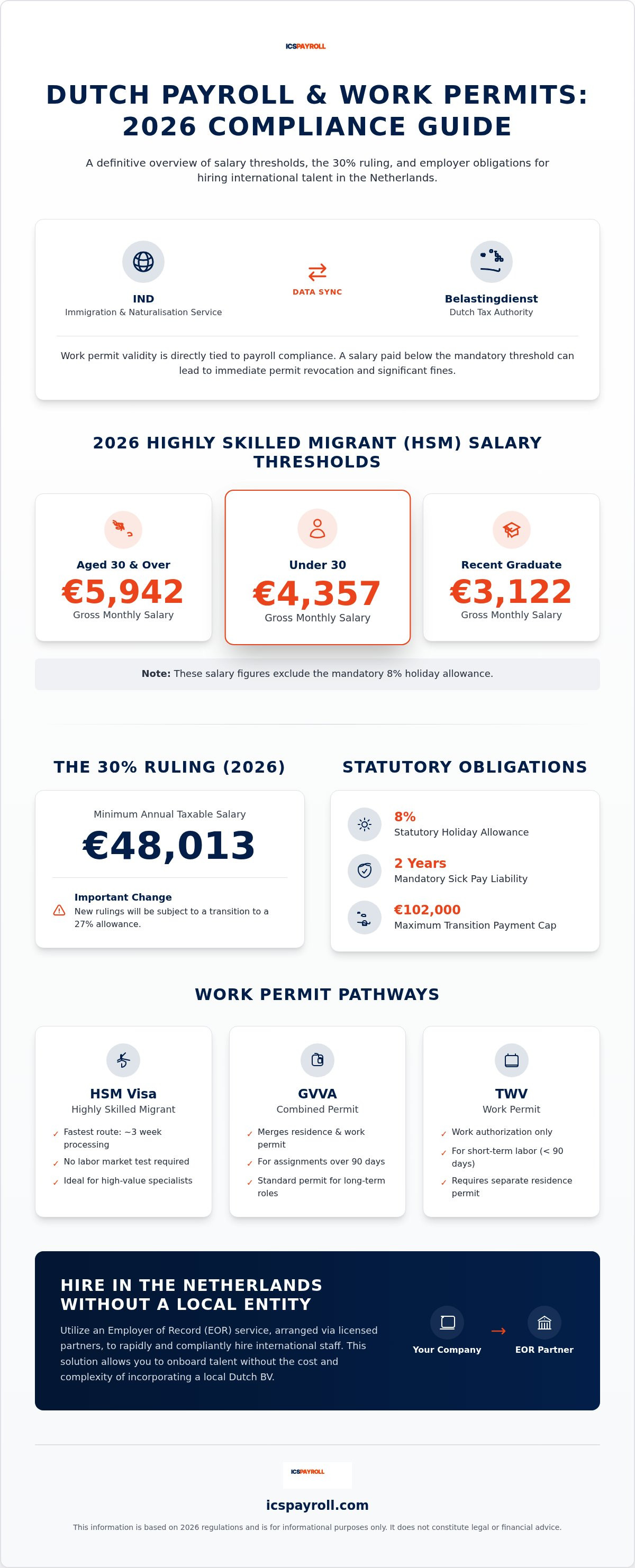
The Tewerkstellingsvergunning (TWV) serves as a short-term solution for labor lasting under 90 days. For longer engagements, the Combined Permit for Stay and Work (GVVA) merges the residence and work authorizations into a single document. Most corporate entities prefer the Highly Skilled Migrant (HSM) scheme due to its streamlined requirements for high-value specialists and executives. This route offers the most flexibility for companies looking to scale their Dutch operations quickly.
Who needs a Dutch work permit in 2026?
Non-EU nationals must navigate a tiered system based on their stay duration and professional role. While Schengen visa holders can visit for business meetings, they aren't permitted to perform productive labor without a TWV. Frontier workers living in Germany or Belgium who hold non-EU passports face similar restrictions and must secure a work permit despite their residency in a neighboring state. Specialized researchers and certain trainees may benefit from specific exemptions, though these cases require individual legal assessment to ensure full compliance with the IND.
The Highly Skilled Migrant (HSM) visa advantage
The HSM visa offers a significant competitive edge by removing the requirement for a UWV labor market test. This means you don't need to demonstrate that no suitable Dutch or EU candidates were available for the role. To use this route, the employer must be an IND-recognized sponsor. For foreign companies without a local legal entity, these sponsorship services are arranged via licensed partners to facilitate rapid market entry.
Applications for the HSM visa are typically processed in about 3 weeks, provided all documentation is accurate. This speed allows for the rapid onboarding of key personnel. A successful Dutch work permit and payroll integration ensures that your internal records always match the figures reported to the IND. In 2026, maintaining the monthly salary threshold of EUR 5,942 for employees over 30 is a non-negotiable requirement for permit validity. Failure to pay the correct salary can lead to the immediate revocation of the permit. Your administrative processes must be synchronized to handle these monthly indexations and statutory holiday allowances without error.
The Critical Link Between Permits and Payroll Compliance
The IND and the Dutch Tax Authority (Belastingdienst) operate with a high degree of data transparency to ensure that employers fulfill their legal obligations. A Dutch work permit and payroll administration are not independent functions; they are legally interdependent. If your payroll records show a salary below the mandatory threshold, the IND can revoke the residence permit immediately and impose significant administrative fines. This synergy means every international hire requires a Dutch-compliant employment contract from the first day of work.
Your administration must manage various premiums with precision, including the Unemployment Fund (AWf), the Disability Insurance Fund (Aof), and the Healthcare Insurance Act (Zvw) levy, which is 6.10% for 2026. Because the IND now audits bank statements to prove net salary transfers, your internal records must perfectly match the figures reported in your monthly Loonaangifte filings. Failure to meet these statutory requirements doesn't just risk financial penalties; it jeopardizes your ability to hire international talent in the future.
Mandatory 2026 salary thresholds for HSM visas
To maintain permit validity, you must meet specific income requirements that are indexed annually. For 2026, the standard annual taxable salary threshold for the 30% ruling is EUR 48,013. However, the Immigration and Naturalisation Service (IND) sets specific monthly gross minimums for Highly Skilled Migrants. Professionals aged 30 and older must earn at least EUR 5,942 gross per month. For those under 30, the requirement is EUR 4,357, while recent graduates from qualifying universities must meet a threshold of EUR 3,122. These figures exclude the mandatory holiday allowance and must be paid into a bank account held in the employee's name.
Statutory benefits and the payroll factor
Dutch law mandates specific benefits that you must process through your payroll system without exception. The 8% holiday allowance is a statutory requirement, usually paid as a lump sum in May. Additionally, you must adhere to the minimum hourly wage, which is EUR 14.99 as of July 1, 2026, following the earlier January rate of EUR 14.71. Accurate calculation of these benefits is essential for maintaining your status as a reliable employer. If you find these technical requirements challenging, you can request a tailored quotation for administration services arranged via licensed partners to ensure total compliance from day one.
Navigating the 30% Ruling and Expat Payroll
The 30% ruling is an essential incentive for attracting international experts to the Netherlands. It allows employers to provide a tax free allowance of up to 30% of the gross salary to cover extraterritorial expenses. This effectively lowers the total cost of employment while increasing the net take home pay for the specialist. A synchronized Dutch work permit and payroll strategy ensures that these tax benefits are applied correctly from the start date. Eligibility is contingent on the 150km rule; the employee must have resided more than 150 kilometers from the Dutch border for at least 16 of the 24 months preceding their arrival.
Significant changes define the 2026 tax landscape. While the allowance remains at 30% for the duration of this year, it transitions to a flat 27% on January 1, 2027. Additionally, the partial non-resident taxpayer status was abolished on January 1, 2025. New applicants in 2026 are subject to taxation on their worldwide wealth in Box 2 and Box 3. Employees who used this status at the end of 2023 may benefit from transitional arrangements until December 31, 2026; however, all other staff must prepare for full Dutch tax liability on global assets.
Applying for the 30% ruling in 2026
It's a collaborative effort between the employer and the employee to secure this ruling. Strict adherence to the four month filing deadline is necessary to secure retroactive benefits from the start of employment. If the submission occurs after this window, the ruling's only applied from the first day of the month following the application. You can access the official forms via the Belastingdienst portal. To qualify, the employee must meet the standard 2026 taxable salary threshold of EUR 48,013 or the reduced threshold of EUR 36,497 for those under age 30 with a qualifying Master's degree.
Payroll administration for 30% ruling holders
Processing the 30% ruling requires splitting the gross salary on the monthly payslip into taxable and tax free components. This reduces the basis for income tax calculation and often moves the employee into a lower tax bracket. Social security contributions are calculated on the full gross salary before the allowance is deducted, up to the statutory maximums. For remote staff based in the Netherlands, the ruling is valid provided the employment contract is compliant with local law. Maintaining a consistent Dutch work permit and payroll record is vital for defending these deductions during a tax audit. Be aware that the ruling is also capped at the Balkenende norm of EUR 262,000 for 2026.
Employer Obligations: Sick Pay and Transition Allowances
Employers in the Netherlands face some of the most rigorous social security obligations in Europe. Central to this is the two year sick pay requirement. If an employee becomes unable to work due to illness, you must pay at least 70% of their gross salary for 104 weeks. In many sectors, collective labor agreements (CAOs) mandate 100% payment during the first year. This obligation is governed by the Gatekeeper Improvement Act (Wet Verbetering Poortwachter), which requires a proactive reintegration process starting from the sixth week of absence. Failure to follow these steps can lead to the UWV imposing a third year of mandatory salary payments.
Beyond sickness, you must budget for the statutory transition allowance (transitievergoeding). This payment is due from the first day of employment if the contract is terminated at the employer's initiative or not renewed. For 2026, the transition allowance is capped at EUR 102,000, or one year's gross salary if the employee earns more than this amount. Ensuring your Dutch work permit and payroll systems are prepared for these potential liabilities is a critical component of long term financial planning.
Managing sickness risk in the Netherlands
Small to medium sized enterprises often find the financial burden of a long term sick employee unsustainable. Utilizing Employer of Record (EOR) services, arranged via licensed partners, provides a layer of protection as the sickness risk is managed at the partner level. This includes handling mandatory reporting to the Employee Insurance Agency (UWV) and coordinating with an Occupational Health Service (Arbodienst). For those managing their own payroll, taking out sickness absence insurance (verzuimverzekering) is highly recommended to mitigate these unpredictable costs.
Contractual limits and Ketenregeling
The Dutch chain rule, or Ketenregeling, strictly limits the use of fixed term contracts. You can offer a maximum of three consecutive contracts over a period of three years. A fourth contract or exceeding the three year limit automatically converts the arrangement into an indefinite agreement. A break of more than six months is required to reset this chain. Probation periods are also strictly regulated: they are limited to one month for contracts between six months and two years, and two months for indefinite or longer contracts.
Compliance with non-compete reforms effective in 2026 is also mandatory. Employers must now provide a written justification for why a non-compete clause is necessary to protect specific business interests. These reforms also require employers to pay compensation to the employee if the clause is enforced after termination. For precise assistance with these legal requirements, you can request a tailored quotation for administrative support arranged via licensed partners.
How to Hire in the Netherlands Without a Local Entity
Establishing a local legal entity is a time-consuming process that often delays market entry. For international companies without a Dutch BV registered at the Chamber of Commerce (KvK), obtaining IND sponsor recognition is impossible. The Employer of Record (EOR) model provides a secure alternative. By utilizing services arranged via licensed partners, you can engage local or international staff without the administrative burden of incorporation. This approach ensures your Dutch work permit and payroll obligations are met through a single, consolidated workflow.
This solution streamlines financial management by providing one monthly invoice. This document covers all statutory costs, including the 8% holiday allowance and employer social security premiums such as the AWf and Aof. It also accounts for the 6.10% Healthcare Insurance Act (Zvw) levy. By partnering with local experts, you gain immediate access to HSM visa sponsorship for your specialists. This ensures all salary thresholds are strictly maintained according to the 2026 indexation without requiring you to hold your own sponsorship license.
Operational set-up in weeks, not months
Speed is a fundamental advantage of the EOR model. You can receive a tailored quotation within 24 hours of your initial inquiry. Once the commercial terms are agreed upon, service agreements and Dutch-compliant employment contracts are typically drafted within days. This allows for an operational start date in weeks rather than the months required for traditional entity setup. If your business strategy changes, you can transition employees from the EOR setup to your own Dutch BV later with minimal disruption to the payroll cycle. This flexibility is essential for companies testing the Dutch market before making a long-term capital commitment.
The ICSPayroll advantage for non-EU hiring
Managing a distributed workforce requires transparent technology and local precision. Our administrative support, arranged via licensed partners, includes full Dutch compliance with pension requirements and HR standards. Employees receive access to a secure online portal to view their payslips, annual statements, and employment contracts. This centralized system ensures that every Dutch work permit and payroll record is archived according to the seven-year legal record-keeping requirement. Contact our team at ICSPayroll to schedule a 2026 compliance audit and verify your current hiring strategy against the latest Belastingdienst regulations.
Securing Your Dutch Market Entry in 2026
Navigating the Dutch labor market requires strict adherence to shifting regulations. Success in 2026 hinges on meeting the EUR 48,013 taxable salary threshold for the 30% ruling and respecting the EUR 102,000 statutory transition payment cap. By integrating your Dutch work permit and payroll workflows, you eliminate the risk of non-compliance with the Belastingdienst and the IND. A unified administrative approach is essential for long term stability when managing HSM visa requirements or statutory sick pay obligations.
You can bypass the complexities of local entity incorporation by leveraging expert support. Our services, arranged via licensed partners, ensure full 2026 Dutch compliance guaranteed with one clear invoice and no surprise charges. With expedited HSM visa processing in 3 weeks, you can focus on scaling your business while we manage the administrative precision required for a seamless onboarding experience.
Hire in the Netherlands with confidence with ICSPayroll. We're ready to help you navigate the complexities of the Dutch labor market with absolute certainty.
Frequently Asked Questions
How long does it take to get a Dutch HSM work permit in 2026?
Expedited HSM visa applications are typically granted within approximately 3 weeks in 2026. This fast track is available only to recognized sponsors. If your company lacks this status, you can utilize services arranged via licensed partners to maintain speed. Standard processing times for non-recognized entities are significantly longer and require more extensive labor market documentation. Ensuring your Dutch work permit and payroll data is accurate from the start prevents unnecessary administrative delays.
Can I hire non-EU staff without having a Dutch legal entity?
You can hire non-EU staff without a local Dutch BV by using an Employer of Record (EOR) solution. This service, arranged via licensed partners, allows the partner to act as the legal employer while you manage the employee's daily tasks. This is a common strategy for international firms entering the market. It ensures full compliance with local labor laws and avoids the risk of creating a permanent establishment tax liability for your foreign headquarters.
What is the minimum salary for the 30% ruling in 2026?
The standard taxable salary threshold for the 30% ruling in 2026 is EUR 48,013 per year. For employees under the age of 30 who hold a qualifying Master's degree, the reduced threshold is EUR 36,497. These figures represent the taxable amount after the 30% allowance has been applied. You can verify these specific requirements on the official Belastingdienst domain to ensure your payroll configuration remains compliant with current tax law.
Does the employer or the employee apply for the Dutch work permit?
The employer initiates the application for a Dutch work permit or Highly Skilled Migrant visa. As the sponsor, the employer must submit the request to the Immigration and Naturalisation Service (IND) and pay the required administrative fees. While the employee must provide personal documentation, the legal responsibility for the application and the subsequent sponsorship compliance rests entirely with the hiring entity or their licensed administrative partner.
What are the mandatory employer premiums in the Netherlands for 2026?
Mandatory employer premiums in 2026 include contributions to the Unemployment Fund (AWf) and the Disability Insurance Fund (Aof). Additionally, employers must pay the Healthcare Insurance Act (Zvw) levy, which is set at 6.10% for the 2026 tax year. These premiums are calculated as a percentage of the employee's gross salary up to specific income caps. Proper Dutch work permit and payroll management ensures these social security costs are calculated accurately and reported monthly via the Loonaangifte.
What happens if an employee on a work permit falls ill?
If an employee on a work permit falls ill, the employer is legally required to pay at least 70% of their gross salary for up to 104 weeks. You must also comply with the Gatekeeper Improvement Act (Wet Verbetering Poortwachter) by initiating a formal reintegration process. Failure to meet these obligations can lead to the UWV extending your salary payment duty by an additional year. Most employers secure sickness absence insurance to mitigate the high financial risk.
Is a labor market test required for highly skilled migrants?
A labor market test is not required for the Highly Skilled Migrant (HSM) scheme. Unlike standard TWV or GVVA permits, you don't need to prove that you couldn't find a suitable candidate within the EU or EEA. This exemption is the primary reason why the HSM route is the preferred method for attracting international specialists. However, the employer must be a recognized sponsor or use services arranged via licensed partners to access this expedited, test-free process.
What is the maximum transition allowance in the Netherlands for 2026?
The maximum statutory transition allowance for 2026 is EUR 102,000. If the employee's gross annual salary exceeds this amount, the cap is adjusted to equal one year of their gross pay. This allowance is mandatory for almost all contract terminations initiated by the employer. It is calculated based on the employee's monthly salary and the duration of their employment. You should account for this potential liability in your annual financial planning and budgeting for Dutch staff.

Article by
Joost Hubregtse
Joost Hubregtse is Director of ICS Staffing & Payroll B.V., the wholly owned subsidiary of Intercompany Solutions behind ICS Payroll. He is responsible for Employer of Record and Dutch payroll services: employment contracts, wage tax and social security filings, holiday allowance, pension, sick leave and CAO compliance, with onboarding possible within 48 hours.
Frequently Asked Questions
Non-EU nationals must navigate a tiered system based on their stay duration and professional role. While Schengen visa holders can visit for business meetings, they aren't permitted to perform productive labor without a TWV. Frontier workers living in Germany or Belgium who hold non-EU passports face similar restrictions and must secure a work permit despite their residency in a neighboring state. Specialized researchers and certain trainees may benefit from specific exemptions, though these cases require individual legal assessment to ensure full compliance with the IND.
Expedited HSM visa applications are typically granted within approximately 3 weeks in 2026. This fast track is available only to recognized sponsors. If your company lacks this status, you can utilize services arranged via licensed partners to maintain speed. Standard processing times for non-recognized entities are significantly longer and require more extensive labor market documentation. Ensuring your Dutch work permit and payroll data is accurate from the start prevents unnecessary administrative delays.
You can hire non-EU staff without a local Dutch BV by using an Employer of Record (EOR) solution. This service, arranged via licensed partners, allows the partner to act as the legal employer while you manage the employee's daily tasks. This is a common strategy for international firms entering the market. It ensures full compliance with local labor laws and avoids the risk of creating a permanent establishment tax liability for your foreign headquarters.
The standard taxable salary threshold for the 30% ruling in 2026 is EUR 48,013 per year. For employees under the age of 30 who hold a qualifying Master's degree, the reduced threshold is EUR 36,497. These figures represent the taxable amount after the 30% allowance has been applied. You can verify these specific requirements on the official Belastingdienst domain to ensure your payroll configuration remains compliant with current tax law.
The employer initiates the application for a Dutch work permit or Highly Skilled Migrant visa. As the sponsor, the employer must submit the request to the Immigration and Naturalisation Service (IND) and pay the required administrative fees. While the employee must provide personal documentation, the legal responsibility for the application and the subsequent sponsorship compliance rests entirely with the hiring entity or their licensed administrative partner.
Mandatory employer premiums in 2026 include contributions to the Unemployment Fund (AWf) and the Disability Insurance Fund (Aof). Additionally, employers must pay the Healthcare Insurance Act (Zvw) levy, which is set at 6.10% for the 2026 tax year. These premiums are calculated as a percentage of the employee's gross salary up to specific income caps. Proper Dutch work permit and payroll management ensures these social security costs are calculated accurately and reported monthly via the Loonaangifte.
If an employee on a work permit falls ill, the employer is legally required to pay at least 70% of their gross salary for up to 104 weeks. You must also comply with the Gatekeeper Improvement Act (Wet Verbetering Poortwachter) by initiating a formal reintegration process. Failure to meet these obligations can lead to the UWV extending your salary payment duty by an additional year. Most employers secure sickness absence insurance to mitigate the high financial risk.
A labor market test is not required for the Highly Skilled Migrant (HSM) scheme. Unlike standard TWV or GVVA permits, you don't need to prove that you couldn't find a suitable candidate within the EU or EEA. This exemption is the primary reason why the HSM route is the preferred method for attracting international specialists. However, the employer must be a recognized sponsor or use services arranged via licensed partners to access this expedited, test-free process.
The maximum statutory transition allowance for 2026 is EUR 102,000. If the employee's gross annual salary exceeds this amount, the cap is adjusted to equal one year of their gross pay. This allowance is mandatory for almost all contract terminations initiated by the employer. It is calculated based on the employee's monthly salary and the duration of their employment. You should account for this potential liability in your annual financial planning and budgeting for Dutch staff.