What is an EOR in the Netherlands? A Complete Guide
By Joost Hubregtse, Director, ICS Staffing & Payroll
All blog posts are reviewed and fact checked by our labour law lawyer Zishan Hussain and our director. Editorial standards
Establishing a Dutch BV just to hire a specialized team is no longer the most efficient path to market entry in 2026. You likely recognize that the Netherlands offers a premier talent pool, but the administrative weight of local labor laws and the strict enforcement of Wet DBA can be a significant deterrent. Many international firms find themselves asking what is an eor netherlands and how it functions as a legal shield against permanent establishment risks. An Employer of Record (EOR) provides a secure bridge to this market by managing all legal and financial obligations on your behalf.
This guide provides a clear roadmap for hiring compliantly within weeks while addressing the latest 2026 statutory requirements. We'll examine the statutory minimum hourly wage of €14.71, the updated 30% ruling salary threshold of €48,013, and the specific social security contributions required to maintain full compliance. You'll gain a complete understanding of how to leverage the EOR model to eliminate administrative burdens and focus on your core business growth.
Key Takeaways
- Understand what is an eor netherlands and how this model allows you to hire staff via licensed partners who handle all legal employer obligations.
- Identify critical 2026 financial benchmarks, such as the €14.71 minimum hourly wage and the €48,013 standard threshold for the 30% ruling.
- Evaluate the benefits of the EOR model compared to establishing a Dutch BV, specifically regarding market entry speed and administrative overhead.
- Ensure full compliance with Dutch labor laws and the Wet DBA by utilizing employment services arranged through our network of licensed partners.
- Learn how to achieve operational readiness in the Netherlands within weeks through a streamlined process and transparent pricing models.
What is an EOR in the Netherlands? Definition and Legal Framework
An Employer of Record (EOR) (primary source: Wet allocatie arbeidskrachten door intermediairs (Waadi), wetten.overheid.nl) is a professional service provider that assumes the role of legal employer for your staff in the Netherlands. This arrangement allows international businesses to hire local talent without the necessity of incorporating a Dutch BV or registering a local branch office. Understanding what is an eor netherlands is essential for any firm seeking to enter the Dutch market quickly and securely. While the EOR manages the administrative complexities of payroll, tax withholdings, and social security contributions, your company retains full control over the employee's daily tasks and performance.
Many foreign entities use this model to mitigate the risk of creating a "Permanent Establishment" (PE). Under Dutch tax law, a PE can trigger corporate tax liabilities and complex reporting requirements if a foreign company is deemed to have a fixed place of business or a dependent agent in the country. Utilizing a specialized service provider to clarify what is an eor netherlands helps ensure that the employment relationship is handled through a local entity, shielding the parent company from specific tax exposures.
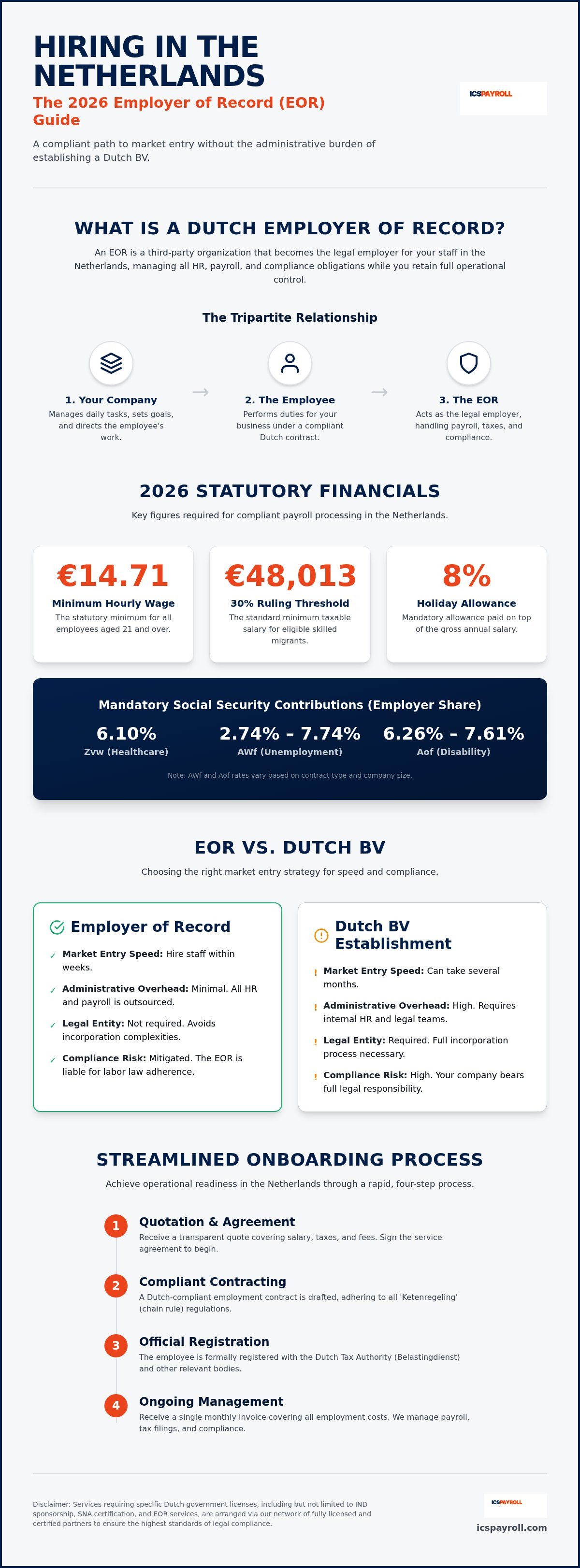
The Dutch EOR model functions as a tripartite relationship between the client company, the employee, and the legal employer.
The Tripartite Relationship Explained
The client company maintains operational control. You manage the employee's work schedule, set performance goals, and integrate them into your corporate culture. The employee performs their duties for your benefit but signs a legal contract with the EOR provider. Finally, the EOR assumes all legal liabilities. This includes ensuring compliance with Dutch labor laws, managing 2026 statutory filings, and processing monthly payroll tax (loonaangifte) submissions. These administrative and legal services, including visa sponsorships, are arranged via licensed partners to maintain the highest standards of compliance.
EOR vs. PEO in the Dutch Context
Distinguishing between an EOR and a Professional Employer Organization (PEO) is vital for your expansion strategy. A PEO typically operates under a co-employment model which requires your business to have an existing local legal entity, such as a Dutch BV. In contrast, an EOR acts as the sole legal employer, making it the preferred choice for companies without a Dutch presence. For a more detailed breakdown of these differences, you can consult our local EOR vs multi-country guide. This distinction ensures you select the model that provides the highest level of security and administrative ease for your specific organizational structure.
How the Dutch EOR Model Works in 2026
The operational workflow for a Dutch EOR is designed for speed and legal precision. It begins with a tailored quotation that accounts for gross salary, mandatory social security, and specific benefits like the 30% ruling. Understanding the operational mechanics of what is an eor netherlands helps businesses plan their Dutch expansion budget with total certainty. Once terms are agreed upon, service agreements and Dutch-compliant employment contracts are drafted within days. It's a rapid turnaround that's essential for securing top talent in a competitive market.
Onboarding involves formal registration with the Dutch Tax Authority (Belastingdienst). This step ensures all wage tax and social security contributions are correctly assigned to the legal employer's record. Clients receive one consolidated monthly invoice that covers the total cost of employment. This process clarifies exactly what is an eor netherlands in terms of administrative relief, as it removes the need for multiple payments to different government bodies.
Onboarding and Contract Management
Contracts must strictly adhere to the 'Ketenregeling', or chain rule. This regulation limits the number of fixed-term renewals to three within a three-year period. If these limits are exceeded, the contract automatically converts to an indefinite arrangement. To ensure clear communication, employees receive handbooks detailing company policies and Dutch workplace norms. Secure digital portals provide staff with immediate access to their monthly payslips and real-time holiday balance tracking.
Monthly Payroll and Compliance Cycles
The EOR calculates and withholds all necessary premiums during each payroll cycle. In 2026, this includes the Zvw (healthcare) premium at 6.10%, the AWf (unemployment fund) at either 2.74% or 7.74%, and the Aof (disability fund) which varies between 6.26% and 7.61%. A statutory holiday allowance of 8% is either accrued monthly or paid out annually in May, depending on the specific contract terms. Pension contributions are a critical component of the Dutch benefits package, typically requiring a contribution of approximately 15.2% of the gross salary. If you need a detailed breakdown of these costs for your specific hiring needs, you can request a tailored quotation to see the exact figures.
Financial Benchmarks and 2026 Statutory Requirements
Effective January 1, 2026, the statutory minimum hourly wage in the Netherlands is €14.71 for employees aged 21 and older. This benchmark is the foundation for any compliant payroll structure when evaluating what is an eor netherlands. Beyond base compensation, employers must account for the mandatory transition allowance if a contract is not renewed. For 2026, the transition allowance cap is €102,000 or one annual salary, whichever is higher. Additionally, sickness risk management is a significant financial obligation, as Dutch law requires the legal employer to pay at least 70% of the salary for up to two years during long term illness.
The EOR model provides a protective buffer by ensuring these statutory costs and insurance requirements are managed correctly. By utilizing employment services arranged via licensed partners, your company avoids the direct liability of managing these complex Dutch labor mandates while maintaining full operational control over your team's daily output.
The 30% Ruling and Highly Skilled Migrants
The 30% ruling remains a critical incentive for attracting international talent to the Netherlands. For 2026, the standard taxable salary threshold for the 30% ruling is €48,013, excluding the tax-free allowance. It is vital to recognize that the partial non-resident status has been abolished, meaning employees can no longer opt for foreign taxpayer status for Box 2 and Box 3 income. Furthermore, newer rulings now follow the 27% rate transition introduced in recent legislation. You can find detailed 30% ruling thresholds and regulations on the official Tax Authority website.
HSM Visa and Sponsorship
For employees residing outside the EEA, Highly Skilled Migrant (HSM) visas are often necessary. These visas are arranged via licensed partners who act as the recognized sponsor with the IND. The application process typically takes approximately three weeks once all documentation is submitted. You should consult the Highly Skilled Migrant (HSM) criteria from the Immigration and Naturalisation Service for official income and age requirements. The EOR provider manages the ongoing sponsorship obligations, ensuring your staff maintains legal work status without your company needing to secure its own sponsorship license.
EOR vs. Dutch BV: Choosing the Right Expansion Strategy
Deciding between incorporating a local entity and utilizing an Employer of Record is a pivotal strategic choice for international firms. A Dutch BV (private limited company) requires a formal incorporation process involving notary fees, minimum capital requirements, and mandatory registration with the Chamber of Commerce (KvK). While a BV offers maximum control over local branding and operations, it also necessitates a permanent administrative infrastructure. This includes managing local corporate tax filings, annual audits, and maintaining a Dutch bank account. For many organizations, the question of what is an eor netherlands becomes relevant when the goal is rapid market entry without these long-term overheads.
The EOR model provides a streamlined alternative by allowing companies to hire staff within weeks rather than months. It shifts the burden of legal and financial compliance to a specialized partner while you retain the ability to direct the employee's work. When comparing speed and cost, the EOR model significantly reduces the initial investment and ongoing legal risk associated with Dutch employment. This approach is particularly effective for businesses that prioritize flexibility and want to avoid the complexities of local entity management during their initial growth phase.
When to Choose an EOR
The EOR path is the most logical choice for companies hiring their first 1 to 5 employees in the Netherlands. It's ideally suited for remote teams where a physical office space isn't required to conduct business. By bypassing the incorporation phase, you can test the Dutch market's viability with minimal financial exposure. For a more granular breakdown of these two paths, you can read our Dutch BV vs EOR comparison to determine which model aligns with your 2026 growth targets.
Permanent Establishment and Tax Risk
A primary concern for foreign companies is the risk of Permanent Establishment, which can trigger significant corporate tax liabilities in the Netherlands. Utilizing an EOR helps mitigate this risk because the EOR acts as the formal local employer. They ensure that all Loonaangifte (payroll tax) filings are strictly compliant with the latest 2026 regulations. If you're considering the BV route, you must consult the Dutch Chamber of Commerce (KvK) for specific rules regarding foreign company registration and local director requirements. To secure your expansion with a local expert, contact us today for a professional EOR consultation.
Why ICSPayroll is Your Local EOR Partner in the Netherlands
Choosing a partner with deep local expertise is essential for navigating the specific legal landscape of the Dutch labor market. ICSPayroll operates as a specialized bridge between international entities and the complex regulatory requirements of the Netherlands. Joost Hubregtse and our professional team focus exclusively on the Dutch market, providing deep expertise in local Wet DBA and VBAR regulations. When businesses ask what is an eor netherlands, they're often seeking a partner that removes administrative risk while maintaining speed. We provide a tailored quotation within 24 hours of receiving your employee's details, ensuring your hiring process remains efficient. To maintain full audit readiness, we adhere to the mandatory seven-year record-keeping requirement for all payroll and employment documents.
Transparent Pricing and One Clear Invoice
We utilize a transparent 'payroll factor' pricing model to eliminate hidden fees and unexpected costs. This factor is a comprehensive multiplier that covers the gross salary alongside mandatory employer costs such as holiday allowance, pension, and social security. Clients receive a single, consolidated monthly invoice that simplifies international accounting and cash flow management. This 'one-stop' solution eliminates the need for separate tax or pension advisors, as all statutory obligations are handled within one professional framework. Our services include full HR administration, from contract drafting to sick-leave reintegration.
Expert Support for Expats and HSMs
Attracting global talent requires a sophisticated understanding of Dutch tax incentives and immigration rules. We facilitate 30% ruling applications to ensure your international staff can utilize the maximum tax advantages available in 2026. Joost Hubregtse and our team ensure that all Loonaangifte (payroll tax) filings are submitted to the Tax Authority by the mandatory deadlines, which fall at the end of the month following the payroll period. For employees from outside the EEA, we arrange expedited HSM visa processing via licensed partners. These applications are typically granted within three weeks, allowing for rapid onboarding and seamless market entry.
Accelerate Your Dutch Market Entry with Compliance and Precision
The Employer of Record model provides a definitive solution for international firms seeking to hire in the Netherlands without the administrative burden of a local legal entity. By understanding exactly what is an eor netherlands, you can leverage a framework that manages complex 2026 statutory costs, including the €14.71 minimum hourly wage and specialized 30% ruling applications. This approach effectively mitigates permanent establishment risks and ensures full compliance with evolving labor laws like Wet DBA and VBAR.
Our team provides a secure bridge to the Dutch market with an operational set-up completed in weeks. You benefit from a consolidated single monthly invoice and the peace of mind that comes with full Dutch compliance guaranteed. We're ready to help you secure top talent and scale your operations with total transparency and local expertise.
Hire in the Netherlands with confidence; get your tailored EOR quote within 24 hours.
By Joost Hubregtse, Payroll Director
Joost Hubregtse is a recognized expert in Dutch labor law and international payroll compliance with over 15 years of experience in the sector. As Payroll Director at ICSPayroll, he specializes in cross border employment solutions and 30% ruling applications. Reviewed by Joost Hubregtse on October 24, 2026.
Frequently Asked Questions
What is the difference between an EOR and a PEO in the Netherlands for 2026?
An EOR acts as the sole legal employer of your staff, whereas a PEO operates under a co-employment model that requires you to have a local Dutch BV. For international companies, the EOR is the standard choice because it eliminates the need for a local legal entity and fully manages the risk of Permanent Establishment. This distinction is critical for maintaining compliance with the latest Dutch labor regulations.
Can a foreign company use an EOR if they do not have a Dutch BV?
Yes, foreign companies can legally employ staff without a local BV by utilizing an EOR. When determining what is an eor netherlands, the most significant advantage is the ability to hire within weeks without registering with the Chamber of Commerce (KvK). The EOR, through its licensed partners, assumes all statutory responsibilities, allowing you to focus on managing your team's daily operations from abroad.
How much does an EOR cost in the Netherlands compared to direct hiring?
The cost of an EOR is typically structured as a management fee or a payroll factor applied to the employee's gross salary. While direct hiring requires significant investment in entity incorporation, local tax advisors, and Dutch accounting software, the EOR model provides a consolidated invoice. This approach often results in lower total overhead for small to medium sized teams by removing the administrative costs of local entity maintenance.
What are the 2026 salary requirements for the 30% ruling through an EOR?
To qualify for the 30% ruling in 2026, employees over 30 must earn a minimum taxable salary of €48,013. For those under 30 with a Master's degree, the threshold is €36,497. These figures are strictly enforced by the Dutch Tax Authority (Belastingdienst). ICSPayroll manages these applications to ensure all 2026 benchmarks, including the transition to the 27% rate, are correctly applied.
How long does it take to set up an employee via a Dutch EOR?
Operational set up typically takes between one and three weeks once the employee's details are finalized. This timeline includes the drafting of compliant contracts and registration with local social security bodies. If a Highly Skilled Migrant (HSM) visa is required, the process is managed via licensed partners and generally takes an additional three weeks, ensuring a rapid path to market entry.
Who is responsible for Dutch sick pay and reintegration under the EOR model?
The EOR, as the legal employer, is responsible for managing sick pay and the mandatory reintegration process. Under the Wet Verbetering Poortwachter, the legal employer must support the employee's return to work for up to two years. These services are arranged via licensed partners to ensure that all legal obligations, including specialized occupational health assessments, are met with clinical precision.
Is the 8% holiday allowance mandatory for employees hired via an EOR?
Yes, the 8% holiday allowance is a statutory requirement for every employee in the Netherlands. It is calculated on the total gross salary and must be clearly stated in the employment contract. The EOR ensures this allowance is either accrued monthly or paid out in full, typically in May, according to the official Dutch government guidelines.
Can an EOR in the Netherlands help with Highly Skilled Migrant (HSM) visas?
Yes, an EOR facilitates HSM visas through licensed partners who are recognized sponsors with the Immigration and Naturalisation Service (IND). This allows your business to sponsor international talent without obtaining your own sponsorship license. The EOR manages the entire application process, ensuring that income requirements and administrative deadlines are strictly followed to maintain the employee's legal work status.
Sources and references
Every rule and figure above is traceable to the sources below: the exact statutory articles, the regulator pages that publish the amounts, the statistical datasets, and the specific court rulings that settle the point. Always check the current text for your own situation.
- Article 7:692 Dutch Civil Code, the statutory definition of payrolling
- Article 7:690 Dutch Civil Code, the agency work (uitzend) contract
- Article 8 Waadi, equal pay for hired-in workers (loonverhoudingsnorm)
- Stichting Normering Arbeid, the NEN 4400-1 register of audited payroll and staffing companies
- Belastingdienst, low and high AWf unemployment contribution rates and when each applies
- Netherlands Labour Authority, enforcement, inspections and penalty policy
- CBS, Compensation of employees and employment by economic activity (national accounts dataset 84165ENG)
- Eurostat, hourly labour cost levels by NACE activity (dataset lc_lci_lev), for cross-country comparison
- Supreme Court 11 April 2025, ECLI:NL:HR:2025:543: the agency work contract of art. 7:690 BW in a triangular platform-work relationship
- Supreme Court 21 November 2025, ECLI:NL:HR:2025:1733: misuse of successive agency contracts under art. 5(5) Directive 2008/104/EC and the Waadi

Article by
Joost Hubregtse
Joost Hubregtse is Director of ICS Staffing & Payroll B.V., the wholly owned subsidiary of Intercompany Solutions behind ICS Payroll. He is responsible for Employer of Record and Dutch payroll services: employment contracts, wage tax and social security filings, holiday allowance, pension, sick leave and CAO compliance, with onboarding possible within 48 hours.

Frequently Asked Questions
An EOR acts as the sole legal employer of your staff, whereas a PEO operates under a co-employment model that requires you to have a local Dutch BV. For international companies, the EOR is the standard choice because it eliminates the need for a local legal entity and fully manages the risk of Permanent Establishment. This distinction is critical for maintaining compliance with the latest Dutch labor regulations.
Yes, foreign companies can legally employ staff without a local BV by utilizing an EOR. When determining what is an eor netherlands, the most significant advantage is the ability to hire within weeks without registering with the Chamber of Commerce (KvK). The EOR, through its licensed partners, assumes all statutory responsibilities, allowing you to focus on managing your team's daily operations from abroad.
The cost of an EOR is typically structured as a management fee or a payroll factor applied to the employee's gross salary. While direct hiring requires significant investment in entity incorporation, local tax advisors, and Dutch accounting software, the EOR model provides a consolidated invoice. This approach often results in lower total overhead for small to medium sized teams by removing the administrative costs of local entity maintenance.
To qualify for the 30% ruling in 2026, employees over 30 must earn a minimum taxable salary of €48,013. For those under 30 with a Master's degree, the threshold is €36,497. These figures are strictly enforced by the Dutch Tax Authority (Belastingdienst). ICSPayroll manages these applications to ensure all 2026 benchmarks, including the transition to the 27% rate, are correctly applied.
Operational set up typically takes between one and three weeks once the employee's details are finalized. This timeline includes the drafting of compliant contracts and registration with local social security bodies. If a Highly Skilled Migrant (HSM) visa is required, the process is managed via licensed partners and generally takes an additional three weeks, ensuring a rapid path to market entry.
The EOR, as the legal employer, is responsible for managing sick pay and the mandatory reintegration process. Under the Wet Verbetering Poortwachter, the legal employer must support the employee's return to work for up to two years. These services are arranged via licensed partners to ensure that all legal obligations, including specialized occupational health assessments, are met with clinical precision.
Yes, the 8% holiday allowance is a statutory requirement for every employee in the Netherlands. It is calculated on the total gross salary and must be clearly stated in the employment contract. The EOR ensures this allowance is either accrued monthly or paid out in full, typically in May, according to the official Dutch government guidelines.
Yes, an EOR facilitates HSM visas through licensed partners who are recognized sponsors with the Immigration and Naturalisation Service (IND). This allows your business to sponsor international talent without obtaining your own sponsorship license. The EOR manages the entire application process, ensuring that income requirements and administrative deadlines are strictly followed to maintain the employee's legal work status.