
The 30% Ruling in the Netherlands: 2026 Employer Compliance and Strategy Guide
By Joost Hubregtse, Director, ICS Staffing & Payroll
All blog posts are reviewed and fact checked by our labour law lawyer Zishan Hussain and our director. Editorial standards
By Joost Hubregtse, Payroll Director
Joost Hubregtse is a specialized Dutch payroll consultant with over 15 years of experience in international labor law and tax compliance. He leads the technical advisory team at ICSPayroll, focusing on complex cross-border employment structures and the 30% facility.
Reviewed by Joost Hubregtse on August 20, 2026
Relying on a "set and forget" approach to international tax benefits is the fastest way to trigger a retroactive audit in the current Dutch regulatory environment. You likely understand that offering a tax-free allowance is essential for attracting global talent, but the increasing complexity of the 30 ruling netherlands conditions for employer compliance makes it difficult to maintain a steady course. Between the 150km distance requirement and the rigorous monitoring of taxable salary levels, the margin for error has never been thinner.
We recognize that the administrative burden of these applications can feel like a stabilizing force turned into a bureaucratic hurdle. This guide provides the clarity you need to master the 2026 salary thresholds, including the standard EUR 48,013 requirement, while preparing for the 27% rate transition and the abolition of partial non-resident status. By the end of this article, you'll have a clear understanding of Dutch payroll compliance and a step by step framework for managing applications through our licensed partners. We will move logically from the latest financial benchmarks to the operational commitments required for a seamless hiring process.
Key Takeaways
- Understand the mandatory 2026 salary thresholds, including the EUR 48,013 standard and the EUR 36,497 requirement for employees under 30 with a Master's degree.
- Prepare for the legislative shift from a 30 percent to a 27 percent tax free rate starting in 2027 and how it affects newer rulings.
- Navigate the abolition of partial non-resident status to ensure full compliance with updated Dutch wealth tax regulations.
- Identify the specific 30 ruling netherlands conditions for employer eligibility, including the 150 kilometer distance requirement and the four month application deadline.
- Learn how to facilitate compliant hiring and ruling applications without a local BV through the use of licensed partners and payroll experts.
The 30% Ruling Framework for Employers in 2026
The 30% ruling is a specialized tax facility designed to facilitate the recruitment of international talent by allowing employers to provide a tax-free allowance. This allowance covers extraterritorial costs, which are the additional expenses incurred by employees living and working outside their home country. Understanding the 30% Ruling Framework is essential for any business operating in the Dutch market. It functions as a reimbursement for costs like double housing, language courses, or travel. In 2026, this scheme remains a cornerstone of the Dutch knowledge economy. It ensures that the Netherlands remains a top-tier destination for high-level professionals despite global competition for talent.
Implementing this facility correctly is a primary requirement for maintaining a compliant payroll. While it's often viewed as an employee benefit, it's fundamentally a payroll tax obligation for the employer. You must ensure that the taxable salary remains above the required thresholds after the deduction is applied. This distinction is critical for avoiding retroactive tax liabilities. The 30 ruling netherlands conditions for employer eligibility allow you to offer a competitive package that attracts scarce expertise without inflating your company's gross wage bill.
The Strategic Value of the Expat Scheme
Hiring from abroad involves significant financial hurdles for the employee. The ruling offsets the high cost of living in the Netherlands by significantly increasing the employee's net take-home pay. Crucially, this benefit doesn't increase the gross salary costs for the employer. It's a cost-effective way to remain competitive in a tight labor market. The 30% ruling serves as a vital instrument for attracting international talent with scarce expertise to the Dutch labor market in 2026. By utilizing this scheme, companies can bridge the gap between Dutch salary standards and the expectations of global specialists.
Key Terminology for Dutch Compliance
Compliance starts with understanding the role of the employer as the withholding agent. This means the employer is responsible for correctly calculating and deducting taxes from the payroll. Meeting the 30 ruling netherlands conditions for employer status requires precise administrative handling. Employers must choose between reimbursing actual extraterritorial costs or applying the fixed percentage. Most prefer the fixed percentage for its administrative simplicity and predictability. It's also vital to distinguish between a Highly Skilled Migrant (HSM) visa and the tax ruling itself. While often paired, they are separate legal processes. An HSM visa grants the right to work, whereas the 30% ruling provides the tax benefit. Ensuring both are handled correctly through licensed partners provides the necessary security for your international operations. The ruling is a joint application, requiring both parties to meet specific criteria from the start of the employment contract.
Eligibility Criteria and 2026 Salary Thresholds
Securing approval from the Dutch Tax Administration requires strict adherence to the 30 ruling netherlands conditions for employer entities and their prospective hires. The fundamental requirement is that the employee must be recruited from outside the Dutch borders. This means the employment contract must be finalized while the candidate is still a resident of another country. Meeting the 30 ruling netherlands conditions for employer status also requires the Belastingdienst to evaluate specific expertise primarily through indexed salary benchmarks. If the compensation meets these 2026 figures, the expertise is generally accepted without a detailed labor market test. The facility is granted for a maximum duration of five years, and any previous periods of residence in the Netherlands will be deducted from this term.
Managing these 30% ruling applications through licensed partners ensures your payroll remains compliant with the latest regulations while removing the administrative burden from your internal teams. It's a precise process. We act as the bridge to ensure all documentation meets the rigorous standards of the Dutch authorities. Using a licensed partner provides the security needed for complex international relocations.
2026 Salary Requirements for Specific Expertise
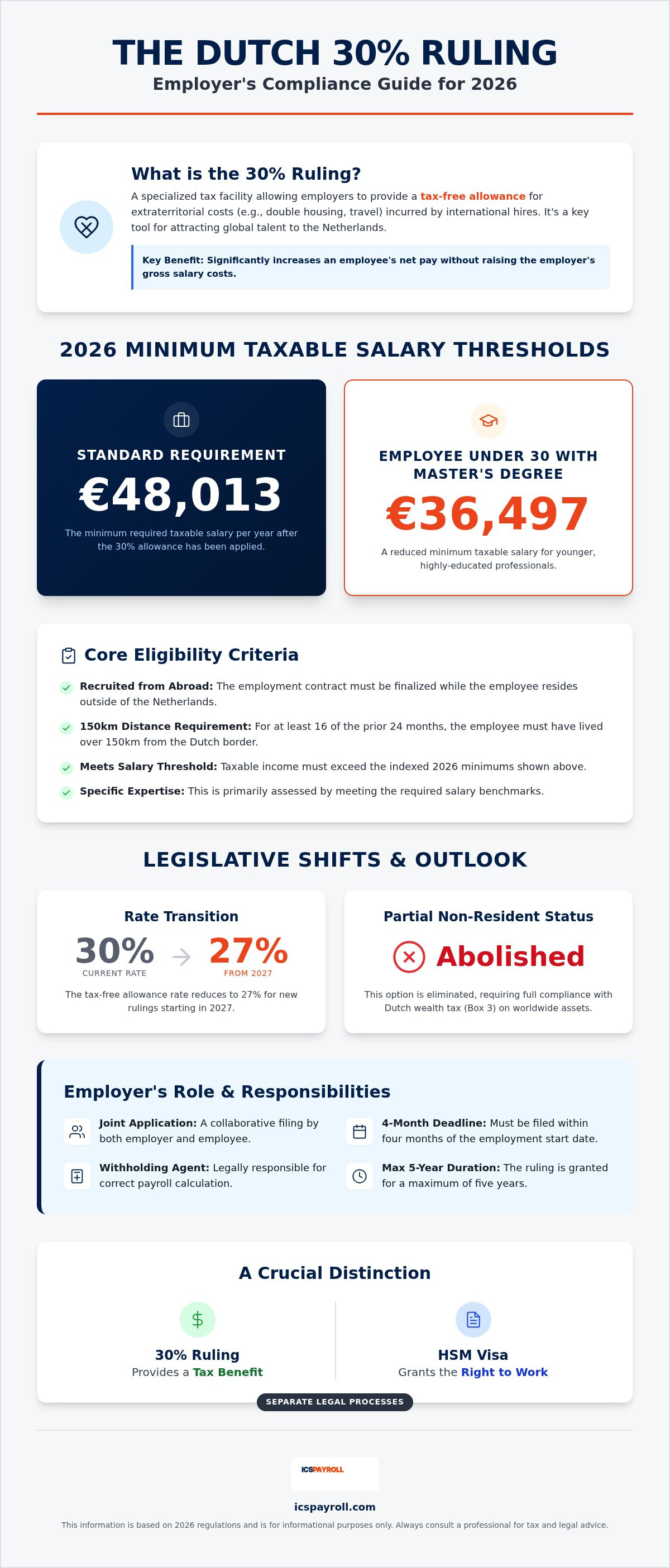
For the 2026 tax year, the Dutch government has set specific taxable salary thresholds that must be maintained to keep the ruling active. According to the official salary requirements provided by the Tax Administration, the standard annual taxable salary threshold is EUR 48,013. For employees under the age of 30 who hold a qualifying Master's degree, a reduced threshold of EUR 36,497 applies. These figures represent the taxable portion of the salary. This is the amount remaining after the tax-free allowance is deducted. If an employee's taxable salary falls below these benchmarks at any point, the ruling may be revoked retroactively. Employers must calculate the maximum possible tax-free percentage by ensuring the remaining 70% of the gross salary, including the 8% holiday allowance, does not dip below these limits.
The 150km Limit and Prior Residency Rules
The 150 kilometer rule is a non-negotiable residency requirement for the facility. To be eligible, a candidate must have lived more than 150 kilometers from the Dutch border for at least 16 out of the 24 months prior to their start date. This distance is calculated as the crow flies from the nearest Dutch border point. The Belastingdienst residency criteria effectively exclude residents of Belgium and Luxembourg. It also excludes significant portions of western Germany and northern France. However, specific exceptions exist for PhD graduates and scientific researchers. For these individuals, the 150km rule and the standard salary thresholds may be waived or modified if they begin their Dutch employment within one year of completing their doctoral studies. Accuracy in verifying prior residency is a critical step in the joint application process.
Navigating the 27% Rate and 2026 Tax Liability Shifts
The legislative landscape for the 30% facility has shifted significantly following recent Dutch budget negotiations. While the initial plan for a tiered reduction to 20% and 10% was scrapped, a new flat rate of 27% will take effect on January 1, 2027. For the 2026 tax year, the 30 ruling netherlands conditions for employer entities require applying the 30% rate for all eligible staff. However, payroll departments must categorize employees based on their start dates. Those whose rulings began before January 1, 2024, fall under a transitional arrangement and will retain the 30% rate for their entire five year term. Understanding these nuances is a core part of the employer responsibility to ensure accurate net pay calculations.
The Abolition of Partial Non-Resident Status
The abolition of partial non-resident taxpayer status represents one of the most substantial changes for international staff. Previously, this status allowed employees to be treated as non-residents for tax purposes in Box 2 and Box 3. According to the Belastingdienst consequences of the ruling, as of January 1, 2025, this option is no longer available for new applicants. Employees who were already benefiting from this status on December 31, 2023, can continue to do so until December 31, 2026. Starting in 2027, these high net worth individuals will be subject to Dutch wealth tax on their global assets. Employers should proactively communicate this change because it directly impacts the financial planning of senior executives and specialized experts.
Understanding the Tapering Rules
The decision to implement a flat 27% rate instead of the previously proposed step-down model provides more administrative certainty for 2026. Maintaining compliance during the transition requires precise record keeping. You must verify the start date of each ruling to determine if the 27% reduction applies in 2027 or if the employee is protected by the older 30% transitional rule. In 2026, all active rulings still utilize the 30% rate, but the payroll administration must be prepared for the automated shift in the following year. This preparation includes updating payroll software and ensuring that salary levels still meet the 30 ruling netherlands conditions for employer compliance after the percentage change. Clear internal documentation of these regimes prevents errors during Loonaangifte filings and protects the company from future tax audits.
The Application Process and Ongoing Employer Obligations
The application for the 30% ruling is a joint request that must be filed by both the employer and the employee. To ensure the ruling applies retroactively from the first day of employment, you must submit the application to the Belastingdienst within four months of the start date. Missing this window is costly. Failing to meet this deadline means the ruling only becomes effective from the first day of the month following the application month. This delay can result in significant tax disadvantages for the employee and complicates the payroll setup. Meeting the 30 ruling netherlands conditions for employer compliance also involves managing career transitions. If an employee changes jobs, they must sign a new contract with the succeeding employer within three months of ending their previous employment to retain the facility.
Compliance doesn't end with the approval of the application. Employers must maintain all related documents, including the original employment contract, proof of prior residency, and educational certificates, for at least seven years. This period aligns with the standard Dutch statutory record-keeping requirement. During an audit, the Belastingdienst will expect to see proof that the employee met the 150km rule and that their taxable salary consistently met the required levels throughout the duration of the ruling.
Step-by-Step Application Guide
The process begins by securing formal employee consent and gathering evidence of their international residency. This evidence typically includes rental agreements or utility bills from their country of origin. Once the documentation is complete, you submit the joint request to the Belastingdienst. While waiting for the decision, you should continue to withhold tax normally. After the formal decision arrives, you can apply the tax-free allowance and perform any necessary corrections for previous months within the same tax year. You can arrange your 30% ruling application through our licensed partners to ensure every step meets these rigorous legal standards.
Payroll Integration and Reporting
Correctly reflecting the tax-free allowance on the monthly payslip is a technical requirement. The allowance is not subject to payroll tax or social security premiums. This reduces the total labor cost for the employer while increasing the employee's net income. However, you must monitor the taxable salary monthly. Unpaid leave, part-time work, or mid-year salary changes can push the taxable portion below the EUR 48,013 threshold. If the salary dips below this indexed amount, the ruling is immediately and retroactively lost for that period. You must also include the ruling details in the monthly payroll tax return filings to ensure the Tax Administration has an accurate record of the applied exemptions.
Optimizing International Hiring via Local EOR Partners
Hiring international talent often requires navigating a maze of local regulations that can delay your market entry. For companies without a physical presence in the Netherlands, meeting the 30 ruling netherlands conditions for employer status is a significant challenge. The Dutch Tax Administration requires a registered withholding agent to apply for and manage the ruling. An Employer of Record (EOR) solves this by acting as the legal employer of your Dutch-based staff. This arrangement allows you to offer the 30% ruling to your employees even if your company is based entirely outside the Netherlands. It provides a bridge between your global operations and the specific requirements of the Dutch tax system.
Hiring Without a Dutch Legal Entity
Establishing a local BV involves significant legal, administrative, and financial commitments. Beyond the initial setup, you must manage ongoing corporate tax filings and avoid "Permanent Establishment" risks that can complicate your global tax profile. An EOR provides a compliant alternative by assuming all legal and labor law responsibilities. This includes managing the "Ketenregeling" contract limits and ensuring all 2026 statutory requirements, such as the EUR 14.71 minimum hourly wage, are met. The EOR manages the entire payroll cycle, from Loonaangifte filings to social security contributions. You can find a detailed comparison of these hiring models in our Employer of Record Netherlands guide. This strategic approach allows you to focus on your core business while we handle the technical complexities of Dutch employment through our licensed partners.
The ICSPayroll Advantage in 2026
ICSPayroll serves as a stabilizing force for international businesses entering the Dutch market. We consolidate all HR administration, including tax ruling support, into a single, transparent payroll factor. This means no surprise charges and predictable monthly invoicing for your organization. Although ICSPayroll is not an IND recognized sponsor, we arrange expedited Highly Skilled Migrant (HSM) visa processing through our licensed partners. This process is typically completed in approximately three weeks, allowing your talent to begin working without unnecessary delays. Our services ensure that the 30 ruling netherlands conditions for employer compliance are monitored continuously. This includes tracking the strict 2026 salary thresholds of EUR 48,013 for standard employees and EUR 36,497 for those under 30 with a Master's degree. Employees benefit from our professional support and a secure digital portal for managing their payslips and employment documents. This combination of local expertise and rapid processing provides the security your business needs to thrive in the Netherlands.
Securing Your International Talent Strategy for 2026
The 2026 landscape for the 30% ruling requires proactive management and technical precision. You must prioritize the EUR 48,013 salary threshold and understand the impact of the 27% rate transition on your future payroll administration. Navigating the 30 ruling netherlands conditions for employer compliance is no longer a static task. It's a continuous obligation that involves rigorous record-keeping and timely applications within the four-month window to avoid losing retroactive benefits.
Partnering with a local expert ensures your international hiring remains seamless and secure. We provide full compliance with 2026 Dutch labor laws, including expedited HSM visa processing in approximately 3 weeks arranged via our licensed partners. Our transparent payroll factor eliminates surprise charges. This allows you to focus on growth while we manage the administrative burden of tax ruling applications and payroll integration. Calculate your Dutch hiring costs and 30% ruling impact with ICSPayroll today to stabilize your expansion into the Netherlands. Your success in the Dutch market starts with a compliant and reliable payroll foundation.
Frequently Asked Questions
What is the minimum salary for the 30% ruling in 2026?
The minimum annual taxable salary for the 30% ruling in 2026 is EUR 48,013. For employees under the age of 30 who hold a qualifying Master degree, the threshold is reduced to EUR 36,497. These amounts represent the 70% taxable portion of the total gross salary. Employers must ensure the employee's compensation remains above these indexed levels throughout the year to maintain compliance with the 30 ruling netherlands conditions for employer eligibility.
Can I apply for the 30% ruling if I am already living in the Netherlands?
You cannot apply for the 30% ruling if you are already residing in the Netherlands at the time of recruitment. The facility is strictly for employees recruited from abroad. To qualify, you must have lived more than 150 kilometers from the Dutch border for at least 16 of the 24 months prior to your first day of employment. This rule ensures the scheme only benefits those incurring extraterritorial costs during their relocation.
How long does the 30% ruling last in 2026?
The maximum duration for the 30% ruling in 2026 is five years, which equates to 60 months. Any previous periods of stay or work in the Netherlands will be deducted from this total duration. It is essential for employers to verify an employee's history in the country before filing the joint application. Once the five year term expires, the employee will transition to standard Dutch income tax rates on their full gross salary without exemptions.
What happens to the 30% ruling if I change jobs?
If you change jobs, you can retain the 30% ruling provided you meet specific timing requirements. You must sign a new employment contract with a succeeding employer within three months of ending your previous contract. The new employer must also qualify as a withholding agent. Both parties then submit a new joint application to the Belastingdienst to transfer the facility. Failure to secure a new contract within this three month window results in the permanent expiration of the ruling.
Is the 30% ruling still 30 percent in 2026 or has it changed to 27 percent?
In 2026, the tax free allowance remains at 30 percent for all active rulings. The reduction to a flat 27 percent rate is scheduled to take effect on January 1, 2027. However, employees whose rulings began before January 1, 2024, are protected by transitional rules and will keep the 30 percent rate for their full term. Managing these 30 ruling netherlands conditions for employer payroll teams requires distinguishing between different start dates to ensure accurate tax withholding.
Does the 30% ruling affect my Dutch pension contributions?
The 30% ruling can affect your Dutch pension contributions because they are typically calculated based on your taxable salary. Since the ruling reduces your taxable income, the pensionable base is lower, which may result in lower future benefits. Some pension providers allow for contributions based on the full gross salary before the 30% deduction. Employers should review their specific pension plan rules and communicate these impacts clearly to international staff during the onboarding process.
What is the 150km rule for the Dutch expat scheme?
The 150km rule requires that an employee lived more than 150 kilometers from the Dutch border for at least 16 out of the 24 months before starting their Dutch employment. This distance is measured as the crow flies from the nearest point on the border. This requirement excludes most residents of Belgium and Luxembourg, as well as parts of Germany and France. Specific exceptions apply for PhD graduates who start their employment within one year of finishing their studies.
Can a remote worker in the Netherlands qualify for the 30% ruling?
A remote worker can qualify for the 30% ruling if they meet all standard eligibility criteria and are formally employed by a Dutch withholding agent. The employee must relocate to the Netherlands and be recruited from a distance of more than 150km. The ruling applies to the salary earned while working in the Netherlands. If the employee performs work from abroad, that portion of their income is generally not eligible for the tax free allowance under current Dutch regulations.

Article by
Joost Hubregtse
Joost Hubregtse is Director of ICS Staffing & Payroll B.V., the wholly owned subsidiary of Intercompany Solutions behind ICS Payroll. He is responsible for Employer of Record and Dutch payroll services: employment contracts, wage tax and social security filings, holiday allowance, pension, sick leave and CAO compliance, with onboarding possible within 48 hours.
Frequently Asked Questions
The minimum annual taxable salary for the 30% ruling in 2026 is EUR 48,013. For employees under the age of 30 who hold a qualifying Master degree, the threshold is reduced to EUR 36,497. These amounts represent the 70% taxable portion of the total gross salary. Employers must ensure the employee's compensation remains above these indexed levels throughout the year to maintain compliance with the 30 ruling netherlands conditions for employer eligibility.
You cannot apply for the 30% ruling if you are already residing in the Netherlands at the time of recruitment. The facility is strictly for employees recruited from abroad. To qualify, you must have lived more than 150 kilometers from the Dutch border for at least 16 of the 24 months prior to your first day of employment. This rule ensures the scheme only benefits those incurring extraterritorial costs during their relocation.
The maximum duration for the 30% ruling in 2026 is five years, which equates to 60 months. Any previous periods of stay or work in the Netherlands will be deducted from this total duration. It is essential for employers to verify an employee's history in the country before filing the joint application. Once the five year term expires, the employee will transition to standard Dutch income tax rates on their full gross salary without exemptions.
If you change jobs, you can retain the 30% ruling provided you meet specific timing requirements. You must sign a new employment contract with a succeeding employer within three months of ending your previous contract. The new employer must also qualify as a withholding agent. Both parties then submit a new joint application to the Belastingdienst to transfer the facility. Failure to secure a new contract within this three month window results in the permanent expiration of the ruling.
In 2026, the tax free allowance remains at 30 percent for all active rulings. The reduction to a flat 27 percent rate is scheduled to take effect on January 1, 2027. However, employees whose rulings began before January 1, 2024, are protected by transitional rules and will keep the 30 percent rate for their full term. Managing these 30 ruling netherlands conditions for employer payroll teams requires distinguishing between different start dates to ensure accurate tax withholding.
The 30% ruling can affect your Dutch pension contributions because they are typically calculated based on your taxable salary. Since the ruling reduces your taxable income, the pensionable base is lower, which may result in lower future benefits. Some pension providers allow for contributions based on the full gross salary before the 30% deduction. Employers should review their specific pension plan rules and communicate these impacts clearly to international staff during the onboarding process.
The 150km rule requires that an employee lived more than 150 kilometers from the Dutch border for at least 16 out of the 24 months before starting their Dutch employment. This distance is measured as the crow flies from the nearest point on the border. This requirement excludes most residents of Belgium and Luxembourg, as well as parts of Germany and France. Specific exceptions apply for PhD graduates who start their employment within one year of finishing their studies.
A remote worker can qualify for the 30% ruling if they meet all standard eligibility criteria and are formally employed by a Dutch withholding agent. The employee must relocate to the Netherlands and be recruited from a distance of more than 150km. The ruling applies to the salary earned while working in the Netherlands. If the employee performs work from abroad, that portion of their income is generally not eligible for the tax free allowance under current Dutch regulations.