
The 30 Percent Ruling for Employers: A 2026 Compliance Guide
By Joost Hubregtse, Director, ICS Staffing & Payroll
All blog posts are reviewed and fact checked by our labour law lawyer Zishan Hussain and our director. Editorial standards
By Joost Hubregtse, Payroll Director
Reviewed on August 14, 2026
Joost Hubregtse is the Payroll Director at ICSPayroll, specializing in Dutch labor law and international tax compliance. With extensive experience in the sector, he helps foreign entities establish a secure presence in the Netherlands through precise administrative management.
Maintaining a competitive edge in the Dutch labor market now requires more than just a high salary; it demands a precise mastery of evolving tax incentives. You likely recognize that the 30 percent ruling for employers remains the most powerful tool for attracting international specialists to the Netherlands. However, the legislative landscape has shifted significantly with the introduction of tapered rates and stricter salary caps. Failing to adapt to these changes risks the loss of top talent and the threat of retroactive tax claims from the Belastingdienst.
This 2026 compliance guide provides the clarity you need to navigate current requirements, including the standard EUR 48,013 taxable salary threshold and the five-year tapering scale. We will examine specific administrative benchmarks, the abolition of partial non-resident status, and the upcoming 2027 transition to a 27 percent rate. You'll learn how to leverage these tax-free allowances, arranged via our licensed partners, to reduce employment costs while providing financial security for your global workforce. This methodical approach ensures your business remains a stabilizing force for international hires.
Key Takeaways
- Learn how the 30 percent ruling for employers serves as a tax-free reimbursement for extraterritorial costs, enhancing your recruitment competitive edge in the Dutch market.
- Identify the specific 2026 salary thresholds, including the EUR 48,013 standard and the EUR 36,497 requirement for younger employees with a master's degree.
- Understand the legislative shift to a tapered percentage scale and the upcoming transition to a 27 percent rate to maintain long-term payroll compliance.
- Master the joint application process and the strict four-month deadline to ensure tax benefits apply retroactively from the first day of employment.
- Discover how to facilitate these complex tax rulings through Employer of Record services arranged via licensed partners to eliminate administrative burdens.
Understanding the 30 Percent Ruling for Employers in 2026
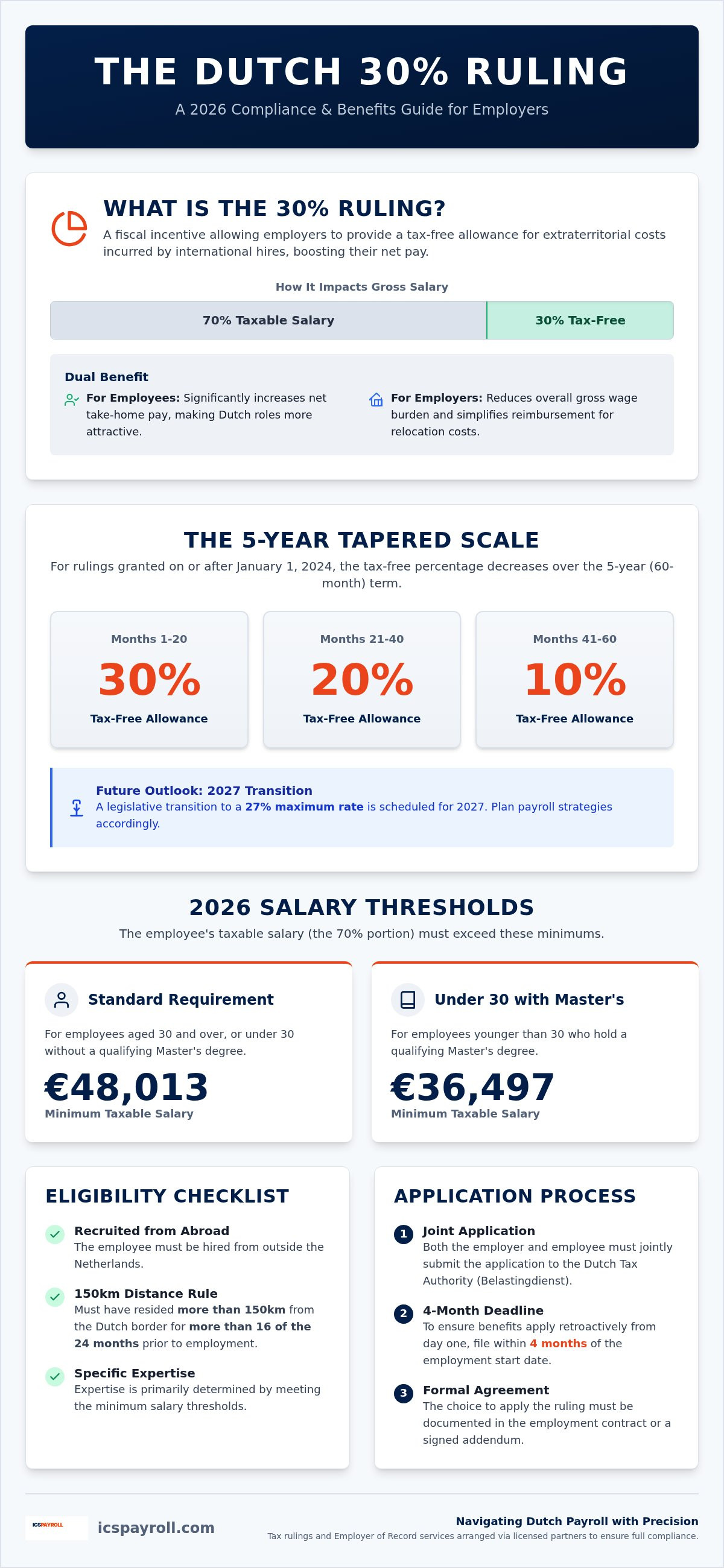
The 30 percent ruling for employers is a specialized fiscal facility designed to attract high-level international talent by providing a tax-free reimbursement for extraterritorial costs. Within the 30% ruling in the Dutch tax system, this benefit allows an organization to pay out a specific portion of the gross salary as a tax-free allowance. This mechanism offers a dual benefit for both parties. It significantly increases the net take-home pay for the employee while simultaneously reducing the overall gross wage burden for the employer. This positioning is essential for staying competitive in the Dutch labor market.
As we move through 2026, the application of this ruling requires heightened administrative precision. While the name "30 percent ruling" remains the standard term, the legislative environment is shifting. For rulings granted on or after January 1, 2024, the tax-free percentage is now subject to a tapered scale over its five-year duration. This means the allowance drops from 30 percent to 20 percent and finally to 10 percent at specific intervals. Additionally, employers must prepare for the planned legislative transition to a 27 percent maximum rate scheduled for 2027. It's critical to understand that the ruling is not an automatic right but a choice between reimbursing actual expenses or applying a fixed percentage of the gross salary.
What Are Extraterritorial Costs?
Extraterritorial costs are expenses incurred specifically because an employee works outside their country of origin. The Belastingdienst identifies these as the extra financial burdens associated with relocating to and living in the Netherlands. Common examples include:
- Relocation expenses and initial travel to the Netherlands.
- Double housing costs during the transition period.
- Language courses for the employee and their immediate family members.
- Storage costs for household goods left in the country of origin.
Distinguishing between these specific costs and regular living expenses is vital for payroll compliance. While moving fees are eligible for tax-free reimbursement, standard costs like groceries or general leisure are not. Employers must maintain meticulous records to ensure all reimbursements fall within these legal categories to avoid future tax liabilities.
The Employer Choice: Actual Costs vs. Fixed Percentage
Organizations have two distinct paths for managing these reimbursements. They can choose to reimburse the actual costs based on submitted receipts or provide a fixed allowance based on a percentage of the gross salary. Most international employers prefer the fixed percentage model because it drastically simplifies payroll administration. Tracking individual receipts for a global workforce creates an administrative burden that often outweighs any potential tax savings. It's a faster, more predictable way to manage international payroll.
This choice isn't just an internal policy. It must be legally documented. The decision to apply the fixed allowance should be formalized in the employment contract or a signed addendum. Clear documentation protects the company during audits and ensures that the payroll factor remains compliant with current Dutch tax laws. Without this formal agreement, the employer risks losing the ability to apply the tax-free allowance correctly.
Eligibility and Salary Thresholds for 2026
Qualifying for the 30 percent ruling for employers requires meeting two fundamental pillars: recruitment from abroad and specific expertise. The "150km rule" is a non-negotiable geographic constraint. An employee must have resided more than 150 kilometers from the Dutch border for more than 16 out of the 24 months prior to their start date. This rule effectively excludes residents of Belgium and parts of Germany and France. The Dutch Tax Authority uses this distance to define "extraterritorial" recruitment. Additionally, the maximum duration for the ruling is five years; any prior periods of residence or work in the Netherlands will be deducted from this total term.
Standard 2026 Salary Requirements
Expertise is legally validated through salary levels. For 2026, the standard taxable salary threshold is EUR 48,013. It's vital to understand that this EUR 48,013 represents the 70 percent taxable portion of the employee's income. Consequently, the total gross salary must be high enough that, after deducting the tax-free allowance, the remaining taxable sum meets this benchmark. Employers must include the mandatory 8 percent holiday allowance in this calculation. However, the 30 percent reimbursement itself is excluded from the threshold check. For employees earning high incomes, a salary cap applies. According to official 2026 salary requirements, the tax-free allowance can only be applied to a maximum gross salary of EUR 262,000. Any income exceeding this amount is taxed at standard rates. If an employee works part-time, they must still meet the full annual threshold; the salary requirement isn't lowered pro-rata for reduced hours.
Exceptions for Master Graduates and Researchers
The Dutch government provides lower entry barriers for younger specialists and academic professionals. Employees under the age of 30 who hold a qualifying Master degree are subject to a reduced 2026 threshold of EUR 36,497. Once the employee turns 30, they must meet the standard EUR 48,013 threshold to continue benefiting from the ruling. Scientific researchers conducting work at designated research institutions or doctors in specialist training are exempt from salary thresholds entirely. This exemption also applies to PhD holders recruited from abroad for specific academic roles. Managing these various cohorts requires precise Dutch payroll administration arranged via licensed partners to ensure total compliance. Proper categorization of these employees from the first working day prevents costly administrative errors and ensures the stability of your international workforce.
The 30-27 Transition and Legislative Changes
The legislative landscape for the 30 percent ruling for employers is currently undergoing a structural transformation. While the flat 30 percent rate was previously the standard, recent amendments have introduced a phased reduction and stricter caps. For high-earning specialists, the "Balkenende Norm" or WNT cap is a critical compliance factor. In 2026, the tax-free allowance applies only to a maximum gross salary of EUR 262,000. Any income exceeding this threshold is subject to standard tax rates without the benefit of the allowance. This cap became effective on January 1, 2026, for all users, including those who received the ruling prior to 2023.
Existing transitional arrangements provide some stability for long-term residents. Employees who were already using the ruling before January 1, 2024, are generally permitted to retain the full 30 percent rate for their entire term. However, for all new applications submitted after that date, the benefit is subject to a tapered scale. This shift requires employers to monitor individual employment durations more closely than in previous years to ensure the correct percentages are applied at each 20-month interval. It's a complex process that demands precise administrative tracking to avoid payroll errors.
The Abolition of Partial Non-Resident Status
One of the most significant changes for international talent is the abolition of partial non-resident taxpayer status as of January 1, 2025. Previously, ruling holders could opt to be treated as non-residents for Box 2 and Box 3 taxes. This allowed them to avoid Dutch tax on worldwide savings and investments, paying only on Dutch-sourced assets. Employees starting in 2026 will now be treated as full residents for tax purposes from their first day. This change potentially increases their overall tax liability if they hold significant foreign assets or property. Employers should proactively communicate this during the recruitment phase to ensure candidates have a realistic understanding of their net financial position in the Netherlands.
Managing the 27 Percent Phase-Down
Organizations must now prepare for a second legislative adjustment. While the current tapered scale for new rulings starts at 30 percent, a planned reduction to a 27 percent maximum rate is scheduled. For rulings granted after 2024, the rate will drop to 27 percent starting January 1, 2027. This change affects the first 20 months of the ruling term for those hired in late 2025 or 2026. To manage this transition efficiently, we recommend using contract addendums that reference the "maximum statutory allowance" rather than a fixed percentage. This approach allows the payroll system to adjust automatically to future rate changes without requiring manual contract renegotiations for every international hire.
Administrative Requirements and Application Process
Securing the 30 percent ruling for employers is a collaborative process that requires a formal joint application from both the organization and the employee. This request must be submitted to the Dutch Tax Authority. Timing is the most critical factor in this procedure. To ensure the ruling applies retroactively from the first day of employment, the application must reach the Belastingdienst within four months of the start date. Applications submitted after this window only become effective on the first day of the month following the application month, resulting in a permanent loss of tax benefits for the initial period.
Compliance does not end with a successful application. Employers must adhere to a strict seven-year record-keeping requirement for all payroll-related documentation. This archive serves as the primary evidence during a tax audit. If an employee changes employers, the ruling can often be transferred, provided the "three-month rule" is respected. The individual must sign a new employment contract with the succeeding employer within three months of leaving the previous one. Any gap exceeding this duration terminates the ruling eligibility permanently. This transition must be handled with clinical precision to maintain the employee's net income stability.
Documentation and Evidence of Expertise
The burden of proof regarding an employee's specific expertise rests with the employer. You must compile a comprehensive file containing the individual's CV, relevant diplomas, and clear evidence of recruitment from abroad. To validate the 150km distance rule, official records such as old rental agreements, utility bills, or bank statements from the country of origin are necessary. It's also a legal requirement that the intent to apply for the ruling is explicitly stated in the employment contract or a signed addendum. Without this documented intent, the Belastingdienst may reject the tax-free allowance application. For expert assistance in managing these complex filings, you can utilize Dutch payroll administration services arranged via licensed partners.
Payroll Integration and Monthly Filings
Once granted, the ruling must be correctly integrated into the monthly "Loonaangifte" (wage tax filing). The tax-free allowance is reported under a specific code to distinguish it from taxable wages. This integration affects several secondary calculations. For instance, the tax-free portion is generally excluded from the pensionable salary and does not form part of the base for social security premiums such as AWf, Aof, and Zvw. When calculating the mandatory 8 percent holiday allowance, employers must ensure the total gross payment remains high enough to meet the 2026 threshold of EUR 48,013. Precision in these monthly filings is essential to prevent retroactive tax claims and ensure the long-term security of your international payroll operations.
Implementing the 30 Percent Ruling via EOR Partners
For many international businesses, the primary barrier to entry in the Netherlands is the legal requirement of a local entity. The Employer of Record (EOR) model provides a compliant alternative that bypasses this obstacle. It allows organizations to utilize the 30 percent ruling for employers without the lengthy delay of incorporating a Dutch BV or establishing a Permanent Establishment. ICSPayroll facilitates these specific tax applications through licensed partners, ensuring that foreign companies can attract high-level specialists immediately. This approach is significantly faster than traditional methods. While local entity setup often takes several months, an EOR arrangement is typically operational in just a few weeks.
We utilize a consolidated "payroll factor" pricing model to simplify your financial planning. This model integrates the costs of the initial 30 percent ruling for employers and the ongoing administrative maintenance into a single percentage of the gross wage. It provides total transparency for your budgeting process and removes the unpredictability often associated with third-party legal fees. By using this factor, you gain a clear view of your total cost of employment from the outset. This stability is essential for maintaining the competitive positioning and peace of mind required when entering the Dutch market.
Compliance Without a Local Entity
An EOR acts as the legal employer of your staff in the Netherlands. They handle all statutory duties, including tax withholdings and labor law adherence, while you maintain direct management of the employee's daily tasks. This arrangement includes IND sponsorship and 30 percent ruling applications, which are arranged via licensed partners to maintain total regulatory alignment. This structure effectively removes the administrative burden of local registration. For a deeper look at this model, see our Employer of Record Netherlands: The 2026 Guide to Compliant Hiring. It serves as a secure bridge for companies looking to hire talent without the overhead of a Dutch subsidiary.
Consolidated Payroll and Tax Management
Managing a global workforce involves juggling various Dutch employer premiums and complex tax rulings. Our service provides a single monthly invoice that covers all social security contributions, tax-free allowances, and holiday payments. This consolidation simplifies financial reporting and ensures that the mandatory 8 percent holiday allowance is calculated correctly alongside the tax-free portion. Additionally, the model includes outsourced sick-leave support and holiday management, which are critical for maintaining compliance with Dutch labor standards. You can find more details in our Dutch Payroll Administration: The 2026 Complete Reference Guide. This methodical approach ensures your business operates with the same level of speed and organization found in local Dutch firms.
Securing Your Competitive Advantage in the 2026 Dutch Market
Mastering the 30 percent ruling for employers is no longer just about offering a tax benefit; it's about navigating a rigorous compliance framework with clinical precision. Organizations must prioritize the standard EUR 48,013 salary threshold and prepare for the upcoming transition to a 27 percent rate to avoid financial penalties. The abolition of partial non-resident status further emphasizes the need for transparent communication with international hires to ensure long-term stability and trust.
Managing these complexities alone often leads to significant administrative burdens. By utilizing an Employer of Record model arranged via licensed partners, your operational setup is complete in weeks rather than months. You receive a consolidated monthly invoice with no surprises, while expert 30% ruling assistance is handled with total accuracy. This stabilizing force allows you to focus on your core business while we handle the technical precision required for Dutch payroll and tax compliance.
Hire in the Netherlands with confidence; get a tailored payroll quote within 24 hours
We look forward to providing the clear path your business needs for a successful and compliant entry into the Dutch market.
Frequently Asked Questions
What is the minimum salary for the 30 percent ruling in 2026?
The standard taxable salary threshold is EUR 48,013 for 2026. For employees under the age of 30 who hold a qualifying Master degree, the required threshold is EUR 36,497. These figures represent the taxable portion after the allowance is deducted. You must ensure the gross salary, including the 8 percent holiday allowance, is sufficient to meet these benchmarks. Detailed indexation figures are available on the official Dutch Tax Authority website.
Can an employee apply for the 30 percent ruling themselves?
No, an individual can't apply for the 30 percent ruling for employers independently. It's strictly a joint application that requires the formal consent and signature of the employer. The intent to apply must be documented in the employment contract or a signed addendum. This collaborative approach ensures the payroll administration is correctly configured to handle the tax-free reimbursement. Review the application requirements on the official tax website.
How does the 150km rule work for the Dutch tax ruling?
The 150km rule requires that an employee lived more than 150 kilometers from the Dutch border for at least 16 of the 24 months before their first day of work. This validates that the employee was truly recruited from abroad. According to the Belastingdienst residency criteria, previous stays in the Netherlands can reduce the total duration of the ruling, which is currently capped at five years.
What happens to the 30 percent ruling if the employee changes jobs?
If an employee changes jobs, the ruling remains valid only if they sign a new employment contract within three months. This is known as the three-month rule. A new joint application must be submitted by the succeeding employer to the Tax Authority. If this gap exceeds 90 days, eligibility is permanently lost. Managing these transitions through services arranged via licensed partners ensures administrative continuity. See the new employer conditions for details.
Is the 30 percent ruling applicable to remote workers living in the Netherlands?
The ruling is applicable to remote workers provided they're residents of the Netherlands for tax purposes and meet all standard eligibility criteria. The employee must be recruited from abroad and their taxable salary must meet the 2026 thresholds. Working from a home office within Dutch borders doesn't disqualify an individual, but the employer must still perform all mandatory filings. Check the general conditions for remote eligibility.
How long does the 30 percent ruling application process take in 2026?
The application process typically takes between eight and ten weeks for the Dutch Tax Authority to issue a formal decision. However, you can apply the ruling retroactively from the first day of employment if the joint application is submitted within four months of the start date. If you miss this deadline, the benefit only starts from the month following the application. Precision in timing is essential to avoid losing several months of tax advantages.
Does the 30 percent ruling affect pension contributions in the Netherlands?
Yes, applying the ruling generally reduces the employee's pensionable salary. Since the tax-free allowance isn't considered taxable income, most Dutch pension funds exclude this portion from the contribution base. This results in lower monthly premiums for both parties, but the employee builds up less pension capital. Review the consequences of the ruling to understand the long term financial impact on your staff.
What are the risks for an employer if the 30 percent ruling is denied?
If the ruling is denied, the employer is liable for all unpaid wage taxes and social security premiums previously treated as tax-free. This leads to significant retroactive claims and potential administrative fines from the Dutch Tax Authority. The employee may also demand a salary increase to maintain their net income. We recommend using professional support arranged via licensed partners to verify eligibility before implementing the 30 percent ruling for employers.

Article by
Joost Hubregtse
Joost Hubregtse is Director of ICS Staffing & Payroll B.V., the wholly owned subsidiary of Intercompany Solutions behind ICS Payroll. He is responsible for Employer of Record and Dutch payroll services: employment contracts, wage tax and social security filings, holiday allowance, pension, sick leave and CAO compliance, with onboarding possible within 48 hours.
Frequently Asked Questions
Extraterritorial costs are expenses incurred specifically because an employee works outside their country of origin. The Belastingdienst identifies these as the extra financial burdens associated with relocating to and living in the Netherlands. Common examples include: Distinguishing between these specific costs and regular living expenses is vital for payroll compliance. While moving fees are eligible for tax-free reimbursement, standard costs like groceries or general leisure are not. Employers must maintain meticulous records to ensure all reimbursements fall within these legal categories to avoid future tax liabilities.
The standard taxable salary threshold is EUR 48,013 for 2026. For employees under the age of 30 who hold a qualifying Master degree, the required threshold is EUR 36,497. These figures represent the taxable portion after the allowance is deducted. You must ensure the gross salary, including the 8 percent holiday allowance, is sufficient to meet these benchmarks. Detailed indexation figures are available on the official Dutch Tax Authority website.
No, an individual can't apply for the 30 percent ruling for employers independently. It's strictly a joint application that requires the formal consent and signature of the employer. The intent to apply must be documented in the employment contract or a signed addendum. This collaborative approach ensures the payroll administration is correctly configured to handle the tax-free reimbursement. Review the application requirements on the official tax website.
The 150km rule requires that an employee lived more than 150 kilometers from the Dutch border for at least 16 of the 24 months before their first day of work. This validates that the employee was truly recruited from abroad. According to the Belastingdienst residency criteria, previous stays in the Netherlands can reduce the total duration of the ruling, which is currently capped at five years.
If an employee changes jobs, the ruling remains valid only if they sign a new employment contract within three months. This is known as the three-month rule. A new joint application must be submitted by the succeeding employer to the Tax Authority. If this gap exceeds 90 days, eligibility is permanently lost. Managing these transitions through services arranged via licensed partners ensures administrative continuity. See the new employer conditions for details.
The ruling is applicable to remote workers provided they're residents of the Netherlands for tax purposes and meet all standard eligibility criteria. The employee must be recruited from abroad and their taxable salary must meet the 2026 thresholds. Working from a home office within Dutch borders doesn't disqualify an individual, but the employer must still perform all mandatory filings. Check the general conditions for remote eligibility.
The application process typically takes between eight and ten weeks for the Dutch Tax Authority to issue a formal decision. However, you can apply the ruling retroactively from the first day of employment if the joint application is submitted within four months of the start date. If you miss this deadline, the benefit only starts from the month following the application. Precision in timing is essential to avoid losing several months of tax advantages.
Yes, applying the ruling generally reduces the employee's pensionable salary. Since the tax-free allowance isn't considered taxable income, most Dutch pension funds exclude this portion from the contribution base. This results in lower monthly premiums for both parties, but the employee builds up less pension capital. Review the consequences of the ruling to understand the long term financial impact on your staff.
If the ruling is denied, the employer is liable for all unpaid wage taxes and social security premiums previously treated as tax-free. This leads to significant retroactive claims and potential administrative fines from the Dutch Tax Authority. The employee may also demand a salary increase to maintain their net income. We recommend using professional support arranged via licensed partners to verify eligibility before implementing the 30 percent ruling for employers.