
Probation Period Netherlands Rules: The 2026 Employer Compliance Guide
By Joost Hubregtse, Director, ICS Staffing & Payroll
All blog posts are reviewed and fact checked by our labour law lawyer Zishan Hussain and our director. Editorial standards
In the Dutch legal system, a probation period is not a flexible trial run but a rigid compliance instrument where a single administrative error renders the entire clause void. Employers often assume they have broad discretion during the initial weeks of an engagement, yet the reality is dictated by strict statutory boundaries. Mastering the probation period netherlands rules is essential for any organization looking to scale its workforce in 2026 while maintaining total regulatory alignment.
You recognize that identifying the right technical fit is essential for your organization’s stability, but the technicalities of Dutch labor law often introduce friction into the onboarding process. This guide provides the professional clarity you need to ensure every contract is legally sound and fully compliant with 2026 standards. We will detail the specific statutory limits for various contract lengths, explain the mandatory written requirements to avoid void clauses, and outline the precise protocols for risk-free termination during the trial run. By following this compliance roadmap, you can secure your local operations and eliminate the administrative anxiety associated with international hiring.
Key Takeaways
- Understand the strict statutory limits for trial periods, including the prohibition of probation clauses in employment contracts lasting six months or less.
- Master the probation period netherlands rules to ensure clauses are agreed upon in writing and do not exceed the one or two month maximum limits.
- Recognize that the 2026 transition allowance, capped at EUR 102,000, begins accruing from the first day of employment despite immediate termination rights during probation.
- Identify why consecutive contracts for the same role cannot include a new trial period unless duties change significantly.
- Learn how leveraging a licensed partner for EOR services ensures compliant contract lifecycle management and facilitates expedited HSM visa processing within three weeks.
Understanding the Legal Framework for Dutch Probation Periods
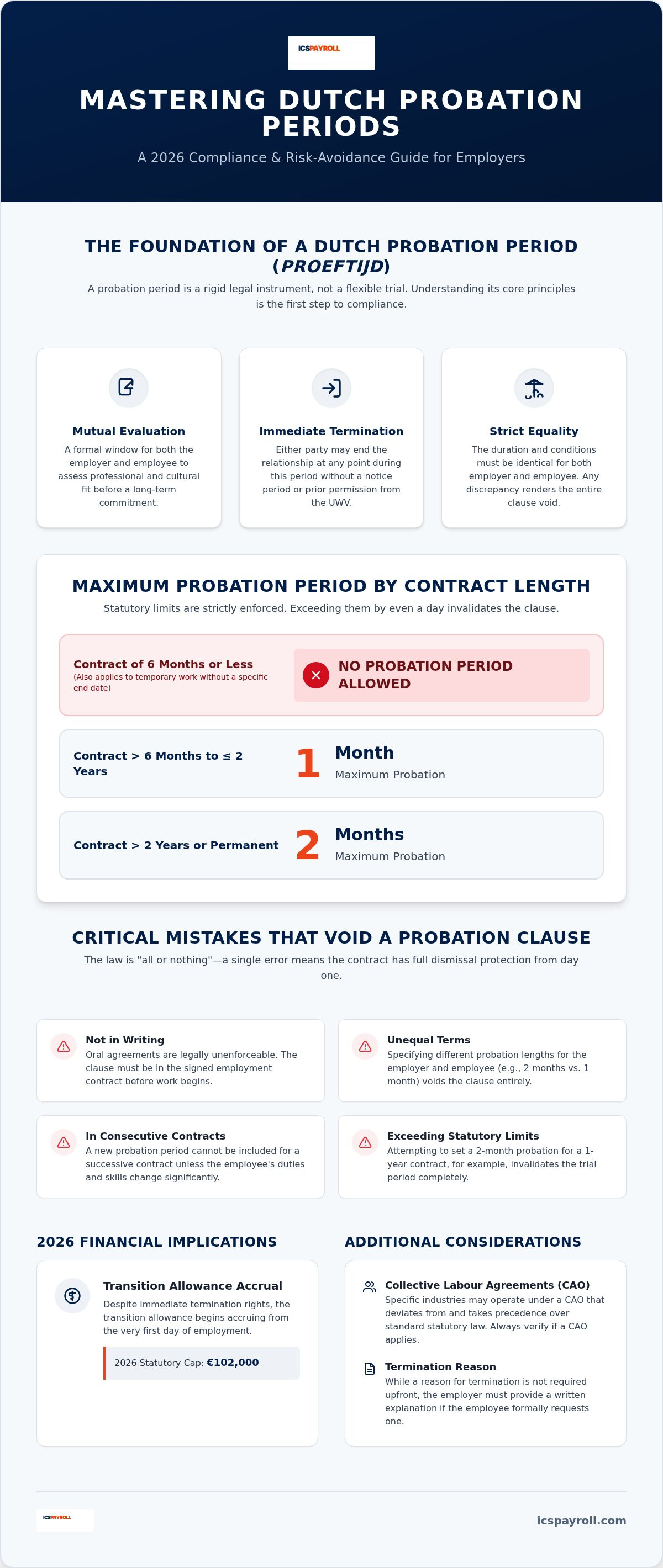
A probation period, known locally as a proeftijd, serves as the formal introductory phase of a Dutch employment contract. It acts as a mutual evaluation window, allowing both parties to assess professional compatibility and cultural fit before a long-term commitment solidifies. Under the standard probation period netherlands rules, the primary benefit of a valid trial run is the right to immediate termination. Either the employer or the employee may end the relationship at any point during this window without providing a notice period or seeking prior permission from the Employee Insurance Agency (UWV).
Equality is a fundamental requirement for the validity of this clause. The duration and conditions of the probation must be identical for both the employer and the employee. If a contract specifies a two month period for the employer but only one month for the employee, the entire clause is considered legally void from the outset. This "all or nothing" legal standard means that even a minor technical discrepancy can result in the employer accidentally creating a contract with full dismissal protection. While the employer is not required to provide a reason for termination during this phase, they must provide a written explanation if the employee formally requests one.
The Requirement for a Written Agreement
Legal precision in documentation is the only way to secure a valid trial period. Oral agreements regarding a probation period have no legal standing in the Netherlands and cannot be enforced. For the clause to hold up in court, it must be recorded in writing and signed by both parties before the employment officially commences. This is typically achieved through a clear clause within the primary employment contract. To mitigate the risk of creating a void agreement, ICSPayroll provides standardized handbooks and contract templates that ensure every clause is drafted to meet the rigorous 2026 compliance standards required for international entities.
Collective Labour Agreement (CAO) Exceptions
While the Dutch Civil Code provides the general framework, specific sectors often operate under their own unique mandates. These are established through a Collective Labour Agreement (CAO), which can deviate from standard statutory limits. Before finalizing any hire, it's essential to verify if your specific industry falls under a mandatory CAO. You can verify sector-specific rules and current legislative updates through the official government portal at overheid.nl to confirm if special durations apply. If a CAO is active, its specific regulations regarding probation take precedence over general labor law, making industry-level research a critical step in the hiring process.
Statutory Duration Limits and 2026 Contract Requirements
The Dutch legal system applies an "iron ring" of protection around employees, meaning the duration of a trial run is non-negotiable. Dutch courts strictly enforce these limits with zero tolerance for administrative oversight or mutual deviation. According to the Global Employment and Labor Guide, failure to align the trial period with the specific contract duration leads to the immediate nullification of the clause. Understanding the probation period netherlands rules requires a precise match between the intended length of the contract and the statutory maximum allowed for that specific tier.
Statutory limits are categorized into three primary tiers based on the duration of the employment agreement. For contracts of six months or less, no probation period is legally permitted. Any attempt to include one, even for a single day, is void. Contracts longer than six months but less than two years are capped at a maximum of one month. Permanent employment agreements allow for the longest trial run, which is strictly limited to two months. If you exceed these limits by even 24 hours, the law treats the contract as though no probation period ever existed.
Fixed-Term vs. Permanent Contract Rules
Precision is required when drafting fixed-term agreements that approach the two-year mark. If a contract is set for a duration of exactly two years, the maximum trial period remains restricted to one month. However, if the contract duration exceeds two years, the employer may legally implement a two-month trial period. For temporary contracts that don't specify a fixed end date, such as those tied to the completion of a specific project, the limit is strictly capped at one month. It's essential to define these dates clearly to avoid accidentally granting full dismissal protection prematurely.
The Prohibition on Extensions
Employers often mistakenly believe they can extend a trial run if both parties agree to more time for evaluation. This is strictly illegal under Dutch law. Even with the employee's explicit written consent, any extension beyond the statutory maximum renders the entire probation clause void. This leaves the employer with a contract that offers no trial run at all. The 2026 enforcement of Wet DBA mandates that all employment contracts, regardless of duration, must strictly align with statutory classification rules to prevent the legal and financial repercussions of disguised self-employment.
Ensuring your contracts meet these rigorous standards is vital for maintaining a compliant workforce. You can simplify this process by using Dutch payroll administration services to manage your contractual requirements through expert licensed partners.
When a Probation Period is Legally Void: Avoiding Compliance Risks
A probation period that fails to adhere to strict statutory requirements is legally considered non-existent. This means the employee receives full dismissal protection from their first hour on the job. Understanding the probation period netherlands rules is essential to prevent these high-stakes compliance errors. A clause is void if it exceeds the maximum duration for the contract type, if it isn't recorded in writing, or if it violates the rules regarding successive employment. Any deviation from the law results in the immediate nullification of the trial run, leaving the employer with a permanent or fixed-term contract that cannot be terminated without cause. For a deeper look at broader regulatory requirements, consult our Employment Law Netherlands 2026 Guide.
Legal validity is an all-or-nothing standard in the Netherlands. You cannot "fix" a void clause after the contract has started. If the initial agreement is flawed, the employer loses the right to immediate termination entirely. This often occurs when businesses use generic international templates that don't account for specific Dutch mandates. Ensuring your contracts are drafted by local experts is the only way to guarantee that your evaluation window is enforceable and your organization is protected from wrongful dismissal claims.
The Successive Employer Trap
A significant compliance risk arises when an employer transitions a worker from an external relationship to a direct payroll contract. If the employee continues to perform essentially the same tasks, the law prohibits a new probation period. This rule applies even if the employee previously worked via a recruitment agency or as a freelancer. The legal perspective is that the employer already evaluated the worker's capabilities. Inserting a trial period in this scenario leads to immediate nullification of the clause. ICSPayroll audits every worker's history to prevent these errors, ensuring your onboarding process remains secure.
Contracts of 6 Months or Less
Dutch law is absolute regarding short-term agreements. Any trial period included in a contract with a duration of exactly six months or less is legally non-existent. Employers cannot bypass this restriction through mutual agreement or supplemental handbooks. Applying the probation period netherlands rules correctly means recognizing that a six-month contract offers zero evaluation time. For official trial period restrictions, refer to the guidelines at business.gov.nl. If evaluation is necessary, the contract must be at least six months and one day long to allow for a one-month trial run.
Termination Rights and the 2026 Transition Allowance Rules
One of the most significant features of the probation period netherlands rules is the flexibility it provides for both parties to terminate the employment relationship immediately. During a valid trial run, neither the employer nor the employee is required to observe a notice period. This allows for a swift exit if the professional relationship does not meet expectations. However, this flexibility does not grant employers the right to dismiss workers on discriminatory grounds. Terminations based on pregnancy, chronic illness, or other protected characteristics remain illegal and can lead to severe legal penalties.
For detailed information on managing final settlements and social security contributions during an exit, refer to our Dutch Payroll Administration Guide.
Statutory Transition Payments in 2026
A common misconception is that dismissals during a trial run exempt the employer from paying a transition allowance (transitievergoeding). Under current Dutch law, the right to this payment begins on the very first day of employment. The allowance is calculated based on the employee’s gross salary and the exact duration of their service. For 2026, the statutory maximum transition allowance is capped at EUR 102,000. If an employee's annual salary exceeds this amount, the cap is set at one gross annual salary. Even if a contract is terminated within the first month, the employer must process a pro-rated transition payment as part of the final settlement.
Administrative Requirements for Dismissal
While you don't need to provide a reason for termination upfront, transparency is a legal requirement if the employee asks for it under the standard probation period netherlands rules. If an individual formally requests the grounds for their dismissal, the employer must provide a written explanation. This document should be drafted carefully to ensure it doesn't inadvertently suggest discriminatory motives. Employers must also ensure that the final payroll reflects the correct termination date for wage tax purposes. Precise reporting to the authorities is mandatory, and you should consult the latest filing requirements at the Dutch Tax and Customs Administration to ensure your filings are accurate.
Managing these administrative burdens requires a partner who understands the intersection of labor law and financial reporting. You can secure your hiring process by utilizing compliant Dutch payroll administration services provided through our expert licensed partners.
Navigating Dutch Probation with a Local Employer of Record
Managing the probation period netherlands rules requires constant vigilance over evolving statutory benchmarks. For international firms, an Employer of Record (EOR) serves as the essential bridge to local compliance. ICSPayroll manages the entire contract lifecycle to ensure that trial period clauses are not only correctly drafted but also effectively executed. This administrative oversight removes the burden of tracking specific 2026 deadlines. It prevents the accidental creation of void contracts that grant premature dismissal protection to new hires.
Compliance for Highly Skilled Migrants
Hiring non-Schengen talent introduces additional layers of regulatory complexity. For 2026, the standard salary threshold for the 30% ruling is set at EUR 48,013. Maintaining this threshold is mandatory for both tax benefits and residency status. Because an employee's right to remain in the country is often tied to their employment, a successful trial run is critical for maintaining HSM residency status. We facilitate this process by arranging visa services via licensed partners, ensuring full security for your international staff. Expedited HSM visa applications are typically granted within approximately three weeks, allowing you to start operations without the usual bureaucratic delays. For a deeper analysis of tax optimization for these hires, consult our 30% Ruling Employer Guide.
The Payroll Factor Advantage
Financial predictability is a cornerstone of successful Dutch operations. Our consolidated monthly invoice streamlines your overhead by including all mandatory contributions, such as the 15.2% pension premium and the statutory 8% holiday allowance. This "payroll factor" approach also provides a protective shield against the financial risks of long-term illness. We cover sickness risk for up to two years, ensuring that an employee's health status doesn't become a sudden administrative or financial liability for your business.
Our system automatically manages the accrual and processing of the transition allowance, which is capped at EUR 102,000 for 2026. By using our expert-vetted contract templates, you can hire in the Netherlands with absolute confidence that every clause aligns with the current probation period netherlands rules. This integrated model allows you to focus on talent performance while we maintain the integrity of your local legal presence through our licensed partners.
Securing Your 2026 Hiring Strategy
Navigating the Dutch labor market requires a rigorous commitment to legal precision. The validity of a trial run rests on strict adherence to the one month versus two month statutory limits and the non-negotiable requirement for a written agreement. Any deviation from these standards renders the clause void, granting immediate dismissal protection to the employee. It's also vital to remember that under the probation period netherlands rules, the transition allowance begins accruing on the first day of work, even if termination occurs during the trial window.
Establishing a compliant presence in the Netherlands doesn't have to be an administrative burden. Our licensed partners provide the infrastructure you need to scale quickly and safely. You benefit from a single monthly invoice with no surprise charges, service agreements ready within days, and expert sick leave support to manage reintegration guidance effectively. We handle the technicalities of the 2026 salary thresholds and contract lifecycle management so you can focus on growth.
Hire in the Netherlands with confidence: Get a tailored EOR quote within 24 hours
Your international expansion is within reach. With the right local expertise, you can build a stable and compliant workforce that drives your business forward in 2026.
Frequently Asked Questions
Can I extend a probation period if the employee is performing poorly?
No. It's illegal to extend a probation period beyond the statutory maximum, even if both parties provide written consent. Any attempt to prolong the evaluation window renders the entire clause void. This means the employee would immediately gain full dismissal protection. Employers must make a definitive decision based on the performance observed within the original timeframe to avoid creating a permanent liability accidentally.
Is a probation period mandatory in a Dutch employment contract?
No, a trial run is a voluntary clause that must be explicitly agreed upon in writing. While most organizations include one for security, a contract is legally valid without it. If you omit the clause, the employee receives full protection from their first hour of work. It's also important to remember that for contracts of six months or less, including a trial period is strictly prohibited by law.
What is the maximum probation period for a 1-year fixed-term contract?
The maximum duration is exactly one month. Under the probation period netherlands rules, fixed-term contracts longer than six months but shorter than two years are strictly limited to this 30 day window. If you accidentally specify a two month period in a one year contract, the entire clause becomes void. This leave the employer with zero trial period rights and no option for immediate termination.
Does the 30% ruling affect the rules of a trial period?
No, the 30% ruling does not alter the duration limits set by labor law. However, the 2026 salary threshold of EUR 48,013 must be maintained throughout the trial run to preserve tax eligibility. If an employee is dismissed during probation, their tax advantage and residency status may be impacted immediately. ICSPayroll manages these applications via licensed partners to ensure total compliance during the initial onboarding phase.
Do I have to pay a transition allowance if I dismiss someone during probation?
Yes, the transition allowance applies from the first day of employment. Even if you terminate the contract after only one week, you must pay a pro-rated amount based on the employee's gross salary. For 2026, the statutory cap for this allowance is EUR 102,000. Our consolidated monthly invoice model automatically accounts for these pro-rated costs, ensuring your final settlement is accurate and compliant with Dutch tax standards.
Can an employee quit immediately during their probation period?
Yes, the right to immediate termination is mutual and applies to both parties. An employee can resign without a notice period and without providing a specific reason during a valid trial run. This flexibility is a core component of the probation period netherlands rules. It allows both the worker and the employer to exit the arrangement swiftly if the professional fit or cultural alignment isn't optimal.
What happens if a probation period clause is found to be void?
The employee receives full dismissal protection immediately. If a clause is void because it exceeded statutory limits or was never recorded in writing, the employer cannot terminate the contract without a valid legal ground or permission from the UWV. This often leads to expensive legal disputes or significant severance requirements. We provide expert-vetted handbooks and contracts to ensure your trial periods remain legally enforceable and secure.
Are the rules different for remote workers hired via an EOR?
No, the statutory requirements remain identical for remote staff. All employees working for a Dutch entity or through an EOR must follow the same duration limits and written requirements. Using an EOR ensures that remote contracts are fully localized and compliant with 2026 standards. This includes managing the 15.2% pension contribution and the 8% holiday allowance through a single transparent invoice that covers all employer obligations.

Article by
Joost Hubregtse
Joost Hubregtse is Director of ICS Staffing & Payroll B.V., the wholly owned subsidiary of Intercompany Solutions behind ICS Payroll. He is responsible for Employer of Record and Dutch payroll services: employment contracts, wage tax and social security filings, holiday allowance, pension, sick leave and CAO compliance, with onboarding possible within 48 hours.
Frequently Asked Questions
No. It's illegal to extend a probation period beyond the statutory maximum, even if both parties provide written consent. Any attempt to prolong the evaluation window renders the entire clause void. This means the employee would immediately gain full dismissal protection. Employers must make a definitive decision based on the performance observed within the original timeframe to avoid creating a permanent liability accidentally.
No, a trial run is a voluntary clause that must be explicitly agreed upon in writing. While most organizations include one for security, a contract is legally valid without it. If you omit the clause, the employee receives full protection from their first hour of work. It's also important to remember that for contracts of six months or less, including a trial period is strictly prohibited by law.
The maximum duration is exactly one month. Under the probation period netherlands rules, fixed-term contracts longer than six months but shorter than two years are strictly limited to this 30 day window. If you accidentally specify a two month period in a one year contract, the entire clause becomes void. This leave the employer with zero trial period rights and no option for immediate termination.
No, the 30% ruling does not alter the duration limits set by labor law. However, the 2026 salary threshold of EUR 48,013 must be maintained throughout the trial run to preserve tax eligibility. If an employee is dismissed during probation, their tax advantage and residency status may be impacted immediately. ICSPayroll manages these applications via licensed partners to ensure total compliance during the initial onboarding phase.
Yes, the transition allowance applies from the first day of employment. Even if you terminate the contract after only one week, you must pay a pro-rated amount based on the employee's gross salary. For 2026, the statutory cap for this allowance is EUR 102,000. Our consolidated monthly invoice model automatically accounts for these pro-rated costs, ensuring your final settlement is accurate and compliant with Dutch tax standards.
Yes, the right to immediate termination is mutual and applies to both parties. An employee can resign without a notice period and without providing a specific reason during a valid trial run. This flexibility is a core component of the probation period netherlands rules. It allows both the worker and the employer to exit the arrangement swiftly if the professional fit or cultural alignment isn't optimal.
The employee receives full dismissal protection immediately. If a clause is void because it exceeded statutory limits or was never recorded in writing, the employer cannot terminate the contract without a valid legal ground or permission from the UWV. This often leads to expensive legal disputes or significant severance requirements. We provide expert-vetted handbooks and contracts to ensure your trial periods remain legally enforceable and secure.
No, the statutory requirements remain identical for remote staff. All employees working for a Dutch entity or through an EOR must follow the same duration limits and written requirements. Using an EOR ensures that remote contracts are fully localized and compliant with 2026 standards. This includes managing the 15.2% pension contribution and the 8% holiday allowance through a single transparent invoice that covers all employer obligations.