
Netherlands Employment Cost Calculator: The 2026 Employer Guide
By Joost Hubregtse, Director, ICS Staffing & Payroll
All blog posts are reviewed and fact checked by our labour law lawyer Zishan Hussain and our director. Editorial standards
A gross salary in the Netherlands is merely the starting point of your financial commitment. The true cost of employment often sits 20 percent higher once statutory obligations are factored in. For international businesses, the gap between a competitive offer and the total budget can be a source of significant financial risk. If you are struggling to quantify these variables, a reliable Netherlands employment cost calculator is essential to avoid unforeseen liabilities with the Belastingdienst.
We understand that navigating the intersection of Dutch labor law and tax regulations feels like a moving target. You need certainty that your 2026 budget accounts for the latest statutory premiums and the evolving 30 percent ruling thresholds. This guide provides that clarity. We will break down the exact costs of hiring in the Netherlands, from the 8 percent holiday allowance to the specific AWf and Aof contributions required for the coming year.
By the end of this article, you'll have a clear payroll factor to apply to any gross salary. We provide a detailed analysis of the 2026 salary thresholds, such as the EUR 48,013 requirement for the 30 percent ruling, and explain how to maintain full compliance while streamlining your international expansion.
Key Takeaways
- Identify the core components of Dutch labor costs, including the mandatory 8 percent holiday allowance and employer social security premiums.
- Master the 2026 updates to the 30 percent ruling, such as the EUR 48,013 salary threshold and the transition to a 27 percent allowance rate.
- Use a Netherlands employment cost calculator to accurately forecast your total budget and ensure compliance with Belastingdienst regulations.
- Compare the operational speed of hiring via an Employer of Record versus the complexity of establishing a local Dutch BV.
- Simplify your financial planning by applying a single payroll factor to consolidate all employer obligations into one transparent monthly invoice.
Understanding the Components of Netherlands Employment Costs in 2026
Budgeting for a Dutch workforce requires a shift from simple salary negotiations to a comprehensive understanding of the total employer burden. The gross salary is only the foundation. To forecast accurately, you must account for statutory premiums, mandatory benefits, and industry specific contributions. Using a reliable Netherlands employment cost calculator ensures that your financial planning aligns with the actual costs processed through the Dutch tax and social security system. Failure to account for these variables often leads to a 20 to 30 percent discrepancy between projected and actual payroll expenses.
Gross Salary vs. Total Employer Burden
Gross salary represents the amount agreed upon with the employee before any deductions. However, for an international business, the "loaded" salary is the critical metric. This figure includes the gross pay plus all additional employer costs. For 2026, the statutory minimum hourly wage is set at EUR 14.71 as of January 1, increasing to EUR 14.99 on July 1. These benchmarks are non negotiable and form the basis for all payroll calculations. Understanding this distinction prevents budget overruns when expanding into the Dutch market. It's essential to recognize that the employer's cost is always significantly higher than the employee's gross income.
Mandatory Benefits Under Dutch Labor Law
Dutch labor law mandates specific benefits that must be included in your budget. The most prominent is the 8 percent holiday allowance. Employers typically pay this as a lump sum in May, though it accrues monthly. Additionally, the ICSPayroll model standardizes pension contributions at 15.2 percent of the gross salary. This ensures a high level of social security for the employee while maintaining administrative simplicity for the employer. These figures are foundational to any accurate Netherlands employment cost calculator. They represent fixed obligations that do not fluctuate regardless of the employee's specific tax ruling status.
Compliance also involves accounting for the transition payment, known as the transitievergoeding. This payment is due upon the termination of an employment contract. For 2026, the statutory cap for this payment is EUR 102,000, or one annual salary if the employee earns more than this amount. Employers must also manage contributions for the Unemployment Fund (AWf), the Disability Fund (Aof), and the Healthcare Insurance Act (Zvw). The AWf rate varies significantly based on contract stability. Permanent contracts use a low rate of 2.74 percent, while temporary or flexible contracts require a high rate of 7.74 percent. Accurate budgeting requires categorizing every employee correctly to apply the appropriate statutory percentage.
Statutory Employer Contributions and Mandatory Insurance Premiums
Beyond the gross salary and holiday allowance, employers must navigate a complex layer of mandatory insurance premiums known as Werknemersverzekeringen. These contributions are not optional. They provide the social safety net for employees in the event of unemployment, disability, or illness. Accurate budgeting requires a precise Netherlands employment cost calculator to account for the specific percentages that apply to your workforce based on contract type and company size. These premiums are calculated on the employee's gross wage up to a maximum income cap of EUR 79,409 for 2026.
The Unemployment Fund (AWf) is a primary component of these costs. The Dutch government uses a differentiated rate system to encourage permanent employment. For employees on a permanent, fixed-hours contract, the low AWf rate is 2.74 percent. If the employee is on a temporary or flexible contract, the high rate of 7.74 percent applies. This 5 percent difference can significantly impact the total cost of hiring, making contract structure a vital consideration for your financial forecasting.
Employers are also responsible for the following monthly premiums:
- Aof (Disability Fund): Small employers pay a lower rate of 6.27 percent, while medium and large employers are subject to a rate of 7.63 percent.
- Zvw (Healthcare Insurance Act): This is a fixed employer contribution of 6.10 percent of the gross wage, which covers the employee's access to the national healthcare system.
- Whk (Werkhervattingskas): This rate varies per employer and is based on the historical disability risk within the company or industry sector.
Social Security (Volksverzekeringen) Breakdown
While employee insurance premiums are strictly employer-paid, national social security contributions (Volksverzekeringen) are typically withheld from the employee's taxable income. These include AOW (state pension) at 17.9 percent, Anw (survivor benefits) at 0.1 percent, and Wlz (long-term care) at 9.65 percent. These are levied on income up to a maximum of EUR 38,883. Employers must ensure these are correctly reported through the monthly Loonaangifte filings to the tax authorities. You can verify the latest official social security rates to maintain total compliance with the Belastingdienst.
Sickness Risk and Reintegration Costs
The Netherlands has some of the most robust employee protections regarding illness. Employers are legally liable for up to 2 years of sick pay, generally at a minimum of 70 percent of the salary. During this period, you must follow strict reintegration protocols mandated by the Wet Verbetering Poortwachter. This includes hiring a certified Arbodienst (occupational health service) to provide mandatory guidance and reporting. These administrative and financial risks are substantial for small or international firms. Within the ICSPayroll model, we manage these sickness risks and reintegration requirements through our consolidated payroll factor, providing you with a predictable, all-inclusive cost structure that removes the fear of long-term disability liabilities.
Calculating the Impact of the 30% Tax Ruling for International Hires
The 30 percent ruling is the most significant tax incentive for attracting international talent to the Netherlands. It allows employers to provide a tax-free allowance for extraterritorial costs, such as relocation and double housing expenses. For a recruiter or financial officer, integrating this into a Netherlands employment cost calculator is essential for presenting an accurate net salary to a candidate. However, the legislation is no longer a static 30 percent benefit. Recent reforms have introduced a staggered reduction. For many newer rulings, a transition to a 27 percent maximum rate is now the standard for long-term forecasting.
Salary Thresholds for 2026 Compliance
To qualify, an employee must meet specific taxable salary benchmarks after the tax-free allowance is applied. For 2026, the standard salary threshold is EUR 48,013 per year. This figure is strictly enforced by the Belastingdienst. If the candidate is under 30 years old and holds a recognized Master's degree, a reduced threshold of EUR 36,497 applies. The tax-free allowance can only be applied to a maximum gross salary of EUR 262,000. These benchmarks are non negotiable. You can review the full IND requirements for highly skilled migrants to see how these align with visa sponsorship criteria.
The Abolition of Partial Non-Resident Status
One of the most drastic changes for 2026 involves the complete abolition of partial non-resident taxpayer status for new applicants. Previously, expats could opt to be treated as non residents for Box 2 and Box 3 tax purposes, shielding their worldwide savings and investments from Dutch taxation. As of January 1, 2025, this option was removed for new rulings. While a transitional rule allows those who held the status before 2024 to retain it until the end of 2026, all new hires must now report their global assets. This change significantly impacts the appeal of a Dutch offer for high net worth individuals.
ICSPayroll acts as a bridge through this complexity. We manage the entire 30 percent ruling application process through our licensed partners, ensuring that both the employer and employee receive the maximum legal benefit. Our Netherlands employment cost calculator models these specific tax variables to give you a clear "payroll factor" that accounts for the 2026 thresholds. By automating compliance checks, we help you avoid the risk of retroactive tax claims if a salary accidentally falls below the required benchmark during the year.
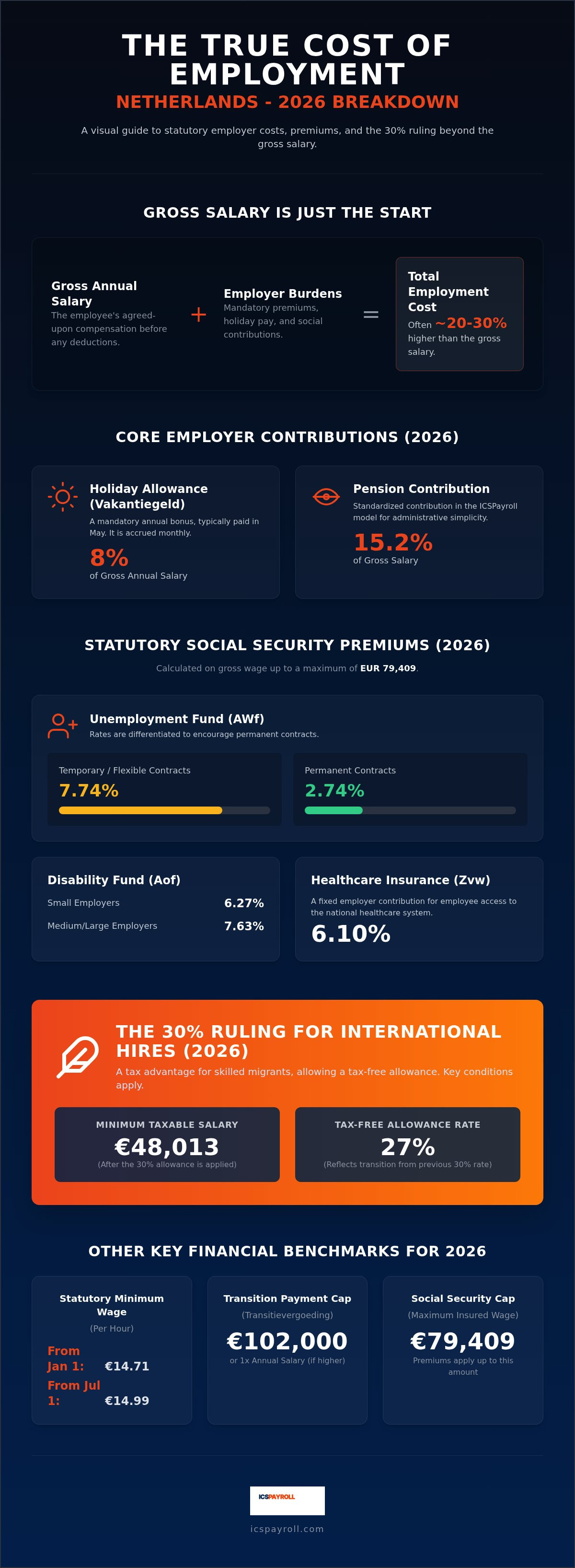
The Total Cost of Employment: Direct Hiring vs. EOR Solutions
Hiring in the Netherlands requires a strategic choice between establishing a local Dutch BV or utilizing an Employer of Record (EOR) service. A Dutch BV involves substantial upfront investment, including notary fees, legal advisory costs, and mandatory KvK registration rules. Beyond the initial setup, you must manage monthly Loonaangifte filings and maintain payroll records for the statutory seven year period. When using a Netherlands employment cost calculator, many international firms find that the administrative overhead of a direct entity often outweighs the benefits for smaller teams.
An EOR service provides a streamlined alternative. It allows you to hire without a local legal entity. The EOR acts as the legal employer, managing all compliance from drafting contracts that respect the Ketenregeling to managing the 30 percent ruling. This model consolidates your costs into one clear invoice. It eliminates the need for separate billing for social premiums, pensions, or insurance, providing total financial predictability for your Dutch operations.
Avoiding Permanent Establishment Risk
Hiring remote staff in the Netherlands without a local entity can inadvertently trigger a "Permanent Establishment" (PE). This status creates corporate tax liabilities for your foreign firm within the Dutch jurisdiction. Using an EOR effectively mitigates this risk. The EOR provider assumes the legal employer status, ensuring that your business remains compliant with local labor laws without the tax exposure of a direct presence. It's a protective measure for companies testing the market or maintaining a distributed workforce.
Speed to Market: Start in Weeks, Not Months
Speed is a primary advantage of the EOR model. While incorporating a BV can take months of legal and administrative preparation, an EOR setup allows for operational hiring within days of a signed agreement. If you are recruiting from outside the EU, Highly Skilled Migrant (HSM) visa processing is typically arranged in approximately 3 weeks via licensed partners. This rapid deployment is critical in a competitive labor market where top talent won't wait months for a visa.
Local expertise is also vital for navigating current legislation such as Wet DBA and the VBAR reforms. These laws strictly define the distinction between independent contractors and employees. Misclassification leads to retroactive social security claims and heavy fines from the Belastingdienst. By outsourcing these responsibilities, you gain peace of mind and legal security. Ready to streamline your Dutch expansion? Get a tailored Netherlands employment cost quotation within 24 hours.
Simplifying Dutch Payroll with ICSPayroll’s All-Inclusive Model
The complexity of Dutch labor law requires a shift from manual estimation to a consolidated financial model. While a standard Netherlands employment cost calculator provides a baseline, ICSPayroll eliminates the administrative burden of tracking individual premium fluctuations. Our "Payroll Factor" model transforms variable employment costs into a single, predictable monthly invoice. This approach ensures that you never encounter surprise billing for social premiums, insurance adjustments, or pension deficits. It provides the financial certainty necessary for long term international expansion.
What Is Included in the Payroll Factor?
The ICSPayroll Factor is a mathematical multiplier applied to the gross salary to cover all statutory and secondary obligations. It's designed for total transparency. By consolidating these items, we remove the need for you to manage multiple vendors or government portals. The factor includes:
- Mandatory Benefits: Includes the 8 percent holiday allowance and the standardized 15.2 percent pension contribution.
- Statutory Premiums: Covers all employer insurance contributions, including AWf, Aof, and Zvw.
- Risk Management: Incorporates the costs of sickness risk and the accrual of the transition allowance, capped at EUR 102,000 for 2026.
- Administrative Support: Includes the application for the 30 percent ruling and HSM visa sponsorship arranged via our licensed partners.
Every employee also gains access to a dedicated online portal. This interface allows them to view payslips, manage contracts, and track holiday balances in real time. We also provide a comprehensive employee handbook to ensure your staff understands their rights and obligations under Dutch law from day one. This human centric approach ensures that your team feels supported while your administrative team remains focused on core business operations.
Getting a Tailored Quotation Within 24 Hours
Standard calculators often fail to account for the specific nuances of your hire, such as age, education level for the 30 percent ruling, or contract stability. Our process is designed for speed and precision. Once you provide the basic salary details and candidate profile, we deliver a custom cost breakdown within one business day. This ensures your Netherlands employment cost calculator results are backed by actual operational data.
This quotation serves as your final budget. There are no hidden fees or separate line items for HR administration. Once you approve the figures, we can move from a quotation to a ready to sign employment contract in just a few days. This efficiency allows you to secure top talent and start operations in weeks, not months. Request your custom 2026 Netherlands employment cost quotation today to lock in your hiring budget with total compliance assurance.
Mastering Your Dutch Expansion Strategy for 2026
Navigating the complexities of Dutch labor law requires more than just a spreadsheet. You need a partner that understands the nuances of the 2026 statutory premiums and the evolving 30 percent ruling. By utilizing a reliable Netherlands employment cost calculator, you eliminate the risk of hidden liabilities and ensure your international budgeting remains accurate. Precise forecasting is the foundation of a sustainable and compliant presence in the Netherlands.
ICSPayroll simplifies this process by providing an operational setup in weeks rather than months. Our model uses a consolidated monthly invoice that covers all premiums, pensions, and sickness risks in one clear line item. We also provide expert assistance for 30 percent ruling applications through our licensed partners; this ensures your hires meet the EUR 48,013 threshold for 2026 compliance. This approach allows you to focus on growth while we secure your administrative and legal foundations.
Hire in the Netherlands with confidence: Get a tailored quote in 24 hours. We look forward to facilitating your success in the Dutch market.
Frequently Asked Questions
How much does it cost to employ someone in the Netherlands in 2026?
Total employment costs typically exceed the gross salary by 20 to 30 percent. This includes the mandatory 8 percent holiday allowance, a 15.2 percent pension contribution, and various social security premiums. For a precise breakdown, using a Netherlands employment cost calculator allows you to model these expenses against the 2026 statutory caps. Employers must also account for the maximum income for employee insurance, which is set at EUR 79,409 for the year.
What is the mandatory holiday allowance in the Netherlands?
The mandatory holiday allowance is 8 percent of the employee's gross annual salary. Most employers pay this as a lump sum in May, though it can be paid out monthly if specified in the contract. This benefit is a statutory requirement under Dutch labor law and must be calculated on the full gross wage. Failure to pay the allowance can result in significant legal penalties and retroactive claims from the Dutch Tax Administration.
Is a pension contribution required for Dutch employees?
While not every industry has a mandatory sector pension, providing a pension scheme is standard practice for competitive hiring. Within the ICSPayroll model, we include a pension contribution at 15.2 percent of the gross salary. This ensures your employees have a robust social safety net while simplifying your budgeting process. These contributions are part of the all inclusive payroll factor, which consolidates multiple social obligations into a single, transparent monthly invoice for your Dutch operations.
How does the 30% ruling affect employer costs?
The 30 percent ruling primarily reduces the employee's income tax burden, but it also impacts employer budgeting. To qualify in 2026, the employee must meet a taxable salary threshold of EUR 48,013. While the ruling makes the net offer more attractive, employer social security premiums like Zvw and AWf are still calculated on the full gross salary. A Netherlands employment cost calculator helps you visualize how these tax advantages influence the final "loaded" cost of employment.
Can I hire employees in the Netherlands without a local legal entity?
You can hire staff without a local entity by using an Employer of Record (EOR) service. The EOR acts as the legal employer of your Dutch staff, managing all payroll, tax filings, and compliance. This model avoids the need for Chamber of Commerce registration and mitigates the risk of creating a Permanent Establishment. ICSPayroll arranges these services via licensed partners, allowing you to hire and manage talent without the administrative burden of a Dutch BV.
What is the minimum wage in the Netherlands for 2026?
The statutory minimum wage in the Netherlands is now based on a fixed hourly rate. As of January 1, 2026, the minimum wage for adults aged 21 and over is EUR 14.71 per hour. This rate is scheduled to increase to EUR 14.99 per hour on July 1, 2026. Employers must ensure all staff, including those on flexible or zero hour contracts, receive these statutory minimum rates to remain compliant with Dutch labor regulations.
How quickly can I set up payroll for a new hire in the Netherlands?
You can establish payroll for a new hire in just a few weeks. If you are hiring an international candidate who requires a visa, Highly Skilled Migrant (HSM) processing is typically arranged in approximately 3 weeks via our licensed partners. This rapid timeline allows international firms to start operations quickly without the long lead times associated with company incorporation. Our streamlined onboarding process ensures all contracts and IND requirements are met before the employee's first day.
What are the employer social security rates in the Netherlands for 2026?
Employer social security rates include the Unemployment Fund (AWf) at 2.74 percent for permanent contracts and 7.74 percent for temporary ones. The Disability Fund (Aof) rate is 6.27 percent for small employers and 7.63 percent for larger entities. Additionally, the Healthcare Insurance Act (Zvw) contribution is fixed at 6.10 percent. These rates apply to income up to EUR 79,409. You can verify the latest figures on the Belastingdienst website to ensure accurate financial planning.

Article by
Joost Hubregtse
Joost Hubregtse is Director of ICS Staffing & Payroll B.V., the wholly owned subsidiary of Intercompany Solutions behind ICS Payroll. He is responsible for Employer of Record and Dutch payroll services: employment contracts, wage tax and social security filings, holiday allowance, pension, sick leave and CAO compliance, with onboarding possible within 48 hours.
Frequently Asked Questions
The ICSPayroll Factor is a mathematical multiplier applied to the gross salary to cover all statutory and secondary obligations. It's designed for total transparency. By consolidating these items, we remove the need for you to manage multiple vendors or government portals. The factor includes: Every employee also gains access to a dedicated online portal. This interface allows them to view payslips, manage contracts, and track holiday balances in real time. We also provide a comprehensive employee handbook to ensure your staff understands their rights and obligations under Dutch law from day one. This human centric approach ensures that your team feels supported while your administrative team remains focused on core business operations.
Total employment costs typically exceed the gross salary by 20 to 30 percent. This includes the mandatory 8 percent holiday allowance, a 15.2 percent pension contribution, and various social security premiums. For a precise breakdown, using a Netherlands employment cost calculator allows you to model these expenses against the 2026 statutory caps. Employers must also account for the maximum income for employee insurance, which is set at EUR 79,409 for the year.
The mandatory holiday allowance is 8 percent of the employee's gross annual salary. Most employers pay this as a lump sum in May, though it can be paid out monthly if specified in the contract. This benefit is a statutory requirement under Dutch labor law and must be calculated on the full gross wage. Failure to pay the allowance can result in significant legal penalties and retroactive claims from the Dutch Tax Administration.
While not every industry has a mandatory sector pension, providing a pension scheme is standard practice for competitive hiring. Within the ICSPayroll model, we include a pension contribution at 15.2 percent of the gross salary. This ensures your employees have a robust social safety net while simplifying your budgeting process. These contributions are part of the all inclusive payroll factor, which consolidates multiple social obligations into a single, transparent monthly invoice for your Dutch operations.
The 30 percent ruling primarily reduces the employee's income tax burden, but it also impacts employer budgeting. To qualify in 2026, the employee must meet a taxable salary threshold of EUR 48,013. While the ruling makes the net offer more attractive, employer social security premiums like Zvw and AWf are still calculated on the full gross salary. A Netherlands employment cost calculator helps you visualize how these tax advantages influence the final "loaded" cost of employment.
You can hire staff without a local entity by using an Employer of Record (EOR) service. The EOR acts as the legal employer of your Dutch staff, managing all payroll, tax filings, and compliance. This model avoids the need for Chamber of Commerce registration and mitigates the risk of creating a Permanent Establishment. ICSPayroll arranges these services via licensed partners, allowing you to hire and manage talent without the administrative burden of a Dutch BV.
The statutory minimum wage in the Netherlands is now based on a fixed hourly rate. As of January 1, 2026, the minimum wage for adults aged 21 and over is EUR 14.71 per hour. This rate is scheduled to increase to EUR 14.99 per hour on July 1, 2026. Employers must ensure all staff, including those on flexible or zero hour contracts, receive these statutory minimum rates to remain compliant with Dutch labor regulations.
You can establish payroll for a new hire in just a few weeks. If you are hiring an international candidate who requires a visa, Highly Skilled Migrant (HSM) processing is typically arranged in approximately 3 weeks via our licensed partners. This rapid timeline allows international firms to start operations quickly without the long lead times associated with company incorporation. Our streamlined onboarding process ensures all contracts and IND requirements are met before the employee's first day.
Employer social security rates include the Unemployment Fund (AWf) at 2.74 percent for permanent contracts and 7.74 percent for temporary ones. The Disability Fund (Aof) rate is 6.27 percent for small employers and 7.63 percent for larger entities. Additionally, the Healthcare Insurance Act (Zvw) contribution is fixed at 6.10 percent. These rates apply to income up to EUR 79,409. You can verify the latest figures on the Belastingdienst website to ensure accurate financial planning.