
Netherlands Employer of Record Services: The 2026 Buyer’s Guide
By Joost Hubregtse, Director, ICS Staffing & Payroll
All blog posts are reviewed and fact checked by our labour law lawyer Zishan Hussain and our director. Editorial standards
Expanding into the Dutch market in 2026 means navigating a regulatory landscape where the margin for error has effectively vanished. You likely recognize that the Netherlands offers a premier talent pool, yet the administrative hurdles of the 30% ruling reforms and the strict enforcement of Wet DBA create significant financial risks. Relying on outdated advice can lead to costly misclassification penalties or rejected visa applications. Utilizing professional netherlands employer of record services allows your organization to bypass the complexities of local entity incorporation while ensuring every contract meets the latest legal standards.
We understand that your primary goals are speed and security. You need compliant employment contracts ready in days and reliable HSM visa processing for non-EU staff arranged through licensed partners. This 2026 buyer's guide explains how to select an EOR partner that can expertly manage the €48,013 salary threshold for the 30% ruling and the €102,000 transition payment cap. We will examine the operational shift toward fixed rate tax rulings and the specific 2026 minimum wage increases. This article provides the technical framework for optimizing your Dutch payroll through a single monthly invoice with no hidden fees.
Key Takeaways
- Understand why utilizing netherlands employer of record services is a more cost-effective and compliant alternative to establishing a Dutch BV for initial market expansion.
- Learn the essential statutory requirements for 2026 including the mandatory 8% holiday allowance and the strict Ketenregeling contract sequence limits.
- Navigate the complexities of HSM visa processing and the €48,013 salary threshold for the 30% tax ruling through expert licensed partners.
- Identify the critical due diligence questions regarding Dutch pension fund integration and insurance coverage when evaluating potential EOR providers.
- Discover the operational advantages of receiving a tailored quotation within 24 hours to secure Dutch talent before your local entity is established.
The 2026 Dutch Labor Landscape: Why You Need an EOR
The Dutch labor market operates under a complex system of civil law that prioritizes employee protection and fiscal transparency. For international firms, establishing a local presence traditionally meant incorporating a Dutch BV. However, this process involves significant lead times, notary fees, and ongoing administrative overhead. Utilizing netherlands employer of record services provides an immediate, compliant alternative. A professional Employer of Record (EOR) serves as the formal employer in the eyes of the Dutch authorities. They handle payroll, social security contributions, and statutory benefits while you manage the employee's daily tasks. This model allows you to test the market or secure top talent without the long-term commitment of a local legal entity.
Understanding Permanent Establishment Risk
Hiring employees directly in the Netherlands without a registered entity often triggers "Permanent Establishment" (PE) status. The Belastingdienst (Dutch Tax Administration) uses specific criteria to determine if a foreign company has a taxable presence. If PE is established, your firm becomes liable for Dutch corporate income tax on profits attributed to that local activity. It also necessitates complex "Loonaangifte" filings and adherence to the seven-year record-keeping requirement. Engaging netherlands employer of record services mitigates this risk by ensuring the legal employment relationship stays within a compliant Dutch structure. For a deeper analysis of these regulations, read our guide on Employment Law in the Netherlands.
The 2026 Shift in Labor Classification
The enforcement landscape changed significantly on January 1, 2025, when the moratorium on the Wet DBA ended. Throughout 2026, the Dutch Tax Administration has been actively auditing companies to identify "bogus self-employment." Foreign entities often mistakenly hire Dutch talent as independent contractors (ZZP'ers) to avoid payroll taxes. This practice now carries severe financial and legal risks. While the broader VBAR proposal saw updates in March 2026, new legislation creating a legal presumption of employment for workers with low hourly rates is now fully enforced. Using an EOR is the safest path for hiring full-time talent. It ensures workers are correctly classified as employees from day one. This protects your business from retroactive social security premiums, interest, and substantial fines. Compliance is no longer optional; it's a prerequisite for operating safely in the Dutch market.
Essential Features of Top-Tier Netherlands EOR Services
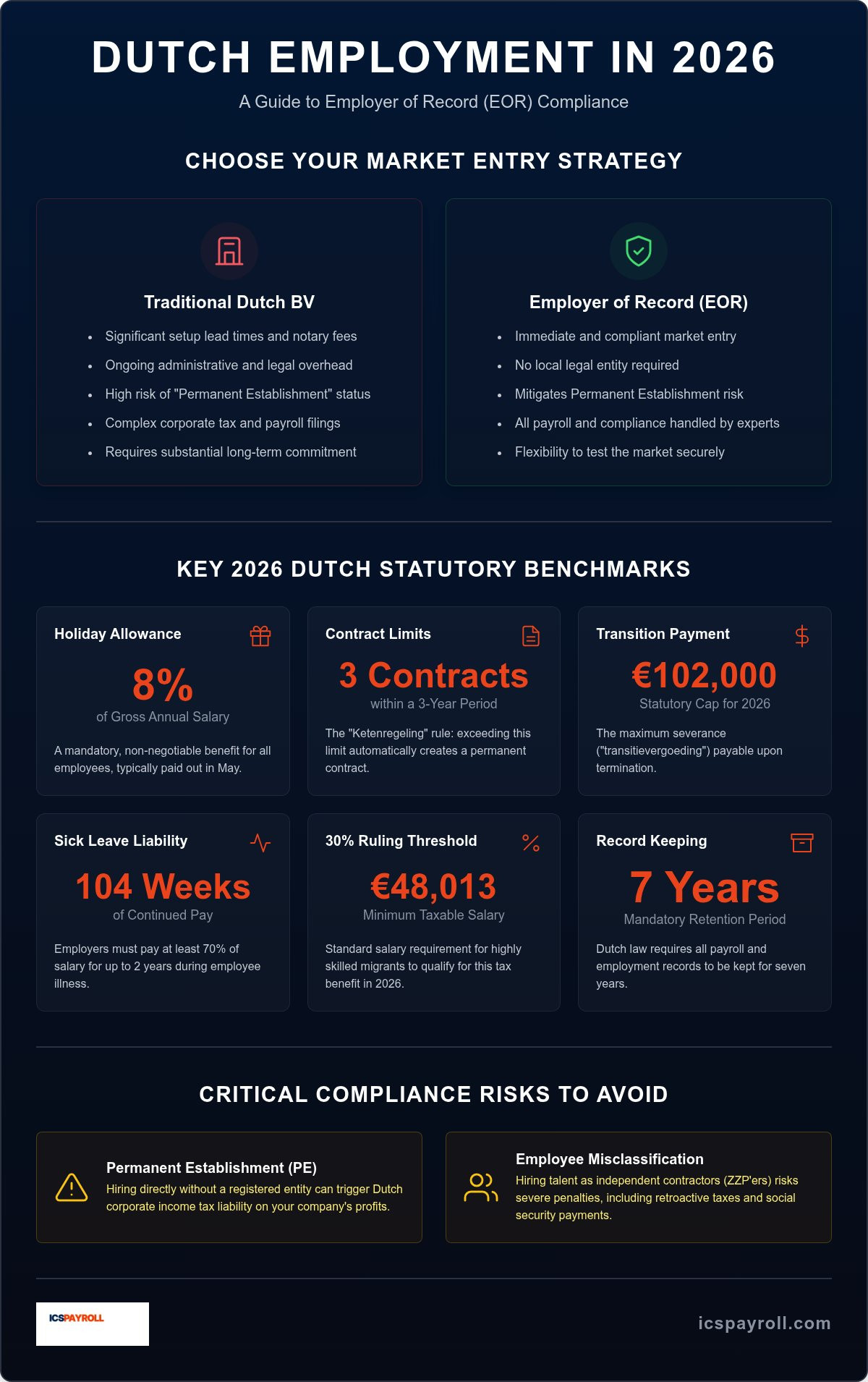
Top-tier netherlands employer of record services distinguish themselves through their management of intricate statutory requirements. In the Netherlands, every employee is entitled to a mandatory 8% holiday allowance, typically paid as a lump sum in May. This is a non-negotiable cost that must be factored into the total employment budget. A professional partner ensures this amount is accrued correctly and paid out on time, maintaining full compliance with Dutch labor law.
Managing the "Ketenregeling" is another critical function of an EOR. This regulation limits fixed-term contracts to a maximum of three over a three-year period. Exceeding this limit automatically converts the relationship into a permanent contract. Your EOR partner must track these timelines with clinical precision to avoid unintended legal obligations. Termination also carries specific financial duties. The statutory transition allowance, or "transitievergoeding," is capped at EUR 102,000 for 2026, unless the employee's gross annual salary exceeds this amount. Effective management of these caps is vital for cost control.
The Dutch system places a heavy burden on employers regarding sick leave. Law requires employers to pay at least 70% of an employee's salary for up to 104 weeks during sickness. This two-year obligation represents a significant financial risk. A reliable EOR manages the reintegration process and provides insurance coverage to protect your business from these long-term costs. To ensure your expansion remains profitable, you should request a tailored quotation that accounts for these specific 2026 benchmarks.
The 30% Ruling and Tax Optimization
Attracting international talent often requires the 30% ruling. For 2026, the standard minimum taxable salary threshold is EUR 48,013 per year. While the tax-free allowance remains at 30% for this year, newer applications are transitioning toward a 27% rate starting in 2027. This change highlights the importance of timely and accurate filings. You can find full eligibility criteria and application steps in The 30% Ruling Guide.
Pension and Social Security Contributions
Employers must also navigate a complex web of social security premiums. This includes the Unemployment Fund (AWf) at 2.74% for permanent contracts and the Healthcare Insurance Act (Zvw) at 6.10%. A standard pension scheme contribution typically requires 15.2% of the gross salary. Understanding these costs is essential when reviewing the Economic forecast for the Netherlands regarding wage growth. As of January 1, 2026, the statutory minimum hourly wage is EUR 14.71, increasing to EUR 14.99 on July 1, 2026.
Local Specialist vs. Global Aggregator: Comparing Models
Selecting the right partner for your Dutch expansion requires an understanding of different operational models. Global aggregators typically utilize a "Partner Network" model. This can lead to communication delays and a lack of transparency regarding local nuances. In contrast, specialized netherlands employer of record services often rely on direct expertise or long-term relationships with licensed entities. This proximity to the Dutch system is essential for navigating the strict oversight of the Belastingdienst and the Employee Insurance Agency (UWV). While global providers offer breadth, local specialists provide the depth necessary to handle sector-specific Collective Labor Agreements (CAOs) and complex tax rulings with total precision.
Speed of Onboarding and Visa Sponsorship
The speed of talent acquisition is often the deciding factor in a successful market entry. Local specialists, by arranging services through licensed partners who are IND recognized sponsors, can typically secure HSM visa grants in approximately three weeks. This expedited processing is a significant advantage for non-Schengen staff who need to begin work quickly. Global aggregators often lack this direct line to the IND, leading to onboarding timelines that can stretch into months. Using a local expert ensures that your staff can relocate and begin their roles without administrative bottlenecks. This approach replaces the faceless nature of large-scale outsourcing with a human-centric, reliable path through Dutch bureaucracy.
Cost Transparency and the Payroll Factor
Pricing models vary significantly between provider types. Global firms often promote a flat-fee structure that appears simple but frequently excludes mandatory employer costs like pension contributions or sickness risk insurance. These items are then billed as separate line items, complicating your financial forecasting. Specialized Dutch providers use a "Payroll Factor" model. This approach consolidates all statutory costs, including the 8% holiday allowance and social security premiums, into a single monthly invoice. This transparency prevents hidden fees and ensures you stay within your budget while meeting all legal obligations. For a comprehensive look at how these models impact your bottom line, refer to our PEO vs. EOR Comparison.
Due Diligence: How to Evaluate a Dutch EOR Partner
Selecting a partner for netherlands employer of record services requires more than a simple price comparison. You must audit their technical capability to manage the 30% ruling application process through licensed partners. Verify that they have established direct integrations with Dutch pension funds and insurance providers. Poor integration often results in delayed contributions, which can trigger audits from sector-specific funds. A high-quality partner should provide a localized employee handbook and a secure online portal for transparent document management. Evaluate their professional agility by testing their response time. A tailored quotation and initial contract draft should be available within 24 hours to ensure you don't lose talent to competitors.
Compliance and Legal Security Checks
Rigorous compliance is the foundation of a secure employment relationship in the Netherlands. Confirm that the provider strictly adheres to the seven-year record-keeping requirement for all payroll and financial documents. They must demonstrate a flawless process for "Loonaangifte" (wage tax return) filings with the Belastingdienst. These filings and payments must be completed by the last day of the month following the wage period. For 2026, it's critical to ask how they manage the abolition of partial non-resident status. While transitional arrangements allow continued use until December 31, 2026, for those who held the status at the end of 2023, new hires require a partner who understands the shift in global tax liability.
Technology and Employee Experience
The employee experience directly impacts talent retention and your brand reputation. Assess the functionality of the online portal to ensure staff can easily access payslips, annual statements, and employment contracts. Dedicated HR support is essential for managing the complex reintegration requirements during long-term sick leave. This includes adhering to the timelines set by the Gatekeeper Improvement Act. Ensure that all legal documents and handbooks are available in both Dutch and English to provide clarity for international staff. To begin your compliance audit and secure your Dutch workforce, you can request a consultation with our local experts.
Why ICSPayroll is the Preferred Choice for Dutch Expansion
ICSPayroll serves as a specialized partner for international businesses seeking reliable netherlands employer of record services. Under the leadership of Joost Hubregtse, our payroll team ensures that every administrative detail adheres to the latest 2026 regulations. We provide a tailored quotation within 24 hours, allowing you to move from talent identification to legal employment without delay. This model enables you to hire in the Netherlands before a BV is established, providing a low-risk entry point into the Dutch market. We act as the bridge between your foreign entity and the complex local system, delivering a one-stop-shop approach that manages everything from visa sponsorship to local payroll through our network of licensed partners.
The ICSPayroll Onboarding Timeline
Speed and compliance are the pillars of our onboarding process. After you accept our quote, we provide service agreements and employment contracts within days. We manage the entire lifecycle of employment through our licensed partners, including expedited HSM visa sponsorship for non-EU staff. While global aggregators often struggle with local bureaucracy, our streamlined process achieves operational readiness in approximately three weeks. This efficiency is central to our "Hire with Confidence" tagline. We provide compliance guarantees that protect your business from the risks of permanent establishment and labor misclassification under the recently enforced Wet DBA and VBAR regulations. You can focus on scaling your operations while we handle the meticulous legal standards required by Dutch authorities.
Consolidated Billing and Transparent Costs
Our "Payroll Factor" model eliminates the confusion of hidden fees common with global providers. You receive a single monthly invoice that covers all statutory and extra-legal costs in one transparent figure. This invoice includes the mandatory 8% holiday allowance, pension contributions, and employer premiums such as the Zvw (6.10%) and AWf (2.74% for permanent contracts). By consolidating these into one total cost, we remove the administrative burden of managing multiple Dutch vendors and insurance providers. We also ensure that the €48,013 salary threshold for the 30% ruling is monitored for compliance. This level of transparency prevents surprise charges and ensures you stay within your budget while meeting all legal obligations. To secure your first hire and optimize your 2026 tax strategy, Request a Tailored Quote today.
Secure Your Dutch Operations for 2026
Navigating the 2026 landscape requires precise management of the 30% ruling thresholds and strict adherence to the Wet DBA. Selecting a local specialist over a global aggregator ensures you benefit from faster HSM visa processing and a transparent payroll factor model. These elements are vital for maintaining compliance without the overhead of a local BV. Utilizing professional netherlands employer of record services transforms complex Dutch labor laws into a strategic advantage for your international expansion. It allows your organization to focus on growth while we ensure every statutory requirement, from the 8% holiday allowance to the €102,000 transition payment cap, is met with clinical precision.
Our local experts provide the reliability and security needed to manage your workforce effectively. We deliver a tailored quotation within 24 hours and arrange HSM visa processing in approximately three weeks via licensed partners. This comprehensive approach removes administrative burdens and provides the peace of mind required to enter a new market safely. Hire in the Netherlands with confidence, request your quote today. We look forward to facilitating your long term success in the Dutch market.
Frequently Asked Questions
How quickly can I hire an employee in the Netherlands using an EOR?
You can hire an employee within days once a service agreement is signed. Professional netherlands employer of record services provide tailored quotations within 24 hours. If the hire requires a visa, the process takes approximately three weeks when arranged through licensed partners. This speed allows you to secure top talent without the months-long delay of establishing a local legal entity, as detailed by the IND processing guidelines.
What is the standard 2026 salary threshold for the 30% ruling?
The standard minimum taxable salary threshold for the 30% ruling in 2026 is EUR 48,013 per year. For employees under 30 with a qualifying Master's degree, the threshold is lower at EUR 36,497. These figures are strictly enforced by the Belastingdienst. It's essential to monitor these benchmarks annually to ensure continued eligibility for the tax-free allowance under current Dutch fiscal regulations.
Does an EOR in the Netherlands handle HSM visa applications?
Yes, an EOR manages the entire Highly Skilled Migrant (HSM) visa process through licensed partners who are IND recognized sponsors. This includes submitting the application and ensuring the employee meets the 2026 salary requirements. For migrants 30 years or older, the minimum gross monthly salary is EUR 5,942 as specified by the IND. This service provides a compliant path for non-EU staff to work legally.
What is included in a Dutch payroll factor pricing model?
The payroll factor consolidates all employer costs into a single monthly invoice. This includes the gross salary, the mandatory 8% holiday allowance, and social security premiums such as the Zvw and AWf. It also covers pension contributions and insurance for sickness risk. This all-inclusive model provides cost transparency and eliminates the surprise fees often found in the flat-fee pricing of global aggregators.
Can I use an EOR if I already have a Dutch BV being formed?
You can use an EOR as a bridge solution while your Dutch BV is under formation. This allows you to begin operations and pay staff immediately without waiting for the KvK registration or bank account setup. Once your entity is fully operational, the employees can be transferred from the netherlands employer of record services to your own payroll through a seamless transition process that maintains continuous employment history.
What are the employer obligations for sick pay in the Netherlands?
Dutch law requires employers to pay at least 70% of an employee's salary for up to 104 weeks during sickness. This two-year obligation is a significant financial risk for foreign companies. An EOR manages this risk by handling the reintegration requirements of the Gatekeeper Improvement Act and providing insurance coverage. This ensures your business remains compliant with strict Dutch labor protection standards and avoids costly legal penalties.
Is the 8% holiday allowance mandatory for all Dutch employees?
The 8% holiday allowance is a mandatory statutory requirement for all employees in the Netherlands. It's calculated based on the gross annual salary and is typically paid as a lump sum in May or June. Some employers choose to pay it monthly, but this must be clearly stated in the employment contract. Failing to pay this allowance violates the statutory minimum wage regulations enforced by the Dutch Labor Authority.
How does the Ketenregeling affect fixed-term contracts in 2026?
The Ketenregeling, or chain rule, limits the number of consecutive fixed-term contracts an employer can offer. In 2026, you may provide a maximum of three fixed-term contracts over a period of three years. A fourth contract, or exceeding the three-year limit, results in an automatic conversion to a permanent contract. Details on the chain rule specify that a six-month break is required to reset this contract sequence.

Article by
Joost Hubregtse
Joost Hubregtse is Director of ICS Staffing & Payroll B.V., the wholly owned subsidiary of Intercompany Solutions behind ICS Payroll. He is responsible for Employer of Record and Dutch payroll services: employment contracts, wage tax and social security filings, holiday allowance, pension, sick leave and CAO compliance, with onboarding possible within 48 hours.
Frequently Asked Questions
You can hire an employee within days once a service agreement is signed. Professional netherlands employer of record services provide tailored quotations within 24 hours. If the hire requires a visa, the process takes approximately three weeks when arranged through licensed partners. This speed allows you to secure top talent without the months-long delay of establishing a local legal entity, as detailed by the IND processing guidelines.
The standard minimum taxable salary threshold for the 30% ruling in 2026 is EUR 48,013 per year. For employees under 30 with a qualifying Master's degree, the threshold is lower at EUR 36,497. These figures are strictly enforced by the Belastingdienst. It's essential to monitor these benchmarks annually to ensure continued eligibility for the tax-free allowance under current Dutch fiscal regulations.
Yes, an EOR manages the entire Highly Skilled Migrant (HSM) visa process through licensed partners who are IND recognized sponsors. This includes submitting the application and ensuring the employee meets the 2026 salary requirements. For migrants 30 years or older, the minimum gross monthly salary is EUR 5,942 as specified by the IND. This service provides a compliant path for non-EU staff to work legally.
The payroll factor consolidates all employer costs into a single monthly invoice. This includes the gross salary, the mandatory 8% holiday allowance, and social security premiums such as the Zvw and AWf. It also covers pension contributions and insurance for sickness risk. This all-inclusive model provides cost transparency and eliminates the surprise fees often found in the flat-fee pricing of global aggregators.
You can use an EOR as a bridge solution while your Dutch BV is under formation. This allows you to begin operations and pay staff immediately without waiting for the KvK registration or bank account setup. Once your entity is fully operational, the employees can be transferred from the netherlands employer of record services to your own payroll through a seamless transition process that maintains continuous employment history.
Dutch law requires employers to pay at least 70% of an employee's salary for up to 104 weeks during sickness. This two-year obligation is a significant financial risk for foreign companies. An EOR manages this risk by handling the reintegration requirements of the Gatekeeper Improvement Act and providing insurance coverage. This ensures your business remains compliant with strict Dutch labor protection standards and avoids costly legal penalties.
The 8% holiday allowance is a mandatory statutory requirement for all employees in the Netherlands. It's calculated based on the gross annual salary and is typically paid as a lump sum in May or June. Some employers choose to pay it monthly, but this must be clearly stated in the employment contract. Failing to pay this allowance violates the statutory minimum wage regulations enforced by the Dutch Labor Authority.
The Ketenregeling, or chain rule, limits the number of consecutive fixed-term contracts an employer can offer. In 2026, you may provide a maximum of three fixed-term contracts over a period of three years. A fourth contract, or exceeding the three-year limit, results in an automatic conversion to a permanent contract. Details on the chain rule specify that a six-month break is required to reset this contract sequence.